Commissioner’s Update – Dec. 15, 2011

Newsletter image
Click the image to view the fully formatted Commissioner's Update.
Wow.

We knew there were a lot of opinions and concerns about the nearly decade-old No Child Left Behind Act and its system of for holding schools accountable. We figured people would have a lot to say, and much of it critical.

But almost 1,300 survey responses in a little more than a week?! Well, it’s exactly what we were hoping for. We also had almost 50 people at our Bangor forum last Thursday night, a small but engaged audience online Tuesday night, and about 40 more in Portland last night.

The highlight for me has been sitting with groups of very thoughtful high school students in Bangor and in Portland who shared their thoughts about what makes for an effective school and an effective teacher, and how to measure those qualities.

Keep the comments coming. I especially encourage you to participate in our Newsroom discussion. We are required by the feds to show how we solicited public input. But, more importantly, we need your input to craft an alternative system for measuring up schools, working with those that need help, and recognizing (and sharing best practices from) schools that are excelling.

There’s a bunch of information online about how we’re going about developing our request for flexibility on our ESEA Flexibility web page. Check it out and join the conversation.

Continue reading “Commissioner’s Update – Dec. 15, 2011”

Commissioner’s Update – Dec. 8, 2011

Newsletter image
Click the image to view the fully formatted Commissioner's Update
How should we help schools improve and recognize their success, all while holding them accountable for their responsibility to our students?

On Monday, we put that question out to the public as part of the process for assembling Maine’s request to the federal government for Elementary and Secondary Education Act (ESEA) flexibility. We haven’t been disappointed by the response.

There’s no shortage of opinions on this topic, as evidenced by the hundreds of responses to our three-day-old online survey and the active participation in our ongoing, online discussion on ESEA flexibility.

I hope to see the outpouring of input continue in the coming days.

Tonight, I head to Bangor to hear from students, teachers, administrators, parents, school board members and others at a public forum at Bangor High School. And next week, I’ll host an online forum and a public forum in Portland to hear even more opinions. Details on those events can be found on our ESEA Flexibility web page.

The more ideas we hear, the stronger our request for ESEA flexibility will be.

Continue reading “Commissioner’s Update – Dec. 8, 2011”

Commissioner’s Update – Dec. 1, 2011

Newsletter image
Click the image to view the fully formatted Commissioner's Update.
If you’ve been waiting for information about Maine’s plans for seeking flexibility from the federal No Child Left Behind law, you’ll have a lot of it in no time.

This week, we’ve launched an expanded and growing web page where we’ll continue to post details about our efforts to secure NCLB flexibility. Soon, that page will also have details about how you can have your say in the process.

Continue reading “Commissioner’s Update – Dec. 1, 2011”

Commissioner’s Update – Nov. 17, 2011

Newsletter image
Click the image to view the fully formatted Commissioner's Update.
This week, educators from Maine and across the country — and even some from outside the United States — have traveled to Auburn to learn about the implementation of Advantage 2014 in that city’s schools.

Advantage 2014 is the Auburn schools’ initiative to roll out iPads to kindergarteners and, ultimately, all city students in the early grades. The Auburn plan, however, involves more than simply equipping the city’s youngest students with tablet devices.

It’s a plan to make those devices an integral part of student learning: to use the adaptive power of iPads to boost basic literacy and numeracy skills, to use any range of iPad apps to enhance students’ problem-solving and critical-thinking skills, to provide students with a way to take control of much of their learning at a young age.

The Auburn school department has a well thought-out plan for deploying iPads, training teachers to use them effectively, and measuring the initiative’s success. And as this week is making clear, many will be watching Auburn’s journey every step of the way.

Please note: There will be no Commissioner’s Update on Nov. 24, Thanksgiving. The next Update will be published Dec. 1.

Continue reading “Commissioner’s Update – Nov. 17, 2011”

Commissioner’s Update – Nov. 10, 2011

Newsletter image
Click the image to view the fully formatted Commissioner's Update.
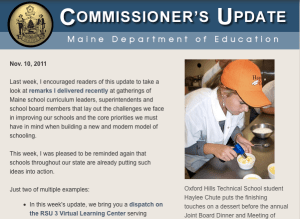
Last week, I encouraged readers of this update to take a look at remarks I delivered recently at gatherings of Maine school curriculum leaders, superintendents and school board members that lay out the challenges we face in improving our schools and the core priorities we must have in mind when building a new and modern model of schooling.

This week, I was pleased to be reminded again that schools throughout our state are already putting such ideas into action.

Just two of multiple examples:

  • In this week’s update, we bring you a dispatch on the RSU 3 Virtual Learning Center serving young families in rural Waldo County. The Virtual Learning Center combines adult education, GED preparation and community college courses with job search assistance provided by the Maine Department of Labor — all accessible to students anytime, anywhere. It’s an impressive application of virtual learning theory that could very well grow to provide more options for students in kindergarten through high school.
  • Kittery residents made the news this week as they began discussing a bold vision for the future of Traip Academy that transforms the school into a learning hub that opens early, closes late and helps students make wise use of online and community resources to broaden their learning.

It’s just further proof that as more of our schools look to move to the next level, they’ll have a growing number of examples to learn from right here in Maine.

Continue reading “Commissioner’s Update – Nov. 10, 2011”

Commissioner’s Update – Nov. 3, 2011

Newsletter image
Click the image to view the fully formatted Commissioner's Update.
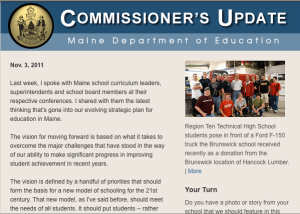
Last week, I spoke with Maine school curriculum leaders, superintendents and school board members at their respective conferences. I shared with them the latest thinking that’s gone into our evolving strategic plan for education in Maine.

The vision for moving forward is based on what it takes to overcome the major challenges that have stood in the way of our ability to make significant progress in improving student achievement in recent years.

The vision is defined by a handful of priorities that should form the basis for a new model of schooling for the 21st century. That new model, as I’ve said before, should meet the needs of all students. It should put students — rather than administrative convenience — at the center of all structures, from bus schedules to where and how students learn.

Take a look at the remarks I delivered last week.

The vision and the plan are still evolving. Please use the comments feature in our Newsroom to participate in the discussion, or use the Contact Us link to send us your thoughts directly.

Continue reading “Commissioner’s Update – Nov. 3, 2011”

Commissioner’s Update – Oct. 27, 2011

Newsletter image
Click the image to view the fully formatted Commissioner's Update.
This week has been full of opportunities for me to witness the unwavering commitment of Maine educators to improving our schools and making sure all of our students are succeeding in their learning.

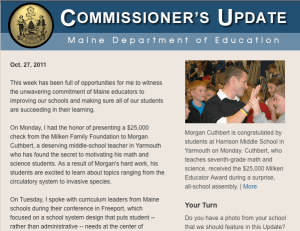
On Monday, I had the honor of presenting a $25,000 check from the Milken Family Foundation to Morgan Cuthbert, a deserving middle-school teacher in Yarmouth who has found the secret to motivating his math and science students. As a result of Morgan’s hard work, his students are excited to learn about topics ranging from the circulatory system to invasive species.

On Tuesday, I spoke with curriculum leaders from Maine schools during their conference in Freeport, which focused on a school system design that puts student — rather than administrative — needs at the center of everything we do.

And today and tomorrow, I plan to spend some time at the fall conference of the Maine School Management Association, whose members plan to focus on standards-based learning, closer integration of career and technical education with all other academics, and better preparation and more constructive evaluations for our educators — all in support of improved student learning.

Continue reading “Commissioner’s Update – Oct. 27, 2011”

Commissioner’s Update – Oct. 20, 2011

Newsletter image
Click the image to view the fully formatted Commissioner's Update.
Earlier this week, the Department of Education put an ambitious, yet achievable, plan for improving our state’s early learning programs into the mail. Now, it’s in the hands of the U.S. Department of Education to determine whether Maine’s Race to the Top Early Learning Challenge grant application is funded.

Staff members at the Maine DOE worked with colleagues at the Maine Department of Health and Human Services and with partners in higher education to craft a plan that sets consistent standards of quality for our current patchwork of early learning programs and offers the programs incentives to subscribe to those high standards. The plan also proposes improvements that will make it easier for families to make informed early childhood care and education decisions, and proposes significant investments in the resources available to train Maine’s workforce of early childhood educators.

If we’re fortunate enough to receive Race to the Top funding, the benefits will be widespread and longlasting. The funding will help us add to the solid foundation for early learning we already have in Maine.

And the results are something the professionals in our public schools will notice. The high-needs children who enter kindergarten with a solid educational foundation will enter our state’s schools ready to succeed.

Continue reading “Commissioner’s Update – Oct. 20, 2011”

Commissioner’s Update – Oct. 13, 2011

Newsletter image
Click the image to view the fully formatted Commissioner's Update.
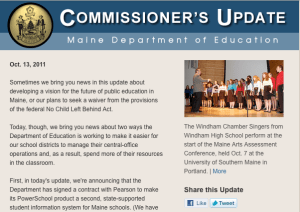
Sometimes we bring you news in this update about developing a vision for the future of public education in Maine, or our plans to seek a waiver from the provisions of the federal No Child Left Behind Act.

Today, though, we bring you news about two ways the Department of Education is working to make it easier for our school districts to manage their central-office operations and, as a result, spend more of their resources where they should be spent — in the classroom.

First, in today’s update, we’re announcing that the Department has signed a contract with Pearson to make its PowerSchool product a second, state-supported student information system for Maine schools. (We have already been supporting district implementation of Infinite Campus.) We’re also offering a reminder about Transfinder — a software program the Department offers to school districts at no charge to help them plan more efficient school bus routes that result in savings.

Both announcements are part of the Department of Education’s efforts to be more of a resource to our school districts — all in support of the teaching and learning at the core of our mission.

Continue reading “Commissioner’s Update – Oct. 13, 2011”

Commissioner’s Update – Oct. 6, 2011

Newsletter image
Click the image to view the fully formatted Commissioner's Update.
On Monday, I joined Gov. Paul LePage, Midcoast-area school administrators, and representatives from that region’s higher education and business communities to discuss education as an economic imperative for Maine’s Midcoast.

The discussion at Rockland’s Strand Theatre was a productive one. Our educators spoke of ambitious plans to make learning an engaging experience for our students by connecting them with resources and experiences that interest them — whether they’re within the school building, at the local career and technical education center, at a nearby community college or at a university campus.

Continue reading “Commissioner’s Update – Oct. 6, 2011”