Winterport Teacher Hillary Hoyt Receives Milken Educator Award at Surprise School Assembly

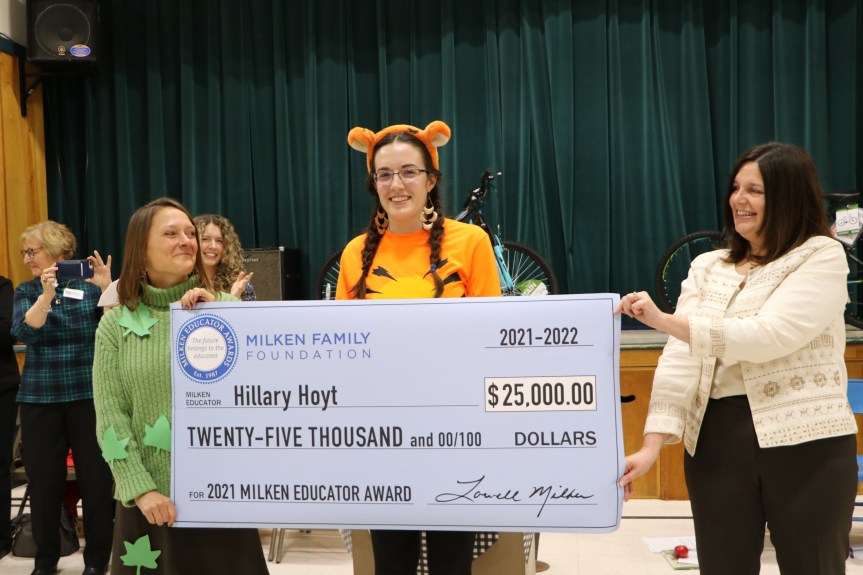
In a surprise assembly earlier today, Hillary Hoyt, a third grade teacher at Leroy H. Smith School, received a $25,000 Milken Educator Award for her commitment to creativity in the classroom, focus on prioritizing children’s individual needs to improve learning outcomes, and leadership both at her school and in her community.

Milken Educator Awards Vice President Stephanie Bishop and Maine Deputy Commissioner of Education Dan Chuhta surprised Hoyt with the honor before cheering students, colleagues, state and local officials, and the media. Hoyt is one of only two educators in Maine and among more than 60 nationwide to receive the recognition during the 2021-2022 school year. She is the first recipient awarded in the RSU 22 School District.

Hailed as the “Oscars of Teaching,” the Milken Educator Awards celebrate, elevate and activate the American teaching profession and inspire young, capable people to join it.

“Hillary Hoyt is a leader, both in her classroom and in her community, and she exemplifies the qualities of a Milken Educator: innovation, creativity and inspirational leadership,” said Bishop, who herself is a 2001 Milken Educator from Virginia. “Her innovative approach to education is creating a pathway to success for each student in her classroom, and for that, we celebrate her here today.”

The Milken Educator Award is not a lifetime achievement honor. Recipients are heralded while early to mid-career for what they have achieved — and for the promise of what they will accomplish given the resources and opportunities inherent in the Award.

“Hillary Hoyt’s passion and dedication to her students, school, and community is truly awe inspiring,” said Maine Education Commissioner Pender Makin. “Her interdisciplinary teaching approach engages and excites her students and fosters a love of learning. Hillary is a trusted mentor and a leader in sharing her innovation and creativity with other educators. She also finds ways to support students and families beyond her classroom, whether as a dance instructor or providing free books to children over the summer. The Maine Department of Education is so proud to join the Milken Family Foundation and the entire RSU 22 community in honoring Hillary with this well-deserved recognition.”

Oprah, a longtime education advocate, shared her congratulations to this year’s winners in a video message shared earlier this year thanking “the most incredible educators around the country” and acknowledging her deep appreciation for the “tireless work” they do.

Hoyt said she was honored and humbled to receive the award. Asked why she went into teaching, Hoyt said, “I wanted to be a teacher because I had some wonderful teachers who showed me what it means to have someone looking out for you every day and showing that I belonged and mattered. I wanted to do the same.”

More about Hillary Hoyt:

Commitment to Creativity: Hoyt’s unique lessons help her third graders build skills for their future success. During the “Million-Dollar Project,” students learned about financing and interest rates as they took out “loans” to buy a house and car, save for college, and fund their day-to-day expenses. Hoyt set up a section of her classroom as a winter wonderland where students could earn time in the ice rink, ice shack and snow mountain by demonstrating good citizenship, according to expectations the children developed together. Hoyt goes to great lengths to hold students’ interest, whether by dressing as a dinosaur when leading a unit on prehistoric life or transforming her room into the sea, with students as jellyfish.

Prioritizes Children’s Individual Needs: Hoyt’s lessons stress innovation, collaboration and independent thinking, encouraging students to tap their imaginations even as they learn important executive functioning skills. She does whatever is necessary to prioritize children’s learning needs. Hoyt digs through data to track student progress, making quick plans to differentiate and reteach those who need extra help, and adding enrichment for those who are ready for more. Since the beginning of the pandemic, Hoyt has flipped her classroom and incorporated new technology, including Flipgrid, Jamboard, Google Classroom and video production. Her students continuously demonstrate growth on state assessments and learn to love education.

Serves as Mentor, Leader: Hoyt is the district’s elementary science teacher leader and has served on district and school committees for math, writing and reading, as well as a state committee writing ELA standards. She mentors student teachers and worked with colleagues to make a series of math videos in preparation for the start of the 2020-21 school year. Hoyt has attended the summer teacher academy at Schoodic Institute, worked on science curriculum with the University of Maine’s RISE Center, and published lessons on the Maine Department of Education’s MOOSE platform, which offers asynchronous learning modules for educators, students and families. She delivered a lesson on weather and natural disasters for The Learning Space, a collaboration between educators and Maine Public Television aimed at students who lack internet access.

Enthusiasm for Extracurriculars: A leader in the Leroy H. Smith community, Hoyt provides free books to students each summer through a partnership with Literacy Volunteers of Maine and Darling’s Ice Cream for a Cause. Her class designs a table based on an author they are studying for the annual Literacy Tea of Bangor. Hoyt played an integral part in WinterKids, which promoted winter outdoor activities for families, and chaired the school’s Family Fun Night. Outside of school, she teaches cheer and dance to college students and children, including Girl Scouts working on their dance badges.

Education: Hoyt earned a bachelor’s in elementary education from the University of Maine Orono in 2013 and earned National Board Certification in 2018.

More information about Hoyt, plus links to photos and video from today’s assembly, can be found on the Milken Educator Awards website at: https://www.milkeneducatorawards.org/educators/view/hillary-hoyt.

More about the Milken Educator Awards: “The future belongs to the educated.”

Along with the financial prize, Milken Educator Award recipients join the national Milken Educator Network, a group of more than 2,800 top teachers, principals and specialists. The network serves as a rich resource for fellow educators, legislators, school boards and others dedicated to excellence in education.

  • In June, the honorees will also attend an all-expenses-paid Milken Educator Awards Forum in Los Angeles, where they will network with their new colleagues as well as veteran Milken Educators and other education leaders about how to increase their impact on K-12 education. In addition, they will learn about how to become involved in the Milken Friends Forever (MFFs) mentoring program, in which freshman Milken Educators receive personalized coaching and support from a Milken Educator veteran on ways to elevate their instructional practice and take an active role in educational leadership, policy and practice.
  • Over the years, more than $140 million in funding, including $70 million for the individual cash awards, has been devoted to the overall Milken Awards initiative, which includes powerful professional development opportunities throughout recipients’ careers.
  • Veteran Milken Educators frequently go on to serve in leadership roles at state, national and international levels.
  • “We find you. You don’t find us!” Unlike most teacher recognition programs, the Milken Educator Awards initiative has no formal nomination or application process. Candidates are sourced through a confidential selection process and then reviewed by blue ribbon panels in each state. The most exceptional candidates are recommended for the award, with final selection made by the Milken Family Foundation.
  • The $25,000 cash award is unrestricted. Recipients have used the money in diverse ways. For instance, some have spent the funds on their children’s or their own continuing education, financing dream field trips, establishing scholarships, and even adopting children.
Eighth Grade Social Studies Teacher Jamie Karaffa Surprised with Milken Educator Award

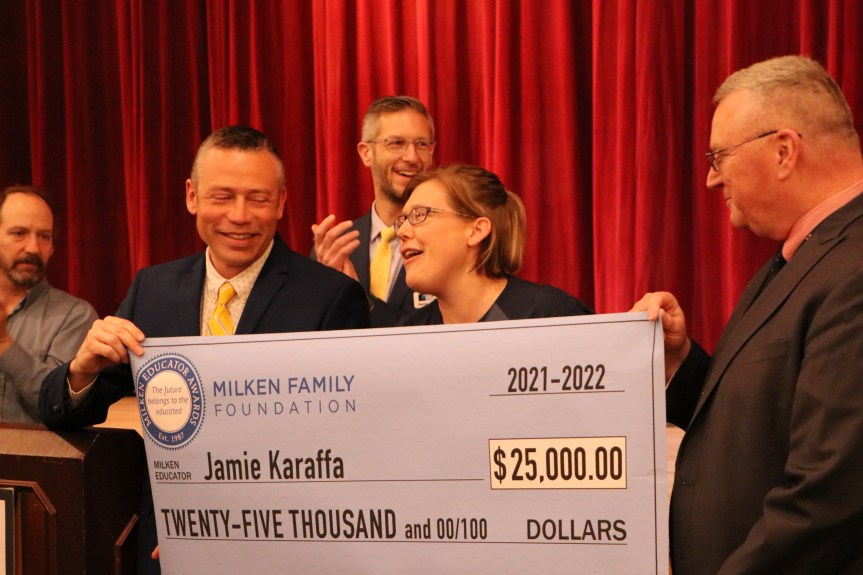
In a surprise assembly today, Jamie Karaffa, an eighth grade social studies teacher at Bruce M. Whittier Middle School in Poland, received a $25,000 Milken Educator Award for her service as a classroom and community leader, innovative approach to creating classroom-to-life connections that make history come alive for her students, and ability to challenge and inspire students to think critically about important historical issues and current events.

Milken Educator Awards Vice President Stephanie Bishop and Maine Deputy Commissioner of Education Dan Chuhta surprised Karaffa with the honor before cheering students, colleagues, state and local officials, and the media. Karaffa is one of only two educators in Maine and among more than 60 nationwide to be recognized with the Award during the 2021-2022 school year. She is the first recipient awarded in the RSU 16 School District. Earlier today, third grade teacher Hillary Hoyt received the Award at a surprise assembly at Leroy H. Smith School in Winterport.

Hailed as the “Oscars of Teaching,” the Milken Educator Awards celebrate, elevate and activate the American teaching profession and inspire young, capable people to join it.

“Jamie makes ancient history feel just as relevant to her students as today’s current affairs, and both come alive in her classroom,” said Bishop, who herself is a 2001 Milken Educator from Virginia. “She challenges her students to think critically and become engaged citizens of their community – and that is a learning outcome that can truly last a lifetime. For her excellent work in and out of the classroom, we are thrilled to present her with this Award today.”

The Milken Educator Award is not a lifetime achievement honor. Recipients are heralded while early to mid-career for what they have achieved — and for the promise of what they will accomplish given the resources and opportunities inherent in the Award.

“Jamie Karaffa makes history come alive for her students by creating immersive, project-based opportunities that build connections between the past and present day while also fostering the critical thinking and leadership skills needed to be engaged and empowered citizens,” said Maine Education Commissioner Pender Makin. “Her passion, creativity, and leadership extend to her role as soccer coach and as a curriculum leader in her district and beyond. The Maine Department of Education is so proud to join the Milken Family Foundation and the entire RSU 16 community in honoring Jamie with this well-deserved recognition.”

Oprah, a longtime education advocate, shared her congratulations to this year’s winners in a video message shared earlier this year thanking “the most incredible educators around the country” and acknowledging her deep appreciation for the “tireless work” they do.

Following the surprise announcement, Karaffa said she was shocked and stunned and she told the school audience, “This isn’t my award alone–this is because all of you as well.”

More about Jamie Karaffa:

Making Classroom Connections to Life: Karaffa helps students understand the connections between history and their own lives. She and her colleagues at Whittier Middle School organize Whittier History Day, when the entire school comes together to share long-term research projects for National History Day. Students learn the essentials of research, including locating sources and evaluating their reliability, forming thesis statements, finding evidence to support their ideas, and structuring their arguments in a clear, compelling way. Pupils learn to write with purpose, format citations, edit their work, and formally present their projects. Many of Karaffa’s eighth-graders have been recognized for their work at the state level, and one student’s project was displayed at the Smithsonian National Museum of Natural History in Washington, D.C.

Challenges Students’ Critical Thinking: Throughout the year, Karaffa engages students in units that encourage them to examine the past and think about how it relates to current events. Her curriculum integrates essential reading, writing and research skills into foundational elements of U.S. and world history, including Reconstruction, segregation, the civil rights movement, World War II and the Holocaust. Karaffa emphasizes working with primary documents as students learn through document-based questions, gallery walks, talk shows, historical sing-alongs and mock elections. She challenges students to become engaged citizens. During election seasons, the class debates local and state legislation, analyzes propaganda tools and candidates’ speeches, and writes essays supporting their chosen candidates, always providing evidence to support their choices. Students understand what is expected of them and regularly exceed those expectations, finding their own voices along the way.

Classroom and Community Leader: A leader in the building, district and beyond, Karaffa has helped develop district and state social studies curriculum, including remote learning units that proved essential during the pandemic. She is a James Madison Fellow, has led professional development at the district level, and has presented at the Maine Council for the Social Studies conference. In addition to her academic work, Karaffa coaches Whittier’s eight-grade girls’ soccer team.

Education: Karaffa earned a bachelor’s in elementary education from Elizabethtown College in 2005 and a master’s in American history and government from Ashland University in 2021.

More information about Karaffa, plus links to photos and video from today’s assembly, can be found on the Milken Educator Awards website at: https://www.milkeneducatorawards.org/educators/view/jamie-karaffa.

More about the Milken Educator Awards: “The future belongs to the educated.”
Along with the financial prize, Milken Educator Award recipients join the national Milken Educator Network, a group of more than 2,800 top teachers, principals and specialists. The network serves as a rich resource for fellow educators, legislators, school boards and others dedicated to excellence in education.

  • In June, the honorees will also attend an all-expenses-paid Milken Educator Awards Forum in Los Angeles, where they will network with their new colleagues as well as veteran Milken Educators and other education leaders about how to increase their impact on K-12 education. In addition, they will learn about how to become involved in the Milken Friends Forever (MFFs) mentoring program, in which freshman Milken Educators receive personalized coaching and support from a Milken Educator veteran on ways to elevate their instructional practice and take an active role in educational leadership, policy and practice.
  • Over the years, more than $140 million in funding, including $70 million for the individual cash awards, has been devoted to the overall Milken Awards initiative, which includes powerful professional development opportunities throughout recipients’ careers.
  • Veteran Milken Educators frequently go on to serve in leadership roles at state, national and international levels.
  • “We find you. You don’t find us!” Unlike most teacher recognition programs, the Milken Educator Awards initiative has no formal nomination or application process. Candidates are sourced through a confidential selection process and then reviewed by blue ribbon panels in each state. The most exceptional candidates are recommended for the award, with final selection made by the Milken Family Foundation.
  • The $25,000 cash award is unrestricted. Recipients have used the money in diverse ways. For instance, some have spent the funds on their children’s or their own continuing education, financing dream field trips, establishing scholarships, and even adopting children.

Commissioner Makin Visits Oxford Elementary in Celebration of the Week of the Young Child

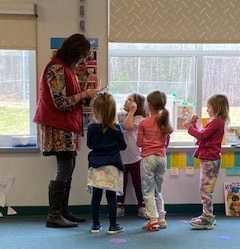
As part of the Maine Department of Education’s celebration of the National Association for the Education of Young Children’s Week of the Young Child, Commissioner Pender Makin visited pre-k and kindergarten classrooms at Oxford Elementary School.

The Week of the Young Child provides an opportunity to shine a light on the importance of early learning and to focus attention on the needs of young children, their teachers, families, and communities.
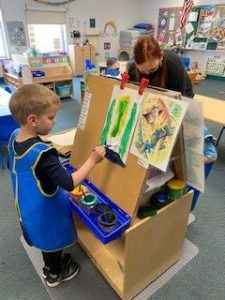
During Makin’s visit, Pre-K students were exploring concepts related to shadows and reflections in centers they could self-select, which included activities such as testing how light can pass through materials, experimenting with materials to see which produce reflections and which do not, and creating pieces of artwork using materials with reflective properties.

In Kindergarten classrooms, children were engaged in a unit of study focused on construction in which they were reading and discussing books related to the topic, exploring engineering concepts through hands-on activities, and working as a classroom community to design a building project that could benefit their community. In one Kindergarten class, students were designing a hotel for homeless families that included a dog park.

Pre-K and Kindergarten classrooms in the Oxford Hills School System utilize whole student, interdisciplinary instructional programs that the Maine DOE, in collaboration with Maine educators, have adapted for Maine using work originally developed by the Boston Public School System.  Both instructional programs are content rich (aligned to Maine’s learning standards) and are designed around opportunity for structured play.

Oxford Elementary’s Literacy Coach, Kim Desjardins pointed out, “When we ask adults what they remember from their Kindergarten experience, most will reply they remember ‘playing’ with blocks or ‘playing’ in the kitchen. The word play is a powerful word that has been lost in our Kindergarten curriculum for many years. Young children are born to play and interact with each other. K For ME encourages students to inquire about the world, participate in deep conversations to problem solve and work with others to develop social skills. Our students love to come to school and learn!”

The Pre-K for ME and K for ME programs are open source and are used in a growing number of Maine schools, including Oxford Hills where Kindergarten teachers were part of a 2-year pilot that helped inform adaptation of the program for use by other Maine schools.

Oxford Elementary Principal, Tiffany Karnes, shared, “It is such a joy to go into a Kindergarten or Pre-K classroom and hear the conversations students are having with each other as they engage in their center work.  Whether it is in the dramatic play area or the block area, students are using their imaginations and incorporating the vocabulary they have learned.  They are building wolf dens when they are learning about animal habitats or dressing up as characters from a book that they have heard during read-aloud and acting out their story.  The level of oral language and increase in vocabulary that we are seeing far exceeds anything we have seen in the past.
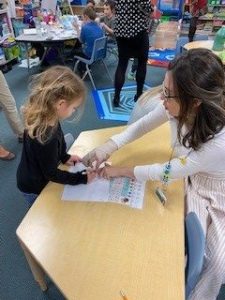
Principal Karnes elaborated, “The K for ME curriculum has been a game-changer for our kindergarten students and teachers.  Prior to implementing K for ME, our kindergarten students were struggling with behaviors and were not making the academic progress we wanted.  Students were coming from a play-based Pre-K for ME classroom into a traditional kindergarten classroom and the seat time, the lack of structured play and other academic demands were very stressful for both students and teachers. Once we started to implement K for ME, we saw increased engagement, improved language development, and higher academic achievement.  Students and teachers were happier, and parents commented on how impressed they were with all that their children were learning.”

For more information about the Maine Department of Education’s early learning efforts, including Pre-K for ME and K for ME, contact Lee Anne Larsen, Early Learning Team Coordinator at leeann.larsen@maine.gov.
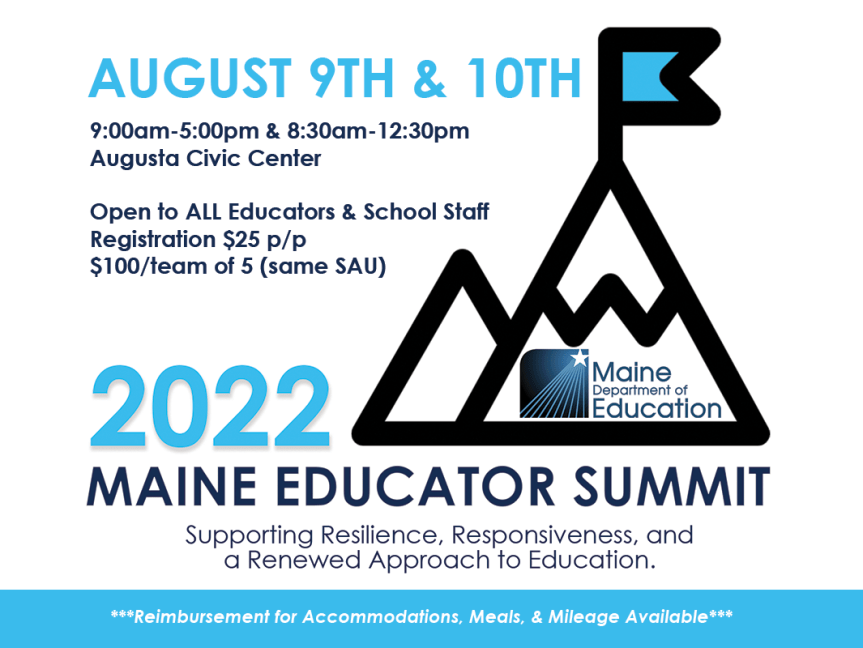
Save The Date: 2022 Maine Educator Summit August 9-10

The Maine Department of Education (DOE) is hosting the 2022 Maine Educator Summit this summer to provide all Maine educators and school staff with opportunities for professional learning, peer networking, and resource materials to further support students impacted by the COVID-19 global pandemic. In sponsoring this event, the Maine DOE aims to further support Maine’s education workforce in the areas of resilience, responsiveness, and a renewed approach to education.

We hope that you and your colleagues will join us for the 2022 Maine Educator Summit at the Augusta Civic Center on August 9-10, 2022. The summit will offer a variety of sessions around topics like social-emotional learning (SEL), school safety, interdisciplinary learning, special education, and more. Participants will be able to join several different learning sessions over the two-day event and the Maine DOE is encouraging teams from each School Administrative Unit (SAU) to register.

Be on the lookout for registration and Summit materials on the Maine DOE website. Reimbursement of accommodations, meals, and mileage is available.                              

Contact hours will also be provided.

If interested in presenting at the summit or for further information about the 2022 Maine Educator Summit, please reach out to Teri Peaslee, Continuous School Improvement Professional Development Coordinator, at (207) 530-7672.

#MEEducatorSummit

Spring Training Continues in April – Check Out This Lineup of MLTI Professional Learning Offerings

Active learning, student engagement, technology integration, digital instructional design, and digital citizenship and online safety are the main topics for an ongoing professional learning series offered by the MLTI Ambassadors. This series features daily offerings that can be attended live via Zoom and are open to all interested educators. The sessions are now available as asynchronous versions through our website. To attend one of the live sessions via Zoom, be sure to register through this April calendar. Please note that the times of these offerings vary from day to day. Asynchronous versions of these sessions will be available through MLTI Professional Learning as well as the MLTI Youtube channel. 

Some topical offerings:  

MondayMonday – Technology Integration with Rob Dominick 

The Technology Integration series has dug into some data describing the effect of technology in the classroom, discussed the foundational integration strategies of TPACK and SAMR, and introduced three other useful strategies of TIM, PICRAT, and Triple E.  

Coming up in April, we will continue to discuss those strategies by analyzing each one and looking into what they actually look like in practice in the classroom. The series will culminate in the last week of April by evaluating some example lesson plans which integrate technology so that participants can apply that skill to their own planning. 

To find the previous professional development sessions in this series, and receive contact hours for them, please visit our YouTube playlist. 

TuesdayTuesday Tech – Student Engagement with Erik Wade 
The student engagement series has been engaging audiences far and wide with professional development about integrating graphic design, inquiry, citizen science, and 3D design and printing. If you would like to view these past professional development opportunities, you can find them by clicking this link 

Coming up in April, we will explore engaging students through virtual reality, math and science simulations, and the use of technology in outdoor education and agriculture.    

WednesdayWednesdays with Werner – Digital Citizenship & Online Safety with Jonathan R. Werner 

This six-part series on Digital Citizenship and Online Safety will draw on the incredible resources Common Sense Education (CSE) has curated to provide educators with a framework for and tools to teach students about Digital Citizenship. April will include the last two offerings: Relationships and Communication (Week 5) and Cyberbullying, Digital Drama, and Hate Speech (Week 6).

Please note, educators can choose any or all of these sessions and do not need to be able to attend all six. After April Break, we will tackle the sixth CSE focus area, News and Media Literacy, in a multi-week series focusing on issues such as Finding Credible News, the Four Factors of Fair Use, and Creator’s Rights and Responsibilities. 

ThursdayThursday – Digital Instructional Design with Kate Meyer 

This series of workshops will explore the creation and implementation of high-quality, engaging, interactive digital learning experiences for your students. Each week we will explore a new digital strategy that you can easily implement into any unit of study. This month we will be exploring Digital Poetry, Design Thinking Infographics, and Podcasting. 

If you missed March’s workshops on Hexagonal Thinking, Silent Discussions, or Curation Projects, you can view them asynchronously on MLTI’s YouTube channel on the Digital Instructional Design playlist. 

FridayFriday – Active Learning with Holly Graffam 
The first series of workshops focused on integrating Problem-Based Learning in the classroom, including an overview of Problem-Based Learning as well explored applications across a variety of content areas from literacy to science.  

Beginning in April, Computer Science across the curriculum will be the subject of the second series of workshops. Sessions will discuss the critical need for computer science in our classrooms and examine engaging, creative ways to integrate computer science into your existing curriculums. 


MLTI Student Conference Sessions Announced!

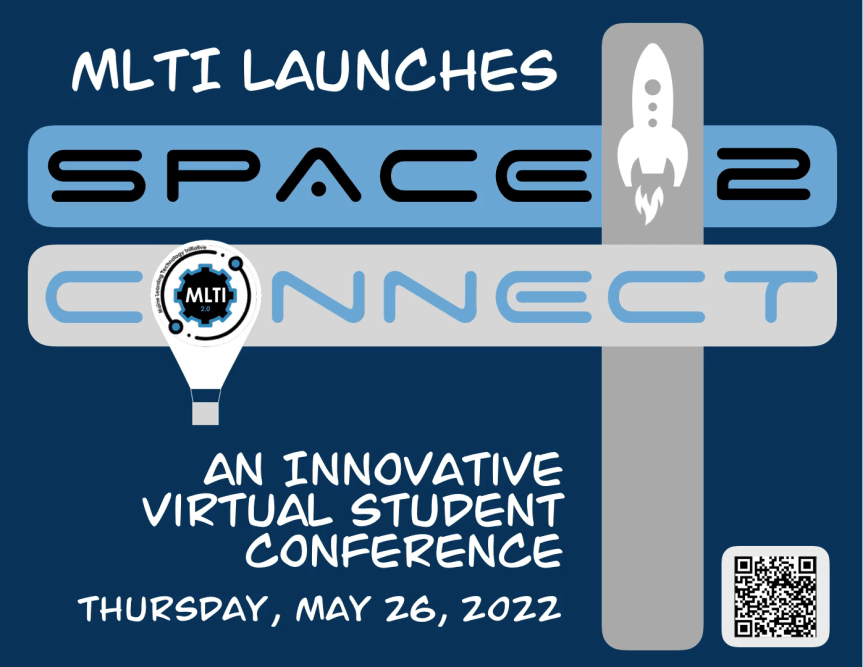
The 19th Annual MLTI Student Conference will be held virtually on Thursday, May 26, 2022, from 8:30am-2:00pm, and will be open to all MLTI 7th and 8th grade students. MLTI is excited to share the conference sessions for this exciting and innovative day!

Registration
Registration for the 2022 MLTI virtual student conference is now open until April 8, 2022. Please select a lead teacher from your MLTI school to fill out the online registration form. We will be asking for lead teacher contact information, school information, as well as a physical shipping address so we can deliver or ship conference materials directly to the attending school. We will also need the total number of students attending in each grade, and the totals for shirt sizes. We ask that schools complete the registration form by April 8, 2022. For questions regarding registration please reach out to Brandi Cota at Brandi.M.Cota@Maine.Gov.

Session Information Now Available
For a list of the sessions available to MLTI students, please visit our website! Once you have registered for the conference, we will send you a link to sign up for the sessions of your school’s choice the week of April 11th. If you have questions about sessions, please join us on Wednesday, April 6, at 3:30pm for a session Q&A. Sign up here!

Session Style
We have redesigned the conference to be classroom-based. Workshop leaders will teach your class new skills, provide time for students to practice these new skills, and then support them as they create something new with what they have learned. This new design will allow students to work together as they explore new resources and applications, create with new digital mediums, and collaborate to complete tasks. For more information on our new conference model please watch our video!

This virtual conference, as with past years, will be hosted on Zoom. The sessions will be 90 minutes, with the morning session running from 9:30am-11:00am, and the afternoon session running from 12:00pm-1:30pm. All necessary materials will be provided to schools before the conference so students will have them to create with during the conference.

Important Dates

  • March 10th Registration Opened
  • April 1st Sessions Announced
  • April 6th Session Q&A with MLTI
  • April 8th Registration Closes
  • April 11th Session Sign Up Opens-Form will be sent to registered schools
  • April 28th Session Sign Up Closes
  • May 12th Session Assignments Finalized

Further Information
For more information, please visit the MLTI Student Conference page or contact Brandi Cota at Brandi.M.Cota@Maine.Gov.

Maine DOE and Holocaust and Human Rights Center (HHRC) of Maine Announce New Project-Based Lessons Now Available to Maine Educators

The Maine Department of Education (DOE) and the Holocaust and Human Rights Center (HHRC) of Maine have partnered to support the many educators working to develop robust and relevant, project-based learning content for the MOOSE (Maine Online Opportunities for Sustained Education) platform. Educators have developed online, PreK-12 learning modules that examine the history of genocide and the Holocaust using an interdisciplinary, project-based approach. The modules are intended to be used by students and educators at every grade level, and includes age-appropriate material to help students learn about the events of the holocaust and associated themes and concepts.  

Teachers, leaders, and experts from all over Maine recently gathered at the Holocaust and Human Rights Center of Maine (HHRC) on the campus of University of Augusta, to recognize the six months of collaboration and support, insight, and hard work of all involved. 

MOOSE was initially designed in response to the pandemic as a way for learning to continue whether students were home, in their classrooms, or otherwise.  With support from hundreds of educators from every county in Maine, over 300 learning modules were created and published for free online use.  MOOSE has evolved to be a model for high quality, interdisciplinary teaching and learning, addressing important issues identified by state and education leaders.  

HHRC Educational Coordinator, Erica Nadelhaft, advised and supported the team with resources, and cultural and emotional support.   

Team Leader, Joanna Martel, praised Content Creators for their work, “Our team worked hard to convey a difficult topic to all students and the partnership with HHRC has been critical to making it all happen.  It is not only the amazing product they have produced but also the tools they have gained and will take back to use in their classrooms that’s exciting to see. The experience of this project has been something we won’t forget and the relationships built between HHRC, DOE, and educators all over the state will last a long time.”   

Honoring and Celebrating All Languages Spoken By Maine Students With the Shift to Multilingual Learners Terminology

Maine is home to students and families who speak a multitude of different languages in their homes and communities. Recognizing and celebrating the linguistic and cultural assets they bring starts with using asset-based language. That’s why the Maine Department of Education (DOE) is transitioning to the term “multilingual learners” (MLs) to describe bilingual and multilingual students who are in the process of learning English. Formerly referred to as “English learners,” MLs enrich their classrooms and communities in invaluable ways. This shift in terminology reflects the principle that all languages a student speaks are important and honored, as they strive towards acquiring English as an additional language – not as a replacement for their primary/home language(s).

Resources from the Maine DOE will begin to reflect this shift right away, and schools are encouraged to embrace this shift as well. Note that the U.S. Department of Education continues to refer to students as English learners, and this may still appear in resources related to federal programs. Programs that teach English to MLs are referred to as English for Speakers of Other Languages (ESOL) programs, and teachers are ESOL teachers or teachers of MLs.

If you have any questions, contact Jane Armstrong, State ESOL Specialist, at jane.armstrong@maine.gov.

American Rescue Plan (ARP) Emergency Assistance to Non-Public Schools (EANS) Program Information

As part of the American Rescue Plan (ARP), Congress set aside $2.75 billion of the Governor’s Emergency Education Relief Fund to provide emergency assistance to students and teachers in non-public schools, as defined below, through the ARP Emergency Assistance to Non-public Schools (EANS) program. The purpose of the ARP EANS program is to provide services or assistance to non-public schools that enroll a significant percentage of students from low-income families and are most impacted by COVID. 

The Maine Department of Education (DOE) has been working with the U.S. Department of Education since the submission of Maine’s ARP EANS application on September 9, 2021. Approval from the US. Department of Education was received on March 16, 2022, and the Maine DOE is moving swiftly to support non-public schools through the $12,327,260 ARP EANS award process.  

An eligible non-public school is an elementary or secondary school that is non-profit; approved in accordance with state law; was in existence prior to March 13, 2020; did not, and will not apply for and receive a loan under the Small Business Administration’s Paycheck Protection Program (PPP) on or after December 27, 2020; and serves a low-income student percentage of 25 percent or greater. The low-income student percentage will be determined by the data on student eligibility for free or reduced-price lunch under the National School Lunch Act.  

Non-public schools interested in participating in the ARP EANS II programs are encouraged to attend the Office of Federal Emergency Relief Programs’ Informational ARP EANS II webinar on March 31, 2022, at 10am.

Please register at https://mainestate.zoom.us/meeting/register/tZctd-GhqT0oGtCt4DQA_oQ9-exUOeTNYquV.

MEDIA RELEASE: Maine Department of Education, Maine Department of Health and Human Services and Avel eCare Partner to Bring Virtual School Nurse Services to Maine Schools

The Maine Department of Education, Maine Department of Health and Human Services, and Avel eCare have partnered to deliver telehealth nursing services to school districts throughout the state, enabling access to nursing services in communities that are struggling with staffing and workload pressures caused by the COVID-19 pandemic and the nationwide school nursing shortage.

To expand these school nursing services, the state of Maine used a portion of its COVID-19 federal relief funding to pilot a program with Avel eCare. The eCare School Health program, which has been an Avel service line since 2015, delivers school nurse services virtually via a secure, two-way video mobile unit. The service is being offered at no cost to schools.

“Our school nurses have been on the frontlines throughout the COVID-19 pandemic, caring for students and providing critical support to keep students, staff and schools safe. They are absolute heroes,” said Education Commissioner Pender Makin. “We also know they are exhausted and stretched so thin, and that many schools have not been able to find the experienced school nurse staff they need. This partnership with Avel eCare, made possible with federal funds, offers additional nursing support to help fill shortages in our schools and expand the care we provide to our students.”

“We’re pleased to partner on this important effort to provide telehealth school nursing services to Maine schools as part of strengthening Maine’s school-based health programs,” said Health and Human Services Commissioner Jeanne Lambrew. “This model bridges gaps in school nursing coverage, helps schools maintain safe and healthy environments, and reduces barriers to learning by providing effective preventive care. School nurses have been invaluable during the COVID-19 pandemic and are a trusted resource for their students, school staffs, and communities.”

According to a recent U.S. CDC report, school nurses help students improve their academic outcomes and can also make a significant impact on the broader community. For example, every dollar invested into school nursing program results in society saving $2.20 because of a reduction in emergency room visits and parents taking time off of work to care for their sick children.

“Even before the pandemic, the lives of school nurses were busy. Now, their jobs have expanded to include public health, and that work is simply too big to do alone. We’re thankful to have the support of Avel eCare to help our nurse provide the daily health services that our children need,” said Tara McKechnie, Principal of Deer Isle-Stonington Elementary School, which was among the first schools to implement the virtual school nurse program.

The program is currently accepting applications and eligible schools are urged to apply today to take advantage of the available grant funding. K-12 schools, once they fill out an online application, will then receive direct support from the eCare School Health team, at no cost to the school, through June 2023.