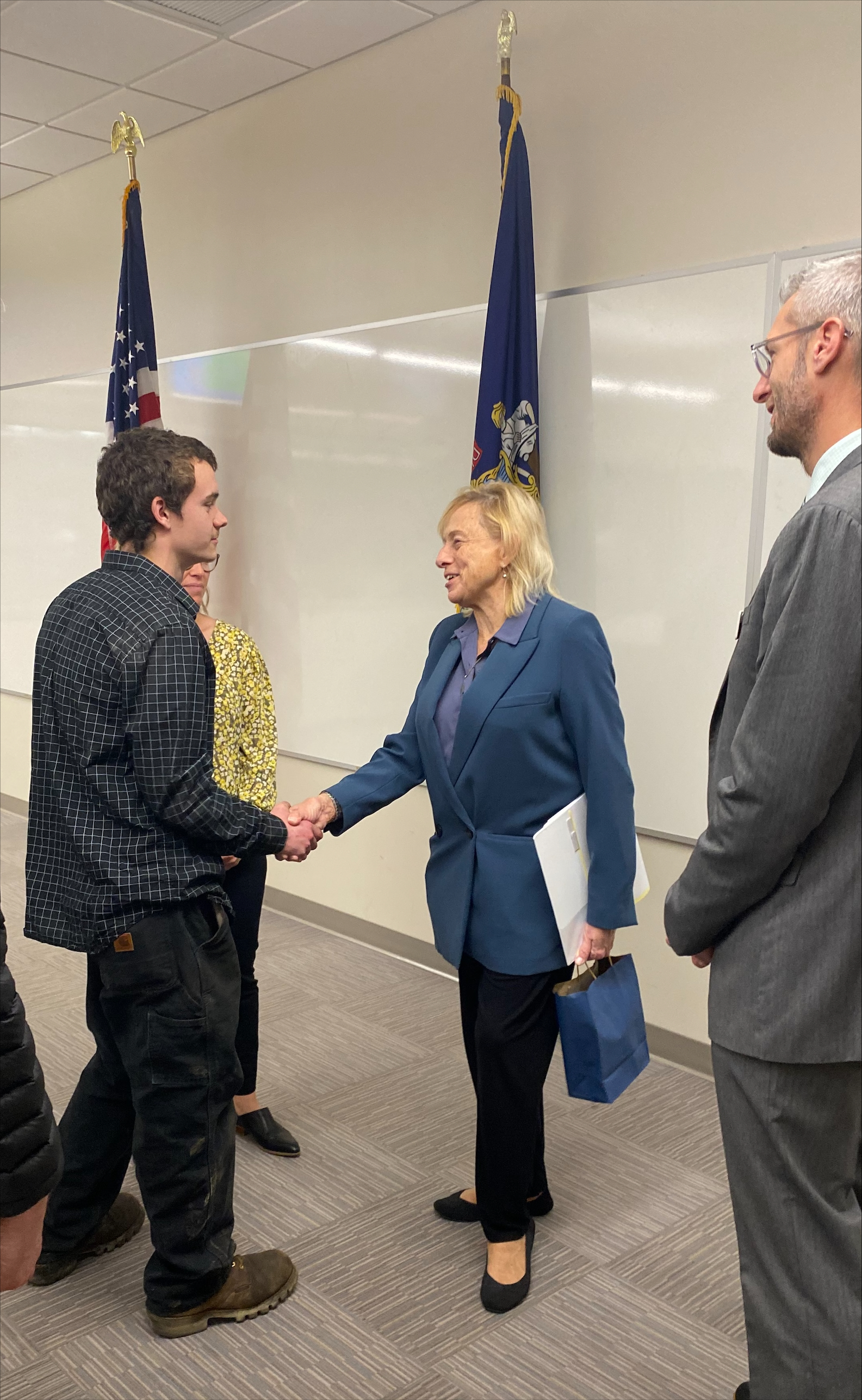
Education Commissioner Pender Makin Kicks Off Annual Read to ME Challenge by Reading to Sanford Pre-K Students 

Maine Education Commissioner Pender Makin kicked off the state’s Read to ME Challenge at Sanford Regional Technical Center by reading If Only… to a group of spirited pre-k students. This is the eighth year that the Maine Department of Education is collaborating with schools, parents and communities on this month-long public awareness campaign to promote the importance of literacy for all of Maine’s students, regardless of age. You can watch video of Makin kicking off the challenge here.

The Read to ME Challenge encourages adults to read to children for 15 minutes, capture that moment via a photo or a video, and then post it to social media and challenge others to do the same using the hashtag #ReadtoME.

Makin also spent time talking with students who are part of Sanford Regional Technical Center’s early childhood education program. Students in the program split their time between their own classroom and interacting with children in the pre-k classroom. Sanford was also able to expand to full day pre-k this year after receiving a grant through the Maine Jobs and Recovery Plan.

“The Read to ME Challenge is about creating a love of reading with children and promoting literacy across our state—and it’s fun,” said Maine Education Commissioner Pender Makin. “Not only did I get to read to an amazing group of pre-k students today, but I had the wonderful opportunity to talk with high school students who are working hard to become future educators through this amazing early childhood education program at Sanford Regional Technical Center.”

The simple act of reading aloud to a child 15 minutes a day for five years results in 27,375 minutes of language exposure, which can put children on the path to high literacy achievement and helps them build knowledge and vocabulary. Research demonstrates a number of benefits to reading to children, from birth through their childhoods and even teenage years, including modeling reading as an enjoyable lifelong activity, stimulating brain development, reducing stress and anxiety, building knowledge of the world, and helping develop the skills necessary to succeed in their lives.

Schools and community organizations can find a toolkit and resources on the Department of Education website and the Department will be sharing videos, photos, and updates from the challenge all month long on social media.

Participants in the challenge are reminded to use the hashtag #ReadtoME and to tag the Maine DOE at @mdoenews on Twitter, @MaineDepartmentofEducation1 on Facebook, and @mainedepted on Instagram.

See who Commissioner Makin Challenged!

Assisting Students in Preparing for Career Opportunities  

This guidance is offered by the Maine Department of Education to clarify the requirement listed in  Sec. 1. 20-A MRSA §4713 and §4730 as it pertains to providing access to the public website of the Maine Department of Labor’s Center for Workforce Research and Information (CWRI) containing statewide employment projections. All Maine middle and high schools are required to include the electronic link to the CWRI employment projections when providing career education programming and guidance for students and parents. 

CWRI Student Dashboard  

The Department recognizes that students may choose to enter the workforce in different ways and strives to provide guidance to help students navigate their postsecondary plans. To this end, the Department of Labor and the Department of Education have launched a student career discovery dashboard that presents the regional and statewide employment projections in an age-appropriate manner for students in grades 6-12. Examples of information presented on the student dashboard include information on annual openings by occupations in career clusters, the typical education requirements by occupation, and annual median wages of occupations.

Maine Learning Results 

The 2020 Maine Learning Results Life and Career Ready standards were updated to support the development of key career readiness elements and career awareness expectations for students in grades K-5 and career exploration and planning expectations for students in grades 6-12.  

Additional Resources 

Department of Labor Center for Workforce Research and Information 

Department of Education Maine Learning Results – Life and Career Ready Resources  

Life-Career Rainbow 

Governor Mills’ Budget Includes Major Investments in Maine Schools, Students, and Educators

Yesterday, Governor Mills released her administration’s budget proposal for the Fiscal Year (FY) 2024-2025 biennium. The proposal includes major investments in Maine’s schools, students, and educators and builds on the historic progress made on education investment throughout her administration.

“Governor Mills has made Maine’s public schools, students, and educators a top priority. She raised minimum teacher pay and covered those additional costs to support local communities. She is also the only Governor who fulfilled the State’s obligation to fund 55 percent of the cost of education,” said Pender Makin, Commissioner of the Maine Department of Education. “From supporting nutritious meals for all students to investing in innovative educational opportunities, this administration has made bold, historic investments in education and this budget builds on that extraordinary progress.”

Education Proposals in Governor Mills’ Budget:

  • Maintaining 55 Percent Education Funding: $101 million to continue meeting the State’s obligation to pay 55 percent of local education costs.
  • Funding Free School Meals: $58 million to fully fund universal free meals for students in public schools and for publicly funded students in approved private schools.
  • Expanding Pre-K: $10.5 million to make pre-kindergarten more available and more accessible across Maine.
  • Strengthening Child Care: $7.8 million to fully fund the salary supplements for child care workers enacted in the FY 2022 supplemental budget, ensuring that caregivers of young children continue to receive increased pay for their vital work helping Maine children develop and thrive.
  • Continuing Free Community College: $15 million to continue providing up to two years of free community college for all students from the high school graduating classes of 2024 and 2025.
  • Supporting Higher Education: $41 million to support a 4.5 increase for Maine’s public higher education institutions, including the University of Maine System, the Maine Community College System, and Maine Maritime Academy.
  • Improving Higher Education Affordability: $10 million to increase the Maine State Grant Program’s maximum award from $2,500 to $3,000. The Maine State Grant Program provides need-based grants to Maine undergraduate students to help with the cost of higher education. If approved by the Legislature, Governor Mills will have tripled the Maine State Grant Program from $1,000 to $3,000 during her time in office.

Educators and Education Leaders Praise Governor Mills’ Education Investments:

“MEA is glad to see the continuation of the full 55% state funding for public schools in the Governor’s budget. The other supports for students and public education in the budget—universal school meals, support for higher education, increased accessibility of pre-K—are all important to the success of Maine’s students and demonstrate the Governor’s commitment to public education and educators,” said Grace Leavitt, President of Maine Education Association.

“With this budget, Governor Mills continues to deliver on her promise to invest in our schools, educators, and students. Maine’s superintendents welcome the Governor’s efforts to ensure the state continues to meet its obligation to pay 55 percent of education funding and provide universal meals to our students,” said Eileen King, Executive Director of Maine School Superintendents Association. “This budget also makes critical investments in programs such as pre-k that will have both immediate and long-term benefits for our students and communities.”

“The Governor has been true to her word since she was elected in her support of public education, the teachers in the classroom, and the students we serve by proposing funding that includes maintaining the state’s obligation to fund public education at 55%, providing $58 million for universal free meals in public schools and approved private schools and expanding support for pre-kindergarten programs,” said Steven Bailey, Executive Director of Maine School Boards Association.

“Educate Maine once again applauds Governor Mills for her focus on strengthening education in our state, at all levels, and building pathways between strong schools and a vibrant Maine workforce. The sustained commitment to maintaining 55% state education funding, universal free meals for students, and salary supplements for child care workers are essential to the success of our learners,” said Dr. Jason Judd, Executive Director of Educate Maine. “Strong investments in higher education are necessary for Maine to meet our education attainment goal of 60% by 2025 in order to meet the needs of our economy. Free community college, much needed additional funding for public higher education, and the increase in the Maine State Grant Program make a bold statement that Maine is serious about providing opportunities for people to reach their highest academic and economic potential. We should be proud that, as a state, we are focusing our resources to ensure more equitable and inclusive outcomes for communities across Maine.”

“Investing in the educators who provide care and education for Maine’s youngest children is foundational to building a strong early childhood education system,” said Tara Williams, Executive Director of the Maine Association for the Education of Young Children. “We thank Governor Mills for her commitment to continue to fund educator salary supplements and invest in this crucial workforce behind the workforce.”

“We are pleased that the Governor’s budget continues to highlight the importance of investing in systems and services that support the well-being of Maine children and families,” said Stephanie Eglinton, Executive Director of the Maine Children’s Alliance. “Wage supplements for early educators, expanded public pre-school, maintaining the state’s share of public school funding, and universal free school meals help ensure that young children have a strong foundation for learning and healthy development. For families challenged with behavioral health needs or substance use disorder, ensuring supportive services are available and accessible is critical to child safety and family well-being.”

“The affordable, high-quality postsecondary education and workforce training provided by Maine’s public universities is the most effective path to social mobility for Mainers and economic prosperity for our state,” said University of Maine System Chancellor Dannel Malloy. “In direct response to the needs of Maine’s people and employers, the 130th Legislature and Gov. Mills made historic investments in public education, especially from pre-kindergarten to community college. I applaud Gov. Mills for the measured budget she released today that builds on those investments and further strengthens pathways to college and great-paying Maine careers. If supported by the Legislature, these additional appropriations will enable UMS to sustain our universities where they are while making strategic investments for the future, meet our obligations to fairly compensate our world-class faculty and staff, and maintain Maine’s national leadership in access and affordability while improving student enrollment and success.”

“Small businesses account for more than 99% of private enterprise in the state and employ more than half of all working Mainers. Many lack their own research and development capacity and, thus, uniquely rely on the expertise and facilities of our public universities to develop the talent, technology, and new and improved products and processes they need to be competitive in an increasingly global marketplace,” said Joan Ferrini-Mundy, who serves as president of the University of Maine and the vice chancellor for research and innovation for the University of Maine System. “Consistent with long-standing calls from the private sector to increase Maine’s economic competitiveness by boldly increasing public investment in public university R&D, the additional appropriations for MEIF proposed by Gov. Mills will allow our universities to better prepare our graduates to be leaders and innovators in the Maine workforce for today and tomorrow, and help Maine companies grow and create more Maine jobs, all while sustaining the state’s abundant natural resources and special quality of life.”

“We’re very grateful Governor Mills supports funding the Free College scholarship at Maine’s community colleges for another two years. Free community college lets students start their lives off right, with a degree or certificate in hand that prepares them for good-paying jobs in dozens of Maine industries or transfer to a four-year college,” said Maine Community College System President David Daigler. “This is the sort of smart state investment in Maine’s young people that provides tremendous benefits to our local communities and the state’s economy.”

“On behalf of thousands of Maine Maritime Academy alumni and supporters throughout the state, we thank Governor Mills for a proposed budget that helps us build toward the future,” said Jerry Paul, President of Maine Maritime Academy. “Her step forward on critical budget needs allows us to continue our ranking as the ‘#1 College in America for Return on Investment for low income students’ as we provide a world-class education and position ourselves as a leader for maritime industry innovation and workforce development, contributing to Maine’s place in a global economy.”


RFA Open for Maine Outdoor Learning Initiative 2023: Coastal Science & Marine Trades 

The State of Maine’s Department of Education is seeking applications to provide funding for a 2nd year of the Maine Outdoor Learning Initiative. The Maine Outdoor Learning Initiative is a statewide effort to increase access to hands-on outdoor learning experiences for Maine students. Through this application process, the Department, will provide funding to Maine nonprofit organizations specializing in coastal exploration, ocean ecology, marine science, and marine career experiences/programming for Maine youth.  

Funding must be used for programs providing authentic, hands-on interdisciplinary marine/coastal experiences opportunities for middle and high school students during summer 2023 and help students recover from the disruptions caused by COVID-19. Innovative design processes, leadership opportunities, and career exploration/development are strongly encouraged as part of the programming. Funding should provide access to students who have/have had limited access to marine/coastal science experiences due to geographic, financial, demographic, or other barriers. 

To be eligible to apply, programs must be offered to Maine students grades 6-12 at no cost to the student or their family, be provided in nature-based, marine science/ecology settings within the state of Maine, occur outside as much as safely feasible, and include transportation to and from program site(s) at no cost to students and families. 

The Department anticipates making five to ten awards as a result of this RFA process and may include partial grants. The total estimated grant funds available are $1,000,000, with individual grants not exceeding $100,000. The number and size of awards will depend on the number of proposals received, available funds, number of youth served, and opportunities provided. The Department reserves the right to eliminate the lowest scoring application(s) and/or make awards for amounts less than that requested, whichever is in the best interest of the State. 

A copy of the RFA, as well as the Question & Answer Summary and all amendments related to the RFA, can be obtained at: Grant RFPs and RFAs webpage 

Any questions must be submitted by e-mail to the Grant Coordinator identified on the Grant RFPs and RFAs webpage by 01/27/23 at 11:59 p.m. local time.  Submitted Questions must include the subject line: “RFA# 202212207 Questions”.  The Department assumes no liability for assuring accurate/complete/on time e-mail transmission and receipt. 

Applications must be received by 02/17/23, at 11:59 p.m. local time and are to be submitted via email to the State of Maine Division of Procurement Services, Proposals@maine.gov. Applicants are to insert the following into the subject line of their email submission: “RFA# 202212207 Application Submission – [Applicant’s Name]”.  

State of Maine 

Department of Education 

RFA# 202212207 

Maine Outdoor Learning Initiative 2023: Coastal Science & Marine Trades 

Resources to Prevent Opioid Overdose in Maine Schools

As directed by the 130th Maine legislature the Department of Education created and collected guidelines and resources for schools who choose to stock emergency medication for a suspected opioid overdose on school grounds.  Naloxone is used in opioid overdoses to counteract life-threatening depression of the central nervous system and respiratory system, allowing an overdose victim to breathe normally. Naloxone is a nonscheduled (i.e., non-addictive), prescription medication. Naloxone only works if a person has opioids in their system; the medication has no effect if opioids are absent. It can be administered by trained persons, which makes it ideal for treating a person experiencing an apparent opioid overdose during school or a school-sponsored activity or otherwise on school grounds. The Rule for Medication Administration in Schools [05-071, Ch. 40, Section 6 (last revised 5/11/2022)], outlines the requirements if a school administrative unit plans to stock naloxone. However, schools must consider including naloxone as only one strategy in combatting substance use disorder.

The Substance Use Among Young Adults Summary in Maine was recently released by Maine CDC and reported that in 2020, nearly one in three young adult Mainers qualified as having a substance use disorder: ranking Maine 3rd in the nation. Research suggests that the area of the brain responsible for decision-making does not fully mature until 25 years of age, making this population more vulnerable to risky and harmful behaviors. Now more than ever we must focus on upstream primary prevention efforts before negative health outcomes occur. Prevention programs within schools can be part of comprehensive health education and social-emotional learning.

Health education can assist students to be better consumers of information, manage the complex world around them and be more inclusive of others. Through an effective skills-based health education curriculum, students will practice skills that protect, promote, and enhance lifelong health. Similarly improving foundational social emotional skills such as self-awareness, self- regulation, social awareness (empathy, compassion & respect for self and others), relationships and critical thinking skill development can be applied to address risk factors for substance abuse. These educational programs can complement a Substance Use Policy within a school administrative unit along with distributing naloxone and educating people about how to prevent, recognize and intervene in overdoses to prevent deaths.

Procurement:

Other Resources:

Contact the Office of School and Student Supports at DOESchoolandStudentSupports@Maine.gov with questions.

Resources to Support Schools Following Today’s Active Shooter Threats

School leaders, educators, and public safety officials worked heroically today to keep students, staff, and schools safe, provide clear communication to families, and follow emergency preparedness plans in response to the active shooter threats that occurred at multiple schools across Maine.

Today’s school threats caused fear and uncertainty across our state, and we know that many students, staff, and school communities may need additional supports to help process the experience. Reassuring students, staff, and families that school is a safe and supportive environment is an important step after any event like this.

The Maine Department of Education continues to offer support and resources to promote the safety and wellbeing of students, families, and educators and we urge you to reach out to us for assistance.

  • The Office of School and Student Supports (O3S) understands that as parents, educators, students, and concerned community members, the intensity of emotions related to these incidences can become obstacles in engaging in everyday activities. O3S offers resources and trainings to bolster connectedness and safety. You can contact DOESchoolandStudentSupports@maine.gov for assistance.

Resources for Parents:

Resources For Educators:

  • The Positive Behavioral Intervention System (PBIS) Team has a collection of resources for supporting schools during and after crisis, coping tips for traumatic events, and materials to support educators and parents in supporting students after an incident of violence and talking to children about violence. You can find those resources here.
  • The Maine School Safety Center (MSSC) can support schools with their emergency planning needs to address preplanning, response, and recovery. The MSSC is available to assist with behavioral threat assessment and mental health trainings. You can learn more about MSSC’s services and contact staff here.

We are grateful to all of you for your efforts today, and every day, to make all Maine schools the safe and supportive environments our students need to thrive.

Governor Mills Announces $25 Million Maine Jobs & Recovery Plan Program to Offer Paid Work Experiences to Maine Students

Governor Janet Mills today announced the Maine Career Exploration program, a $25 million, two-year initiative of her Maine Jobs & Recovery Plan to connect 6,000 young people in Maine to future career opportunities by funding paid work experiences with employers across the state.

Through offering paid work experiences for Maine young people aged 16-24, the Maine Career Exploration program will enable thousands of students to enter the labor force in fields of their interest through work opportunities with Maine employers. In addition to work experience, students may also earn education credits through the program.

The Maine Career Exploration program is a recommendation of Maine’s 10-year Economic Development Strategy (PDF), unveiled by Governor Mills in 2019, to support Maine’s goal of adding 75,000 workers to Maine’s workforce by 2030. The program is led by the Department of Economic and Community Development in partnership with the Department of Education, Department of Labor, and the Governor’s Children Cabinet.

The Governor announced the Maine Career Exploration program today at Morse High School in Bath. Bath, Brunswick, and Topsham schools have used Jobs Plan funds to create a Regional Internship Program, in partnership with the Midcoast Chamber of Commerce, to provide students with work-based learning experiences at local businesses.

“Through the Maine Career Exploration program, high school students will gain meaningful, hands-on work experiences at local businesses that will prepare them to succeed in careers right here in Maine, strengthening our workforce over the long-term,” said Governor Janet Mills. “My Administration will continue to address Maine’s longstanding workforce shortage by making sure our students have the skills, and our businesses have the workers, that they need to succeed.”

“Our state needs to add 75,000 new workers by the end of the decade to keep our economy strong. Preparing Maine students for success in the workforce is a key part of achieving that goal,” said Heather Johnson, Commissioner of the Department of Economic & Community Development. “Maine Career Exploration will introduce thousands of Maine students to future employment options, giving them real world work experience and supporting our business community at the same time.”

“By expanding real-world, engaging learning opportunities with Maine employers, the Career Exploration program will help students explore career options, develop critical work and life skills, and plan for their futures,” said Pender Makin, Commissioner of the Department of Education. “These opportunities are also important for strengthening Maine’s workforce and building connections between schools and local businesses.”

“The mission of JMG is to identify students who face barriers to education, and to guide each one on to a successful path toward continued education, a meaningful career, and productive adulthood,” said Craig Larrabee, JMG President and CEO. “Our commitment is to equitably expand opportunity for students who need it most, particularly those most impacted by the COVID-19 pandemic. With this funding, JMG will support more than 4,000 high school juniors and seniors, throughout all sixteen counties of the state, in engaging with Maine’s employers to gain meaningful workforce experience.”

“This funding will significantly enhance the quality of our Mt. Ararat High School Community Pathways program. Most importantly, we will be positioned to provide many more meaningful and engaging learning experiences to support students in pursuing their dreams, interests, passions, and aspirations,” said Douglas Ware, Community Learning Coordinator at Mt. Ararat High School in Topsham.

“Governor Mills and her administration saw the workforce need, heard from the businesses and the schools, and made the incredible choice to invest in some of Maine’s best problem solvers – our teachers, administrators and business leaders,” said Cory King, Executive Director of the Midcoast Chamber of Commerce. “The investment into this program through the Maine Jobs and Recovery Plan is helping make this concept of paid, meaningful work for students a possibility.”

The Career Exploration program has three primary components:
Awards to Schools and School Districts

The Maine Department of Education has awarded over $5.6 million to 26 school districts, schools, adult education programs, and higher education institutions to create or expand extended learning opportunities for students, which include paid work experiences.

Examples of these efforts include:

  • The Aroostook County Action Program and Eastern Maine Development Corporation will provide paid work experiences to youth in northern and eastern Maine. Career Exploration funds will be used to strengthen and expand existing workforce & training programs through new employer partnerships, reaching students who do not qualify for existing programs, and offering support services to address transportation and technology needs.
  • In RSU 13 in Rockland, students will explore different career paths and learn basic job-seeking skills and financial literacy. Following these classes, students will participate in 10-week internships with local businesses.
  • Telstar Middle High School in Bethel will develop workforce opportunities for students in grades 9-12. These include job shadowing, career immersions with employers, credit-earning experiences, career camps during school breaks, and local internship programs.

Jobs for Maine Graduates

  • Funding from the Career Exploration Program will support expansion of extended learning opportunities, paid work experiences, and coaching now offered by Jobs for Maine Graduates for rising juniors and seniors at 90 high schools in Maine.

Community-Based Organizations

  • Through the Governor’s Children’s Cabinet, five community-based organizations in Cumberland, Sagadahoc, Androscoggin, Penobscot, and Aroostook counties will help disadvantaged young people access meaningful paid work opportunities and valuable employment experience.

The Maine Jobs & Recovery Plan is the Governor’s plan, approved by the Legislature, to invest nearly $1 billion in Federal American Rescue Plan funds to improve the lives of Maine people and families, help businesses, create good-paying jobs, and build an economy poised for future prosperity.

In the last year since the Jobs Plan took effect, the Mills Administration has delivered direct economic relief to nearly 1,000 Maine small businesses, supported more than 100 infrastructure projects around the state to create jobs and revitalize communities, and invested in workforce programs estimated to offer apprenticeship, career and education advancement, and job training opportunities to 22,000 Maine people.

Read a full report of the Jobs Plan’s investments in the past year here. For more about Maine Jobs & Recovery Plan, visit maine.gov/jobsplan.

Media Release: Casco Bay High School Teacher Matthew Bernstein Named 2023 Maine Teacher of the Year

In a surprise ceremony held at Casco Bay High School in Portland, the Maine Department of Education and Educate Maine named ninth grade Humanities and Social Studies teacher Matthew Bernstein as Maine’s 2023 Teacher of the Year while students and colleagues at the school congratulated and honored his tremendous impact on his students and dedication to teaching.

“We are thrilled to announce Matthew Bernstein as Maine’s 2023 Teacher of the Year. Today we celebrate Mr. Bernstein’s love of teaching, his dedication to his students, and his leadership role in education,” said Maine Education Commissioner Pender Makin. “Mr. Bernstein’s students and colleagues at Casco Bay High School have described him as energizing, empowering, inclusive, a mentor, supportive, patient, and loving. Congratulations!”

Bernstein’s Teacher of the Year journey began in May, when he was named the 2022 Cumberland County Teacher of the Year. Along with 15 other County Teachers of the Year, Bernstein was selected from a pool of hundreds of teachers who were nominated earlier this year. In August, he was named one of four state finalists before being selected as the 2023 Teacher of the Year.

Bernstein’s pedagogy is centered around student voices and student activism. He believes that the purpose of education is to help students find their way of contributing to a more equitable world. He is passionate about creating opportunities for students to experience joy and belonging at school on a daily basis and, to that end, he believes in cultivating meaningful relationships with students, often through his work as a 9th grade crew advisor, that are grounded in deep listening and holistic support. Bernstein has served as a team leader, crew team leader, and is currently a professional learning community coach where he facilitates ongoing professional learning with his colleagues.

He is a member of the Portland Public Schools Social Studies Vertical Content Team, collaborating with teachers across the district and local experts to develop Wabanaki Studies curriculum. It is through these efforts to embrace opportunities that deepen his knowledge and practice that he was recently named a 2022 National Endowment for the Humanities Summer Scholar, participating in a seminar entitled, “Teaching the Holocaust through Visual Culture.”

While not teaching, Bernstein is playing or coaching soccer and basketball, reading a book, or trying to determine where to find Portland’s best slice of pizza. He has a Bachelor of Arts in History with a European History concentration from Bowdoin College where he was also a Bowdoin Teacher Scholar. He is the 2022 Cumberland County Teacher of the Year.

“I’m extremely grateful that Mr. Bernstein is getting the recognition that he deserves after years of being a role model for me and so many others. With all of his hard work, kindness and compassion I’m in a true awe of the human that Mr. Bernstein is, all I can hope for is to be the kind of educator that he is,” said former student Yusur Jasim who nominated Bernstein.  

The Teacher of the Year Program is a year-long process that involves educator portfolio and resume submissions, interviews, oral presentations, and classroom visits made by a selection panel comprised of State Board of Education members, school administrators, Maine Department of Education staff, legacy Teachers of the Year, and other Maine business partners.

“Educate Maine is proud to administer the Maine Teacher of the Year program. Matt Bernstein is an intentional and dedicated practitioner who will serve as an ambassador for educators and students across our state.  We look forward to working with him as we continue our efforts to recognize excellence within our educational workforce and elevate the teaching profession in Maine,” said Educate Maine Executive Director Jason Judd.  

As the 2023 Maine Teacher of the Year, Bernstein will spend his year of service advocating for students and teachers and speaking to the importance of education in preparing Maine students for the future.  He will also represent Maine in the National Teacher of the Year program.

“Matt Bernstein puts celebrating and recognizing the needs of individual students at the forefront of his teaching. Whether it is through the subtle check-ins he has with each student before, during, and after lessons or the immense time that goes into planning thoughtful lessons related to what his students need, Matt establishes a classroom community — his crew — by always putting student choice and voice first. Students want to be in Mr. Bernstein’s room because they know that that is a space where they can be seen, heard, and truly listened to and I know Matt will take that same practice forward as he represents Maine as 2023 Maine Teacher of the Year,” said Kelsey Stoyanova, Maine’s 2022 Teacher of the Year.  

“He is a passionate, knowledgeable, enthusiastic and energetic teacher who represents everything that is good about Maine educators,” said Tory Kornfield, Teacher of the Year Selection Member and Maine State Board of Education Representative. 

The Maine Teacher of the Year program is administered by Educate Maine, a business-led advocacy organization, in partnership with the Maine Department of Education, the Maine State Board of Education, and the Maine County and State Teachers and County of the Year Association (MCSTOYA). Funding for the program is generously provided by Maine businesses.  The program’s lead sponsor is Bangor Savings Bank.  Other program sponsors include Dead River, Geiger, Hannaford, the Maine State Lottery, Unum and the Silvernail Family.

For more information about the Maine Teacher of the Year program, visit www.mainetoy.org.

###

Maine Education Commissioner Pender Makin Visits Schoodic Institute’s Maine Outdoor Learning Initiative Program

Maine Education Commissioner Pender Makin headed to the Schoodic Peninsula last week to take part in a Maine Outdoor Learning Initiative program run by the Schoodic Institute. More than 50 sixth through eighth graders from Hancock Grammar School, and their teachers, took part in a two-night, three-day outdoor coastal learning experience.

Students engaged in real-life, hands-on learning through exploring tide pools, photojournalism projects, marine chemistry, mapping, night hikes, art projects, forestry, and other activities that combine different subject areas to learn about science and coastal ecology. The programs were selected by teachers to connect to what students are learning back in their classrooms and are aligned with the Maine Learning Results.

“These students are collaborating, they are outdoors, and they are experiencing deep and meaningful learning through applied, project-based experiences that combine content areas,” said Maine Education Commissioner Pender Makin. “And there is a team of dedicated staff here at Schoodic working with these students in partnership with their classroom teachers. These kinds of experiences are extraordinarily important and meaningful, and students will always remember their time here.”

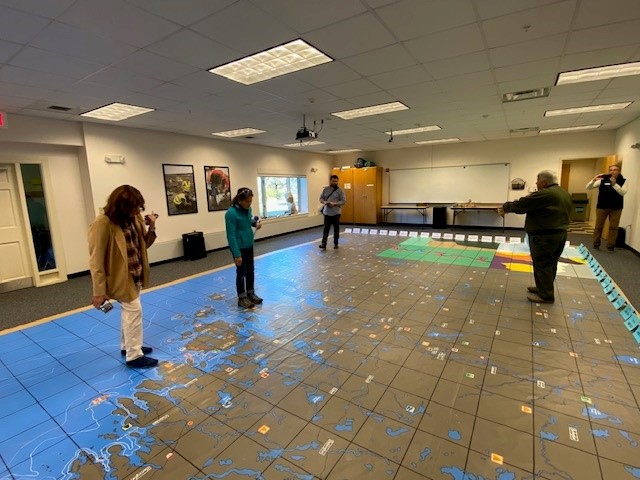
Makin got to tour the outdoor and classroom learning facilities, bunkhouse, and take part in the morning wrap up activities with students where they mapped all of their locations during their time in the program and created graphics highlighting problems and solutions to climate change issues.
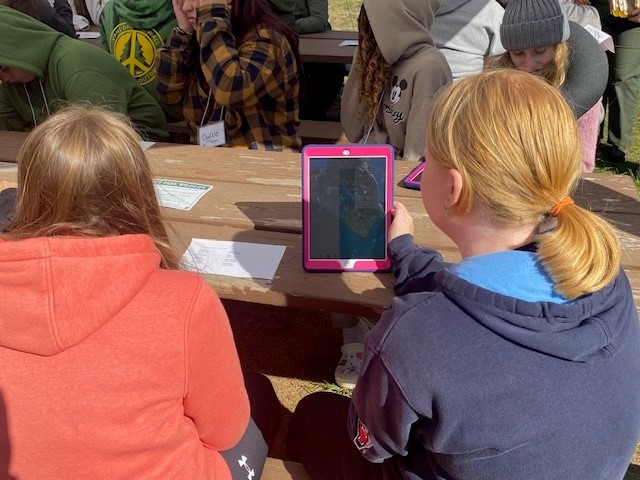
Schoodic’s Maine Outdoor Learning Initiative program engaged 2,000 Maine students in summer day programs and hundreds of Maine students in their multi-day immersive outdoor Schoodic Education Adventure (SEA) program. Schoodic Institute’s outdoor, hands-on coastal education programs encourage students to learn, discover, understand, and solve problems by experimenting and evaluating possible solutions. Curriculum-based outdoor education on the rugged coast of Maine offers an unparalleled experience for students and an exciting way to build science literacy and enthusiasm. For many students, this is their first experience spending the night away from home or their first time getting a coastal experience.

The Initiative also funding several teaching assistant positions, providing living-wage internship opportunities for young people that will provide a springboard for full careers in outdoor education in Maine.
“Schoodic Institute is thrilled to work with the Maine Outdoor Learning Initiative to create hands-on coastal education opportunities here in Downeast Maine for under-resourced schools and low-income families. Furthermore, the early-career internship positions created through this initiative will be springboards for bright careers in outdoor education in Maine,” said Schoodic Institute President and CEO Nicholas Fisichelli.

Schoodic Institute was one of several organizations that received funding through Governor Mills’ Maine Outdoor Learning Initiative. The Initiative, developed by the Maine Department of Education using Federal funding, gives middle and high school students the opportunity to participate in marine and coastal ecology learning programs, including marine research and exploration, boat building, sailing, career exploration with marine businesses, island immersion programs, and more. There was also a specific focus on engaging students who do not typically have access to such experiences due to distance, cost, or other barriers.
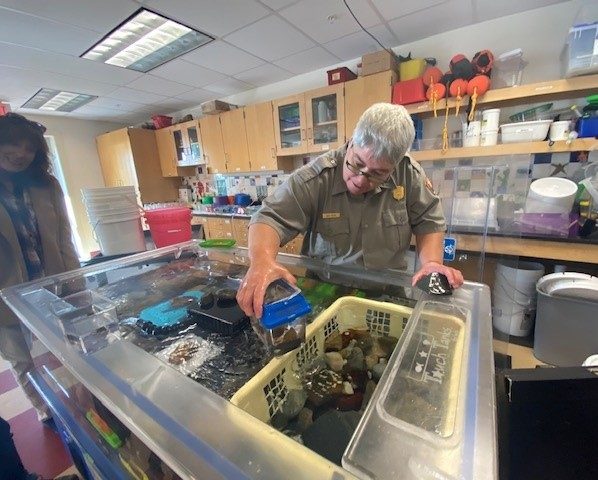
Spending time outdoors has been shown to help reduce stress and anxiety and to equip students with skills and knowledge that can help them succeed inside the classroom. Being able to interact with nature while building connections with peers is also beneficial students’ recovery following the disruptions and difficulties caused by the pandemic.

Read more about Maine Outdoor Learning Initiative experiences here.

Department of Education Family and Community Needs Analysis Survey

The Maine Department of Education (DOE) is inviting all families to participate in our “Family and Community Needs Analysis Survey” by October 14th, 2022.

The survey responses are confidential, and names of respondents will be anonymous. Participation in the survey is completely voluntary. This survey will ask family members questions about how COVID-19 has impacted the learning and development of their children and youth. The survey is designed to be completed within 15 minutes.

The survey responses will be used to identify additional projects and initiatives that the federal Elementary and Secondary School Emergency Relief (ESSER) funds may be used to support. The ESSER funding can support activities and interventions that respond to students’ academic, emotional, aspirational, and social needs while addressing the impact of COVID-19.

Please take some time to complete the anonymous survey here

If you have questions about the survey, please contact Shelly Chasse-Johndro at (207) 458-3180 or by email at shelly.chassejohndro@maine.gov. Thank you very much for your time and support.