2025 MLTI Student Conference: Call for Session Proposals

The Maine Department of Education’s (DOE) Office of Teaching and Learning (OTL) is issuing a call for session proposals for the 2025 MLTI Student Conference. This annual event is organized by the OTL’s Learning Through Technology team and is a part of the Maine Learning Technology Initiative (MLTI). This year’s conference will be held in-person on Thursday, May 22, 2025, at the University of Maine campus in Orono. It is open to grades 5 through 10 in all MLTI school administrative units (SAUs).

The 2025 MLTI Student Conference theme is travel, and the event will use the hashtag #LetsDiriGo. Ideally, sessions will be tailored to that theme, but it’s not a requirement. There are endless possibilities for session topics; however, the focus should be technology-centered and may include traditional technology use, computer science, or even unplugged activities.

Session Proposal Requirements

  • Platform Agnostic: Sessions should not be device-specific.
  • Free Tools and Apps: Sessions should use only free apps and tools that are accessible to all participants.
  • Age Appropriate: Sessions must be suitable for 5th- through 10th-grade MLTI students.
  • Interactive: Sessions should actively engage students in exploration, creation, and collaboration.

Sessions may be led entirely by educators, or students can co-lead with educators. The Maine DOE will also consider session proposals from educational organizations, higher education institutes, and other interested parties directly related to education. For inspiration, session descriptions for the 2024 MLTI Student Conference can be found here.

This year, sessions will be 60 minutes long and should actively engage students in exploration, creation, and collaboration through technology and/or computer science. Presenters should plan to deliver their session twice, unless their schedule prohibits them from doing so.

To submit a session proposal, please complete the 2025 MLTI Student Conference Presentation Proposal Form.

Updated Schedule for the 2025 MLTI Student Conference

8:15 – 9:00 a.m.: Check-in (45 minutes)

9:00 – 9:30 a.m.: Welcome and Opening (30 minutes)

9:45 – 10:45 a.m.: Session 1 for everyone (60 minutes)

11:00 a.m. – noon: Lunch OR Session 2A (60 minutes)

  • Half of students go to lunch at Hilltop or York.
  • Half of students go to Session 2A.
  • Session 2B presenters go to lunch at Bear’s Den.
  • Includes 15 minutes of passing time

12:15 – 1:15 p.m.: Lunch OR Session 2B (60 minutes)

  • Students who attended Session 2A go to lunch at Hilltop or York.
  • Students who attended lunch go to Session 2B.
  • Session 2A presenters go to lunch at Bear’s Den.
  • Includes 15 minutes of passing time

1:30 – 2:30 p.m.: Uber Session and Closing (60 minutes)

Important Dates:

  • Presenters must register to present at the 2025 MLTI Student Conference before March 21.
  • Student registration opens February 3. Upon receipt of all registration materials, a session sign-up link will be provided.
  • The window for student session registration is April 14 through May 2.

If you have questions, please contact the Maine DOE Learning Through Technology team at doe-ltt@maine.gov.

Submit a T-Shirt Design to Represent the 2025 MLTI Student Conference (#LetsDiriGo!)

The Maine Department of Education’s (DOE) Maine Learning Technology Initiative (MLTI) is excited to announce a T-shirt design competition for the 22nd annual MLTI Student Conference on May 22, 2025. All students in MLTI schools are invited to unleash their creativity and design the official T-shirt for this in-person event, which will be held at the University of Maine. The theme for this conference is #LetsDiriGo!

Every year, this competition gives student designers a unique opportunity to see their work come to life beyond a computer screen. Last year’s winning designs came from Maranacook Community Middle School in Readfield (for the MLTI Student Conference) and the Samuel L. Wagner Middle School in Winterport (for the MLTI Maine Winter Classic). Other recent winners have included students from Gray-New Gloucester High SchoolWaterville Junior High School, and Southern Aroostook Community School.

The Maine DOE is, once again, looking forward to selecting a student design for these T-shirts, which will also be available in youth sizes this year. Please review eligibility and submission guidelines for the 2025 MLTI Student Conference T-shirt design competition here. You may submit your entry using this submission form.

Upcoming Competition Dates:

  • March 16, 2025: T-shirt designs due (no late entries accepted)
  • April 4, 2025: finalists selected/winner notified

If you have questions about this contest or need assistance, please contact MLTI Project Manager Bethany Billinger at bethany.billinger@maine.gov.

The Maine Learning Through Technology Initiative (MLTI) is part of the Maine DOE Office of Teaching and Learning. For more information about the MLTI Student Conference, please email doe-ltt@maine.gov.

Register Now for the 2025 Maine Winter Classic Student Event in March

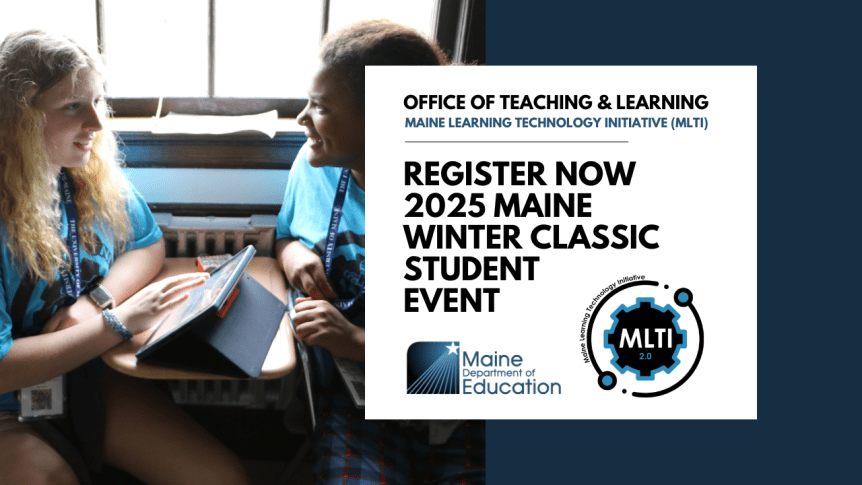
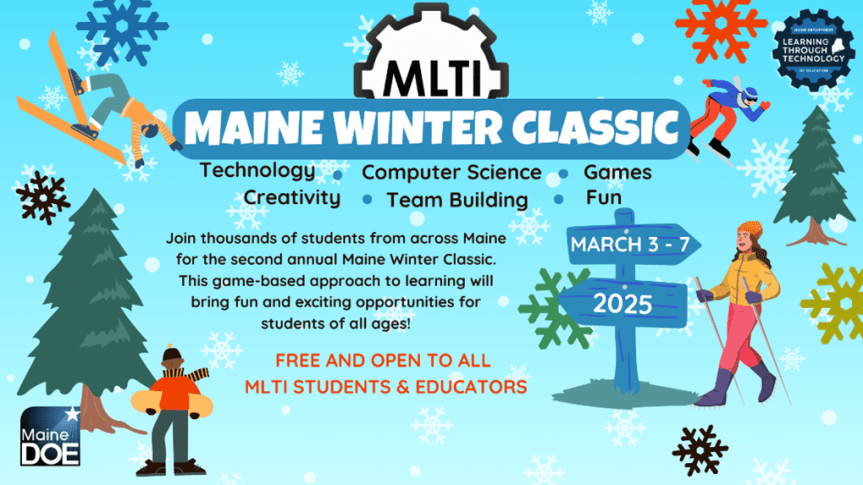
Registration is now open for the Maine Department of Education’s (DOE) 2025 Maine Winter Classic student event, put on by the department’s Maine Learning Technology Initiative (MLTI). This event will be held the week of March 3, 2025. It is open to all MLTI school administrative units (SAUs), and thousands of students of all ages from across the state are expected to participate.

This is the second year that MLTI has hosted this event, which effectively replaced the MLTI Virtual Student Conference. The Maine Winter Classic provides an interactive game-based learning experience for students, as they “travel” around Maine on a virtual gameboard, completing a variety of tasks, earning tokens, and learning about topics like computer science, digital citizenship, digital design, and gamification.

Those interested in learning more can access the overview materials from the 2024 Maine Winter Classic, as well as a variety of support resources. MLTI also asks that all participating staff please watch this recorded session before the 2025 event.

Registration is free, and all materials will be provided. MLTI strongly recommends that teams register prior to January 3 to ensure they receive their materials (including MLTI t-shirts) before the big week! MLTI will accept registrations after this date but cannot guarantee t-shirts and materials for late registrations.

2025 Maine Winter Classic

The Maine Learning Technology Initiative (MLTI) is part of the Maine DOE Office of Teaching and Learning. For questions about the Maine Winter Classic or other MLTI student conferences, please contact MLTI Project Manager Bethany Billinger at bethany.billinger@maine.gov.

Submit a T-Shirt Design to Represent the 2025 Maine Winter Classic!

The Maine Learning Technology Initiative (MLTI), through the Maine Department of Education’s (DOE) Office of Teaching and Learning, is excited to announce a T-shirt design competition for the Maine Winter Classic, MLTI’s virtual statewide student conference. This contest is open to all students in MLTI schools.

Students who would like to participate are invited to create a design for the official T-shirt that will be distributed statewide to thousands of students during the Maine Winter Classic, scheduled for the week of March 3, 2025. This conference offers an engaging, game-based learning experience for students, as they “travel” across a virtual gameboard, completing various tasks and earning tokens, while exploring topics like computer science, digital citizenship, digital design, and gamification.

The Maine DOE is looking forward to selecting a student design for these T-shirts (which will also be available in youth sizes this year). You can review eligibility and submission guidelines for the T-shirt design competition here. Please submit your entry using this 2025 MLTI Student Conference T-Shirt Design Competition Submission Form.

Competition Timeline and Important Dates:

  • Nov. 1, 2024: competition opens
  • Jan. 3, 2025: T-shirt designs due (no late entries accepted)
  • Jan. 24, 2025: finalists selected and winner notified

If you have questions about this contest or need assistance, please contact MLTI Project Manager Bethany Billinger at bethany.billinger@maine.gov.

For more information about the Maine Winter Classic and/or the in-person MLTI Student Conference later in the year, please email doe-ltt@maine.gov.


Join the Maine DOE Learning Through Technology Team at the ACTEM Fall Conference!

The Maine Department of Education Office of Teaching and Learning’s Learning Through Technology (LTT) Team hopes to see you at the ACTEM Fall Conference.

The LTT Team will have a booth and playground on the main floor, and we hope attendees stop by to connect, join our mailing list, and check out what resources are available to support technology education in your school.

Maine DOE’s short playground sessions will focus on the Computer Science Mobile Lab technologies (Lego, Sphero, and Merge), Animation, Green Screening, VR with Meta Quest, Bloxels Game Design, and more.  Check out the listing and schedule.

The LTT team is presenting eight sessions over the two days of ACTEM, covering a variety of topics in addition to our playground offerings. You can find more information about the sessions below.

The Association of Computer Technology Educators of Maine’s (ACTEM) annual Fall Conference is held at the Augusta Civic Center on October 10-11th. ACTEM’s mission is to influence and enhance education in Maine through the use of technology. Our conference offers workshops, keynotes and exhibitors centered around this mission. The conference is a popular event for Maine educators each fall.

We hope to see you there!

LTT Team Session Descriptions

AI for Accessibility
with Jeff Ireland, Janice Medenica, and Stephanie McGruder

We will learn and practice using various AI tools to make your general curriculum more accessible for students. AI tools can increase the efficiency with which we generate, level, or translate text and make content more relevant for our students. AI can also help with scaffolding, assessment creation, high-interest content creation, and so much more. Bring some of your content with you and see how you might make your content more accessible for your students.

Bored Class? No, Board Games! Gamification With Tabletopia
with Chris Beckwith and Janice Medenica

Educators have long been in competition with digital entertainment for student attention at school. The tabletop board game simulator, Tabletopia, can be leveraged to engage students and reinforce what they are learning in the classroom. Building on the success of the last MLTI virtual student conference, the Maine Winter Classic, we will introduce this platform and share best practices for implementing the features available via the free version of Tabletopia.

Future Minds: Cultivating a Culture of AI Investigation
with Nicole Karod and Ashley Carroll

This session introduces elementary education to artificial intelligence, emphasizing its enhancement of teaching and productivity. Discover how AI can support differentiated instruction, foster creativity, and streamline administrative tasks. Gain practice strategies for integrating AI, boosting productivity, and inspiring students with future-ready skills.

Future-Proofing Technology Education in the Age of AI and Emerging Technologies
with the Maine DOE’s LTT Team

Join the Learning Through Technology (LTT) team from the Maine DOE for this engaging discussion-based panel on future-proofing education to help prepare students for emerging technologies. In this session, we’ll discuss the importance of foundational skills for success in an increasingly changing, technologically based society. Come to this session to explore these questions and learn more about how the LTT team can support your work.

Integrate Coding to Go Beyond Just the CS
with Allison Braley and AJ Rog

This session will show you how to embrace Scratch as a tool for students to show their knowledge, no matter what class they are in. Scratch can give students a creative outlet to what they are learning in your class. Go beyond Google Slides, Canva, and Google docs as a way to show understanding. Give your students the chance to show their learning by creating games, adventures, interactive stories, and much more.

It’s Elementary, My Dear Miltie: MLTI in Grades 1-5
with Jon Graham, Amy McInerney, Ashley Carroll and Donna Netzer

This year elementary schools have become part of MLTI like never before. The program has been tracking toward more focused support and inclusion of elementary educators, but we can do more. In this session, we will look at some recent elementary successes from our team. We will also look at what the program is planning, but we want to hear from you! If you are an elementary educator, please come, share and advocate how MLTI can best serve you and your students.

License to Drive: Developing Digital Wisdom & Leadership
by Jonathan R. Werner & Gwyneth Maguire

We know that the Digital Native is a myth, yet we often expect our students to navigate tech independently.  In this session, we will look at how to support students as they move toward independent navigation of the complexities of their online lives.   We’ll also explore ways to support their journey toward gaining greater digital wisdom including media balance and well-being. We will conclude by crowd sourcing strategies to create independent digital leaders.

Tech Integration VS Tech Use: Enhancing Learning
with Donna Netzer

Using technology is fun and engaging for students but it can often be seen as a toy not a tool. Technology integration isn’t just bringing in technology to the classroom, it is incorporating it in a way that enhances learning. We will explore the difference between just using tech with learning and integrating technology in a way that enhances learning in the classroom.

Maine DOE AI Guidance – We need your input!

The Maine Department of Education (DOE) Learning Through Technology Team is seeking input from Maine educators, administrators, and all other support staff for the creation of Artificial Intelligence (AI) Guidance.

Our AI Guidance is designed to empower the confident integration of AI tools and foundational knowledge in Maine classrooms to prepare our students to thrive in an AI-influenced world. To do this with the most benefit for educators, we seek to gather your input. We envision a resource with interactive learning and multiple entry points.  Our guidance will not be mandated or a policy, but a guide to help empower educators in their schools.

We are excited to have you join us and discuss the needs in your classrooms, schools, and school administrative units. We will be doing collaborative Zoom calls throughout September.

Below are the dates and a link to register and receive the Zoom link:   

If you can’t join us on one of those dates, please consider giving us your input with this form.

These sessions will be held with Nicole Karod (The Emerging Technology Digital Specialist) and the Learning Through Technology Team.  If you have any questions feel free to reach out to Nicole at nicole.karod@maine.gov

TeachWithTech Grant Allows for Enthusiastic, Independent Learning with Lego Sets at Chelsea Elementary School

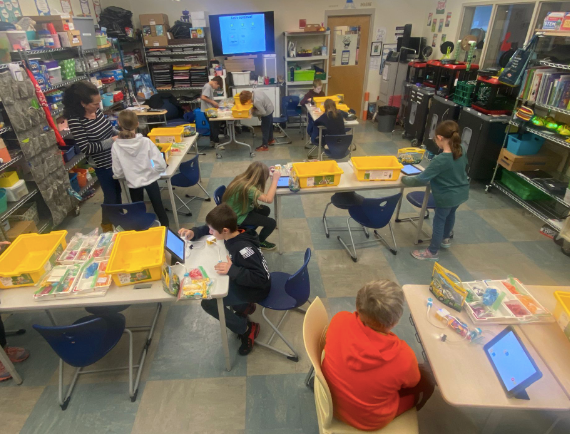
(Pictured: Students in the Maker Space with Lego SPIKE kits and iPads, which were purchased through the Maine Department of Education’s TeachWithTech grant)

Students at Chelsea Elementary School were overjoyed at the sight of twenty new Lego sets as they walked into the classroom this year.

Through the Maine Department of Education’s TeachWithTech  grant, Chelsea Elementary School was able to receive twenty Lego SPIKE Essentials Kits. These Lego sets were accompanied by iPads, which were preloaded with the SPIKE app.

#TeachWithTech provides additional supplemental technology to schools that are part of Maine Learning Technology Initiative (MLTI), to support the initiative to teach and learn with technology. The grant encourages school districts to think of how to create transformative learning experiences for students with technology.

Rosie Del Tejo Williamson (Learning Commons Teacher) and Helen Wright (Learning Commons Education Tech) hoped that students would be able to work independently but were available for assistance.

As soon as the students walked into the MakerSpace room, their excitement was palpable as soon as they and noticed the Lego and iPad setup. They immediately dove into exploration. Despite having no prior experience with the SPIKE app or Lego Spike Essentials, students confidently used coding to bring their Lego creations to life. When difficulties occurred, many students were adept at experimentation and troubleshooting, and many helped their peers. Williamson and Wright were impressed by the students’ confidence in this new situation, as well as their enthusiasm for learning in action.

Williamson and Wright are grateful that TeachWithTech allowed their students to have this transformative learning experience and hope to continue to use technology for engaging learning.

The #TeachWithTech grant is available to any school district that is a part of the Maine Learning Technology Initiative. Priority is given to applicants who focus on greatest student impact, serve socioeconomically disadvantaged districts, prioritize student populations traditionally underrepresented in technology, and demonstrate a commitment to pursuing high-quality teaching and learning through technology.

The next grant window will open in the Fall of 2024. Check TeachWithTech | Department of Education (maine.gov) for updates.

Seeking Applicants for Maine DOE Mobile Learning Program Director

The Maine Department of Education (DOE) seeks a passionate Educator and Curriculum Developer to join our dedicated educational team in the Office of Teaching and Learning. This one-year contracted position will be instrumental in advancing the state’s commitment to fostering an inclusive, well-rounded educational experience that supports every student’s academic, social, emotional, and physical development. This position will lead the Maine DOE’s mobile learning program that will work with teams within the Maine DOE and Maine educators to develop career-focused, interdisciplinary, project-based, and experiential learning experiences to share with classroom teachers.

Ideal candidates will be educators from any content background with a strong understanding of how to design real-world, interest- and career-focused learning experiences to teach the STEAM learning concepts.

Key Responsibilities:

  • Design and Develop STEAM Lessons: Create innovative, hands-on STEAM lessons and activities that align with Maine’s educational standards, play-based pedagogy, and the whole child framework. These lessons should be career-focused and interdisciplinary, integrating science, technology, engineering, arts, and mathematics concepts.
  • Collaborate with Educators: Work closely with classroom educators to co-facilitate STEAM lessons, ensuring they are tailored to meet the diverse needs of all students. Provide professional development and training for teachers to implement STEAM activities in their classrooms effectively.
  • Develop Assessment Tools: Create and utilize assessment tools and strategies to measure student engagement, understanding, and growth. Collect and analyze data to evaluate the effectiveness of STEAM lessons and programs.
  • Foster a Collaborative Environment: Encourage a collaborative atmosphere that promotes exploration, experimentation, and problem-solving among teachers and students. Implement instructional practices that enhance critical thinking, creativity, communication, and innovation.
  • Support Whole Child Development: Support students’ social-emotional development by creating a safe and inclusive learning environment. Encourage student participation and curiosity in STEAM subjects through hands-on, experiential learning.
  • Engage with Community: Engage with parents, guardians, and the broader community to promote the importance of STEAM education and the whole child framework. Organize and participate in events, workshops, and presentations to showcase student projects and achievements.
  • Stay Current with Trends: Stay abreast of the latest research and trends in STEAM education and the whole child approach to integrate best practices into the curriculum.

Qualifications:

  • Educational Background: Bachelor’s degree in Education, a STEAM-related field, or a related discipline (Master’s degree preferred). Teaching certification or relevant professional experience in STEAM education.
  • Understanding of Whole Student Framework: Strong understanding of the whole student framework and its application in educational settings. Experience in curriculum development and instructional design, particularly in STEAM subjects.
  • Skills: Excellent communication, collaboration, and facilitation skills. Ability to inspire and engage students and educators in hands-on, experiential learning. Proficiency in using technology, multimedia, and digital tools to enhance and share learning experiences.

This is a unique opportunity to join the Maine Department of Education and contribute to a transformative educational initiative that prepares students for a dynamic future. If you are passionate about STEAM education and committed to the holistic development of every child, we encourage you to apply.

Salary: $120,000 from July 1, 2024 through June 30, 2025. This position is eligible for remote work.

Access the application here. (Application deadline: June 27th, 2024)

Please contact Chief Teaching and Learning Officer, Beth Lambert, at beth.lambert@maine.gov with questions.


#TeachWithTech Grant Makes 3D Printing Accessible and Ecological at MDIRSS/AOS #91

The Mount Desert Island Regional School System’s (MDIRSS/AOS #91) Filabot Full Recycling initiative is creating new opportunities and ways of engaging in innovative educational practices in environmentally and economically conscious ways that foster interdisciplinary collaboration, improve engagement, increase student motivation, promote the growth in critical thinking skills, and stimulate thinking about ecologically sustainable practices in a high-tech world.

Funded by a $35,322 #TeachwithTech grant from the Maine Department of Education (DOE), the initiative is part of a project led by MDIRSS/AOS #91 IT Lead Luis Jones-Rodriguez, working with MDIRSS K-8 Educational Technology Lead Cindy Lambert and Pemetic Elementary School IT Integrator Mike Brzezowski, to reignite the district’s use of 3D printers for curricular purposes in ways that are more economical, ecological, and innovative. The district is one of 33 schools or school districts that received this grant.

What could be more fun and engaging than learning some of the principles of the scientific method and physics by making and launching your own rocket? While many students have done some iteration of the bottle rocket task using a plastic soda bottle and some type of launcher, students at the Pemetic Elementary School can design and create their own rockets using the school’s 3D printers, marrying curriculum, practical application, and innovation.

“The 3D printed rockets are part of science class.  This year they will do data collection on a standard ‘control’ rocket and be introduced to a few physics’ principles.  Next year they learn more about the principles governing rockets and will create a modified design to compete in either an accuracy or a distance challenge,” said Brzezowski.

Projects like these can be exciting and interesting for teachers and students alike, but they also can be costly and wasteful. According to 3D4Create, a spool of filament will print 20-30 five- to six-inch tall models with 15-20% infill (“infill” refers to the internal structure of a printed item that gives it weight and strength). Each one kg spool can cost between $19-$32, which makes errors, a natural part of learning, and the inevitable production of waste byproducts costly. Jones-Rodriguez’s grant-funded project will allow the school district to make filament from discarded 3D printed projects otherwise destined for landfill, printing waste, and recyclable plastics that can be used in every school. The Teach with Tech grant has enabled Jones-Rodriguez to purchase the equipment needed to establish a complete recycling system that, besides producing savings in the schools’ budgets, will “also allow the kids to make mistakes” without having to worry about the cost of those errors and promote sustainable practices island-wide. The new equipment can produce recycled filament in any color and in 1.75mm and 2.85mm thicknesses.

The goal, said Jones-Rodriguez, “is that no school will buy filament whatsoever and to have a place where plastics can be recycled instead of put into a landfill.” The recycling and production process will serve all of the MDIRSS/AOS #91. Schools have recycling containers to collect commercial food-grade plastics like soda bottles and milk jugs, and Jones-Rodriguez aspires to collect materials community-wide one day. Once it is fully operational, he estimates that the district could save an estimated $1,250 a month or $15,000 a year on filament costs.

Sustainability concerns and frustration with limiting resources also were driving factors behind this project. There had been pushback and 3D printing had started to fall out of favor because “anything that is printed was not recyclable,” said Jones-Rodriguez. In 2015, there was at least one 3D printer in one of the ten schools in MDIRSS/AOS #91. By 2022-2023, the eight schools on Mount Desert Island had “maybe two each,” according to Jones-Rodriguez. Not only were four schools left out of luck, but the ones in place were old and took a long time to print. Their use had fallen because “the old ones would take a week or more” to print items for just one class because they “were prone to failure and very slow.” In the pre-COVID era, some of the district’s schools were using some printers, including MDI High School, whose Maker Space students produced “ear savers” for face masks during the COVID period. Today the district’s schools have been outfitted with new printers that can print up to a “full class’s worth” of projects in one day, he said.

While the complete recycling process is time-consuming, it will be worthwhile.  The home-grown filament project opens the door to a greater variety of items the students can create through the types of recycled plastics that are collected. “Different plastics have different uses,” he said. While filament made from food-safe plastics can be more durable, for instance, they have a low heat resistance, which can make them unsuitable for outdoor use. “Nylon from fishermen is what I’m really excited about because that’s the most durable.”  The plastic nylon used in nets and lines has higher heat resistance and is UV-resistant, making it ideal for filament that can be used for products like lampshades and outdoor furniture. “Everyone is excited that it’s making 3D printing eco-friendly,” Jones-Rodriguez said.

Ultimately the goal is to incorporate 3D printing projects across the curriculum and in different subject areas, Jones-Rodriguez said. At Pemetic Elementary School, that has already started under Brzezowski’s guidance. While the Pemetic science class is working with rockets, one of the school’s French classes is printing chocolate molds that will be used to create chocolate bars with custom wrappers. The wrappers will “have reference to French culture, history, and symbology” and once the students make and wrap the bars using the molds, they will hold a “French Chocolate Market” at Birch Bay Retirement Village, where students will be able to talk to the residents about their chocolates and French culture, and residents will be able to “purchase” the chocolates with tokens they have been given, said Brzezowski. From a French classroom to a Maker Space and then into the community, all wrapped up in a chocolate bar, what student could argue with that?

The Maine Department of Education’s TeachWithTech grant is part of the Maine Learning Technology Initiative (MLTI). The grant is awarded to MLTI schools through a formal grant process and provides supplemental technology and related professional learning to support innovative teaching and learning with technology. Learn more about the TeachWithTech Grant here.

This story was submitted by Mount Desert Island Regional School System (MDIRSS/AOS #91). To submit good news about your school to the Maine Department of Education, complete our Good News Submission form.

Virtual Reality Enhances Cultural Learning in Cony High School’s German Class

Deb Backman’s German 3 class at Cony High School in Augusta is leading the way in educational technology by integrating virtual reality (VR) into their curriculum, thanks to the Maine Department of Education’s (DOE) TeachWithTech grant.

To immerse students in German culture and language, Mrs. Backman conducted a virtual field trip using VR headsets to explore the columns of STOA 169 in Polling, Germany. This innovative approach exposed students to Germany’s rich artistic scene and provided a unique opportunity for linguistic practice and cultural exploration.

The student response to the VR experience was overwhelmingly positive. They observed the intricate designs of the columns and engaged in thoughtful discussions about their significance while honing their German language skills.

Following the virtual excursion, students participated in a hands-on activity during which they created their own interpretations of columns using paper towel rolls. This practical exercise reinforced their understanding of the architectural elements discussed during the VR journey and encouraged creative expression.

Mrs. Backman observed a notable increase in student engagement and comprehension following the VR field trip and subsequent activity. Students demonstrated a deeper appreciation for art and culture and an enhanced ability to articulate their observations and interpretations in German.

Integrating VR technology into the classroom exemplifies Cony High School’s commitment to providing innovative and immersive learning experiences that empower students to broaden their horizons, develop cultural competency, and strengthen their language proficiency in an engaging and impactful manner.

The Maine Department of Education’s TeachWithTech grant is part of the Maine Learning Technology Initiative (MLTI). The grant is awarded to MLTI schools through a formal grant process and provides supplemental technology and related professional learning to support innovative teaching and learning with technology. Learn more about the TeachWithTech Grant here.

This story was submitted by Cony High School, Augusta School Department. To submit good news about your school to the Maine Department of Education, complete our Good News Submission form.