Maine Students Enjoy ‘Take ME to Work Day’ at the State House During School Vacation

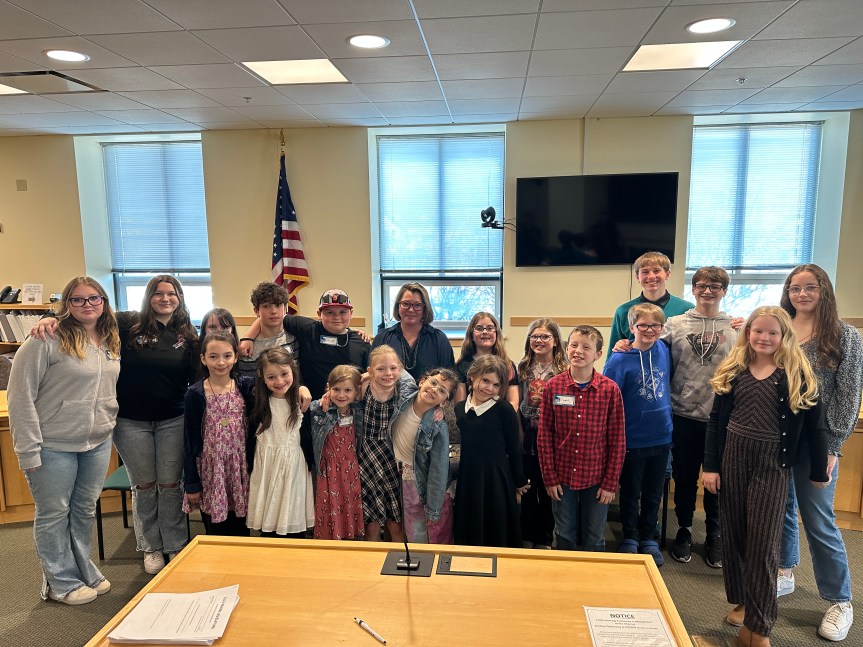
State employees, including the Maine Department of Education (DOE), recently participated in the annual Take ME to Work Day by hosting their children and/or children they know for the day at the Maine Capitol Complex and at state-operated locations across Maine.

The day offered a chance for state employees to give their kids the opportunity to learn more about what they do for the people of Maine and see first-hand the inner workings and importance of our government.

Take ME to Work Day started with tours of the Maine State House, followed by a visit from Governor Janet Mills in the Hall of Flags. She greeted the kids and employees and delivered a message about the meaningful and fulfilling work of state government and its many employees.

While the state had many other activities for kids participating in Take ME to Work Day, the Maine DOE once again took the opportunity to provide a jam-packed day full of fun experiences and learning opportunities for Maine DOE employees and their kids.

Following the State House tour, a mock legislative hearing was held with the help of Laura Cyr, a member of Maine DOE’s Legislative Team. Cyr explained to students about the Legislative Committee on Education and Cultural Affairs and the types of bills they oversee. Then, students volunteered to pretend to be senators and representatives on the committee and hear about a mock bill: An Act to Improve Education by Lowering the Driving Age (to 10 years old). After introducing the hypothetical bill, each student got the chance to speak about the bill, either in favor, against, or neither for nor against the bill.

Students brought up many important points, including that it would be convenient to be able to drive themselves to school if they missed the bus, that anyone young or old who has a driver’s license should have to take driving classes, and that kids are probably not ready to be driving at age ten. They also discussed the potential parking kerfuffle that would take place at school if, suddenly, everyone younger than ten years old was driving to school. Ultimately, the kids decided that the bill would need many changes if it were to proceed.

Following the mock hearing, students and adults got the opportunity to ride a Thomas Electric Bus from C.W. Cressy & Son. On the ride, which took everyone across Augusta’s Memorial Bridge to more State of Maine office buildings, students enjoyed the quiet bus ride and talked about the fact that there is no traditional engine when you open the hood. The group also learned that charging an electric bus takes about 3 hours and will ride for 150 miles on that charge.

Over across the bridge, the group’s destination was a visit with Maine DOE’s Child Nutrition Team to see the culinary classroom and participate in a make-your-own-pizza lunch. Led by Chef Michele Bisbee and her daughter, students learned about the different learning opportunities afforded to school nutrition staff across Maine, both in-person and remote, through the culinary classroom. They also washed up and made their own pizzas. While the group waited for lunch to cook, Chef Bisbee quizzed them on the different food groups and discussed the intricacies of serving nutritional food in Maine schools. Bisbee ended the discussion by asking kids to thank the school nutrition staff at their school next week when school is back in session.

After lunch, the group rode the electric bus back to the Capitol Complex and joined the Maine DOE Learning Through Technology Team’s  Jon Graham to learn about and have hands-on fun with computer devices as part of Maine DOE’s Maine Teaches Computer Science (CS) initiative.

Following a brief overview and history of the Maine Learning Through Technology Initiative (MLTI), Graham showed kids all of the older and newer MLTI devices and showcased some of the computer science tools available to Maine schools through Maine DOE-administered grants and opportunities, such as Sphero BOLTs, Sphero Indi Cars, and a Dash robot. These tools allowed students to play around with and try computer coding in real time. Maine leads the nation in offering universal computer science education.

The day was full of fun opportunities, laughs, learning, new friends, and possibly some budding future Maine State employees.

Maine’s Take ME to Work Day occurs annually in the spring; for more information about the program, visit Maine’s Bureau of Human Resources Page.

21st Annual MLTI Student Conference Registration Closes Soon; Calling for Session Proposals

There’s still time to register to attend the Maine Department of Education (DOE) Maine Learning Technology Initiative (MLTI) Student Conference! Join us for a fun-filled day of technology learning with #CampMLTI, the in-person student conference.  Registration to attend the in-person MLTI student conference on May 23rd at the University of Maine in Orono is open until April 5th.

Please register using this form as soon as possible to ensure your group can attend. 

The MLTI Student Conference is a unique technology experience developed exclusively for students at MLTI schools.  Since MLTI’s beginning in 2001 this conference has been providing students with their own conference where they can engage in authentic, relevant, technology-rich, learning experiences that prepare them for a fulfilling future. Starting in 2020, MLTI has offered a virtual Student Conference and now we offer two events annually. The 2024 virtual conference, the Maine Winter Classic, occurred last month and brought together approximately 5,000 participants from schools in every county across the state.

Submit a session proposal! 

The Maine DOE is issuing a call for session proposals for the in-person student conference on May 23rd, 2024 at the University of Maine at Orono. 

Conference Theme: #CampMLTI – This year’s conference is using a fun summer camp and camping-based theme. We love to have sessions that are tailored to the theme, but it’s not a requirement. There are endless possibilities for session topics. Technology-focused is essential; from traditional use of tech to unplugged, it’s all on the table. 

Sessions should be “platform agnostic” (not device specific) and feature only free apps and tools that are accessible to all, and appropriate for 5th through 10th grade MLTI students. If you have concerns or questions about these requirements, please contact the Maine DOE Learning Through Technology team at doe-ltt@maine.gov. 

Sessions can be led entirely by educators or students co-led with educators. We will also consider educational organization, higher ed, and other education stakeholder proposals. 

Sessions are blocked for 90 minutes and should actively engage students in exploration, creation, and collaboration through technology and/or computer science. Presenters should plan to deliver their session twice, unless their schedule needs prohibit this. 

We hope you’ll consider submitting a session proposal and join us. To submit a session proposal, please complete this form. 

Important Dates 

  • Friday, April 5th, 2024 – Registration Closes 
  • Friday, April 5th, 2024 – Session Proposals Due 
  • Monday April 8th, 2024 – Notification of Session Acceptance 
  • Monday, April 8th, 2024 – Session Registration Opens 
  • Friday April 26th, 2024 – Session Registration Closes 
  • Thursday, May 23rd, 2924 – MLTI (in-person) Student Conference

For further questions, please contact the Maine DOE Learning Through Technology team at doe-ltt@maine.gov. 

Virtual Reality Transforms Learning at Cony Middle and High School #TeachWithTech

Funded by the Maine Department of Education (DOE) Teach With Tech Grant, Cony Middle and High School has embraced a new approach to education through virtual reality (VR) technology. The school’s acquisition of VR headsets and software from Class VR, a London-based company, is reshaping the learning experience for both students and educators.

Katelyn Rodriguez, Director of Technology Integration for the Augusta School Department, applied for the Teach With Tech Grant last school year with the goals of bringing the world into the classroom and fostering experiential learning.

By leveraging VR technology, students at Cony are exploring artifacts and places beyond their geographical and economic reach, and opening their minds to new possibilities.

Recently, 7th-grade science classes utilized VR/AR content to expand on their human anatomy unit. Students were able to visualize AR objects of the human skeletal system, muscular system, and nervous system. They looked at the human heart and digestive system using the Merge Cubes acquired during COVID-19. Students enjoyed being able to look around and even go inside the human heart and digestive system. The real breakthrough occurred as students made observations and asked questions about what they were experiencing, promoting engaging discussions and a deeper understanding of the complex anatomy concepts. Megan Allen and Allison Hunt, with the assistance of Katelyn Rodriguez, took the lesson one step further by allowing students to play in a VR simulation of the digestive system. They became a piece of pizza that traveled down the esophagus, into the small intestine, then the large intestine, and beyond.

The Teach With Tech Grant has propelled Cony Middle and High School into a new era of learning. VR technology has not only enhanced students’ understanding of complex subjects, but has also inspired educators to rethink traditional teaching methods. The immersive learning experiences enabled by VR are set to shape the educational landscape at Cony for years to come.

For Cony students, the classroom is no longer confined by walls but extends to virtual realms, providing an enriched and dynamic educational experience.

Part of the Maine DOE Maine Learning Technology Initiative (MLTI), the Teach With Tech Grant was awarded to MLTI schools in the spring of 2023 and is available again this spring. This grant provides supplemental technology and related professional learning to support innovative teaching and learning with technology. Learn more here.

This story was submitted to the Maine Department of Education by Cony Middle/High School. To submit a story from your school, fill out our good news submission form.

Maine Learning Technology Initiative (MLTI) Opens Spring Application for Teaching and Learning Technology Grant #TeachWithTech

The Maine Department of Education (DOE) Maine Learning through Technology Initiative (MLTI) is pleased to announce the release of the spring application of the #TeachWithTech grant. This grant is available to all MLTI school districts to provide supplemental technology and related professional learning to support innovative teaching and learning with technology. This program aims to provide funding opportunities to educators who want to bring technology into their schools in ways that are innovative, impactful, and intriguing.

A few examples of eligible technology include:

  • 3D Printing
  • Video Production Equipment
  • Audio / Podcasting Equipment
  • Robotics & Coding Kits
  • Drones
  • Digital Microscopes & Doc Cameras
  • Specialized cameras (GoPro, 360, etc.)
  • And so much more!

This grant is designed to offer supplemental technology that is not already provided through the MLTI program; device applications will not be considered. Instead, districts are encouraged to think about innovative learning through technology and submit an application to invest in technology that will create transformative learning experiences for students and supplement the devices already provided through MLTI.

Priority will be given to applicants who:

  • Focus on the greatest student impact.
  • Serve socioeconomically disadvantaged school districts.
  • Prioritize student populations traditionally underrepresented in technology.
  • Demonstrate a commitment to pursuing high-quality teaching and learning through technology.
  • Show a commitment to effective implementation and long-term success.

We’ve streamlined the application and reporting process to create more ease every step of the way. Applications will be reviewed as they come in and awardees will be notified once the evaluation is complete.

Interested, but not sure where to start? Register for a Q&A session, check out our FAQ, and connect with the Maine DOE’s Learning Through Technology team to learn more.

Register for a Q&A session via the links in the “Important Dates” section below.

Important Dates

  • Friday, January 30th; Application Window Opens
  • Tuesday, February 13th, 2024, 3pm; Q&A Session #1
  • Thursday, February 29th, 2024, 8am; Q&A Session #2
  • Tuesday March 12th, 2024, 3:00pm; Q&A Session #3
  • Friday, April 30th, 2024; Application Window Closes
  • July 1st, 2024; Grant Awardees Contract Begin

Click here to access the #TeachWithTech FAQ.

Click here to review the application and apply!

Have questions? Want more information? Contact the Learning Through Technology team at doe-ltt@maine.gov

Media Release: Maine DOE Awards $1.5 Million in Cyber Performance Grants to 61 School Administrative Units

Augusta, ME—The Maine Department of Education’s (DOE) Maine Learning Technology Initiative (MLTI) awarded a total of $1.5 million in Cyber Performance Grants to 61 Maine school administrative units (SAUs). These grants fund SAU projects to upgrade end-of-service infrastructure, strengthen managed detection and response for network security, firewalls, and cloud backup services, and to provide professional learning.

The grants were in response to the federal Cybersecurity Act and the Cybersecurity and Infrastructure Security Agency’s (CISA) report on K12 education Protecting Our Future, which provides schools with recommendations. These include implementing multifactor authentication, security awareness training, professional development, system backups, patch management, minimizing threat exposure, incident response plans, and investments in CISA’s Cyber Performance Goals. Maine Schools continue to learn and progress through the implementation of CISA’s recommendations.

“Getting a Managed Detection and Response (MDR) with our grant is helping us be a lot more proactive in monitoring our endpoints. It was like hiring a cybersecurity professional to watch over our staff devices and servers,” said Mike Arsenault, Yarmouth IT Director.

“The Cyber Performance Grant provided a firewall as an additional layer of defense against cyber threats, offering redundancy to enhance our overall security resilience, ensuring continuous protection, and minimizing the risk of unauthorized access or malicious activities on a network,” said Dr. Dave Fournier, RSU71 Belfast IT Director.

The cyber performance grant is a part of the Maine Learning Technology Initiative’s comprehensive set of supports that include software, broadband and wireless network support, technical support, professional learning, and cyber safety, which together aid all local school units to effectively use technology for teaching and learning.

Have questions? Want to learn more? Reach out to MLTI’s Infrastructure Specialist, Jim Chasse at james.chasse@maine.gov.

Maine SAUs Receiving Cyber Performance Grants

1 Acton Public Schools 22 Nobleboro Public Schools 43 RSU 61
2 Auburn Public Schools 23 RSU 01 44 RSU 68
3 Bangor Public Schools 24 RSU 04 45 RSU 71
4 Bar Harbor Public Schools 25 RSU 06 46 RSU 75
5 Biddeford Public Schools 26 RSU 09 47 RSU 83/MSAD 13
6 Boothbay-Boothbay Harbor CSD 27 RSU 11 48 Scarborough Public Schools
7 Bristol Public Schools 28 RSU 14 49 South Bristol Public Schools
8 Brunswick Public Schools 29 RSU 15 50 South Portland Public Schools
9 Cranberry Isles Public Schools 30 RSU 16 51 Southwest Harbor CSD
10 Ellsworth Public Schools 31 RSU 17 52 St. George Public Schools
11 Falmouth Public Schools 32 RSU 18 53 Tremont Public Schools
12 Glenburn Public Schools 33 RSU 20 54 Trenton Public Schools
13 Great Salt Bay CSD 34 RSU 25 55 Vassalboro Public Schools
14 Kittery Public Schools 35 RSU 29 56 Waterville Public Schools
15 Lisbon Public Schools 36 RSU 33 57 Wells-Ogunquit CSD
16 Madawaska Public Schools 37 RSU 35 58 Westbrook Public Schools
17 Millinocket Public Schools 38 RSU 40 59 Winslow Schools
18 Mount Desert Public Schools 39 RSU 52 60 Yarmouth Public Schools
19 MSAD 27 40 RSU 56 61 York Public Schools
20 MSAD 76 41 RSU 57    
21 Mt. Desert CSD 42 RSU 60    


Seeking Student Submissions for MLTI Student Conference 2024 T-Shirt Design Competition

The Maine Department of Education’s (DOE) Learning Through Technology team is seeking student artwork for this year’s in-person MLTI Student Conference that will be held at UMaine on May 23rd.  Past winners from Gray-New Gloucester High School, Waterville Junior High School, Auburn Middle School, and Southern Aroostook Community School have been able to see their designs exist beyond their computer screens. This contest is open to all students in MLTI school districts.
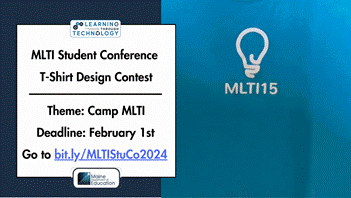
This year’s theme is “Camp MLTI,” so judges will be looking for an entry that focuses on camping. This t-shirt will be worn by more than one thousand students and educators who will be joining us at this annual event. The winners will be recognized during the event. Submissions are due no later than February 1st. Winners will be announced within two weeks of submission.
Click here for more information, including the submission guidelines and link to submit.

For questions about the MLTI Student Conferences, please contact the MLTI Project Manager, Bethany Billinger, bethany.billinger@maine.gov

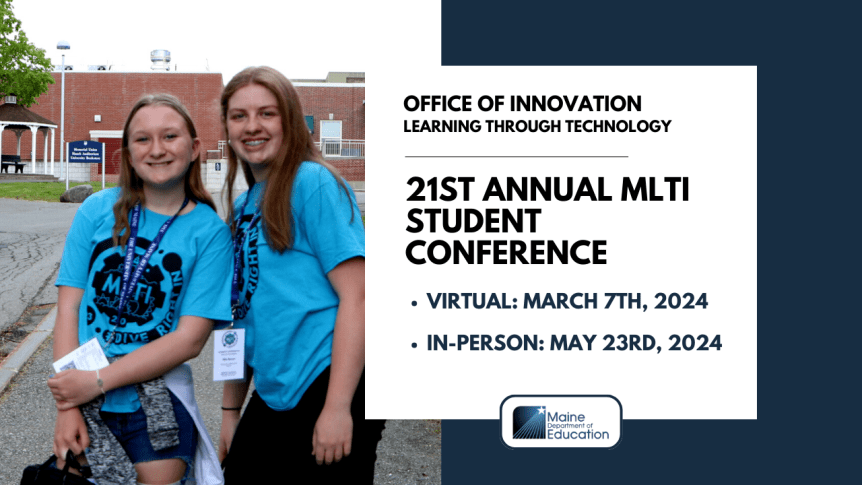
Two MLTI Student Conference Events Planned for 2024 – Registration Open and T-Shirt Design Contests Begins! 

The Maine Department of Education’s (DOE) Learning Through Technology Team is excited to open the registration and t-shift design contest for the 21stannual MLTI Student Conference events! 

Two separate events are being organized this year, each with a distinctive look and approach. We will be organizing another in-person event this year as well as a virtual event again this year, but we are shaking things up. And, for the first time ever, we are hosting two separate t-shirt design contests! See below for more information about these exciting updates. 

MLTI WinterMLTI Virtual Student Conference, March 7th, 2024 

The Learning Through Technology Team is shaking things up with our MLTI Virtual Student Conference this year! We are excited to announce the MLTI Winter Classic, our fifth Virtual Student Conference. This event will be hosted in March this year to provide a unique and innovative opportunity that is better tailored to school schedules and allows for more flexibility than ever before. Join us in a game-based day of fun! Register now to ensure your team can participate in the MLTI “Winter Classic”! 

This event is open to all school districts in the MLTI program. Registration is free and all materials will be provided. Register prior to January 8th to ensure that your team/classroom receives their materials and MLTI t-shirts before the big day! 

Click here for more information and to register for the MLTI Virtual Student Conference. 

MLTI SpringMLTI In-Person Student Conference, May 23rd, 2024 

Join us again this year for a day of learning through technology at the University of Maine in Orono. We are excited to invite you to “Camp MLTI” the 2024 MLTI In-Person Student Conference in May. This event brings together over a thousand students and educators from all across the state for a day of engaging sessions and activities at Maine’s largest university.  

This event is open to all educators and students, grade 5-10 school districts in the MLTI program. Registration is free and all materials will be provided. Register prior to March 29th, to ensure that your team/classroom receives their materials and MLTI t-shirts before the big day! 

Click here for more information and to register for the MLTI In-Person Student Conference (PDF). 

MLTI Student Conference T-Shirt Design Contests! 

For the first time ever, we are hosting two separate t-shirt design contests! This contest is open to all students in MLTI school districts, grades 5-10. Design the t-shirt that students around the state will wear during the MLTI Student Conferences! The winners will be recognized during the event they were selected for. Submissions for the Virtual Student Conference are due December 15th, and submissions for the In-Person Student Conference are due no later than February 1st. Winners will be announced within two weeks of submission. 

Click here for more information, including the submission guidelines and link to submit. 

For questions about the MLTI Student Conferences, please contact the MLTI Project Manager, Bethany Billinger, bethany.billinger@maine.gov 

MLTI Podcast, Teaching with Tech, Returns for Season Two!

Teaching with Tech is back! The Maine Department of Education (DOE), Learning Through Technology team is excited for the second season of their MLTI (Maine Learning Technology Initiative) Ambassador podcast where they will highlight new faces and voices centered around supporting technology integration across Maine. In the first season of Teaching with Tech, episodes focused on a variety of topics ranging from digital citizenship, artificial intelligence, STEAM-based learning, and gamification in the classroom. The Ambassadors share exciting strategies and tools as well as interviews from the field which showcase how teachers and schools are using innovative educational strategies to provide students with the best experience possible.

The MLTI Ambassador team kicked off season two with an episode titled “What are the Ambassadors Working on?” This episode highlights projects that the team is looking forward to this year as well as gives examples of ways they can support districts, schools, and teachers all over Maine. October will be the first themed month, focusing both episodes around educational technology in the arts. Join the team as they interview educators about how they incorporate technology, tools, and strategies into their classrooms and schools. Be sure to look out for “Community Corner” bonus episodes which cover additional topics outside of the monthly theme. Last season saw bonus episodes dedicated to game-based learning in elementary physical education, the Educate Maine Symposium, and Student Leadership Ambassadors of Maine (SLAM) Clubs.

See a listing of 2023/3024 MLTI Ambassadors here.

Do you have a topic you want to hear on Teaching with Tech or know an educator doing exciting work with technology integration? The MLTI Ambassadors would love to hear from you! To join the conversation, email the team at DOE-LTT@maine.gov. Teaching with Tech is now streaming on Apple PodcastsSpotifyGoogle Podcasts, and YouTube Music.

For more information about the Teaching with Tech podcast or other MLTI Ambassador initiatives, contact the MLTI Ambassador Program Facilitator, Jonathan R. Werner, jonathan.werner@maine.gov

Maine DOE MLTI Ambassador Program Welcomes Five New Distinguished Educators

The Maine Department of Education’s (DOE) Maine Learning Technology Initiative (MLTI) Ambassador program is expanding to include five additional distinguished educators.

MLTI Ambassadors are distinguished educators, on loan from their school for two years, to bring their expertise and experience as a resource and partner with MLTI.

The Ambassador program is a signature program of MLTI 2.0. The full team of ten Ambassadors will deliver professional learning experiences and provide instructional coaching to MLTI-participating schools.

Chris Beckwith
Chris Beckwith

Chris Beckwith

Chris Beckwith comes to the MLTI Team from Reeds Brook Middle School, where he served as a technology integrator. A 30-year veteran with a Masters in Instructional Technology, Chris has taught technology, computer science, science, mathematics and health. Prior to his time in RSU22, Chris worked at the James Doughty School and Ellsworth Middle/High School. He has also run summer camp classes at the Maine School of Mathematics and Science (MSSM) for ten years. He is currently part of the DOE’s CSI program and has participated in both CS Ed Showcases. Chris is passionate about robotics, 3D design, drones, and AR/VR and has shared these topics and others at state and regional conferences. Chris is an avid Star Wars fan and lives in Hampden.

Jeff Ireland
Jeff Ireland

Jeff Ireland

Jeff Ireland comes to the MLTI Team from Oak Hill Middle School in Sabattus, where he served as a 5th/6th grade STEM teacher.  A 27-year veteran with a Master’s degree in Educational Leadership, Jeff worked for 10 years as a late elementary level teacher followed by 10 years as a building assistant principal and principal before returning the classroom to teach fifth grade. He has spent his entire career in the same school system, RSU4 (formerly School Union 44). Jeff is also a Registered Maine Guide and Professional Fly Casting Instructor. He is married to an elementary school teacher, is the proud grandfather of two, and lives in Wayne.

Gwyneth Maguire
Gwyneth Maguire

Gwyneth Maguire

Gwyneth Maguire comes to the MLTI Team from Old Orchard Beach High School, where she served as a library/media specialist and technology integrator.  She holds a Master of Education in Educational Technology from Boston College and a Library Media Endorsement from Central Washington University.  A 25-year veteran, Gwyneth has taught in both public schools, including Cape Elizabeth and MSAD60, as well as Department of Defense Schools. She was previously the ACTEM Conference Co-Chair and continues to serve on the Conference Committee. Gwyneth was called the district’s “MVP” by her superintendent for her ability to connect staff to appropriate tech, produce useful tutorials, and help with systematic organization of tech during COVID. She has worked with adults of all skill levels and backgrounds through positions at the Department of Defense, The Cape Courier, and the Portland Dioceses, as well as EdTech professional learning contractors. Gwyneth lives in Cape Elizabeth.

Donna Netzer
Donna Netzer

Donna Netzer

Donna Netzer comes to the MLTI Team from Princeton Elementary School, where she served as the math teacher for grades 6-8. A 15-year veteran, Donna holds a Masters of Education with focus on Special Populations (Trauma-informed). In her small school, Donna has worn many hats – math instructional coach, trauma coach, local teacher’s association president and running a PK-8 tech club. Princeton Elementary was the school she attended and it is where she has worked for her entire career and she is particularly proud of the national Pegasus Award for Princeton’s work on positive school culture. Donna is well respected in her school and in the Washington county region as someone who makes technology happen through writing grants, organizing training and building carts. She recently participated in the DOE’s CSI program. She lives in Princeton.

AJ Rog
AJ Rog

Aaron “AJ” Rog

Aaron “AJ” Rog comes to the MLTI Team from the Lyman Moore School in Portland, where he serves as Computer Science teacher and technology instructional coach. A 27-year veteran with a Masters of Education in Technology, AJ has spent most of his career working in Portland Schools. In addition to computer science and technology integration, AJ spearheaded an iPad initiative at elementary level.  Prior to teaching in Maine, AJ taught in Las Vegas for 12 years, working in grades 3-5 and later grades 6-8. He has done a lot of computer science training of other educators through CSTA Maine and Project>Login. Outside of school, AJ is a longtime swimming coach and is currently the Head Coach of Seacoast Swim Club in Cumberland. AJ lives in Cumberland with his wife Alexis.

The Maine DOE’s Learning Through Technology Team works hand-in-hand with the MLTI Ambassadors to support the MLTI professional learning plan in addition to the many other components of MLTI. For more information about MLTI 2.0, please contact Project Manager Bethany Billinger (bethany.billinger@maine.gov).  To work with the MLTI Ambassadors, please contact MLTI Ambassador Program Facilitator Jonathan R. Werner (jonathan.werner@maine.gov).


Maine DOE’s Second Annual Computer Science Showcase Features Innovative Student and Educator Projects

Students and educators from 40 school administrative units (SAUs) across Maine recently participated in the Maine Department of Education’s (DOE) Second Annual Computer Science Education Showcase at the Collins Center at the University of Maine. The Showcase highlighted innovative computer science education programs and projects in schools across Maine, with hands on, interactive exhibits.

Exhibits featured a variety of computer science education projects, including robotics, artificial intelligence (AI), 3D design, coding, augmented reality/virtual reality (AR/VR), data science, cybersecurity, and more. Robotics students participated in a live demonstration on stage where they had to work together to move objects and overcome structural barriers, requiring teamwork and problem solving.

The Showcase also included a panel discussion with educators, a student, industry representatives, and experts highlighting the importance of computer science education, opportunities for students and educators, and where the field is headed.

“If you can just simply show them and introduce students to these [computer science] concepts, then it opens up a whole world to them. You can be a kid from Maine and do really amazing things in the computer science field,” said Allison Braley, a teacher from RSU 25.

“These are foundational skills we are talking about, and they are across every sector. These are critical 21st century skills that everyone needs regardless of what pathway you choose in life. Kids can stay in Maine, they don’t have to go to Boston or California for these jobs. Employers are here. It doesn’t matter what background you’re from or what zipcode you’re from, this is for every student,” said Angela Oechslie from Project Login.

“If computing is an elective and only for some, you mostly get those students who set out to do that because they see themselves as who society says should do it. The beauty of looking at computer science from pre-k through 12 is that it can be universal, and you can make those opportunities for anybody to stumble across them—it’s young women, it’s those who are the first generation in their family to go to college, it’s kids in rural areas, it’s kids from underrepresented groups. We can diversify the field and we can make the field richer by giving everyone a chance to say that’s the thing I love,” said Penny Rheingans from UMaine.

“Most of the really difficult problems we need to solve over the next 30 years are going to be solved using computer science,” said Judson McIntosh, an Engineering Manager at Tyler Technologies.

Maine continues to lead on computer science education and is the only state to provide interdisciplinary computer science education to all pre-K through grade 12 students in the state. Earlier this year, more than a thousand students from across the state participated in the Maine DOE’s Maine Learning Technology Initiative (MLTI) Student Conference. Students had access to more than 40 sessions that engaged them in essential computer science skills and knowledge, including animation, AI/machine learning, AR/VR, audio editing, CAD/3D Design, robotics, coding, and video game design. More than a dozen of the sessions were led or co-led by students.

Nearly 100 educators from across the state attended a multi-day institute in July, focused around computer science education. Educators spent two and a half days engaging in sessions and collaborating to integrate computer science into their classrooms and upcoming school year activities. Topics included Robotics & Programming, Coding & Hardware, Augmented & Virtual Reality, and much more. The more than 600 participants at this year’s Maine Educator Summit also had access to multiple workshops and sessions related to computer science and technology skills and integration.

Last year, the Mills administration launched a new Maine DOE initiative to provide every Maine school with a free mobile computer science lab. Schools were able to order one of three mobile lab options: Robotics and Programming, Augmented and Virtual Reality, and Coding and Hardware. Each lab contains computer science equipment valued at $5,000 and is designed to be integrated into any content area and skill level. Additionally, the initiative made available professional learning opportunities for educators tailored to each computer science topic area.