Maine DOE Launches GIS World Language Educator Map to Support Expansion of World Language Opportunities Statewide

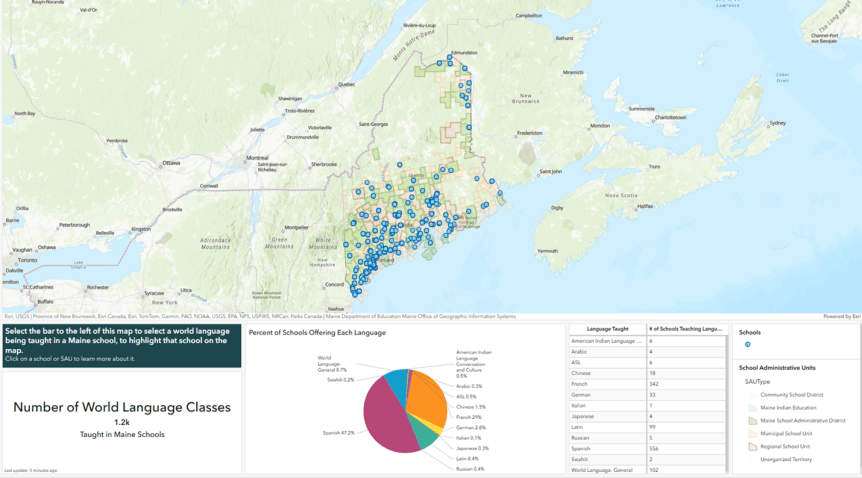
The Maine Department of Education (DOE) is introducing a new resource designed to support the expansion of world language opportunities for students across the state: the Graphic Information System (GIS) World Language Educator Map.

Available on the Maine DOE World Languages webpage, this interactive map provides a statewide view of where world language instruction is offered and the language options available. On the map, each Maine school offering world language instruction appears as an interactive point, displaying the school administrative unit (SAU) that the school is a part of, as well as the language(s) taught.

By making this data visible and actionable, the map makes regional trends easier to identify, supporting intentional planning, targeted recruitment, and stronger collaboration among higher education institutions, SAUs, and educator preparation partners.  Ultimately, the goal of the map is to help SAUs and higher education partners make informed decisions about program expansion, teacher learning possibilities, and long-term language-learning sequences.

These insights directly support the development of pre-K–12 pathways that prepare students for the Maine Seal of Biliteracy, the state’s recognition of students who demonstrate proficiency in English and at least one additional language.

Please note: This map was created using SAU-reported data from the Maine DOE’s NEO reporting system. If you believe this information is inaccurate, please check with your SAU’s data personnel and contact Maine DOE Bilingual/Multilingual Education Specialist Melanie Junkins at melanie.junkins@maine.gov.

Monthly World Language Office Hours

To support statewide use of this tool, the Maine DOE is launching monthly office hours for educators, administrators, and partners. These sessions will:

  • Offer guidance on using and interpreting map data.
  • Highlight strategies for building or expanding world language pathways.
  • Connect educators across Maine to share promising practices.
  • Explore how the 5 Cs of the Maine Learning Results (Communication, Cultures, Connections, Comparisons, and Communities) can be leveraged to strengthen programs.

These office hours are intended to create a space for collaboration, problem solving, and shared vision building, helping to ensure that all students, no matter where they live, can access high-quality language learning. Registration for office hours is required. You may register here: World Language Educators Office Hours.

For more information, please contact melanie.junkins@maine.gov.

Maine DOE Teacher Leader Fellow and National Expert Highlight Collaborative Approaches for Multilingual Learners with Exceptionalities

The Maine Department of Education’s (DOE) professional learning on multilingual learners with disabilities was in the spotlight at this year’s Northern New England Teachers of English Speakers of Other Languages (NNETESOL) 2025 Annual Conference, themed, “Opening Doors Through Language and Literacy Instruction” and held on November 15 at Southern New Hampshire University. Through a joint session, Maine’s leadership in advancing collaborative, equitable instruction for multilingual learners with disabilities took center stage, bringing this emerging area of practice to educators from across New England.

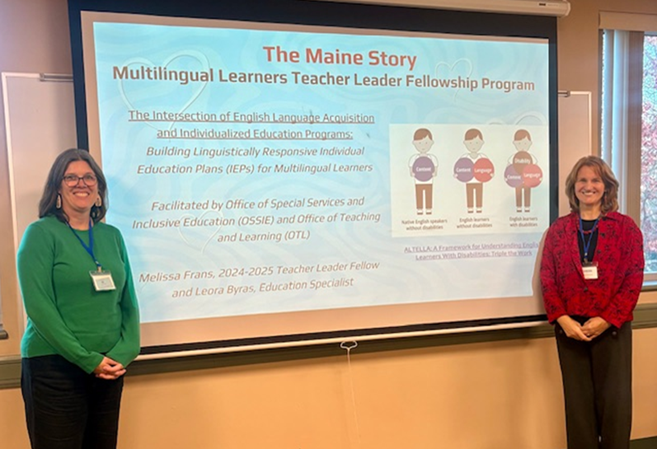
This joint session, “Implementing Joint Professional Learning About Dually Identified Multilingual Learners,” was presented by Melissa Frans,a Maine DOE Teacher Leader Fellow and Special Education Multilingual Coordinator for Portland Public Schools, and Dr. Andrea Honigsfeld, a professor in the School of Education and Human Services at Molloy University. Dr. Honigsfeld teaches graduate courses on cultural and linguistic diversity, language and literacy development, educational equity, and collaborative practices supporting multilingual learners with disabilities. She has authored more than 30 books.

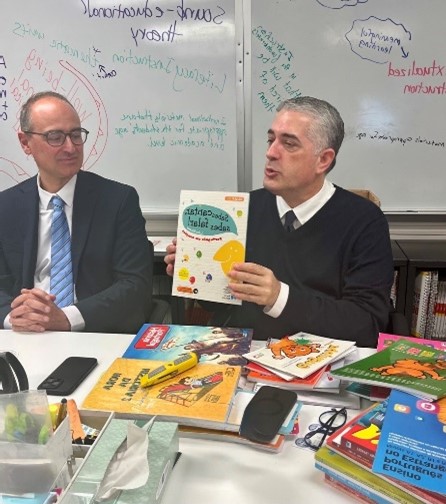
“When I learned that my book, ‘Collaboration for Multilingual Learners with Exceptionalities: We Share the Students,’ coauthored with Dr. Audrey Cohan, was integrated into a statewide professional learning series led by Melissa, I was honored to see my work utilized in such a thoughtful and creative way,” Dr. Honigsfeld shared. “With the Maine DOE providing numerous high-quality, open-access resources on the topic of dually identified multilingual learners, I wanted to learn more about the Maine initiative and invited Melissa to submit a proposal to the 2025 NNETESOL conference with me.”

Frans and Honigsfeld’s session explored the complex needs of dually identified multilingual learners, students who are both multilingual learners and eligible for special education services, and underscored the importance of coordinated, cross-disciplinary professional learning to support them effectively. Frans and Honigsfeld introduced key models for collaborative professional development that deepen shared understanding, strengthen communication, and promote instructional alignment between English for Speakers of Other Languages (ESOL) and special education teams.

“Presenting with Andrea at NNETESOL was a masterclass in collaboration!” Frans said. “I was proud to highlight the Maine DOE Teacher Leader Fellow program in strengthening our collective efficacy across Maine and beyond for supporting multilingual learners.”

The presentation also highlighted the Maine DOE’s statewide efforts to expand joint professional learning for educators serving dually identified multilingual learners. This initiative brings ESOL and special education professionals together to build expertise, align practices, and ensure equitable learning experiences for students.

“Dr. Honigsfeld has a reputation for writing accessible books that are grounded in research and sensibly designed for educators,” Frans added.

For more information about related Maine DOE resources and professional learning offerings, please visit the Multilingual Learners with Disabilities webpage. Details about Dr. Honigsfeld’s publications and work are available here.

The Maine DOE remains committed to expanding knowledge, strengthening collaboration, and opening doors for multilingual learners across the region. Multilingual learners thrive when school administrative units (SAUs) implement a coordinated approach through an Integrated Multi-Tiered System of Support (iMTSS), enabling educators to provide timely, individualized support that honors each student’s language needs, identities, and strengths.

The Teacher Leader Fellow program is part of the Maine DOE Office of Teaching and Learning.

Professional Learning Series: Developing Individual Language Acquisition Plans (ILAPs) for Multilingual Learners with Collaboration and Instructional Planning in Mind

Are you new to Individual Language Acquisition Plans (ILAPS) or looking to strengthen your team’s approach? Do you serve a small multilingual learner population and want a practical framework that ensures compliance with state and federal guidelines and promotes student growth? If so, consider attending a two-part virtual series that the Maine Department of Education (DOE) is hosting to offer a clear, collaborative process for developing ILAPS that reflect each student’s language profile, strengths, and instructional needs.

An ILAP is a required, school-based plan for every student identified as a multilingual learner. An effective ILAP clarifies educator roles, targets timely and individualized supports, and honors students’ identities and assets to foster growth, engagement, and belonging. Led by Maine DOE Teacher Leader Fellows Rebecca Carey and Melissa Frans, this series will help participants to learn how to design ILAPs that meet state and federal requirements, while advancing equity, access, and belonging through intentional instructional planning and partnership.

Format:

Participants must attend both sessions of this series. Each session includes one hour of structured learning followed by 30 minutes of collaborative sharing and discussion. Registration is required. Please register here.

Session Topics:

Intended Audience:

English Speakers of Other Languages (ESOL) teachers, directors/coordinators of multilingual programs, and general education teachers who support multilingual learners may find this series beneficial. Participants will develop actionable, collaborative approaches to ILAPs aligned with WIDA Standards and supportive of instructional planning.

Schedule:

This two-part virtual series will be held from 3:30-5 p.m. on:

  • Wednesday, November 5, 2025
  • Thursday, November 6, 2025

Participants who attend both sessions will receive three contact hours.

The Teacher Leader Fellows program is a part of the Maine DOE Office of Teaching and Learning. For more information, please contact Jane Armstrong, Maine DOE State ESOL Specialist, at jane.armstrong@maine.gov.

ADMINISTRATIVE LETTER: Legal Requirements to Provide English Language Acquisition Services to Students Who Are Multilingual Learners (Revised October 9, 2025)

Administrative Letter: #2
Policy Code: IHBEA
TO: Public School Administrators
DATE: August 22, 2019, Revised September 15, 2021, Revised June 21, 2023, Revised October 9, 2025

SUBJECT: The legal requirements for providing English for Speakers of Other Languages (ESOL) services to students who are multilingual learners

Please note that “multilingual learners” is used with reference to students who were previously known as “English learners (ELs).” Federal language still uses “English learners (ELs)” to refer to “multilingual learners.”

Topics included in this letter:

  • Identification of Students Who Are Multilingual Learners
  • Exit Criteria from ESOL Services
  • Monitoring and Reentry into Multilingual Learner Status
  • Delivery of ESOL services
  • Administration of WIDA ACCESS and WIDA Alternate ACCESS (if applicable)
  • Enrollment of Immigrants and International Students
  • Rights of Students Who Are Multilingual Learners to Education
  • Students Who Are Multilingual Learners and Special Education

Identification of Students Who Are Multilingual Learners
It is a federal requirement that all students who are multilingual learners be identified within 30 days of enrollment from the beginning of the school year. For students enrolling at the start of the school year, parents/guardians must be notified of their child’s English learner status within the same 30-day period. After the start of the school year, school administrative units (SAUs) must notify parents/guardians within two weeks of their child’s identification.

Each SAU must provide the Maine Department of Education’s (DOE) Language Use Survey to the parent/guardian of every student, pre-kindergarten through grade 12, enrolling in the SAU for the first time. The Language Use Survey must be included in the SAU’s enrollment packet or online enrollment system. If a student changes schools within an SAU, a new Language Use Survey is not required.

The Language Use Survey is available for download in English and 29 of Maine’s most commonly spoken languages. Parents/guardians are entitled to complete the Language Use Survey in their preferred language. SAUs must provide translation/interpretation services upon request.

The purpose of the Language Use Survey is to identify students who might be multilingual learners. The Language Use Survey decision tree provides guidance on its use. If any question is answered with a language other than English, the student should be administered an English language proficiency screener. (Please note that Sign Language is not a qualifying language for multilingual learner status; however, if a student uses Sign Language and an additional language other than English, the student may be eligible for multilingual learner status.) See Multilingual Learner Identification for information about the required screeners and identification thresholds, by grade level.

Students who were screened for multilingual learner status but who did not initially qualify may be re-screened at any time if a potential need for ESOL support becomes apparent.

Exit Criteria from ESOL Services
A multilingual learner who demonstrates proficiency on the state’s annual English language proficiency assessment is eligible for exit from ESOL services. In Maine, the annual English language proficiency assessment is the WIDA ACCESS or, for multilingual learners with the most significant cognitive disabilities eligible for alternate assessments, the WIDA Alternate ACCESS. Information about both of these assessments can be found on Maine DOE’s English language proficiency assessment page, located here: English Language Proficiency Assessments | Maine Department of Education.

In Maine, an overall Composite Proficiency Level (CPL) of 4.5 on WIDA ACCESS qualifies multilingual learners for exit from ESOL services. Multilingual learners with the most significant cognitive disabilities, eligible for participation in alternate assessments, can be exited from ESOL services with an overall CPL of 4.0 on the WIDA Alternate ACCESS.

In rare instances, multilingual learners qualify for a domain exemption on the WIDA ACCESS or WIDA Alternate ACCESS based on a disability as documented in the student’s Individualized Education Plan (IEP). In these instances, the SAU must submit a Less Than Four Domains request to the Maine DOE. The Maine DOE will ensure the correct Do Not Score code is entered for the student domain(s) in WIDA Assessment Management System. The student’s state ID will also be submitted to WIDA/Data Recognition Corporation for calculation of an overall CPL and the development of an Individual Student Report. The Less Than Four Domains request can be located on the English language proficiency assessment webpage: English Language Proficiency Assessments | Maine Department of Education > Special Forms Request.

Monitoring and Reentry into Multilingual Learner Status
Per federal guidance, SAUs must monitor the performance of former students who are multilingual learners for at least two years after exiting. If, during the two years of monitoring, or at any time thereafter, a former student who is a multilingual learner shows a potential need for continued ESOL support, that student must be rescreened with the WIDA Screener Online to determine multilingual learner status. If a student scores below the state-defined identification threshold, the student must be reentered into multilingual learner status, must receive ESOL services, and must take WIDA ACCESS or WIDA Alternate ACCESS, if applicable, until exiting.

Delivery of ESOL Services
An SAU is required to determine the components of an effective English language acquisition program tailored to the needs of each student, which may include, but is not limited to, tutoring, additional classroom support, materials, sheltered instruction, professional development for content area teachers, or other strategies per the Office for Civil Rights December 1985 Title VI policy memorandum, Title VI Language Minority Compliance Procedures.

The Maine DOE requires the English Language Acquisition Service Provision for a student who is a multilingual learner to be provided or overseen by a 660 ESOL-endorsed teacher. (See 34 Code of Federal Regulations C.F.R. Section 100.3 (b)(ii)). All students who are multilingual learners must be provided with English language support services that enable them to meaningfully access the curriculum to meet grade-level standards. English language development and content area knowledge are to be acquired simultaneously rather than consecutively. In other words, English language proficiency is not a prerequisite to participate in grade-level, content classes. If students who are multilingual learners receive services that remove them from content area classes (such as a newcomer program or pull-out services), any academic deficits that result must be remedied so that the student remains on track with their non-multilingual learner peers academically.

English language support services are to be provided in a way that minimizes the isolation of students who are multilingual learners from the general student population and encourages students who are multilingual learners to participate in all aspects of the school program, including advanced coursework, career and technical education, gifted and talented programs, and extracurricular activities. Students who are multilingual learners are entitled to ESOL services until exiting by demonstrating English language proficiency on WIDA ACCESS or WIDA Alternate ACCESS, if applicable.

Administration of WIDA ACCESS and WIDA Alternate ACCESS
The annual English language proficiency assessment for all students identified as multilingual learners in kindergarten through grade 12 is required by federal law under the Every Student Succeeds Act (ESSA) of 2015. Participation in state assessments is also required under state statute; it is part of annual ESEA application assurances for Title funds. Participation is also included in the school approval process for public schools, including charter schools, and private schools with 60% or more publicly funded students.

In Maine, the required English language proficiency assessment is WIDA ACCESS. A small percentage of multilingual learners with the most significant cognitive disabilities, found eligible for participation in alternate assessment through the IEP team process using state guidance resources, participate in WIDA Alternate ACCESS. The Maine DOE defines English language proficiency as a composite proficiency level of 4.5 on WIDA ACCESS and 4.0 on WIDA Alternate ACCESS.

The Maine Multilingual Learner Identification and Placement Guidance Document, updated annually, outlines all training requirements for test administrators of WIDA ACCESS and WIDA Alternate ACCESS. Federal peer review requirements outline specific standards for test administration training across state assessments, and, therefore, these training requirements for test administrators of English language proficiency assessments are mandatory. It is not required that test administrators be an ESOL-endorsed teacher; however, only an ESOL-endorsed teacher is qualified to design, oversee, and implement an English language support program, which includes the interpretation of WIDA ACCESS and WIDA Alternate ACCESS results.

Enrollment of Immigrants and International Students
Title VI of the Civil Rights Act of 1964 prohibits discrimination based on race, color, or national origin, among other factors, by public schools. SAUs are required to enroll children regardless of citizenship or immigration status per Plyler v. Doe. This applies equally to students who are immigrants and international students attending a Maine public school as an exchange student or tuition-paying student.

All students, including those who are immigrants and international students, must be screened for multilingual learner status. Any student who is identified as a multilingual learner, regardless of citizenship or immigration status, is entitled to ESOL services and must be administered WIDA ACCESS or WIDA Alternate ACCESS, if applicable, annually. International/exchange students are not exempt from Title I required state academic assessments. In Maine, recently arrived multilingual learners who have been enrolled in a U.S. school for fewer than 12 months are exempt from one administration of the state’s English language arts assessment only. See the Maine Comprehensive Assessment System website for further questions and information.

SAUs are not permitted to discourage the enrollment of children who are undocumented immigrants by asking about their immigration status, denying enrollment to those with international birth certificates, or denying enrollment to children whose parents decline to provide their social security numbers or race and ethnicity information. Federal regulations allow schools to ask for children’s social security numbers to be used as student identifiers; however, they should inform parents of the purpose and that disclosure of such numbers is voluntary. Schools may not deny enrollment if parents refuse to provide a child’s social security number. SAUs may require proof that a child lives within SAU boundaries, which may include lease agreements, utility bills, or other documents; however, schools may not ask parents about a child’s immigration status to establish residency. SAUs may require proof of a child’s age, but they may not bar enrollment because a child has an international birth certificate or no birth certificate. 

Rights of Students Who Are Multilingual Learners to Education
The Civil Rights Act of 1964 remains the foundation of the legal rights of a student who is a multilingual learner. Lau v. Nicholsconfirms that all students who are multilingual learners are entitled to meaningful access to the curriculum.  

Although the 2015 U.S. Department of Education ‘Dear Colleague’ guidance on English learners has been rescinded, the civil rights protections underlying that guidance remain fully in effect. Under both federal law (Title VI of the Civil Rights Act of 1964 and the Equal Educational Opportunities Act of 1974) and the Maine Human Rights Act, SAUs have an obligation to ensure that multilingual learners have meaningful access to the SAU’s educational programs and services. Failing to provide appropriate language assistance services or to remove barriers to program participation may constitute discrimination on the basis of national origin and language, which is prohibited under the Maine Human Rights Act. SAUs are accountable for implementing policies, practices, and supports that guarantee equitable access to instruction, comparable participation in academic and extracurricular programs, and timely communication with families in languages they can understand.

If a parent refuses ESOL services, this must be documented, but parental refusal does not release the school or SAU from its responsibility to provide meaningful education to students who are multilingual learners. If a student who is a multilingual learner cannot make academic progress without ESOL services, the student has a right to ESOL services, even if a parent refuses. Parental consent is not required to administer an English language proficiency screener or WIDA ACCESS or WIDA Alternate ACCESS, if applicable. Under state law, SAUs are responsible for administering WIDA ACCESS to all students who are multilingual learners, regardless of parental consent (20-A M.R.S. §6209 (1-A)).

Students Who Are Multilingual Learners and Special Education
Students may qualify for, and have legal entitlement to, both ESOL and special education services. There are specific guidelines for both ESOL and special education that are to determine students’ eligibility for each type of service. Depending on a student’s disability and IEP, universal testing tools or accommodations may be needed to measure English language proficiency. When evaluating a student who is a multilingual learner for disabilities, screening must be linguistically and culturally appropriate. It is advisable to measure a student’s skills in the student’s primary language to clarify whether challenges are due to a learning disability or English language development.

Students who are multilingual learners should not be placed in a special education program unless their IEP determines this placement is appropriate to access specially designed instruction. Multilingual learner status is not a disability and is not covered by the Individuals with Disabilities Education Act (IDEA) or Maine Unified Special Education Regulation (MUSER). The Maine DOE ESOL Team and Office of Special Services and Inclusive Education have collaborated to develop a policy and resource guide on Identifying and Serving Students Who Are Multilingual Learners with Disabilities. This resource can be used by school teams when making determinations about a student’s status and program of services.

For students who are multilingual learners with IEP teams, the U.S. Department of Education has provided the following guidance:

“When an EL student is determined to be a child with a disability—as defined in IDEA, or an individual with a disability under the broader definition of disability in Section 504—the student’s EL and disability-related educational needs must be met. For EL students, in addition to the required IEP team participants under IDEA, it is essential that the IEP team include participants who have knowledge of the student’s language needs. It is also important that the IEP team include professionals with training, and preferably expertise, in second language acquisition and how to differentiate between the student’s needs stemming from a disability or lack of ELP.”

Students who are multilingual learners with learning disabilities are eligible for exit from ESOL services when they demonstrate English language proficiency by achieving an overall composite proficiency level of 4.5 on WIDA ACCESS or an overall composite proficiency level of 4.0 on WIDA Alternate ACCESS, if applicable.

If you have questions or would like further information about serving students who are multilingual learners, contact Jane Armstrong, Maine DOE ESOL State Specialist, at Jane.Armstrong@maine.gov.

If you have questions regarding WIDA’s English language proficiency assessments, contact Mechelle Ganglfinger, Alternate and English Language Proficiency Assessments Coordinator, at Mechelle.Ganglfinger@maine.gov.

If you have questions regarding students who are multilingual learners and eligible for special education, contact Erin Frazier, Director of the Maine DOE Office of Special Services and Inclusive Education, at Erin.Frazier@maine.gov.

Maine Schools Strengthen Global Connections in the Fall of 2025

As a new season of learning unfolds, Maine classrooms are building on the strength of global connections. Through community celebrations, exchanges, and new language resources, students and educators are experiencing how language and culture are assets for learning.

In Lewiston, Portuguese cultural brokers and educators are partnering with the Maine Department of Education (DOE) and Portugal’s education leaders to bring free, high-quality resources into classrooms—work extending from Maine’s international agreement with Portugal. Teachers are accessing digital materials from Porto Editora that support Portuguese as a foreign, second, and heritage language. Additionally, local feedback has provided a reminder that implementation support matters: Since few classrooms in Maine have Portuguese-speaking teachers, educators may need guidance about how to use these materials effectively. The Maine DOE continues to coordinate practical “how-to” supports and warm introductions, so resources are usable in everyday instruction.

Maine educators are also connecting through events that celebrate language and culture. The Taipei Economic and Cultural Office in Boston hosts Taiwan’s 114th National Day Celebration on October 3. A week later, teachers will gather at Husson University for the Maine Chinese Language Conference, an annual convening organized with the Bangor Chinese School/Chinese Language and Culture Center of Maine (CLCCM) that offers professional learning and continuing education units (CEUs).

Maine students continue to benefit from opportunities in German. At Cony High School—one of only 14 U.S. schools in PASCH (Schools: Partners for the Future), a global initiative of the German Federal Foreign Office via the Goethe-Institut—two students head to Estes Park, Colorado for an immersion weekend and competition with peers from across the Americas. Each summer, two Cony students also receive full scholarships for a three-week course in Germany, and this November, Goethe-Institut representatives will visit campus to share additional pathways, including study abroad.

deb backman

“As a PASCH school, Cony has access to unique global connections, cutting-edge teaching resources, and annual teacher training that elevate German instruction,” Deb Backman, German teacher at Cony Middle and High School in Augusta, and 2025 Kennebec County Teacher of the Year, said. “Students build real language fluency and cross-cultural understanding, with many chances to use their skills inside and outside the classroom.”

Maine’s collaboration with the Académie de Nantes (France) supports classroom-to-classroom exchanges and educator partnerships that give students real audiences for their language skills. Those supports exist today but are underutilized; the Académie is actively seeking conversations with Maine educators about how to increase participation and make these opportunities easier to access.

“The supports are in place, and we want to hear directly from Maine educators about what would make participation easier and more impactful for their students,” Maine DOE Director of Strategic Partnerships Ayesha Hall said. “Districts can connect with partner contacts on the Global Partners Network webpage, and I’m glad to make a warm introduction, when helpful.”

Together, these stories show that Maine schools are not just teaching languages; they are building bridges. By investing in multilingual pathways and international partnerships—and by listening to local feedback that improves access and use—schools across the state foster the curiosity, respect, and collaboration skills students need to thrive in a connected world.

A next step for educators and administrators: On October 20, 2025, from 3:30 to 4:30 p.m., the Maine DOE hosts the next session of the Multilingual/Multicultural Connections Webinar Series—a virtual session for educators and district leaders who want practical ways to translate international partnerships into classroom learning and schoolwide engagement. Please register here, if you are interested in attending.

For more information, please contact Ayesha Hall, Maine DOE Director of Strategic Partnerships, at Ayesha.Hall@maine.gov. Additionally, if this work is of interest to you, consider visiting the Maine DOE Global Partners Network webpage.

Maine DOE Launches Multilingual Resource Kit to Grow Seal of Biliteracy Recognition Across Schools and Communities

The Maine Department of Education (DOE) is proud to launch the Seal of Biliteracy Resource Kit,a comprehensive, multilingual outreach package designed to promote biliteracy, expand participation, and celebrate language diversity across Maine’s schools and communities. Let’s celebrate Maine’s multilingual future, one student, one language, and one Seal at a time!

The Maine Seal of Biliteracy honors graduating high school students who demonstrate proficiency in English and at least one additional language, including American Sign Language, affirming that multilingualism is both a personal strength and a statewide asset for college, career, and civic readiness.

Why the Seal Matters

Fred Ravan, Spanish teacher and president of Educators for a Multilingual Maine, recognizes the value of this earned distinction and shared why it is so meaningful: “It is important to me because it enables my students to showcase their linguistic ability.”

Record Growth in 2024-2025

The previous academic year marked a milestone for the Seal of Biliteracy in Maine:

  • 518 students earned the Seal (the highest number since the program’s launch in 2018).
  • This represents a 32% increase over the previous year.
  • 198 multilingual learners earned the Seal (33% of recipients).

The Maine Seal of Biliteracy Dashboard will be up to date soon, reflecting the 2024-2025 school year.

Success Story: From Student to Educator

Behind every number is a story. Erik Blacksmith, now the Multilingual Learner (ML) Coordinator of RSU 26, earned the Seal as a student: “The Seal of Biliteracy opened up doors for me so that I could pursue the language I wanted at a higher level in college, without having to start over.” Stories like Erik’s show the Seal’s life-changing potential.

A Compass for Implementation: Updated Seal Coordinator Guide

The updated Coordinator Guide provides step-by-step tools for districts to:

  • Identify and support eligible students
  • Administer approved language proficiency assessments
  • Award and record the Seal
  • Celebrate student achievements
  • Submit data securely to the Maine DOE

Using the guide helps to ensure equitable access for all eligible students, no matter where or how they acquired their language proficiency.

Partnership in Action

To expand awareness and access, the Maine DOE has developed a Resource Kit available in 18 languages.

This kit was made possible through the work of Bowdoin Public Service Intern Bobin Park, whose efforts transformed local needs into statewide impact, demonstrating how service learning can advance both equity and engagement.

(Bobin Park at the Maine Education Association Conference, July 2025)

Wendy Van Damme, Bowdoin College Associate Director for Public Service, shared:

“The Bowdoin Public Service Initiative provides opportunities for students to participate in the work of government offices. Interns learn from their supervisors and their experiences at host offices, and they also make unique and creative contributions to the work, drawing on their specific life and academic perspectives.”

The ongoing partnership between the Bowdoin Public Service Initiative and the Maine DOE shows how thoughtfully matched internships can amplify both student growth and state priorities, especially in exciting areas like biliteracy.

Inside the Resource Kit: Multilingual Tools for Schools and Communities

The Resource Kit includes outreach materials in 18 languages, ideal for use at:

  • Schools
  • Libraries
  • Family engagement nights
  • Community events

What’s included:

  • Testing and assessment considerations
  • Multilingual flyers, brochures, and family-friendly overview materials
  • Sample social media templates and promotion tips

This inclusive approach ensures that heritage speakers, multilingual learners, and students who speak less commonly taught languages are seen, valued, and encouraged to participate.

Maine Employers Endorse the Seal: From Classroom to Career

An increasing number of Maine employers now recognize the Seal as a meaningful credential, signaling graduates’ ability to communicate across cultures, which provides a competitive edge in today’s global workforce.

Employers value the Seal because it:

  • Signals a diverse and globally ready workforce
  • Strengthens community and customer connections
  • Promotes equity and inclusion in hiring
  • Validates adaptability, problem-solving, and cross-cultural skills

“We value candidates who demonstrate proficiency in multiple languages and view multilingualism as a powerful asset in today’s workforce,” Amelia Lyons Rukema, CEO of the Maine Mobile Health Program, said.

Sector Spotlights:

  • Tourism and Hospitality: With more than 14 million visitors who came to Maine in 2024, multilingual staff enhance guest experiences and cultural connections.
  • Education: With more than 8,000 multilingual learners in Maine schools, bilingual educators are essential.
  • Skilled Trades: 4.6% of Maine’s workforce is immigrant-based. Language supports safety, retention, and productivity.
  • Healthcare: Multilingual professionals improve communication and patient outcomes.

Join the Conversation: Seal of Biliteracy Virtual Office Hours

Whether you’re confirming eligibility, exploring assessment options, or planning a celebration, you’re not alone. The Maine DOE will host monthly virtual office hours for:

  • School and school administrative unit (SAU) coordinators
  • Educators and administrators
  • Students and families
  • Community and cultural liaisons

Details:

  • Fourth Wednesday of each month from September 24, 2025-June 24, 2026
  • Virtual format (all are welcome!)
  • Registration required: Please register here.

For further information or with questions, please contact Melanie Junkins, Maine DOE Multilingual and Bilingual Education Specialist, at melanie.junkins@maine.gov.

Language, Culture, and Connection: Maine DOE Launches Global Partners Network Webpage

The Maine Department of Education (DOE) is proud to announce the launch of its new Global Partners Network webpage, a central hub highlighting Maine’s six active international agreements with China, France, Germany, Portugal, Spain, and Taiwan. This resource marks an important step in ongoing efforts to connect Maine educators and students to global learning opportunities that strengthen multilingualism, cultural understanding, and future readiness.

This launch follows the successful completion of the Maine DOE’s Multilingual/Multicultural Connections Webinar Series, a five-part virtual learning experience that brought together educators, school leaders, and community partners from across the state. This series underscored how language and culture enrich educational experiences and showcased how global partnerships can play a vital role in building inclusive, globally-engaged classrooms.

While the current webpage focuses on Maine’s formal partnerships with six international partners, it also serves as the foundation for a broader resource center. As the Maine DOE builds out this evolving resource, additional tools, professional learning opportunities, exchange program information, and language pathway guidance will be added in the coming months.

“Our goal is to make global engagement more visible and accessible to all Maine schools,” Ayesha Hall, Maine DOE Director of Strategic Partnerships, said. “This launch celebrates what we’ve already accomplished through international collaboration and sets the stage for deeper connections and expanded support for language and culture in education.”

What You’ll Find on the Webpage:

  • Overviews of international agreements with China, France, Germany, Portugal, Spain, and Taiwan. A description of how these partnerships support Maine schools through cultural and linguistic exchange
  • Updates on future resources and programs under development

This initiative reflects the Maine DOE’s commitment to advancing its Strategic Plan priorities—especially Priority 2: Workforce Development and Priority 3: Strengthening Educational Excellence and Equity—by ensuring all Maine learners have access to the benefits of multilingualism and cross-cultural exchange.

Visit the Global Partners Network webpage here. With questions, please contact Ayesha Hall at Ayesha.Hall@maine.gov.

Language, Culture, and Connection: Maine Expands Global Reach with Portugal Agreement

Pictured left to right: Fred Ravan, President of Educators for a Multilingual Maine (EMME); Melissa O’Neal-Low, Maine DOE Director of Special Projects; Page Nichols, Maine DOE Chief Innovation Officer, Dan Chuhta, Maine DOE Deputy Commissioner; Pender Makin, Maine Education Commissioner; Tiago Araújo, Consulate of Portugal in Boston; João Caixinha, U.S. Coordinator for the Portuguese Language Programs and Education; and Ayesha Hall, Maine DOE Director of Strategic Partnerships.

On May 6, 2025, the Maine Department of Education (DOE) formalized a new partnership with the Portuguese Ministry of Education by signing a Memorandum of Understanding (MOU), establishing deeper collaboration around language education, educator exchange, and international engagement.

Held at the Burton M. Cross Building in Augusta, the signing ceremony was both symbolic and strategic. It reflects the continued commitment of the Maine DOE to expanding access to meaningful global learning opportunities, especially those that promote multilingualism and cross-cultural understanding in Maine schools.

“This agreement is about more than language,” Ayesha Hall, Director of Strategic Partnerships, said. “It’s about connection—building a bridge between Maine educators and the Portuguese-speaking world and opening doors for students to see themselves as global citizens.”

The agreement outlines several key areas of collaboration:

  • Support for Portuguese language instruction in Maine schools
  • Opportunities for teacher and student exchange
  • Professional learning and resource-sharing between Portuguese and Maine educators

The MOU also enhances the portfolio of existing partnerships that the Maine DOE maintains with countries including Spain, France, Germany, Taiwan, and China. Each agreement contributes to the department’s broader vision for culturally-responsive and globally-informed education.

Following the signing, representatives from both governments gathered with invited guests for conversation and light refreshments—a moment to celebrate the relationship and set the tone for the work to come.

More information about the Portugal MOU and other international MOUs can be found on the recently updated Global Partners Network webpage, which serves as a central hub for international programs and educator resources and partnership opportunities.

Maine DOE Affirms Commitment to Language and Culture: Promoting Multilingual and Multicultural Learning Across Schools

(Pictured: Ayesha Hall, Maine DOE Director of Strategic Partnerships, with Fred Ravan, President of Educators for a Multilingual Maine [EMME].)

The Maine Department of Education (DOE) is proud to have successfully concluded its Multilingual/Multicultural Connections Webinar Series, a five-part virtual professional learning experience designed to expand access to language learning, cultural inclusion, and international collaboration in Maine schools.

This work reflects an ongoing commitment by the Maine DOE to promote multilingual and multicultural learning as critical components of student success. Through this series, the Maine DOE provided a platform for educators, school leaders, and international partners to come together, share strategies, and build community around a shared vision for more inclusive, globally-connected classrooms.

Each session explored timely and essential topics—including how to integrate Indigenous and critical languages, how to make the most of international Memoranda of Understanding (MOUs), and how to use tools like the Seal of Biliteracy and the Multilingual Learner Dashboard to expand language learning pathways.

“This wasn’t just a webinar series—it was an invitation to join an important conversation about inclusion in Maine schools,” Ayesha Hall, Maine DOE Director of Strategic Partnerships, said. “Educators are already doing the work. Our job is to make sure they’re supported with access to partnerships, resources, and opportunities that reflect the needs of learners in our state today.”

As the series wrapped up on May 5, 2025, educators heard directly from district teams that have already begun integrating global partnerships and multilingual learning into their school communities—affirming all that is possible when language and culture are viewed as assets.

To continue supporting this work, the Maine DOE has updated its Global Partners Network webpage, where educators, district leaders, and partners can:

  • Revisit the webinar series and explore featured programs.
  • Connect with Maine DOE-supported international partnerships.

You may explore the Global Partners Network here. For more information or for inquiries regarding partnerships with the Maine DOE, please contact
Ayesha Hall, Maine DOE Director of Strategic Partnerships, at Ayesha.Hall@maine.gov.

Maine DOE Launches Professional Learning Series: Supporting Multilingual Learners Transitioning into Maine High Schools

The Maine Department of Education (DOE) Office of Teaching and Learning is proud to announce a new three-part professional learning series designed for educators working with multilingual learners (MLs) who are enrolling in a Maine high school for the first time.

This interactive series will support high school-based teams in building inclusive, responsive systems that address the unique needs of multilingual students. Focus areas include English language development (ELD) instruction, content-area learning with integrated language supports, opportunities to showcase multilingual abilities, and advisory structures that emphasize high support and meaningful family engagement.

What to Expect: Throughout the series, participants will engage in collaborative discussions, explore real-life scenarios, and analyze models that support successful transitions for multilingual students entering high school. Guest speakers will offer expert insights and lived experiences to deepen collective understanding.

Session Overview

  • Session 1 (May 1, 2025): Introduction and overview of state and federal guidelines related to high school enrollment for multilingual learners
  • Session 2 (June 3, 2025): Goal setting for students who are new to English, including opportunities to pursue the Seal of Biliteracy
  • Session 3 (June 17, 2025): Strengthening student and family engagement with a focus on college and career readiness pathways

Who Should Attend: This series is ideal for high school-level educators and staff, including:

  • English for Speakers of Other Languages (ESOL) teachers
  • School counselors
  • Social workers
  • Content-area teachers
  • Administrators and school leaders

Program Details

  • Format: Virtual and interactive; each session will run from 3–4:30 p.m.
  • Opportunities for pre- and post-webinar learning
  • Nine contact hours for entire series participation

Registration Information: Participants are encouraged to register as a team, ideally including an ESOL teacher, school counselor, and administrator. Register here to participate in all three sessions.

Meet the Facilitator: This series will be facilitated by Jen Lunt, a 2024–2025 Teacher Leader Fellow with the Maine DOE. Lunt is a seasoned educator and passionate advocate for MLs, with a focus on supporting smooth transitions and fostering inclusive, student-centered environments. Lunt has also developed an asynchronous resource, Orientation Checklist for New Multilingual Students. Check out the video and one-pager.

If you’re unable to attend this live professional learning series but would like to continue building your skills, Maine educators have access to asynchronous learning through the WIDA Consortium, of which Maine is a member. All Maine pre-service and in-service educators can access these resources by creating a WIDA Secure Portal account. To get started, visit Maine’s WIDA state page. To obtain a new login, contact help@wida.us or call (866) 276-7735. Once you have a WIDA Secure Portal account, you will be able to access a variety of self-paced professional learning modules.

For questions, please contact Jane Armstrong (Jane.Armstrong@maine.gov) or Melanie Junkins (Melanie.Junkins@maine.gov).