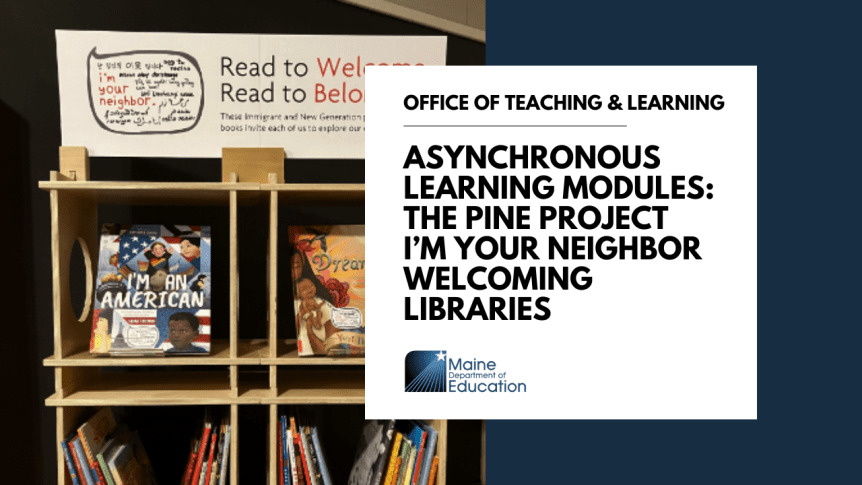
The Pine Project. This first-in-the-nation Maine DOE initiative aims to foster inclusive school environments by helping readers to explore themes of immigration, diversity, and belonging.
In September, every school administrative unit (SAU) in Maine received a Welcoming Library: Pine Collection, made up of 30 picture books that reflect the diverse experiences of immigrant families and their children. Embedded in these books are social-emotional learning (SEL) discussion questions that educators can refer to when facilitating impactful classroom conversations. Alongside the library, The Pine Project also offers a professional learning series, which features self-guided training for educators on how to use these books to teach critical skills like self-awareness, self-management, social awareness, relationship building, and responsible decision-making.
The Pine Project professional learning modules follow the Collaborative for Academic, Social, and Emotional Learning (CASEL) framework. Educators are encouraged to engage with the modules sequentially, taking time for reflection, deeper thinking, and personal engagement before advancing to the next module. The training focuses on key themes like identity, agency, belonging, collaborative problem-solving, and curiosity, featuring insights from leading Maine educators, as well as immigrant and first-generation authors.
You can access The Pine Project’s free professional learning modules here.
Melanie Junkins, Multilingual and Bilingual Education Specialist with the Maine DOE, and Kirsten Cappy of I’m Your Neighbor Books are leading The Pine Project. Content creators include lead educator Michelle Amato, consulting educator Melissa Guerrette, and project assistants Ange Ishimwe and Dhananji Rathnayake. Other team members are Michelle Amato, Aris Ayala Cruz, Dezh Azaad, Abusana Micky Bondo, Xavier Botana, Kirsten Cappy, Leonarda Carranza, Louise El Yaafouri, Melissa Guerrette, Ange Ishimwe, Terry Catasús Jennings, Francie Latour, Anne Sibley O’Brien, Muon Thi Van, Andrea Wang, and M.O. Yuksel.
The Pine Project represents a significant advancement in promoting equity and understanding in Maine schools. Educators are encouraged to fully utilize these resources, revisiting unfamiliar topics as needed and exploring the concepts further using the available online tools.
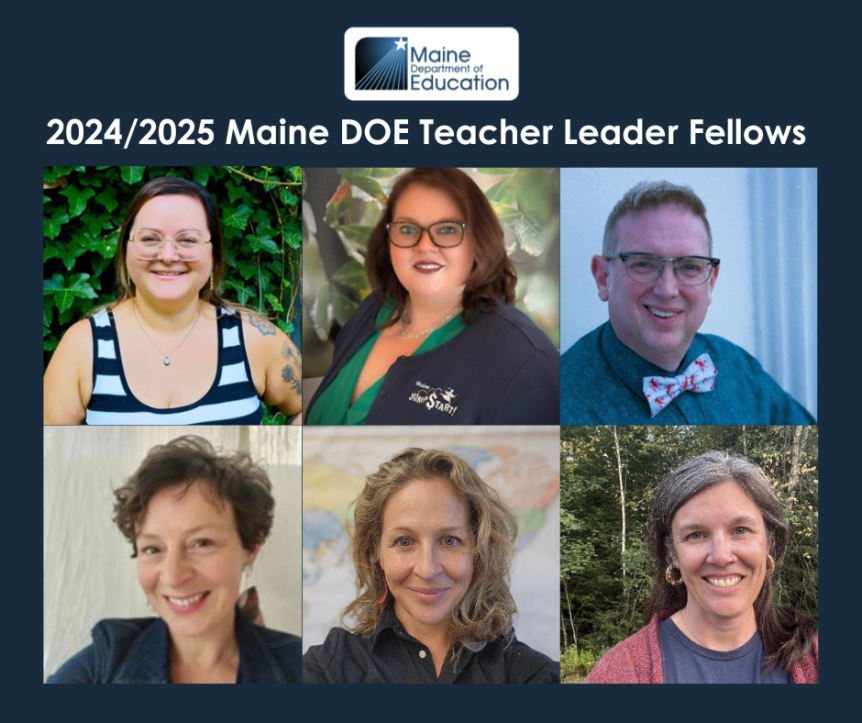
The Maine Department of Education (DOE) has welcomed its 2024/25 Teacher Leader Fellows. The new class of six extraordinary educators are from across the state and bring expertise in civics, personal finance, integrated arts, and multilingual learning, specifically with newcomers, as well as multilingual learners with disabilities.
Please help us welcome Breanna Bellefontaine-Krupski from Scarborough High School, Joshua Chard the 2024 Maine Teacher of the Year, Samantha Drost from Caribou High School, Rebecca Carey from RSU 3, Jenny Lunt from South Portland Middle School, and Melissa Frans from Portland Public Schools!
The civics, art, and/or personal finance Teacher Leader Fellows will provide educators across Maine with integrated resources and materials, host professional learning opportunities, and maintain webpages with rich and informative content. To receive weekly communications and monthly professional learning around civics, art, and/or personal finance, click here (Select a subscription to – “Integrate THIS – 2024/25 Teacher Leader Fellows Newsletter”)
Also, be on the lookout for curated resources and materials, integrated professional learning opportunities, and facilitated responsive communities of practice, all designed for educators working with elementary and secondary newcomers and multilingual learners with disabilities, PreK-12. Visit the Maine DOE Multilingual Learner website to learn more!
For more information about this or other innovative teaching and learning programs at the Maine Department of Education, contact, Beth Lambert, Chief Teaching and Learning Officer, at beth.lambert@maine.gov.
Meet the 2024/25 Teacher Leader Fellows
Breanna Bellefontaine-Krupski
Breanna Bellefontaine-Krupski
Maine DOE Civics Teacher Leader Fellow
Scarborough High School Civics teacher
“I am ecstatic to be in this new position at the Office of Teaching and Learning to share some of my favorite civic resources with fellow Maine government teachers, professional development opportunities, and potential community connections. Let’s support Maine teachers in ways to engage and integrate robust civic educational resources and opportunities into their classrooms,” said Breanna Bellefontaine-Krupski, Civics Teacher Leader Fellow.
Breanna Bellefontaine-Krupski, or Mrs.B-K as students call her, is the 24/25 Civics Teacher Leader at the Maine Department of Education’s Office of Teaching and Learning. Civic education is her passion, and she has had the privilege of doing it for the last 14 years! Breanna is a lifelong Mainer and lives in Southern Maine with her lovely family. She teaches at Scarborough High School and has worked at two rural schools in Maine. In recent years, she has served as part of a Maine Teacher Leader Cohort in 2019, earned National Board Certification in Social Studies, and worked with several civic organizations to expand her ability to deliver a positive educational experience to her students. Breanna is also a 2022-24 Constitutional Fellow with the National Constitution Center, a member of their Teacher Advisory Board, and an ambassador for Retro Report Education. Breanna is thrilled to be in this new position at the Office of Teaching and Learning to share her favorite civic resources with fellow Maine government teachers, professional development opportunities, and potential community connections. Let’s support Maine teachers in ways to engage and integrate robust civic educational resources and opportunities into their classrooms!
Questions or thoughts on Maine Civic’s resources? Email Breanna and get the conversation started! breanna.krupski@maine.gov
Joshua Chard
Joshua Chard Maine DOE Arts Integration Teacher Leader Fellow Teacher at East End Community School, Drama Director at Deering High School in Portland, 2024 Maine Teacher of the Year
“My approach to designing and implementing curriculum for young learners always starts through a culturally responsive lens. I believe in the power of joyful relationships, which are at the heart of everything I do in my classroom. Arts Integration encourages students to become more engaged and creative, making connections that stick with them,” said Joshua Chard, Maine DOE Arts Integration Teacher Leader Fellow.
Joshua Chard, the 2024 Maine Teacher of the Year, is a second—and third-grade looping teacher at East End Community School and the winter and spring drama director at Deering High School in Portland. He is excited to serve as the Teacher Leadership Fellow for Arts Integration through the Maine Department of Education. Chard is deeply inspired by the honor of lifting and celebrating his diverse learners.
Chard holds a Bachelor of Science degree in Elementary Education with a concentration in theater from the University of Southern Maine, a Master of Science degree in Education with a K-6 Literacy focus from the University of New England, and a certificate in K-6 Standards-Based Mathematics from the American College of Education. He is also certified as a K-12 teacher of English to speakers of other languages.
Chard is proud to teach at two of the most culturally diverse schools north of Boston. During his 33-year career, he has been an educational technician, has taught fourth and fifth grade, and has been a mathematics instructional coach. He has passionately dedicated his entire career to working in high-needs urban schools and is excited to have a platform to share the fantastic work there. Chard is genuinely enthusiastic about the possibilities of arts integration in our classrooms. Blending music, drama, dance and movement, and visual arts with core subjects brings learning to life in vibrant ways. According to Chard, “Arts Integration encourages students to become more engaged and creative, making connections that stick with them.”
Outside of school, Chard is an actor and director who participates in local theater. He also loves exploring Maine’s beaches and lighthouses with his husband and their grandsons.
Questions or thoughts on Maine Arts Integration resources? Email Joshua! Let’s get the conversation started! joshua.chard@maine.gov
Samantha Drost
Samantha Drost
Maine DOE Personal Finance Teacher Leader Fellow Caribou High School Consumer Economics Teacher
“ Join me this year in exploring free resources, free professional development, and fun lessons for all ages as we embark on this money adventure together! Let’s inspire the next generation of savvy savers,” says Samantha Drost, Personal Finance Teacher Leader Fellow.
Samantha Drost, is the new Personal Finance Teacher Leader Fellow for the Maine Department of Education’s Office of Teaching and Learning. She is excited to bring you a dynamic approach to financial education. As the 2019-20 Maine Jump$tart Teacher of the Year, she is passionate about making personal finance both engaging and accessible. Samantha loves creating a lively space in her classroom at Caribou High School, where students don’t just learn—they play through gamification! With the help of her favorite resource, Next Gen Personal Finance (NGPF), she has transformed traditional lessons into real-life experiences. Whether it’s budgeting, investing, or understanding credit, students get hands-on practice in a safe and fun environment, learning to make smart financial choices every day.
Samantha’s personal finance teaching journey began in 2018 at a Next Gen Personal Finance FinCamp and Jump$tart National Educator Training, where she found her “family” of personal finance teachers. She hopes to inspire you like those events inspired her by bringing hands-on, real-world practice to your classroom. al Finance resources? Email Samantha! Let’s get the conversation started! samantha.drost@maine.gov
Rebecca Carey
Rebecca Carey
Maine DOE Multilingual Learner (ML) Teacher Leader Fellow: Elementary Newcomer
ESOL Teacher/Coordinator, RSU 3
“I am enthusiastic about this opportunity to support educators throughout our state as a Maine DOE Teacher Leader Fellow in the ESOL and Multilingual Learning Office. I am honored to work with the other talented and deeply knowledgeable Teacher Leader Fellows as we collaborate to offer timely, meaningful, and supportive professional learning and resources. My passion lies in honoring student assets and meaningfully supporting the rights of students and their families. I truly look forward to this work together,” said Rebecca Cary, Multilingual Learner Teacher Leader Fellow.
Rebecca Carey has 25 years of experience working with multilingual learners in Maine. She has worked as a PreK-12 ESOL Teacher, ESOL Coordinator, Freelance ESOL Consultant, and as a Maine DOE ESOL Consultant. Currently, Rebecca serves as the Maine Virtual Teams Facilitator for the ExcEL Leadership Academy and as the ESOL Lead Teacher and ESOL Coordinator in RSU 3. She is excited to work collaboratively to support students and families and to build systems and structures that support family engagement, cultural attunement, equity, and student success. Rebecca is honored to be serving Maine educators and our multilingual students, as well as collaborating with amazing colleagues through the Teacher Leader Fellows role.
Questions or thoughts about supporting newcomers at the elementary level? Email Rebecca! Let’s get the conversation started! Rebecca.carey@maine.gov
Jenny Lunt
Jenny Lunt
Maine DOE Multilingual Learner (ML) Teacher Leader Fellow: Secondary Newcomer
ESOL Teacher, South Portland Middle School
“I’m so excited to be part of this new type of support for working with multilingual students and families. It is an honor to help respond to the shifts popping up in schools around the state. As an educator, my passion is finding new ways to be culturally and linguistically responsive and asset-focused. As a student advocate, I’ve been lucky to be part of the journeys of many students – from newly arrived students to multilingual students who are now serving on school boards in their communities. In this new TLF role, I’m excited to share my own learning that has come from years of facing challenges and collecting wisdom from colleagues, students, and families. I’m also thrilled to be able to do this work to serve folks in Maine – a place I adore and feel grateful to be,” said Jenny Lunt, Multilingual Learner Teacher Leader Fellow.
Jenny has been an ESOL teacher in the Portland area for more than 15 years and has taught 5th through 12th grades. She is currently working as a 7th and 8th grade ESOL teacher at South Portland Middle School. Jenny earned a Bachelor of Arts from Barnard College in Political Science and a Master’s Degree in Teaching from University of Southern Maine as a recipient of the Maine Education Association’s Scholarship Program for Teacher Preparation Programs. She is passionate about supporting an asset-based approach for all MLs and engagement with families.
Questions or thoughts about supporting newcomers at the secondary level? Email Jenny! Let’s get the conversation started! Jennifer.Lunt@maine.gov
Melissa Frans
Melissa Frans
Maine DOE Multilingual Learner (ML) Teacher Leader Fellow: Multilingual Learners with Disabilities
Special Education Multilingual Coordinator, Portland Public Schools
“I am excited to support educational professionals across Maine who are working with multilingual learners with disabilities. Navigating the intersection of multilingualism, multiculturalism, and disability can be complex and benefits from a team of people learning and working together. I look forward to collaborating and expanding our professional capacity through understanding the legal rights of our students and how to holistically support their instructional needs with a focus on a strengths-based approach,” said Melissa Frans, Multilingual Learner Teacher Leader Fellow.
Melissa Frans works in the Portland Public Schools as the Special Education Multilingual Coordinator. Her role focuses on implementing systems and structures to support dual-identified multilingual students with disabilities through guidance and collaboration with educators and families. She has her Certificate of Advanced Study in TESOL, Masters in Special Education and is certified to teach in those subject areas as well as general elementary education. She has worked in public education for two decades as an ESOL teacher and special education ed tech and has worked in Portland for eighteen of those years. She serves on the MEA Committee of Human and Civil Rights and Social Justice and is passionate about disability justice and equitable learning opportunities for multilingual and multicultural students. In her free time, she enjoys traveling and spending time outdoors with her family, working in her garden, and walking in the woods with her dog.
Questions or thoughts about supporting multilingual learners with disabilities? Email Melissa! Let’s get the conversation started! Melissa.Frans@maine.gov
The Maine Department of Education (DOE) is pleased to provide support to School Administrative Units (SAUs) in their continued implementation of Maine’s English Language Development Standards.We invite all districts to participate in the following trainings:
A free, self-paced, six-module course called The WIDA ELD Standards Framework: A Collaborative Approach is available to all Maine public school educators through the WIDA Secure Portal. If you do not have a WIDA Secure Portal account, contact WIDA Client Services to have one set up for you. (Note that you must have a Maine public school email address.)All twelve WIDA self-paced courses provide leaders and educators the opportunity to responsively designed and implement professional learning through active facilitation and collaboration cycles for language growth and development. This can happen during department/grade level meetings, allocated professional learning time, or extended learning structures such as Communities of Practice (CoPs) and Professional Learning Communities (PLCs).
The Maine DOE is also hosting a virtual workshop facilitated by WIDA: Planning with the WIDA ELD Standards Framework. The workshop will occur on October 2nd and October 9th from 3:30 – 5:00 pm. Participants must attend both sessions. This is an opportunity to leverage collaborative teams through participation. The workshops are free and limited to 40 participants. Registration closes September 25th. Register here.
Visit the Maine DOE website to access additional professional learning opportunities related to the WIDA ELD Standards and other topics specific to ESOL and bilingual/multilingual programs.
If you have any questions about the WIDA ELD Standards or the requirements for implementation, please get in touch with Jane Armstrong, Maine DOE English for Speakers of Other Languages (ESOL) State Specialist at Jane.Armstrong@maine.gov or Melanie Junkins, Maine DOE Bilingual and Multilingual Education Specialist at Melanie.Junkins@maine.gov
In alignment with supporting a culture of innovation and continuous improvement, new tools have been created for school nurses. This newest project directly reflects the advocacy and care our Maine school nurses possess, further strengthening our public health infrastructure.
A sample welcome letter from the health office for any new family in a school community was created, which contains an annual health form and medication authorization form, as well as interview forms for asthma, diabetes, and seizures. These tools have been translated into Maine’s top nine languages and are now available on the Maine Department of Education (DOE) Coordinated School Health webpage entitled Sample Forms.
School nurses are part of welcoming new families into our schools and communities; therefore, this spring, the Maine DOE school nurse regional liaison Lori Huot, BSN, RN, Nationally Certified School Nurse (NCSN) extended a warm invitation to the nurses she serves in Cumberland and York County to attend the monthly office hours hosted by the Maine DOE English to Speakers of Other Languages (ESOL) Specialist Jane Armstrong. This multidisciplinary collaboration uncovered the need for more health-centered, culturally responsive, readily available, and translated tools to provide equity through language access, resulting in these updated resources.
The Maine DOE extends a special thank you to the Maine school nurses who participated in this collaboration.
Maine DOE’s Office of Innovation and the Office of School and Student Support collaborate to host monthly ESOL (English to Speakers of Other Languages) office hours. These sessions are open to all school personnel and aim to provide optimal support for ESOL educators and guidance on assisting multilingual learners and their families.
Maine continues to embrace and enroll multilingual students and families statewide, witnessing a 15% increase in student count from 2023 to 2024. Jane Armstrong, State ESOL Specialist, highlights that roughly 63% of Maine’s 206 school administrative units have enrolled multilingual learners.
The Office of School and Student Supports has many resources for school staff to improve school services. Guidelines and Resources for School Health Services center on providing culturally responsive, evidence-based care that improves overall health.
This summer, the Maine Department of Education’s (DOE) Adult Education Team hosted its third annual Supporting Adult Multilingual Learners Institute at Sugarloaf Mountain. Adult Education teachers, curriculum designers, and administrators had the opportunity to learn from speakers, engage with different breakout sessions, and have meaningful discussions with their peers. Additionally, many fun activities, such as trail walks and yoga, were offered for participants to enjoy the nature of the Carrabassett Valley region.
Maine has become home to many refugees and asylum seekers. Over half of Maine’s Adult Education learners are multilingual and come from 115 different countries– five of the most enrolled are Somalia, Angola, D.R. Congo, Afghanistan, and Syria. The Supporting Adult Multilingual Learners Institute aims to prepare educators to best support those of other cultures and help them overcome teaching obstacles.
There were two group-wide workshops at the conference. In these workshops, talented speakers presented on themes regarding adult education, particularly as it relates to culture, and allowed for group-wide discussion. One workshop, Deepening Our Cultural Competence and Cultural Humility, was led by Suheir Alaskari (Associate Director of Student Employment Services at Colby College), and the other, Opportunities and Challenges of Cross-Cultural Communication with Adults, was led by Abbie Yamamoto (Director of Portland Adult Education).
The workshops aimed to educate professionals on issues that can present barriers for multilingual and multicultural learners. One important theme was the consciousness of social cues and language uses. Idioms and pop culture references are examples of high-context culture, as they feel natural to U.S.-born citizens, but can be highly confusing to outsiders. Not only is high-context culture confusing, but it also creates a barrier of exclusion. Conversely, low-context culture creates an inclusive space where people of varying backgrounds can learn from each other and bond. Another imperative theme was how taking the time to learn and understand the culture of adult students creates a more-relevant learning environment for them and validates their cultural identities.
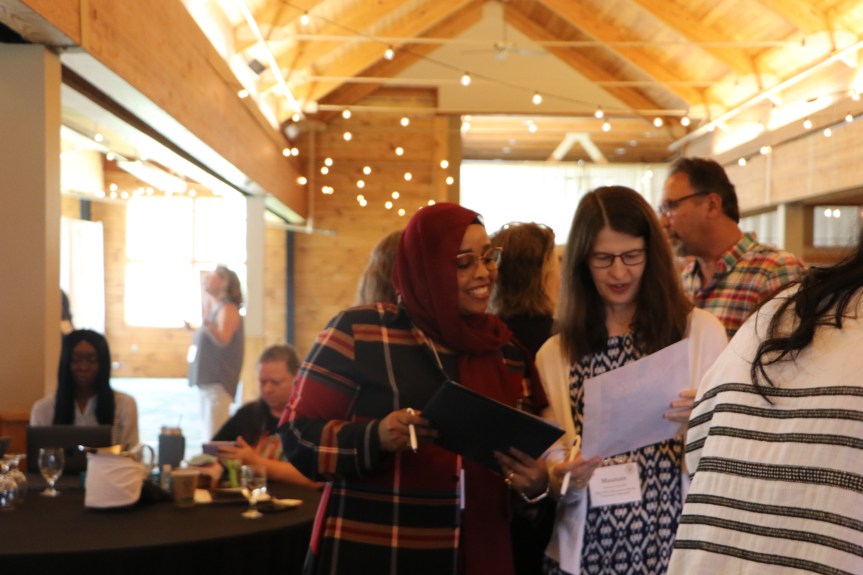
Educators had a chance to connect and share stories from the field.
Educators should also reflect on their own American culture and use it to find common ground with their students’ cultures to help connect further with them. Mike Emery (Director of Lake Region and Fryeburg Area Adult Education) remarks: “One of the things that has been really great in the past couple of years is we’ve shifted the focus from just being on instruction to a broader purpose. For someone who’s a director or doing other aspects of programming, it’s been really helpful to think about how to start new workforce partnerships in programs like that. There are some things around credentialing that are very different working with a foreign-born professional as someone born and raised in the US.” Focusing on consciousness and supporting students will not only enhance adult students’ learning but will also help them feel more accepted in America.
Some participants also led breakout sessions. There were four breakout sessions total and educators had six options to choose from per session. Some breakout topics included: Using EnGen for IET, Stuff I Wish My Teacher Knew, Using Data to Inform Multilingual Programming, The Immigrant Identity in the Classroom and Beyond, and Fostering Diversity in the Workforce: Building Partnerships and Pathways for Multilingual Learners, Paradigms of Belonging. Breakout sessions allowed for participants to focus on themes of interest and engage in more intimate discussions.
Educators appreciated having new frameworks to work within and gaining new skills in cultural competency. Many Adult Educators remark that their favorite part of their job is getting to see their students succeed: “It’s a bonus when you have students coming to you every day saying ‘Teacher, thank you so much. I learned so much today; this is incredible.’ They’re so appreciative, it’s amazing.” Remarks Melanie North (Teacher at Lewiston Adult Education and part of the Supporting Adult Multilingual Learners Institute planning committee). As influxes of migrants continue to increase, it is imperative that educators are equipped to best teach and support them.
Joy and enthusiasm were in the air at Sugarloaf, and educators hope to keep the annual institute running and improving for many more years to come. “I really have seen that this institute over the past three years has grown and continues to grow. You can feel it in the field. I’ve worked in multiple programs in Kennebec County and I feel that because of this institute and the push to have culturally relevant professional development we’re seeing culturally-relevant adult education programs.” stated Tekia Cox (Academic Program Coordinator at Mid-Maine Regional Adult Community Education).
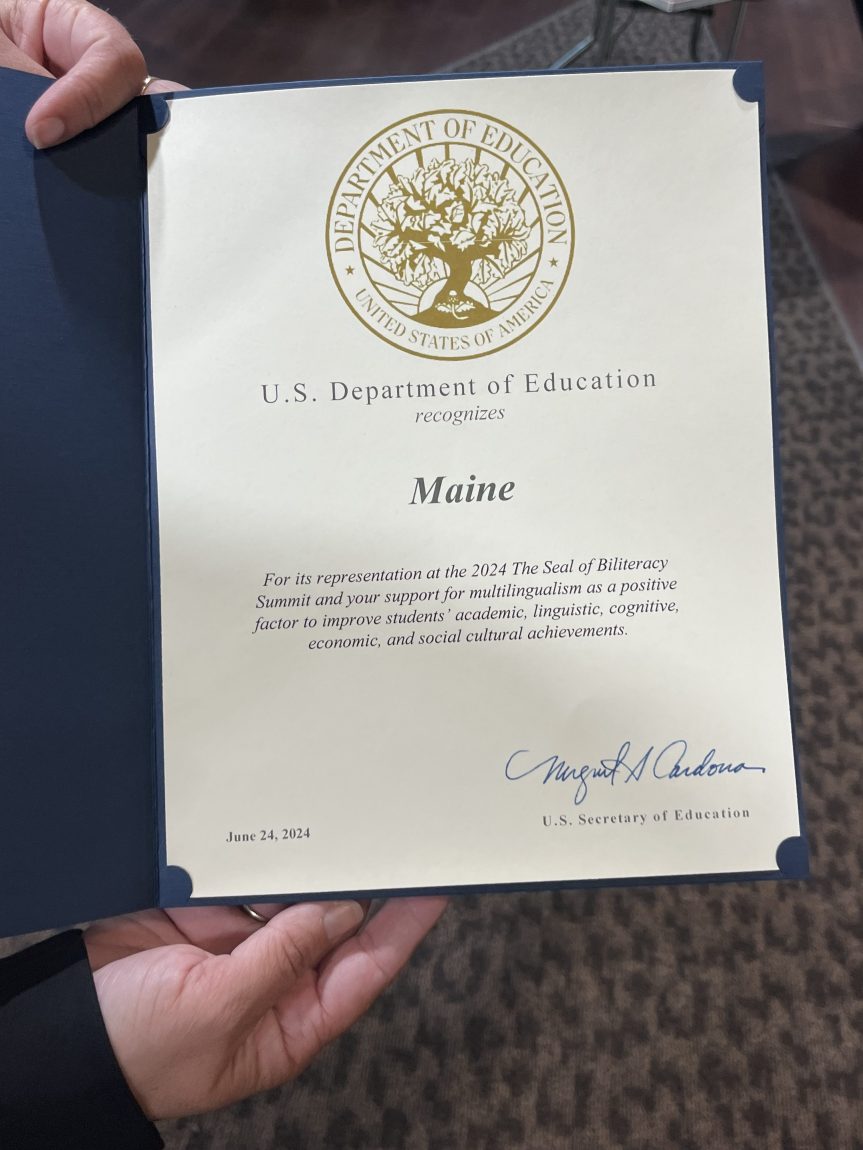
The first national Seal of Biliteracy Summit took place in Washington, DC, recently, and representatives from the Maine Department of Education (DOE) attended. The event brought together educators, policymakers, and language advocates to celebrate and promote multilingual education. It highlighted the achievements of students who earned the Seal of Biliteracy, an award recognizing proficiency in English and an additional language.
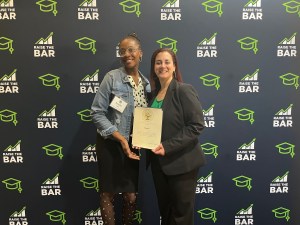
Left to Right: Ayesha Hall, Maine DOE Director of Strategic Partnerships, and Beth Lambert, Maine’s Chief Officer of Teaching and Learning.
Among the attendees were Beth Lambert, Maine’s Chief Officer of Teaching and Learning, and Ayesha Hall, Maine DOE Director of Strategic Partnerships. The Maine DOE plans to use this celebratory platform to continue promoting equitable access to global engagement opportunities for all Maine students. The Maine DOE’s Office of Innovation and Office of Teaching and Learning are working together to create a more inclusive experience for all students by presenting Maine’s multilingual learning and world languages programs as collaborative efforts at the state level.
The Seal of Biliteracy, endorsed by the Maine DOE and awarded to students in many Maine schools, acknowledges students who have demonstrated high proficiency levels in both English and another language through rigorous assessments. The Seal, which appears on students’ transcripts, enhances their post-secondary and career opportunities by showcasing their bilingual skills.
In Maine, the program includes various languages, such as Mandarin, Arabic, Chinese, French, Spanish, and Somali. The recent awarding process has been streamlined, allowing schools to confer the Seal of Biliteracy directly, making the recognition more accessible to students across the state.
The summit aimed to expand the Seal of Biliteracy’s reach and impact, encouraging more states and districts to adopt similar programs and highlighting the importance of multilingualism in an increasingly globalized world.
For more information about the Seal of Biliteracy in Maine, visit the Maine DOE website.
In alignment with supporting a culture of innovation and continuous improvement, new tools have been created for school nurses. This newest project directly reflects the advocacy and care our Maine school nurses possess, further strengthening our public health infrastructure.
A sample welcome letter from the health office for any new family in a school community was created, which contains an annual health form and medication authorization form, as well as interview forms for asthma, diabetes, and seizures. These tools have been translated into Maine’s top nine languages and are now available on the Maine Department of Education (DOE) Coordinated School Health webpage entitled Sample Forms.
School nurses are part of welcoming new families into our schools and communities; therefore, this spring, the Maine DOE school nurse regional liaison Lori Huot, BSN, RN, Nationally Certified School Nurse (NCSN) extended a warm invitation to the nurses she serves in Cumberland and York County to attend the monthly office hours hosted by the Maine DOE English to Speakers of Other Languages (ESOL) Specialist Jane Armstrong. This multidisciplinary collaboration uncovered the need for more health-centered, culturally responsive, readily available, and translated tools to provide equity through language access, resulting in these updated resources.
The Maine DOE extends a special thank you to the Maine school nurses who participated in this collaboration.
Maine DOE’s Office of Innovation and the Office of School and Student Support collaborate to host monthly ESOL (English to Speakers of Other Languages) office hours. These sessions are open to all school personnel and aim to provide optimal support for ESOL educators and guidance on assisting multilingual learners and their families.
Maine continues to embrace and enroll multilingual students and families statewide, witnessing a 15% increase in student count from 2023 to 2024. Jane Armstrong, State ESOL Specialist, highlights that roughly 63% of Maine’s 206 school administrative units have enrolled multilingual learners.
For the latest data, please visit the Multilingual Learner Data Dashboard. The final ESOL office hours for School Year 2023-24 will be held on June 17, 2024, from 3:30-4:30pm and registration can be found here.
The Office of School and Student Supports has many resources for school staff to improve school services. Guidelines and Resources for School Health Services center on providing culturally responsive, evidence-based care that improves overall health.
Visual Access to Mathematics (VAM) – Free professional learning course with a focus on English learners/multilingual learners for grades 6 and 7 mathematics teachers:
Grade 6 and 7 mathematics teachers in Maine are invited to register for a FREE professional learning course focused on visual representations to support mathematical problem solving and communication and led by Pam Buffington and Johannah Nikula from Education Development Center.
Teachers will learn evidence-based strategies that they can integrate with their current mathematics curriculum to benefit English learners/multilingual learners and all students.
The course starts with an in-person summer institute (August 13th-15th in Cheshire, CT with hotel/mileage/meal costs covered) and continues during the school year with flexible online sessions. If enough teachers from Maine sign up, then a second summer institute option location in Maine will be added for August 21st-23rd.
Benefits include an $850 stipend for teachers and the option to sign up for graduate credit for a fee.
Check out the VAM flyer for additional information about this opportunity. Share the flyer with mathematics teachers in grades 6 and 7 who may be interested. They can register here for an information session to learn more directly from course developers.
This opportunity is part of a project the Regional Educational Laboratory
Northeast & Islands (funded by the U.S. Department of Education) is conducted in partnership with the Connecticut State Department of Education. Teachers from Maine are being invited to participate in coordination with the Maine Department of Education.
If you have any questions, please contact vam@edc.org
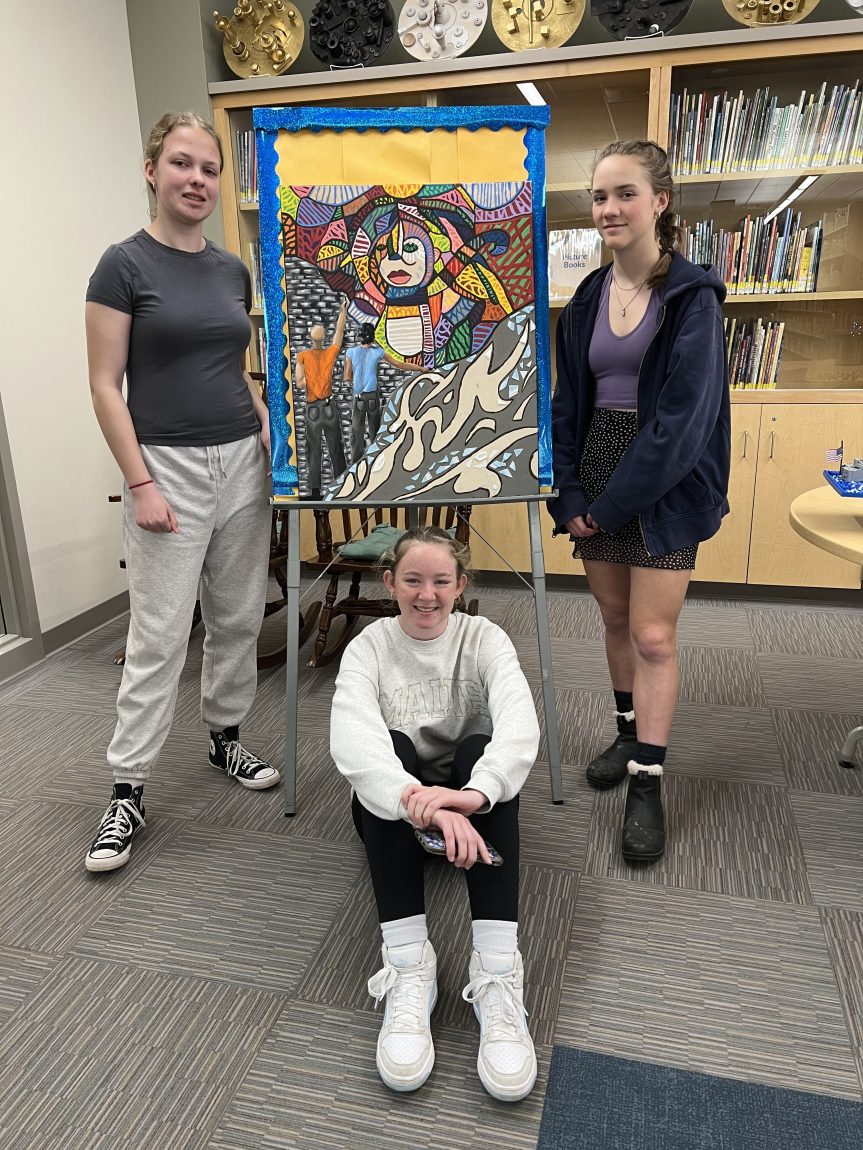
(Pictured: Morse High School freshman Rose Strelneck, Isla Polizotto, and Hannah Keller with their painting, a reimagined version of a FAMA mural done in Paris.)
Three students from Morse High School have won the 2024 French American Friendship Contest sponsored by The French Consulate in Boston.
This esteemed competition, open to high school students studying French and their teachers across New England, is a testament to the enduring bond between France and the United States.
Organized by the Cultural Service of the Consulate General of France in Boston and the Lounsbery Foundation, the contest blends education with enjoyment, inviting participants to explore the historical, cultural, artistic, and personal dimensions of Franco-American relations. This year’s theme commemorated significant milestones, including the 200th anniversary of Lafayette’s final journey to the United States and the 80th anniversary of the Normandy landings.
The highlight of the contest is undoubtedly the grand prize: a one-week trip to Paris and Normandy, generously funded by the Lounsbery Foundation. During the trip, the winners will immerse themselves in the rich tapestry of French history and culture. From cruising along the Seine River to admiring the iconic Eiffel Tower from the Trocadero esplanade, their itinerary promises a blend of iconic landmarks and poignant historical sites, including the Musée des Armées, Pointe du Hoc, and the Caen Memorial Museum.
The winning trio spearheaded the creation of the FAMA mural painting. Comprising three talented freshmen—Rose Strelneck, Isla Polizotto, and Hannah Keller.
Congratulations to Rose, Isla, and Hannah for their outstanding accomplishment!
This story was submitted by Morse High School French teacher, Rebecca Deschaine. To submit a good news story to the Maine Department of Education, please use our submission form.
As part of our work to elevate the expertise of the Maine education field, the Maine Department of Education (DOE) is looking to hire Maine English for Speakers of Other Languages (ESOL) educators in the following areas: elementary newcomer programming, including SLIFE, secondary newcomer programming, including SLIFE, and Multilingual Learners with disabilities.
These educators will be provided a stipend through this program to:
Enhance and revise content on the Maine DOE website related to their focus area;
Provide Maine educators technical assistance regarding classroom-specific best practices in their focus area;
Provide a monthly, 1-hour long professional learning opportunity for Maine educators. The professional learning will be based on requested needs from the field and will be offered virtually, synchronously, and archived for asynchronous access;
Form a community of practice that will be co-facilitated by the TLF and ESOL State Specialist to build and/or enhance systems and structures of collaboration among stakeholders specific to the emerging trends and needs in the field. The COP will meet monthly to build collective efficacy through common reads, expert guests, and actionable, differentiated planning.
The Fellows will be selected from Maine’s field of exceptional educators through a competitive process. Applicants must demonstrate that they have experience as classroom educators (all levels welcome to apply), have demonstrated innovative approaches in their classroom, have knowledge and experience in the focus area, and have been involved in learning communities throughout Maine.
Since the fellowship is in addition to their regular teaching job, fellows will work remotely and outside their contracted school hours.
Fellows will begin work as soon as suitable candidates are found. Work will begin in the 2024-25 school year (August – August) for 12 months. Fellows will be expected to work up to 20 hours/month for a stipend of up to $2,000/month.
Click here to apply. Applications close on June 21st, 2024.
For more information or questions, please contact Beth Lambert, Maine DOE Chief Teaching and Learning Officer, at beth.lambert@maine.gov.









 Maine DOE Newsroom