Growing Within: A Rural District’s Response to the Need for a Multilingual Learner Educator

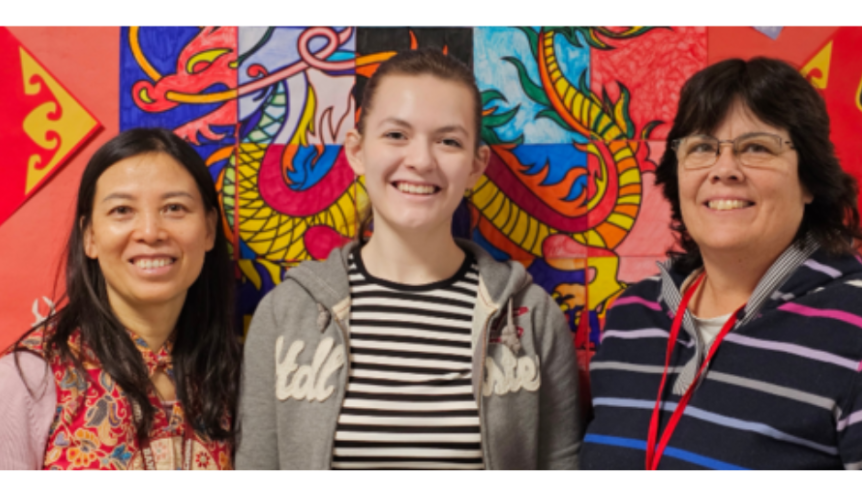
(Pictured: Educator Amy Trombley, with students Sustada Ma, El-Shammah Nsadha, and Ammala Ma)

At the beginning of the 23/24 school year, Limestone Community School was facing a need for an ESOL (English for Speakers of Other Languages) educator to meet the federal requirements of newly enrolled students. As the language use survey indicated a need for assessments, Principal Ben Lothrop recognized that while a 660-certified teacher wasn’t necessary on-site in the past, now it was. He first posted a position for a 660-certified educator with no success. In rural communities in Maine, finding a certified multilingual learner educator is often difficult, as it does fall in the US Department of Education’s teacher shortage.

“In rural areas across the state of Maine like Limestone and Aroostook County, we struggle to find qualified regular education teachers, much less anything more specialized like an ESOL teacher. In the past, I’ve had to ‘grow my own,’ and this is no different. It’s a great opportunity for the teacher, our students, and the local area as more and more people with various cultural and language backgrounds are moving into our area.”

The next step was for Lothrop to identify an educator who may want to pursue the emergency certification for 660. Title I teacher, Amy Trombley, jumped at the opportunity. “ESOL is a very rare certification, especially in this rural area of Maine, but it is still very much needed. I have a history of working with multilingual learners before my teaching career and loved the experiences that it brought with it. It is a very rewarding job! My main goal in teaching is to make sure the needs of every single student is met. With this certification, I can ensure needs are met for all demographics and make the education experience for multilingual students is that much more equitable.” Trombley applied for and received emergency 660 certification and then enrolled in the University of Southern Maine in the Teaching English to Students of Other Languages (TESOL) program with the District’s support. She has also taken advantage of free professional learning offered by the Maine Department of Education (DOE): WIDA webinar series, “Scaffolding Learning through Language.”

The Maine DOE has assisted with technical support throughout the WIDA Screener assessment and implementation of a newly formed ESOL support.  Administrative Letter #27:  Legal Requirements to Provide English Language Acquisition Services to Students who are Multilingual Learners (Revised 6.21.23)  Multilingual Learner guidance can be found here.

At the Maine DOE, we recognize an increased demand for 660 certification specialists in Maine. We are offering a collaborative webinar with Maine DOE ESOL Specialist Jane Armstrong, Certification Coordinator Erin Reinhard, Family Engagement Specialist Melanie Junkins, and the University of Southern Maine TESOL program instructors Dr. Andrea Stairs-Davenport, Dr. Alec Lapidus, and Dr. Melinda Butler. This one hour webinar is designed for administrators and educators in the state who want to learn more about obtaining a 660 certification, the differences in emergency, conditional, and full certification, and a pathway to earn this certification at the University of Southern Maine.

To find out more, register here for the webinar “ESOL 660 Certification Pathway,” on October 27, 2023, from 1-2 pm.

Questions regarding the webinar can be directed to Melanie Junkins (melanie.junkins@maine.gov), Maine DOE Family Engagement and Culturally Responsive Specialist.

Resources Available for WIDA ELD Standards

On May 25, 2021 the Maine Department of Education announced through a Priority Notice its adoption of the WIDA English Language Development Standards Framework, 2020 Edition as a critical companion to the Maine Learning Results. WIDA’s ELD Standards Framework, 2020 Edition, serves as a foundation for systems that foster engaged interactive student learning and collaborative educator practice. The Framework is centered on equity for all students and fosters the assets, contributions, and potential of culturally and linguistically diverse children and youth. It also provides a clear and coherent structure to guide the development of curriculum, instruction, and assessment of content-driven English language learning.

As you continue to implement the WIDA ELD Standards Framework, 2020 Edition in your educational setting, the Maine Department of Education would like to make you aware of several resources which may support your work.

New guidance for educators and administrators implementing the WIDA ELD Standards Framework

  • WIDA recently launched two new implementation guides to support educators and administrators as they implement the WIDA ELD Standards Framework.
    •  The WIDA ELD Standards Framework Implementation Guide is designed specifically for classroom teachers and instructional leaders, as well as other professionals who work with multilingual learners. It includes guidance about planning for language development in units and lessons, sample resources, and ideas for what implementation of the Framework could look like in practice.
    • This guide is accompanied by an Administrator Supplement focusing on programmatic aspects of systemic ELD standards implementation for school and district administrators.
  • All Maine educators may access WIDA’s excellent virtual, self-paced eWorkshops through their WIDA account.
    • Click here to read about how to get started with WIDA’s eWorkshop The WIDA ELD Standards Framework: A Collaborative Approach
    • This eWorkshop explores ways to use the WIDA ELD Standards Framework, 2020 Edition to support multilingual learners’ achievement and language development It contains many wonderful examples and videos demonstrating how the implementation looks in a classroom setting. For K-12 educators. Time to complete: 4 hours
    • Contact hours are available through WIDA upon completion of all eWorkshops
  • The Maine Department of Education has the following asynchronous professional learning opportunities for deepening your knowledge about the WIDA ELD Standards:

The State ESOL Specialist is available to support you directly through technical assistance calls and in-person professional learning opportunities. 

For further information please contact Jane Armstrong, State ESOL Specialist, jane.armstrong@maine.gov.

Portland Public Schools Hosts Annual Seal of Biliteracy Awards Ceremony

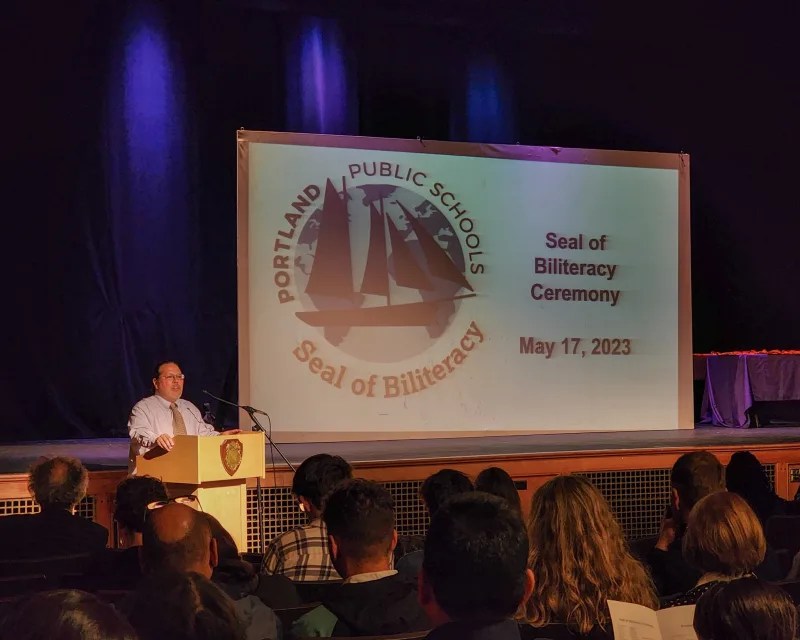
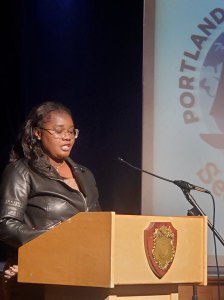
(Pictured: Carlos Gomez, Director of Language Development, Portland Public Schools)

“Many years ago my grandmother said, ‘Learning a new language is like having another little house in which you can take refuge and escape from the world to give yourself your own time. Learn today so that tomorrow you can enjoy yourself freely without any issues.’ I did not understand this wisdom at that time. I was a girl, I did not know what was coming soon. However, her wise words were never erased from my mind and heart, now more than ever I understand what she said because the process of learning a new language was difficult but after the storm, I am freely enjoying the rainbow.” These are the words of Portland High School student and Maine Seal of Biliteracy recipient, Estrella Alemán Delgado.

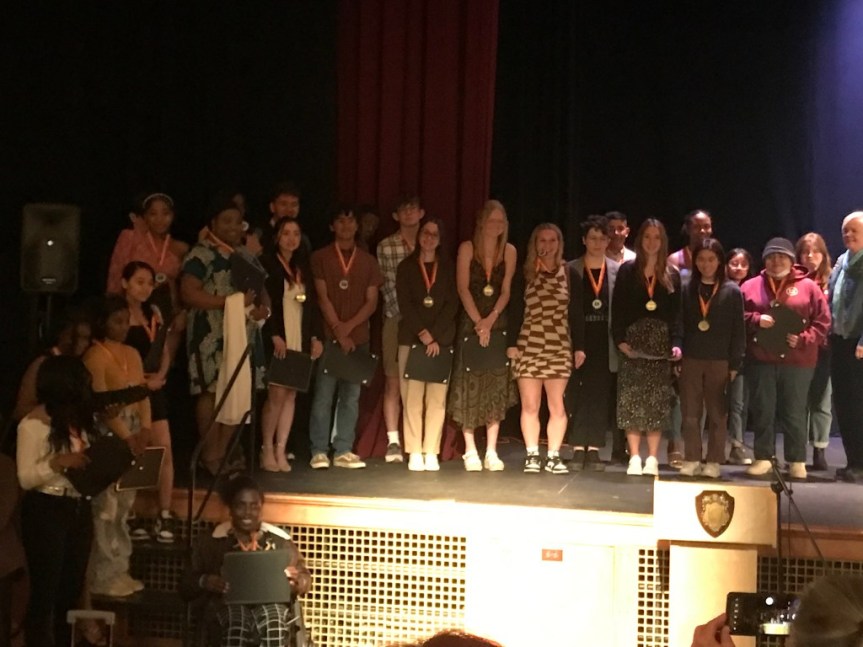
Portland Public Schools (PPS) hosted its annual Seal of Biliteracy Awards ceremony on May 17, 2023. There were 66 Seal recipients this year from Portland High School, Deering High School, and Casco Bay High School – 40 percent more than last year and the most since the award began in 2018.

The Seal of Biliteracy is an award that recognizes graduating students for having a high degree of skill in English and one or more additional languages. Nearly all states in the United States now offer this award, celebrating multilingualism and giving students an edge for their post-secondary studies and/or future careers. The Seal of Biliteracy underscores for younger students, parents, and community members who speak a language other than English at home that it’s important to maintain heritage languages. The Seal of Biliteracy also honors the dedication of world language students who pursue higher-level language courses. Highlighting the value of multilingualism, this award becomes part of a student’s transcript and gives students an edge for their post-secondary studies and/or future careers. Students who earn the Seal of Biliteracy may be eligible to earn up to 8 college credits at certain Maine Universities and Colleges based on their demonstrated proficiency levels in their target language(s).

Mayinga Mukinayi, Seal of Biliteracy Recipient

Several students shared their language-learning experiences during the ceremony. Student speaker and Seal recipient, Mayinga Mukinayi spoke about the challenges and rewards she experienced as a multilingual learner. “My experience of learning English was very challenging because when I arrived in the United States, I didn’t know anything about English other than ‘Good Morning’ and counting a few numbers. It was hard, but I kept wanting to learn. I read English books and listened to English music without understanding. Sometimes I even slept with headphones on- putting words in English so that my mind could listen. Even if I was sleeping, my brain would be awake to listen. Now that I know English, although I’m still learning, I can communicate, and with my Portuguese and French I can help people who are in the same place as me when I arrived in the United States.  I help in the classrooms, as a teacher’s assistant. I even helped out in the summer as a TA in a multilingual classroom for middle school students. I still help even outside of school, translating in churches or even on the streets, when someone asks me for help.”

The following are the 16 languages in which this year’s recipients have achieved proficiency: Arabic, Bengali, Dari, French, German, Hindi, Latin, Lingala, Kinyarwanda, Pashto, Portuguese, Serbian, Somali, Spanish, Tajik and Urdu. The variety of languages represented in the ceremony gave a sense of the breadth of the language diversity at the Portland Public Schools, where one-third of students come from homes where languages other than English are spoken – a total of more than 50 languages.

Melea Nalli, PPS’s interim Co-superintendent and Assistant Superintendent of Teaching and Learning spoke extensively about the benefits of multilingualism. The ability to speak multiple languages is an undeniable asset in today’s increasingly global world. Learning another language transcends the confines of one’s own background and improves and expands one’s understanding of the world, diverse cultures, and perspectives. She noted that proficiency in two or more languages enhances students’ ability to succeed academically and in the workplace.  Language learning makes important contributions to students’ cognitive development, mental flexibility, memory, and concentration. Research shows that language learning correlates with higher academic achievement on standardized test measures. Additionally, demand for employees who are proficient in more than one language is growing in the United States and throughout the world. Multiple language proficiency opens the door to a wide variety of career opportunities.

Seal of Biliteracy Recipients from Portland Public High Schools

If you are interested in developing a Seal of Biliteracy Program in your school, please reach out to Rebecca Carey, ESOL Consultant at rebecca.carey@maine.gov or visit Maine Seal of Biliteracy.


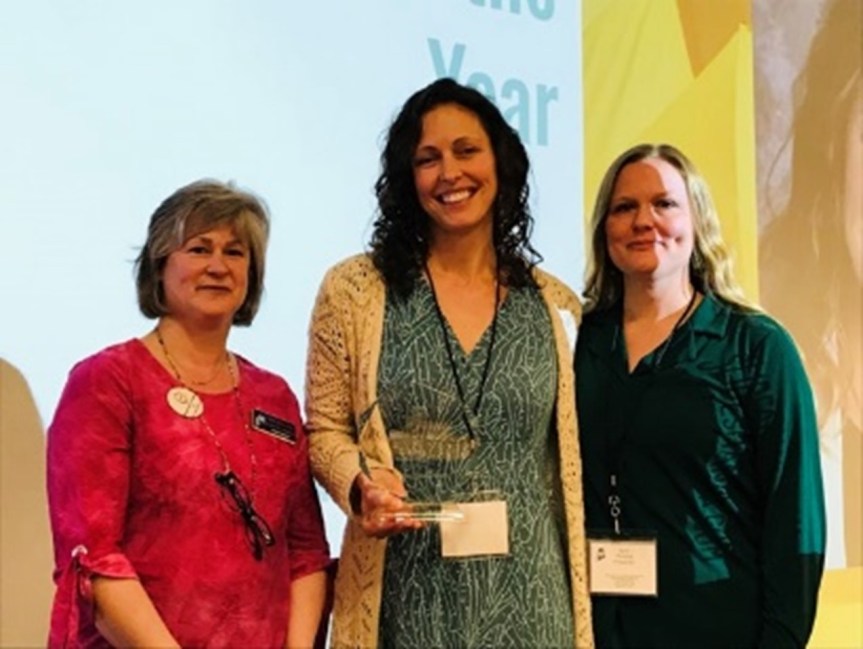
Laura Wittmann Named 2023 ESOL Teacher of the Year

Ms. Wittmann was nominated for this recognition based on her demonstration of best practices in teaching English, her participation in professional growth, and her service to students and the school district. In her role as the ELL District coordinator for Bangor Schools, she advocates for students and their families, by connecting them to social and cultural activities in the community as well as connecting them to social workers and local volunteer groups who facilitate social and medical services.

Ms. Wittmann is also a teacher at William S. Cohen School and Mary Snow School. In the classroom, she works to relate her students’ background knowledge to the curriculum content, in order to ensure that the students can access the material at the same level as their peers, regardless of their level of English proficiency. She feels that “as a Maine ESOL teacher, (she) love(s) to help students find their voices and tell their stories (in English), and create bridges between their respective home languages and cultures, and their new identities as Mainers.”

Educators for a Multilingual Maine (EMME) is a non-profit organization whose purpose is to promote and improve the teaching and study of languages and cultures of the world. EMME also strives to further the common interests of teachers, students and others in the state of Maine, for whom languages play an important role. EMME was formerly known as FLAME, the Foreign Language Association of Maine. Learn more about EMME at http://www.emmaine.org.

Maine Department of Education Defines Students with Limited or Interrupted Formal Education (SLIFE)

The Office of English Speakers of Other Languages (ESOL) Programs and Bilingual Programs has released a state definition of a Student with Limited or Interrupted Formal Education (SLIFE). This is a student who meets the following criteria:

  1. Is a multilingual learner;
  2. Has an English language proficiency level (as measured by WIDA assessments) of level 2.0 or below for students in grades 2-3 or level 2.5 or below for students in grades 4-12;
  3. Is at least eight years old; and
  4. Has experienced at least one of the following:
    1. No formal schooling
    2. Interruptions in formal schooling (defined as two or more re-enrollments or two years or more less schooling than typical peers)
    3. Consistent but limited formal schooling outside the United States; and/or
    4. Functions at two or more years below expected grade level in native language literacy and/or math skills relative to typical peers

For the past two and a half years, members of the Maine Department of Education (DOE), the Multilingual Learner Advisory Committee (MLAC), Support Ed, and Agora Learning, have been developing this definition to be specific and easily applied and understood.

Support Ed provided four webinars on SLIFE characteristics and general needs, resources and strategies for serving SLIFE, graduation and post-secondary education guidance and opportunities, and a wealth of resources for educators to refer to. Recordings of webinars are archived here: https://www.maine.gov/doe/learning/multilinguallearner/p

A padlet of SLIFE resources can be found here: https://padlet.com/diane30/maine-department-of-education-supporting-students-with-limit-a2eouyixynryahtm?utm_source=Padlet.

Agora Learning and Support Ed are continuing their work to develop a SLIFE screener to be used by our Maine school districts. Maine DOE will be developing a SLIFE guidance manual and additional professional learning opportunities that will support districts to identify SLIFE and develop SLIFE programming.

If you have questions regarding the Maine DOE SLIFE definition, please contact:

Rebecca Carey: rebecca.carey@maine.gov

Robin Fleck: robin.fleck@maine.gov

Report on Bilingual Education in Maine Now Available

Bilingual education, including language immersion programs, offer exciting and impactful interdisciplinary learning opportunities for students. Research shows that developing proficiency in two or more languages has cognitive, educational, economic, and sociocultural benefits.

In response to interest in developing bilingual programs from a variety of schools across the state, the Maine Department of Education launched the Multilingual Education Task Force (METF) in May of 2022. Over 100 educators and community members came together to learn about bilingual education and to provide the Department with recommendations to inform its plan for promoting bilingual programs and supporting interested schools. The Department would like to express its sincere appreciation to METF participants for their contributions to this important work.

The Multilingual Education Task Force Report compiles participants’ recommendations and offers a road map of action steps for the Department. Educators and community members who would like to pursue the development of a bilingual program in their school are encouraged to contact April Perkins, English for Speakers of Other Languages (ESOL) & Bilingual Programs Specialist, at april.perkins@maine.gov.

New Seal of Biliteracy Awarding Process 

The Maine Seal of Biliteracy is an award that recognizes student achievement in language learning. This award highlights the value of multilingualism and gives students an edge for their post-secondary studies and/or future careers. Starting this school year, schools will be able to award the Seal of Biliteracy to students directly, without submitting an application to the Maine Department of Education.  

Each participating school will designate a local Seal of Biliteracy Coordinator, who will have several key responsibilities. Full details about the process and requirements are included in the new Maine Seal of Biliteracy Coordinator Guide. We are hopeful that these changes will increase accessibility to the Seal of Biliteracy and make the process easier and more streamlined for students and their teachers.  

If you are a student who would like to earn the Seal of Biliteracy, but your school is not yet participating in this award, or if you have any other questions about the Seal, contact April Perkins, ESOL & Bilingual Programs Specialist/ Maine Seal of Biliteracy Coordinator at april.perkins@maine.gov  

Professional Learning Opportunity: Teacher Leaders – Planning with the WIDA English Language Development Standards

English for Speakers of Other Languages (ESOL) teachers, coordinators/directors, Ed Techs, tutors, and instructional coaches are invited to join the Maine Department of Education and WIDA for a hybrid workshop on planning with the WIDA English Language Development (ELD) Standards!

This hybrid workshop is designed to support ESOL educators in providing local professional development and support for using the WIDA ELD Standards Framework (2020 edition) to plan instruction at the unit level. This workshop is for you if you can answer “yes” to any of these questions:

  • Have you been asked to provide professional development about the WIDA ELD Standards Framework (2020 edition) to educators in your school or district?
  • Do you engage in co-planning with content/classroom educators on a regular basis?
  • Do you have experience evaluating and/or designing content lessons and units?
  • Do you have a strong background in the WIDA Standards system and in working with multilingual learners?

Participants who complete the workshop will receive an invitation to join a consortium-wide pilot community of practice with quarterly activities and collaborative online discussions.

There will be a live virtual session on 11/30/22 from 3-4pm, followed by an in-person workshop on 12/6/22 from 9am-3pm in Augusta. Register here.

If you have any questions about this professional learning opportunity, contact April Perkins, ESOL & Bilingual Programs Specialist, at april.perkins@maine.gov or (207)441-9043.

Students with Limited or Interrupted Formal Education (SLIFE) Virtual Professional Development Sessions

The Maine Department of Education and SupportEd are partnering up to provide K-12 Maine educators with four free virtual professional development sessions focusing on Students with Limited or Interrupted Formal Education (SLIFE).

  • Zoom – Conveniently join all virtual PD sessions online via Zoom.
  • Maine Educators – Virtual PD sessions are intended for all Maine teachers grades K-12.
  • 2-hour Sessions – Sessions will last two hours with time to apply strategies included.

SupportEd’s vision is to reimagine the landscape of education for Multilingual Learners (MLs). Specializing in Multilingual Learners (MLs), SupportEd meticulously crafts personalized solutions to fit every partners’ strengths and goals. SupportEd provides educators and administrators with the expertise and resources to help champion the success of MLs within and beyond the classroom. The SupportEd team is comprised of nationally recognized Multilingual Learner experts, best-selling authors, and accomplished researchers — all with extensive experience working in the classroom and/or district.

Download a flyer

Culturally Responsive Teaching and Social Emotional Learning for SLIFE


Thursday, September 22 | 3:00 pm

During this two-hour session, participants will develop an understanding of culturally responsive teaching and social emotional learning for SLIFE. SupportEd will lead participants in defining SLIFE and their characteristics and exploring strategies and tools for creating a culturally responsive school climate that includes social emotional learning practices for SLIFE. Time will also be provided to apply the tools and strategies to their class and school communities.

Effective Instruction of SLIFE  


Thursday, October 20 | 3:00 pm

During this two-hour session, participants will develop an understanding of effective instruction for SLIFE. SupportEd will lead participants in exploring a framework for effective instruction of SLIFE and discussing strategies for supporting SLIFE engagement with and understanding of content learning. Time will also be provided to set goals for supporting the academic needs of SLIFE in all classrooms and schools.

Supporting SLIFE Family and Community Engagement 


Thursday, November 17 | 3:00 pm

During this two-hour session, participants will develop an understanding of how to support SLIFE family and community engagement. SupportEd will lead participants in defining the importance of engaging SLIFE families and community in learning and exploring strategies for partnering with SLIFE families and expanding community collaboration in support of students. Time will also be provided to plan for partnering with SLIFE families and expanding community collaboration.

Supporting Graduation and Post-Secondary Success of SLIFE  


Thursday, December 15 | 3:00 pm

During this two-hour session, participants will develop an understanding of how to support the graduation and post-secondary success of SLIFE. SupportEd will lead participants in discussing barriers and solutions related to graduation and post-secondary success for SLIFE and explore strategies for supporting graduation and post-secondary success of SLIFE. Time will also be provided to apply strategies to plan for implementing strategies for supporting graduation and post-secondary success of SLIFE.

New Guidance on Multilingual Learners with Disabilities

A new guidance manual is now available on Identifying and Serving Multilingual Learners with Disabilities. The appropriate and accurate identification of students who are multilingual learners (MLs) with disabilities is a complex process requiring a team approach. Under- and overidentification of MLs for special education and related services is a persistent challenge nationwide.

The manual was developed through the collaboration of Maine Department of Education Special Services and English for Speakers of Other Languages (ESOL) staff members. We are hopeful that this guidance will provide educators with the information and resources they need to make the most appropriate determinations for students.

Please join us for an overview on September 19th at 3:00pm to learn how this guide can support your work with students who are MLs. Register here.

For a deeper dive into different sections of the manual, we are also offering the following series of trainings, and we encourage both ESOL and Special Education staff to attend.

For those who cannot attend, all sessions will be recorded and archived on the Maine DOE YouTube channel for viewing at your convenience. If you have any questions, contact April Perkins, ESOL & Bilingual Programs Specialist, at april.perkins@maine.gov.