MEDIA RELEASE: School Nutrition Programs to Feed Children Beyond School Year with Summer Food Service Program

AUGUSTA — With the assistance of the U.S. Department of Agriculture, Maine public schools have long offered a nutritious breakfast and lunch meal program to thousands of children in Maine during the school year. During the pandemic, many flexibilities were put into place to ensure children had access to complementary meals while learning remotely from home or attending school in person.

We applaud those who worked tirelessly to provide food to children during a challenging school year. With summer right around the corner, that important service will continue in many areas of Maine. The Summer Food Service Program, a program of the U.S. Department of Agriculture, operates at hundreds of sites across Maine to ensure children get the nutrition they need.

“Maine’s National School Lunch Programs are an invaluable lifeline to our students for whom schools are a much needed and consistent source for food.” said Maine Department of Education Commissioner Pender Makin. “The Summer Food Service Program helps schools continue to provide this critical resource to Maine students through the summer months, and we are committed to assisting schools and communities as they address the needs of the whole child.”

The Summer Food Service Program may be offered statewide in areas or at sites where more than 50 percent of the children are eligible for free or reduced meal benefits under the National School Lunch Program or where census track data supports the need. This summer, area eligibility waivers have allowed sites to operate in areas that have need due to the COVID-19 public health emergency. Eligible sponsoring organizations include schools, nonprofit residential summer camps, government agencies, and tax-exempt organizations including faith-based organizations.

In July 2020, 112 sponsors participated in the program, serving meals at 730 sites throughout the state. Sponsors operate open sites in all 16 counties in Maine; anyone 18 and under may come to eat at no cost. Many sponsors will be utilizing USDA flexibilities which allow meals to be consumed off site to promote physical distancing and are offering innovative delivery and service models to meet the demand safely.

To find nearby Summer Meal sites, please visit USDA’s Summer Meal Site Finder website at: https://www.fns.usda.gov/meals4kids, text “Summer Meals” to 97779 or call Maine 211.

Updated information will be available late-June.

For more information about the Maine DOE’s Summer Food Service Program, contact adriane.ackroyd@maine.gov, call 592-1722 or visit https://www.maine.gov/doe/schools/nutrition/programs/sfsp.

###

In accordance with Federal civil rights law and U.S. Department of Agriculture (USDA) civil rights regulations and policies, the USDA, its Agencies, offices, and employees, and institutions participating in or administering USDA programs are prohibited from discriminating based on race, color, national origin, sex, disability, age, or reprisal or retaliation for prior civil rights activity in any program or activity conducted or funded by USDA.

Persons with disabilities who require alternative means of communication for program information (e.g. Braille, large print, audiotape, American Sign Language, etc.), should contact the Agency (State or local) where they applied for benefits.  Individuals who are deaf, hard of hearing or have speech disabilities may contact USDA through the Federal Relay Service at (800) 877-8339.  Additionally, program information may be made available in languages other than English.

To file a program complaint of discrimination, complete the USDA Program Discrimination Complaint Form, (AD-3027) found online at: http://www.ascr.usda.gov/complaint_filing_cust.html, and at any USDA office, or write a letter addressed to USDA and provide in the letter all of the information requested in the form. To request a copy of the complaint form, call (866) 632-9992. Submit your completed form or letter to USDA by:

(1)     mail: U.S. Department of Agriculture
Office of the Assistant Secretary for Civil Rights
1400 Independence Avenue, SW
Washington, D.C. 20250-9410;
(2)      fax: (202) 690-7442; or
(3)      email: program.intake@usda.gov.

This institution is an equal opportunity provider.

The Maine Human Rights Act prohibits discrimination because of race, color, sex, sexual orientation, age, physical or mental disability, genetic information, religion, ancestry or national origin.

Complaints of discrimination must be filed at the office of the Maine Human Rights Commission, 51 State House Station, Augusta, Maine 04333-0051. If you wish to file a discrimination complaint electronically, visit the Human Rights Commission website at https://www.maine.gov/mhrc/file/instructions and complete an intake questionnaire. Maine is an equal opportunity provider and employer.
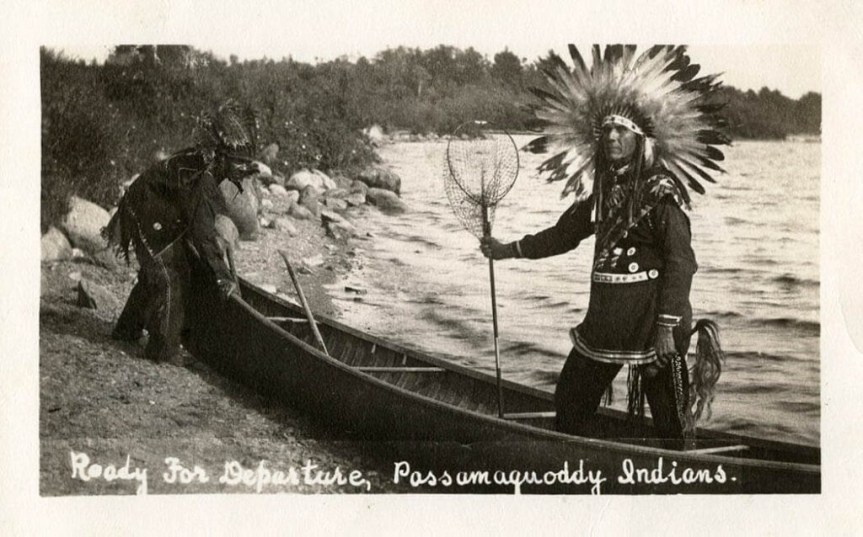
MEDIA RELEASE: National Funding to Support Enhanced Access, Utilization of Wabanaki Resources

Image: Courtesy of the Hudson Museum HM7182.133

Collaborators on the project include partners from Raymond H. Fogler Library, the College of Education and Human Development and Native American Programs at UMaine, members of the Wabanaki Confederacy and the Wabanaki Studies Working Group, the Maine Department of Education, the Abbe Museum in Bar Harbor, Amherst College and the University of Massachusetts Amherst.

The National Endowment for the Humanities has awarded a grant of more than $59,000 to the University of Maine’s McGillicuddy Humanities Center to support development of a centralized digital portal that will improve access to Wabanaki historical and cultural resources and archival collections currently distributed across UMaine and, in the future, to incorporate collections curated by several external institutions.

“Teaching about the people whose land we inhabit today is crucial work and I am excited to be able to represent the Maine Department of Education (DOE) in support of this grant,” said Maine DOE Coordinator of Secondary Education and Social Studies Specialist Joe Schmidt. “During my time at the Department I have strived to make sure that we remove barriers for educators when it comes to teaching about Maine Native Americans and from the start of her time at the Department, Commissioner Makin has made this one of her top priorities as well. By working to develop a centralized portal of historic artifacts, educators will be better equipped to develop and deliver inclusive and accurate curriculum related to Wabanaki history and culture. Through this grant, we will take another step in making sure that all of our students can see themselves as important contributors to the past and present of all that Maine has to offer.”

UMaine professor of English Margo Lukens, a faculty adviser to the McGillicuddy Humanities Center, will lead the interdisciplinary Wabanaki Resources Portal project, which seeks to enhance utilization of existing resources to promote the study of Wabanaki history and culture at the elementary, high school and post-secondary levels in Maine and to facilitate interdisciplinary academic and arts scholarship.

UMaine’s archival holdings related to Wabanaki history and culture are extensive, and include the collection of Fannie Hardy Eckstorm, an early twentieth-century independent scholar of Wabanaki history and culture; the Molly Spotted Elk Collection, which provides a Penobscot view of the United States and Europe; the Linda Gilbert Collection of Penobscot Indian Music featuring original audio recordings about traditional song and dance; and the Maine Indian Collection, one of the largest institutional collections of Wabanaki baskets and basketmaking materials and tools, which is curated by the Hudson Museum. The museum also maintains a collection of significant primary resources, particularly images portraying traditional Wabanaki activities such as basketmaking and harvesting.

Other Wabanaki artifacts stewarded by UMaine include photographs of Passamaquoddy and Penobscot people including prominent tribal members Andrew Sockalexis and Lucy Nicolar Poolaw, who was also known as Princess Watawahso, characteristic objects from the 1880s through today, and the Senator William S. Cohen Papers related to the Maine Indian Land Claims Settlement Act of 1980. Fogler Library also maintains copies of recordings of Wabanaki speech and story now in the Library of Congress collection.

Much of the Wabanaki history and cultural material now housed in University of Maine collections is the intellectual and physical property of the Wabanaki tribes. A 2018 memorandum of understanding between UMaine and the Penobscot Nation delineates a process of artifact co-curation that includes tribal members to ensure culturally responsive care and use of archival material held by a nontribal organization. Maine’s Native American communities will be included in decision and policymaking related to the collections, including controlling access to culturally sensitive materials. UMaine is working to develop a similar memorandum of understanding with the Passamaquoddy Tribe.

Currently, access to UMaine’s resources is limited by siloed storage across multiple, unconnected locations and formats. Developing a centralized portal where digital copies of historic artifacts can be archived as searchable files will enhance interest in Wabanaki history and cultures while serving a diverse stakeholder base with interests in American history, literature, linguistics, law, art and natural sciences, as well as the study of colonization and decolonization in American society.

The Wabanaki Resource Portal project will center the ideas and perspectives of Wabanaki people in providing access to significant historical materials meant to educate the public, facilitate scholarship, preserve Wabanaki traditions and art, and support development of inclusive and accurate K–12 curricula that enhance the teaching of Wabanaki history and culture in Maine schools.

Collaborators on the portal project include partners from Raymond H. Fogler Library, the College of Education and Human Development and Native American Programs at UMaine, members of the Wabanaki Confederacy and the Wabanaki Studies Working Group, the Maine Department of Education, the Abbe Museum in Bar Harbor, Amherst College and the University of Massachusetts Amherst.

Lukens has co-authored “‘Still They Remember Me’: Penobscot Transformer Tales, Volume 1” with Penobscot language master Carol Dana and University of Southern Maine linguistics faculty Conor Quinn. The book recounts traditional tales of Gluskabe, the tribe’s culture hero, as told by Penobscot Newell Lyon to anthropologist Frank Speck. Speck published the stories in 1918 in an academic report titled “Penobscot Transformer Tales.” The 2021 bilingual edition of Transformer Tales, which was designed for language learning, presents the stories in contemporary Penobscot orthography with updated English translations and features artwork created by tribal members. The book will be available from the University of Massachusetts Press in June 2021.

For more information about this project contact Joan Perkins, joan.perkins@maine.edu

Wabanaki Seminar June 12, 2021 9am-12:15pm

The Maine Department of Education is delighted to invite educators statewide to our June 12 recognition of the 20th Anniversary of the signing of LD 291 which requires the teaching of Wabanaki History and Culture in Maine classrooms.

Please join us and a variety of educational leaders from 9-12:30 on Saturday, June 12. We will begin the morning with greetings from Governor Mills, Commissioner Makin and a keynote by legislation sponsor, Hon. Donna Loring.

Register here

For more information about the Wabinaki Seminar contact Joe Schmidt at joe.schmidt@maine.gov

MEDIA RELEASE: Three Maine Schools Win a Brand New $100K DON’T QUIT!® Fitness Center

Today, Governor Janet Mills and fitness icon Jake (Body by Jake) Steinfeld, Chairman of the National Foundation for Governors’ Fitness Councils (NFGFC), announced three Maine schools have won a state-of-the-art $100,000 DON’T QUIT! Fitness Center. The multi-million dollar DON’T QUIT! Campaign has selected Deer Isle-Stonington Elementary School in Deer Isle, Gorham Middle School in Gorham and SeDoMoCha School in Dover-Foxcroft for new fitness centers in recognition of their commitment to the health of their students.

“The last year has proven just how important investing in the health of our students is to keeping our state strong,” said Governor Mills. “I congratulate these deserving schools on being selected to receive a state of the art fitness center and I thank them for their commitment to the health and well-being of Maine children. These centers would not be possible without the generosity of the National Foundation for Governors’ Fitness Councils and Mr. Steinfeld and I thank them for their investment in the children of Maine.”

“We had an overwhelming response from elementary and middle schools throughout the great state of Maine. None of this would have been possible without the incredible support of Governor Mills, who helped make this campaign a huge success by putting the health and well-being of children first,” said Mr. Steinfeld.  “Three schools really embodied our mission of building a nation of the fittest, healthiest kids in the world.  I’m thrilled to announce that Deer Isle-Stonington Elementary School, Gorham Middle School and SeDoMoCha School are all being awarded a brand new $100,000 DON’T QUIT! Fitness Center. Congratulations to all, we look forward to visiting these three schools during our ribbon cutting ceremonies this fall!”

Each fitness center is financed through public/private partnerships with companies like The Coca-Cola Company, Anthem Blue Cross and Blue Shield Foundation, Wheels Up and Nike, and does not rely on taxpayer dollars or state funding. Fitness in Motion provides all the fitness equipment, which is manufactured right here in the United States. The foundation’s goal is to build a nation of the fittest, healthiest kids in the world.

These state-of-the-art DON’T QUIT! Fitness Centers will be unveiled during ribbon cutting ceremonies this fall. This year, the NFGFC program will have completed 40 states and will make its way into all 50 states in the coming years.

For more information about the National Foundation, visit www.natgovfit.org.

###

MEDIA RELEASE: Maine DOE Hosts Students Statewide for Virtual MLTI Student Conference

Maine students and teachers came together yesterday for a day of learning, collaboration, and innovative thinking at the 18th Annual Maine Learning Through Technology (MLTI) Student Conference.

Student Project: Maine Moose

Hosted by the Maine Department of Education (DOE) in partnership with CATES, the Conference was one of the largest synchronous student learning tech conference in the history of the world, with students from across Maine tuning in virtually to gain insights into the challenges facing Mainers during remote learning, how to develop innovations through peer collaboration to solve complex problems, and begin to develop the mindset of the social entrepreneur.

Student Project: You are important

In addition to participating in a number of innovative synchronous Block Sessions and asynchronous activities using Gathertown as a virtual conference platform to learn new skills and deepen knowledge, conference participants also had the opportunity to work in teams to develop a product or innovation that addresses their chosen challenge (Mental Health Support; Equity in Education; Peer Collaboration; New Ways to Learn).

“Get ready to be REALLY creative today! Be bold with your ideas and be guided by your wildest imagination,” said Education Commissioner Pender Makin in her opening remarks. “Design and innovate as if the future depends upon in. Because in so many ways, it truly does.”

“[The pandemic] has given you a front row seat that will inform your experience with this year’s innovation challenge,” added Maine CDC Director Dr. Nirav Shah in his remarks during the conference.

Students’ groups “pitched” their product to conference participants, who voted for their favorite in each challenge category – 38 hours of innovative pitches were created on flipgrid!

“Your pitches demonstrate what amazing thinkers, problem solvers, designers, and engineers, you all are,” said Maine DOE Director of Innovative Teaching and Learning Beth Lambert. “Your work today and in the innovation challenge will lead the way for our state and the entire nation when it comes to redesigning remote learning and the shape of our public education system!”

Pre-Conference students got the opportunity to learn about the different challenges related to remote learning during the pandemic and their implications for Maine DECD’s 2030 Vision + Goals so they could research interesting reports, design frameworks, innovation protocols, videos, and other information related to their challenge.

After the Conference each team of students that wishes to continue on to Part II of the $10,000 Challenge is matched with a mentor to further develop their innovation or venture and submit “a demo”, “pitch deck”, and/or executive summary for their product. Challenge Grand Prize winners will be announced at special online awards ceremony featuring UMaine innovation leaders, and invited to continue developing their innovation through the CATES Center for Social Innovation Summer Incubator program in prep for a fall launch.

For more information about the conference and the Innovation Challenge visit the MLTI website: https://mlticonference.com/

Media Release: Mills Administration Updates COVID-19 School Health Advisory System

All counties now green.

AUGUSTA — The Mills Administration today released an update to its color-coded Health Advisory System that classifies counties’ relative risk of COVID-19 transmission to assist schools as they continue with their efforts to deliver instruction and support students safely.

Maine’s Department of Health and Human Services (DHHS) and Center for Disease Control and Prevention (Maine CDC) assessed COVID-19 data and trends for all counties and released the following designations:

  • NOW GREEN: The new case rate in Androscoggin County has fallen by more than 25 percent, and the positivity rate is similar to that of several other counties.
  • All other counties remain green.

These designations are made out of an abundance of caution and for the consideration of school administrative units in their decisions to deliver instruction. DHHS and Maine CDC continue to review evidence that indicates lower transmission of COVID-19 in schools compared to the general population.

Over the last 30 days, the rate of new cases for school staff and students has fallen to 39 per 10,000, about 35 percent lower than a new case rate of 60 per 10,000 for the general population.

This continues to demonstrate that in-person learning in schools that follow public health precautions can be conducted safely, without increased transmission of COVID-19, when schools use proven health and safety protocols and resources.

The Health Advisory System categorizations are defined as follows:

  • RED: Categorization as “red” suggests that the county has a high risk of COVID-19 spread and that in-person instruction is not advisable.
  • YELLOW: Categorization as “yellow” suggests that that the county has an elevated risk of COVID-19 spread and that schools may consider additional precautions and/or hybrid instructional models to reduce the number of people in schools and classrooms at any one time.
  • GREEN: Categorization as “green” suggests that the county has a relatively low risk of COVID-19 spread and that schools may consider in-person instruction, as long as they are able to implement the required health and safety measures.  Schools in a “green” county may need to use hybrid instruction models if there is insufficient capacity or other factors (facilities, staffing, geography/transportation, etc.) that may prevent full implementation of the health and safety requirements.

The county-level assessments are based on both quantitative and qualitative data, including but not limited to recent case rates, positivity rates, and syndromic data (e.g., symptoms of influenza or COVID-19). Those data are publicly posted every week on the Maine CDC website. DHHS and Maine CDC also consider qualitative factors, such as the presence of outbreaks that may potentially affect school-age children.

The Health Advisory System reflects ongoing analysis of evolving data, and serves as one piece of information that school and district leaders can use to make decisions about how to deliver education during the school year. The qualitative and quantitative considerations and data used by the CDC in determining community transmission risk levels for schools can be located here: How County Risk Levels for Maine Schools are Determined

The Health Advisory System can be found on the Maine DOE website in Part I of the Framework for Reopening Schools and Returning to In-Person Classroom Instructionhttps://www.maine.gov/doe/framework/part-I.

Maine schools have been safely open since the fall by adhering to the six requirements for returning to in-person instruction and by following the protocols for identifying close contacts that are found in the Standard Operating Procedure for a positive case in schools, regardless of their county color designation.

The next update will be provided on June 4, 2021. Updating this advisory on a two-week basis aligns with the incubation period for COVID-19 and allows for greater stability in the trend data for small counties.

###

MEDIA RELEASE: Two Maine High School Students Named “National Cyber Scholars” After Winning Nationwide Competition to Identify Rising Stars in Critical Industry

30,000 Students Across the Country Sought to Qualify for this Cybersecurity Competition hosted by National Cyber Scholarship Foundation

The National Cyber Scholarship Foundation has named two Maine students, “National Cyber Scholars” after winning a rigorous 48-hour competition designed to evaluate aptitude in combating cyber threats, showcasing the advanced programming available in Maine schools.

Maine National Cyber Scholars:

  • Dena Arrison, Freeport High School
  • Vealy Lai, Maine School of Science and Mathematics

Over 30,000 high school students across the country sought to qualify for this year’s competition, and only 5,000 advanced to the first round. Of those students, only 600 nationwide performed well enough to earn the title “National Cyber Scholars.” These students each won a $2,500 scholarship and an invitation to participate in the Cyber Foundations Academy, a multi-week training and certification course.

Cybersecurity is a critical issue facing this country with the potential to impact our nation’s government, defense, communications and financial systems. According to recent studies, in order to properly defend our infrastructure from attack, we need to train more than 3 million cybersecurity professionals. This scholarship and competition are designed to attract and incentivize more students to enter the field.

“Congratulations to Dena and Vealy for this incredible honor! We are so proud of all the students that participated in this competition, and grateful for the schools who prepare, encourage, and support students in pursuing opportunities like this,” said Maine Education Commissioner Pender Makin. “Our state education system continues to make strides that allow us to adapt and prioritize the ever-changing advances in technology, including laying the foundational groundwork for a robust cyber security workforce here in Maine.”

“This scholarship recognizes high school students who have demonstrated exceptional cybersecurity talent,” noted David Brown, executive director, National Cyber Scholarship Foundation. “The NCSF mission is to help close the critical cybersecurity skills gap by identifying and developing the next generation of cyber professionals. Each and every student who participated in this competition has the potential to develop their skills and build a successful career in cybersecurity.”

There are several qualification pathways for the National Cyber Scholarship Competition including CyberStart America, a free online program that helps students discover their interest in cybersecurity and develop their talent and skills. The NCSC offers 600 college scholarships to top-ranking competitors. Additionally, National Cyber Scholars, along with the competition’s 1,000 finalists, are invited to participate in the Cyber Foundations Academy.

To learn more visit: National Cyber Scholarship Foundation.

###

MEDIA RELEASE: Maine DOE Joins MACTE in Honoring 2020/2021 CTE Students of the Year 

The Maine Department of Education (DOE) and the Maine Administrators of Career and Technical Education (MACTE) would like to congratulate the recently announced 2020/2021 Career and Technical Education (CTE) Students of the Year.

Maine’s CTE Sites and Centers recognize an outstanding graduating senior annually. Students who are recognized participate in one of a multitude of CTE programs in regions across Maine including electrical, culinary arts, multimedia, heavy equipment operations, advanced communications, certified nursing programs, early childhood education, law enforcement, building trades, agriculture, and plumbing and heating, to name a few. Many of these students are graduating high school with college credits and/or certifications that will allow them to begin working on the frontlines immediately while others have obtained advanced training and experience that will enable them to make informed choices about their future career path and education journey.

“Maine’s Career and Technical Education programs provide some of the most innovative, project-based learning opportunities available in our state,” said Education Commissioner Pender Makin. “I commend these distinguished seniors on their dedication and determination in following their passions through experiential learning. I wish each and every one of them the very the best as they write the next chapter of their future!”

To honor these students individually, Maine DOE will be highlighting each of the CTE Students of the Year with an individual profile in the Maine DOE Newsroom and on its social media sites (Facebook and Twitter) showcasing their work as CTE students and future plans as graduating seniors, including positive words from the educators who guided them on their journey.

“The Maine Administrators of Career and Technical Education are incredibly proud to honor these exceptional students,” said MACTE President Rob Callahan.  “Their hard work, professionalism and personal character have distinguished them in rigorous programs of study.  They are surely the leaders of tomorrow both in their chosen professional area and in Maine. Congratulations all!”

2021 CTE Students of the Year:

Students are listed in alphabetical order by CTE Site/Center

Nathan Crossley
Electricity Program
Bath Regional Career and Technical Center, Bath
Matthew Laflamme
Business Leadership Program
Biddeford Regional Center of Technology, Biddeford
Everett Blair
Law Enforcement Program
Capital Area Technical Center, Augusta
Brendan Blackstone
Agriculture & Welding Programs
Caribou Regional Technology Center, Caribou
Dymond Dake
Welding Program
Coastal Washington County Institute of Technology, Machias
Elaine Perkins
Early Childhood Education
Croix Regional Technical Center, Calais
Haley Walsh
CNA & Biotechnology
Foster Technology Center, Farmington
Bryce Carter
Biomedical Science Program
Hancock County Technical Center, Ellsworth
Omar Elalam
Advanced Computer Technologies II program
Lake Region Vocational Center, Naples
Colin Merritt
Plumbing & Heating
Lewiston Regional Technical Center, Lewiston
Wyatt Shepard
Building Trades program
Maine Region Ten Technical High School, Brunswick
Emily Miller
Design/Technology Program
Mid-Coast School of Technology, Rockland
Paige Dudley
Outdoor Leadership program
Mid-Maine Technical Center, Waterville
Alexis Violette
Machine Tool and Business Programs
MSAD #24, Van Buren
Katahdin Javner
Construction Technology, Information Technology, and Automotive Technology
Northern Penobscot Tech, Lincoln
Culiandra Nero
Graphic Design
Oxford Hills Technical School, Norway
Christiana Rae Gannon (Anna)
Carpentry Program
Portland Arts and Technology High School, Portland
Brandon Dubie
Agriscience Program
Presque Isle Regional Technology Center, Presque Isle
Mary T Lombardi
Engineering & Architectural Design
Sanford Regional Technical Center, Sanford
Jasmine Dixon
Building Construction
School of Applied Technology, Mexico
Emma Huntley
Early Childhood Education Program
Somerset Career and Technical Center, Skowhegan
Alyssa Drake
Nursing Program
Southern Aroostook County, Houlton
Anthony Pelletier
Allied Health Pathway
St. John Valley Technology Center, Frenchville
Ann Gerardi
Criminal Justice Program
Tri-County Technical Center, Dexter
Mackenzie Stepp
Medical Assisting Program
United Technologies Center, Bangor
Daisy Bradney
Culinary Arts Program
Waldo County Technical Center, Waldo

MEDIA RELEASE: Two Maine Students Named 2021 U.S. Presidential Scholars

U.S. Secretary of Education Dr. Miguel Cardona today announced the 57th class of U.S. Presidential Scholars, recognizing 161 high school seniors for their accomplishments in academics, the arts and career and technical education fields.

The Maine scholars include (hometown, scholar, school, location):

  • ME – Orrington – Devon Michael Hunter, John Bapst Memorial High School, Veazie, Maine.
  • ME – Springvale – Aislynn K Worden, Sanford High School, Sanford, Maine.

“The 2021 Presidential Scholars represent extraordinary achievements for our extraordinary times,” said U.S. Secretary of Education Miguel Cardona. “I am delighted to join President Biden in saluting these outstanding young people for their achievements, service, character and continued pursuit of excellence. Their examples make me proud and hopeful about the future. Honoring them can remind us all of the great potential in each new generation and renew our commitment to helping them achieve their dreams.”

The White House Commission on Presidential Scholars selects scholars annually based on their academic success, artistic and technical excellence, essays, school evaluations and transcripts, as well as evidence of community service, leadership and demonstrated commitment to high ideals.

Of the 3.6 million students expected to graduate from high school this year, more than 6,000 candidates qualified for the 2021 awards determined by outstanding performance on the College Board SAT or ACT exams or through nominations made by Chief State School Officers, other partner recognition organizations and the National YoungArts Foundation’s nationwide YoungArts™ program.

As directed by Presidential Executive Order, the 2021 U.S. Presidential Scholars are comprised of one young man and one young woman from each state, the District of Columbia and Puerto Rico, and U.S. families living abroad, as well as 15 chosen at-large, 20 Scholars in the arts and 20 Scholars in career and technical education.

Created in 1964, the U.S. Presidential Scholars Program has honored over 7,600 of the nation’s top-performing students. The program was expanded in 1979 to recognize students who demonstrate exceptional talent in the visual, literary and performing arts. In 2015, the program was again extended to recognize students who demonstrate ability and accomplishment in career and technical education fields.

The Presidential Scholars Class of 2021 will be recognized for their outstanding achievement this summer.

A complete list of 2021 U.S. Presidential Scholars is also available at http://www.ed.gov/psp.

MEDIA RELEASE: 2021 County Teachers of the Year Announced in Virtual Ceremony  

Teachers from all 16 of Maine’s counties were honored today in a virtual announcement that was broadcast live on the Maine Department of Education’s YouTube page.

As part of the Maine Teacher of the Year Program, hundreds of teachers across Maine are nominated by a member of their school community. Through a rigorous application process, one teacher from each county is selected as the County Teacher of the Year by a panel of teachers, principals, and business community members within the county.

During the ceremony, teachers were honored by Maine Department of Education Commissioner, Pender Makin; Educate Maine Executive Director, Jason Judd; State Board of Education member, Peter Geiger; 2021 Maine Teacher of the Year, Cindy Soule; Maine County, State Teachers of the Year Association Co-President Shana Goodall; and Maine’s 2021 Poetry Out Loud Champion, Emily Paruk, a senior from Gorham High School.

2021 County Teachers of the Year:

After being named, Maine County Teachers of the Year serve as ambassadors for teachers, students, and quality education state-wide throughout the year, and continue to participate in an intensive Maine State Teacher of the Year selection process.

The Maine County Teachers of the Year are available to make presentations to local and regional organizations.

The Maine Department of Education’s Teacher of the Year Program is administered through a collaborative partnership with Educate Maine. To learn more about the Teacher of the Year Program visit: https://www.mainetoy.org/

For more information about the 2021 Maine County Teachers of the year contact Rachel Paling (Maine DOE) at rachel.paling@maine.gov or Dolly Sullivan (Educate Maine) at dolly@educatemaine.org.

MEDIA RELEASE: All Maine School Nurses Named 2020/2021 School Nurses of the Year

Since 1972, National School Nurses Day has been set aside to celebrate this unique and specialized division of nursing.  This year Governor Janet Mills and the Maine Department of Education join the Maine Association of School Nurses (MASN) to celebrate and honor school nurses on May 12th, recognizing ALL Maine school nurses as the 2020-2021 “School Nurses of the Year.”

“This past year, unlike any other, school nurses in particular across the State of Maine have helped adapt with grace and grit to protect the health of our children,” said Governor Mills in her video message to Maine school nurses.

Traditionally, school nurses have been charged with ensuring students are safe, healthy, and ready to learn. They are responsible for bridging the gap between healthcare and education.  However, since last March, the COVID-19 pandemic has exhausted school district resources and launched school nurses into new and uncharted territory.  It has redefined the role both in school buildings and communities.   

School nurses serve as a critical health hub for students, ensuring that students are ready for learning by managing complex chronic conditions; identifying and addressing mental health issues; leveling the field on health disparities and promoting healthy behaviors; enrolling children in health insurance and connecting families to healthcare providers; handling medical emergencies and now, navigating through the COVID-19 pandemic by testing, tracking and educating students and school personnel. 

In a pandemic, nursing requires a focus on individual patient care, as well as a larger perspective of public health.  Nursing skill, knowledge, intuition, and practice does not stop at the four walls of a school, but must encompass the community at large.  There is a constant awareness of how decisions affect others inside and outside of school. Students’ lives don’t end when the last bell rings and they board the bus home. These same students go to work, volunteer, visit family, and play sports.  School nurses shoulder a responsibility to keep children healthy so that the community remains healthy. 

Generally (in a non-pandemic year) school nurses operate behind the scenes in “stealth mode”, providing care, comfort and pain relief. This year however, school nurses have navigated insurmountable pressure to explain and defend community health measures and promote health and safety for all school community members. This year, school nurses have been working especially hard to facilitate students’ return to in-person learning. This means putting all the recommended mitigation measures in place while supporting teaching staff as they meet educational needs of all students. 

And so, as we approach May 12th, please remember to thank your school nurse with an elbow bump and congratulate them on being named Maine School Nurse of the Year 2021