Media Release: Governor Mills Announces Major Expansion of Maine Outdoor Learning Initiative 

$6.6 million investment will provide 4,000 students with access to free afterschool and summer outdoor learning and career exploration programs 


Governor Janet Mills today announced a significant expansion of her Maine Outdoor Learning Initiative that will provide thousands of middle and high school students with access to free outdoor learning and career exploration programs this summer and fall. 


Launched by Governor Mills in 2022, the Maine Outdoor Learning Initiative is a statewide effort to connect Maine’s young people to the outdoors through engaging, hands-on learning opportunities. In its first two years, more than 2,500 students have participated in programs ranging from hiking and kayaking to farming and forestry. 


The $6.6 million expansion – utilizing federal funds – will now provide roughly 4,000 students across Maine with access to more than 100 afterschool and summer programs between now and the fall. The expansion triples the total amount of funding invested in the Initiative over last two years.  


“In just two years, the Maine Outdoor Learning Initiative has helped thousands of Maine students to experience different parts of our beautiful state, develop a lifelong love of nature, and learn knowledge and skills that will help them succeed academically. This expansion will allow even more students to benefit from this extraordinary program,” said Governor Janet Mills. “I thank the many partners across Maine for their hard work to make these experiential learning opportunities possible.” 


“The Maine Outdoor Learning Initiative offers hands-on, enriching, highly engaging opportunities that allow Maine students to explore and learn from the great outdoors,” said Maine Education Commissioner Pender Makin. “These opportunities connect students with Maine’s natural beauty, build leadership skills, allow them to work in groups, and support their wellbeing. We thank all of the schools and organizations that stepped up to grow this exciting initiative.” 
 

The Maine Outdoor Learning Initiative was developed by the Maine Department of Education (DOE) at the direction of Governor Mills, delivering on a promise made during her 2022 State of the State Address to provide children with more opportunities to learn about and explore Maine’s natural beauty and resources after two years of the pandemic. The program has prioritized participation by students from low-income families from regions of Maine where access does not typically exist for such programs. 


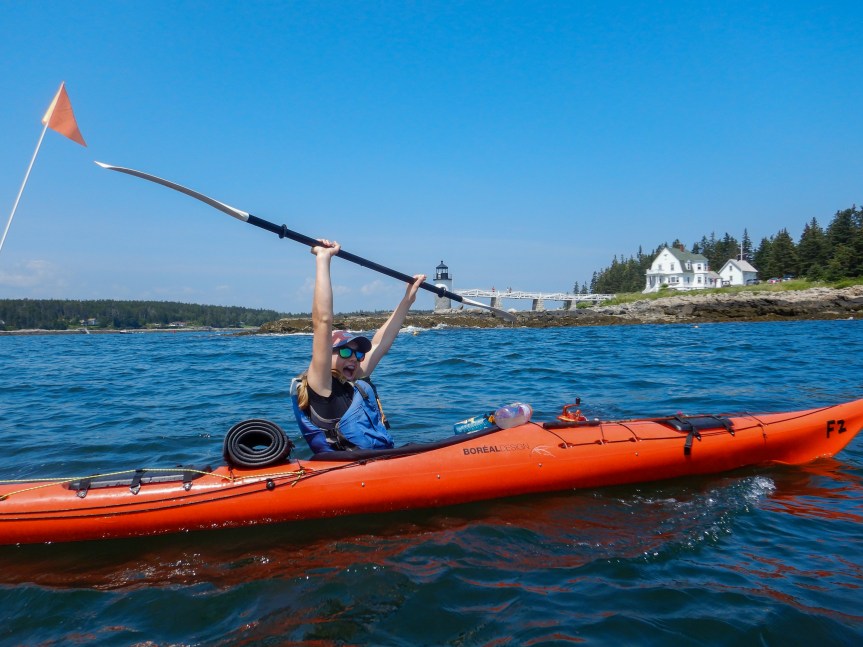
Students have explored clam flats, operated forestry machinery, camped on islands, built boats, kayaked along Maine’s coasts and in the state’s lakes and rivers, worked alongside maritime and forestry workers, learned about scallop farming, and developed outdoor leadership skills while hiking through the woods, and much more.  


Some of the 100 programs made available by the expansion include backpacking trips along the Appalachian Trail offered by the Chewonki Foundation, sailing opportunities with Sailing Ships Maine, and a science career exploration program offered by the Downeast Institute for Applied Marine Research and Education, among others. The Biddeford, Saco, and Dayton School Departments will offer kayaking, hiking, and ocean exploration opportunities for New Mainers and unhoused youth. Sixty-four schools and community organizations received Maine Outdoor Learning Initiative grants. 


“Chewonki is thrilled and honored to take part in the Maine Outdoor Learning Initiative. Maine is home to amazing landscapes and a rich outdoor heritage that presents a world of opportunity for our children. Yet far too many of those children lack access to meaningful outdoor education and outdoor recreation programs. This initiative opens the door to invaluable learning experiences for our youth. Together, we can foster the next generation of Maine students who will cherish the woods, waves, waters, and trails of our state, who can see themselves engaging meaningfully in our outdoor economy, building their families and careers here, and who will always feel proud to be part of such a wonderful place to live,” said Nancy Kennedy, Acting President of the Chewonki Foundation. 


“This grant will allow us to provide a team of students with an outdoor education experience intertwined with their classroom learning in English, science, and math. Our grant also includes an educator component, which gives our middle school teachers an opportunity this summer to spend time writing a unit for the 2024-2025 school year that integrates outdoor education experiences. I believe this opportunity will ultimately prove to be a benefit to all of our middle school students in Scarborough Public Schools,” said Katie Vetro, Director of Curriculum and Assessment of Scarborough Public Schools. 


“The Maine Outdoor Learning Initiative enables us to provide mentorship, hands-on learning, and outdoor adventure to youth who would not otherwise have access to these opportunities. Students are already looking forward to a summer of hiking, paddling, gardening, citizen science, service learning, and career exploration,” said David Wessels, Belfast High School Extended Learning Opportunities Coordinator.  


Maine DOE has launched a new Maine Outdoor Learning Initiative portal to help families easily access available programs and identify opportunities for their children to participate. All programs are at no cost to families, include free transportation, and are designed for students who face economic or other barriers to experiencing high-quality outdoor learning experiences.  


The Outdoor Learning Initiative is paid for through the Governor’s Emergency Education Relief (GEER) Program funds received from the US Department of Education. The Initiative is complimented by the Maine Career Exploration Program, a $25 million initiative of the Governor’s Maine Jobs & Recovery Program to connect teenagers and young adults to high-quality paid work experiences across the state. Since its launch in October 2022, the program has engaged more than 2,700 participants in paid work experiences. 

Maine’s 2024 County Teachers of the Year Announced

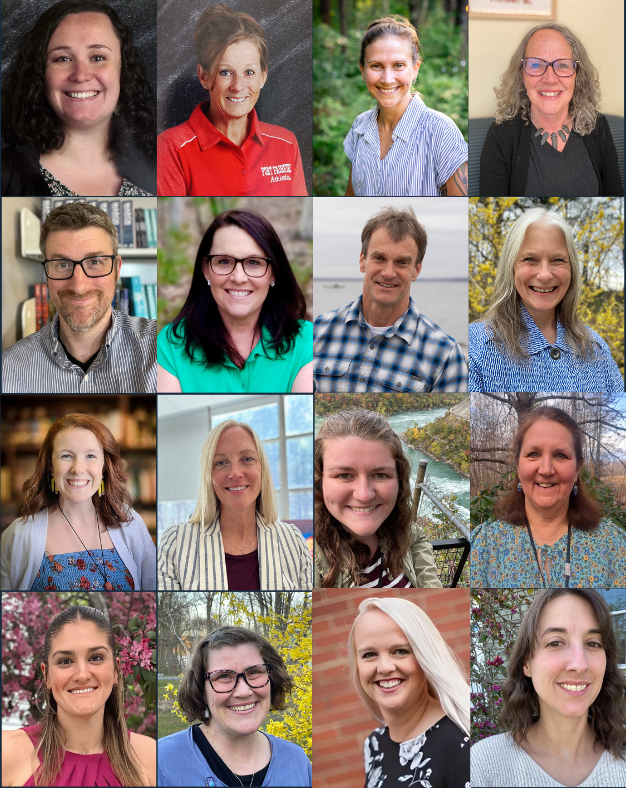
Sixteen Maine teachers were announced as 2024 County Teachers of the Year today at a ceremony in the Hall of Flags at the Maine State Capitol during Teacher Appreciation Week. Governor Janet Mills joined Maine Department of Education Commissioner Pender Makin, Educate Maine Executive Director Jason Judd, State Board of Education Chair Fern Desjardins, 2024 Maine Teacher of the Year Joshua Chard, and Maine County and State Teachers of the Year Association Co-President Hillary Bellefleur to announce and honor the new class of County Teachers of the Year.

More than 600 teachers across Maine were nominated by a member of their school community and these 16 outstanding educators were selected as County Teachers of the Year by a panel of teachers, principals, and business community members within their county. They range from having taught six years to 39, include elementary, middle, and high school teachers, and teach subjects including English Language Arts, science, social studies, library and technology, health, and physical education.

Maine County Teachers of the Year serve as ambassadors for teachers, students, and schools throughout their year of service. For example, Maine’s 2023 County Teachers of the Year created the #LoveMaineSchools campaign to celebrate the great things that are happening in schools across the state and lift up educator voices.

Throughout the summer, the teachers will continue to participate in an intensive Maine State Teacher of the Year selection process and Maine’s Teacher of the Year will be announced in the fall.

“As the daughter of a longtime public school teacher, I have the deepest respect and admiration for the Maine educators who work tirelessly to equip our students with the knowledge and skills they need to have bright futures,” said Governor Janet Mills. “I congratulate this year’s County Teacher of the Year honorees for their commitment to excellence in education, and most importantly, for their outstanding work in teaching our children.”

“It’s an honor to celebrate these 16 teachers who were nominated by colleagues, parents, and students for their passion, leadership, dedication, and the tremendous difference they make in the lives of their students and at their schools. Congratulations to each of Maine’s 2024 County Teachers of the Year,” said Maine Education Commissioner Pender Makin.

“We are immensely proud of the distinguished educators in the 2024 County Teacher of the Year Cohort,” said Educate Maine Executive Director Jason Judd. “We look forward to supporting and collaborating with them throughout their year of recognition, where they will serve as ambassadors for students, teachers, and quality education in Maine.”

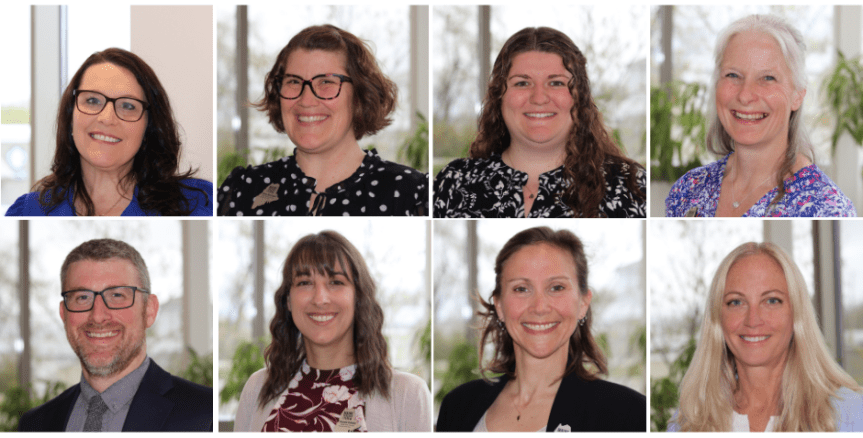
2024 County Teachers of the Year:

The Maine Department of Education’s Teacher of the Year Program is administered through a collaborative partnership with Educate Maine. To learn more about the Teacher of the Year Program visit: https://www.mainetoy.org/. The event was also broadcast live on the Maine Department of Education’s YouTube page.

Media Release: Maine DOE and Live and Work in Maine Launch New Phase of Nationwide “Live and Teach in Maine” Campaign

Second Year of Multifaceted Campaign Utilizes the Voices of Maine Teachers and Includes Targeted Advertising and Events to Recruit and Support a Vibrant Educator Workforce in Maine

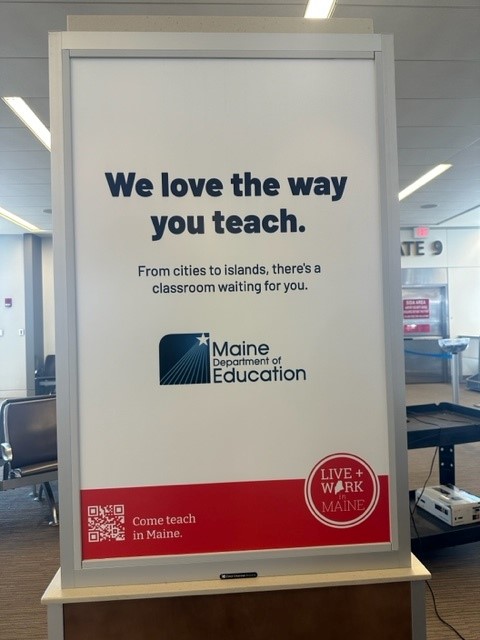
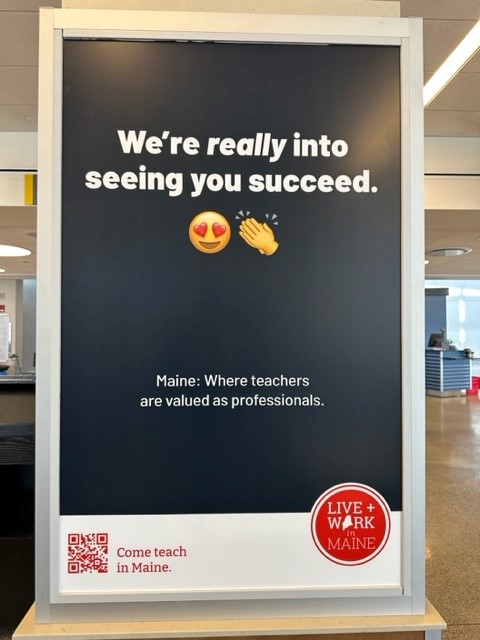
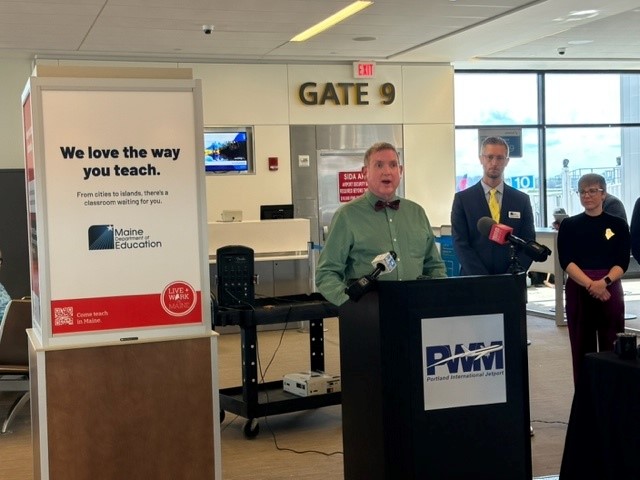
To kick off Teacher Appreciation Week, the Maine Department of Education (DOE) and Live and Work in Maine joined teachers and education supporters to launch the second year of their Live and Teach in Maine campaign. At an event at Portland International Jetport, Live and Work and the Maine DOE unveiled new Jetport ads that highlight the unique benefits of teaching and schools in Maine.

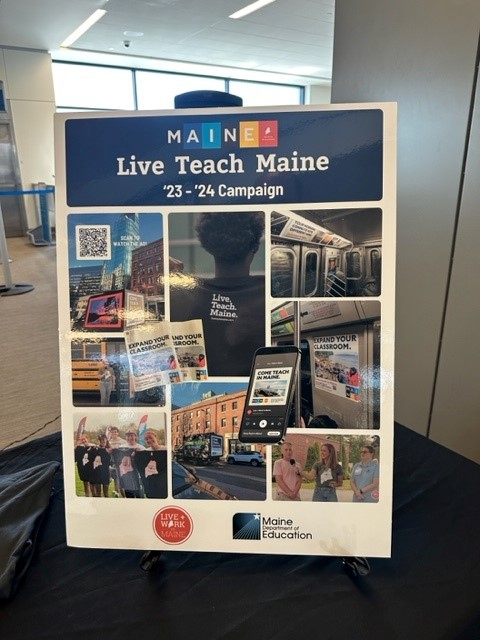
The Jetport ads are part of a multifaceted campaign to attract educators and strengthen the education profession. The Live and Teach in Maine campaign includes a highly targeted advertising effort, videos highlighting Maine teachers, access to the Live and Work job board for all schools, and events across Maine to highlight education as a rewarding profession and connect and celebrate educators. The partnership between Live and Work in Maine and Maine DOE seeks to attract new educators to Maine’s public education system and elevate and celebrate the many outstanding teachers in our classrooms right now.

“Maine is an amazing place to live and an extraordinary place to teach, and we’re proud to partner with Live and Work in Maine to reach new audiences, highlight Maine educators talking about why they love teaching in Maine, and connect people with opportunities to join the teaching profession,” said Maine Education Commissioner Pender Makin. “If you’ve ever thought of teaching in Maine schools, now is the time. We’re a state that deeply values and respects the creativity, autonomy, and professional judgment of our educators and school leaders.”

“Maine has long been celebrated for the quality of our public schools. This campaign aims to amplify the incredible work of educators who are already making a difference here and to use their success to encourage others to bring their careers and passion to Maine,” said Live and Work in Maine Executive Director Nate Wildes. “We are particularly excited about this project because of the wealth of positive marketing material at our disposal—from the exceptional quality of our public schools to the relatively low cost of living compared to regional urban centers, there are abundant reasons for skilled educators to consider upgrading to Maine.”

“Maine isn’t just a place to work—it’s a place to live, thrive, and make a difference. With its outstanding education system, breathtaking natural beauty, tight-knit communities, and high quality of life, Maine offers educators the perfect blend of professional fulfillment and recreational fulfillment,” said Maine 2024 Teacher of the Year Joshua Chard. “So why wait? There are amazing teaching positions waiting for you. Join us in Maine, where every day is an opportunity to inspire, educate, and explore.”

“As an educator, I feel blessed to be at a school that honors my autonomy and voice, and provides me with an opportunity to try new things and have fun with my students,” said 2023 York County Teacher of the Year Lisa Tripp. “As Maine educators, we also have the most incredible resource to share with our students—our beautiful nature.”

“The Maine Department of Education is proud to partner with Live and Work in Maine for a second year of our Live and Teach in Maine campaign,” said Maine Department of Education Deputy Commissioner Dan Chuhta. “As we begin Teacher Appreciation Week, I want to extend our sincere thanks and deep appreciation to all of the teachers in our state for the extraordinary work you do to help children thrive. And to anyone thinking about becoming a teacher, whether you are in college right now or considering a change in career, now is a great time to join our profession.”

Maine, like most of the nation, continues to experience an educator shortage that was exacerbated by the pandemic. This partnership builds on the Maine DOE’s wide-ranging efforts to recruit, retain, and support a vibrant educator workforce and leverages Live and Work in Maine’s knowledge and expertise as the state’s premier organization devoted to attracting and retaining Maine’s workforce.

During the first year of the Live and Teach in Maine campaign, there were more than 22 million impressions of the digital ads featuring teachers talking about how great it is to live and teach in Maine, nearly 2 million people engaged with the Live and Teach in Maine website, nearly 64,000 people viewed education jobs, and nearly 2,000 applied for teaching jobs. The campaign also featured physical advertising on subways in major cities, mobile billboards, and teacher-specific ads on college campuses. The Maine DOE also reported that more individuals sought teacher certifications last year than before the pandemic.

The campaign is funded through federal emergency relief funds to build and sustain Maine’s educator workforce following the pandemic.

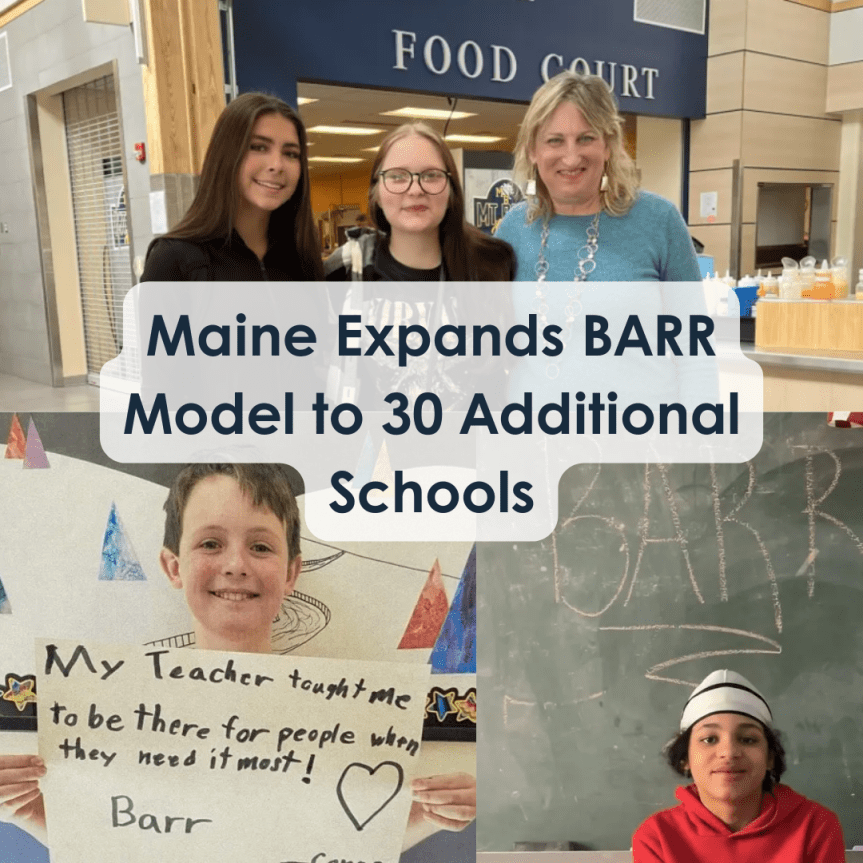
Media Release: Maine Expands Building Assets Reducing Risks (BARR) Model to 30 Additional Schools

Nearly 100 Maine Schools Now Implementing BARR Through Maine DOE Grants to Increase Academic Achievement, Engagement, and Student and Educator Wellbeing

The Maine Department of Education (DOE) announced grants for 30 additional Maine schools to implement the Building Assets Reducing Risks (BARR) model to increase academic achievement, engagement, and student and staff wellbeing. These new grants build on the Maine DOE’s initial BARR investment last summer, with nearly 100 schools now implementing BARR across the state.

BARR offers schools a framework that combines relationship building and asset development with real-time data to support students based on their strengths and connections to school. Empirical studies show that BARR results in increased student engagement, reduced chronic absenteeism, a 40 percent reduction on average in failure rates after one year of implementation, increased student achievement rates, and a reduction in high-risk student behavior and substance use. Educators report increased job satisfaction, higher levels of collaboration, and higher likelihood of persisting in their jobs after implementing BARR.

These positive changes are reflected in Maine schools that are already implementing BARR. Since implementing BARR, Bucksport High School’s graduation rate increased by more than 15 percent and Mt. Blue School High School has experienced a 30 percent decrease in chronically absent students, with a daily attendance rate of 94.14 percent. Through BARR, Noble Middle School has created more than 200 mentor matches to support students with significant risk factors. Westbrook High School’s BARR team was able to identify increased anxiety as the cause of a chronically absent student’s disengagement. They collaborated as staff and worked with the student’s family to create personalized interventions to improve the student’s experience at school. Now actively engaged in school activities and supported by a comprehensive plan, this student is not only coming to school and passing classes but has found a new passion for theatre.

“We are focused on empowering educators and school leaders, providing them with the tools and resources to strengthen the incredible teaching and learning happening in Maine schools. When I speak with educators who have implemented BARR in their schools, they are so enthusiastic about the positive academic and wellbeing changes they’ve experiences with students and the deeper relationships they are building with students and colleagues,” said Maine Education Commissioner Pender Makin. “We’ve invested in BARR as a state because of the extensive research behind it and the overwhelming support it has among Maine educators. BARR offers a flexible framework that any school can adapt to meet their unique needs with results that extend years beyond the initial investment.”

“We are thrilled with the success of the schools implementing BARR in Maine. Bucksport, Maine was the first high school to take on the BARR model after I developed the model as a high school counselor in its original site in Minnesota. Jim Boothby, superintendent of Bucksport, saw BARR’s potential in 2010, and now we are the most researched model in the country,” said BARR Founder and Executive Director Angie Jerabek. “Maine schools continue to show student and educator gains under the BARR model, and we are excited to partner with the Maine Department of Education in this expansion.”

“The numbers speak for themselves,” said Mt. Blue High School social studies teacher Matt Fournier. “BARR doesn’t take time out of our schedule; it makes time. Since we are building relationships, we get greater buy-in, and students are more connected to the school.”

“I’m a true believer in the program. We originally brought it on because the main focus was grades and the transition into ninth grade. For us, it really made a difference when we could see the number of failures in our coursework had changed significantly in the first year and then changed again the next year. And then as time went on, it went into more of the behavioral and checking in with the students and making sure they had trusted adults and really working on how they created a culture within the ninth-grade cohorts,” said Superintendent Mary Anne Spearin, who first implemented BARR as principal of Calais Middle/High School. BARR expanded to Calais Elementary School this year.

“The Loranger team is very excited to be partnering with BARR and implementing their research-based program. We know that this will help us grow and better meet the needs of all of our learners. We’re grateful for the funding to bring a program that has proven results among many schools in our state. We are eager to begin working with BARR to put into practice a system that supports both staff and students,” said Loranger Memorial School Principal Matthew Foster, who first experienced BARR as a classroom teacher at Noble High School. He is enthusiastic about bringing BARR to his school as an administrator in Old Orchard Beach.

“We are excited to welcome BARR to Indian Township School,” said Indian Township School Principal Molly Newell. “BARR’s focus is on building supportive relationships, addressing social-emotional needs, and promoting academic success, which aligns with our school’s goals of culturally relevant education, community involvement, and holistic student development within the context of our Indigenous values and traditions.”

More than 60 Maine educators just attended BARR’s national conference, with Commissioner Makin speaking on a panel of other state education leaders about how they are improving outcomes in their states. Educators from Brunswick Junior High School, Calais Elementary School, Maranacook Community High School in Readfield, Mt. Blue Regional School District, and Saccarappa Elementary School in Westbrook led workshops and served on panels to share the expertise they have gained through BARR implementation.

Maine was selected by the National Governors Association as one of five states who are engaged in exemplary efforts to support the mental health and wellbeing of students and school staff. Through this initiative, the NGA is supporting implementation of the BARR model in other states through technical support at the national level.

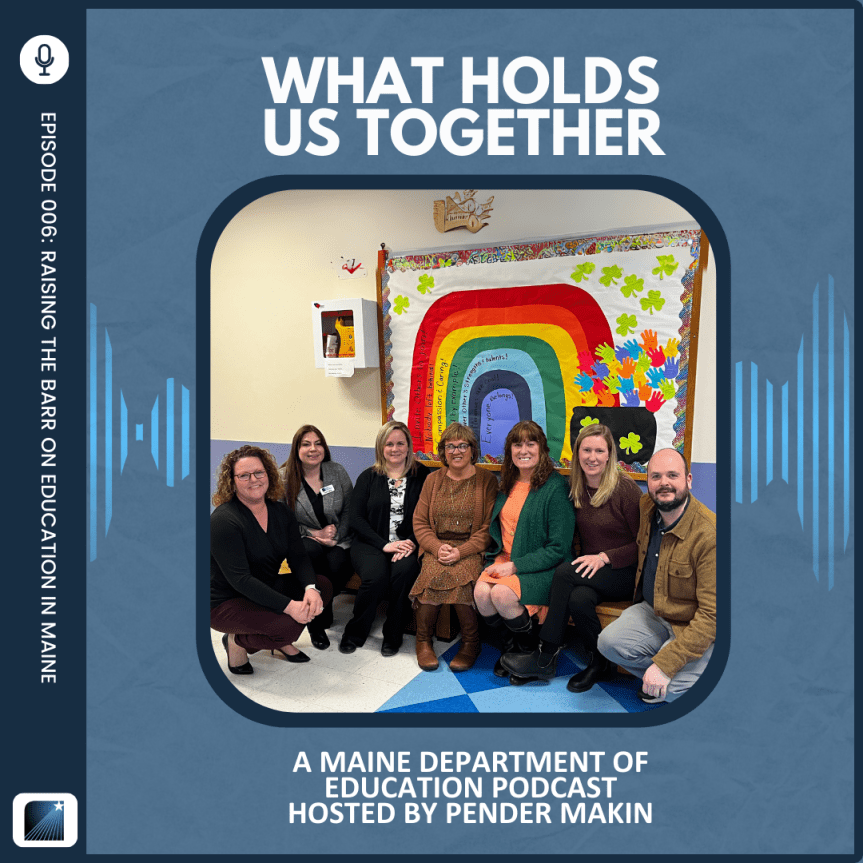
Read more about the BARR experience at Mt. Blue High SchoolCalais Elementary School, and Noble Middle School. Listen to Commissioner Makin’s podcast highlighting BARR schools here.

The Maine DOE used American Rescue Plan funding to create a competitive BARR grant to help schools invest in the model. To learn more about this funding, visit Maine’s Whole Student Pandemic Response page.

New BARR Grantees
AOS 94 – Ridge View Community School
AOS 96 – Fort O’Brien School
Baxter Academy for Tech & Sciences
Cherryfield School District – Cherryfield Elementary
Easton School Department – Easton Elementary School
Eustis Public School District – Stratton Elementary School
Indian Township School
Madawaska School Department – Madawaska Middle/High School
MSAD 17 – Paris Elementary School
MSAD 24 / RSU 88 -Van Buren District Secondary Sch
MSAD 6 – Edna Libby Elementary School
MSAD 6 – George E Jack School
MSAD 6 – H B Emery Jr Memorial School
MSAD 61 – Lake Region Middle School
North Haven Community School
RSU 10 – Buckfield Jr-Sr High School
RSU 14 – Jordan-Small Middle School
RSU 14 – Manchester Elementary School
RSU 14 – Windham Primary School
RSU 2 – Hall-Dale Middle and High School
RSU 2 – Monmouth Academy
RSU 2 – Monmouth Memorial School
RSU 23 – Loranger Memorial School
RSU 3 – Mt View High School
RSU 38 – Readfield Elementary School
RSU 39 – Caribou High School
RSU 56 – T W Kelly Dirigo Middle School
RSU 74 – Carrabec Community School
Saco Schools – Saco Middle School
Winthrop Public Schools – Winthrop Middle School
2023 Grantees
Acadia Academy
AOS 90, Princeton Elementary
Biddeford High School
Biddeford Intermediate School
Biddeford Middle School
Brunswick Junior High School
Calais Elementary School
Calais Middle/High School
Camden Hills Regional HS
Gorham School Department- Great Falls Elementary School
Gorham School Department- Narragansett Elementary School
Gorham School Department- Village Elementary School
Islesboro Central School
Kittery- Traip Academy
Maine Academy of Natural Sciences
MSAD 46- Dexter Regional High School
MSAD 44- Telstar Middle School
MSAD 52- Leavitt Area High School
MSAD 52- Tripp Middle School
MSAD 55- Sacopee Valley High School
MSAD 55- Sacopee Valley Middle School
MSAD 58- Day Mountain Regional Middle School
MSAD 58- Kingfield Elementary
MSAD 58- Mt. Abram High School
MSAD 58- Phillips Elementary
MSAD 6- Bonny Eagle Middle School
MSAD 60- Noble Middle School
MSAD 61- Lake Region High School
MSAD 70- Mill Pond School
MSAD 75- Mt. Ararat Middle School
MSAD 17- Oxford Hills Middle School
MSAD 49- Lawrence High School
RSU 24- Charles M. Sumner Learning Campus
RSU 34- Leonard Middle School
RSU 38- Maranacook Community High School
RSU 38- Maranacook Community Middle School
RSU 4- Oak Hill High School
RSU 4- Oak Hill Middle School
RSU 78- Rangeley Lakes Regional School
RSU 10- Mountain Valley High School
RSU 10- Mountain Valley Middle School
RSU 13- Oceanside Middle School
RSU 14- Windham High School
RSU 16- Bruce M. Whittier Middle School
RSU 16- Elm Street School
RSU 16- Minot Consolidated School
RSU 16- Poland Community School
RSU 34- Old Town Elementary
RSU 35- Marshwood High School
RSU 35- Marshwood Middle School
RSU 56- Dirigo High School
RSU 59- Madison High School
RSU 83/MSAD 13- Moscow Elementary School
RSU 83/MSAD 13- Upper Kennebec Valley Jr/Sr High School
RSU 9- Academy Hill School
RSU 9- Cape Cod Hill School
RSU 9- G.D. Cushing School
RSU 9- Mt. Blue High School
RSU 9- Mt. Blue Middle School
RSU 9- W.G. Mallett School
RSU 16- Poland Regional High School
RSU 64- Central High School
RSU9- Cascade Brook School
SAD 17- Oxford Hills Comprehensive High School
Sanford High School
Westbrook School Department- Canal School
Westbrook School Department- Congin Elementary
Westbrook School Department- Saccarappa School
Westbrook School Department- Westbrook High School
Westbrook School Department- Westbrook Middle School


Maine DOE Podcast Highlights Calais Schools Implementing BARR to Strengthen Relationships and Student Engagement

Maine Has More Than 70 Schools Implementing the Building Assets Reducing Risks Model (BARR), With Additional Funding Available for More Schools to Implement the Program

On the latest episode of the Maine Department of Education’s (DOE) “What Holds Us Together” podcast, Education Commissioner Pender Makin talked with Calais Elementary School Principal Sue Carter and Calais Superintendent Mary Anne Spearin about their experiences implementing the Building Assets Reducing Risks (BARR) model in their district. BARR combines relationship-building and the use of real-time data to strengthen student engagement, wellbeing, achievement, educator wellbeing, and connections across the school community. Listen here.

Calais Elementary School began implementing BARR this school year in fifth and sixth grade through a statewide grant opportunity provided by the Maine DOE through federal funds. More than 70 schools across Maine are now BARR schools, with additional funding available for schools that want to implement BARR in the next school year.

Makin spent the day at Calais Elementary School to experience the successes the school is having with BARR firsthand and taped her podcast onsite with the school leaders. Read more about her visit here.

“I’m so grateful that you hosted us today from the Department. We brought a team and we got to visit all of the classrooms. We also got to sit in on some of the BARR activities, including what’s called U-Time. When I asked ‘What is U-Time?’ she said, ‘Well, it’s an activity that we do where we learn a little bit more about ourselves and about our classmates.’ And it was just so well said. And then we also got to sit in with a group of teachers having a conversation that’s called a small block conversation, where they were discussing students in this particular case, who are appearing to be thriving across the board who are high academic achievers, and they discussed each student in terms of possibilities, ways to be more challenged, and also any concerns that might otherwise have gone unnoticed,” said Makin during her podcast intro.

Makin asked Carter what she and educators are experiencing through their BARR implementation.

“We started BARR at the elementary school in September. We applied for the state-provided program and it has really grown and become part of our school, culture, and climate,” said Carter. “Recently, we looked at our attendance. We usually don’t look at attendance until it’s a problem, and [now we] identified some kids that have been out seven days, taking the opportunity to send a letter home to say, ‘Hey, your kids missed seven days. We don’t want them to be truant, how can we help to make sure that they get to school?’ The data is inputted every week. You talk about and see that data over time.”

Spearin implemented BARR while she was an administrator at the middle/high school and provided a longer-term view of the BARR experience.

“The Calais Middle/High School adopted the program in 2016. I’m a true believer in the program. We originally brought it on because the main focus was grades and the transition into ninth grade. For us, it really made a difference when we could see the number of failures in our coursework had changed significantly in the first year and then changed again the next year. And then as time went on, it went into more of the behavioral and checking in with the students and making sure they had trusted adults and really working on how they created a culture within the ninth-grade cohorts,” said Spearin.

While at the school, Commissioner Makin had the opportunity to participate in a sixth-grade U-Time activity called “What’s on your plate?” Every U-Time is different, and in Carly Davis’s sixth-grade class, it was all about self-discovery. Sixth graders and DOE team members were each given a paper plate, which they folded in half.  On one side were the participants’ responsibilities, and on the other were the things they did in their free time. After making the plates, Davis engaged the students through a series of discussion around having a balanced plate, which portions are taking up too much time, which portions they love, which portions they wish they had less of, and so forth. On the back of the plates, students wrote one thing they wished they could add or take away from their plate.

Students learn about one another through these activities, about themselves, and teachers about their students in a deeper way. Teachers also share these valuable insights at their block meetings so the entire teaching team has that information. Block meetings happen weekly, with teacher cohorts discussing not just academic-related data but every student’s strengths, passions, and personal goals. This opens a broader, more positive discussion around the whole student. The team works off a spreadsheet that builds a picture of each student by reviewing a variety of in-school factors, including progress in class, attendance, and behavior. The team also discusses factors outside the school, such as extracurricular interests, personal health, issues with other students, or troubles at home. All this data collection allows the team to flag challenges early and work together to solve problems. Importantly, teachers track not just problems but student strengths to identify achievable goals to get or keep students on track for success. For students coping with the toughest situations in and out of school, BARR’s model requires a weekly Community Connect meeting that involves more specialized staff, such as the school nurse and school psychologist along with school administration.

“The other piece that’s really important about BARR is we always talk about the kids who are struggling or you know, not doing so well. But today we actually talked about four kids who were doing very well,” said Carter. “So it identifies those kids and we talked about those kids as well, which I think you need to have a balance, and the program forces you to do that. [The teachers] are very, very committed to it.”

Makin asked Carter if she is seeing any changes in student outcomes or differences in school culture now that she is more than halfway through her first year of implementing BARR.

“I would say so. Last week, the kids had posters that they wrote on about what BARR has done for them. [And they wrote] it helped me be aware of myself, it helped me to be more friendly, it brought me joy, it taught me empathy. So absolutely, every person, adult and student, is able to vocalize what they are gaining from BARR without having to think about it,” said Carter. “There’s not any way that can’t carry over to outside of school as well because it’s in them. It’s a part of them, and they’ll take that with them and as they move on to middle school, which is very important. It will help them be successful there as well.”

Makin asked what Carter and Spearin would say to other school leaders considering BARR.

“From the superintendent role and perspective, I would say that I am 100 percent in support of BARR. I loved it as a building administrator and as a team member. I saw the changes that it made for our freshmen students coming in. It supports our students. It gives them additional resources because it forces you to bring in resources from your community,” said Spearin. “The other part is the fact that teachers are out there alone and this forces time together. It forces them to look at the kids as our kids, not my kids. It also forces them to really look at the positives. It forces them to look at the challenges and to come up with a community solution to what’s going on with those students in the positive times and in the challenging times. And so it really does give the teachers the ability to have a team to work from and it also allows them to sit and look at the positives that are coming from all the work that they’re doing. We do not have enough time built into the day to do that unless you have a program that really encourages that.”

Makin asked how activities like U-Time, the regular data collection that educators are engaged in, and the conversations in block times create better grades and fewer failures in ninth grade.

“We had kids who would be looking at not doing their homework. You had an entire team of teachers saying I know that the basketball season is coming up and this is really important to this kid. Who knows this kid well enough to be able to go have that conversation about what they need to get that work done so that their grades don’t drop below the athlete eligibility piece? Or I know this student and they’re really having some challenges at home. Who knows a student well enough and has a connection to be able to reach out [to them]? We even had liaisons with the community that came in and we could then open those conversations up with them as well,” said Spearin. “Instead of a student that went through eight different periods in a two-day time and nobody had the opportunity to reach out and say, we know there’s something going on, how do we support you? And it wasn’t doing the work for them. It was saying what do you need to be successful?”

Applications are now open to all willing and qualified public schools that would like to become a BARR school. Click here to apply. Applications are due by March 22, 2024, by 5 pm EST. The Maine DOE will cover all costs of implementing the program for schools new to BARR for the 2024-2025 school year.

The Maine DOE used American Rescue Plan funding to create a competitive BARR grant to help schools invest in the model.

Maine DOE Podcast Highlights Hands-On Career and Technical Education Experiences

Commissioner Makin Talks with CTE Directors Randy Crockett from Oxford Hills Technical School, Bobby Deetjen from Mid-Coast School of Technology, and Bill Tracy from Hancock County Technical Center

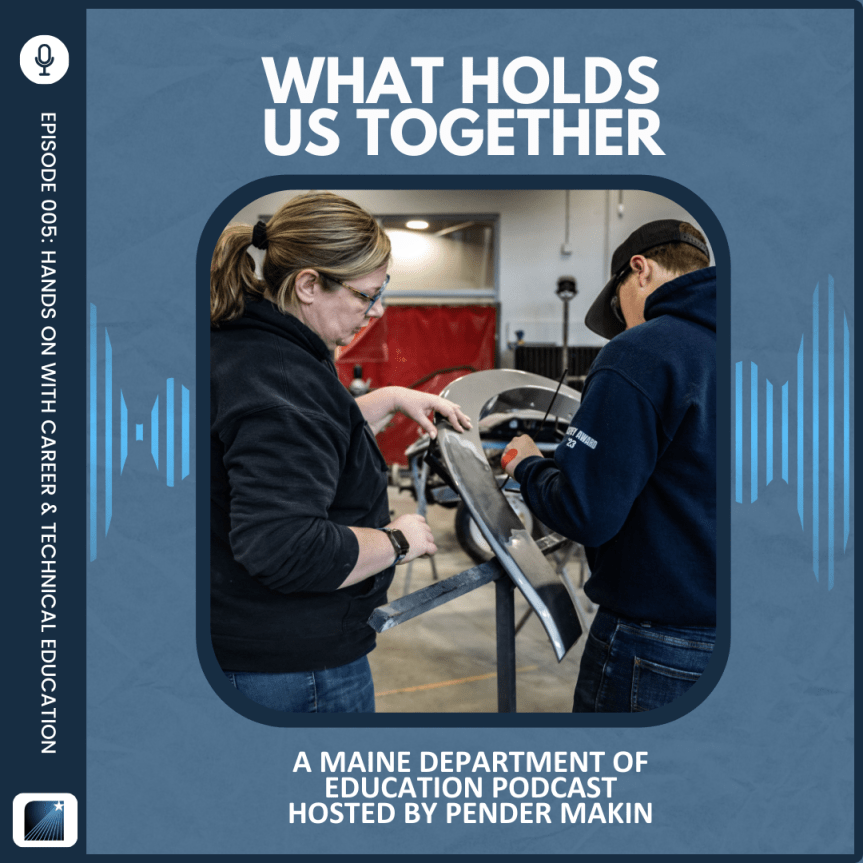
Career and Technical Education (CTE) programs provide Maine students with hands-on experiences in programs like culinary arts, welding, auto, law enforcement, early childhood education, and so much more. On this month’s What Holds Us Together podcast, Maine Education Commissioner Pender Makin talks with three CTE leaders about this engaging learning pathway, Randy Crockett from Oxford Hills Technical School, Bobby Deetjen from Mid-Coast School of Technology, and Bill Tracy from Hancock County Technical Center. They share how CTEs help students build the skills, knowledge, and real-world experiences they need to thrive. Listen here.

“We’re big believers in the hands-on, real-world, interdisciplinary learning that’s happening at Maine’s Career and Technical Education schools. [Students are] learning skills, they’re learning academic content, they’re solving problems and using critical thinking, they’re developing teamwork skills and communication skills—it’s such a robust model of education,” said Education Commissioner Pender Makin on the podcast.

“What happens in our school is pretty magical on a daily basis. We’re dealing with students who are future doctors, engineers, electricians, welders, you name it. These are going to be contributing members of our communities and we get to watch them at 16 and 17 really grow and make decisions that are going to impact our communities as a whole,” said Mid-Coast School of Technology Director Bobby Deetjen.

“It’s nice to be able to offer things that students need and want in the community,” said Hancock County Technical Center Director Bill Tracy. “That model of being able to learn and then immediately apply and practice is something that our students talk a lot about and being able to have that hands-on opportunity.”

“Our spaces are intermingled with the academic areas as well, so a student can walk from engineering and architectural design to their calculus class. It really makes a big difference in terms of access,” said Oxford Hills Technical School Director Randy Crockett, who also talked about the importance of hands-on learning. “That actual application is going to deepen their learning. They have to problem-solve in real time instead of abstract thinking.”

The group also discussed how the CTE model encourages students to take risks and be confident in trying new things.

“We tell our students, if you don’t fail at something that means you are not going to learn to your fullest potential. That’s going to increase engagement right there where students are going to have that kind of opportunity to feel at ease and take a chance,” said Deetjen, who explained that when students are worried about the social pressures around them if they fail, they’ll never take that chance to begin with and CTE programs take that pressure away.

Tracy summed up the power and potential of what CTEs in Maine offer.

“You can walk down the hall and see welding going on, you can see a car being taken apart, you can see [students] looking at electrical systems, and then you can go up and see three-year-olds running around in a classroom, and then you can step over to another classroom where they’re turning cockroaches into cyborgs and learning to control them. Then you walk down the hall and they’re making this amazing meal. What is this world? It’s just an amazing thing,” he said. “That is the world, and we’re just this small-scale piece of what reality is.”

Maine CTE program enrollment surpassed 10,000 students this year, and communities and the State continue to invest in this transformational learning pathway. Maine’s 27 Career and Technical Education regions and centers enroll students in 85 programs. The Mills administration invested $20 million from the Governor’s Jobs Plan to expand CTEs in Maine. In addition to the Jobs Plan funding, the Governor and the Legislature have increased funding for CTEs by more than $10 million.

Maine Teachers Share Why They #LoveTeaching as Part of a National Campaign to Promote Educator Voices

Maine DOE Partners with News Center Maine to Highlight Stories From Teachers Across Maine

Augusta, ME—The Maine Department of Education (DOE) partnered with News Center Maine this week to highlight the voices of teachers and school staff sharing why they #LoveTeaching during a weeklong national campaign.

#LoveTeaching week is a national campaign started by educators in 2015 and takes place every year around Valentine’s Day. All week, News Center Maine featured videos from Maine’s 2023 County Teachers of the Year and other educators sharing their joy and love of teaching.

Here’s what some teachers shared in their video messages about why they #LoveTeaching:

“I love to teach because every single day I get to make good memories for kids. It’s a great day when kids leave my class and can be overheard saying, ‘this is the best day of my life.’ In my class, that’s where the magic happens,” said Dawn McLaughlin, physical education teacher at Milo Elementary and Brownville Elementary and 2023 Piscataquis County Teacher of the Year.

“I enjoy building rapport with my students. When I see smiles on the faces of students in the classroom and in the halls, on stage, or on the competition fields, I know I’ve made a difference. There are few professions where you get to help our future take steps towards attaining their goals and aspirations. That’s why I love teaching,” said Rob Messier, math teacher at Mt. Ararat High School and 2023 Sagadahoc County Teacher of the Year.

“My favorite thing about being a teacher is that learning occurs beyond the four walls of the classroom and it’s boots on the beach to collect authentic data that connects learning to our community. I also love that my students, colleagues, and community partners are like family, and I find them truly inspired,” said Colleen Maker, biology and marine biology teacher at Washington Academy and 2023 Washington County Teacher of the Year.

“I love teaching because the future of the world is literally in my classroom today. I get to see the amazing working minds of my students in action every single day. They come up with new ideas and creative and wonderful views on the world that they see around them, and it just fills my heart with so much hope for a beautiful and amazing future,” said Lisa Tripp, science teacher at Bonny Eagle Middle School and 2023 York County Teacher of the Year.

“I love teaching in Maine schools because I get to teach the next generation of Maine educators,” said Meghan Stubbs, Hancock County Technical Center’s early childhood education instructor and Maine’s 2023 Milken Educator.

The video messages aired on News Center Maine all week and can be found here.  Educators can participate in the campaign by posting their videos to social media and using the hashtags #LoveTeaching and #LoveSchoolStaff.

Commissioner Makin Kicks Off Read to ME Challenge at Jameson Elementary School in Old Orchard Beach

The Read to ME Challenge Promotes Literacy by Encouraging Adults to Read to Children for At Least 15 Minutes, Challenge Others

Maine Education Commissioner Pender Makin kicked off Maine’s Read to ME Challenge today by reading Manolo & the Unicorn to second graders at Jameson Elementary School in Old Orchard Beach. The students enthusiastically responded to Makin’s call for them to join the Read to ME challenge themselves and read to an adult or younger child in their lives. They also discussed their favorite books and who the students plan to read to.

The Read to ME Challenge encourages adults to read to children for 15 minutes, capture that moment via a photo or a video, and then post it to social media and challenge others to do the same using the hashtag #ReadtoME. This is the ninth year that the Maine Department of Education (DOE) is collaborating with community organizations and schools on this month-long public awareness campaign to promote the importance of literacy for all of Maine’s students, regardless of age. The DOE will highlight Read to ME Challenge events throughout February through Read Across America Day.

“This is about sharing the love and joy of reading. When you’re able to read together, it creates shared human experiences that transcend everything else that is happening in our electronic world. When you hear the words, and those words create the colors and the shapes in your mind, you can create a whole different world and it’s a very magical and beautiful thing for kids. Reading just 15 minutes a day can help create a lifelong habit for children,” said Commissioner Makin.

The simple act of reading aloud to a child 15 minutes a day for five years results in 27,375 minutes of language exposure, which can put children on the path to high literacy achievement and helps them build knowledge and vocabulary. Research demonstrates a number of benefits to reading to children, from birth through their childhoods and even teenage years, including modeling reading as an enjoyable lifelong activity, stimulating brain development, reducing stress and anxiety, building knowledge of the world, and helping develop the skills necessary to succeed in their lives.

The Maine DOE recently launched $10 million in literacy grants for schools to build the capacity of year-long, core literacy instruction for all students and support core literacy instructional components based on the science of reading, including phonics, phonemic awareness, fluency, vocabulary, and comprehension.

Schools and community organizations can find a toolkit and resources on the Department of Education website and the Department will be sharing videos, photos, and updates from the challenge all month long on social media. Participants in the challenge are reminded to use the hashtag #ReadtoME and to tag the Maine DOE at @MaineDepartmentofEducation1 on Facebook, and @mainedepted on Instagram.

Media Release: New Maine DOE Student Cabinet Holds Inaugural Session

Student Discussions Centered Around Mental Health, School Safety, Diversity, and Supporting All Students and Educators

This year’s Maine Department of Education (DOE) Student Cabinet convened its inaugural session this week, hosting 25 Maine students spanning from 4th grade to their first year of college and representing all Maine counties. 

Established in 2019, the Maine DOE created the Student Cabinet to give Maine students a voice in education policy. Addressing the Student Cabinet, Maine Education Commissioner Pender Makin underscored the significance of the initiative. “You have a very important role in Maine’s education system,” the Commissioner explained, “because you’re going to be our ears on the ground. You’ll let us know how education is working for you, and the young people you represent.” 

Students spent the day meeting with Maine officials, including Governor Mills, legislators, State Treasurer Henry Beck, and representatives from the Secretary of State’s office.  

“Meeting with the governor gave us a chance to speak out on what we really think about different school systems,” commented India Veilleux, an eighth grader at York Middle School.  

Throughout the day, students collaborated to outline their priorities for the upcoming 2023-2024 Cabinet session. Meilan Martine, a Cape Elizabeth High School student, advocated for increased diversity, emphasizing that “it’s important to show perspectives of different types of people to prepare students for the real world. “ 

Cody Leighton of Jonesport-Beals High School in Washington County highlighted the importance of bolstering support for educators, citing “a lack of resources the educators receive is a lack of education students receive.” 

The Cabinet will convene virtually on a monthly basis to continue their discussions and work, and will meet again at the State Capitol in May. 

Student Cabinet Members 

Student Cabinet Member  School 
Ahnalese Elizabeth Higgins   University of Maine at Farmington 
Ava Rosser  Caribou Community School 
Alissa Witham  Calais Middle-High School  
Blake Corey Dodge  Ridge View Community School 
Chase Weaver   Belfast Area High School  
Cody Leighton  Jonesport-Beals High School 
Dawson C. Whitten  University of Maine at Presque Isle 
Dorsa Tajvidi  Orono High School 
Elza Cahn  Lamoine Consolidated School 
Fadumo Hussein  Lewiston Public Schools 
Grace Dunton  Skowhegan Area Middle School 
India Veilleux  York Middle School 
Keelie M. Dunphy  Samuel L. Wagner Middle School 
Kyle Andrew Petrovic  Winslow High School 
Lochlan Aldrich  Morse High School 
Lucas Ayden James Fortier   Oxford hills middle school 
Maden Oliver Jovin  Oceanside Middle School 
Makenzie Burton-Wing   Albert S. Hall School 
Margaret McCarthy  Hope Elementary School 
Mary Evelyn Gallagher  Nobleboro Central School 
Meilan Martínez  Cape Elizabeth High School 
Phat Thai (State Board Member)  Deering High School 
Robert Christopher Pollard Junior  Kennebunk High School 
Ronan Drage  Boothbay Region Elementary School 
Rosalyn L.J. Cote  Oak Hill Middle School 
Ryan Hafener (State Board Member)  Hampden Academy 
Shelby Tracy  Mountain Valley High School 
Taggart Chung  The Adams School 
Winter Adams   University of Maine at Farmington 
Xariah Jayne MacDonald  Mount Ararat Middle School 


Media Release: Mills Administration Releases Plan to Transform CDS and Improve Special Education Services for Young Children

The Plan Presented to the Legislature by the Maine DOE Would Transition Oversight of Educational Services for Young Children With Disabilities From CDS to Local School Systems over a 3-Year Phase-In 

The Maine Department of Education (DOE) delivered a report today to the Joint Standing Committee on Education and Cultural Affairs of the Maine Legislature detailing recommendations to solve decades-long structural challenges that have limited Maine’s ability to successfully provide special education services to preschool-aged children. The recommendations include a proposal to transition oversight of educational plans for preschool-aged children with disabilities from the Child Developmental Services (CDS) agency to local public school systems.

Today’s recommendations were previewed by Governor Mills in part one of her State of the State Address earlier this week. She declared that Maine’s use of a quasi-governmental organization to provide special education services to preschool-aged children “just isn’t working for Maine kids,” and that “every other state in the nation educates pre-k children with disabilities through their public school systems. Maine should do the same.” Mills urged the Legislature to work with her Administration to fix Child Development Services.

“The Department of Education is proud to offer a plan that, if implemented by the Legislature, will dramatically improve the services and education that Maine provides to our youngest learners with disabilities. This plan reflects best practices and the priorities expressed by educators and school leaders, parents, CDS staff, experts, private providers, and advocates, and it’s the right thing to do. We look forward to working with the Legislature to transform the structures that have held a failed system in place for decades and do right by some of the most vulnerable children in our state,” said Maine Education Commissioner Pender Makin. 

Since CDS was established more than 30 years ago, there have been dozens of statutory revisions and proposed bills to transition oversight of services to public schools, but the laws driving insufficient services have remained in place. Maine is the only state that requires an independent organization, separate and apart from public schools, to oversee the state’s obligation to ensure special educational services for preschool children who require these supports and services. Most other states designate local public schools as responsible for overseeing the provision of educational services for young students with disabilities, either directly or through contracts with local private providers and regional sites.

The Maine DOE’s report recommends a three-year phase-in of the responsibility of educational services for preschool-age children with disabilities from the CDS agency to local school administrative units (SAUs). A pilot year would begin July 1, with several willing SAUs receiving both the funding and the responsibility for the provision of services to preschoolers with disabilities. All SAUs would assume these responsibilities by the fall of 2026. Under this plan, students may be served directly in local public pre-K classrooms or may continue in current placements, with the goal always leading toward full inclusion in the general education setting.

The proposal does not require the establishment or expansion of pre-K programs in local schools, nor does it displace CDS workers or private providers, as all service providers are important partners in ensuring services are available to every child who is eligible. CDS regional service hubs and private community providers who are willing to work with the public schools to ensure services in accordance with federal laws will be critically needed partners to support a successful education system for pre-K students with disabilities.

The State is committed to providing funding to support the transition and to sustain special education services for young children. The Department’s recommended funding model is informed by the Essential Programs and Services (EPS) formula, with allocations for student subsidy counts flowing through the formula, but with the special education and related services funding remaining outside of the formula, paid upfront in quarterly payments requiring no local share. During the pilot for fiscal year 2025, the funding generated by the formula would be provided outside of the formula at 100 percent state share, since the mill rate and total cost of education have already been established and local budgets are in process. $10 million will be included in the supplemental budget request to cover the costs for special education and related services for these children. The State’s budget will also include $4 million for renovation projects for schools looking to start up or expand pre-k programs.

The Maine DOE developed the proposal after engaging in multiple meetings, focus groups, and individual interviews with stakeholder representatives, including parent advocacy groups, superintendents, school board members, educators, public school service providers, private schools and community-based providers, special education directors, and other state experts. It was also developed based on the recommendations from a Public Consulting Group, Inc. (PCG) report commissioned by the Legislature, findings and priorities from the legislated LD 255 and LD 386 advisory groups that met in 2022, U.S. Department of Education Office of Special Education Programs (OSEP) guidance, existing data, national experts, and a thorough examination of the current needs and capacities in our state.

Intensive training and technical support will be provided for schools in developmentally appropriate practices for working with young children and their families and in inclusive educational practices that allow all children to learn together and to receive necessary supports.

The proposal would ensure that Maine is in line with recent guidance from the US Department of Education’s Office of Special Education Programs which reiterates and clarifies the expectation that children with disabilities be educated in the least restrictive environment, alongside their typically developing peers. Under current Maine statutes, public schools are responsible for children with and without disabilities in grades K-12 and for nondisabled pre-K students. Pre-K students with disabilities, however, must enter special education through a separate system for evaluations, individualized educational program (IEP) development, and educational programming – 80 percent of which is currently provided outside of the public school setting.

Maine’s pre-K system is second only to Arkansas in the percentage of students with disabilities who are excluded from the general education settings in local public schools. 12.5 percent of pre-K students in Maine receive education in private, special purpose programs, the most restrictive environment, according to the federal government. The national average for these most restrictive placements is between 1 to 2 percent.

The proposal would also expand the availability of services to children. The current structure makes it difficult for CDS staff members to meet growing needs and find placements in pre-school education classrooms and related special education services due to the overreliance on private providers, pervasive shortages of childcare settings in Maine and nationwide, and the fact that providers are able to choose which students they serve, leaving some children without access to education.

The Maine DOE’s proposal to the Legislature today builds on unprecedented efforts by the Department to improve the services provided by CDS despite current legal constraints. Recent achievements include:

  • In just three years, the Department has supported public schools in serving preschoolers with disabilities so that now more than 20 percent of these children, who were previously excluded from the general education classrooms, are educated in their local schools, in the least restrictive environment, alongside their typically developing peers.
  • The Department has used grant funding to support community readiness assessments and to foster partnerships between local public schools and community-based service providers, childcare settings, and private schools.
  • Trainings and technical assistance in best practices for working with very young students and their families have been provided statewide, with ongoing opportunities for educators, school leaders, and CDS staff to build greater capacities.
  • Preschool startup and expansion grants have been provided to schools statewide, funding plans that implement inclusive practices and strong community partnerships.
  • The Department has supported CDS by increasing staffing, offering workers free college courses toward teacher certification, and increasing wages and benefits.
  • CDS leadership has been provided with a comprehensive organizational improvement plan to bring their student data, accounting systems, and other operations in line with state expectations.

The Maine DOE provided this report to the Legislature as a result of LD 1528 directing the Department to submit a report to the Joint Standing Committee on Education and Cultural Affairs regarding services provided by the CDS System to include a plan for oversight of a free, appropriate public education for eligible children from 3 years of age to under 6 years of age in SAUs. Read the full report here.