The Maine Department of Education (DOE) is sharing resources and guidance to support school administrative units (SAUs) that are interested in establishing a school-based condom availability program.
In lieu of legislation, the Committee requested that the Maine DOE inform SAUs of their authority to adopt a protocol that allows for free condom access and distribution in schools.
To support schools in this work, Maine Family Planning, a Maine-based nonprofit organization specializing in reproductive health care and education, has developed a resource to assist with planning and implementation: Maine Family Planning – Condom Availability Tip Sheet (PDF).
The Maine Department of Education (DOE) is now accepting applications from individuals interested in learning more about the competitive grant process. Selected applicants will be trained to serve as peer reviewers who assist the Maine DOE in reviewing, assessing, and scoring competitive grant proposals for the 21st Century Community Learning Centers (CCLC) program.
The 21st CCLC program is a federally funded education program that helps schools and communities develop before-school, after-school, and summer educational programs that support students and their families. This year’s Request for Proposals (RFP) for the 21st CCLC program was released to the public on January 6, 2026, and is available online. The Maine DOE anticipates receiving proposals from local education agencies/school administrative units (SAUs), community-based organizations, and other eligible entities seeking awards under this RFP.
Peer Reviewer Qualifications:
Peer reviewer applicants will be selected based on their experience in providing effective academic support, enrichment, youth development, and related support services for children and youth. The most qualified applicants will be individuals with experience in the administration of high-quality youth development programs within schools and communities. Examples of the experienced individuals sought include, but are not limited to:
21st CCLC program directors and site coordinators
Teachers and principals
College and university staff
Youth development workers
Community resource providers
Required Tasks:
Selected applicants must be able to participate in online training and review grant proposals through a web-based system. Applicants will work individually to read each assigned proposal and create detailed, objective, constructive, and well-written comments on approximately 10 proposals based on the criteria established in the RFP. These comments will be submitted to the Maine DOE prior to participating in the scheduled consensus scoring sessions. It is anticipated that peer reviewers will have a three week window to complete their individual review of assigned proposals.
Following the individual review of proposals, each successful applicant will be required to participate in a series of two online/virtual consensus scoring sessions hosted by the Maine DOE. It is during these consensus scoring sessions that the peer review team will score each grant proposal.
Selected applicants must complete the following tasks during the following dates:
Task
Dates
Times
Participate in an online training webinar
April 2, 2026
1-2:30 p.m.
Review grant applications through a web-based system and provide individual, written comments on each application (to be submitted to the Maine DOE)
April 10, 2026 – April 30, 2026
any time
Participate in online/virtual consensus scoring sessions with other members of the peer review team (Applicants MUST be available on all four scoring days but will only be selected to participate for two days.)
May 4, 2026 – May 5, 2026; or May 7, 2026 – May 8, 2026
9 a.m.-4 p.m.
Compensation for Services:
Selected applicants who complete the required tasks will be provided an honorarium of $100 per assigned proposal. Previous participants have also found that serving as a member of the peer review team is an excellent opportunity for professional development and growth. It is likely that, if selected, applicants will be exposed to new program models, strategies, and practices. These new concepts may provide ideas and support for ongoing work as well as future grant writing efforts. Most importantly, the time given to this effort will help ensure the funding of quality education programs for the children and families of Maine.
How to Apply:
Interested applicants must contact Travis Doughty, Maine DOE Title IV State Coordinator, at travis.w.doughty@maine.gov to obtain a copy of the 2026 peer reviewer application. Please return the completed application, along with a current resume or curriculum vitae (CV), by March 17, 2026.
Pursuant to Title IV, Part B of the Elementary and Secondary Education Act, as amended by the Every Student Succeeds Act of 2015, peer reviewers may not include any applicant, or representative of an applicant, who has or will submit a proposal in response to the current RFP grant competition.
Deadline:
The Maine DOE will accept peer reviewer applications through March 17, 2026, or until the needed positions are filled. Interested applicants are encouraged to apply as soon as possible.For more information, please contact Travis Doughty at travis.w.doughty@maine.gov or 207-624-6709.
The work of the Maine School Transportation Safety Commission is officially underway following the first meeting of the Commission on Friday, February 27, 2026.
The Commission was established via Executive Order in January 2026 following the tragic deaths of two Maine students in transportation-related incidents. Ten Commission members, including representatives from the Maine Department of Education (DOE), Maine Department of Public Safety, and Maine Department of the Secretary of State, will review current school transportation protocols in Maine in an effort to identify changes and/or improvements.
Per the Executive Order, the Commission is tasked with:
Reviewing current statutes and regulations related to safety standards, protocols, and school bus driver training and ensuring clear communication of these requirements to all school districts.
Producing an updated set of best practices for school bus safety and disseminating it to all school districts.
Identifying changes or improvements needed in school transportation rules to ensure the safety and well-being of all students, staff, and drivers.
Identifying school bus safety features that can be installed, upgraded, or replaced, including door anti-pinch sensors and control (crossing) arms.
Encouraging and assisting school districts in the effective communication of school bus safety information to students and families.
Confirming that school districts have a process to complete, on a semi-annual basis, school bus safety training checklists.
Identifying training needs for bus drivers and a mechanism for this training to be provided to all school transportation units.
The Maine DOE has established a webpage for the Maine School Transportation Safety Commission where the Commission’s meeting schedule, as well as related materials, will be posted. The Commission is currently scheduled to meet on March 13, 19, and 27, 2026—with options for both in-person (Fallen Heroes Meeting Room, 45 Commerce Drive, Augusta, ME 04330) and via Zoom (links to come) attendance for members of the public.
Members of the public may also submit questions/comments for the Commission’s consideration at transportationsafety.gov@maine.gov or through the form available on the webpage.
A final report by the Commission is due to the Governor and Maine State Legislature by April 30, 2026.
In mid-December, a group of Brunswick High School students gathered at the Maritime Industrial Workforce Training Center—a new regional hub for shipbuilding and technical training that sits on the redeveloped site of the former Naval Air Station at Brunswick Landing. The building, now nearly 50,000 square feet of classrooms and lab space, was created by Maine Maritime Academy in partnership with Bath Iron Works and other regional education partners to prepare the next generation of Maine’s maritime and manufacturing workforce.
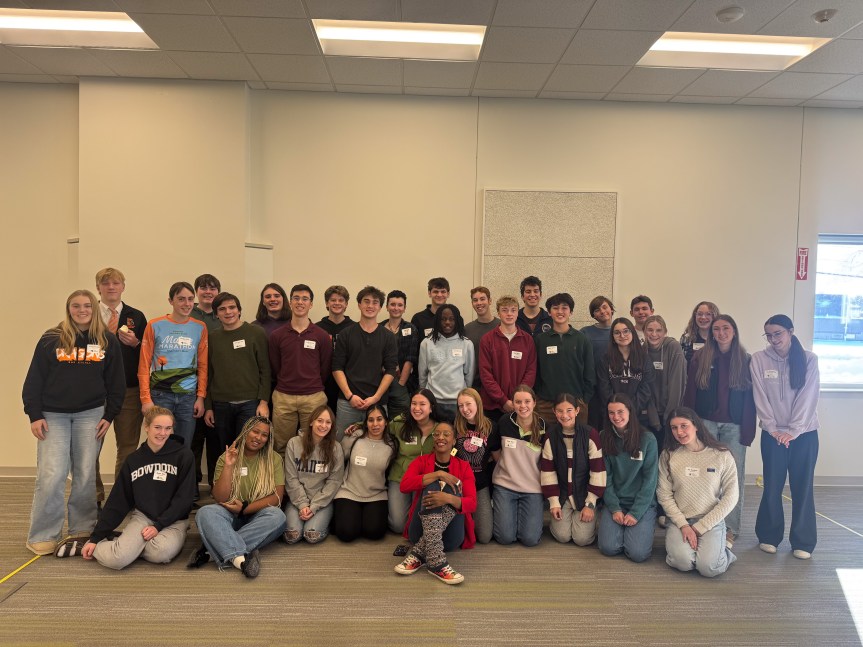
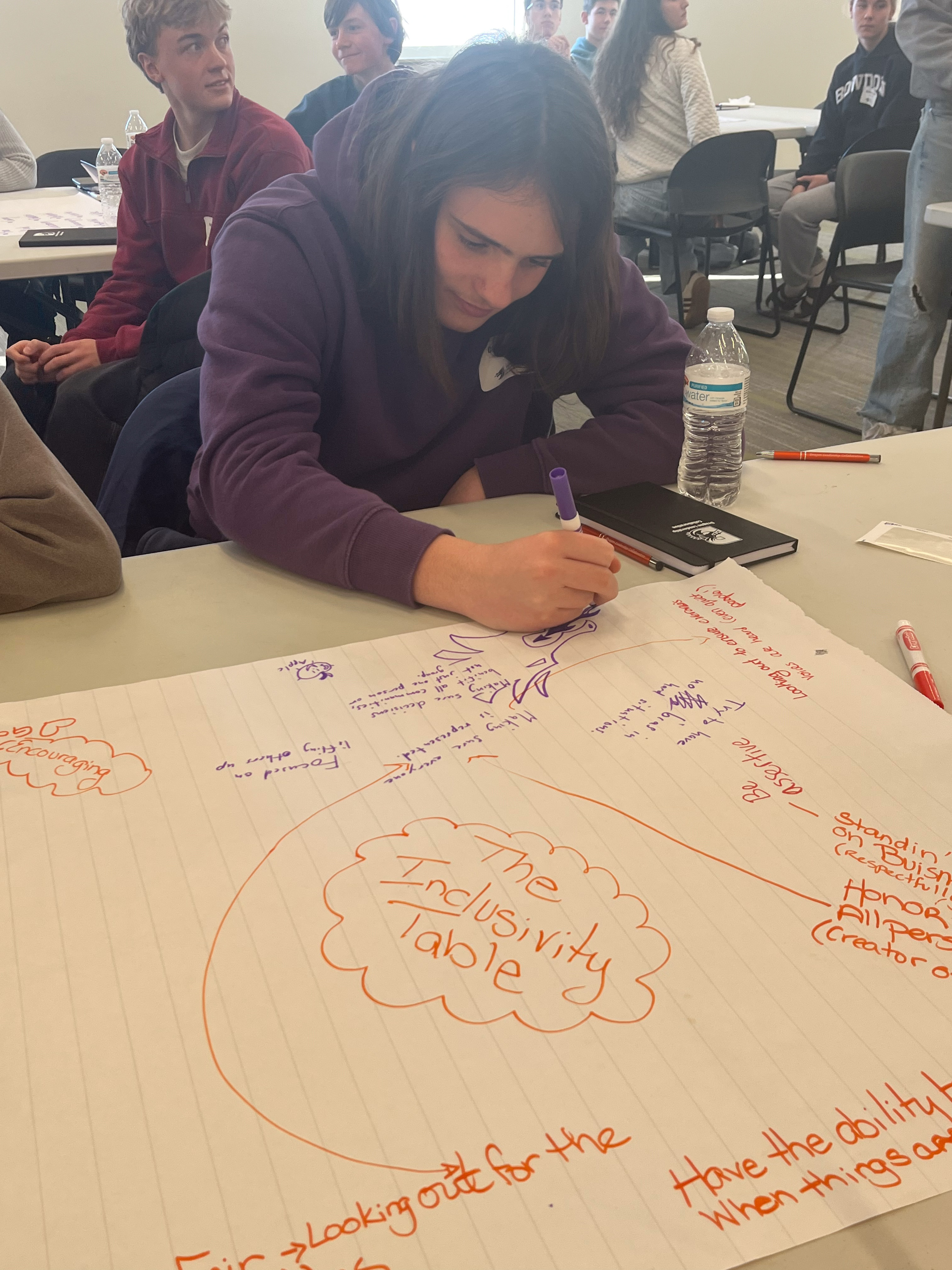
For these students, the center became the backdrop for the first session of the Dragon Leadership Collaborative, a grant-supported program at Brunswick High School designed to cultivate inclusive, student-centered leadership. With support from the MaineHealth Community Health Improvement Fund, the Collaborative brings together student leaders from across school athletics programs, the performing arts, student government, clubs, and students identified by staff as emerging leaders—to help them build skills, confidence, and connections. The Collaborative is coordinated by a team of school leaders, including Kaitlin Urges, Brunswick High School Dean of Students, and Brunswick High School Athletic Director Kaili Philips.
The first session was held at Brunswick Landing to give students focused time away from their regular schedule and connect their leadership work to a space that represents opportunity, workforce development, and pride for the Midcoast community. Students began the morning with a keynote from Ayesha Hall, Director of Strategic Partnerships at the Maine Department of Education (DOE). Hall spoke about “look-fors” in leadership—what you should actually be able to see in someone who is leading well, regardless of whether they have a formal title—and drew on her own experience as an education and community leader to highlight the many ways students already shape school culture through relationships, creativity, and everyday choices. Throughout a discussion, students asked thoughtful questions about the challenges of leadership, including how to handle conflict and how to stay grounded when others look to them for direction.
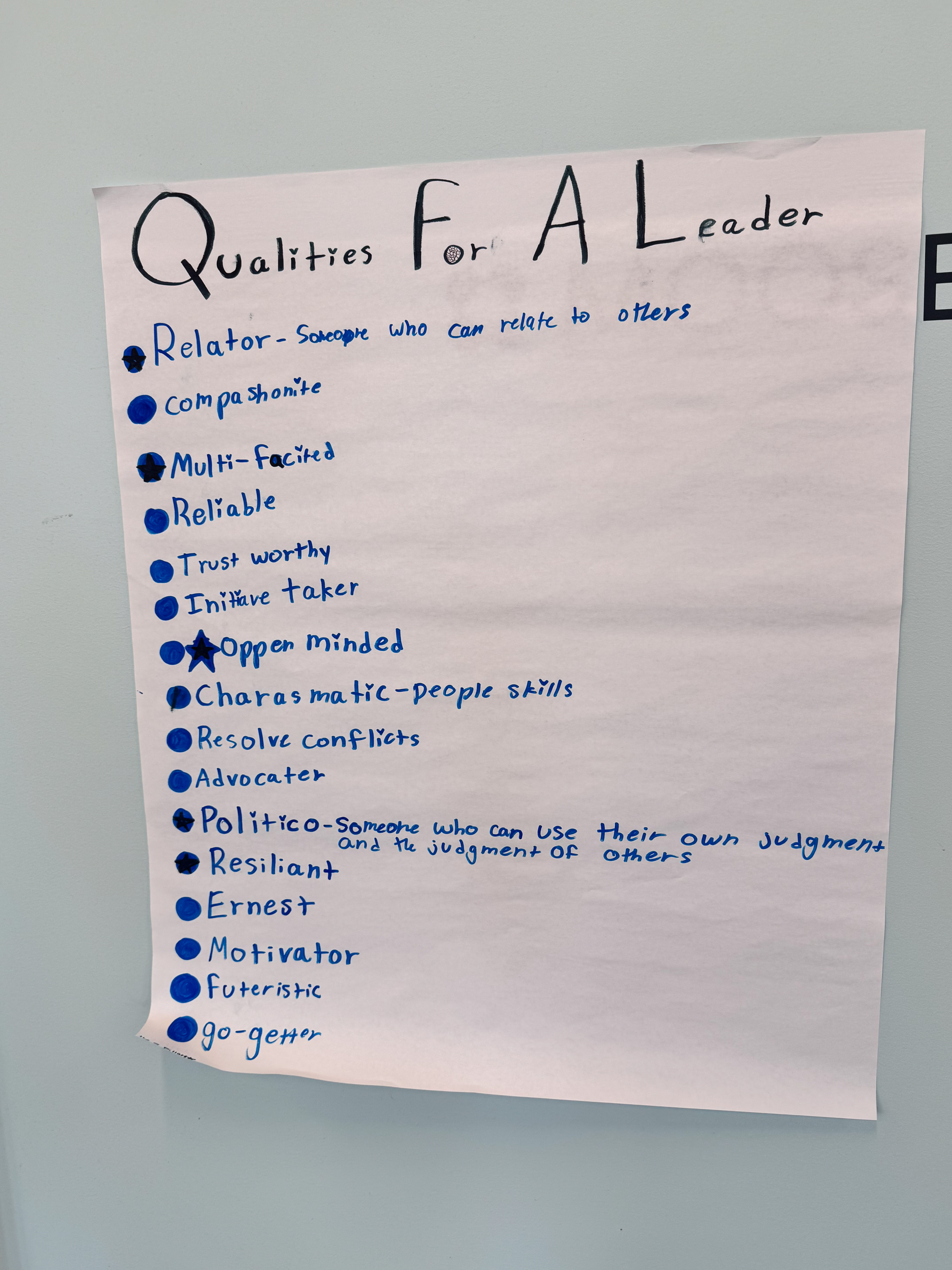
The rest of the session was built around student voice. In small groups, students developed shared agreements for how they want to work together and identified the “qualities of a Brunswick High School leader.” They reflected on which of those qualities come naturally and which they are still developing, and then they considered what their school and the groups they represent need from them as leaders. The morning closed with each student setting a personal leadership goal to work on before the Collaborative meets again. go deeper on
As part of an exit activity, students suggested topics they want to explore more deeply in future gatherings. In a follow-up email, organizers shared that two themes rose to the top: “Leading without being bossy” and “Traditions that support equitable, healthy groups.” With those priorities in mind, the team is planning a workshop on leadership styles and personality traits for late February, with a guest from the University of Southern Maine’s career advising center, and a spring workshop with a nonprofit focused on recognizing healthy and unhealthy group dynamics.
“We are excited for our next two workshops with this group,” organizers noted in their update, reflecting the school’s commitment to letting student interests shape the direction of the Collaborative.
Although the Dragon Leadership Collaborative has only met once so far, Brunswick High School leaders say they see it as a promising way to recognize a wider range of student leaders and to give them tools to use their voices for positive change. By pairing MaineHealth Community Health Improvement Fund support with a partnership-rich location like the Maritime Industrial Workforce Training Center, Brunswick is helping students practice leadership in the same kinds of spaces that are preparing Maine’s future workforce.
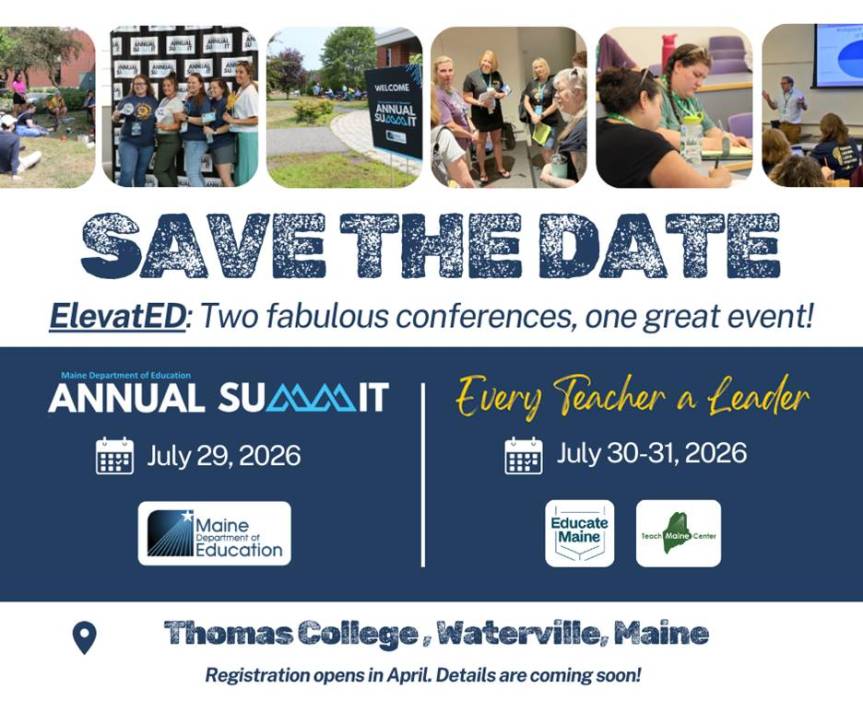
The Maine Department of Education (DOE) is excited to be partnering with Educate Maine and the Teach Maine Center this summer to bring together two impactful statewide events into one powerful “ElevatED” professional learning experience!
The 2026 Maine DOE Annual Summit and the second annual Every Teacher a Leader Conference will be held consecutively at Thomas College in Waterville, allowing for three days of collaboration, inspiration, and high-quality professional learning for Maine’s education workforce.
Event Dates and Location
Maine DOE Annual Summit: July 29, 2026
Every Teacher a Leader Conference: July 30-31, 2026
Thomas College, Waterville, ME (180 West River Road, Waterville, ME 04901)
Day 1, the Maine DOE Annual Summit, is tailored to meet the needs of Maine’s education workforce, including school staff, educators, school safety professionals, and building and instructional leaders, offering opportunities to connect, exchange ideas, and access the tools, resources, and professional learning needed for the upcoming school year. Days 2 and 3, the Every Teacher a Leader Conference, feature teacher-led sessions, spotlighting outstanding educators from across Maine, designed specifically for classroom teachers.
We look forward to welcoming educators, school leaders, and partners from across the state for this exciting collaboration. Registration opens in April; stay tuned for more details!
When Amanda Bryant, a fifth-grade teacher at Mountain Valley Community School in RSU 10, applied for the 2025 Global Health Teacher Fellowship Program, she hoped to find new ways to spark curiosity and bring real-world learning into her classroom. What she gained—and what she gave her students—was far more powerful, though.
Bryant was selected as one of just 12 educators nationwide to participate in the prestigious fellowship, which engages teachers in designing innovative learning experiences that explore interconnected global health inequities through journalism and reporting. Over 28 hours of professional development, Bryant collaborated with educators and journalists from across the United States and around the world to build lessons that connect students to underreported global health issues in meaningful ways.
“This was truly an eye-opening experience,” Bryant said. “I learned so much about my own teaching practice but also about the similarities and differences among educators working in very different settings. It helped broaden my perspective and strengthened my commitment to bringing real-world issues into my classroom.”
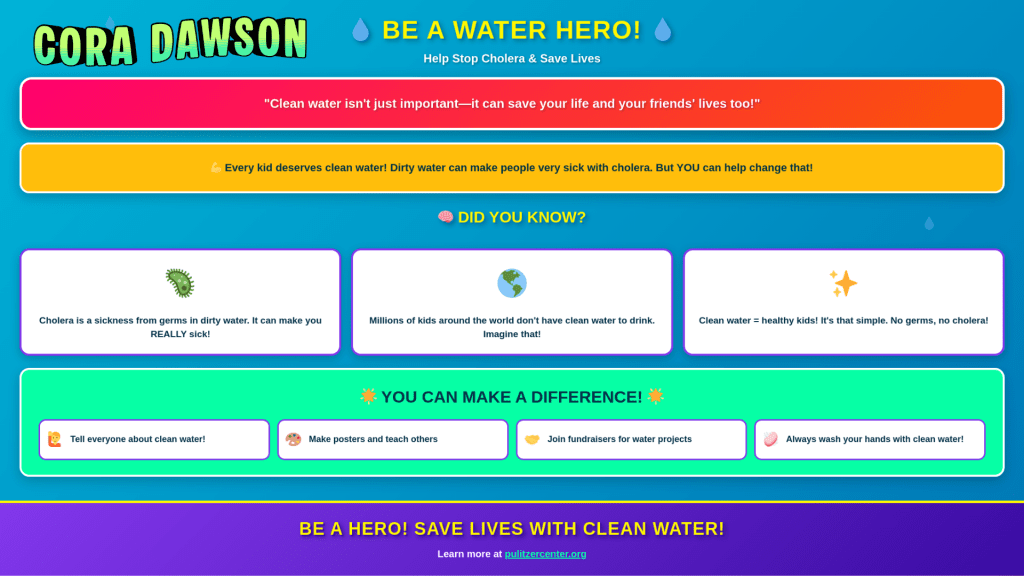
For her project, Bryant introduced her fifth graders to the work of Bangladeshi scientist Dr. Firdausi Qadri, whose groundbreaking research on cholera, an infection caused by ingesting food or water contaminated with bacteria, focuses on preventing the disease through vaccines and access to clean water. In Bryant’s class, many students were surprised to learn that cholera is still a major global health threat and that clean-looking water is not always safe.
The unit began with students examining images of water and discussing what “clean” truly means. From there, Bryant guided them through an in-depth exploration of Pulitzer Center reporting by journalist Martin Enserink, carefully breaking down the science, social impact, and global inequities tied to cholera. Together, the class analyzed misinformation, studied the science behind disease transmission, and examined how access to clean water and vaccines varies around the world.
The learning culminated in student-created call-to-action projects, in which students selected a focus area: promoting clean water access, encouraging vaccination, or educating others about cholera. Their work included posters, digital presentations, and even original podcasts created using Canva.
“Some of the most creative projects I had were podcasts that students created on Canva,” Bryant said. “This was a really ambitious project for fifth graders who have just started using Canva this year in my classroom. I was very proud of them and their dedication to this project.”
Through the project, students were also able to recognize how much impact one scientist can have—and how vital support and funding are to that work. Students also developed a deeper understanding of global health inequities and the importance of critical thinking.
“One of the biggest takeaways was that just because something looks safe doesn’t mean it is,” Bryant explained.
Bryant said the fellowship reshaped her approach to teaching and assessment. Through collaboration with fellow educators, she gained new strategies for measuring student learning beyond traditional tests. She is already applying those lessons in her current American Revolution unit, offering students multiple ways to demonstrate understanding through projects and creative work.
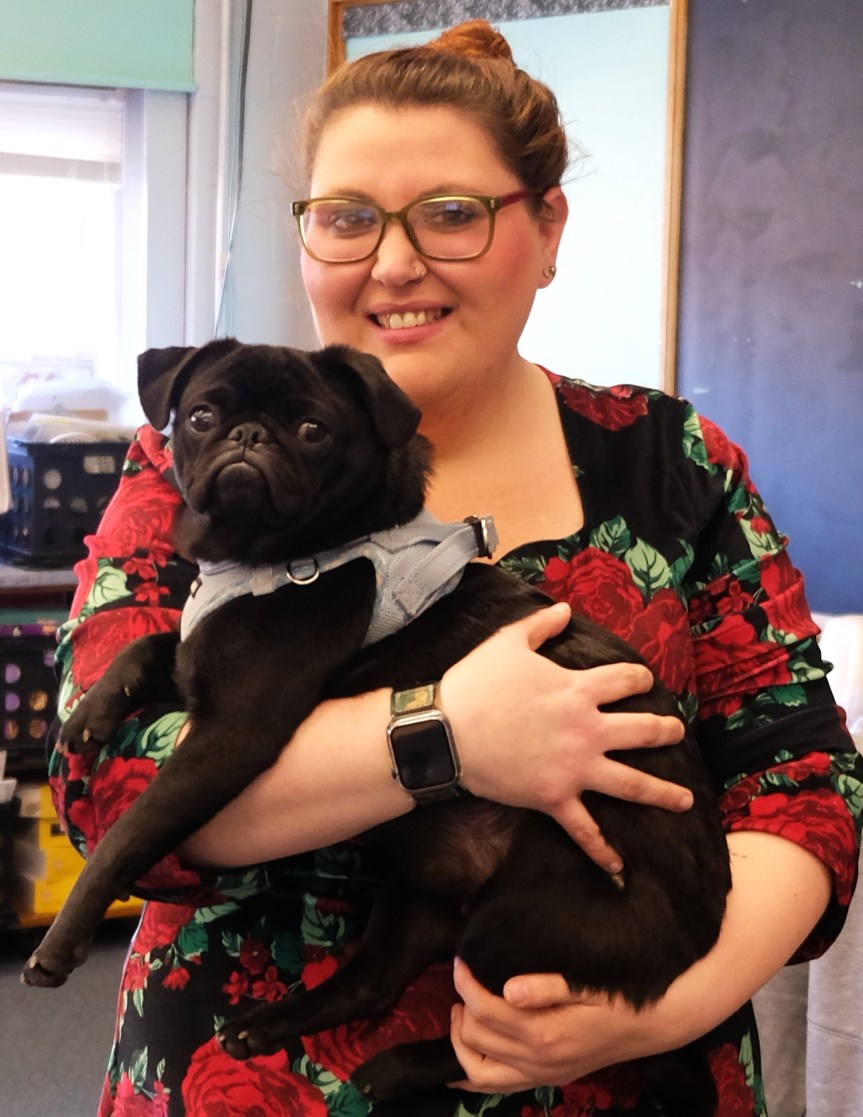
Outside the classroom, Bryant balances her teaching with work as an EMT and the joyful challenge of training Murph, her six-month-old, two-pound service dog. Yet. she says her motivation always circles back to her students.
Growing up with dyslexia, Bryant struggled academically and often felt disconnected from school.
“I want to be the teacher for my students that I didn’t always have,” Bryant said. “I want them to know that their challenges don’t define their potential.”
That philosophy drives everything she does—from global health projects to service dog training.
“It’s all about the spark,” Bryant said. “Seeing students realize that history is happening now, or watching Murph master a new skill—it’s about connection, curiosity, and growth. I want my students to see that they don’t have to stay in one lane. They can be historians, scientists, advocates, and dog lovers all at once.”
Soon, Bryant’s work—along with projects from the other fellowship participants—will be featured on the Pulitzer Center website, extending the impact of her classroom far beyond western Maine.
For her students, though, the greatest lesson may be the simplest: Learning can change the way you see the world—and your place in it.
This story idea was written in collaboration with Mountain Valley Community School. To submit a good news story to the Maine DOE, please fill out the good news submission form.
Maine educators, this is your final opportunity to participate in this year’s statewide professional learning series hosted by the Maine Department of Education (DOE)!
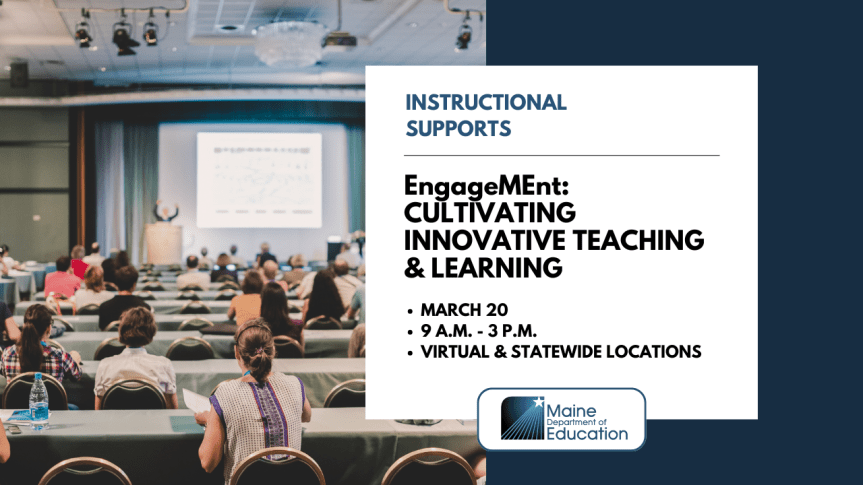
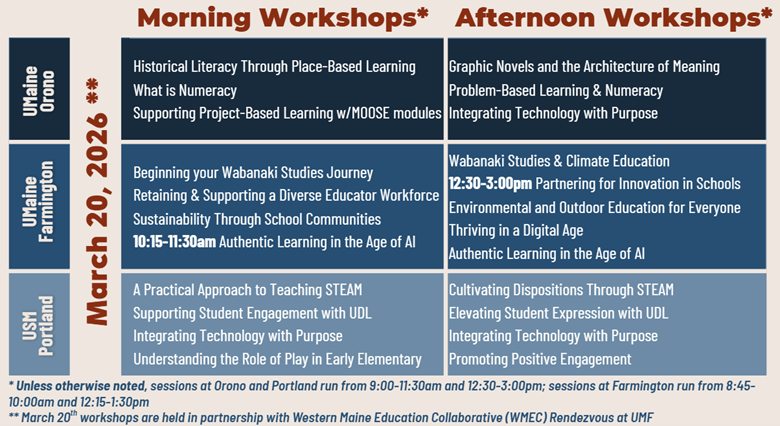
The Maine DOE Office of Teaching and Learning and Office of Innovation invite teachers, ed techs, administrators, and pre-service teachers to join the final professional learning day of the 2025-2026 school year on Friday, March 20, 2026.
In partnership with the University of Maine System, this free, high-quality professional learning experience is made possible through a collaboration with the University of Maine at Orono (UMaine), the University of Maine at Farmington (UMF), and the University of Southern Maine (USM). The Maine DOE is grateful to these institutions for helping make accessible, regionally grounded professional learning available to educators across Maine.
Participants may attend in person at UMaine or USM or virtually via livestream from anywhere in Maine.
All participants are eligible for contact hours, and recordings will be available for asynchronous viewing following the event.
Please register today! Registration can be accessed on the Maine DOE website or in the event brochure, which includes the session descriptions.
Planning to attend in person? Each workshop session offers an interactive experience with limited seating (50 participants per session). Registration is required, so early sign-up is encouraged.
Prefer to participate remotely? Virtual attendance offers unlimited access statewide.
Come as you are. Learn in ways that work for you. Connect with educators across Maine in a welcoming professional learning community grounded in equity, innovation, and real-world learning.
With questions or for more information, please contact Beth Lambert, Maine DOE Chief Teaching and Learning Officer, at beth.lambert@maine.gov.
A partnership note: March 20 workshops at UMF are held in partnership with the Western Maine Education Collaborative (WMEC) “Rendezvous.” Only members of WMEC may attend these sessions in person.
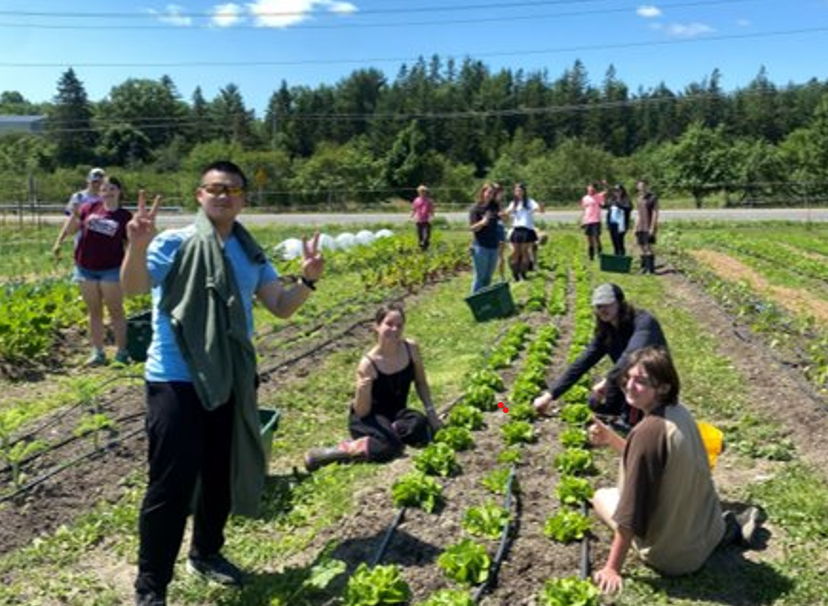
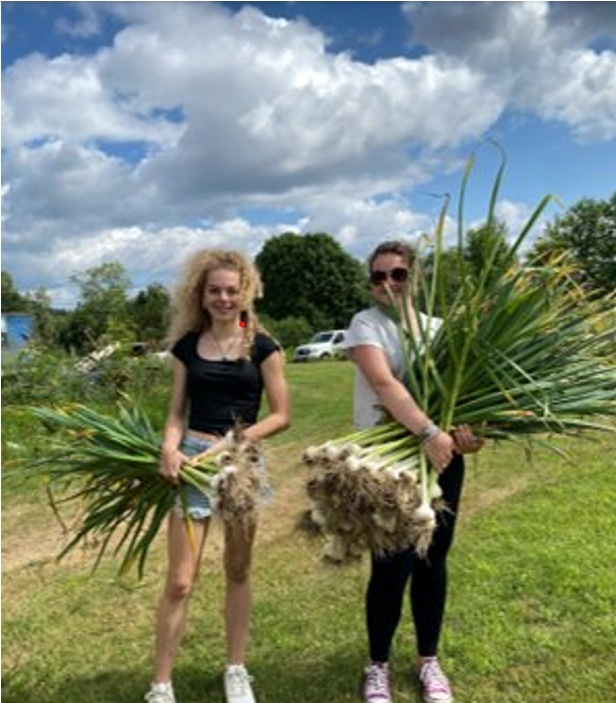
Pictured: Students in Washington County learn how to grow crops.
Since 2022, Maine has invested a historic $7.1 million to expand Extended Learning Opportunities (ELO) programming throughout the state. ELOs provide schools with opportunities to create meaningful connections with employers statewide. In turn, they help young people better understand career opportunities and acquire valuable foundational career skills, including initiative, adaptability, problem-solving, teamwork, and communication.
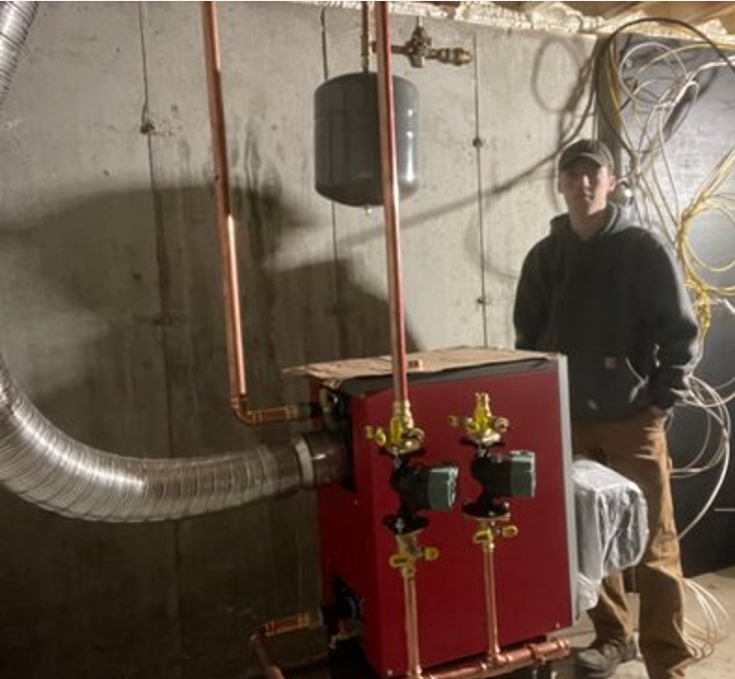
Through ELOs, Maine students are learning by doing. They are earning credentials, such as certified nursing assistant; installing boilers alongside skilled tradespeople; training to become future educators; participating in law-related ELOs; and engaging in countless other hands-on, career-connected experiences.
In 2024, the Maine State Legislature codified ELOs in statute as an approved education pathway. This statute, intentionally written with flexibility, empowers schools and communities to design ELO programs that meet local workforce needs, while honoring student interests and goals.
ELOs by the Number
There have been two rounds of Maine DOE ELO grants. The first round, $5.6 million of the Maine Jobs and Recovery Plan (MJRP), was awarded in 2022 to 26 schools and community-based organizations throughout the state, covering 13 counties. In 2025, the state invested a second round of $1.5 million to support ELO 2.0, which funded 12 ELO programs. These awardees included expansions of existing ELO programming and the launch of new programs.
Between the fall of 2022 and fall of 2025, the Maine DOE grant-funded ELO programs have seen:
3,000+ core and elective credits earned.
6,000+ student participants.
3,000+ new school-employer partnerships.
8,000+ community and business engagements.
These numbers represent more than participation; they reflect aspiration, engagement, and strengthened collaboration among educators and employers, as ELOs continue to become part of the fabric of Maine’s education landscape. (Please note that this data does not include the outcomes of other ELO programs in Maine, such as those that are supported locally or funded through other agencies.
Some examples of these recent investments include ELOs at:
Mountain Valley High School, focused on building local aspirations and local talent.
Brewer High School and Marshwood High School, embedding ELOs schoolwide.
A partnership between the Rural Aspirations Project and Healthy Acadia, expanding ELO access to all high school students in Washington County.
Together, these programs demonstrate that ELOs are not isolated efforts; they are becoming part of the fabric of Maine’s education landscape.
The ELO program at the Maine DOE also works closely with the Maine Career Exploration Program, housed within the Maine Department of Economic and Community Development. This program provides 75 hours of paid career exploration for youth ages 16-24, supporting job shadows, internships, mentorships, apprenticeships, digital learning, independent study, community service, and work-based learning experiences, including ELOs.
Regional Collaborations
Throughout Maine, the Community Coordinators Collaborative (C3) serves as an active educator-led network dedicated to building strong business partnerships that expand students’ access to meaningful career exploration experiences, including job shadows, career talks, workplace tours, and internships. By connecting students directly with employers, C3 helps Maine youth navigate future career pathways and strengthens efforts to retain talent and grow Maine’s workforce. Likewise, there are several regional collaborations, both newly formed and long established, such as the York County, Washington County, and Midcoast Collaboratives, all working to deepen partnerships and expand opportunities within their communities.
Current and Future ELO Opportunities
Career Exploration Survey: On February 6, 2026, a short survey was shared through the Maine DOE newsroom.This survey was designed to identify which school administrative units (SAUs) and Career and Technical Education (CTE) schools are currently engaged in career exploration activities—and to gather insights into what is working, what is needed, and where additional support could make the biggest impact. Responses will help inform statewide efforts related to resources, professional development, and technical assistance for pre-K–12 students and school staff.
Monthly, no-cost, virtual, synchronous professional development hosted by the Maine DOE ELO team: Professionals in the field will share their best practices and resources, and agency partners will present on their programs and how students and school ELO programs may access them. The Maine DOE ELO team will also host office hours for ELO grantees. Please see the Maine DOE ELO webpage for upcoming opportunities.
ELO celebration at the Hall of Flags: Join the Maine DOE ELO team and students/staff from ELO programs statewide on April 30, 2026, from 1-4 p.m. at the Hall of Flags in Augusta.This afternoon will be spent celebrating and raising awareness about ELOs in Maine by highlighting the impactful work of communities, students, staff, and partners. Students will display their ELO work through a student showcase of statewide ELO profiles.
Supporting younger learners in careerexploration: The Maine DOE ELO team will be launching a community of practice (COP) for educators who provide career exploration experiences for younger learners (preK-8). This COP builds on the successful summer pilot, Maine Out of School Time program. (MOST) which supported career exploration for students in grades 4–6. To learn more about MOST, please watch this short video and stay tuned for updates on how to join the community of practice. This expansion reflects the understanding that career exploration does not begin in high school; it begins with early exposure, curiosity, and possibilities!
For further information about ELOs and Maine’s efforts to expand career exploration for Maine students, please visit the Maine DOE ELO webpage or contact Maine DOE Extended Learning Coordinator Lana Sawyer at Lana.Sawyer@maine.gov.
On February 3, 2026, the Institute for Humane Education, in partnership with the Maine Department of Education (DOE) Office of Teaching and Learning, launched the Maine Solutionaries Literacy Engagement Project. This initiative centers on Solutionary learning, an approach that engages students in identifying real-world problems, researching root causes, considering multiple perspectives, and designing ethical, sustainable solutions, while strengthening literacy skills across disciplines.
The in-person kick-off event opened with a reflective prompt, inviting participants to name a skill, habit, or disposition they hope their students develop before leaving their classroom. This question grounded the work ahead and set a shared goal for the next two months to better equip educators to cultivate those outcomes.
This first session featured literacy-focused activities that modeled authentic reading, thinking, and collaboration. Participants rotated through stations to read and analyze texts through a Solutionary lens. A role-based reading and perspective-taking exercise then invited educators to explore the impacts of pollution from the viewpoints of both people and animals. Finally, small-group discussions supported collaborative meaning-making, as participants shared passages and built understanding through structured conversation.
Together, these experiences highlighted core literacy practices, including reading across text sets, explicit vocabulary development, active listening, annotation, and collaborative discussion. The energy in the room was palpable: Although many participants had just met, a strong sense of community quickly formed around a shared commitment to engaging students in meaningful, real-world learning.
As a follow-up to the in-person kickoff, educators from across the state gathered virtually on February 9, 2026, with noted educator and author Cris Tovani. Tovani guided participants in exploring the critical role of background knowledge in building comprehension and deepening literacy skills. Educators reflected on their experiences creating text sets and discussed the power of pairing non-fiction and fiction texts to spark engagement and understanding. This session also focused on curating accessible resources that promote universal access and support ongoing inquiry.
The Maine DOE’s Solutionary-integrated literacy work is set to continue, with additional virtual sessions scheduled later this month and into the spring.
For further information, please contact Kathy Bertini, Maine DOE Interdisciplinary Instruction Coordinator, at kathy.bertini@maine.gov.
Title 4A funds received from the U.S. Department of Education (ED) support the implementation of this project. The project has an award totaling $50,000, of which $50,000 is federally funded and directly attributed to project implementation. The contents are those of the author(s) and do not necessarily represent the official views of, nor an endorsement by, ED or the U.S. government.
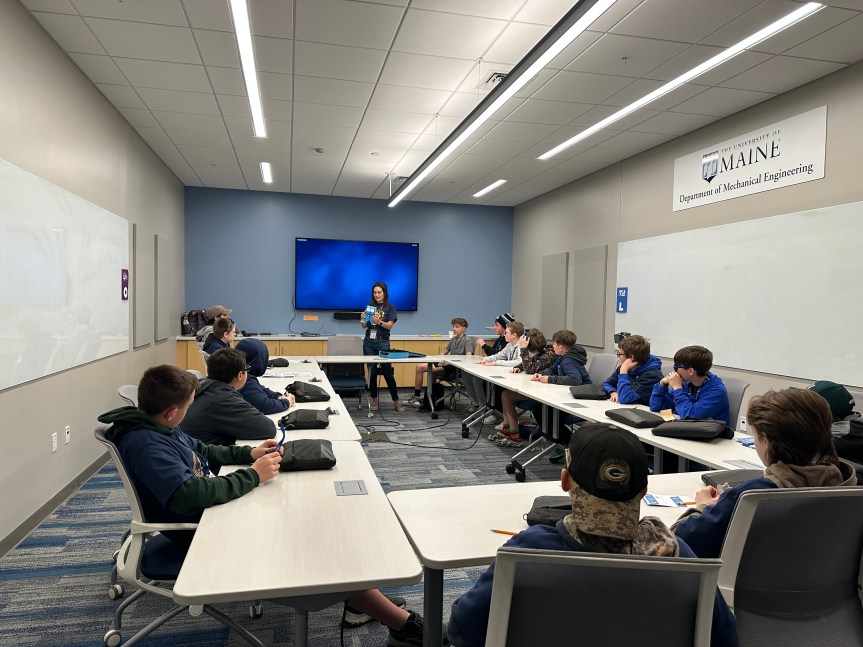
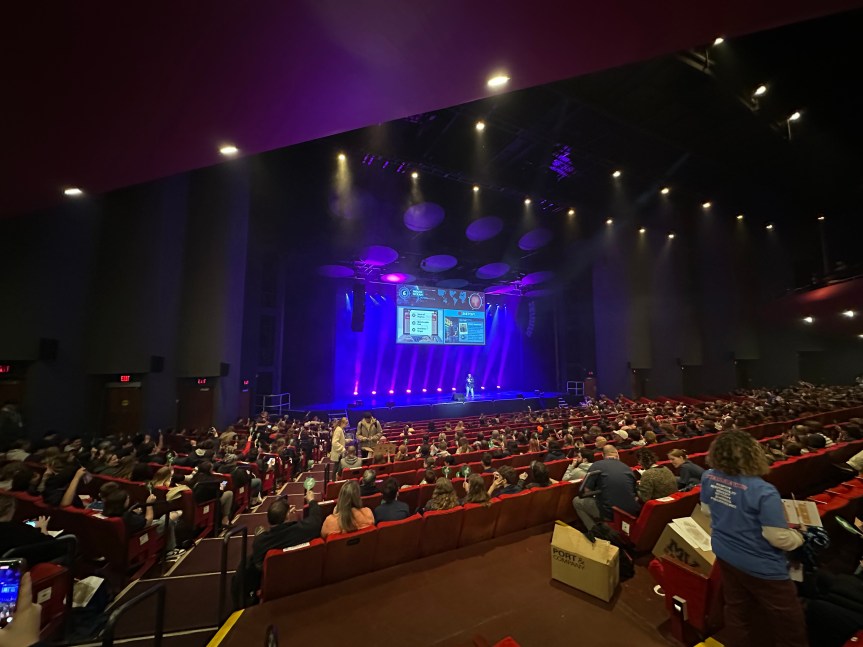
Registration is now open for the Maine Department of Education’s (DOE) 23rd annual Maine Learning Technology Initiative (MLTI) Student Conference. The deadline to register is March 27, 2026.
The conference will be held on May 21, 2026, at the University of Maine campus in Orono. This statewide event is open to all MLTI school administrative units (SAUs) and is expected to welcome more than 1,000 students in grades 5-10 for a full day of hands-on learning, creativity, and exploration.
How to Register for the Conference
Step 1: Request your registration packet. Complete this brief form to receive your comprehensive registration packet via email.
Step 2: Submit your registration materials. Fill out the packet and use the included link to upload the required documents. Registration must be completed by March 27, 2026, to ensure correct conference T-shirt sizes for your group.
Step 3: Sign up for sessions. Once your registration is reviewed, you will receive a link to select sessions. Sessions fill up quickly and are first-come, first-served, so early sign-up is encouraged!
About the Conference
This year’s theme, “Full STEAM Ahead,” invites students to explore the world of STEAM (science, technology, engineering, arts, and mathematics) through engaging, hands-on sessions. Past topics have included:
Multimedia creation
AR/VR
3D design
Robotics
Machine learning
Game design
Students will receive a conference T-shirt designed by a fellow student. The T-shirt design contest is currently open through March 20, 2026. Additionally, the call for session proposals for both students and educators is open through March 20, 2026.
The event will conclude with a large-scale, interactive “Global session,” bringing hundreds of students together for a collective experience.
With questions about the MLTI Student Conference, MLTI Maine Winter Classic, or other MLTI events, please contact Maine DOE MLTI Project Manager Bethany Billinger at bethany.billinger@maine.gov.
MLTI is part of the Maine DOE Office of Teaching and Learning.


 Maine DOE Newsroom