Book Study – Finding Your Blind Spots: 8 Guiding Principles for Overcoming Implicit Bias in Teaching

Join the Maine Department of Education’s (DOE) Office of School and Student Supports (O3S) as they read and reflect on Finding Your Blind Spots: 8 Guiding Principles for Overcoming Implicit Bias in Teaching, by Hedreich Nichols. Members of the Maine DOE introduced this book study to participants at the Educator’s Summit in early August, and have also introduced participants to the author! The O3S first heard Nichols’ work on Jennifer Gonzalez’s podcast: Uncovering Your Implicit Biases: An Exercise for Teachers | Cult of Pedagogy.

Hedreich Nichols is an educator, writer, and passionate advocate who is sharing her lived experiences with readers and participants of this book study so that we can be reflective practitioners and can truly understand bias. You can also find her work and conversations but searching #Smallbites on Twitter. Check out the author’s website to learn more about the book.

This opportunity is open to all Maine educational personnel.  Sessions are being held on Thursdays – either at 3:00 pm or 7:00 pm.  Participants are welcome to join for both or just one session! January 26, 2023 is our first offering, and we will be reflecting on chapters 1-3.

Register here and choose your time preference.

Future sessions are scheduled on February 9, 2023 and February 16, 2023. CEUs are offered for participation (8 hours). For any questions about this opportunity, please contact Maine DOE Family Engagement and Cultural Responsive Specialist Melanie Junkins at melanie.junkins@maine.gov.

Seeking Educators to Pilot MOOSE Platform; Info Session 1/18/23

Do you want to explore and implement innovative curriculum this spring? Are you interested in expanding your impact outside your classroom/school? The Maine Department of Education (DOE) is currently looking for dynamic, creative, and collaborative educators to pilot MOOSE modules and would love to have your class participate! 

Now in its third year, Maine’s Online Opportunities for Sustained Education (MOOSE) platform continues to grow. Last year, we added PreK-12 Learning Progressions to our already robust bank of MOOSE modules – created by Maine teachers for Maine students. These modules center on interdisciplinary, project-based learning experiences that are accessible, inclusive, and available for free online. 

Feedback on the modules themselves and their usability is vitally important as we are constantly improving existing modules and applying lessons learned to new creation. We are looking for Maine educators interested in using an existing MOOSE module in their classroom with five (5) or more students and providing feedback about the experience. You get to decide the module(s) you want to pilot based on what works best for you and your students this spring. Stipends will be provided for up to two modules ($500 each) that you have piloted and provided feedback on. All required elements must be completed by June 30th, 2023. 

If you are interested in applying but still have questions, the MOOSE team will be holding a Q&A session via Zoom on Wednesday, January 18th, 2023 from 3 – 4 pm. Registration for the Q&A session can be found here. The session will be recorded and sent to anyone who registers even if they aren’t able to make it in person. Questions can be submitted ahead of time to be answered in the session.

For more information, please contact Jaime Halbmaier Stuart. Jaime.halbmaier-stuart@maine.gov 

If you are ready to apply applications can be found here. Applications are due by January 27th, 2023. 

Expansion and Revisions to Computer Science Integration (CSI) Initiative

In an effort to be responsive to the feedback we’re receiving about the Computer Science Integration (CSI) Initiative, the Maine Department of Education has redesigned the CSI Initiative to better meet the needs of Maine’s education field. Please find the new design and expectations below. We hope that this will help to alleviate concerns that folks had in participation. 

In this new design, we’ve shortened the duration of our first cohort to January 2023-September 2023 and we’re offering two tiers of engagement:

  • CSI Educators can engage in Tier 1 only or;
  • CSI Educators can engage in Tier 1 and Tier 2 (CSI Educators who engage in Tier 2 must engage in Tier 1) 

Tier 1

In Tier 1, educators will engage in CSI PD and work to create “Artifacts” (model lessons, support resources, coaching models, etc.) for their school and to share statewide. Educators will be provided a stipend of $1,500 to engage in computer science integration PD and work with educators within their school to contribute to a repository of computer science integration artifacts that will be available to educators statewide. 

Tier 1 will engage educators in Maine DOE provided CSI PD; work will be virtual/remote and meetings will occur outside of school time; Tier 1 PD will consist of virtual meetings and asynchronous activities and discussions. 

By September, Tier 1 CSI educators will feel confident in their understanding of computer science integration and will have successfully worked with other educators in their school to integrate computer science into existing lessons and class time. CSI educators will contribute to a repository of computer science integration artifacts that will be available to educators statewide. 

Tier 2

In Tier 2, CSI educators will engage in the Maine DOE’s CSI Summer Institute and CS Showcase. Educators will be provided a stipend of $1,000 and travel expenses, to attend the CSI Summer Institute and present at the Computer Science Showcase. These are in-person events that will take place during the summer of 2023, dates and locations TBD. 

Tier 2 will consist of a multi-day summer institute and the CS Showcase. Educators will engage in a multi-day institute where they network, collaborate, and work together to grow computer science across the state and in their own schools. These educators will also take part in the CS Showcase, showing off some of the awesome work they’ve done throughout the past few months of CSI. 

Expansion of the CSI Initiative

Additionally, we’re excited to announce that we’re able to expand this opportunity beyond one educator per school! This will allow schools who have more than one educator interested in this initiative to take part! 

To nominate an educator to be a part of this exciting opportunity, please complete this brief form. 

If you have already completed a nomination, there is no need to resubmit. We will be contacting all nominees that have already been submitted to provide next steps before the end of the day on Friday, January 6th. 

If you have questions or would like more information, please reach out to Maine DOE’s Computer Science Specialist, Emma-Marie Banks, at emma-marie.banks@maine.gov 

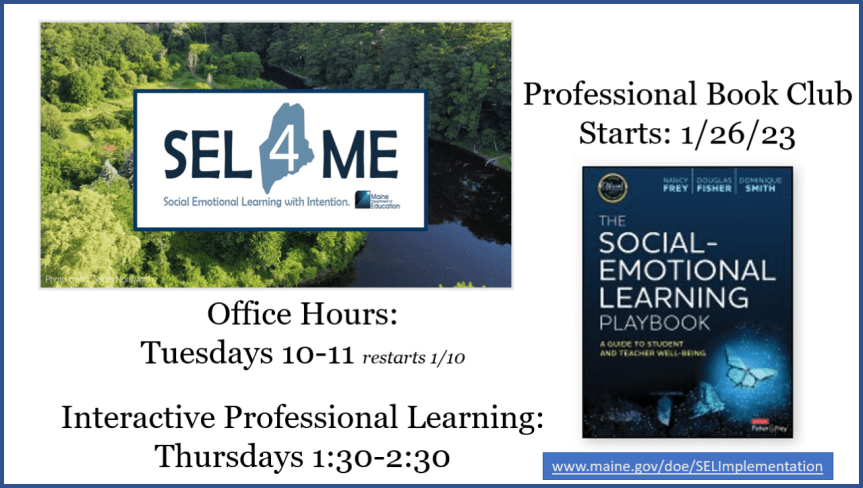
Winter/Spring Social Emotional Learning Implementation Office Hours and Professional Learning Opportunities

Please join Maine Department of Education (DOE) Social Emotional Learning (SEL) Specialist Sarah Norsworthy for the following SEL Implementation Professional Learning Opportunities being offered this winter and spring. Professional learning about SEL Implementation will occur in 4 strands, read & discuss, thinking routines, picture books and EdTech.

  • Weekly Open Office Hours: Tuesdays from 10:00-11:00 AM – Drop in with questions, comments, or for connection. Offered virtually – Pre-Register here Via Zoom Link
  • Weekly Interactive Professional Learning Opportunities: Thursdays from 1:30 – 2:30 PM – Offered Virtually – Pre-Register here Via Zoom Link. Each session will start with 20 minutes of focused learning followed by a conversation on classroom application. More info is available on the SEL Implementation Webpage. Upcoming sessions include:
    • 1/5/23 – Using Pear Deck To Build Belonging/Social Awareness
    • 1/12/23 – Picture Book Spotlight: Learning About Ourselves & Others. My Name Is An Address – A pronunciation guide is linked here. We will explore this book and talk about extending it within classrooms. Bring a copy – if you can.
    • 1/19/23 – Thinking Routine Spotlight: Developing Belonging, Social Awareness & Curiosity
    • 1/26/23 – Book Group: The Social Emotional Learning Playbook Module 1. Join ready to discuss module 1. Educators are encouraged to join with colleagues to continue the conversation within your schools.

Join the SEL Listserv for regular updates, and bookmark the SEL Implementation Webpage – resources and information are being regularly added.

For more information contact Sarah CB Norsworthy, Maine DOE SEL Implementation Specialist at sarah.norsworthy@maine.gov.

2023 Maine School Winter Wellness Summit: Prioritize Your S.E.L.F.

Prioritize Your S.E.L.F. – Sleep. Eat. Laugh. Fitness. “Be the best you, so you can be your best for your school.”

Join your colleagues from across the State to refill your wellness toolbox! This is a professional (and personal) learning event that will feature outstanding keynote speakers and engaging health promotion and wellness sessions. There will also be opportunities to learn about state programs and local school district wellness teams, successful wellness strategies, resources, and programs to can help build an action plan for healthier staff, students, school community, and learning environments.

When: Friday, January 27th from 8:00 a.m. – 3:30 p.m. (Snow date February 3rd)
Where: The Samoset Resort, Rockport, ME
Who: School and community individuals and teams of 2 or more interested in schoolsite health promotion and wellness
Cost: Early registration extended to January 6 from December 30 – $60/person. Regular registration after January 6 – $75/person. Late registration after January 20 – $90/person; Registration closes January 24. Morning Refreshments and lunch included in registration. Contact hours will be available. *If you will be paying by purchase order please contact susan.berry@maine.gov before you register. Now available: Scholarships to support access to the 2023 Winter Wellness Summit. Visit the website for details: Employee & Student Wellness Professional Learning

Our theme is focused on the importance of healthy habits and how they are interconnected. All areas of health will be addressed, (physical, mental, emotional, social, etc.) with knowledge and skills/strategies shared to enhance daily health practice. The content will support all within a school community promoting overall health and wellness.

Keynote Speakers:

Nancy H. Rothstein
Nancy H. Rothstein

The opening keynote speaker, Nancy H. Rothstein, aka The Sleep Ambassador®, is a globally known sleep expert on a quest to raise awareness, educate and provide strategies to optimize sleep for all. Sleep is integral to health, performance, productivity, safety, and well-being. This is a challenge for many so expanding our understanding of the impact of sleep, or not enough sleep, on our health is vital to our performance and well-being. Nancy’s goal is to empower people to enhance their sleep so they can live at their best.

Larry Weaver
Larry Weaver

The closing keynote, Larry Weaver, is a comedian and motivational speaker who delivers a one-of-a-kind, interactive, and uplifting message. He will illustrate keys to a positive attitude that are crucial to success and… simply having more fun at work! Larry will leave you laughing, learning, and better equipped to become more positive in your personal and professional life.

The goal of the Maine School Winter Wellness Summit is to inspire and empower participants to take care of one’s health and create healthier, more positive, and safer schools for all school personnel and students by engaging in health promotion and improving personal health and well-being and enhancing academic achievement.  In addition to the keynote presentations, this year’s agenda includes time to network with colleagues and professionals from across the state who value and practice health promotion and wellness, engaging and educational workshops on personal wellness practices and programs to support positive school environments, and support for worksite wellness program planning.

For more information visit the Maine DOE Employee and Student Wellness Website.  Contact susan.berry@maine.gov if you have any questions and please plan now to join us for the 2023 Winter Wellness Summit!

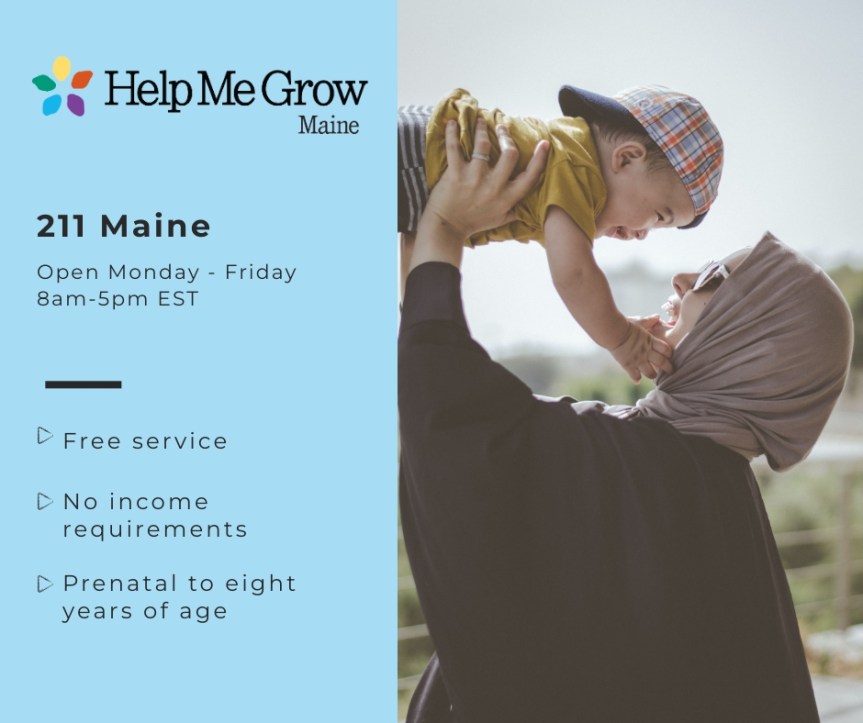
Help Me Grow Maine – A Free Resource to Connect Children and Families to Services

We are excited to share the launch of Help Me Grow Maine, a resource developed by Maine’s Department of Health and Human Services. This is a free, easy-to-access resource that connects children up to 8 years of age and their families, as well as pregnant people, with information and services related to child development and other family needs. Please share this resource with your school support staff, families, and school communities.

More about ‘Help Me Grow, Helping Families in Maine’

The earliest years of a child’s life present great opportunities to promote positive outcomes that will set a trajectory for the rest of their lives. Resources and services to address the needs of families with young children must work together as a coordinated system to have the greatest possible impact in this critical developmental time frame.

Throughout the state of Maine, there is an existing grid of resources to help provide for the development and well-being of Maine’s children. This grid works as designed for some families; they easily connect and receive a consistent supply of what is needed to support them. For many other families, though, connecting with the grid is a challenge. They can’t readily plug in, and if they do connect, they experience an inconsistent flow of resources, for a variety of reasons. Those reasons could include confusing eligibility requirements, difficulty reaching or hearing back from a resource after trying to connect, siloed programs with limited knowledge of each other, and many others. These challenges and more can prevent families from connecting with the supports they and their children need to be healthy in every way.

Help Me Grow Maine exists to strengthen this resource grid. This is accomplished by connecting families to providers, and providers to other providers, in ways that improve success in access. Help Me Grow’s Resource Specialists support families all over the state, and importantly, also report to stakeholders and policymakers the ongoing needs in our communities. Our central access point is a way for all families of children birth to eight, as well as pregnant people, to reach out and be linked with information, resources, and referrals to the already-existing services that are part of the grid here in Maine. We are a low-barrier resource, requiring no formal referral from a professional, no financial or diagnostic criteria, and no paperwork to complete to begin the process.

Reasons to reach out to Help Me Grow include:

  • You are working with a family that needs additional supports, but you are unsure what they are eligible for/where to refer them.
  • A family needs support in getting successfully through the process to connect with a program or resources (CDS, Targeted Case Management, Early Care and Education settings, etc.).
  • You would like to speak as a professional with a resource specialist about what resources are available for a family you are working with, or about resources in your area in general.
  • You would like a child to receive a developmental and/or social-emotional screening.

Help Me Grow is now available statewide. Support through Help Me Grow can be accessed by both families and providers by calling 207-624-7969 or via our online referral portal found here: Help Me Grow Maine Online Referral. Families can also access support via our partnership with 211 Maine; when calling 211, Option 5 will transfer callers to a Resource Specialist from Help Me Grow, and 211 specialists also collaborate to provide “warm transfers” of callers to Help Me Grow when appropriate.

For more information or to complete a developmental screening, please visit our website. You can also reach out to Melinda Corey, Help Me Grow Outreach Specialist, to learn more (207-441-1553, call or text; melinda.corey@maine.gov).

Deer Isle Stonington High School Students Pitch in to Improve Elementary Outdoor Classroom

School Union 76 was awarded funding for a Rethinking Responsive Education Ventures (RREV) pilot project last year to create outdoor learning spaces for students across the district. With those funds, the district has created an ADA-accessible boardwalk with an adjacent ADA Outdoor Classroom that is part of a nature trail, both are designed to be inclusive for all students to be able to engage, connect, and explore and significantly boost their student learning proficiencies across all subjects – and even the students are pitching in to make improvements to the new spaces.

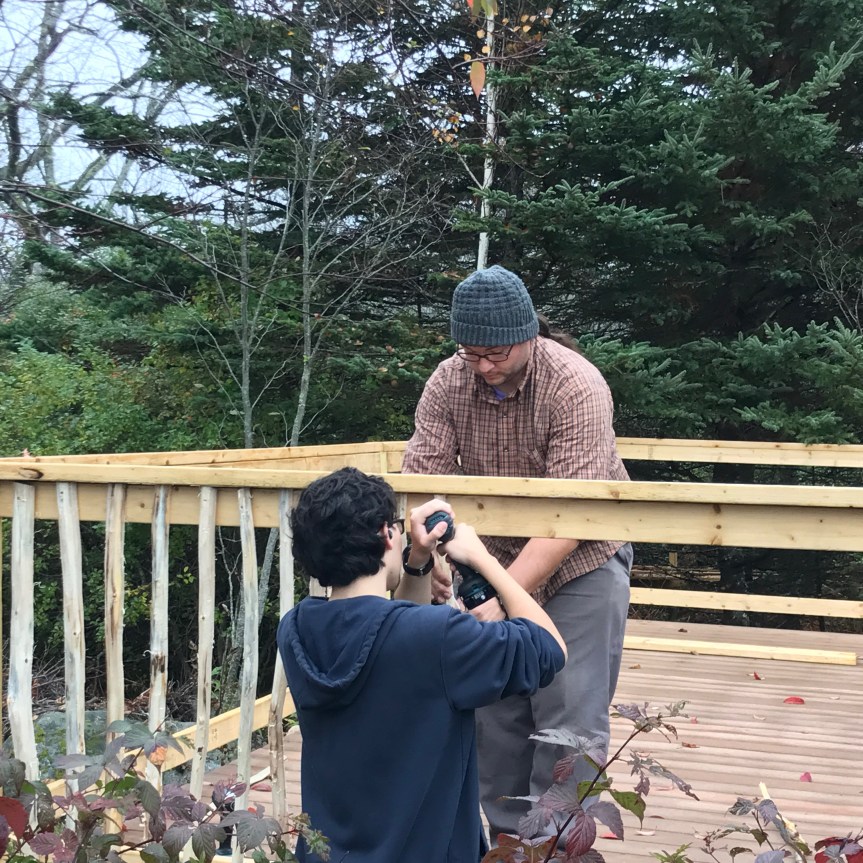
As part of regular maintenance to the district grounds, many saplings were taken down this past summer in the process of maintaining the campus driveway and the well. One of the teachers wisely set them aside, rather than sending them to the local dump. After agreeing to build the railing, Deer Isle Stonington High School students taking a course named Construction I class measured and planned their project. Then, they stripped the bark from the aspen, maple, and beech trees and cut the pieces to the correct length to assemble a beautiful railing for the new Outdoor Classroom. Visitors can see by their handiwork that they considered spacing and the shape of the branches as they installed the branches.

In addition to this upgrade, 7th graders have also stepped in to help. After hearing of the desire from the kindergarten classes for immediate seating, they rolled stumps leftover from prom into the space.

“The end result is stunning!” Remarked Science Teacher Mickie Flores. “Students and staff at both the elementary and high school are enjoying the space as a place to be outdoors and a place to learn,” she added.

RREV is an initiative of the Maine Department of Education, funded by the Education Stabilization Funds through the US Department of Education’s Rethink K-12 Education Models, that bolsters Maine educators’ innovative efforts to support their students with agile, effective, and resilient learning experiences that improve learning outcomes for all students.  

Martin Mackey, the former RREV Project Director who tragically passed away in April of 2022, embodied the RREV spirit: to think and act boldly to meet the needs of students. His passion was to “change lives.” As such, he challenged each and every RREV participant to do just that as they designed pilot ideas that would ultimately have a lasting systemic impact on students.  After 18 months of leading RREV, Martin’s passion had been passed on to over 200 educators who had participated in innovation professional development. From those educators, over 40 Pilot ideas were brought to fruition and have received over $8 million in RREV awards. Through their pilot ideas, these educators have pledged to commit themselves to innovation. 

The Maine DOE encourages all schools and districts across the State of Maine to learn more about these innovative educators and their RREV pilots through the RREV website and the online RREV collaborative platform known as EnGiNE. It is through EnGiNE that we all hope to continue the Martin Momentum to change students’ lives through innovative and responsive educational programs. 

Winter Virtual Events Hosted by the National Center for Community Schools

The National Center for Community Schools is hosting the following virtual events this winter. For more information about these events email them at nccs@childrensaidnyc.org.

Webinar: Essential Resources for Driving Community Schools Forward
Thursday, January 12, 2023, 3-4 PM ET | Virtual | Free

The Community Schools Forward task force, convened by four national partners —the Center for Universal Education at Brookings, the Children’s Aid National Center for Community Schools, the Coalition for Community Schools, and the Learning Policy Institute—brought together national and local community school practitioners and advocates to identify and create field-informed resources to align, build, and scale evidence-based, effective, and sustainable community schools.

On January 12, join a webinar to launch the Community Schools Forward task force’s essential community school resources. The webinar will delve into the process of creating the essential resources and underscore their most important aspects. Following a keynote conversation and a framing presentation, a moderated panel discussion of experts—including NCCS Director Abe Fernández—will share their perspectives on what makes this a unique moment for the education field and how the work of the task force can advance community schools. – Register here

Community Schools 101 – January 5 | Virtual | Free

While a growing number of school districts across the country are adapting and scaling the strategy, there are still leaders, practitioners, and partners that have questions about what it means to be a community school and how to get started. This free virtual session, led by the NCCS team, will provide an introduction to the foundational elements of the community school strategy and how it can work for your school community. Register here

Community School Coordinator Boot Camp – January 31 – February 3 | Virtual

A professional learning opportunity exclusively for community school coordinators. Coordinators will learn foundational skills, develop an action plan, and build a network of peers. Check out our Agenda at a Glance and register today! Register here

Community School Supervisor Boot Camp – February 10 | Virtual

A half-day professional learning opportunity for those who supervise community school coordinators. Attendees will learn about coordinators and how to support them, strategies to navigate and build relationships across a school system, and collaborative practices to successfully develop the community school strategy. – SAVE THE DATE!

Windham High School Students Practice Skills in Civic Engagement and Dialogue with Elected Officials

Approximately 20 Windham High School (WHS) students participated in three separate day-long retreats entitled the “Can We? Project”. Building up to the third retreat, students learned the skills of ‘listening to understand’ through a series of story exchanges. Then, using what they learned in the first retreat, students practiced their listening skills by discussing divisive topics at the second retreat where students chose political and social issues they deemed essential.
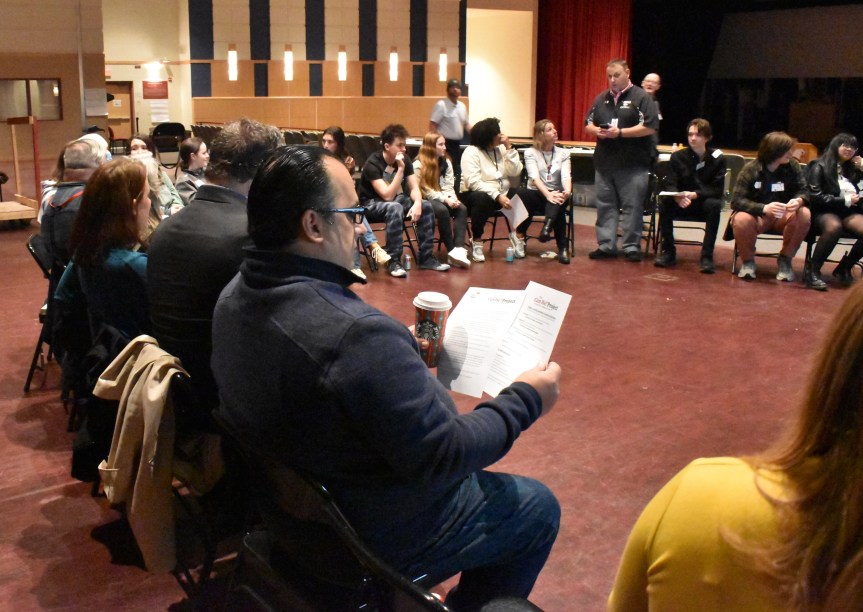
On the last day of the Can We? Project retreat, Wednesday, Dec. 7th, students practiced civic engagement skills by presenting their perspectives on their areas of concern to elected officials from the Windham Town Council and the RSU 14 School Board.

Students shared concerns from a global and local perspective ranging from various social, political, and environmental topics.

The students only had 1 ½ hours to choose from one of the issues established by the group to develop an argument. After their presentations, the elected officials were offered an opportunity to ask questions or give an opposing viewpoint to consider.

WHS English teacher, and Can We? Project liaison Chelsea Scott said four student groups and one teacher group presented to the officials in about an hour.

“The student’s level of courage was admirable,” Scott said. “They transformed feelings of anxiety into action and used the little time they had to prepare to create insightful presentations.”

School board member and chair, Kate Brix, was impressed with the students and the Can We? Project process, stating that it was a powerful example of the importance of student voice.

“Student engagement is a core belief of RSU 14’s strategic plan, and the students of this project were extremely articulate and respectful as they presented their viewpoint on a topic important to them,” she said. “The students I met clearly illustrated that they care and think deeply about issues that impact all our lives. I can’t say enough about how impressed I was with them and know that the skills they learned will be put to good use beyond their high school years.”

Town Council member and chair Mark Morrison said the project was timely and a valuable lesson in learning respectful dialogue between people with differing viewpoints.

“We saw the students apply and follow the program process with their presentations which stressed presenting respectfully, listening, and asking questions in a way that did not make the dialogue personal,” Morrison said. “I hope this program continues so the students learn the skills needed to effectively communicate so the focus is on the ideas where the pros and cons can be discussed and measured, not on the person. I hope I’m invited back to participate in another discussion.”

After the presentations, the students had an opportunity to reflect upon what they learned most.

“I realized I need to do more research about my subject,” stated senior Teddy Becker.

Junior Mareena Batsungnern said participating in the Can We? Project helped develop her skills in leadership. “It has also given me the courage and motivation to voice my beliefs to others.”

Junior Griffin Moreau said the Can We? Project taught him something that many of us try to learn in an attempt at deep listening. “The thing I think that I learned the most is, ‘be comfortable with silence’. It is something that I have struggled with all my life and have only started to realize the answer to and the Can We? project has helped with that.”

Scott stated that the Can We? Project was instrumental in empowering the students to truly listen to each other and discuss divisive topics with empathy and a desire to understand rather than to react.

“Participants have expressed that they feel supported, surprised, and inspired by this program and that they now have the tools and knowledge to participate in their own democracy,” she said.

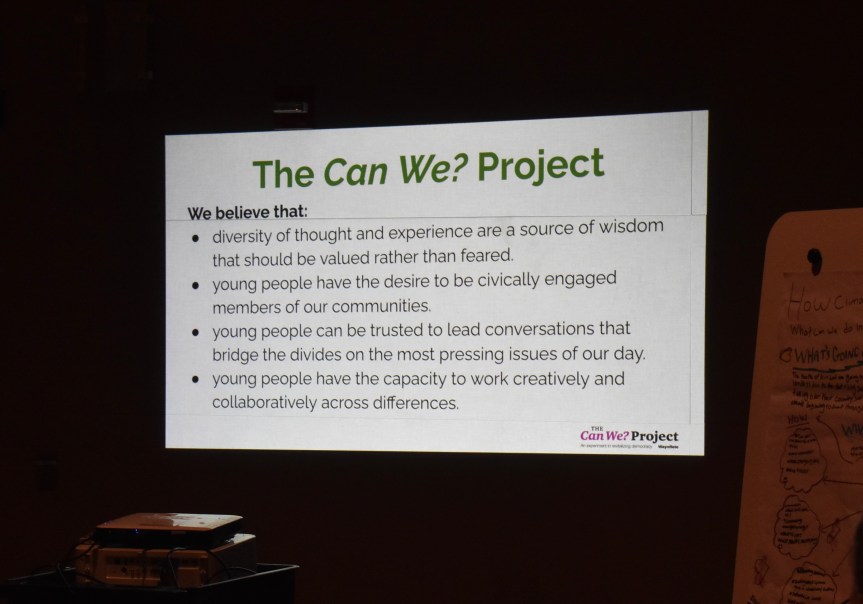
Briefly, the Can We? Project was developed collaboratively between the Third Thought Initiatives for Civic Engagement from Waynflete School and the Maine Policy Institute. The mission is to allow high school students the opportunity to engage in thoughtful dialogue across different perspectives.

All three retreats were held at WHS and guided by John Holdridge, the Director of the Third Thought Initiatives for Civic Engagement, and Jacob Posik, the Director of Communications from the Maine Policy Institute. The twenty students were self-selected to participate and represented a true cross-section of ages, academic foci, family experiences and interests.

Students will have the opportunity to expand their experiences with other high school students across the state who also participated in the project, taking their experiences and practice of civil conversation and dialogue to the next level. In addition, WHS teachers who participated in the retreats plan to incorporate the project as an initiative for the whole school.

A thank you goes to the following elected officials who gave the gift of listening and allowing students to practice skills of civic engagement and dialogue respectfully. Thank you to Windham Town Council members Mark Morrison, Dave Nadeau, and Nick Kalogerakis. RSU 14 school board members (Kate Brix, Kate Leveille, Char Jewell, and Jessica Bridges) and former State Representative Patrick Corey.