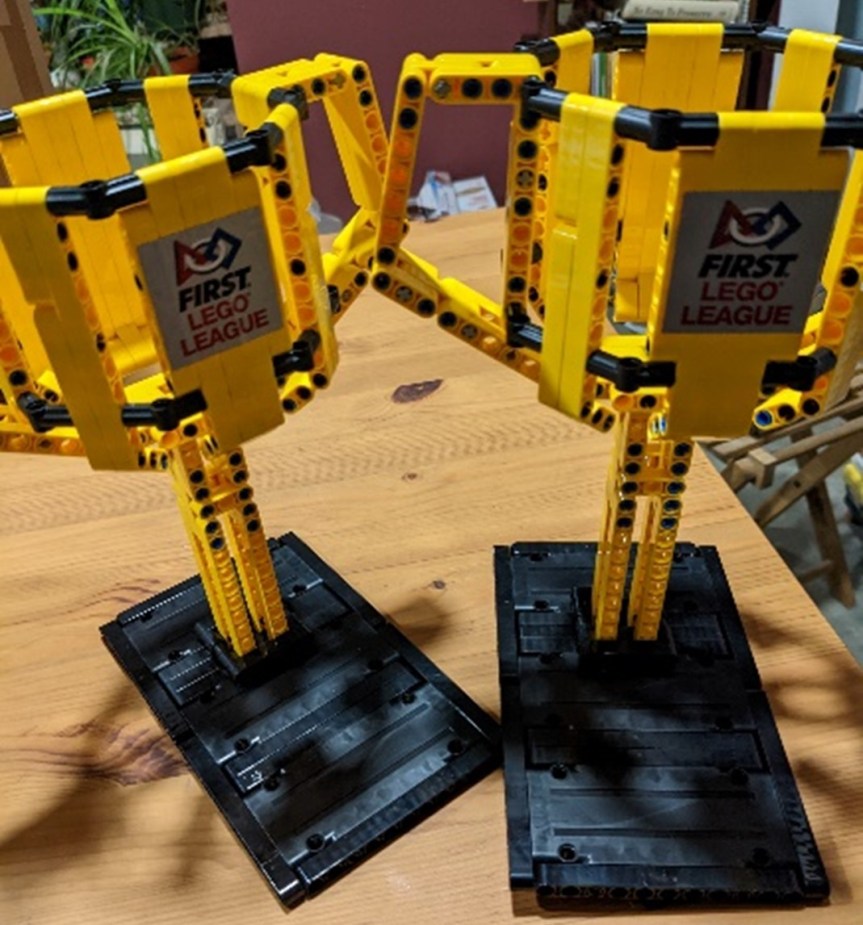
Middle School Teams Prepare for the FIRST Lego League (FLL) Robotics Competition

Spruce Mountain High School in Jay will host the Maine FIRST LEGO League Challenge State Championship with teams from all over the state this weekend. After a small-scale event at Messalonskee last year and no in-person event the year before, this FIRST Lego League (FLL) event aims to move a step closer to excitement and engagement that only the Civic Center in Augusta could contain! Every season, FIRST has a new theme that goes across its different groups. “Energize” is the theme for the 2022-2023 season with an emphasis on energy generation, efficiency, and use. At the FIRST LEGO League (FLL) level, teams will take part in the “Superpowered” challenge and “explore where energy comes from and how it is distributed, stored, and used – and then put their superpowered creativity to work to innovate for a better energy future.”

This year’s event will have 25 teams competing from across the state. Three of the teams competing this year are the Veazie Vikings (Team 26180) from Veazie Community School, the STEAM Powered Knights (Team 34104) from St. George Elementary School and the RoboSharks (Team 14407) from the Shapleigh School.

The Veazie Vikings Robotics team started in 2016 and are looking to have another successful showing coming off their success last season, which included two awards. They won the Maine Global Innovation Award with their “Veazie Moves” app design and had the highest scoring robot in the competition. Their success even led to a feature on NewsCenter Maine. This year’s team has a mix of veteran and rookie middle school students who each get to build and program a robot. Combining the building and programming to complete assigned tasks on a game field is really what brings the team together. Team coach Brian Gonyar said, “Students learn teamwork. They share ideas, successes, and failures.” Working around students’ busy after-school activities can be challenging, but they are able to practice most days. The team project that focuses on biomass energy production has been an undertaking, but they are optimistic.
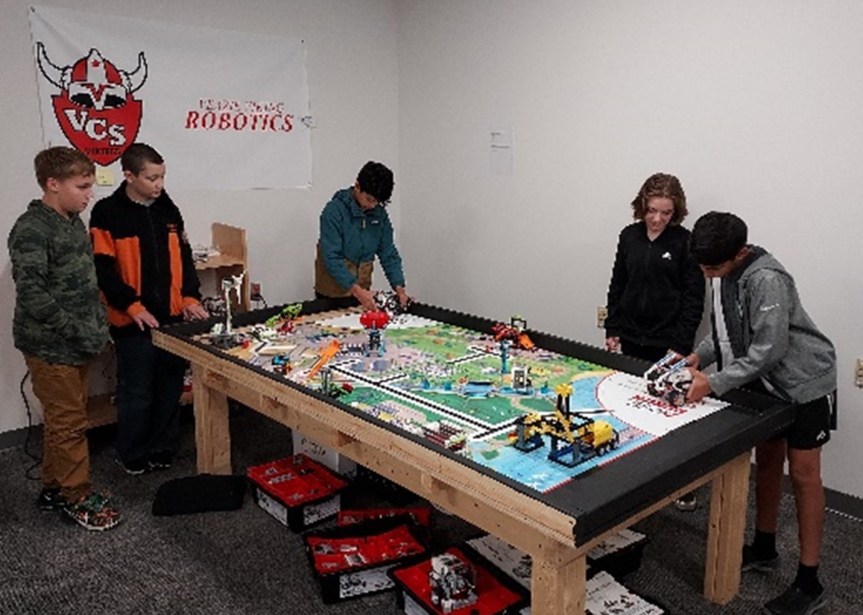
St. George Elementary School’s team was formed by STEAM teacher Amy Palmer and Technology & Makerspace Director Paul Meinersmann in 2017. Team 34104 has not had a straight path. After participating in the state competition in 2017, the team is finally returning to the event held in Oakland last year. This year, they will be returning to the Maine FLL State Championship with a completely new group of students. Like many robotics teams in Maine, they are rebuilding their program after going dark during the pandemic. This new team, who renamed themselves the STEAM Powered Knights (they were formerly the “Electro Dragons”), are looking to charge back into robotics action this year.

Shapleigh School will be making their debut at this year’s event. Fifth grade teacher Heidi Randall went through the necessary training this summer to begin coaching a team this school year. They were in the starting process in 2020 and are excited to be able to finally organize a team. “It was certainly a learning year with a huge learning curve,” said Randall, “Our enthusiasm is high as we are getting the final week after the break!”  For students and coaches alike, the first time going to an event is a learning experience, but one that will help the team grow and better prepare for the future.

On December 3, 2022, the Veazie Vikings, the St. George STEAM Powered Knights, and the Shapleigh RoboSharks will join many FLL teams at Spruce Mountain High School for the Maine FIRST LEGO League Challenge State Championship. This is event is free and open to the public. Children of all ages can watch FLL teams compete. There is still a high need for volunteers to help at this event in a variety of capacities. If you have any interest in volunteering at this event, please contact Geoff Cyr (geoffrey.cyr@gmail.com). To learn more about opportunities for Robotics in Maine schools, check out Robotics Institute of Maine (RIM). For information about computer science in Maine schools, please check out the Maine Department of Education’s Computer Science page. If you have a robotics success story at your school, email jonathan.m.graham@maine.gov.
Computer Science Mobile Lab – Training Webinars and Support Resources

Join us during Computer Science Education (CS Ed) Week for FREE virtual training for the mobile computer science labs! We’re excited to announce that we’ll be hosting webinars throughout next week to help folks get started with their lab equipment. These will be vendor-provided trainings and will cover the basics of unboxing, configuring, and getting started. Webinars will be live and recorded. Recordings will be posted to the website once they become available.

Additionally, we’ve put together a webpage to provide immediate resources and support for each mobile lab option. These resources offer some quick access information to help get going with the equipment

To check out these resources, learn more about the webinars, and to register, click here. You’ll see the mobile lab options and can find quick start resources as well as the registration links for the webinars.

If you have questions or would like additional information, please reach out to Maine DOE’s Computer Science Specialist, Emma-Marie Banks at emma-marie.banks@maine.gov

NEO and Synergy – State Reporting Training

The Maine Department of Education Data Team is available to provide training in both NEO and Synergy for anyone looking to understand more about the navigation of these programs for state reporting purposes. Trainings can be done one-on-one with new or current users, in small groups, or in a group setting for whole districts.

Training is targeted to meet the needs of anyone utilizing Synergy and/or NEO, including, but not limited to;

  • Student data specialists
  • Staff data specialists
  • Administrative Assistants
  • Superintendents

Training can be held virtually or in person at the preference of the district and/or user. For more information or to sign up for training please contact:

AlLee Cookson
Data Quality Trainer
Alexandra.Cookson@maine.gov
207-446-3897

Or submit an Onboard Training Registration online survey.

Student Voice and Choice a Big Part of Brewer High School Extended Learning Program

“We are seeing dramatic improvement in attitude and effort on the part of our students,” said Brewer High School’s Extended Learning Opportunities (ELO) Coordinator Kevin Napolillo. “They feel that their career goals are finally being addressed and can see the value of what they are doing.”

Along with a growing number of schools and districts across Maine, Brewer High School has established an Extended Learning Opportunities (ELO) Coordinator to work with students to set up intentional career/work experiences and coordinate efforts for students to experience and learn about different jobs, career paths, and work opportunities available here in Maine and beyond.

“We have set up extended learning opportunities in the areas of auto mechanics, child psychology, and marine biology just to name a few,” said Napolillo. “We have also established a CNA [Certified Nursing Assistant] training program with a local nursing home.”

Napolillo says that the best part of his job is, “Observing the signs of realization when a student becomes aware that the school personnel will find out their likes and foster their desires for careers.”

In an effort to keep the program student directed, Napolillo has also worked to establish a relationship with the local Chamber of Commerce to develop relationships with local business owners.

It takes those strong local and State partnerships to develop and sustain a successful Extended Learning Opportunity programming and to that end, Napolillo would like to extend a debt of gratitude to: Walker’s Garage-Brewer, Brewer Center for Health and Rehabilitation, and Bangor Region Chamber of Commerce.

Extended Learning Opportunities (ELOs) are hands on, credit bearing courses outside of the traditional classroom with an emphasis on community-based career exploration. These opportunities are personalized for students and help them explore options for their professional lives. They help students engage in learning through instruction, assignments, and experiential learning. The Maine Department of Education (DOE), along with State-wide partner Jobs for Maine Graduates (JMG), have made a concerted effort to provide working models, support, and funding opportunities for Maine schools to set up ELO programs within their school communities. To learn more about Maine’s initiatives with extended learning opportunities, visit: https://www.maine.gov/doe/index.php/learning/elo or reach out to Maine DOE ELO Coordinator Rick Wilson at rick.wilson@maine.gov.


Aroostook County Teachers of the Year Lead Effort to Face Regional Teacher Shortages

Aroostook County Teachers of the Year (CTOY) Leslie Marquis (2017), Bill Guerette (2018), Kim Barnes (2019), Jocelyn Saucier (2020), and Heather Anderson (2022), along with Maine Teachers of the Year (TOY) Elaine Hendrickson (2001) and Alana Margeson (2012) came together to plan, The Future of Aroostook County Education Symposium, or otherwise known as FACES, on November 17th at Caribou Community School.

Current teachers, ed techs and paraprofessionals, interested high school students, pre-service teachers, administrators, career/guidance counselors, community partners, policymakers, and higher education representatives enjoyed an evening of conversation, collaboration, and visioning to address the critical need to both draw and keep dedicated educators in our schools as we face an unprecedented time of teacher workforce shortages in Aroostook County, Maine, and nationally.

Maine DOE Educator Excellence Coordinator Emily Doughty, Educate Maine Program Specialist Kaitlin Young, and Valley Unified School District Superintendent Ben Sirois served as keynote speakers to ground conversations about teacher recruitment and retention. Delta Kappa Gamma Society of Women Educators also supported the evening event.

“In true Aroostook County fashion, we ‘rolled up our sleeves’ and dug into the what, why, and how of teacher recruitment and retention,” said 2019 Aroostook CTOY and 8th grade Teacher Kim Barnes.

New STEAM Lab at Glenburn School Making a Big Impact

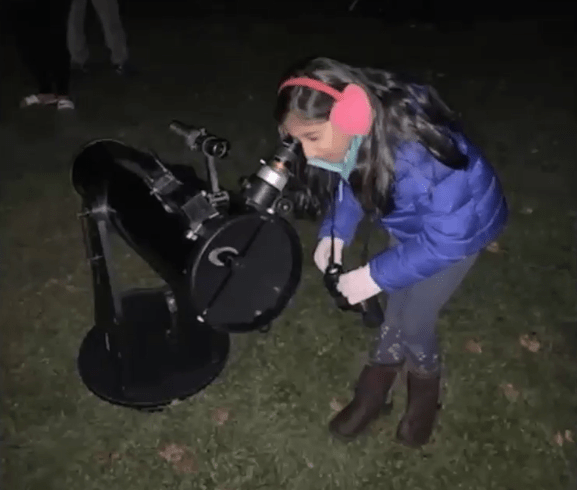
(Pictured: A Glenburn student looks through the telescope at the Star Party.)

Establishing a culture of creation, innovation and hands-on learning is becoming a focal point at Glenburn School. The driving forces toward that goal are a couple of long-time educators – Technology Integrator, David Davis, and Technology Director, Ken Worster. Last year the administration implemented a plan to repurpose a science lab to house materials for a new STEAM (Science, Technology, Engineering, Arts, Math) Lab. Worster advocated for functional space for technology creation since the one-to-one devices had made the traditional computer lab unnecessary. Davis credits his administrative team at Glenburn for its support of this initiative and feels “fortunate that [his] administration had the vision of technology integration” in order to bring this plan to life.

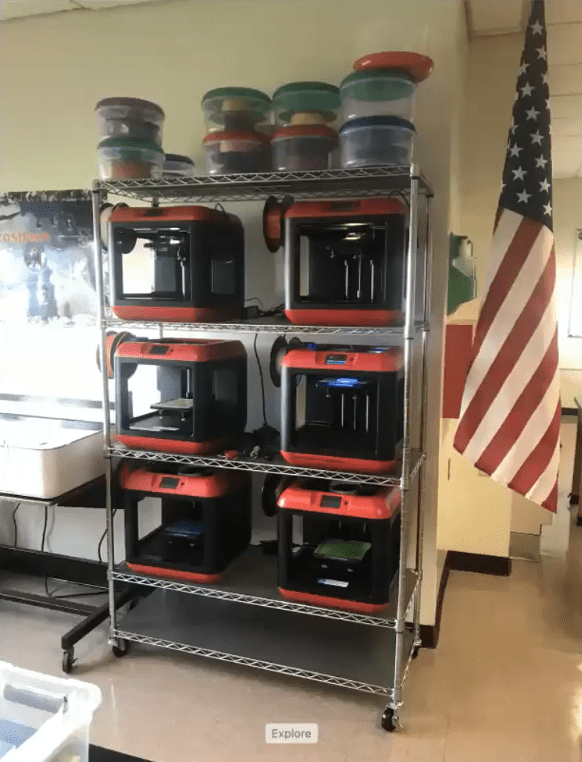
The STEAM Lab consists of several technology tools including a laser cutter, green screen, a fleet of iPads, a recordable microscope, over a dozen 3-D printers, codable robots, and more. Davis and Worster’s hope is to establish the lab as an integral part of the curriculum for educators. Worster mentioned that the immediate goal is to have teachers “looking at their content and bringing it to David in a way where they can have that conversation about how they can integrate our technology.”

Even in the Lab’s infancy, Davis is already seeing its impact in the classrooms, most notably in the sixth and seventh grade English Language Arts classes. In those classes, students have been able to dive deeper into their reading by designing and printing 3-D objects or characters from their books, by recreating scenes with green-screen video, and by etching “plaques” with the laser cutter that outline the author’s biography.

Additionally, Davis and Worster envision enhanced student engagement through the STEAM Lab by incorporating it into science classes across the school. Davis integrated an astronomy theme and tiered the work for the various grade levels. Students in kindergarten through second grade used the online platform Wixie to design constellations that were then etched with the laser cutter, students in third through fifth grade also used the laser cutter to design the phases of the moon, and finally, sixth through eighth grade students created a 3-D model of a footprint that incorporating each student’s constructed quote acting as if they were to be the first ones stepping onto Mars.

Glenburn Engraving
(Left to Right) Constellations designed in grades K-2, moon phases etched in grades 3-5, 3-D printed footprint in grades 6-8.

Davis and Worster concluded the unit by coordinating with the Challenger Learning Center and the Versant Power Astronomy Center at the University of Maine to host a “star party” outside at the school. The night was a huge success with over 200 family members attending. It allowed students the chance to stargaze with a telescope which Worster noted was the first time for most of them.

Even with the initial success of the STEAM Lab, Davis and Worster know that it will take time for the innovative culture to spread throughout the school. While they admit the program is not without its wrinkles, they are hopeful that a steadfast dedication to technology integration will create breakthroughs for their staff. Davis knows that it pays off to start small and have it build from there, “If I could just get [the teachers] there once or twice, it will take on a life of its own.”

Glenburn Printers
Sets of 3-D printers at Glenburn School

This story was written and coordinated by MLTI Ambassador Rob Dominick as part of the Maine Schools Sharing the Success Campaign. To learn more, or to submit a story or an idea for a story, email rachel.paling@maine.gov.


Regional Connection Events for Extended Learning Opportunity (ELO) Coordinators

Jobs for Maine Graduates (JMG) is hosting Regional Connection Events throughout Maine for ELO (Extended Learning Opportunity) Coordinators. Each event is held in-person where a light breakfast and lunch will be provided, as will opportunities to spend time sharing, connecting, and being inspired. Find a detailed schedule/program here.

The December schedule is as follows:

  • North Region – University of Maine at Orono on Dec 6th, 9am – 3pm
  • Central Region – Thomas College on Dec. 13th, 9am – 3pm
  • Southern Region – University of New England, Biddeford on Dec. 15th, 9am – 3pm

If you have a scheduling issue please feel free to join a region that is a different location from your school/organization.

Register here.

For more information reach out to JMG’s Extended Learning Opportunities Team.

What Are the MLTI Ambassadors Cooking Up?  Daily Asynchronous Professional Learning Offerings Starting 11/28  

Student Engagement, Blended Learning, Project Based Learning, Supporting All Learners and Computer Science & Computational Thinking Pedagogies are the main topics for a four-week professional learning series being offer by the MLTI Ambassadors starting on November 28. These daily offerings will go live on the MLTI Youtube channel and are open to all interested educators and will include useful resources and contact hours.  These are also available as a professional learning calendar with links to the video and slides going live every day! 

Mixing in Mare Student Engagement - Joshua Schmidt, MLTI Ambassador

Student Engagement
Lead by Joshua Schmidt on Mondays 

The student engagement series will extend last year’s videos from Erik Wade to four additional topics to help teachers create more authentic engagement in their classrooms. We will cover the similarities and differences in game-based learning and gamification, creating breakouts and escape rooms, leveraging group work to increase classroom discussions, and strategies to make those discussions more authentic and valuable. We will also discuss tools to help with each of these strategies and speak to other MLTI Ambassadors to hear examples of what has worked in their schools.   

To find the previous professional development sessions in this series, and receive contact hours for them, please visit our YouTube playlist. 

  • Topic 1: Comparing Game-Based Learning and Gamification 
  • Topic 2: Creating Escape Rooms and Breakouts to Increase Student Engagement and Critical Thinking 
  • Topic 3: Leveraging Group Work and Technological Resources to Increase Classroom Engagement and Discussions 
  • Topic 4: Making Classroom Discussions Authentic and Using Tools to Support Authentic Discussions  

Computer Science Integration Pedagogies - Yuhong Sun, MLTI Ambassadora

Computer Science & Computer Technology Integration Pedagogies
Lead by Yuhong Sun by Tuesdays 

Over the past decade, there has been increasing research on computer science pedagogies. The data shows that certain teaching methods are more effective than others in computer science education. The series of Computer Science & Computer Technology Integration Pedagogies will explore the popular pedagogies for Computer Science and Computer Technology Integration, such as computational thinking, contextualized learning, collaborative learning and learning away from the computer. The series will use examples from Computer Science teachers, math and science teachers and discuss how the teaching methods are effectively used in the classrooms to support the learning process, to develop students’ critical thinking and problem-solving skills and prepare them for the 21st century job market. 

  • Topic 1: Computational Thinking Skills Development 
  • Topic 2: Engaging Students Through Contextualized Learning 
  • Topic 3: Building Critical Thinking and Problem-solving Skills Through Collaborative Learning 
  • Topic 4: Cultivating Computer Science Skills by Teaching Away from the Computer 

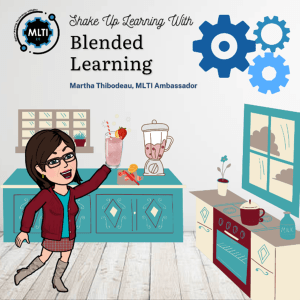
Shake Up Learning With Blended Learning - Martha Thibodeau, MLTI Ambassador

Blended Learning
Lead by Martha Thibodeau on Wednesdays 

The Blended Learning Series will explore an introduction of this pedagogical strategy and tools to enhance student learning. Included in this series will be an overview of blended learning models, techniques to support student choice and pacing, and developing teacher workflows. If you like the idea of blended learning, but are overwhelmed by the details, this is the series for you. Join the MLTI Ambassadors as we discuss ways to maximize student learning and efficiently manage your role in the blended learning environment. 

  • Topic 1: Introduction to Blended Learning Models.  
  • Topic 2: Student Experience in Blended Learning   
  • Topic 3: Teacher Workflow within Blended Learning 
  • Topic 4: Tools to Enhance Blended Learning
     

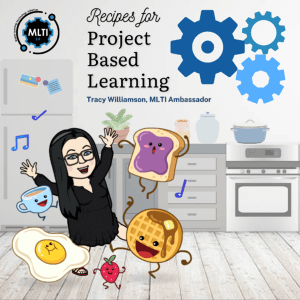
Recipes for Project Based Learning - Tracy Williamson, MLTI Ambassador

Recipes for Project Based Learning
Lead by Tracy Williamson on Thursdays 

The Project Based Learning series will offer creative ideas to help students learn to think critically, collaborate and communicate on real-world projects. We’ll share tips, digital tools and resources to help you implement engaging team-based activities aligned with content area standards like creating a student news team, a student podcast series and STEAM projects that support the Sustainable Development Goals. We’ll also share digital tools and techniques for curating resources and data for long-term projects and creating effective and aesthetic presentations to share work with the community. 

  • Topic 1: Student News Team Projects 
  • Topic 2: Student Podcast Series 
  • Topic 3: STEAM Projects around the Sustainable Development Goals 
  • Topic 4: Presenting Projects: Taking PBL to the Community  

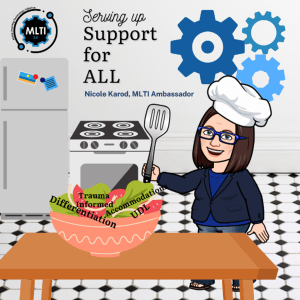
Serving ip Support for ALL - Nicole Karod, MLTI Ambassador

Support for ALL
Lead by Nicole Karod on Fridays 

This professional development series will share tools and methods for supporting all learners.  As we all know our classroom are filled with a variety of needs, both academically and behavioral.  In this series you’ll discover ways to meet students’ needs through differentiation, be a trauma informed educator, create and design with all students in mind, as well as fill your toolbox with tools for modification and accommodations.  I will also be joined by other MLTI Ambassadors to discuss how these strategies can look different in different classrooms. Join me on Friday each week to develop your toolbox toward supporting all students in the classroom. 

  • Topic 1: Differentiation in the classroom 
  • Topic 2: Trauma informed classroom 
  • Topic 3: UDL (Universal Design for Learning) 
  • Topic 4: Tools for modification and accommodations 

Inclusion for All: How to Support All Learners through Universal Design for Learning (UDL) and Multi-Tiered Systems of Support (MTSS)

The Office of Special services and Inclusive Education at the Maine Department of Education is pleased to announce our next speaker in our Special Topics Series – Dr. Katie Novak on January 4, 2023 from  3:30-4:30 pm.

Audience: General & Special Educators, Administrators, Parents, Caregivers and Community Members Interested in Universal Design for Learning (UDL) and Muti-Tiered Systems of Support(MTSS)

Cost: FREE Please register for the Zoom link here

While rocking out to a co-created playlist by DJ Swiff, attendees will understand:

  • A big picture of UDL, how it fits within a multi-tiered system of support (MTSS),
  • How we can proactively design learning experiences that plan for variability and help all students reach rigorous, grade-level standards.
  • Be inspired as you learn about variability and barriers, firm goals and flexible means, and the power of expert learning.
  • How to be better prepared to design lessons and instruction that impact learners from preschool to adulthood in ways that are innovative, inclusive, and impactful (and fabulous!).

About the Presenter:

Katie Novak, Ed.D., is an internationally renowned education consultant, author, graduate instructor at the University of Pennsylvania, and a former Assistant Superintendent of Schools in Massachusetts. With 20 years of experience in teaching and administration, an earned doctorate in curriculum and teaching, and eleven published books, Dr. Novak designs and presents workshops both nationally and internationally focusing on the implementation of inclusive practices, Universal Design for Learning  (UDL), multi-tiered systems of support, and universally designed leadership.

Dr. Novak is the author of the best-selling books, UDL Now! A Teacher’s Guide to Applying Universal Design for Learning in Today’s Classrooms, Innovate Inside the Box, with George Couros, Equity by Design, with Mirko Chardin, and The Shift to Student-Led with Catlin Tucker.

Be sure to be watching for announcements in the Maine DOE Newsroom of future featured guests in our series!

If there are additional questions about this webinar or the series, please email Tracy (Tracy.W.Whitlock@maine.gov), Anne-Marie Adamson (anne-marie.adamson@maine.gov ) or Dee Saucier (danielle.m.saucier@maine.gov).

RFA- Restorative Practices for System Involved Youth in Maine Schools 

The State of Maine is seeking applications to provide funding to Maine Schools in need of establishing or expanding support for System Involved Youth. 

A copy of the RFA, as well as the Question & Answer Summary and all amendments related to the RFA, can be obtained at: https://www.maine.gov/dafs/bbm/procurementservices/vendors/grants 

An Informational Meeting will be held on November 28, 2022 at 4:00 PM at the following location: https://mainestate.zoom.us/j/81803613490

Applications must be submitted to the State of Maine Division of Procurement Services, via e-mail, at: proposals@maine.gov. Applications must be received no later than 11:59 p.m., local time, on December 15, 2022. Applications will be opened the following business day. Applications not submitted to the Division of Procurement Services’ aforementioned e-mail address by the aforementioned deadline will not be considered for award. 

State of Maine 

Department of Education 

RFA# 202211180 

Restorative Practices for System Involved Youth in Maine Schools