
The Maine Department of Education (DOE) is pleased to announce that four Maine schools have been awarded $50,000 grants to support their ‘community schools’ work. Community Schools is a local engagement strategy that creates and coordinates opportunities with its public school to accelerate student success. It is an effective, evidence-based, and equity-driven strategy for school improvement included under section 4625 of the federal Elementary and Secondary Education Act.
The grant awardees and the projects supported by the funding are as follows:
- Biddeford Schools/Biddeford Primary – Increase mental health supports; provide access to legal services; create community garden; host vacation-week camps
- Portland Public Schools/Talbot Elementary School – Add positions (i.e. stipends) for After-School Coordinator, Homework Diner Coordinator & Interpreters, and Walking School Bus Coordinator; increase materials to support these enrichment opportunities
- RSU 9/Cape Cod Elementary – Hire Community School Coordinator; provide Social Worker and Nurse stipends; increase after-school academic and enrichment support; support adding a service animal; increase dental care access
- RSU 34/ Old Town Elementary School – Add after-school enrichment; continue food security/insecurity support; add Homework Diner
Supported by the Maine DOE’s Office of School and Student Supports, last spring a Community Schools Request for Applications (RFA) process resulted in these four schools receiving $50,000 each in grant funding to support their work. So far two of the awardees have implemented a Community School Coordinators position to create a community of practice (COP) including Jennifer Goodwin, RSU #34/Old Town Elementary School; and Kristin Hanna, Portland Public Schools/Talbot Elementary School. It is anticipated that Biddeford and RSU 9 will be able to use grant funding to add such coordination throughout the school year.
“To be able to fund four districts at the time we did is a great start heading into what we hope is a post-pandemic school year,” said Director of the Office of School and Student Supports Julie Smyth. “Community School models are receiving so much attention nationally – the Biden administration is committed to adding 25,000 new community schools, which will impact over 300,000 students,” added Smyth, who is committed to working with state partners to grow Maine’s understanding and support for Community Schools.
Smyth and her team have already begun convening a community of practice (COP) group among the grant recipients this week. The purpose of the COP is to build community to support each other, to learn together, and to leverage existing knowledge to support more schools in moving forward with Community Schools work.
Although the next Community Schools RFA will not be available until SY 2024-2025, it will have the potential to provide up to 10 additional school administrative units with start-up funding. In accordance with Title 20-A, §9923: Designation of community schools (maine.gov), the Maine DOE hopes to biannually designate 10 additional community schools.
For more information on Community School Coordinators and Community Schools visit any of the following websites:
- Coordinators Appreciation Week 2022 : Community Schools
- Community Schools Playbook (futureforlearning.org)
- Community Schools Coordinators Network
- About : Community Schools
For further information and questions, reach out to Julie Smyth, Director of the Maine DOE Office of School and Student Supports at julie.a.smyth@maine.gov.


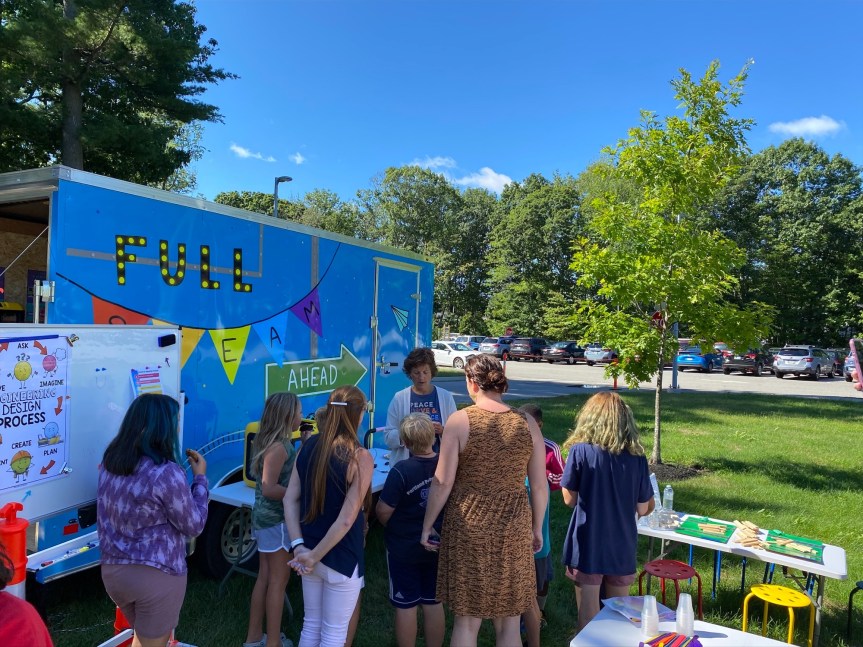
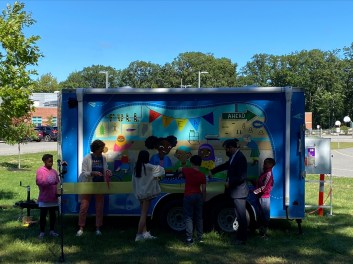 The Mobile Makerspace will travel to elementary schools for two-week visits this fall and spring. Once at the schools, students along with their classroom teachers will visit the Mobile Makerspace for mini or immersive experiences depending on their grade level. It will provide every PreK-5 student in Portland Public Schools with at least one design/innovation/engineering experience each year. One project example involves sail cars. Based on grade-level standards, students will be exploring properties of materials as they try to determine the best material, the best size, and the best shape for their sail. During their experience, students will employ the Engineering Design Process to guide their work – Asking – Imagining – Planning – Creating – Experimenting – Improving.
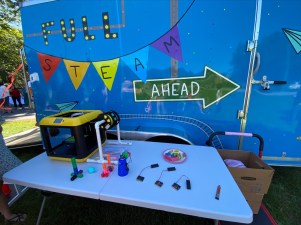 At the ribbon cutting, a group of 5th grade students got to explore some of the high- and low-tech gear and opportunities contained in the Mobile Makerspace, including the 3-d printer, technology projects, books on STEM-related topics, and creative building opportunities.
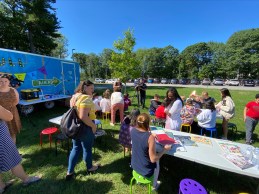 Portland Public Schools, in partnership with the Foundation for Portland Public Schools, worked with the community to design, build, and outfit this mobile lab. The trailer was secured from On the Road trailers, Blue Planet Graphics installed the artwork, and Casco Bay High School alum Charlie Hindall made the artwork.


 Maine DOE Newsroom