The RSU 12 Palermo Panthers and RSU 54 Team Son-day squared off in the Maine Department of Education’s (DOE) first regional Farm to School Cook-off on March 23rd. The competition was held at the Westbrook Regional Vocational Center and is the first of three regional competitions that will take place this month, sponsored by the DOE’s Child Nutrition Office.
The school teams, consisting of one school nutrition professional and one student, were tasked with creating a breakfast and lunch meal using three local ingredients, including buckwheat flour as the breakfast “challenge” ingredient and beets as the lunch “challenge” ingredient, as well as one USDA food.
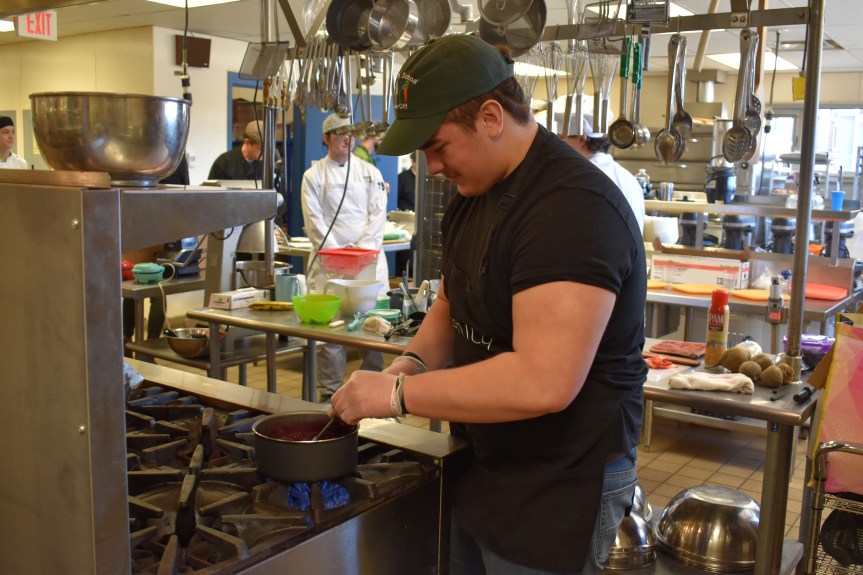
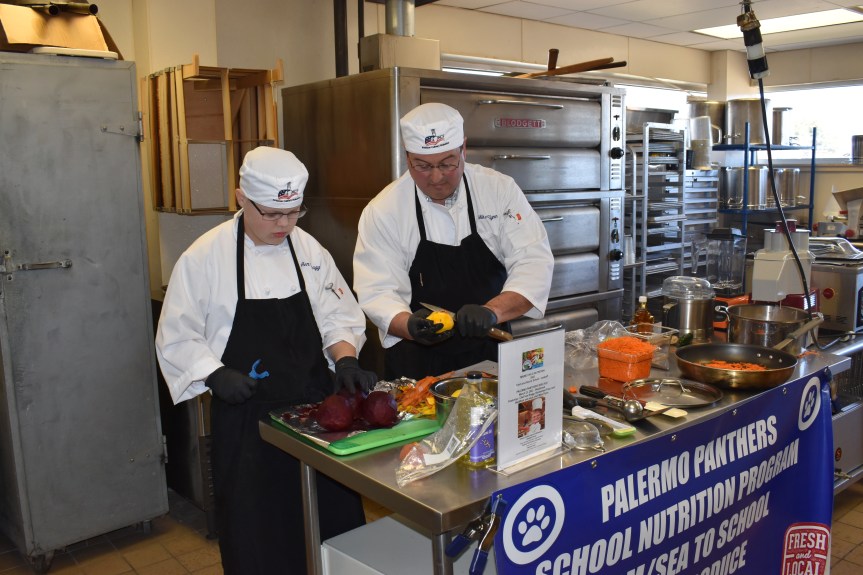
Mike Flynn and Ben Bragg from the Palermo Panthers cooked up a breakfast “paco”, which consisted of egg and cheese rolled into a buckwheat flour pancake.
Mike and Ben from RSU 12
Gina Bailey and her son Caleb Pratt from Team Son-day whipped up a breakfast flower waffle using buckwheat flour, and presented their dish in the shape of a flower with fruit as the pedals and stem. Both teams created a beet smoothie, using a kid-friendly approach to a less familiar vegetable.
RSU 54 breakfast flower waffle
Gina and Caleb from RSU 54
For lunch, the Palermo Panthers made “muchos tacos” using various proteins, served on top of a homemade buckwheat flour tortilla, with a beet/carrot slaw on the side. Team Son-day cooked grilled chicken with red flannel hash, a buckwheat biscuit, and heart shaped watermelon on the side.
Gina handing her breakfast plate to the judges
Team Son-day, who has been competing in the cook-off for several years, walked away with the win. They dedicated this event to their late mother and grandmother, and the dishes were specially crafted with her in mind.
A great day was had by all! Following two more regional cookoffs set for March 29th and March 31st, RSU 54 will advance, along with winning teams from the remaining regional cookoffs, to the finals round which will take place at the Child Nutrition Culinary Classroom on April 26th.
Maine DOE team member Jennifer Hopkins is being highlighted this week as part of the Get to Know the Maine DOE Team Campaign. Learn a little more about Jennifer in this question and answer.
What are your roles with DOE?
I am the Executive Assistant to the Child Development Services Director Roberta Lucas.
What do you like best about your job?
Roberta keeps me on my toes, every day is different which I love! I never get bored that’s for sure.
How or why did you decide on this career?
I’m not sure what lead me down this path, I guess it was just meant to be.
What do you like to do outside of work for fun?
I enjoy spending time with my husband of 29 years, our two daughters, and their fiancés. We all go hiking, snowshoeing, skiing, kayaking and just spending time together whenever we get a chance! I enjoy getting outside and enjoying all Maine has to offer!
As part of the American Rescue Plan (ARP), Congress set aside $2.75 billion of the Governor’s Emergency Education Relief Fund to provide emergency assistance to students and teachers in non-public schools, as defined below, through the ARP Emergency Assistance to Non-public Schools (EANS) program. The purpose of the ARP EANS program is to provide services or assistance to non-public schools that enroll a significant percentage of students from low-income families and are most impacted by COVID.
The Maine Department of Education (DOE) has been working with the U.S. Department of Education since the submission of Maine’s ARP EANS application on September 9, 2021. Approval from the US. Department of Education was received on March 16, 2022, and the Maine DOE is moving swiftly to support non-public schools through the $12,327,260 ARP EANS award process.
An eligible non-public school is an elementary or secondary school that is non-profit; approved in accordance with state law; was in existence prior to March 13, 2020; did not, and will not apply for and receive a loan under the Small Business Administration’s Paycheck Protection Program (PPP) on or after December 27, 2020; and serves a low-income student percentage of 25 percent or greater. The low-income student percentage will be determined by the data on student eligibility for free or reduced-price lunch under the National School Lunch Act.
Non-public schools interested in participating in the ARP EANS II programs are encouraged to attend the Office of Federal Emergency Relief Programs’ Informational ARP EANS II webinar on March 31, 2022, at 10am.
The Readiness and Emergency Management for Schools (REMS) Technical Assistance (TA) Center will offer a new Conducting K-12 Site Assessments With SITE ASSESS training session on April 5. This dynamic and interactive 2.5-hour training is designed to assist school districts and schools with conducting site assessments and using SITE ASSESS, the REMS TA Center’s free and secure mobile app that allows personnel to walk around a building and grounds, and examine their safety, security, accessibility, and emergency preparedness. This Virtual Training by Request (VTBR) opportunity is being offered in partnership with the U.S. Department of Education’s Office of Safe and Supportive Schools (OSSS).
When: Tuesday, April 5, 2022 Time: 10:30 a.m. to 1:00 p.m. ET Cost: NO CHARGE Register here(registration for this event closes on Friday, April 1, 2022 at 5:00 p.m.)
This training is intended to provide participants with an introduction to site assessments, including their purpose; who should serve on a site assessment team; how site assessments support school preparedness activities; how data from site assessments are incorporated into the planning process put forth in the Guide for Developing High-Quality School Emergency Operations; and key topics such as Crime Prevention Through Environmental Design. This training also provides an overview of SITE ASSESS, including how it was developed by the REMS TA Center, some of its key features, and how to use it collaboratively.
Audience
The intended audiences for this training are those who serve on an emergency operations plan planning team and/or a site assessment team including, but not limited to:
School district and school administrators, educators, facilities staff, food management and cafeteria staff, transportation staff, security staff, school nurse, athletic department staff, and support staff; and
Community partners, such as law enforcement, including school resource officers, fire officials, and Emergency Medical Services personnel.
Training Objectives
The aim of this training is to help participants be able to:
Understand the purpose of a site assessment and its
importance in school preparedness;
Conduct a site assessment using the SITE ASSESS
mobile app; and
Use SITE ASSESS to identify areas of improvement in
education facilities.
For more information, contact the REMS TA Center 1-855-781-REMS [7367] or info@remstacenter.org.
Learn important Federal guidance on school emergency management planning through a new 2.5 hour training on April 12. This Virtual Training by Request (VTBR) opportunity is being offered by the Readiness and Emergency Management for Schools (REMS) Technical Assistance (TA) Center, on behalf of the U.S. Department of Education’s Office of Safe and Supportive Schools (OSSS).
Each school day, our nation’s schools are entrusted to provide a safe and healthy learning environment for approximately 55 million elementary and secondary school students in public and nonpublic schools. In June 2013, the Obama Administration released the Guide for Developing High-Quality School Emergency Operations Plans (School Guide) which provides an overview of Federal guidance on school emergency management planning.
The School Guide, produced by the U.S. Departments of Education; Justice, led by the Federal Bureau of Investigation; Homeland Security, led by the Federal Emergency Management Agency; and Health and Human Services, incorporates lessons learned from events, like the school shooting in Newtown and the tornadoes in Oklahoma, as well as years of emergency planning work by the Federal government, to present a recommended process, important content elements, and key considerations for school emergency operations plan (EOP) development.
In collaboration with their local government and community partners, schools can take steps to plan for these potential emergencies through the creation of a high-quality school EOP. With this training, an expert team will provide an overview of the recommended six-step planning process to create a high-quality school EOP, which includes the following:
Step 1: Forming a Collaborative Planning Team
Step 2: Understanding the Situation
Step 3: Determining Goals and Objectives
Step 4: Plan Development
Step 5: Plan Preparation, Review, and Approval
Step 6: Plan Implementation and Maintenance
Pre- and -post training activities will provide guidance on how this training is relevant to emergency operations planning and assist with the implementation of what is learned.
The intended audiences for this training include, but are not limited to: those interested in creating, revising, or enhancing school EOPs; school staff who serve, or will serve, on their school or school district’s EOP planning team; and other interested community stakeholders, including first responders, emergency medical services personnel, law enforcement, and others.
When: Tuesday, April 12, 2022 Time: 10:30 a.m. to 1:00 p.m. ET Cost: NO CHARGE Register here(Registration for this event closes on Friday, April 8, 2022, at 5:00 p.m.)
For more information contact The REMS TA Center 1-855-781-REMS [7367] or info@remstacenter.org.
The Maine Department of Education (DOE) is preparing to launch the Multilingual Education Task Force (METF), an initiative to support the development of bilingual programs in Maine schools.
Bilingual programs have benefits for all students, including, but not limited to:
Superior academic performance;
Greater inclusion and improved socioemotional and learning outcomes for multilingual learners;
Intercultural communicative competence; and
Future opportunities for employment in the global economy.
If you are interested in participating as a member of the METF, you are welcome to submit an application. All educators and community members who would like to learn more about bilingual education and begin advocating for, and taking steps toward developing a program in a Maine school are encouraged to join.
May 5, 2022: Examination of opportunities to implement dual language education programs
May 12, 2022: Identifying the challenges and solutions to implement dual language education programs
May 23, 2022: Begin a strategic plan to build the foundation to implement dual language education programs
To learn more about bilingual education, its benefits, various program models, and how to begin the implementation process, check out the Multistate Association for Bilingual Education website. Contact April Perkins, ESOL/Bilingual Programs Specialist, at april.perkins@maine.gov with any questions.
Maine Positive Behavioral Interventions and Supports (PBIS) is a statewide effort designed to help school teams form a proactive, schoolwide, systems approach to improving social and academic competence for all students. Schools in Maine are engaging the implementation of PBIS through a variety of training and coaching opportunities offered by the Maine Department of Education in strong partnership with the University of Maine System. PBIS has documented outcomes for schools who implement PBIS with fidelity and integrity related to dramatic decreases in the number of behavior problems experienced in their schools. Additionally, students and staff in these schools report higher ratings of school climate scores than those in comparative schools who do not use a system of Positive Behavioral Interventions and Supports.
Maine DOE will be accepting new applications for schools interested in PBIS to join a 3-year professional development cohort to establish a strong Tier One System. If you would like to learn more, our team will provide an overview of the PBIS Cohort Model and other pathways to access training and coaching for our Maine schools on April 6, 2022 at 3:30pm.
Education Commissioner Pender Makin visited Katahdin Elementary School this week to meet with students and staff and experience the growing outdoor learning opportunities at the school.
Commissioner Makin was joined by Superintendent and Katahdin Elementary School Principal Dr. Marie Robinson, who proudly introduced her staff, many of whom are graduates of the Katahdin schools. The sense of pride and community was evident throughout the building, as well as the commitment to a supportive and fun learning environment. Ms. Jaide Berry joined on the tour of the school and talked about the ways in which she uses the outdoor spaces to connect with students as part of their social and emotional skill building activities. Katahdin Elementary School has created a space where students and staff learn about restorative justice practices, including understanding how the brain works, and how to communicate effectively as valued members of the school and classroom communities.
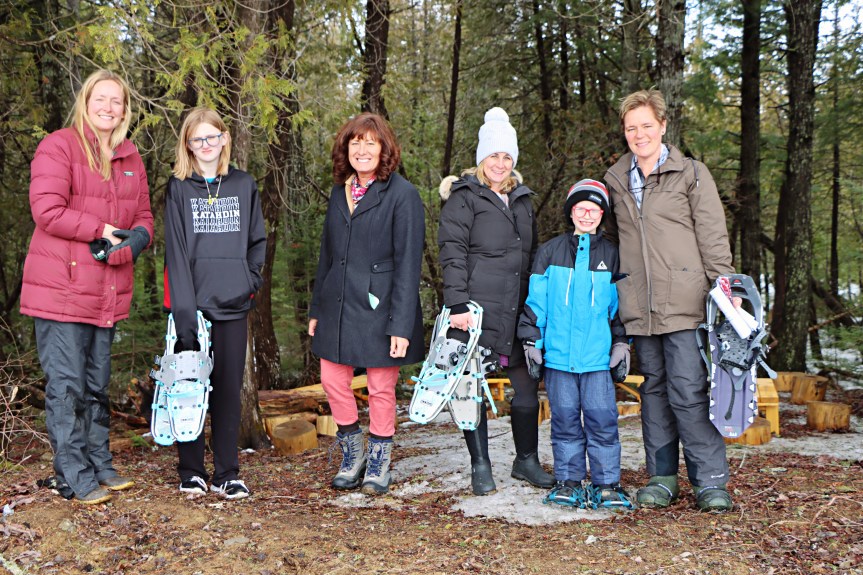
As she greeted pre-k students on their way into afternoon classes, and learned about another class’ outdoor investigation to find signs of spring, Commissioner Makin had the privilege to thank the teachers of Katahdin Elementary School for all of their hard work and dedication to their students. After a quick tour inside, it was time to put on snowshoes and head out to investigate the amazing learning spaces on campus. The school has snowshoes, skis, and a clothing supply closet that students can access, ensuring that with the right gear, all weather is good weather for learning!
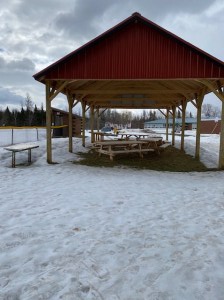
Joined by grade 2 student Bentley and grade 5 student Abbie, Commissioner Makin got to check out outdoor learning spaces, including a shelter built by grade 5 students with the volunteer assistance of a school board member, who used his military training to design a cozy and dry space, and a pond where a game camera caught the exciting adventures of a beaver family and their hut.
With a commitment that began in 2016 to getting students outdoors more, Katahdin Elementary School has developed a campus with trails, a weather station, raised garden beds, and even their own apple orchard. As schools shifted to outdoor learning spaces over the past two years as a prevention method for the spread of COVID-19, the school expanded their own offerings, and used federal relief funds to build large outdoor learning pavilions, and RREV (Rethinking Responsive Education Ventures) funds received through the Maine Department of Education for other outdoor spaces.
On Wednesday, March 23, at 1pm, the EPA will host the first informational webinar on the 2022 Clean School Bus Program.
The Clean School Bus Program will provide $5 billion over the next five years to replace existing school buses with low- and zero-emission school buses. Each year, approximately $500 million will be available exclusively for electric school buses and approximately $500 million will be available for electric buses and multiple types of cleaner alternative fuel school buses.
EPA anticipates that the 2022 Clean School Bus Program application period will open to the public in late April and close in July. We expect that this program may cover up to 100% of school bus and associated charging infrastructure costs for low income, disadvantaged, and rural school districts, while offering significant funding to all schools. Additional Clean School Bus funding opportunities are expected to follow later.
The state will be working closely with the EPA to offer technical assistance to schools wishing to apply for this funding. If you are interested in learning more about technical assistance, please reach out.
Twenty-six teams from across Maine, New Hampshire, and Massachusetts gathered at Thomas College, in Waterville, to compete in the New England District Pine Tree Event robotics competition.
This two-day qualifying event marked a return after a two-year absence due to the COVID 19 pandemic. For teams to qualify for the New England District Event that will be held in West Springfield, Massachusetts next month, they needed to win one of the top two awards (the Chairman’s Award and the Engineering Inspiration Award) or make it into the finals. While there were no spectators in the stands and there were limitations on team members present, there was no shortage of energy and excitement at the event.
Saturday was packed with activity as teams jumped between competing on the field for valuable points, making modifications to their robots in the pit, and interviewing with judges. A common theme share with the judges was how teams had managed to survive during the pandemic. While there were no “rookie” teams, this was the first competition for many of the student participants. By the end of a full first day of competition, The Bucks’ Wrath (Team 6329) from RSU25 went into the playoffs as the top ranked team, narrowly edging out B.E.R.T. from MSAD6.
Despite a wintery mix that swept through on Saturday night, teams were ready bright and early for the playoffs. One of the unique aspects of the playoff format is that different teams come together to form three-team alliances. This can allow for some underdog teams to be part of a winning alliance, which proved to be the case for LRTC 8023 (Team 8023) out of Lewiston as they partnered up with Orange Chaos (Team 4564) out of Brewer and Morpheus (Team 5813) out of New Hampshire. The trio won an intense final match with a close point count, a pair of yellow cards, and a toppled robot. The three finalists, The Buck’s Wrath, Windham Windup (Team 3467) from New Hampshire, and Spartan Robotics (Team 7907) from Massachusetts, qualified to go on to the New England District Event.
Members of B.E.R.T. try to get their robot up onto a higher bar at the conclusion of a match
Victorious members of the Orange Chaos team
The day concluded with the awards ceremony that recognized teams in a variety of categories.
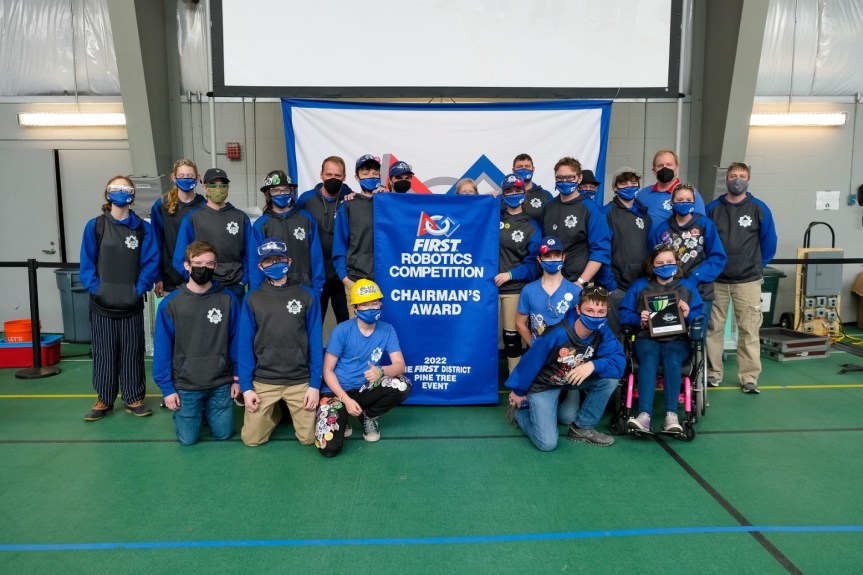
The Blue Crew claimed the top honor of Chairman’s Award at the 2022 Pine Tree Event
The Chairman’s Award went to the Blue Crew (Team 6153) with students from Mt. Blue High School, Spruce Mountain High School, and the Foster Technology Center in Farmington. A young team from rural Western Maine and made up of students from 13 towns across 4 counties, the Blue Crew came together weekly for team meetings and almost nightly during the build season. The Blue Crew brought in members from the SMART team at Spruce Mountain when it dissolved and quickly assimilated them into the team. Their inclusivity is one of their most notable qualities as they include students of diverse backgrounds and physical and cognitive abilities, and elevate them to key roles within the team. R2Blue2, the Blue Crew’s mascot, is well-known in the community and regional robotics competitions. They take him to the middle and elementary schools within their school districts, where they have worked with classes and FLL (First Lego League) teams.
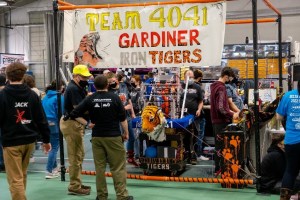
Team 4041’s pit area is easy to find.
The Iron Tigers (Team 4041) out of Gardiner won the Imagery Award. Decked out in black and orange, and always accompanied by their tiger mascot, Cheetoh, the Iron Tigers exemplified the aesthetic spirit of the award.
The Gracious Professionalism Award went to The Collective (Team 4906) from Mid-Maine Technical Center in Waterville.
The Entrepreneurship Award went to The Buck’s Wrath (Team 6329) from Bucksport High School.
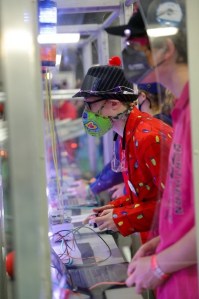
The exciting and colorful Northern Force (Team 172) won the Team Spirit Award, whose flag-waving, neon-light flashing, and hot pink outfits were certainly eye-catching in the pit.
The Quality Award went to the Riot Crew (Team 58) from South Portland for the excellent modularity of their work.
The Innovation in Control went to the Outliers (Team 5687) from Portland’s Baxter Academy, whose effective mechanical system for climbing allowed them to consistently climb up to the highest bar in matches.
Other Maine teams competing were: Infinite Loop (Team 2648) from Messolonskee High School, Delta Prime Robotics (Team 4473) with students from Hall-Dale and Richmond High School, Radical Impact (Team 5265) from Chevrus High School, Equilibrium (Team 6161) from Gray-New Gloucester High School and The ANOMALY (Team 3451) from Sanford Regional Technical Center.
Award winners from New Hampshire included Chop Shop (Team 166) winning the prestigious District Engineering Inspiration Award, Tornadoes (Team 7314) winning the Judges’ Award, Windham Windup winning the Excellence in Engineering Award and Morpheus winning the Autonomous Award.
Award winners from Massachusetts included NUTRONs (Team 125) who won the Industrial Design Award, AZTECHS (Team 157) winning the Creativity Award.
If you are interested in learning more about FIRST Robotics Programs in the New England region, please check their website.






 Joined by grade 2 student Bentley and grade 5 student Abbie, Commissioner Makin got to check out outdoor learning spaces, including a shelter built by grade 5 students with the volunteer assistance of a school board member, who used his military training to design a cozy and dry space, and a pond where a game camera caught the exciting adventures of a beaver family and their hut.



 The Innovation in Control went to the Outliers (Team 5687) from Portland’s Baxter Academy, whose effective mechanical system for climbing allowed them to consistently climb up to the highest bar in matches.
 Maine DOE Newsroom