The Maine Department of Education (DOE) Interdisciplinary Instruction Team is partnering with the Institute for Human Education to continue the Maine Solutionaries Project through the fall to educators interested in supporting students in applying their learning. This exciting project will provide an opportunity for educators in Maine to take a custom version of the Solutionary Micro-credential Program and participate in state-wide educator cohorts that focus on individual topics of interest. Not only will educators be able to participate at no cost, but they will also be eligible to earn a $1400.00 stipend upon completion of the program.
To participate in the first cohort, educators must attend a one-day in-person workshop at the Brunswick Hotel on Thursday, September 19th, followed by four one-hour group Zoom meetings plus a 1:1 Zoom meeting with the cohort facilitator or coach between Zoom meetings 3 and 4. In between the Zoom meetings, participating teachers will complete and submit work on the Learning Board. We understand that travel can be a concern, so we want to assure you that all travel expenses (mileage, lodging the night before if 2+ hours away, breakfast/lunch) are covered — those who complete the micro-credential by November 18th are eligible to earn a $1400.00 stipend.
To participate in the second cohort, educators must attend four in-person workshops in Brunswick Hotel on Thursday & Friday, October 24 & 25, and Thursday & Friday, Nov 7 & 8. There will be no Zoom meetings; all work will be done in person. Travel expenses are covered (mileage, lodging if 1+ hours away for 4 nights, and breakfast/lunch for both sessions). Participants must attend all four days — those who complete the micro-credential by November 18th get a $1400.00 stipend.
We understand how challenging it can be for educators to take time away from their classrooms to attend a four-day institute. However, this unique opportunity will equip you with a comprehensive plan to implement Maine Solutionaries within your classroom, enhancing both your teaching practices and your students’ learning experiences.
Spots are filling quickly, so visit the Maine Solutionaries Project website to learn more about this collaboration, view an informational webinar, or register for the project.
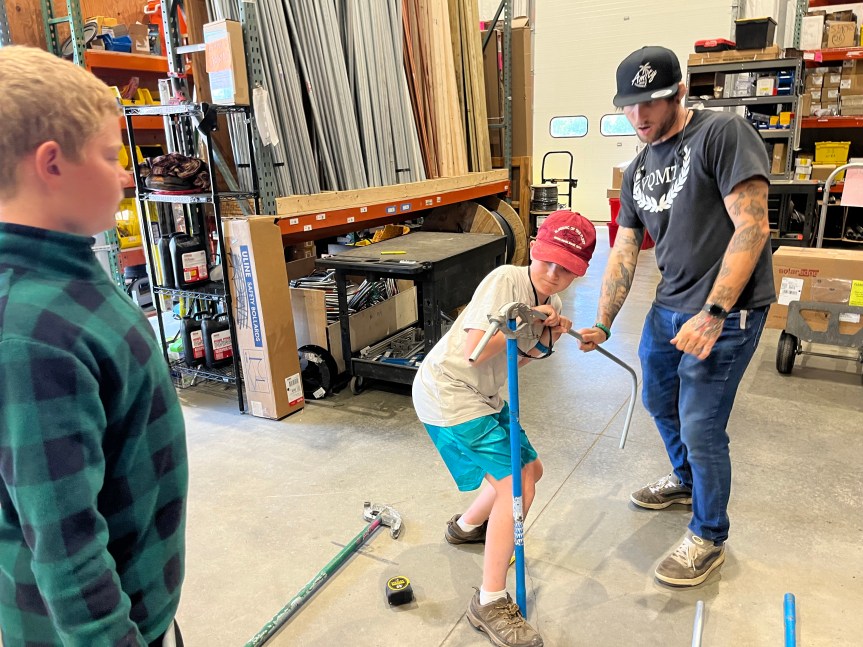
With support from the Maine Department of Education’s (DOE) Maine Out of School Time grant, upper elementary and middle school students from North Haven Community School, located on North Haven Island, visited and explored a variety of Maine businesses this summer.
The grant was funded through the Maine Jobs and Recovery Plan, a statewide expansion of extended learning programming to engage students throughout the state in real-world career exploration experiences.
North Haven Community School Principal Shaun Johnson did most of the planning, logistics, and drove the school van on all trips over the course of the two-week, first of its kind, “camp” experience. The opportunity allowed students to participate in early career exploration in various aspects of Maine’s “green” economy, giving students the chance to learn more about businesses and jobs focused on environmental sustainability.
Students went on off-island visits, including tours of Robbins Lumber, Front Street Shipyard, Lyman Morse, Midcoast School of Technology, GoLogic, Revision Energy, and Bowdoin University’s Office of Sustainability. Students were also visited on the Island by businesses, such as EcoMaine.
Students also got to experience environmentally sustainable efforts closer to home. North Haven Community School’s high school science teacher, Samantha Taggart worked with students in the school garden and gave them a tour of Cider Hill Farm on North Haven, which is owned by community member Becky Bartovics. School board member and local contractor Morten Hansen gave students a tour of Congresswoman Chellie Pingree’s house near Turner Farm. Local Island Institute Fellow Claire Oxford talked to students about how climate change will impact flooding and tide levels over the next several decades.
Here are a few pictures from the two-week opportunity:
One student, having such a good time, remarked, “Why can’t this camp be longer?”
Johnson says that finding local and school-related enrichment activities for students on the island during the summer, especially those who are too young to work, can be a challenge.
“This grant opportunity really gave us the motivation and support we needed to make something happen,” said Johnson.
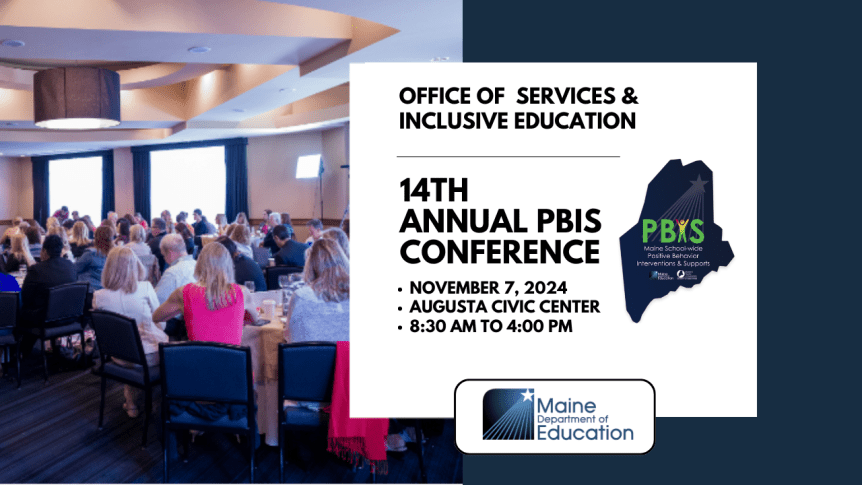
Join the Maine Department of Education (DOE) Office of Special Services and Inclusive Education for the 14th Annual Maine PBIS Conference at the Augusta Civic Center on Thursday, November 7, 2024 from 8:30 AM – 4:00 PM. The conference is a chance for Maine Positive Behavior Interventions and Supports (PBIS) leaders and implementers from across Maine and beyond to come together to celebrate, learn, and network together.
This year’s keynote speaker is Dr. Ruthie Payno-Simmons, the founder of RPS Educational Impact and serves as the Associate Director at the Midwest and Plains Equity Assistance Center (MAP Center). She leads the coordination, design, and delivery of universal, targeted, and systemic equity-focused professional learning experiences and technical assistance to state and local agencies throughout the MAP Center’s 13-state region. Her keynote address is on, “Enhancing Positive and Supportive School Climate Through Storytelling and Rightful Presence.”
Conference Fees:
General (individual)- $195
Group (groups of 3 or more attendees)- $165
Student (full-time undergraduate or graduate student enrolled in 6 credits per semester for at minimum two semesters per year)- $85
Lead Presenter (those accepted to present; only lead presenters are at no charge; co-presenters will be charged the individual rate)- $0
For more information about the conference, to submit a proposal, sign up for a school showcase, and/or to register to attend the conference, visit the PBIS Conference Website.
In alignment with supporting a culture of innovation and continuous improvement, new tools have been created for school nurses. This newest project directly reflects the advocacy and care our Maine school nurses possess, further strengthening our public health infrastructure.
A sample welcome letter from the health office for any new family in a school community was created, which contains an annual health form and medication authorization form, as well as interview forms for asthma, diabetes, and seizures. These tools have been translated into Maine’s top nine languages and are now available on the Maine Department of Education (DOE) Coordinated School Health webpage entitled Sample Forms.
School nurses are part of welcoming new families into our schools and communities; therefore, this spring, the Maine DOE school nurse regional liaison Lori Huot, BSN, RN, Nationally Certified School Nurse (NCSN) extended a warm invitation to the nurses she serves in Cumberland and York County to attend the monthly office hours hosted by the Maine DOE English to Speakers of Other Languages (ESOL) Specialist Jane Armstrong. This multidisciplinary collaboration uncovered the need for more health-centered, culturally responsive, readily available, and translated tools to provide equity through language access, resulting in these updated resources.
The Maine DOE extends a special thank you to the Maine school nurses who participated in this collaboration.
Maine DOE’s Office of Innovation and the Office of School and Student Support collaborate to host monthly ESOL (English to Speakers of Other Languages) office hours. These sessions are open to all school personnel and aim to provide optimal support for ESOL educators and guidance on assisting multilingual learners and their families.
Maine continues to embrace and enroll multilingual students and families statewide, witnessing a 15% increase in student count from 2023 to 2024. Jane Armstrong, State ESOL Specialist, highlights that roughly 63% of Maine’s 206 school administrative units have enrolled multilingual learners.
The Office of School and Student Supports has many resources for school staff to improve school services. Guidelines and Resources for School Health Services center on providing culturally responsive, evidence-based care that improves overall health.
The Maine Department of Education (DOE) Interdisciplinary Instruction Team is hosting two asynchronous professional learning courses called Question, Reflect, Repeat:Introduction to the Question Formulation Technique.
The Question Formulation Technique is a powerful strategy to help students and adults ask their own questions, advocate for themselves, and participate in decision-making processes.
There will be two asynchronous sessions running from:
Happy back to school! The Maine Department of Education (DOE) has put together a virtual Back to School Backpack of resources and information to assist school and School Administrative Unit (SAU) leaders as a new school year begins. The Backpack contains resources related to school and student supports, health and safety, school nutrition, school administration and operations, teaching and learning supports, and strengthening the education workforce. You can access the DOE’s Back to School Backpack here.
You’ll find links to forms and information schools often need at the start of a new school year, resources that educators can use in the classroom, instructional supports and programs, and much more.
We wish you a wonderful back to school and a new school year filled with excitement, powerful learning, connection, and joy. Thank you for everything that you do for Maine schools and students.
Resolve 2024, Chapter 164 directs the Maine Policy Research Institute and the Maine Department of Education (DOE) to conduct a targeted review of general-purpose aid for local schools. This review will focus on recruitment, retention, salaries and benefits; property valuation as a determinant of municipal ability to pay; regional cost differences; and a comparison of other states’ mechanisms. Within these focused themes, the Maine DOE will be considering expenditure-driven components, municipal ability to pay, regional adjustments, and adjustments to the state share of the total allocation. This report is due to the Maine Legislature on March 15, 2025.
In an effort to include a variety of stakeholder voices from regions all across Maine, the Maine DOE is conducting a series of listening sessions to receive your feedback. While we hope our superintendents, teachers, school business officers, directors of special services, and career and technical education directors will join in these conversations, participation is not limited to those within the field of education. To this end, each session will include a virtual-only option for participants. In order to ensure that each participant has an opportunity to speak, the Maine DOE will follow the legislative practice of a 3-minute comment.
The times and dates of these listening sessions are as follows:
September 23, 2024 from 11:30 am-1:00 pm, Zoom Link
September 24, 2024 from 3:00 pm-4:30 pm, Zoom Link
September 25, 2024 from 7:00 am-8:30 am, Zoom Link
September 26, 2024 from 5:00 pm-6:30 pm, Zoom Link
September 27, 2024 from 3:00 pm-4:30 pm, Zoom Link
Discussion questions:
How does the Essential Programs and Services (EPS) funding formula align with current needs at your school?
Do the categories of essential programs and services adequately match your understanding of what is essential to an education?
Do the categories of essential programs and services align with the ways your school utilizes funding?
What do you consider to be the greatest barrier to equity in EPS?
What do you consider to be the greatest contributor to regional differences in the delivery of education in Maine?
Participants may also submit their feedback in writing to Laura Cyr, Department of Education, State House Station #23, Augusta, Maine 04333, or laura.cyr@maine.gov. For documentation purposes, written feedback is very helpful.
The Maine State Board of Education is beginning conversations with the public about Rule Chapter 115: The Credentialing of Educational Personnel. Resolve 2024, Chapter 137 directed the State Board of Education to amend Rule Chapter 115, with special attention to sections related to the State Board of Education’s report submitted to the Joint Standing Committee on Education and Cultural Affairs in 2023.
The State Board of Education intends to take the following steps with respect to review of these rules:
Begin speaking with experts in the field
Revise necessary sections of Chapter 115
Invite public feedback on the revisions
File updated rule
Engage with Legislative oversight of the rule
The State Board of Education will hold several regional meetings focused on ideas and goals related to certification regulations in a general sense. These meetings will also focus on specific sections of Chapter 115 and will provide invaluable feedback to the State Board. In addition, the State Board of Education’s Certification and Higher Education Committee will provide time within the established meeting schedule to receive public feedback on Rule Chapter 115.
Dates for these meetings are as follows:
August 28, 2024: 10:30 am – 12:00 pm; for the Zoom link, please email Emily Cummins
September 25, 2024: 10:30 am – 12:00 pm
October 23, 2024: 10:30 am – 12:00 pm
November 20, 2024: 10:30 am – 12:00 pm
December 18, 2024: 10:30 am – 12:00 pm
Taking into consideration the insights gained from all of these discussions, the State Board of Education will propose updates to Rule Chapter 115 and begin the Maine Administrative Procedures Act (A.P.A.) routine technical rule process pursuant to Title 5 MRS §8052 (public notice of filing, public hearing, open public comment period). Once the proposed rule has been filed, the public will be notified of the scheduled public hearing and comment period. This will be an opportunity to provide written and oral comments regarding the proposed rules. The State Board of Education will review all comments and respond accordingly. Updates to the rules will then be submitted for review as to form and legality and legislative oversight before final adoption.
“Education and support for our students goes way beyond the classroom,” said Principal Jeanna Tuell. As a long-time administrator for RSU 34, Tuell has been an integral part of Old Town Elementary School’s shift to the Community School Model.
Tuell explains that years ago, the school’s long-time school counselor raised concerns about the sheer amount of work it was taking to give their student population the support they truly needed to thrive at school. It was at that time that they had a collective realization they needed to seriously think outside the box to improve things not only for their students, families, and the community but for their teachers and staff as well.
A community school model, as defined by the Coalition for Community Schools, is both a place and a set of partnerships between the school and other community resources. Community schools exist in all regions of the United States, and their numbers are growing fast.
“When you are looking at student support, you are not just looking at what the supports are that the student needs right now, you have to look bigger, at what they might need outside the school, and what their families might need, and how that affects the whole school environment and the whole community outside,” said Jennifer Goodwin, Old Town Elementary School Coordinator. Goodwin has served in the role of Community School Coordinator since the school set in motion their plan to become a community school in 2017.
The community school model was first recognized by the Maine State Legislature in 2015/2016 when they authorized state funding for a limited number of community schools established under 20-A MRSA Chapter 333. Currently, three schools in Maine receive funding from the Maine DOE to support their community school strategies: Old Town Elementary School in Old Town, Cape Cod Hill Community School in New Sharon, and Gerald E. Talbot School in Portland.
As the longest-standing community school in Maine, Old Town has had time to build community partnerships and strategies that truly support its student population. One of those strategies is their amazing outdoor learning program which is complimented by a robust set of garden beds and greenhouses located right on school grounds.
“Almost immediately when I started, I got approached by teachers saying, ‘we want school gardens,’” explained Goodwin. “The University of Maine was able to do their capstone project and build us our first 12 beds. Then we got a partnership with Rogers Farms, and then we had an amazing parent garden coordinator come on that really helped it grow.”
The program has been so successful over the years that they have been able to do a full curriculum integration at every grade level. They have also benefited from a fruitful partnership with Rogers Farms that includes a community farm stand.
Old Town School Gardens:
Jennifer Goodwin
Several other community partnerships provide their students with everything from winter fun with Winter Kids, to theatre, and even more outdoor education through Maine Outdoor Education program in Millinocket. They also partner on Community Cupboard which serves students, families, and community members.
Another important tentacle of this work is their partnership with local health services such as Pathways of Maine, Acadia Hospital, and Penobscot Community Health Care (PCHC) for counseling services for students and families. Their partnership with PCHC extends into a recently added health clinic located inside the school building. The clinic is staffed with licensed health care professionals who provide students not only with counseling services, but basic healthcare needs like an annual wellness check, a strep test, or an ear/eye exam to diagnose and treat common childhood viruses.
The PCHC Health Clinic located inside Old Town Elementary School:
With the incredible number of meaningful community partnerships Old Town has worked so hard to get under their belt, they are quick to credit their partners and community for their shared commitment to this work.
“When anything needs to be done, it gets done here because people really care about their community, their kids, and there is a lot of pride,” explained Tuell. “Those community partners happen very naturally. It’s not just one particular partner, it’s a combination of a lot of people. I feel like that’s what makes this town so unique and so special.”
Tuell also acknowledges how incredibly important it has been for them to have a Community School Coordinator who can not only coordinate and see through the partnerships and strategies but also works to pull together administrators, teachers, and school support staff on a regular basis to prioritize the evaluation and re-evaluate their student (and community) support strategies.
To learn more about Old Town Elementary Community School, check out this video interview with Principal Tuell and Community School Coordinator Jennifer Goodwin.
Maine DOE Community Schools Consultant Ann Hanna (former principal of Gerald E. Talbot Community School) is working on advancing community school strategies in interested schools across Maine by providing technical assistance and support.
To learn more about community schools in Maine, please contact Ann Hanna, at ann.c.hanna@maine.gov.
(Pictured: Back row, from left: Emma Hafenecker, Clara Ernst, Abigail Ragsdale, Emily Roy, Stacey Augustine, Tim Strange. Front, from left: Wiley Billings, Brennan Tibbetts, Maple Corey, Sandy Jamison. [photo courtesy of Annie Twitchell])
The fifth-grade students at Cascade Brook School had some very exciting projects this past school year. Two teams entered the 2023/24 Toshiba/NSTA ExploraVision National Science competition.
Led by their Gifted and Talented Teacher/Coach, Sandra Jamison, the students brainstormed world problems, picked one, and then developed an invention that could solve the problem. This required lots of research and innovative thinking. They researched past and present technology, designed their “solution” and then wrote about breakthroughs needed to make it a reality, explained their design process, and drew their invention.
One team, comprised of fifth graders Emily Roy, Brennan Tibbetts, and Maple Corey came up with the idea for ‘H.E.L.P.’, a small device that would sit in the ear and receive signals and data from the body, diagnose the symptoms, and help treat the cause.
H.E.L.P. stands for ‘Helping Everyone Live Perfectly’ and the device is like having a doctor in your ear. The H.E.L.P. team earned an honorable mention in the ExploraVision competition, which means they placed in the top ten percent of all 2,000 competing teams. Each student received a certificate commemorating this achievement.
The second team, comprised of fifth graders Clara Ernst, Wiley Billings, Emma Hafenecker, and Abigail Ragsdale, designed MER, short for Medical Earth Robot. The students wanted to find a way to help with one of the most preventable deaths on the battlefield: loss of blood.
A prototype of the MER device.
MER is a robot with three compartments, two of which have drills to tunnel through the ground. The third compartment is where the magic happens: a protective dome unfolds and covers an injured person. Inside the dome, robotic arms equipped with tools perform essential emergency medical care to stabilize the patient before transmitting a signal to the nearest emergency medical personnel and moving to the next patient.
The MER project was selected as one of 24 regional winning projects. As Regional winners, each student and their coach received a Chromebook and participated in a National competition.
Both teams were recognized and honored in a special ceremony on April 25, 2024 at Cascade Brook School with a Toshiba representative Tim Strange. Cascade Brook School sure is proud of these students!! Congratulations to Emily, Brennan, Maple, Clara, Wiley, Emma, and Abigail!






 Maine DOE Newsroom