Some of the most memorable experiences students have occur outside the classroom on field trips. This webinar hosted by Civics Teacher Leader Fellow Jessica Graham and Humanities Teacher Leader Fellows Dorie Tripp and Jim St. Pierre, will cover an array of beneficial field trips around Maine. This webinar will cover not only the field trips, but how to organize them and how to find grants that will pay for them. We hope you will attend and offer your own ideas for meaningful field trips.
(Pictured: Wayne Napples and Jazmyne Peeples from RSU 75)
On May 7th, three school teams squared off at Central Maine Community College in Auburn for the Maine Department of Education (DOE) 2024 Farm to School Cook-off.
Teams representing RSU 75, Lewiston Public Schools and Auburn Public Schools, and consisting of one school nutrition employee and one student, sharpened their knives and skills for a fun day of cooking. They whipped up vegetarian and meat-based dishes using local tofu donated from Heiwa Tofu in Rockport and local chicken donated from Maine Family Farms in Portland; both of which were challenge ingredients for the competition. The dishes were scored based on presentation, taste, creative use of challenge ingredients, and feasibility to be used in a school kitchen.
The first course was a vegetarian meal highlighting tofu. Brittany Cote and Simon Bolduc from Auburn Public Schools came prepared making a delicious tofu parmesan meal made with Maine Marinara Sauce, which was a fun twist on the popular comfort food. Alicia Smith and her son Jesse Smith from Lewiston Public Schools made a tofu ramen bowl, using meatballs made with tofu and a kick of spice, and whole grain noodles for the pasta. Wayne Napples and Jazmyne Peeples from RSU 75 made a BBQ lime tofu kabob that was vibrantly colored with vegetables that resemble summer is right around the corner.
Alicia Smith and her son Jesse Smith from Lewiston Public Schools
Brittany Cote from Auburn Public Schools
Jesse Smith from Lewiston Public Schools
Wayne Napples and Jazmyne Peeples from RSU 75
Next, came the meat-based meal for round two of the competition. RSU 75 and Lewiston both came prepared making hot honey chicken sandwiches; each with their own unique style; one with a whole grain pretzel bun and the other with a whole grain croissant. Auburn created a chicken shawarma on a toasted whole grain flatbread, marinated chicken that brought aromatic spices across the kitchen and tzatziki sauce.
The RSU 75 team, who was new to the competition this year, ended up walking away with the grand prize, and meat-based meal winner. Lewiston walked away as the vegetarian meal winner. A great day was had by all, and the teams showed great creativity, execution of ingredients, and teamwork throughout the entire competition.
Guest judges were: Carrie Clark, a chef judge from Norimoto Bakery in Portland; Ellen Dore, the School Nutrition Director for RSU 16; and Georgia Knowles this year’s student judge, she is a 7th grader at King Middle School in Portland.
Lewiston Team holding their award as the vegetarian meal winners.
Team RSU 75 won round two for meat-based meal, here they are holding their award.
All of the teams pose for a group picture after the competition.
The Teams pose with the judges after the competition.
The Maine DOE Child Nutrition Team is always looking for new teams to participate in the cook-off! For more information and to learn more about Maine’s Farm & Sea to School Program, visit the Maine DOE website or reach out to the Maine DOE Child Nutrition Team.
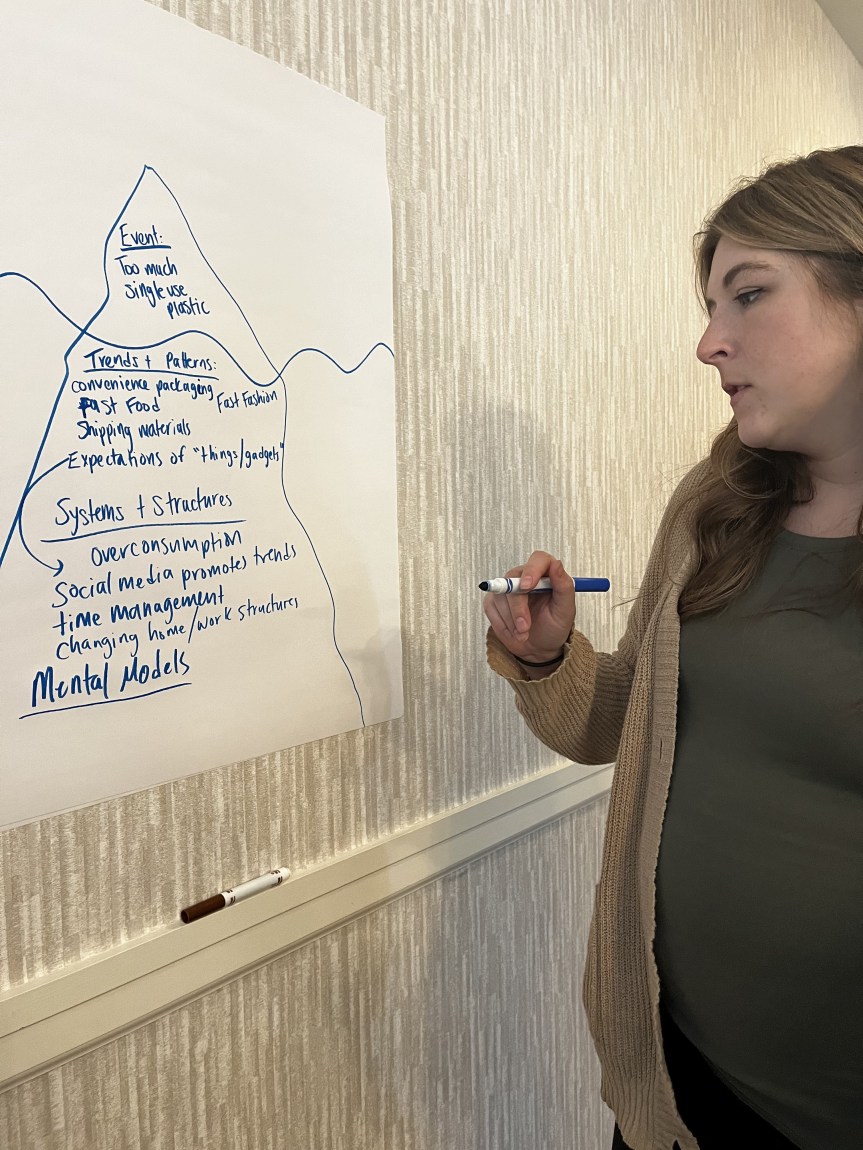
(Delaney Rideout, a high school science teacher from Mattanawcook Academy, participates in the Solutionaries’ iceberg problem-solving exercise.)
More than 40 Maine educators came together recently for the first of four Maine Solutionaries project kick-offs. Guided by the Institute for Humane Education, these educators learned how to use the curriculum to empower students to solve the real-life problems they care about in their schools and communities.
“The Maine Solutionaries Project is a really exciting opportunity for Maine teachers to engage in professional learning. It’s cohort-based, so we are bringing teachers from all over the state together into groups who are focusing on topics such as plastics, food waste, or climate change,” said Julie Meltzer, the Director of K-12 and Teacher Education for the Institute for Human Education.
The Maine Solutionaries Project is an exciting new addition to Maine’s educational toolkit, developed through a collaboration with the Maine Department of Education (DOE) Interdisciplinary Instruction Team and the Institute of Humane Education. Together, the Institute and Maine DOE seek to inspire and support educators to cultivate a generation of Solutionary change-makers capable of effectively addressing and resolving real-world problems, honing their critical thinking and problem-solving skills.
When asked the essential question, “What is a Solutionary?” Meltzer explained,“A Solutionary is a next-level problem-solver change-maker who looks at systems and looks at things in their community or in their school that they want to change for the better and considers all the stakeholders, analyzes why it’s happening, and then comes up with ideas to address the problem, while thinking about what’s good for people, animals and the environment.”
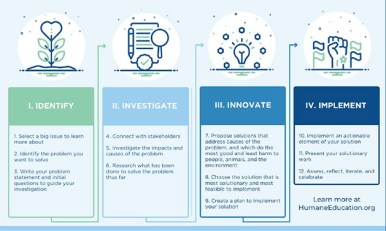
The Solutionary Framework consists of four phases: Identify, Investigate, Innovate, and Implement.
“Maine teachers have seen improved student engagement and deeper learning when they implemented Solutionary inquiry to action projects with their students” reports Meltzer.
Nell Herrmann, an Enrichment Educator at Blue Hill Consolidated School, comes from a field science background but transitioned to education in the early 2000s. After many years of feeling like her students’ personal harbinger of environmental doom, Herrmann wanted to provide students with an opportunity to make some actionable changes in her classroom.
“I started to feel sort of a sense of despair that I was giving these kids all this bad news, and so I reached out to the president of the Institute for Humane Education, and she suggested that I try learning about the Solutionary framework and using it with my students,” Herrmann recounted. “I did and I found that it was very empowering. And it took what I was teaching the kids a step further and gave them the ability to see that they have the power to make a change.”
The four phases of the Solutionairie Framework .
Herrmann’s first Solutionary course was a huge hit with her students and an excellent example of the Solutionary framework in action. Speaking at the Maine Solutionaries Project Kick-Off session, Herrmann shared the story of her first Solutionary project: “My students and I were investigating some environmental threats to the Bagaduce Watershed, our local watershed, and one of the threats they identified were invasive green crabs. And so they were collecting data, which they were inputting into the Gulf of Maine Marine Research Institute webpage and database, but then decided that they didn’t want to put the crabs back into the ecosystem because they’re so destructive to the ecosystem. So, they decided as a solution that they would collect the data as they’ve been doing, but then keep the crabs and test out some different recipes and host a green crab cafe with some of those recipes.”
Herrmann was asked not only to speak at the Maine Solutionaries Project kick-off but also to be a Solutionary coach for one of the project’s first cohorts. At the kick-off, along with meeting and learning from speakers like Herrmann, these first cohort educators got to know each other through icebreakers, took part in mock Solutionary lessons, and prepared for the next chapter of their Solutionary journey. Speaking with educators after the kick-off, it was clear that the first cohort of the Maine Solutionaries Project can’t wait to bring the framework into their classroom.
“I am really excited about having a bigger community to connect with to work on problems that empower our students to figure out solutions so that they can be taking action instead of feeling like they’re only on the receiving end,” said Heather Martin, the librarian at Harriet Beecher Stowe Elementary School.
From further north in Lincoln, Delany Rideout plans to roll out the Solutionary framework to her Mattanawcook Academy High School science students.
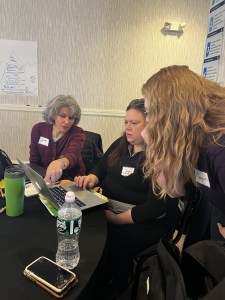
Heather Martin, a librarian from Harriet Beacher Stowe, helps her fellow first-cohort educators set up the virtual learning portals where they will build their 2023-2024 Soultionaries classes.
“I think it’s good for teachers in rural Maine to bring solutions to their schools because we are giving students skills to take action,” she said.“That’s really important for them and empowering them to know that they can make changes in their community even though they might not have as many resources as other bigger places.”
The first two cohorts of the Maine Solutionaries project are well on their way. They are completing Solutionary prep work, participating in class meetings online, and beginning to design the projects they will do with students during the 2024-20254 school year.
Bring the Maine Solutionairies Project to your school! Visit The Maine Solutionaries Website to apply for the next six cohorts. The final deadline for applications is July 31.
The Maine Solutionaries Project is a part of Maine’s whole student Pandemic Response and was funded through Federal Emergency Relief Funding. The project has an award totaling $719,500, of which 100% is federally funded and directly attributed to project implementation. The contents are those of the Maine Solutionaries Project and do not necessarily represent the official views of, nor an endorsement, by the US Department of Education or the U.S. Government. Learn more about how Maine used Emergency Relief funding at Maine’s Whole Student Pandemic Response page!
U.S. Secretary of Education Miguel Cardona today announced the 2024 U.S. Presidential Scholars, recognizing 161 high school seniors for their accomplishments in academics, the arts, and career and technical education fields.
The Maine scholars include (hometown, scholar, school, location):
ME – Kennebunk – Isaac N. Kahn, Kennebunk High School, Kennebunk, Maine.
ME – Raymond – Kylie Jade Thibodeau, Gray New Gloucester High School, Gray, Maine.
“The 161 high school seniors selected for the 60th anniversary of the U.S. Presidential Scholars represent the best of our nation’s schools and inspire hope in the bright future of this country,” said U.S. Secretary of Education Miguel Cardona. “On behalf of President Biden, I am delighted to celebrate their accomplishments, and encourage these scholars to continue to aim high, lift up others, and embrace opportunities to lead.”
The White House Commission on Presidential Scholars selects scholars annually based on academic success, excellence in the arts and in technical education, through essays, school evaluations and transcripts, as well as a demonstrated commitment to community service and leadership.
Of the 3.7 million students expected to graduate from high school this year, more than 5,700 candidates qualified for the 2024 awards determined by outstanding performance on the College Board SAT or ACT exams or through nominations made by chief state school officers, other partner recognition organizations and YoungArts, the National Foundation for the Advancement of Artists.
As directed by Presidential Executive Order, the 2024 U.S. Presidential Scholars are comprised of two students from each state, the District of Columbia and Puerto Rico, and U.S. families living abroad, as well as 15 chosen at-large, 20 scholars in the arts and 20 scholars in career and technical education.
Created in 1964, the U.S. Presidential Scholars Program has honored over 8,200 of the nation’s top-performing students. The program was expanded in 1979 to recognize students who demonstrate exceptional talent in the visual, literary and performing arts. In 2015, the program was again extended to recognize students who demonstrate ability and accomplishment in career and technical education fields. 2024 is the program’s 60th anniversary.
The Presidential Scholars Class of 2024 will be recognized for their outstanding achievement this summer with an online recognition program.
A complete list of 2024 U.S. Presidential Scholars is available at http://www.ed.gov/psp.
Pursuant to the authority granted under section 8401(b) of the Elementary and Secondary Education Act (ESEA), the Maine Department of Education (DOE) intends to apply for a Tydings Amendment waiver from the U.S. Department of Education (USDOE). As required, the Maine DOE is seeking 15 days of public comment from May 8, 2024 – May 23, 2024, on the request to waive the period of availability for ARP ESSER state administrative funds.
Requirements from which Maine will be seeking a waiver include:
A Tydings amendment waiver from Section 421(b) of the General Provisions Act to the U.S. Department of Education (USDOE). The Tydings amendment waiver seeks an extension to the availability of Federal Fiscal Year 2022/State Fiscal Year 2023 Elementary and Secondary Education funds. Programs affected by this waiver:
ARP ESSER (state administrative funds only)
The Maine DOE must solicit and respond to public comment on its waiver request and provide evidence of the available comment period. The Maine DOE moves forward to support critical responsibilities finalizing the administration of ARP ESSER, including reporting on the use of funds, conducting ongoing monitoring of subgrantees, and managing close-out activities.
Comments can be submitted to Chief of Federal programs, Janette Kirk at Janette.Kirk@maine.gov.
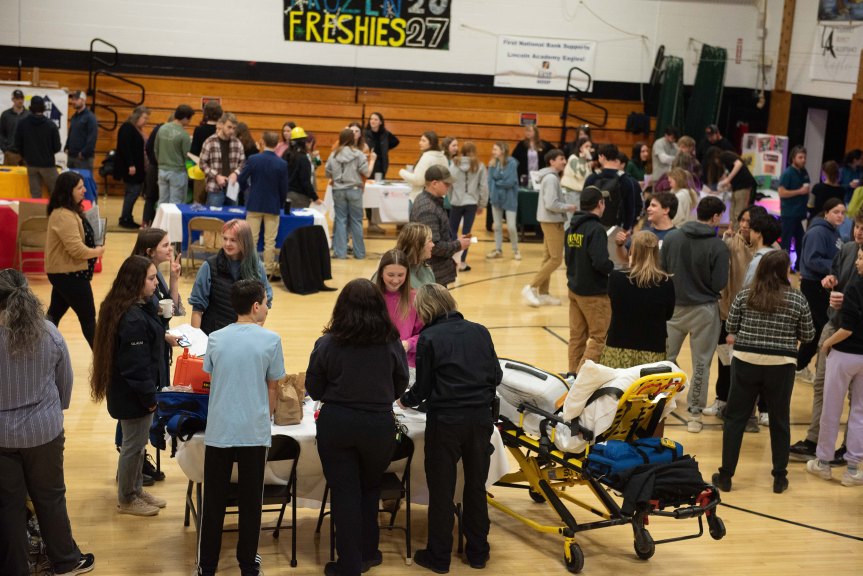
This spring, Lincoln Academy hosted its third annual Peter J. Benner ‘92 Job Fair in Nelson Bailey Gym. Lincoln Academy students, as well as students from Wiscasset Middle High School and AOS 93, were invited to meet local employers.
Representatives from local businesses set up tables and spoke with students about immediate job openings and long-term career paths in their fields. Each organization offered entry level jobs for those that want to move right into trades employment after graduation, as well as multiple career pathways in areas like banking, health care, manufacturing, engineering, design, computer science, marketing, and logistics to name a few. Many participating businesses have openings for weekend and summer employment as well.
Participating businesses were: Back Cove Yachts, Bangor Savings, Bath Savings, Bristol Parks and Rec, CLC Ambulance, CLC YMCA, Coastal Counties Workforce Solutions, Darling Marine Center, DiMauro Electric, First National Bank, Hagar Enterprises, Hannaford, Kieve Wavus, Lie-Nielsen Tools, Lincoln County 911, Lincoln County Sheriff’s Office, LCTV, Lincoln Health, Maine Kayak, Masters Machine, Mid-Coast Energy Systems, Midcoast Federal Credit Union, Mobius, Molnlycke, Padebco Boatyard, Renys, and Washburn Doughty. Lincoln Health brought six current employees who are also Lincoln Academy graduates to talk to students about their career paths at Lincoln Health.
“They came in the uniform that they wear to work, and represent both clinical and non-clinical jobs,” said Jen Kopp, Senior Talent Acquisition Partner. “We wanted students to know that there are many kinds of jobs at Lincoln Health, and not all of them involve direct patient care.”
Senior Mya Bessey is heading to nursing school next year, and she hopes to live outside of Maine for a while. “But I talked to Lincoln Health today, and I know they will hire me if I want to come home,” she said. “I already have an internship with the CLC Ambulance,” said Lincoln Academy senior
Ethan Barter, who joined the Alna volunteer fire department last year as a junior and “realized that I like helping people.” He plans to study paramedics and fire science next year at Southern Maine Community College (SMCC) and hopes to return to Lincoln County to work in emergency services. At the job fair he talked to Central Lincoln County 911 Dispatch, and Lincoln Health, who both had representatives at the fair.
Bill Morgner, President and Owner of Mid-Coast Energy, says his company is constantly in need of young people to enter the trades. Through Mid-Coast’s Pre-Apprenticeship and Apprenticeship programs, young people can work their way through professional licenses in the order that they choose. “We try to match young people with mentors based on their interests,” said Morgner. “Pre-Apprentices can start as soon as junior year, and we are always looking for people.”
Lincoln Academy senior Keegan Bond plans to take advantage of the Mid-Coast Energy apprenticeship program after graduation, and work through their junior apprenticeship program, which offers both hands-on experience and pays for apprentices to get licenses in the trades and they’ll pay for certifications over the next ten years. He hopes to follow in the footsteps of his brother Griffen Bond, who graduated from Lincoln Academy in 2022 and is currently pursuing his HVAC certification through the Midcoast Energy apprenticeship program.
“Engaging with adults who aren’t in your immediate sphere can be intimidating and awkward for young people,” Heather D’Ippolito, Director of Community Engagement and Development at Lincoln Academy. “We are so grateful to all of our community partners who made this fair an engaging and welcoming space for students.”
This story was submitted by Lincoln Academy. To submit good news about your school to the Maine Department of Education, complete our Good News Submission form.
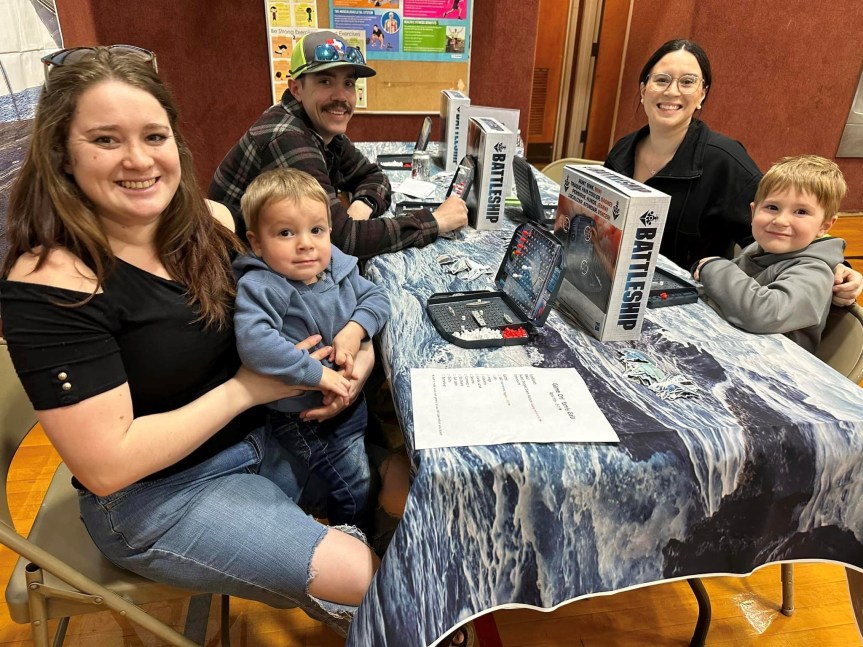
Beech Hill School in Otis, Maine, hosted its first-ever Game On! The “Family Gala” event brought together students, staff, and families for a fun-filled community event, with attendees enjoying an evening of classic games and good company. From Checkers to Connect 4, LCR to Battleship, giant versions of Sorry, Candy Land, and Jenga to an UNO tournament, the event had something for everyone. The Beech Hill School gymnasium was transformed into a game room with board games, card games, and other fun activities.
Beech Hill School’s administration and staff organized the game gala to link home and school and create a space for family and community members to gather and connect. Since the Maine Educator Summit in August 2023, the district’s administrative team has been aiming to increase family engagement post-pandemic. Leaders have been strategic about the purpose and design of evening activities to increase family attendance and foster school connectedness.
In addition to the board games and other fun activities, hot meal items, snacks, and drinks were available for purchase at the event. The Beech Hill School Student Council organized a cake and pie auction where families could bid on delicious desserts donated by local bakeries and made by Hancock County Technical Center (HCTC) culinary arts students. Eighth graders hosted BINGO games throughout the evening, with prizes generously donated by local stores and restaurants. All proceeds go toward school-wide initiatives. Additionally, former (high-school-aged) Beech Hill School students returned to lead younger students in creating their own DIY game crafts.
The Game On! The Family Gala was a great opportunity for people of all ages to come together and enjoy a fun-filled evening while supporting the school’s programs. Warmer temperatures and thoughts of spring had already prepared everyone to shake off the winter doldrums and gather for the community event. The evening was a testament to the strong sense of community at Beech Hill School and will be remembered as a highlight of the school year. The school hopes to make this event a tradition and is already looking forward to next year.
This story was submitted by Beech Hill School. To submit good news about your school to the Maine Department of Education, complete our Good News Submission form.
The Office of Special Services and Inclusive Education invites you to join us in the first two webinars in our “Inclusive Education Webinar Series” presented by Dr. Kate Macleod, an innovative inclusive educator, researcher, author, and assistant professor of special education at the University of Maine Farmington.
May 22nd : The Way to Inclusion: How We Create Schools Where Every Student Belongs
Grounded in the work of Dr. Kate MacLeod’s latest book, The Way to Inclusion: How Leaders Create Schools Where Every Student Belongs (ASCD, 2023) this webinar will take participants through theinclusive school change process – from creating an inclusive vision, to identifying current successes and barriers to inclusion, reimagining roles of existing staff, and everything in between. Participants will leave with research-based ideas, practical resources, and advice from leaders who are implementing inclusive change in their schools and districts.
The Maine Department of Education (DOE) is highlighting the important work of school nurses this week in celebration of School Nurse Day on May 8.
For over 120 years, school nurses have been critical to all aspects of student health, including improving public health. Each year, school nurses statewide complete the School Health Annual Report. It is used to satisfy the requirements for health-related data collection, which includes emergency medication administration, vision and hearing screening data, and other points.
Vision and hearing screenings are required in Maine schools. In the 2022-2023 school year, school nurses coordinated 122,310 screenings. Of these, 7,082 were referred for further evaluation. Early learning and literacy skills can be delayed when students have undetected hearing or vision deficits. School nurses are responsible for directing and overseeing school health screening programs and following up with referred students for evaluation and potential treatment. Without these screenings, over 7,000 Maine students would be potentially at risk for learning difficulties.
To learn more about the school health annual report and other data related to school-aged children, please visit the School Health Services: Data webpage.
The School Nurse Summer Institute is an immersive multi-day in-person event that brings school nurses together biennially. The goal is to increase the knowledge and understanding of current research and evidence-based practices in school nursing, as well as increase awareness of resources available within the State of Maine. School nurses in attendance will leave feeling energized with the latest knowledge and renewed energy to support Maine students.
Thomas College in Waterville, Maine
July 30th and July 31st
Register here(select School Nurse Summer Institute 2024 from the dropdown)
This year’s theme is An Adventure in Learning. Day One starts with a keynote presentation by Dr. Puthiery Va, Director of the Maine CDC, followed by nursing skill-building sessions and a resource fair with over thirty exhibitors. Day Two starts with a panel presentation on Population Equity and is followed by break-out session options, including MaineCare services, human trafficking, school safety, trauma-informed care, empowering school nurses, supporting LGTBQ+ youth, communicating and supporting the substitute nurse experience, Human Papilloma Virus and vaccine hesitancy.
This event is planned by the Maine Department of Education (DOE) Coordinated School Health Team, a part of the Office of School and Student Supports in partnership with the Maine Association of School Nurses (MASN).






 Maine DOE Newsroom