Nominate an outstanding teacher in your community for the 2024 National History Teacher of the Year! Each year, Gilder Lehrman recognizes first-rate K-12 teachers who find creative ways to bring history to life in their classrooms. Winners are selected from each state and US territories and become finalists for the national award. State winners will receive $1,000 each. The national winner will receive a $10,000 prize and a ceremony in their honor in New York City.
Go to www.gilderlehrman.org/nhtoy to submit your nomination. The deadline to submit a nominations is April 30, 2024.
For more information about the History Teacher of the Year award, please contact Jaime Beal, Interdisciplinary Instruction Specialist at jaime.beal@maine.gov
The Maine Department of Education (DOE) Maine School Safety Center (MSSC) offers training in several service areas, all at NO COST to schools and school administrative units (SAUs). MSSC’s flagship training opportunity is the School Safety Specialist (SSS) program, provided through Eastern Maine Community College (EMCC), which helps fulfill the statute Sec. 1. 20-A MRSA §1001, sub-§16 (LD892), which states you must have a “designated employee having oversight regarding school safety.”
School Safety Specialist Program
School Safety Specialists are prepared to:
Supports and assists administrators in coordinating the review, editing, and updating of Emergency Operations Plans for their district and/or school building each year as established under Maine Statute 20-A, 1001, chapter 101, sub-chapter 1, section 16 https://legislature.maine.gov/legis/statutes/20-A/title20- Asec1001.html
Involve appropriate stakeholders in the development of district/school level Emergency Operations Plans through the formation of a safety team to include the following: police and fire departments, emergency management agency, EMS, local medical facilities, community members, administrators, parents, and students.
Network with appropriate stakeholders to enhance school safety at the SAU and/or school level.
Act as a resource for other individuals in the SAU on issues related to school safety.
Work with the Maine School Safety Center to provide professional development for faculty and staff on school safety-related issues that encourage a safe school environment.
The details of the program:
Cohorts start at the beginning of every month and have 6 weeks to complete.
All work is done asynchronously through EMCC and takes approximately 20-25 hours to complete.
Work is divided into badges. Badges are outlined above. Each badge consists of interactive modules, a quiz, and reflection questions, except ICS courses which are accessed through FEMA.
Your motivation for enrolling:
Become a safety leader in your school.
Earn Digital Badges through EMCC and contact hours for recertification.
Be a school safety liaison with the Maine School Safety Center.
Create a network of safety specialists in the state.
School Safety Specialist Badges
Introduction to the Maine School Safety Initiative
The Maine School Safety Center has a School Emergency Management Coordinator who can help with resources, training, and guidance on anything involving emergency management in schools. The areas include, but are not limited to:
Emergency Operations Plans
Emergency Exercises and Drills
Implementation of Multi-Disciplinary Teams
Implementation of Safety Teams
For further support or information regarding School Emergency Management, reach out to School Emergency Management Coordinator, Bridgette Gilbert Bridgette.Gilbert@maine.gov.
The Maine School Safety Center is not a regulatory agency. All of their services are 100% free to you and your school. MSSC does not enforce any rules or laws, they provide assistance to SAU’s to help make schools a safer place for all students, staff, and visitors. For further information visit Maine School Safety Center website.
Two weeks before the solar eclipse on April 8th, Williams Elementary School in RSU 18 principal Melanie Smith visited all classrooms to read aloud the book A Few Beautiful Minutes Experiencing a Solar Eclipse, written by Kate Allen Fox. During her visits, Principal Smith also shared a video with students that explained the difference between solar eclipses and lunar eclipses.
A Few Beautiful Minutes Experiencing a Solar Eclipse, written by Kate Allen Fox
Maps of the path of totality across the United States and our state of Maine were also shown and discussed with students.
In addition to the academic presentations and discussions happening at school, the Williams Elementary School community collected cardboard tubes during the month of March in preparation for a special solar eclipse project. The week before the solar eclipse, art teacher David Clark and 3rd-grade teacher Brynn Charest helped students create their own eclipse viewers out of the collected recycled materials. The self-created handheld eclipse viewers will allow students to view the solar eclipse indirectly. All students in RSU 18 were also provided solar glasses to be distributed to students on Monday, April 8th.
Students working on their solar eclipse viewers:
In addition, Williams Elementary teachers used eclipse resources provided by the Maine Department of Education to educate students about the upcoming solar eclipse.
“We wanted to ensure that our children had background knowledge about a total solar eclipse so that they would understand what was happening on April 8th and know how to view the solar eclipse safely,” said Principal Smith.
For more information, resources, and safety advice for schools regarding the 2024 Social Eclipse, please visit the Maine DOE Eclipse Resource page.
This story was submitted to the Maine DOE by Williams Elementary School. To submit a story about your school, please fill out our Good News Submission form.
The U.S. Department of Education annually designates teacher shortage areas for the purposes of deferment of loan repayments or reductions of teaching obligation. The Maine Department of Education (DOE) recently requested input regarding designated teacher shortage areas for federal reporting and would like to thank all those who submitted information during the comment period. The comments related to teacher shortage enabled the Maine DOE to add additional teaching endorsements to the U.S. DOE proposal.
In Maine, the annual teacher shortage list is utilized by the Maine DOE to determine which endorsements are eligible for emergency certification and for reciprocity from other states, per 20-A MRS §13012-B.
The following are PreK-12 teacher shortage areas for the 2024-2025 school year:
General Elementary
Computer Technology
Early Childhood
English for Speakers of Other Languages
English/Language Arts (Middle and Secondary Level)
Gifted/Talented
Health and Physical Education (Combined Endorsement)
Mathematics (Middle and Secondary Level)
Music
Science-Physical (Secondary Level)
Science-Life (Secondary Level)
Science (Middle Level)
Social Studies (Middle and Secondary Level)
World Languages
Visual Arts
Deaf-Hearing Impaired*
Teacher of Students with Disabilities*
* On October 4, 2022, the U.S. Department of Education Office of Special Education Programs (OSEP) released a memorandum to clarify the requirements of IDEA Part B, which outlines the expectations for the preparation and training of all special education teachers nationwide and that special education certification or licensure requirements may not be waived. This includes the prohibition on issuance of emergency certificates.
The benefits to student financial aid recipients, such as loan cancellations, are indicated in the following regulatory provisions:
34 CFR 682.210(b)(5)(ii), (b)(7), (q), and (s) enable a borrower who had no outstanding Federal Family Education Loan (FFEL) Program loan on July 1, 1987, but who had an outstanding FFEL Program loan on July 1, 1993, to qualify for deferment of loan repayment under the Stafford Loan Program anytime within the life of the borrower’s loan(s) for up to three years of service as a full-time teacher in a private elementary or secondary school in a teacher shortage area designated by the Department, and as certified by the chief administrative officer of the particular school in which the borrower is teaching;
34 CFR 674.53(c) enables Federal Perkins Loan borrowers who are full-time teachers of mathematics, science, foreign languages, bilingual education, or any other field of expertise where the State educational agency determined there is a shortage of qualified teachers to qualify for cancellation of up to 100 percent of the outstanding balance on the borrower’s Federal Perkins loans; and
34 CFR 686.12(d) enables grant recipients to fulfill their teaching obligation under the Teacher Education Assistance for College and Higher Education (TEACH) Grant Program (regarding the requirement to serve at least four academic years, within eight years of graduation) by teaching in a “high-need field,” which includes academic disciplines/subject areas identified as teacher shortage areas at the time the grant recipient begins teaching in that field.
Stafford Loan and Supplemental Loans for Students (SLS) borrowers who have questions concerning their loans, including the teacher shortage area deferment, can contact the Federal Student Aid Hotline at 1-800-4FED-AID.
Federal Perkins Loan borrowers should contact the school where they received the loan.
Please contact Erin Reinhard at Cert.DOE@maine.gov with any questions or concerns.
Pursuant to the authority granted under section 8401(b) of the Elementary and Secondary Education Act (ESEA), the Maine Department of Education (DOE) intends to apply for a Tydings Amendment waiver and a Title I Carryover of Excess waiver from the U.S. Department of Education (USDOE). As required, the Maine DOE is seeking 15 days of public comment from March 22, 2024 – April 6, 2024, on the request to waive the period of availability for Elementary & Secondary Education Act funds. and Title I, Part A carryover limitations.
Requirements from which Maine will be seeking a waiver include:
A Tydings amendment waiver from Section 421(b) of the General Provisions Act to the U.S. Department of Education (USDOE). The Tydings amendment waiver seeks an extension to the availability of Federal Fiscal Year 2022/State Fiscal Year 2023 Elementary and Secondary Education funds. Programs affected by this waiver:
Title I, Part A of the ESEA (Improving Basic Programs Operated by LEAs), including the portions of the SEA’s Title I, Part A award used to carry out section 1003 school improvement, section 1003A direct student services, if applicable, and Title I, Part D, Subpart 2
Title I, Part B of the ESEA (State Assessment Formula Grants)
Title I, Part C of the ESEA (Education of Migratory Children)
Title I, Part D, Subpart 1 of the ESEA (Prevention and Intervention Programs for Children and Youth Who Are Neglected, Delinquent, or At Risk)
Title II, Part A of the ESEA (Supporting Effective Instruction)
Title III, Part A of the ESEA (English Language Acquisition, Language Enhancement, and Academic Achievement)
Title IV, Part A of the ESEA (Student Support and Academic Enrichment Grants)
Title IV, Part B of the ESEA (21st Century Community Learning Centers)
Title V, Part B, Subpart 2 of the ESEA (Rural and Low-Income School Program)
McKinney-Vento Education for Homeless Children and Youth Program
A carryover limitation waiver from Section 1127(a) of the Elementary & Secondary Education Act of 1965, as amended for Federal Fiscal Year 2023/State Fiscal Year 2024 Title I, Part A funds. The carryover limitation waiver seeks to waive the requirement that limits the Maine DOE’s ability to grant to its local educational agencies (LEAs) a waiver of the 15 percent Title I, Part A carryover limitation of more than once every three years.
The Maine DOE must solicit and respond to public comment on its waiver request as well as provide evidence of the available comment period. As the Maine DOE moves forward to provide as much flexibility as possible and continued support for expending ESEA federal funds, comments can be submitted to: Janette.Kirk@maine.gov
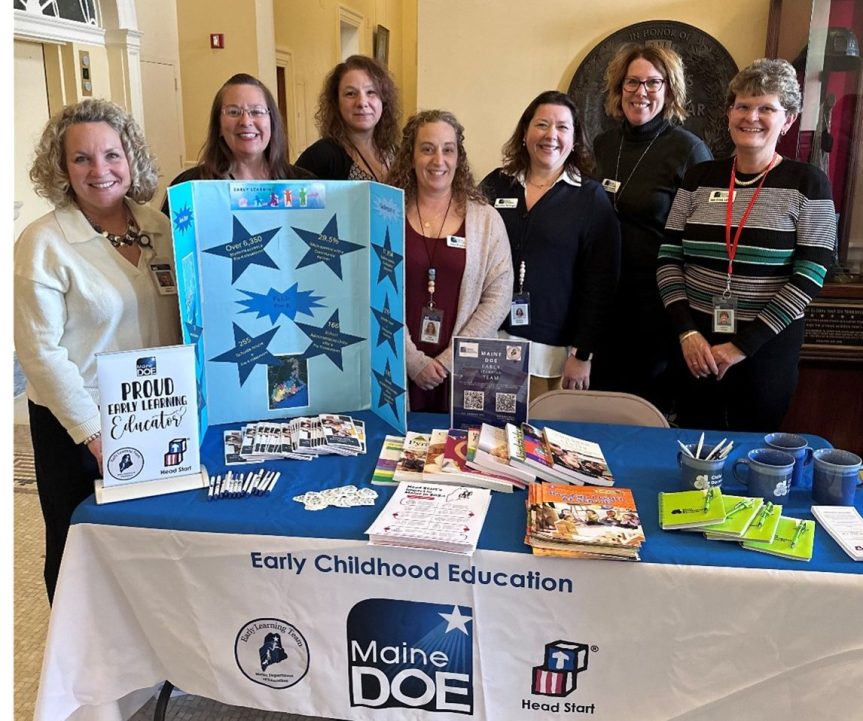
Staff from Maine’s Department of Education’s (DOE) Early Learning Team and Child Development Services gathered with several other Early Childhood agencies, organizations, and programs in the Hall of Flags at the Maine State House in Augusta on Thursday, March 21st for the annual Early Childhood Day at the Hall of Flags.
The event allowed early childhood educators, families, and advocates to unite to celebrate and elevate the need for high-quality early care and education (ECE) opportunities and the importance of a strong ECE workforce in Maine.
Maine DOE Early Learning Team and members of Child Development Services (pictured above) took part in the event by sharing resources and facilitating a session related to public pre-k partnerships.
For more information and resources on early learning in Maine, visit:
There’s still time to register to attend the Maine Department of Education (DOE) Maine Learning Technology Initiative (MLTI) Student Conference! Join us for a fun-filled day of technology learning with #CampMLTI, the in-person student conference. Registration to attend the in-person MLTI student conference on May 23rd at the University of Maine in Orono is open until April 5th.
The MLTI Student Conference is a unique technology experience developed exclusively for students at MLTI schools. Since MLTI’s beginning in 2001 this conference has been providing students with their own conference where they can engage in authentic, relevant, technology-rich, learning experiences that prepare them for a fulfilling future. Starting in 2020, MLTI has offered a virtual Student Conference and now we offer two events annually. The 2024 virtual conference, the Maine Winter Classic, occurred last month and brought together approximately 5,000 participants from schools in every county across the state.
Submit a session proposal!
The Maine DOE is issuing a call for session proposals for the in-person student conference on May 23rd, 2024 at the University of Maine at Orono.
Conference Theme: #CampMLTI – This year’s conference is using a fun summer camp and camping-based theme. We love to have sessions that are tailored to the theme, but it’s not a requirement.There are endless possibilities for session topics. Technology-focused is essential; from traditional use of tech to unplugged, it’s all on the table.
Sessions should be “platform agnostic” (not device specific) and feature only free apps and tools that are accessible to all, and appropriate for 5th through 10th grade MLTI students. If you have concerns or questions about these requirements, please contact the Maine DOE Learning Through Technology team at doe-ltt@maine.gov.
Sessions can be led entirely by educators or students co-led with educators. We will also consider educational organization, higher ed, and other education stakeholder proposals.
Sessions are blocked for 90 minutes and should actively engage students in exploration, creation, and collaboration through technology and/or computer science. Presenters should plan to deliver their session twice, unless their schedule needs prohibit this.
As part of the scheduled periodic review of the Maine Learning Results, the Maine Department of Education (DOE) is seeking public comments regarding the current social studies standards. These comments will inform the work of the standards revision teams.
The standards review process opens with a public comment and public hearing prior to the convening of teams that will review and revise the social studies standards. The public hearing will occur on April 29th, Burton Cross Building, 111 Sewall Street, Augusta, Room 500, from 3-5pm and is intended to give anyone the opportunity to weigh-in on the direction of future social studies standards in Maine. Anyone may speak at the public hearing. People wishing to speak will be asked to sign in and it will be helpful, but not mandatory, to provide a written copy of their comments.
Anyone unable to attend the public hearing may send written comments by 5 pm on April 29th, 2024. Written comments may be emailed to sis.doe@maine.gov with the subject “Social Studies Standards Review” or mailed to Maine Department of Education, attn: Beth Lambert, 23 State House Station, Augusta, ME 04333. You may also fill out this form.
For further information about the standards review process contact Beth Lambert at Beth.Lambert@maine.gov.
The Maine Department of Education (DOE), Child Development Services – Early Intervention for ME is seeking comments from the public on its annual application for federal funds under Part C of the Individuals with Disabilities Education Act (IDEA), which covers early intervention services for infants and toddlers with developmental delays and/or suspected disabilities from birth to their third birthday.
The application, which covers Maine fiscal year 2025 (starting July 1, 2024) is posted on the Maine DOE’s website at Part C Application. The Part C budget is estimated/projected based on Maine’s current award, pending the State’s receipt of the finalized federal award for the coming year. Both documents will be posted from March 22, 2024, through May 22, 2024.
Written comments will be accepted from Monday, April 1, 2024, until 4 p.m. on Tuesday, April 30, 2024. Please send comments to Erin Frazier at erin.frazier@maine.gov or 23 State House Station, Augusta, ME. 04333
Calling all Maine kindergarten teachers, administrators, and curriculum directors! Are you interested in exploring strategies to help support transitions from early childhood settings into a Kindergarten setting? If so, you may be interested in engaging in an upcoming project the Maine Department of Education (DOE) is launching related to the design of a Kindergarten Entry Inventory (KEI).
A KEI is a tool administered in the beginning of Kindergarten to help teachers gather information about children’s development across a range of domains so that teachers can be responsive to children’s learning. Additionally, data aggregated from KEIs can help strengthen Maine’s early care and education system by identifying areas of steady growth and continuous improvement.
In 2022, the Maine Department of Education (DOE), in partnership with the Department of Health and Human Services (DHHS), was awarded the Preschool Development Renewal Grant B-5. This three-year, $8,000,000/year grant supports early care and educational programming for our youngest students. One of the many projects included in the grant is the development of a KEI.
If you are an early childhood educator or school administrator serving these grade levels, please be on the lookout for an upcoming survey later this spring. The survey will gather multiple points of information including current assessment practices utilized as part of children’s transition into, and journey through, kindergarten. The survey will also gather educators’ thoughts about the design of a KEI and questions they may have. Additionally, the survey will offer an opportunity to recruit for educator involvement by either serving on a KEI Advisory Team or by being a Kindergarten Entry Implementation Team Member.
Keep watching your emails. More details and information will follow soon.
For questions, please reach out to Karen Mathieu, Maine DOE Kindergarten Entry Inventory Specialist, at karen.mathieu@maine.gov .









 Maine DOE Newsroom