Maine’s Preschool Development Renewal Grant is supporting the Maine Department of Education in offering grant funding to school administrative units (SAUs) to increase the number of eligible 4-year-olds attending high-quality public Pre-Kindergarten (Pre-K) programming through partnerships with licensed community providers (center-based and family child care) during the 24-25 school year.
In order to realize its goal of achieving universal access for students to public Pre-K, the State is supporting SAUs in increasing the number of partnerships with licensed community-based providers (e.g., center based and family child care) to ensure equitable access to high-quality early care and education, especially for our most vulnerable children.
Partnerships with licensed community-based providers support SAUs to achieve full-day/full-week programming for children and to meet the needs of working families while increasing their offering of Public Pre-K.
The Public Pre-K Partnership Pilot Grant RFA will provide funding to support new partnerships with either a licensed center based provider or a licensed family child care provider.
The timeline for the RFA process is as follows:
March 22, 2024-RFA Released
April 8, 2024—Question Submission Deadline
April 25, 2024- RFA Submission Deadline
All questions about the Pre-K Partnership Pilot Grant RFA should be submitted to the Pre-K Partnership Pilot Grant Coordinator identified on the Grant RFPs and RFAs webpage.
Any additional questions about this opportunity may be directed to Michelle Belanger, Pre-K Partnership Specialist, Michelle.Belanger@maine.gov.
The Maine Department of Health and Human Services (DHHS), in partnership with the Maine Department of Education (DOE), was awarded a Preschool Development Renewal Grant (PDG) from the US Department of Health and Human Services in December of 2022. With this three-year grant, the state is implementing initiatives to build greater infrastructure and capacity to create a more coordinated, efficient, and high-quality mixed delivery system for children ages birth to eight and their families. The plan builds upon successful cross-agency work to ensure that all children enter Kindergarten prepared to succeed and are well supported during the early elementary years.
Included in this grant is the opportunity for a summer summit series in 2024 and 2025 to support communities in their local system alignment and coordination for early childhood care and education programming from birth through the early elementary years. Teams accepted to participate in the summit will also be awarded $800 mini grants to support their efforts in developing and implementing action plans to address an identified early care and education need in their communities.
The goals of the Early Childhood Summit include:
Fostering community level coordination and collaboration across the mixed-delivery early care and education system, which includes child care programs, head start and elementary schools, to improve alignment and transitions for children and families.
Strengthening understanding of evidence-based practices that are critical to leverage across the birth-grade 3 span in order to promote whole child development.
Supporting community-based planning and implementation efforts through mini-grants and ongoing technical assistance support.
What will the summit structure be like?
The content of the summit will include a variety of keynote addresses and workshop sessions connected to the goals outlined previously. Topics will include promoting inclusionary practices and addressing challenging behaviors, promoting play as a foundational learning strategy, and promoting smooth transitions from early childhood education programs into public schools for children and families. Time will also be provided for teams to work collaboratively on action planning.
When will the summits be held?
The 1-day summits will be held in two regions (see dates/locations below). Teams will apply to attend in one of the two locations. The summits will run from 8:30 a.m.- 4:00 p.m.
Thursday, July 11, 2024, Keeley’s Banquet Center, 178 Warren Avenue, Portland, Maine
Tuesday, July 16, 2024, Jeff’s Catering & Event Center, 15 Event Center Way, Brewer, Maine
What are the requirements of participation for all team members?
All team members will be expected to participate in the professional development and technical assistance components outlined below.
The components include:
Projected timeline:
One check in meeting prior to the July 2024 Summit
June 2024
Attendance and participation at Summer Summit July 2024
July 11 or 16, 2024
Bi-annual consult with the Departments (1/2)
Fall 2024
Bi-annual consult with the Departments (2/2)
Winter 2025
Attendance and participation at Summer Summit in July 2025
July 2025
What is the composition of teams?
Teams may have up to five members. There must be at least:
one public early elementary school educator and
one child care provider/educator represented (family child care and/or child care center) on the team.
The additional three members may include but are not limited to:
Representative of the local business community
Parent of a child using early childhood services
School Administrator
Home Visitor
Mental health care provider
Head Start Representative
Health care provider
Community librarian
Representative of an organization that supports workforce development
Provider of services under the federal Individuals with Disabilities Education Act, Part B or Part C
Provider of professional development to early care and education professionals
A faculty member of a career and technical center or higher education institution specializing in early childhood, if available
How will the mini grants work?
Each team will receive an eight-hundred-dollar ($800) grant to support their action planning and implementation work over the first year. Another min-grant will be available following successful completion of the first year and participation in 2025 summit.
Do you want to engage students in learning about Maine’s Natural Resources? Do you want to promote outdoor education? Do you want access to environmental science equipment? Do you want to provide students with more opportunities to master the Maine Science and Technology Learning Results Standards? The Envirothon KickStarter Program may be for you.
Through a collaboration between the Maine Association of Conservations Districts and the Spruce Mountain High School Envirothon Team, an Envirothon KickStarter Program is available to organizations that have not had teams compete in the last 2 years.
Available through a Diversity Grant from the U.S. Forest Service, the National Conservation Foundation, and the NCF Envirothon, the KickStarter Kits are intended to provide resources to help new advisors teach students content and skills related to preparing for an Envirothon Competition.
The Kits will include materials such as a Biltmore Log Scale Stick, Trees of Maine book, soil testing materials, water data sampling materials, and other supplies for environmental science. It is expected that organizations receiving Envirothon Starter kits will organize a team to compete in the 2024 or 2025 Envirothon and the kits will be available this spring through 2025 or until the funds are depleted.
Additionally, as part of the Envirothon KickStarter program, there will be online training for any advisors and students to help them learn about Envirothon, including newly formed and veteran teams. Teachers may receive contact hours towards recertification for participation.
For more information about Envirothon or the Envirothon KickStarter Program, you may email Spruce Mountain High School Envirothon Advisor Rob Taylor at rtaylor@rsu73.com.
More information on the Envirothon and how to register:
To register for a 2024 Maine Regional Envirothon, please visit: Maine’s Envirothon Registration Webpage. Registration is $125 per team and includes T-shirts for team members. Registration must be completed by April 5th.
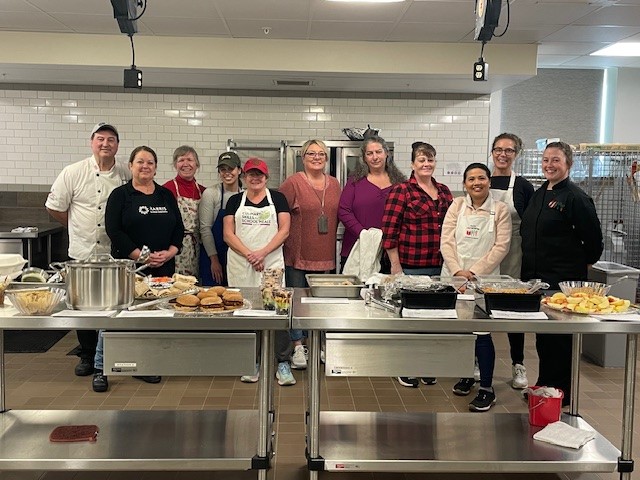
Last month, the Maine Department of Education (DOE) Child Nutrition team hosted ten School Food Service staff members in their Culinary Classroom in Augusta for vegan/vegetarian culinary training.
Five teams of two prepared eleven dishes from lentil sloppy joes, Asian salad, sweet potato & bean burrito, and tortilla soup to cookie dough hummus. After preparing the dishes, they enjoyed the fruits of their labor and discussed each dish.
Comments included the ease of preparation, how ingredients could be used in other dishes, how appealing the look and flavor of several dishes were, and how some were a good way to use commodity products.
The Maine DOE Child Nutrition team operates the Culinary Classroom to provide culinary and food safety training to School Nutrition Professionals across the entire state of Maine. Along with in-person training, the team also records training videos and recipes that are accessible as needed via their website.
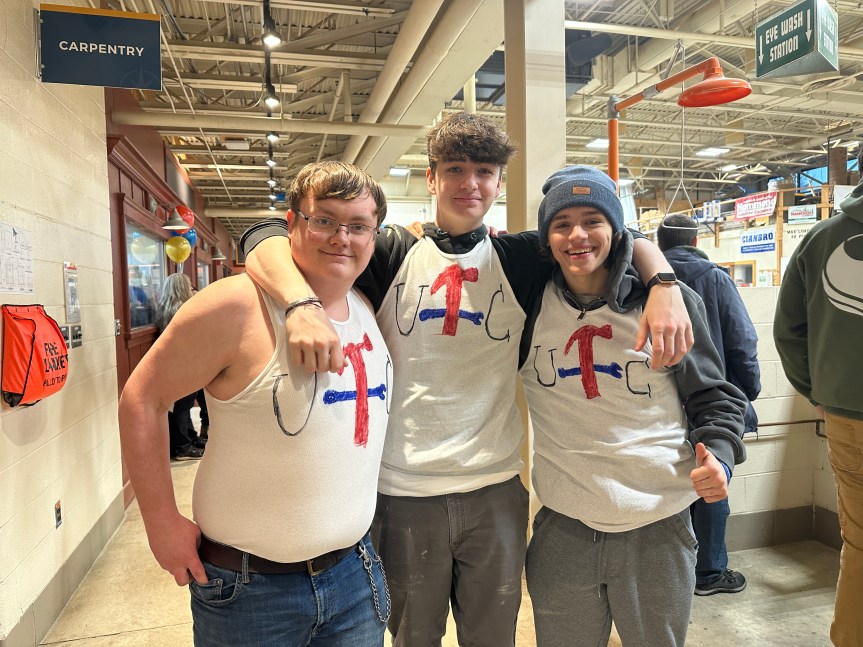
(Pictured: United Technology Center students [L to R] Dominic, John, and Joe attend SkillsUSA with homemade t-shirts rooting for their friend, Zach who is competing in the construction competition this year.)
UTC student Dominic shows off the back of a t-shirt he made to root for his friend competing in SkillsUSA this year.
The hallways of United Technologies Center (UTC) were packed with students dressed in different uniforms adorned with the SkillsUSA emblem on March 15 as they came together from across Maine to test their talents at Maine’s annual SkillsUSA event.
Competitions started on March 14th, the day before, and were happening in locations all over Bangor, as they do each year in the spring.
“I’m so nervous,” one student said to another as they climbed the steps to the second floor in search of their instructor and to find the site where their competition would soon start. Students come from Career and Technical Education (CTE) schools all over Maine, some even come the day before due to the distance they have to travel to participate. Many have been preparing for months and even years to take part in the event.
“You’ve got this!” an instructor said to another nervous student as they rushed by to get to another competition.
“I love it!” said Laura Manzo an instructor from Northern Penobscot Tech Region III in Lincoln. Manzo was sitting on a high stool in front of students working in teams of two in the TV/Video Production competition, something she had coordinated for the second year in a row this year. She said being the coordinator of a competition entails locating all of the judges, creating the prompt for the students to use for the event, and being there to run the competition. This year the prompt was to create a promotional video on Solar Eclipse Safety.
Northern Penobscot Tech Region III Instructor Laura Manzo sitting on a stool helping students who are competing in the TV/Video Production competition.
During the competition, Manzo was on hand answering questions and directing students as the 11 teams worked with cameras and other video equipment, in addition to computers with editing software, on planning, filming, narrating, editing, and putting together a video for the judges to view later that day. Their competition started at 6:45 am that morning and would last until 11:30 am. Manzo, in her 5th year of teaching at Northern Penobscot Tech, was excited about the lineup of judges this year but also nervous for the students who would need to film in the rain, an unexpected challenge the day brought.
“We will see what they come up with,” she said hopefully as she flashed a smile and continued answering questions from students and checking her clipboard.
Down the hall students, instructors, judges, and family members lined the halls looking through big picture windows as competitions started for everything from cake decorating to cosmetology, auto collision repair, and more.
To one end of a UTC hallway sat Rylee, a student at Hancock County Technical Center (HCTC), and Ally a student at Somerset County Technical Center (SCTC) waiting outside a competition room for their turn at the Basic Health Care Skills competition.
Rylee said she likes coming to SkillsUSA because it’s something different. “It’s definitely out of my comfort zone,” she said. She was smiling as she recalled how she was talked into coming last year and again this year.
For Ally, coming to Skills is about, “showing off my talent, showing off my skills, and making friends.” The two sat close together among other students clutching their posters and presentation materials, waiting to do a presentation in front of judges where they would also need to do an interview and showcase basic healthcare skills. They had no idea who among them would get called to go in next.
(L to R) Ally from Somerset County Technical Center and Rylee from Hancock County Technical Center.Lydia from Sanford Regional Technical Center shows off her Courtesy Corp Vest.
In addition to students in the traditional competition rooms were students wearing reflective vests that said “Courtesy Corp.” Lydia from Sanford Regional Technical Center, who was wearing one of these vests, explained that she was currently competing and had been since SkillsUSA started the day before. Courtesy Corp is a community service competition where students are tasked with helping patrons who come to watch the event. They are available throughout the event to help direct people and answer questions. Their competition ends after they help get audience members seated at the main ceremony which was set for later that night at the Cross Insurance Arena in Bangor.
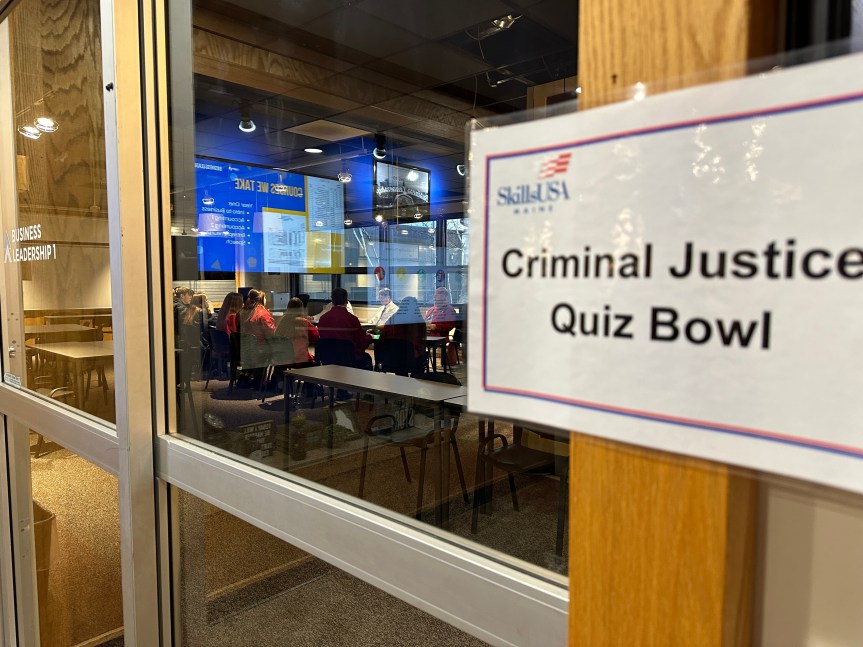
At the top of the stairs was HCTC Law Enforcement student Mercedes with her team of 6 students (5 competitors and one alternative). They and the other teams were all wearing red coats and waiting outside of a conference room for their turn at the criminal justice quiz bowl. This was Mercedes’s team’s second year competing in this competition, and her team won gold last year.
“We studied, so it’s just a matter of rising to the challenge,” she said. Before Mercedes and her team got called into the competition room she shared that after she graduates, she plans to go to Thomas College and pursue their 4-year Criminal Justice Program with a concentration in Law Enforcement and hopes to one day work for the Maine State Police.
Students compete in the Criminal Justice Quiz Bowl competition.
While UTC continued to bustle well past noon, other locations in the area were also hosting students at various competitions across the two-day event, like Fire Fighting, Diesel Equipment Technology, Entrepreneurship, Medical Math, and Early Childhood Education (and more) taking place at Eastern Maine Community College right next door. There were also many competitions at Cross Insurance Area where eventually everyone would end up later that evening.
Student Pin Design
Students’ T-Shirt Designs
Student Welding Sculpture
Starting the day before were a few special competitions for middle school students which also took place at Cross. Traditionally CTE programs, courses, and pathways are more widely available for high school-aged students and most of the students competing each year are in high school and college, but a growing number of middle schools are starting to offer career and technical education options as well.
Lamoine Consolidated School brought 50 students to compete at SkillsUSA this year, which is a record high for them. There were also students from Hancock Grammar School and Caribou Community School.
Middle school students had the opportunity to compete in State T-Shirt, State Pin Design, Team Engineering Challenge, Job Skill Demonstration, Woodworking Display, Community Service, Job Interview, Promotional Bulletin Board, Co2 Dragster, and 3D Printing.
A picture of the Middle School level Team Engineering Challenge in action
Middle School students from Lamoine Consolidated School take a group picture before they leave for SkillsUSA (image courtesy of Amanda Frost, LCS teacher and parent)
Lamoine Consolidated School teacher and 2023 Hancock County Teacher of the Year Miranda Engstrom, who helped coordinate one of the competitions this year, says that all the middle school students talked about having a great time and are already looking forward to next year’s competition.
“They all overcame challenges and feel more confident in themselves and their abilities to solve problems and explain solutions,” she said. As a fierce advocate for expanding career and technical education opportunities for middle school students, Engstrom adds that any other middle schools that want to be involved in SkillsUSA can reach out to their local technical school director, or reach out directly to Maine’s SkillsUSA Chapter.
When the competitions were completed and done, the students, instructors, administrators, parents, family members, and friends gathered at the Cross Insurance Area for the awards ceremony. Once the very large crowds of audience members were seated, Lydia and the rest of the Courtesy Corp competitors finally finished their competition as well, resting their green vests to also get seated for the ceremony. The ceremony entails top competitors being called up on stage and given gold, silver, and bronze metals, Olympic style standing on cascading platforms, and celebrated but one and all.
Middle School students accepting medals at SkillsUSA
The crowd at Cross Insurance Arena
Lamoine Consolidated School ended up with seven middle school students qualifying for the National Leadership and SkillsUSA Conference in the following competitions: Team Engineering Challenge, Promotional Bulletin Board, and State Pin Design. (Congratulations to Ian Frost, Jordan Chan, Benjamin Baldridge, Elza Cahn, Piper Smith, Kaia Tulloss, and Natalia Briggs!)
Mercedes and her team from the Hancock County Technical Center rose to the challenge as well by earning themselves a gold medal again this year in the Criminal Justice Bowl. As did Rylee from Hancock County Technical Center who ended up winning the silver medal in the Basic Health Care Skills competition. You can see a full listing of all the medal winners announced by SkillsUSA Maine here.
Congratulations to all of the winners, the many student competitors, as well as all of the people behind the scenes who work very hard to make this amazing event happen every year and who help prepare the students to compete.
Top winners of Maine’s SkillsUSA event will go on to compete at the national level in the SkillsUSA Conference in Atlanta, Georgia in June.
Maine public schools invited to submit applications for the new 2024-2025 rating cycle
Maine school administrative units (SAUs) may apply for the Integrated, Consolidated 9-16 Educational Facilities Program through the application posted on the Maine Department of Education (DOE) Office of School Facilities website. The application deadline is June 30, 2025.
This new rating cycle provides an opportunity for SAUs to apply for state support for the regionalization of two or more high schools in combination with a Career and Technical Education school, the University of Maine System, the Maine Community College System, and industry partnerships. The selected integrated model would be administered by a consolidated governance structure.
The Maine DOE will review completed applications and develop a priority list that will be used to designate a model project for funding. The process is governed by Chapter 61 State Board of Education Rules for Major Capital School Construction Projects.
Questions regarding the application should be directed to Scott Brown, Maine DOE’s Director of School Construction, at scott.brown@maine.gov. Questions and answers will be posted here.
The Maine Department of Education (DOE) is seeking comments from the public on its annual application for federal funds under Part B of the Individuals with Disabilities Education Act (IDEA), which covers services to children with disabilities, ages 3-22.
The application, which covers Maine fiscal year 2025 (starting July 1, 2024) is posted on the Maine DOE’s website at https://www.maine.gov/doe/learning/specialed/fiscal. The Part B budget is estimated/projected based on Maine’s current award, pending the State’s receipt of the finalized federal award for the coming year. Both documents will be posted from March 19, 2024, through May 18, 2024.
Written comments will be accepted from Monday, April 1, 2024, until 4 p.m. on Tuesday, April 30, 2024. Please send comments to Erin Frazier at erin.frazier@maine.gov or 23 State House Station, Augusta, ME. 04333.
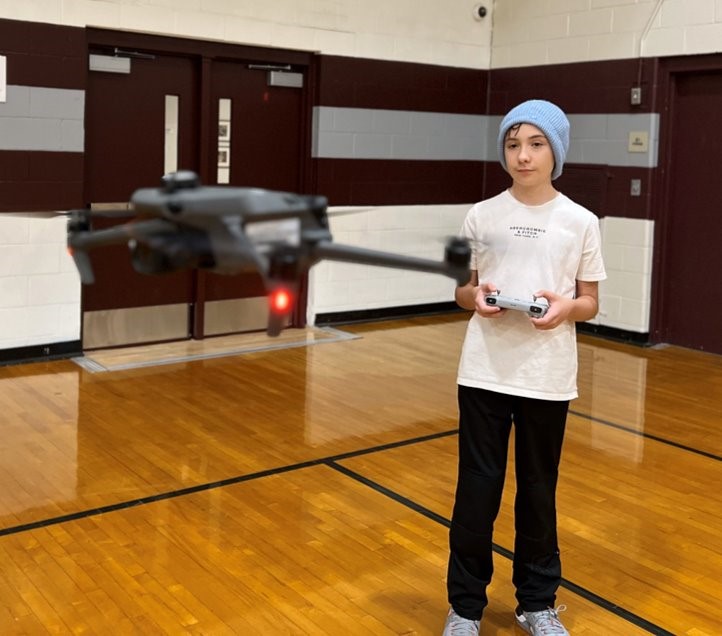
(Pictured: Saco Middle School 7th grader, Keegan Wong, pilots a drone during a skill-building portion of the drone piloting club.)
This year, Saco Middle School (SMS) has three exciting student technology projects that highlight highly engaging, student-driven learning. These projects are a combination of projects funded through the Maine Department of Education (DOE) Maine Learning through Technology Initiative (MLTI) as well as a student project submission to the Samsung Solve for Tomorrow STEM competition.
Lyla Picard, 8th grader, shows off her drawing that was then imprinted onto cardboard using the Glowforge printer.
The Maine DOE #TeachWithTech grant enhances teaching and learning through the use of innovative technology. Saco Middle School’s grant award of $19,517.50 funded two initiatives at Saco Middle School, a laser-cutting and engraving printer to be utilized in their STEM program and an afterschool drone pilot training club. Both of these projects reflect the school’s commitment to advancing education through cutting-edge tools and a focus on engaging students in learning.
The Glowforge printer purchased for the school’s STEM lab uses laser technology to cut, engrave, and shape a variety of materials, including wood, acrylic, leather, and paper. Under the direction and initiative of STEM teacher Sam Blunda, students have been able to create intricate prototypes for design projects and produce personalized and custom items on a variety of materials.
“These printers have enabled students to bring their ideas to life, including the printing of wooden staff desk placards and Saco Schools engraved beach stones,” said Saco School Department Assistant Superintendent Meg Parkhurst. “Students have been able to recycle old materials to create functional and artistic items.”
One project included the printing of cutout pieces that could then be assembled into small toys. This served as a way to repurpose materials that may have otherwise been thrown away, such as old file folders, and also provided a gift that students were able to donate to children in the area to build.
The drone pilot training extracurricular activity run by staff members Chris Hayden and Lisa Ronco used professional drones and has provided students with a dynamic and engaging learning experience after school. Through small group sessions, students have mastered the basics of drone flight, navigated obstacle courses, honed their search and locate skills, and even tackled blind multi-directional courses using only the camera image for navigation. The acquisition of two Mavic 3 Classic drones and five Mavic 3 Mini drones has facilitated hands-on learning.
Beyond the technical skills, students are now well-versed in the requirements for FAA Remote Pilot certification for search and rescue, motion picture cinematography, and working with law enforcement.
As part of their journey to the National Samsung Solve for Tomorrow competition, Saco Middle School (SMS) 7th-grade students crafted this compelling video to highlight their project’s impact. Knotmarkers, conceived and executed by the inventive minds of SMS’s Maine State winning students with the guidance of Ms. Lindsay Girard, revolves around creating 100% biodegradable, sustainable, and refillable markers. This innovative solution aims to combat the staggering environmental impact of the 400 million markers discarded annually in landfills throughout the United States. The team’s commitment to utilizing locally sourced materials and an efficient production process underscores their dedication to reducing the carbon footprint.
Samsung Solve for Tomorrow is a national competition that challenges students in grades 6-12 to use their STEM (Science, Technology, Engineering, and Mathematics) skills to address real-world issues in their communities and affect positive social change. Outshining their high-school competitors from across the state, SMS secured a remarkable $12,000 Samsung prize package, a video kit to assist in the national competition, and a designated Samsung Employee Mentor. The Top 10 National Finalists will be chosen by March 26, 2024, at which time the Community Choice voting will take place for the Top 3 National Winners announced on April 29, 2024.
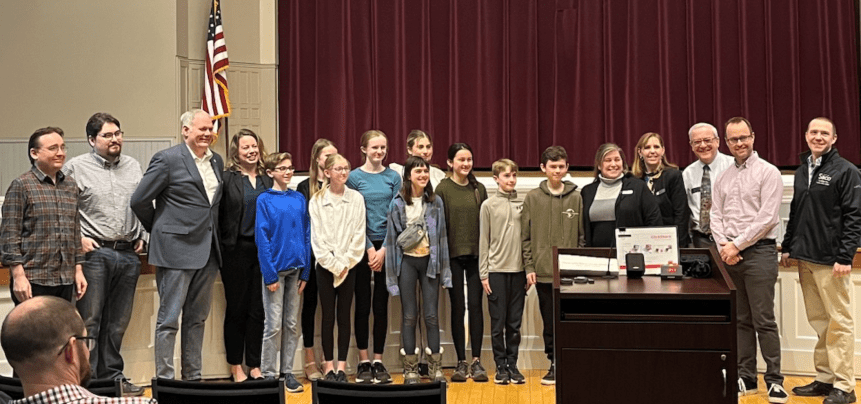
Students share their solve for tomorrow project with Saco’s City Council.
To enhanced Maine’s high-quality Career and Technical Education (CTE) programs, the Maine Department of Education (DOE) is seeking your input.
As required under the Strengthening Career and Technical Education for the 21st Century Act (“Perkins V”), the Maine DOE is completing a non-substantive revision of our four-year Perkins state plan. Among minor updates, this revision to the state plan will also include adjusted values of Maine’s state-determined performance levels (“SDPLs” or “performance levels”) for the 2024-2025 school year through the 2027-2028 school year. These proposed adjusted values will more accurately represent available student data and will reflect more achievable thresholds at the state level.
Maine’s proposed SDPLs for the upcoming four years are now available for public comment for the next sixty (60) days, with public comment closing on May 13, 2024. Feedback should be provided through the available survey, found here. More information on the state plan and on Maine’s existing secondary and postsecondary SDPLs can be found on the Accountability page of the Maine DOE’s CTE website. Please note: the Perkins indicators (1S1, 2S1, etc) may not be changed: Maine is federally required to report on these performance indicators.
Comments will be reviewed and included in the final version of Maine’s 2024 Perkins State Plan (Revision). For additional information, please contact Dwight A. Littlefield (dwight.a.littlefield@maine.gov) .
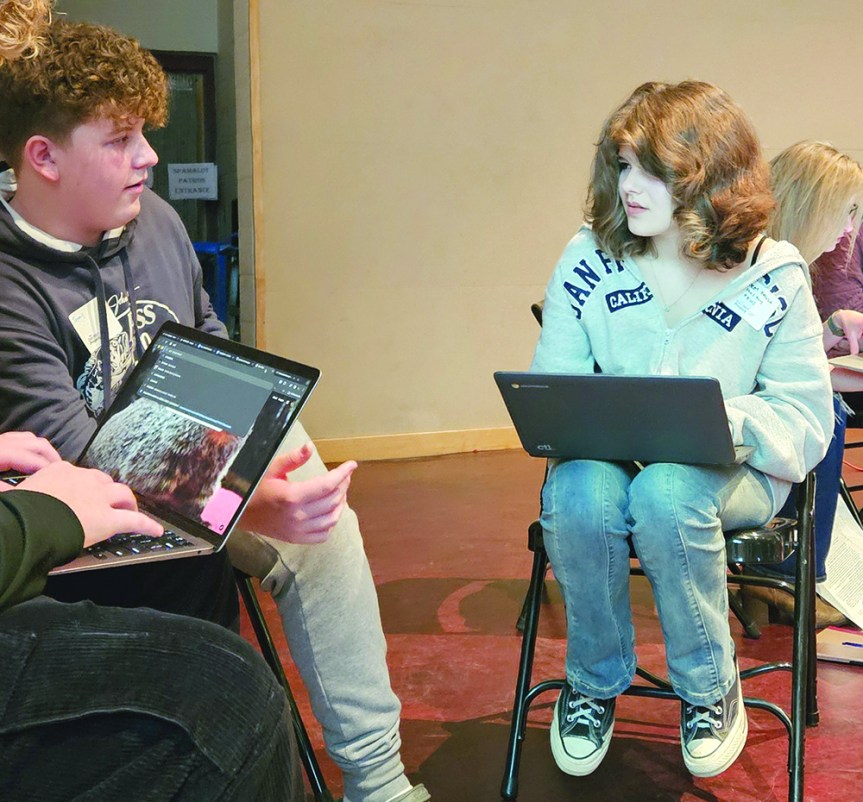
(Pictured: WHS freshman James Arthurs, left, and Poland Regional High senior Audrey Fryda engage in a courteous conversation regarding a current legislative issue.)
For the second consecutive year, a student group from Windham High School (WHS) volunteered to participate in the Can We? Project and hosted their peers from Poland Regional High School (PRHS) in mid-February to practice skills needed for civilized conversations.
The Can We? Project is an initiative intended for high school students to rejuvenate democracy by learning the abilities necessary to engage in respectful civil dialogue. This is Poland High’s first year participating in the Can We? Project. At last month’s gathering, students from both schools had the opportunity to discuss diverse perspectives and complex issues, doing so by showing a level of maturity and respect needed in difficult discussions.
“My experience with Can We? reinforced my admiration for this generation of students,” a PRHS social studies teacher and Can We? Project liaison Elaine Fryda said. “They are mature, earnest, and articulate. I was impressed by how seriously they discussed important current events.”
Jen Dumont, a WHS JMG specialist/teacher, and Can We? Project liaison agreed, saying that any time a space is provided for students to meet and communicate with peers, in a safe and solution-oriented way, it opens students’ perspectives and encourages empathy.
“Having the opportunity to host Poland Regional High School Can We? Project students gave our Can We? participants a chance to exhibit leadership skills and showcase some of the conversation tools they have developed during our past Can We? Project retreats,” Dumont said. “It is always edifying to realize that there are other students with similar stories and concerns from around our state.”
A few students from both schools shared their experiences from participating in the project.
Audrey Fryda, a PRHS senior, admitted that in an age of internet, it is easy to be swept into a biased and stereotypical way of thinking.
“I think it is easy to be sucked into an echo chamber of sorts, where you find things on the internet that align with what you believe to be true,” she said. “By engaging in conversations, we are having today with peers who think differently, we break those stereotypes and expand our empathy for others. By being able to do this, we are taught how to deal with important and controversial issues in an intelligent and respectful manner.”
WHS freshman James Arthurs said that if you take the moment to listen to one another, even if you don’t agree on a topic, you can come to an understanding or simply agree to disagree and remain civil.
“I enjoy participating in these conversations because it helps me learn different sides of a story – so I can understand where others are coming from,” Arthurs said. “It also helps me better understand my own perspective and has sometimes changed my viewpoint a bit. I also have understood my perspective more thoroughly where I am better able to support and advocate for it.”
PRHS senior Jonathan Crump said this was the first opportunity he had to talk about laws being passed and enjoyed hearing what everyone had to say. His involvement with the Can We? Project provided a deeper understanding of real conversations.
“Most of my experiences with Can We? were positive, but I want to point out that the project isn’t a ‘utopia of open mindedness’ if you will,” Crump said. “I still felt that I was being judged by people around me, just to a lesser extent. In all, it was fun to engage in dialogue with my peers and Can We? is definitely a step taken to bridge the gap between our country’s political divide.”
The Can We? Project was founded in 2018 by Third Thought Initiatives for Civic Engagement at Waynflete School. Originally a weekend retreat serving 35 students, the project now works throughout the school year with nearly 300 students in 14 public partner schools in Maine. Can We? is a collaborative effort between Waynflete, Maine Policy Institute, a non-profit that works to expand individual liberty and economic freedom in Maine, and Narrative 4, a national storytelling exchange program that teaches the skills of compassion through active listening with others.
Dumont explained that as adults, we have a certain responsibility to students to provide the space for active listening, and it is the reason why she is a teacher and a Can We? Project liaison.
“It’s important we provide the structure and safety to share students’ personal stories and have solution-oriented conversations that build bridges between people of various backgrounds and opinions,” she said. “I feel very honored to have been able to participate. I look forward to seeing the Can We? Project evolve and take on an incarnation here that can have further impact on our student population and staff.”
Elaine Fryda agrees with Dumont.
“Can We? provides students a unique opportunity to practice empathy, communication, and reflection,” she said. “Participation in the project fosters curiosity, courage, and caring. It goes without saying that we all could use more of these traits in our lives.”
This story was submitted by Windham High School. To submit a good news story to the Maine Department of Education use our Good News Submission form.








 Maine DOE Newsroom