Maine school administrative units (SAUs) may apply for major capital school construction projects through the application posted on the Office of School Facilities website. The application deadline is August 30, 2024.
This new rating cycle provides an opportunity for SAUs to apply for state support to undertake a major capital construction project. If a SAU applied during the last cycle in 2017-2018, they will need to reapply if they wish to be included in this rating cycle.
The Maine Department of Education (DOE) will review completed applications and create a needs-based priority list that will be used to designate projects for funding. The process is governed by Chapter 61 State Board of Education Rules for Major Capital School Construction Projects.
Questions regarding the application should be directed to Scott Brown, Maine DOE’s Director of School Construction, at scott.brown@maine.gov. Questions and answers will be posted here.
Do you know any teens who want tobuild leadership skills while making a difference in their community? The United States Federal Emergency Management Agency (FEMA) is now accepting applications for its Youth Preparedness Council.
The Youth Preparedness Council supports FEMA’s commitment to involve youth across the U.S. in preparedness-related activities. It also provides youth with an opportunity to present their perspectives, feedback, and opinions to FEMA officials. Youth Council members regularly meet with FEMA staff and attend the annual Youth Preparedness Council virtual summit.
The Maine Department of Education encourages you to share this opportunity with students in grades 8 – 11.
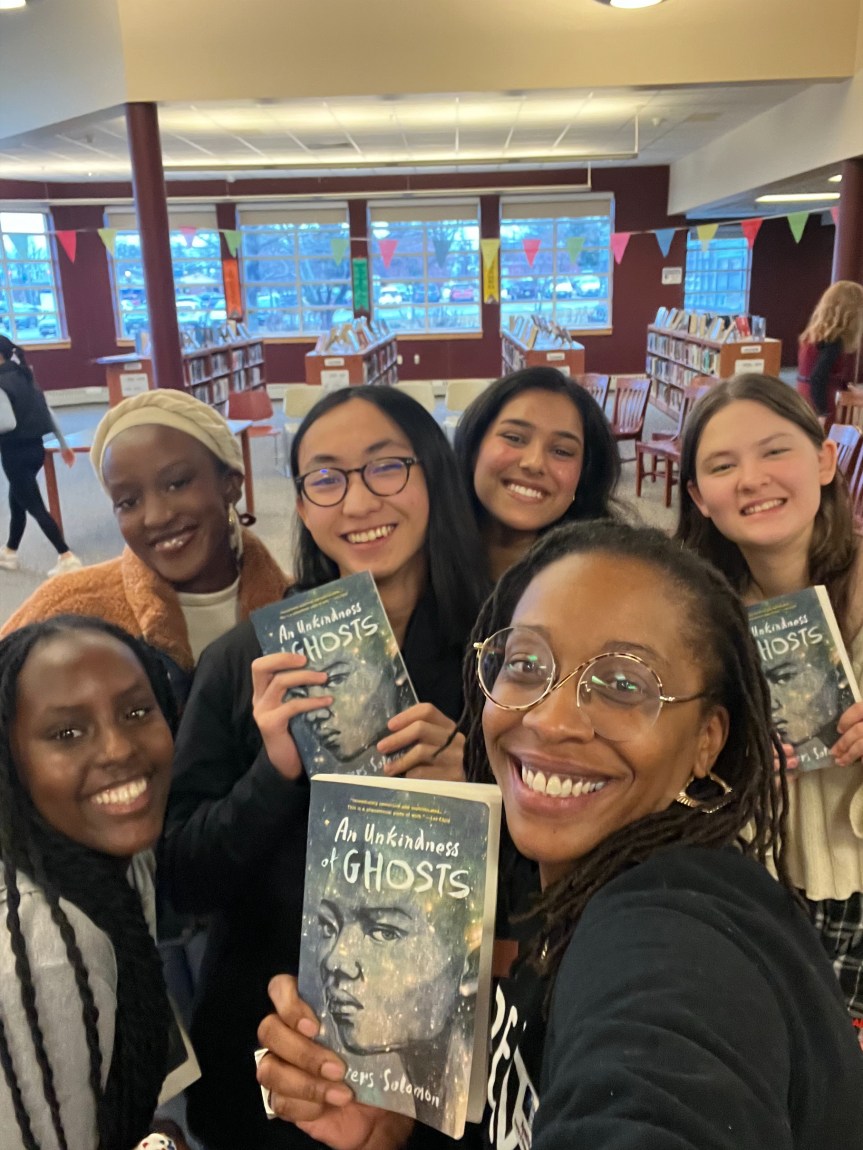
(Pictured: Scarborough High School Students pose with Maine Department of Education Director of Strategic Partnerships Ayesha Hall.)
Scarborough High School’s school library, the Learning Commons is celebrating current fiction to encourage curiosity, discover ideas and perspectives, and inform self-understanding and awareness of the world we live in. It was part of this learning journey that students recently engaged in a book event that helped empower them to reframe the way we think about the society we live in.
Two years ago, School Librarian Deirdre Dupree had the idea of creating book events to encourage, support, and celebrate reading. In the first year implementing the book events Dupree, along with Library Ed Techs Mackenzie Crouse and Jeff Ertman began by using, among other standards, the CASEL framework beginning with self. They held four events throughout the year using memoirs, set the book event “curriculum” with an essential question, and solicited staff from different departments to help them facilitate and deliver their curriculum.
Held during one of the school’s four blocks in the school day, students participate through two pathways, either teachers can sign up to bring their class to the event or students who have a scheduled study hall during the block the book event is taking place can sign up to attend individually.
This year the team moved on to social awareness and society and have been working with folks who have expertise on these two social issues. Recently they called on Maine Department of Education Director of Strategic Partnerships Ayesha Hall, a school psychologist and former SEL & Equity Resource Coordinator for Lewiston Public Schools to help them host their most recent event.
With 70 students and staff present, the group embarked on a guided discussion of the young adult book, “The Unkindness of Ghosts” by Rivers Solomon.
As part of this discussion, students were asked the question: Is it important for societies to be fair?
As the conversation began, Hall explained what happened next, “Students were like ‘What kind of question is this? The only people who would answer no to this question are the individuals who benefit from the unfairness in the first place.’,” remarked Hall. “I was blown away…”
Getting curious, Hall asked the students to pose a more appropriate question to which the students worked together to come up with the following: How do we break down/analyze systems to ensure they are equitable?
The discussion helped the students reframe the question in a way that digs deeper into the question of equity in society but also helps work toward a solution.
“Engaging with literature allows readers to empathize with the experiences of characters in humanizing ways. This allows for reflection and understanding while honoring each individual’s journey as we move in the world,” Dupree concluded.
“It was an honor to host the conversation with them!” Hall added.
Dupree says the Scarborough Learning Commons’ next event is tentatively scheduled for the end of March.
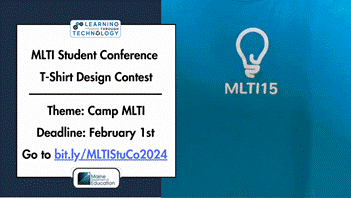
The Maine Department of Education’s (DOE) Learning Through Technology team is seeking student artwork for this year’s in-person MLTI Student Conference that will be held at UMaine on May 23rd. Past winners from Gray-New Gloucester High School, Waterville Junior High School, Auburn Middle School, and Southern Aroostook Community School have been able to see their designs exist beyond their computer screens. This contest is open to all students in MLTI school districts.
This year’s theme is “Camp MLTI,” so judges will be looking for an entry that focuses on camping. This t-shirt will be worn by more than one thousand students and educators who will be joining us at this annual event. The winners will be recognized during the event. Submissions are due no later than February 1st. Winners will be announced within two weeks of submission.
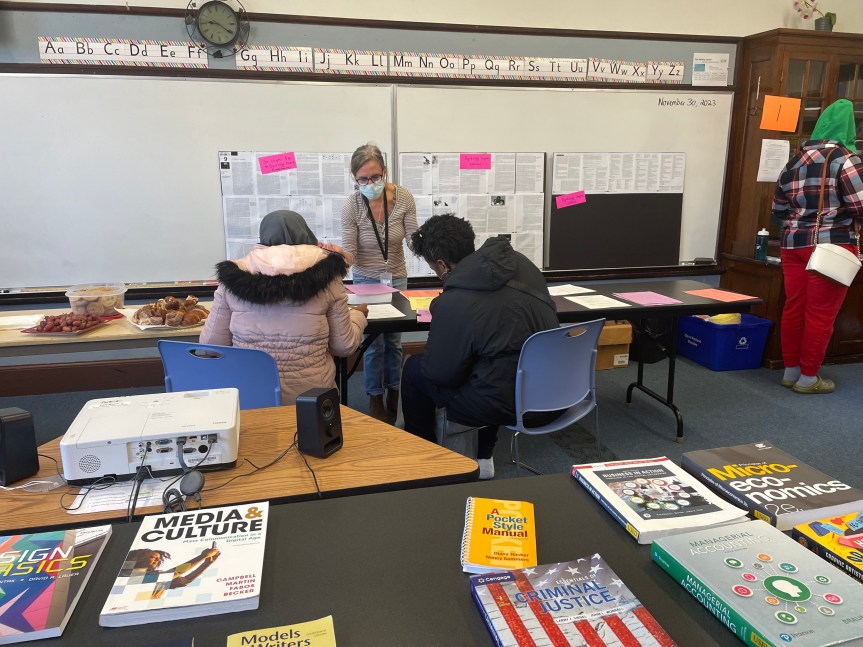
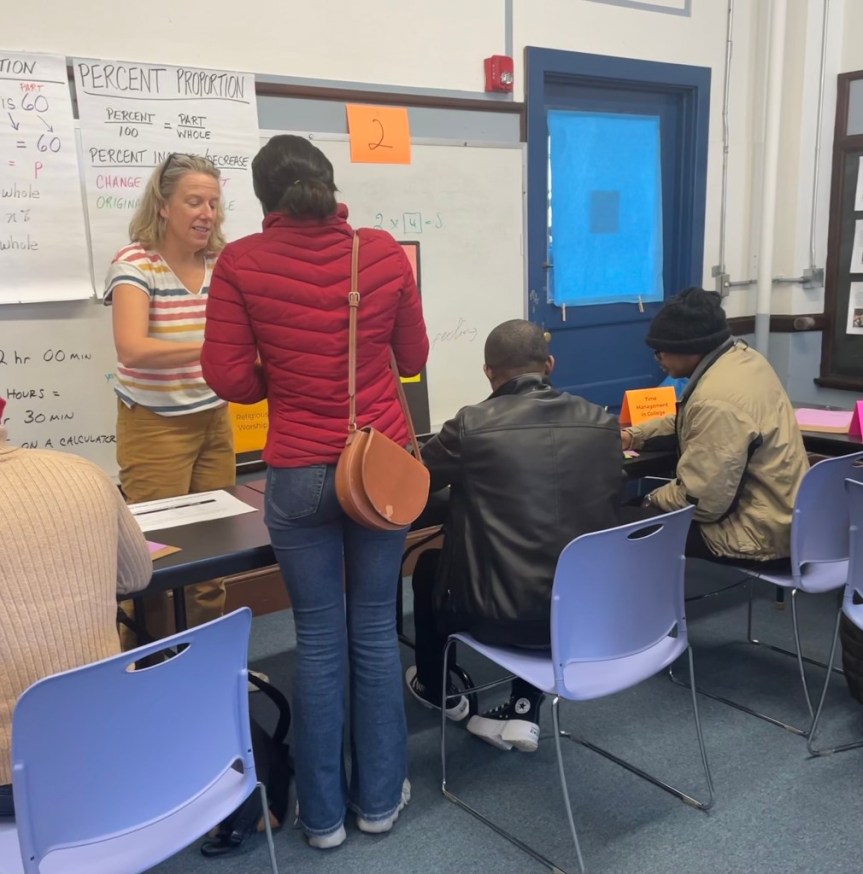
(Pictured: Heather Wood, Dean of Instruction at Portland Adult Ed helping students at a reading and writing station during a recent “Curious About College” workshop.)
Portland Adult Education recently launched a new program, “Curious About College,” that aims to empower adult learners interested in embarking on their higher education journey. Adult Education in Maine has offered Maine College and Career Access (MCCA) programming since 2001 (formerly called College Transitions) to provide readiness for pathways to postsecondary education and careers. With increased enrollments in community colleges across the state and the opportunity of “free college,” student preparedness programs and collaborative partnerships are needed now more than ever.
Anja Hanson, Academic Advisor at Portland Adult Education shares some history and context about “Curious About College”:
We started meeting last year because we felt that prior orientations, meetings, and classes didn’t fully communicate to students what we wanted learners to understand about college in the U.S. This is true for both first-generation and multilingual students. Why should they understand? Preparing for college is so abstract, complicated, and baffling.
Simulated College Experience
We wanted to find a way to make it more concrete. This is how “Curious About College” came to be. We wanted students to do all of the following:
Handle current college textbooks
See the pages of a single psychology textbook chapter spread out on a wall
Listen to a lecture and take notes
Find information on a syllabus
Figure out which math class their degree program would require at SMCC
Plan a week’s schedule that includes all the obligations that work and family demand of adult students
Know what fees they would have to anticipate
Since most of our students are planning on attending SMCC, we used materials in current use there, and we set up 6 stations so that students could engage in activities and ask questions. We gave them checklists to take notes on what they noticed or learned. What we observed last spring and during our recent fall session is that students at various levels of English proficiency and sophistication about college can all get something from this event.
Hanson shared that as they moved about the room, students helped each other. They looked overwhelmed. They looked intrigued. It’s not as though they could learn everything they needed to know in this brief event, but they could discover that they had more to learn, which is precisely what they must understand if they want to go to college.
This photo is from a Time Management station 15 minutes after the event officially ended. Hanson shared that, “it suggests something about how much students need opportunities like these to grapple with what their dreams and goals will demand. We’d love to see other high schools and adult education programs offering Curious About College events.”
Alice Shea (College and Career Success Coordinator) at a time management station.
Feedback from Learners
Students observed how fast the English lectures were when they had to take notes while translating mentally. They noted the amount of time they’d need to commit for reading, planning and completing assignments, the costs of textbooks, how all the programs require math, and the heavy amount of writing. One learner noted that every [degree] program at SMCC requires math. After the event, some learners reflected that it would not be easy, but with practice, they can succeed while others decided they were not ready yet. All learners left the event more aware of college requirements and what it would require to be successful.
Empowering Adult Learners
“Curious About College provides a strong foundation where I can discuss the realities of college and the college system with students, said Alice Shea, College and Career Success Coordinator at SMCC. “I would love it if all students entering college had the opportunity to experience Curious About College. The event empowers students to understand their strengths and limitations and make decisions that will help them be successful in the college system. It takes me out of the role of ‘advising’ students and moves me into the role of a professional colleague engaging in a guided conversation with a student where they decide what works best for them.”
Shea is one of seven College and Career Success Coordinators (CCSC) located at each Maine community college and employed by local Adult Education programs funded by the Maine Jobs Recovery Plan. These roles serve prospective and current community college students as they work toward their goals at the college. Priorities for the CCSCs are Adult Education learners and enhancing the collaboration between Adult Education and their respective community colleges.
Heather Wood (Dean of Instruction at Portland Adult Education) and learners at a Reading and Writing station.
Alice Shea (College and Career Success Coordinator) at a time management station.
Carmen Moreno-Diaz (Intercultural Center Director at SMCC) at a What is Free with Free College Station.
Current and Future Endeavors
Portland Adult Education, Hanson, and Shea seek to expand this opportunity for learners in their community and are demonstrating a mock event for other Adult Education programs in Cumberland County to see the model in action. Shila Cook, ABE/ELL Coordinator at Westbrook Adult Education, and colleagues are holding a Curious about College event for Westbrook High School students and Adult Education learners in late January. Shea’s College and Career Success Coordinator colleagues across the state are working on similar programming to support their adult learners in their college endeavors. At Eastern Maine Community College, Brian Loring, the Success Coordinator there, will offer monthly sessions to interested Adult Education learners, especially HiSET graduates at EMCC. At Kennebec Valley Community College, Carolyn Haskell and colleagues are preparing a “Brighter Futures Day” for March. This is an event for Adult Education learners to come to campus and learn more about what being a student there requires as well as their opportunities and resources. This semester, Adult Education’s MCCA through Turner Adult Education, will hold their class at Central Maine Community College to immerse learners in the college environment.
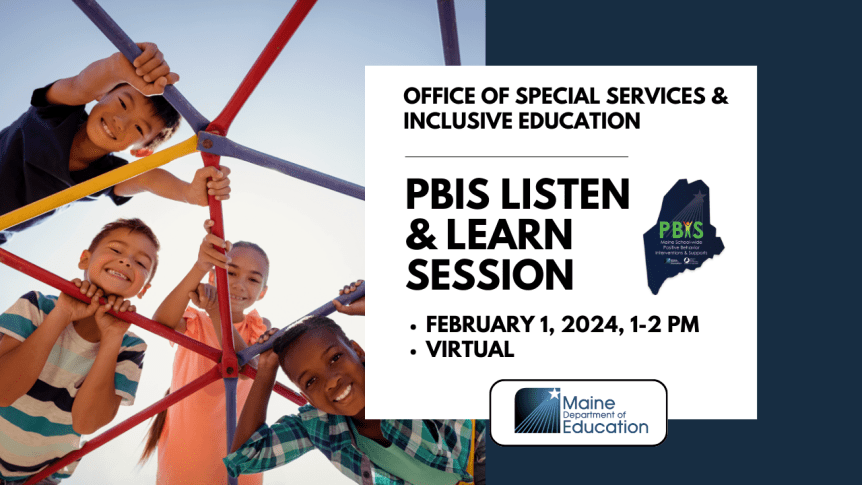
Is your school administrative unit (SAU) and/or school interested in implementing Positive Behavioral Interventions and Supports (PBIS)?
PBIS is “an evidence-based, tiered framework for supporting students’ behavioral, academic, social, emotional, and mental health that creates safe, positive, equitable schools, where every student can feel valued, connected to the school community and supported by caring adults.” (Center on PBIS, 2024).
Maine PBIS offers a 3-year intensive training and coaching model to support districts and schools in implementing Tier 1 PBIS with fidelity. To learn more about Maine PBIS and the training model please join the Listen and Learn Session and explore the resources below.
PBIS Listen and Learn Session February 1, 2024, 1-2 PM Register here
Nestled in the woods off a back road in western Maine you will find Cape Cod Community School. Part of the Regional School Unit (RSU) 9 of the Mount Blue area, Cape Cod Hill takes a different approach to serving its community. It is one of just a handful of Community Schools located in Maine.
A community school model, as defined by the Coalition for Community Schools, is both a place and a set of partnerships between the school and other community resources. Community schools exist in all regions of the United States and their numbers are growing fast.
In Maine, the community school model was first recognized by Maine Legislative Action of the First Regular Session of the 127th Legislature (2015-2016), in the budget bill Public Law 2015, chapter 267. At that time, the Maine DOE was authorized to fund a limited number of community schools, established under 20-A MRSA Chapter 333. Currently, three schools in Maine receive funding from the Maine Department of Education (DOE) to support their community school strategies: the Gerald E. Talbot School in Portland, Old Town Elementary School in Old Town, and the Cape Cod Hill Community School in New Sharon.
In its second year of implementation, Cape Cod Hill Community School has already put a lot of resources and strategies into place with big plans for many more to follow. Principal Carol Kiesman along with Social Worker Amanda Clark and School Nurse Jesstine Meader are the force behind these big changes and they work as a team to tackle the role of Community School Coordinator. An essential part of the success of a community school.
To accomplish a community school model, the team at Cape Cod Hill has garnered countless resources through ongoing partnerships throughout the Franklin County region and beyond to offer students and their families support beyond academics. Resources like behavioral health by way of counseling services for families and children through an outpatient counselor who comes to the school to see children in addition to case management through Maine Behavioral Health Organization. Also now available are dental health services offered to every child right at school, food and nutrition resources available through the school’s food pantry, and many more partnerships that bring in community members, resources, and services that benefit students and families.
“In the past things were more academic-centered, this is more community-centered,” explains Kiesman. “This is looking at the whole child and what can we offer to the children and the families besides academics. Yes, academics are huge, they are important, but we know that there is more to children’s lives than just academics.”
One of the most successful and new programs started by the school is its no-cost before and after-care program which runs from 7:00 am to 4:30 pm on school days. The program allows parents to work without having to find care for their children for those couple of hours before and after school that never seem to line up just right with the average workday. This program has been a game-changer for many of their families and the fact that there is no income threshold makes it that much more accessible for everyone. The Community Schools grant funding provided by the Maine DOE made this program possible.
Pictures from the Before and After-Care Program:
One of the ongoing programs the team has up and running is its food pantry, which also serves as a clothing and book pantry as well as bringing much-needed resources to the community. The pantry has been around for a while but the team at Cape Cod Hill has gotten innovative in maximizing its impact in recent years by creating discrete access to the pantry via a side door to the school, giving community members a way to grab what they need without having to make a grand entrance. They’ve also been able to utilize the help of community partners like Good Shephard Food Bank who help with food donations and have welcomed help from community members who come in regularly to keep the pantry organized and stocked with foods and other resources that families need and want.
Other ongoing partnerships include Franklin County Adult Ed providing monthly classes at Cape Codd Hill Community School on things like cyber security, social-emotional learning topics, and multi-tiered systems of support/response to intervention components that can be implemented at home. They have also invited the Franklin County Sheriff’s Department over for monthly “lunch and jokes” in which members of the Sheriff’s Office get to dine with the students at lunchtime and exchange good-humored stories and jokes.
“We are going beyond our four walls,” said Clark. “Maine schools are providing a lot of these things and they are doing amazing work. I think, for us, the community school initiative and model gave us that extra layer of support to be able to provide the things we felt like we were missing.”
Community schools foster a shared vision for student success and thoughtfully engage the community in making the vision a reality. Over time, community schools become the center a of community where everyone belongs, works together and thrives. They become the hub of their neighborhoods and communities, uniting families, educators and community partners toward student success.
To hear directly from the team at Cape Cod Hill Community School, check out this 5-minute video interview where Kiesman and Clark talk about their journey to becoming a community school and their plans for the future:
Maine DOE has welcomed Community Schools Consultant Ann Hanna, who has joined the Maine DOE Office of School and Student Supports. Hanna proudly served as the principal of the Gerald E. Talbot Community School in Portland where she led the school through a transformative process to become a Community School. Hanna will be working on advancing Community School strategies in interested schools across Maine by providing technical assistance and support as needed. The Maine DOE is also working on the next application for funding for SY 24-25, and information on that will be shared via Newsroom in the coming days.
To learn more about community schools in Maine, please contact Ann Hanna, at ann.c.hanna@maine.gov.
For the 9th consecutive year, the Maine Department of Education (DOE) will collaborate with community organizations and schools to promote the Read to ME Challenge, a month-long public awareness campaign held during February across Maine.
The Read to ME Challenge is intended to bolster enjoyment in reading and to support children’s literacy growth by challenging adults to read to and/or with children for at least 15 minutes during the month of February. Challenge readers are invited to capture the moment via a photo or a video and post it on social media platforms such as Facebook, Instagram, and X/Twitter with the hashtag #ReadtoME. They are also encouraged to continue the impact by challenging social media friends to read to children and spread the impact across the state. Maine DOE encourages you to tag us on social media posts by including a X/Twitter tag at @mdoenews, a Facebook tag @MaineDepartmentofEducation1, and/or an Instagram tag @mainedepted.
While anyone can participate in the Read to ME Challenge, this initiative offers a wonderful opportunity for schools, child cares, libraries, and many other community organizations to plan engaging strategies for completing the challenge and demonstrating commitment to reading to children. In the past there have been a variety of student and adult groups that have organized impactful reading events. These include college and high school sports teams, civic organizations, library programs, recreation departments, and educational organizations.
The Read to ME Challenge will run for the month of February, leading up to Read Across America Day on March 2, 2024. Learn more about the Read to ME Challengeon the Maine DOE Website and be looking for more details about the kick-off soon.
For questions about the Read to ME Challenge, contact Leeann.Larsen@maine.gov, Maine DOE Director of Early Learning. To share your reading photos and videos with the Maine DOE tag us on social media and we will share your post!
On an abnormally warm December day at Nokomis Middle School in Newport, the 8th-grade class is having a fundraiser called “The Maine Sampler.” This fundraiser is more than students asking for money; it is an interdisciplinary unit that spans multiple disciplines and allows students to practice their communication skills, perseverance, creativity, and reflection.
Every year before the winter holidays, students work with their Social Studies and ELA teachers to develop a creative Maine-made product they will mass produce and sell to the public. Social Studies teachers Dan Decker and Lucas Jewett work with students for five weeks to apply their knowledge of economics to an authentic entrepreneurship experience. They start by picking partners and developing ideas. Dan explained, “Students tend to focus on baked goods, but we encourage them to reach out to family and friends with unique skills.” Lucas added, “We encourage them to be mindful of their partners, too. Going into business as an adult requires you to be mindful of who you pick as a business partner.” Students take this advice to heart because all the money they make will be used for field trips, their 8th-grade trip, and the 8th-grade recognition event. Once the teams decide on an idea, they calculate the cost of materials and set their prices. Parents provide all the supplies, but there is also financial assistance for any family that needs it. Students’ “homework” is to mass produce their products.
As they develop their business plans in social studies, they are working on advertising and marketing in ELA. Their teachers, Sarah Murray and Mariah McGuire support advertising through student-created web pages that describe their products and create aesthetically pleasing and informative posters for their tables. Each website includes images and descriptions of the product, a mission statement, and important background information.
On the day of the event, students gather in the gym to set up their tables, decorate them with handmade posters and accessories, and lay out their products. Members of the public and students in the 5th, 6th, and 7th grades will wander around purchasing the student-made products with tickets that they purchase at the ticket table. With the support of math teachers Makenzie Wheeler and Sue Orcutt, students at the ticket table convert every dollar into a ticket that can be used to purchase items or enter raffles. During the two and a half hours, students will communicate with adults and peers to explain and sell their products.
“This is a way to promote a business I already have,” Bentley Lane explained. “When my grandfather and I go hunting, we find deer antlers. He taught me how to process and mount them, and I have built a business selling them.”
Naomi Millet expressed similar feelings about learning about business and economics work. “Learning the economics of selling things is interesting.” Naomi also added she liked being creative, seeing her ideas become products, and working with her friends.
After the event, students will focus on reflection and application. Dan and Lucas will work with students to reflect on the event through the social and financial lens. They will also create opportunities for students to look at applications of their learning beyond the Maine Sampler event. Bentley has already started applying what he has learned. “I like this type of learning because I am applying what I learn to my current business.”
The Maine Department of Education (DOE) and the Maine Centers for Disease Control and Prevention (CDC) jointly released the 2023 Maine Integrated Youth Health Survey (MIYHS) results on Friday, December 15, 2023. The MIYHS data provides schools with up-to-date trends around health behaviors and experiences for Maine middle school and high school students. Results of the survey also give educators an important snapshot of adolescent well-being connected to key health topics.
Maine schools play a critical role in shaping mental, physical, and social growth among our youth. The MIYHS results highlight an increasing need for quality, comprehensive health education and the implementation of proven strategies to educate the whole child. Questions on the survey address behaviors connected to substance use, nutrition, physical activity, sexual behavior, health status, and protective factors, to name a few. The MIYHS highlights trending topics in the areas of mental health, suicide ideation, depression, specific health conditions (diabetes, asthma, obesity), housing stability, and school connectedness.
Building on our understanding of young people’s environments can only expand our opportunities to improve the world around them. The MIYHS results serve as a mechanism to help guide our work in education, to provide resources for students around healthy decision-making, and to deliver tools to young people for the navigation of their pre-teen and teenage years. In 2023, 77% of high schoolers reported having a connection to a teacher who cares about them and supports them (up from 73% in 2021). Maine high schools can utilize this data to make connections with their students and provide programming to connect with a higher percentage of students. Additionally, vaping use decreased significantly with students who indicated they had vaped at least one time (29% in 2021 to 16% in 2023). The messaging being shared around the dangers of vaping is growing and could impact strategies for the reduction of other harmful behaviors.
Findings from the MIYHS data continue to expose concern for marginalized populations (gender, race, ethnicity, and sexual identity). Students continue to experience varying levels of trauma and distress with substance use and abuse, mental health, access to essential services, and protective factors. An understanding of what Maine students encounter in their daily lives can assist adults in furnishing the resources necessary to improve all areas of health and wellness for young people.
Sources of Strength A student-led school culture program that brings together trained adult advisors and peer leaders to create campaigns for the school community that focus on positive, uplifting and hopeful messaging.
Mental Health Promotion Toolkit These materials provide information on mental health promotion, tips for addressing health disparities, and roadmaps for implementing innovative strategies to improve mental health and substance use prevention efforts in schools. For more information about the Maine Pediatric and Behavioral Health Partnership Program, please call 1-833-MPBHP11 (1-833-672-4711) or contact Melissa Maurais at Maurais@maine.gov









 Maine DOE Newsroom