Community Schools Informational Session

Is your school or district interested in learning about how schools can partner with families and community-based organizations to provide supports so that every child has access to what they need to reach their full potential? Have you considered becoming a Community School?  In many communities throughout Maine, not all families have access to healthy food, stable housing, vision care, or dental health services their children need. The impact of these challenges doesn’t stop when students step into the classroom.  Community Schools work with families and community-based organizations as partners to provide comprehensive supports and opportunities to meet the needs and interests of students and families.

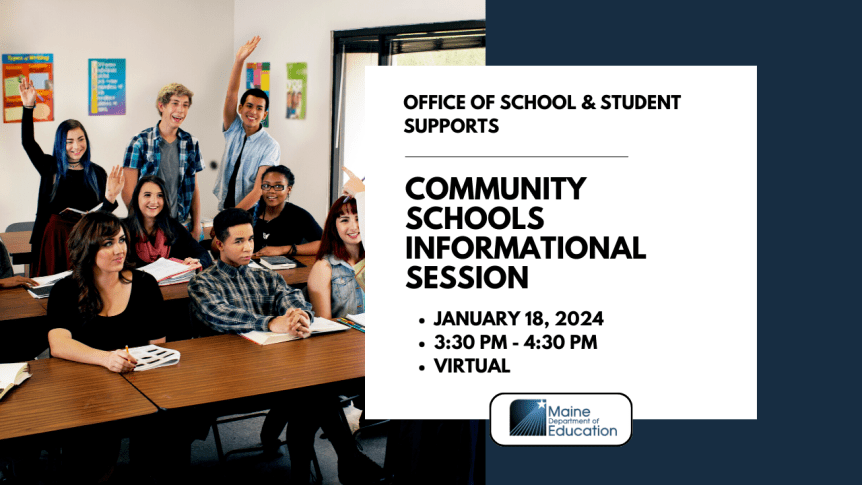
Informational Session

  • January 18 Registration – 3:30 – 4:30 Register HERE
  • Join the Maine Department of Education for a Community Schools informational session to learn more about Community Schools – the benefits and the steps toward implementation.
  • The session will be recorded and shared if you are unable to attend the live presentation.

Community Schools: Background

The Community School model was first recognized by Maine Legislative Action of the First Regular Session of the 127th Legislature, in Public Law 2015, chapter 267, which authorized the Department of Education to fund a limited number of community schools.

According to the National Coalition of Community Schools, community schools create the conditions necessary for students to thrive by focusing attention, time, and resources on a shared vision for student, school, and community success. Its integrated focus on academics, health and social services, youth and community development and community engagement lead to improved student learning, stronger families, and healthier communities. The community school strategy transforms a school into a place where educators, local community members, families, and students work together to strengthen conditions for student learning and healthy development. As partners, they organize in- and out-of-school resources, supports, and opportunities so that young people thrive.

Community schools vary in the programs they offer and the way they operate, depending on their local context. What makes community schools unique is the combination of four key features – or pillars- that together create the conditions necessary for students to thrive. The pillars are as follows:

  1. Integrated student support.
  2. Expanded learning time and opportunities
  3. Family and community engagement
  4. Collaborative leadership and practices

Information about Community Schools can be found on the Maine Department of Education’s Community School webpage at https://www.maine.gov/doe/schools/safeschools/communityschools. For more information, reach out to Julie Smyth, Director of School and Student Supports at Julie.a.smyth@maine.gov or Ann Hanna, Community School Consultant, at ann.c.hanna@maine.gov
 

MaineCare in Education Bootcamp

Please join the Maine Department of Education (DOE) and Maine Department of Health and Human Services (DHHS) Office of MaineCare Services for MaineCare in Education Bootcamp. This one day workshop is presented in a hybrid format with in-person and virtual opportunities on February 9th and 16th from 10 – 2 pm at the DHHS Building located at 109 Capital Street in Augusta. In person attendance is limited to 40. Light refreshments and coffee will be served. Lunch will be on your own.

Topics covered will include:

  • MaineCare basics
  • MaineCare covered service
  • reimbursement opportunities
  • IEP documentation
  • day treatment support
  • transportation
  • interpreter services
  • nursing services
  • how to start billing
  • MaineCare SEED
  • EPS School health-related services
  • technical assistance opportunities

Intended Audience: SAUs, SPPS, anyone accessing Maine CARE in schools

For questions or more information contact Amanda Castner at Amanda.castner@maine.gov.

New Extended Learning Opportunities (ELO) Program at Buckfield Jr/Sr High School Expanding Thanks to School and Community Partners

Gretchen Kimball has been working on getting a new ELO program up and running at Buckfield Jr/Sr High School this school year. Serving the communities of Hartford, Sumner, and Buckfield, Kimball has her plate full working with all interested students to coordinate extended learning experiences that enrich their learning.

“I sincerely enjoy when students drop by to tell me their first meeting with their community mentor (game warden, child psychologist, athletic trainer, etc.) went well and they’re excited to get on with the learning,” said Kimball.

Some of the latest successes she is celebrating are helping several special needs students begin their internships at a local convenience store, in addition to coordinating three honors students internships with the school’s athletic trainer.  She has also been working with the Buckfield Jr/Sr High School Alternative Education program where students are working with a race car fabricator, a dentist, and a Maine game warden. Most recently, Kimball has helped a few more students begin an EMS internship with the local Rescue/Fire Station.

“It’s just a smattering of what’s happening but the kids are engaged in their learning, and it gives me hope for future success,” said Kimball.

In addition to the internship opportunities, Kimball says she has a lot of students taking advantage of JMG’s Maine Career Badge this trimester. “I have career presentations lined up every other Friday through March at the middle school level, and we’re exploring the opportunity for a mini-career fair put on by high school students for an audience of middle school students,” she explained.

Looking even further ahead, in conjunction with the Guidance Department, Kimball is working with Central Maine Community College (CMCC) Department Chair of Public Service & Social Sciences Matt Tifft. She’s exploring ways in which she can build ELOs around their sociology, psychology, and conservation law classes at CMCC.

“There’s student interest, but there are no social sciences offered at our school,” explains Kimball. “I’m hoping this will fill a niche!”

Kimball would like to thank the following people and organizations for contributing to the success of students and the Buckfield Jr/Sr High School ELO Program: Korah Soll- Rural Aspirations, Sandra Fickett- Tilton’s Market, Tom McKenney- Maine State Game Warden, Dr. Convey- Oxford Hills Dental, TJ Brackett- Brackett Racecar Fabrication, and JMG (Jobs for Maine Grads).

Extended Learning Opportunities (ELOs) are hands-on, credit-bearing courses outside of the traditional classroom with an emphasis on community-based career exploration. These opportunities are personalized for students and help them explore options for their professional lives. They help students engage in learning through instruction, assignments, and experiential learning. The Maine Department of Education (DOE), along with state-wide partner Jobs for Maine Graduates (JMG), have made a concerted effort to provide working models, support, and funding opportunities for Maine schools to set up ELO programs within their school communities. To learn more about Maine’s initiatives with extended learning opportunities, visit: https://www.maine.gov/doe/index.php/learning/elo or reach out to Maine DOE ELO Coordinator Rick Wilson at rick.wilson@maine.gov.

PUBLIC COMMENT: School Meal Equipment and Program Improvement Fund

As a result of Public Law 2023, Chapter 457 which enacts 20-A MRSA §6664, the Maine Department of Education is proposing a new rule to guide the administration of the School Meal Equipment and Program Improvement Fund.

As required by law, a period of public comment opens January 17 through February 16, 2024. Written comments may be submitted to DOE Rulemaking Liaison Laura Cyr, State House Station #23, Augusta, Maine 04333; 207-446-8791 or laura.cyr@maine.gov until 5:00 pm February 12. For documentation purposes, written comments are preferred.

  • Timeline for Rulemaking for Rule Chapter 52 – New Rule – Routine Technical
  • File: January 9, 2024
  • Post: January 17, 2024
  • Comment Period End: February 16, ,2024

The proposed Rule Chapter can be found here: https://www.maine.gov/doe/about/laws/rulechanges

You may also submit comments to the following location: Nutrition Rule Form

CONTACT PERSON FOR THIS FILING (include name, mailing address, telephone, fax, TTY, email): Laura Cyr, laura.cyr@maine.gov, 446-8791

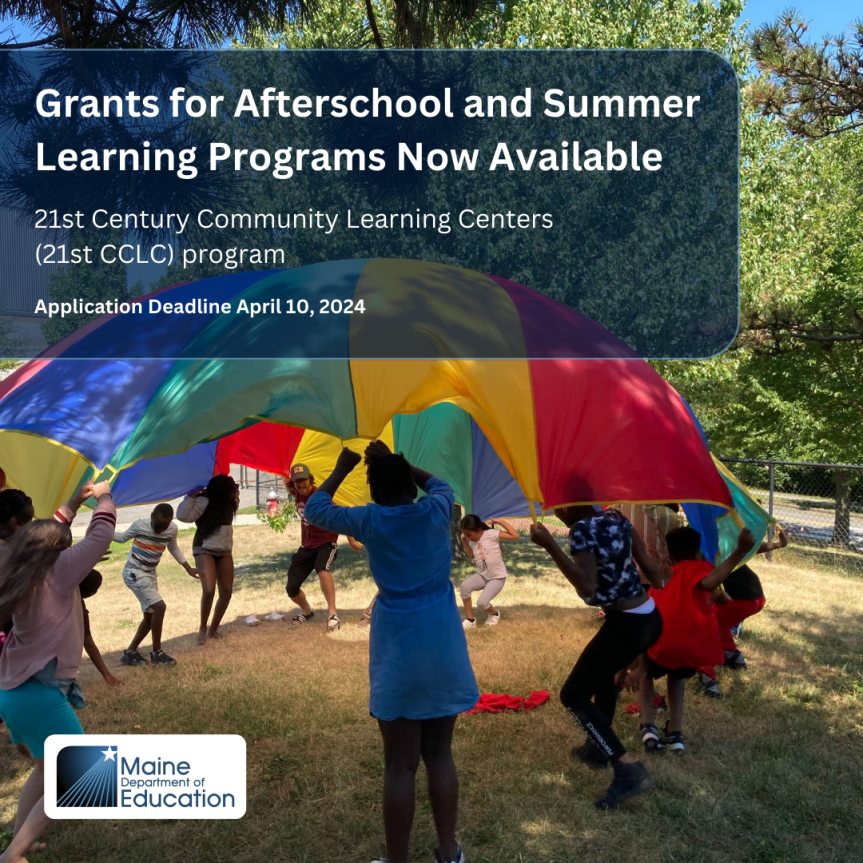
Grants for Afterschool and Summer Learning Programs Now Available, Application Deadline April 10, 2024

The Maine Department of Education (DOE) is pleased to announce the release of a request for proposals (RFP) seeking bids from organizations interested in implementing comprehensive afterschool and summer learning programs in 2024-2025. It is anticipated that roughly $3.5 million will be available to issue grant awards this spring.

Authorized under Title IV, Part B of the Elementary and Secondary Education Act, as amended by the Every Student Succeeds Act (ESSA) Act of 2015, the 21st Century Community Learning Centers (21st CCLC) program provides competitive grant funding to support before-school, after school, and summer learning programs that focus on improving the academic performance of students in Pre-Kindergarten through grade 12.

The primary purpose of the 21st CCLC program is to provide funding for school and community partnerships that establish or expand community learning center programs. These programs provide students in high-need, economically disadvantaged communities with academic tutoring and enrichment opportunities designed to complement their school-day academic program. In addition, these programs can provide a broad array of additional support services related to overall student health and well-being.

Local 21st CCLC programs – which can be located in elementary schools, secondary schools or similarly accessible community facilities – provide high-quality support services to students during non-school hours. As such, these programs also support working parents and families by providing safe, supportive learning environments for students at times when school is not normally in session.

The request for proposal (RFP), which includes information regarding eligibility, program requirements, and more, is available here. An informational webinar for this RFP will also be posted to the Department’s application website on January 24, 2024. It is strongly recommended that interested organizations view this presentation, in its entirety, before submitting a proposal for 21st CCLC program funding.

Below is the anticipated timeline for the Department’s current 21st CCLC grant competition:

  • January 9, 2024—RFP Released to Public
  • January 24, 2024—Informational Webinar Posted Online
  • February 7, 2024—Deadline for Submission of Questions in Response to RFP
  • February 21, 2024—Interested Organizations Submit Intent to Apply Form
  • April 10, 2024—Proposal Deadline
  • April 2024—Formal Peer Review of Proposals
  • May 2024—Grant Award Notifications
  • July 1, 2024—Grant Award Start Date

Please be advised that the dates above are subject to change. Interested organizations must consult the RFP document for the most accurate dates and deadlines regarding this opportunity.

For more information on the 21st Century Community Learning Centers (21st CCLC) Program, contact State Coordinator, Travis Doughty, at travis.w.doughty@maine.gov.

Reminder: Quarter 2 Reporting is Open – Validation Due January 15

Attendance, Behavior, Bullying, and Truancy reports for Quarter 2 (October, November, and December) open as of January 1st.

Validation of these reports are due on Monday, January 15th.

These reports will need to be reviewed and validated. Superintendent validation is required for all quarterly reporting.

Reporting Resources:

For questions about quarterly reporting contact MEDMS.Helpdesk@maine.gov or call 207-624-6896.

Webinar: Culturally Responsive Practices in Special Education

The Maine Department of Education (DOE) Office of Special Services and Inclusive Education and its partners at Maine Access to Inclusive Education Resources (MAIER) invite you to join Penn State University’s Dr. Jonte’ C. Taylor (JT), for a webinar on Culturally Responsive Practices in Special Education. This LIVE session will provide well-structured content on different pedagogies and how teaching and learning can be conducted by developing strategies that promote environmental characteristics and principles for students with disabilities in inclusive settings.

Participants will learn the importance of developing cultural practices in special education and how to provide intensive support for students regardless of dis/ability. The session will help the participant to develop action points and strategies necessary for incorporating cultural practices into the teaching and learning process.

  • The webinar will be held on Tuesday, January 23rd from 4:00 – 5:00 pm via Zoom (a link will be provided to you once you register)
  • Register here NOTE: This webinar will NOT be recorded, you need to attend to see the webinar.

Dr. Jonte’ C. Taylor (JT) is an Associate Professor of Special Education in the Department of Educational Psychology, Counseling, and Special Education in the College of Education at Penn State University. He taught for approximately 10 years with various populations from PreK to Adults in settings ranging from inclusive classrooms to residential treatment facilities. His research interests include science education for students with disabilities, evaluating innovative classroom practices, and bullying issues for students with Autism, Learning Disabilities, and Emotional/Behavioral Disorders.  His most recent publication Mixtape Volume 1: Culturally Sustaining Practices Within MTSS Featuring the Everlasting Mission of Student Engagement was published this year.

NOTE: There are additional learning options regarding this topic from MAIER. MAIER has 5 hours of free, online/asynchronous learning modules from Dr. Taylor HERE. You can take these online learning modules before or after the webinar. You can get UMaine contact hours for these online learning modules once you complete the modules and an evaluation.

For additional information contact Sarah Howorth at sarah.howorth@maine.edu

Regional School Calendar Coordination Between SAUs and CTEs

This notification is a reminder that Regional School Calendars are due by June 1, 2024 for school administrative units (SAU) and private schools, approved for tuition purposes, in coordination with their local secondary career and technical education (CTE) school. This requirement is part of Public Law 2011, Chapter 686 to promote collaboration among local school administrative units that may benefit from inter-administrative unit collaboration beyond CTE.

For school year 2024-25, both regional school calendars and individual calendars for each school administrative unit must be submitted by the director of the local CTE Center/Region to the Maine Department of Education (DOE) no later than June 1, 2024, for a decision on approval by July 12, 2024.

Guidance and templates or Regional School Calendars can be accessed electronically on the Maine DOE website.

Given the coordination required to fulfill this law, the Maine DOE recommends that SAUs initiate discussions as soon as possible, including representatives from all affected secondary schools and their associated career and technical education center or region.

Please visit the Maine DOE Website for more information, including guidance, instructions, templates, a waiver process, and a link to the complete law.

Further questions should be directed to Emily Doughty emily.doughty@maine.gov at 207-592-0314 or Dwight Littlefield dwight.a.littlefield@maine.gov at 207- 441-8927.

Subscribe to the Maine DOE Interdisciplinary Instruction Newsletter

Are you looking for ways to enhance your instructional practices and transfer your students’ learning to the next level? Look no further. The Interdisciplinary Instruction team has created a monthly newsletter that you can subscribe to. This newsletter will highlight innovative interdisciplinary classroom resources and upcoming professional learning opportunities.

To subscribe, click the link below, fill in your contact information, and click “Interdisciplinary Instruction” in the “subscribe me to” section. When we publish a new newsletter, it will automatically arrive in your inbox.

Subscribe here (If you are already subscribed to Maine DOE publications like the Maine DOE Update or other newsletters we publish when you submit your information, you will be redirected to update your preferences.)

For further questions or help, reach out to Interdisciplinary Instruction Team Coordinator Kathy Bertini at kathy.bertini@maine.gov.

Book Study: Asynchronous Cognitive Science

Cognitive science can offer educators an understanding of how students learn so they can apply it to their practice. Interacting with cognitive science  can be challenging though. If you are interested in learning more about cognitive science in a simple yet informative way, this book study is for you.

The book, “Why Don’t Students Like School,” by Daniel T Willingham is an education-focused dive into the cognitive science of how students learn. This 11-week asynchronous book study will allow participants to reflect on their current practice while discovering and applying new knowledge. A free copy of the book will be mailed to your school, and each participant can receive up to 17 contact hours. The book study starts on January 22, 2024.

To join, click this Book Study link and fill out the form. Please email any questions to erik.wade@maine.gov.