Public Comment Period for Proposed Rule Chapter 115 – The Credentialing of Education Personnel

In response to the 131st and 132nd Maine Legislature, the Maine State Board of Education is engaging in rulemaking to revise Chapter 115: The Credentialing of Education Personnel in alignment with its 2023 report to the Legislature. In that report, the State Board reviewed a number of credentialing topics, including pathways for specific endorsements.  
 
As required by law, a period of public comment opened on September 24, 2025, and will continue through October 25, 2025. Written comments may be submitted to Maine DOE Legislative Team member Laura Cyr at laura.cyr@maine.gov, 207-446-8791, or State House Station #23, Augusta, Maine 04333 until 5 p.m. on October 25.
 
Additionally, a public hearing for the proposed new rule will be held in person and virtually on October 15, 2025, from 3-5 p.m. at the Burton M. Cross Office Building (111 Sewall Street Room 103, Augusta, Maine 04333). As space will be limited, participants are encouraged to attend virtually via Zoom, using the following link:
 
Join the Zoom Meeting here.
Meeting ID: 879 4623 6101
Passcode: 47786916
 
With questions, please contact Laura Cyr at laura.cyr@maine.gov or 207-446-8791.
 
Summary of Proposed Changes to Chapter 115 Part I
The updates to Chapter 115 Part I refine definitions, expand credentialing pathways, and adjust requirements for educational technicians, conditional certificates, and emergency credentials. The revisions aim to enhance flexibility in staffing, while maintaining high-quality standards and compliance. Key changes include:

Definitions and General Requirements

  • Updated and clarified definitions for credential, clearance, conditional certificate, endorsement, lapsed credential, employed, contracted service provider, and others
  • Renewal “lapsed” grace period extended from six months to twelve months
  • More precise requirements stipulate that all individuals must hold the appropriate credential on the first day of service; school administrative units (SAUs) must verify credentials annually.

Out-of-State and Out-of-Country Certification

  • Streamlined process for accepting equivalent certificates from other states or countries
  • Requires official transcripts for international coursework and a course-by-course analysis from an approved evaluator
  • Certificates issued under reciprocity are valid for five years and renewable in accordance with Maine’s requirements.

Educational Technician Certificates

  • Reorganized into Ed Tech I, II, III, and Emergency Ed Tech categories with clearer permitted responsibilities and supervision levels. Eligibility updates include:
    • Ed Tech I: high school diploma/GED
    • Ed Tech II: reduced requirement from 60 credits to 48 credits or two years of CTE employment
    • Ed Tech III: may qualify with 90 semester hours or an approved Maine training program, such as community college “learning facilitator” programs
    • Emergency Ed Tech: must complete a state-approved program targeting essential skills
  • Certificates are valid for five years; renewal requires three semester hours of approved study/in-service training per term.

Conditional Certificates

  • Still valid for three years, non-renewable
  • SAUs must provide intensive supervision and mentoring for conditionally certified teachers and specialists.
  • Provision for issuing additional conditional certificates in shortage areas, if the applicant documents English is not their first language

Emergency Teacher Certificate

  • May be issued only to fill a staffing shortage.
  • Eligibility expanded to include:
    • Bachelor’s degree or equivalent work experience
    • Enrollment in an educator preparation program
    • Ed Tech III certification (excluding Emergency Ed Tech III)
  • Holders must participate in a mentoring program.
  • Term limited to one year, renewable up to three times total

Clearance Certificates

  • Required for all non-certified staff in schools or Child Development Services (CDS) sites
  • Valid for five years from the date of application; renewable with proof of service and CHRC completion
  • These updates emphasize greater flexibility in staffing, particularly for Ed Techs and conditional/emergency certifications, while reinforcing oversight, renewal, and mentoring obligations for SAUs and the Maine DOE.

Summary of Proposed Changes to Maine Chapter 115 Part II
This document contains extensive revisions to teacher and administrator certification requirements. Key changes include:

General Changes across Multiple Endorsements

  • Addition of Portfolio Pathway: A new “Endorsement Eligibility Pathway 3” has been added to most teaching endorsements, allowing candidates to earn certification through an approved portfolio process with superintendent and department approval.
  • Revised Language: “Graduated from” changed to “Successful completion of” throughout the document for consistency
  • Reduced Conditional Certificate Requirements: Many conditional certificate requirements have been reduced (e.g., from 24 to 18 semester hours for secondary teachers, from 24 to 15 semester hours for ESOL teachers).

Specific Endorsement Changes
Early Elementary and Elementary Teachers (029, 020)

  • Added portfolio pathway option
  • Restructured conditional certificate requirements to include portfolio option

Middle Level Teachers (1.3)

  • Added world languages to the endorsement areas covered (grades 5-8)
  • Added specific teaching methods and coursework requirements
  • Included language proficiency testing options (ACTFL, STAMP, ASLPI)

Secondary Teachers (1.4)

  • Reduced the conditional certificate requirement from 24 to 18 semester hours
  • Added portfolio pathway

Pre-K through Grade 12 Teachers (1.5)

  • Expanded from 2 to 4-6 pathways, depending on endorsement
  • Added specific pathway for endorsement 700 (industrial arts/technology education), including apprenticeship and experience requirements
  • Added detailed pathway for endorsement 510 (physical education) with specific coursework requirements
  • Reduced the conditional certificate requirement from 24 to 18 semester hours

Special Education (Section 2)

  • New Endorsement 283: Provider of Early Intervention/Teacher of Children with Disabilities, Birth to Age 5
  • Revised grade span of 282: Birth through grade 12
  • Added portfolio pathway options
  • Modified grade span renewal option, allowing current 282 holders to renew in birth-grade 12 span

ESOL Teachers (1.8)

  • Added fifth pathway option
  • Reduced the conditional certificate requirement from 24 to 15 semester hours
  • Allowed alternative credit options (CEUs, in-service hours, workshops)

Library Media Specialist (1.11)

  • Removed competency demonstration requirement reference
  • Streamlined pathways and requirements

School Counselor (1.12)

  • Added detailed CACREP standards alignment requirements
  • Specified coursework in three areas: Foundations, Contextual Dimensions, and Practice of School Counseling

Athletic Director (1.14)

  • Added second pathway option
  • Added detailed coursework requirements covering legal issues, student athlete wellness, and diversity
  • Restructured renewal requirements

Career and Technical Education (Section 3)

  • New Endorsement 095: Career Development Coordinator in CTE
  • New Endorsement 096: Student Services Coordinator in CTE
  • Added sixth transitional pathway for those holding current CTE certificates seeking additional endorsements
  • Reduced professional certification requirements from 12 to nine semester hours

Administrator Certificates (Section 4)

  • Changed terminology from “Certificate” to “Endorsement” throughout Section 4
  • Added references to the Student Services Coordinator in CTE role across multiple certificates
  • Maintained PSEL (Professional Standards for Educational Leaders) alignment requirements
  • Clarified internship/practicum requirements with three options: approved program, one year employment, or mentorship plan

These changes generally aim to provide more flexible pathways to certification, while maintaining quality standards—with particular emphasis on portfolio options, CTE positions, and special education specializations.

Maine Student Leader Nathan Prest Honored with 2025 FosterClub Outstanding Young Leader Award

The Maine Department of Education (DOE) is proud to celebrate Nathan Prest, a student leader and advocate, for being named a 2025 FosterClub Outstanding Young Leader. This national recognition honors exceptional youth with lived experience in foster care who are creating positive change in their communities.

Presented annually by FosterClub, a leading national nonprofit supporting youth in foster care, the Outstanding Young Leader Award celebrates individuals who demonstrate extraordinary leadership, resilience, and advocacy.

Prest received the award for his tireless work supporting youth in Maine through leadership and advocacy, particularly around transition supports and eligibility through age 22 for students with disabilities. His efforts are rooted in a deep commitment to belonging, resilience, and empowering others—especially those navigating both the foster care system and the transition to adulthood.

Prest is a current member of the Executive Student Transition Committee (ESTC), a youth-led advisory group of the Transition Maine initiative under the Maine DOE Office of Special Services and Inclusive Education. Transition Maine works to support students with disabilities as they move from high school into adult life, including employment, post-secondary education, and independent living. Prest’s voice has been central to shaping the program’s statewide direction and impact.

“We could not be more proud of Nathan and his accomplishments,” Connor Archer, Transition Maine Project Consultant, said. “Nathan’s commitment to inspiring others is remarkable, and his resilience in doing so has helped reshape many important initiatives when it comes to helping our students with varying abilities and challenges transition from high school into adulthood successfully. In 2025 alone, Nathan has presented at several conferences and summits, representing the strong presence that Transition Maine has not only here in Maine but across the country.”

“Nathan is an important and wonderful member of the ESTC, and we are so proud of him receiving this amazing award,” Xavier Pettis, Chair of the ESTC, said. “His work with youth advocacy and his own lived experience bring tremendous joy and excitement to everything he does with us. We are all excited to work alongside him in this journey as a leader and human being, as he grows and evolves over these next few years!” 

About Nathan Prest

Prest’s journey in foster care began at just four days old. After living with a foster family and then his grandmother, who became his primary support system until her passing, Prest returned to his former foster family, who eventually adopted him. Despite early life challenges, he graduated from Bonny Eagle High School, a milestone he once thought unreachable.

Today, Prest is a passionate advocate for youth with disabilities, including those living with autism, like himself. He speaks at youth summits and conferences, where he shares his story to encourage others to dream big and persist. He’s currently writing a book about his experiences and hopes to one day launch a business that supports others who are navigating similar journeys.

The Maine DOE congratulates Prest on this national recognition and thanks him for his ongoing leadership, both in Maine and beyond. His work embodies the core values of Transition Maine—empowerment, advocacy, and resilience—and we are proud to have his voice helping to shape a more inclusive and supportive future for all Maine students!

Learn more about the award and this year’s recipients here. You can also read Nathan Prest’s bio on FosterClub’s website.

Seeking Members for Maine DOE Truancy, Drop Out, and Alternative Education Advisory Committee

The Maine Department of Education (DOE) is seeking individuals who are invested in identifying and reducing barriers to school attendance for Maine students. The Truancy, Drop Out, and Alternative Education (TDAE) Advisory Committee will advise the Commissioner of Education on the development and implementation of state and local policies and programs that are needed to deal effectively with the incidence of truancy and dropouts in Maine schools.

In accordance with PL 2007, c. 667, §10 (AMD), the committee will consider its mandate in a broad context to assess the causes of truancy and dropouts, the effectiveness of alternative education and prevention programs, and the social and educational programs or changes needed to encourage students to remain in school, including reintegration planning and aftercare services provided for juvenile offenders who have been released from juvenile facilities in the state and have enrolled in schools in the state.

Details

  • This 15-member committee meets monthly throughout the year to review and discuss current information related to student attendance, as well as to examine policy and guidance practices for the state. Committee members will join for a two-year period, with the option of being reappointed. The committee represents diverse backgrounds from different parts of the state. 
  • The committee has the following openings for a two-year term:
    • school counselor or school social worker
    • representative of a local positive action committee on truancy, dropout, and alternative education programs. (In the past, this position has been filled by nonprofit executive directors or those in leadership positions within state associations such as the Alternative Education Association of Maine.)
    • business community representative

Please consider sharing this opportunity with your network. If you are interested in being considered for appointment, please send an email with a paragraph explaining your background in areas of truancy, dropout, and alternative education—and how your area(s) of expertise will support the work of the committee—to Susan Lieberman, Co-Chair of the TDAE Committee, at susan.lieberman88@gmail.com and Julie Smyth, Director of the Maine DOE Office of School and Student Supports, at julie.a.smyth@maine.gov. The deadline to send this email is October 10, 2025.

Please address any questions to susan.lieberman88@gmail.com or julie.a.smyth@maine.gov.

Maine DOE Update – October 3, 2025

From the Maine Department of Education


Data Reporting

Fall Data Reports Now Open in NEO

Several fall data reports are now open in the Maine Department of Education’s (DOE) NEO system, including Dropout, October 1 Enrollment, and Staff Certification. Superintendents must review, validate, and certify the following reports in October. |  More


News & Updates

Maine Recognized Nationally for Digital Equity and Human-Centered Innovation in 2025 Government Experience Awards

The Maine Department of Education (DOE) is proud to announce that Maine has been recognized in the 2025 Government Experience Awards, presented by the Center for Digital Government (CDG). These national awards honor states, cities, counties, and agencies leading the way in delivering accessible, equitable, and engaging digital services. |  More

Clarification Surrounding LD 384, “An Act to Prevent Student Homelessness”

During the first session of the 132nd Maine Legislature, Public Law 2025, Chapter 453 was passed, taking effect on September 24, 2025. It is effectively a continuation of the Preventing Student Homelessness Pilot Program that the Maine Department of Education (DOE) implemented over the past two years. |  More


Maine Schools Sharing Success Stories

Maine Schools Strengthen Global Connections in the Fall of 2025

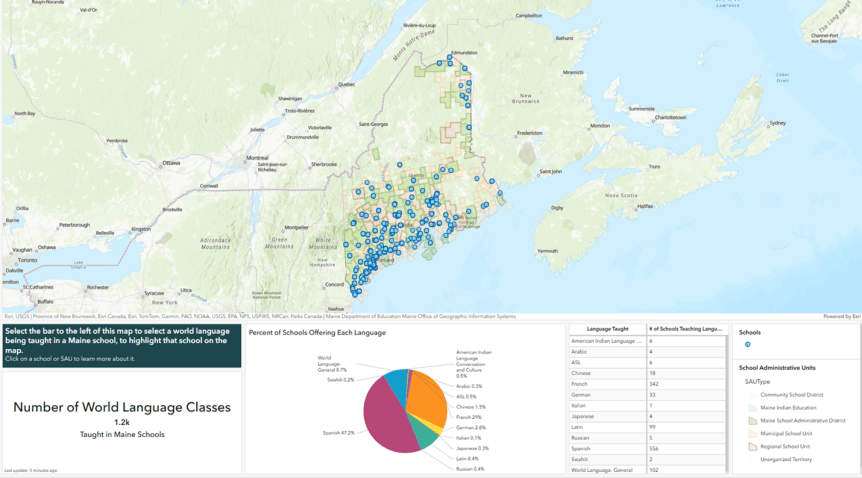
As a new season of learning unfolds, Maine classrooms are building on the strength of global connections. Through community celebrations, exchanges, and new language resources, students and educators are experiencing how language and culture are assets for learning. |  More

Stepping Forward: How Problem Solving Has Allowed RSU 29 to Succeed in the Transition of Early Childhood Special Education Services

Innovation in education comes in many forms, whether from a teaching or an administrative angle. During the 2023-2024 school year, staff at RSU 29 in Houlton learned about an upcoming major opportunity for innovative leadership: joining Cohort 1 of the transition of early childhood special education services from Child Development Services (CDS) to school administrative units (SAUs). |  More

Submit good news to the Maine Department of Education here.


Professional Learning/Training Opportunities

Reminder to Register for the Maine Green Schools Symposium on November 7

The Maine Department of Education (DOE) is thrilled to announce Maine’s first-ever Green Schools Symposium—a groundbreaking event celebrating climate education and sustainability leadership across Maine’s schools. It will take place on Friday, November 7 from 8:30 a.m. to 3 p.m. at Thomas College in Waterville. |  More

View the Maine Department of Education’s Events Calendar here.


Career/Project Opportunities:

Find education-related jobs in Maine.

Maine Schools Strengthen Global Connections in the Fall of 2025

As a new season of learning unfolds, Maine classrooms are building on the strength of global connections. Through community celebrations, exchanges, and new language resources, students and educators are experiencing how language and culture are assets for learning.

In Lewiston, Portuguese cultural brokers and educators are partnering with the Maine Department of Education (DOE) and Portugal’s education leaders to bring free, high-quality resources into classrooms—work extending from Maine’s international agreement with Portugal. Teachers are accessing digital materials from Porto Editora that support Portuguese as a foreign, second, and heritage language. Additionally, local feedback has provided a reminder that implementation support matters: Since few classrooms in Maine have Portuguese-speaking teachers, educators may need guidance about how to use these materials effectively. The Maine DOE continues to coordinate practical “how-to” supports and warm introductions, so resources are usable in everyday instruction.

Maine educators are also connecting through events that celebrate language and culture. The Taipei Economic and Cultural Office in Boston hosts Taiwan’s 114th National Day Celebration on October 3. A week later, teachers will gather at Husson University for the Maine Chinese Language Conference, an annual convening organized with the Bangor Chinese School/Chinese Language and Culture Center of Maine (CLCCM) that offers professional learning and continuing education units (CEUs).

Maine students continue to benefit from opportunities in German. At Cony High School—one of only 14 U.S. schools in PASCH (Schools: Partners for the Future), a global initiative of the German Federal Foreign Office via the Goethe-Institut—two students head to Estes Park, Colorado for an immersion weekend and competition with peers from across the Americas. Each summer, two Cony students also receive full scholarships for a three-week course in Germany, and this November, Goethe-Institut representatives will visit campus to share additional pathways, including study abroad.

deb backman

“As a PASCH school, Cony has access to unique global connections, cutting-edge teaching resources, and annual teacher training that elevate German instruction,” Deb Backman, German teacher at Cony Middle and High School in Augusta, and 2025 Kennebec County Teacher of the Year, said. “Students build real language fluency and cross-cultural understanding, with many chances to use their skills inside and outside the classroom.”

Maine’s collaboration with the Académie de Nantes (France) supports classroom-to-classroom exchanges and educator partnerships that give students real audiences for their language skills. Those supports exist today but are underutilized; the Académie is actively seeking conversations with Maine educators about how to increase participation and make these opportunities easier to access.

“The supports are in place, and we want to hear directly from Maine educators about what would make participation easier and more impactful for their students,” Maine DOE Director of Strategic Partnerships Ayesha Hall said. “Districts can connect with partner contacts on the Global Partners Network webpage, and I’m glad to make a warm introduction, when helpful.”

Together, these stories show that Maine schools are not just teaching languages; they are building bridges. By investing in multilingual pathways and international partnerships—and by listening to local feedback that improves access and use—schools across the state foster the curiosity, respect, and collaboration skills students need to thrive in a connected world.

A next step for educators and administrators: On October 20, 2025, from 3:30 to 4:30 p.m., the Maine DOE hosts the next session of the Multilingual/Multicultural Connections Webinar Series—a virtual session for educators and district leaders who want practical ways to translate international partnerships into classroom learning and schoolwide engagement. Please register here, if you are interested in attending.

For more information, please contact Ayesha Hall, Maine DOE Director of Strategic Partnerships, at Ayesha.Hall@maine.gov. Additionally, if this work is of interest to you, consider visiting the Maine DOE Global Partners Network webpage.

Maine Recognized Nationally for Digital Equity and Human-Centered Innovation in 2025 Government Experience Awards

The Maine Department of Education (DOE) is proud to announce that Maine has been recognized in the 2025 Government Experience Awards, presented by the Center for Digital Government (CDG). These national awards honor states, cities, counties, and agencies leading the way in delivering accessible, equitable, and engaging digital services.

Maine received a Project State Government Experience Award for its Maine Online Open-Source Education (MOOSE) platform. MOOSE provides free, optional resources for pre-K–grade 12 educators that are aligned to the Maine Learning Results. Developed by Maine educators, the platform features modules in topic areas and themes identified as high-need by teachers across the state.

Launched in response to varying levels of access to in-person education during the COVID-19 pandemic, MOOSE was designed to harness the expertise of Maine educators and create a free, statewide resource for online learning. Now in its fourth year, MOOSE continues to evolve—expanding its dedicated online platform and offering modules built within pre-K–grade 12 learning progressions to support student success.

This national recognition highlights Maine’s ongoing commitment to digital equity and human-centered design, ensuring that students, families, and communities can access education in clear, inclusive, and equitable ways.

Winners from across the country were celebrated at the GovX Summit on September 25, a virtual event showcasing innovation in public service.

Learn more about the 2025 Government Experience Awards on the Center for Digital Government website.

Explore Maine’s MOOSE platform and find out how to get involved: Maine Department of Education | The MOOSE Project.

Fall Data Reports Now Open in NEO

Several fall data reports are now open in the Maine Department of Education’s (DOE) NEO system, including Dropout, October 1 Enrollment, and Staff Certification. Superintendents must review, validate, and certify the following reports in October:

  • Dropout Report – Due October 15, 2025.

  • EPS October 1 Student Enrollment Report (including EF-S-05 Part 1) – Currently Open for review only. Certification opens on October 16, 2025. This report is due on October 30, 2025.
    • MEDMS Support recommends waiting until October 30 to certify this report.
    • Certification is required by superintendents and special education directors.

  • Staff Certification Report (including EF-S-05 Part 2)– Due 10/30/2025.
    • Certification of the EF-S-05 Part 2 is required by special education directors prior to superintendent certification.

Reporting guidance and instructions about these reports can be found on the MEDMS Data Systems Support webpage. Recorded webinars that may help those filling out these reports are available on the Maine DOE Data YouTube playlist.

With questions about fall reporting, please contact the Maine DOE MEDMS Support at MEDMS.Support@maine.gov or call 207-624-6896.

Clarification Surrounding LD 384, “An Act to Prevent Student Homelessness”

During the first session of the 132nd Maine Legislature, Public Law 2025, Chapter 453 was passed, taking effect on September 24, 2025. It is effectively a continuation of the Preventing Student Homelessness Pilot Program that the Maine Department of Education (DOE) implemented over the past two years.
 
For Fiscal Year (FY) 2024 and FY25, this program was funded at $1.5 million per year. The funding approved for FY26 totals $125,000. Due to this significant reduction of funding, the Maine DOE is reassessing its allocation method and will communicate with school administrative units (SAUs) when and how this limited funding will be available.
 
An Update on the Closeout of the State-Funded Preventing Student Homelessness Pilot Program

Effective July 1, 2023, the Preventing Student Homelessness Pilot Program funding was distributed to all SAUs based on the number of students experiencing homelessness reported in the Student Information System, with each SAU receiving a minimum of $750. SAUs had the option to accept the allocated funds on Grants4ME or opt out of receiving these dollars.

The Maine DOE consolidated the funds that were not expended in FY24 and funds that were declined by SAUs in FY25 to offer a July 2025 reallocation to participating SAUs to be utilized during the 2025-2026 school year. This reallocation amount is available within the FY25 Preventing Student Homelessness Funding Application on Grants4ME.

Allowable uses of Preventing Student Homelessness funds include:

With the July reallocation of funds within the FY25 funding application, the Maine DOE has adjusted the obligation and final invoice timeline for the FY25 Preventing Student Homelessness funding to allow additional time for the drawdown of funds to assist students. Authorized expenses must fall between July 1, 2024 and March 31, 2026, with final invoices due by May 1, 2026.

Please direct any questions related to Preventing Student Homelessness to Signe Lynch, Maine DOE McKinney-Vento Specialist, at signe.lynch@maine.gov.

Thank you for your continued support in providing school stability for students experiencing housing instability.

Reminder to Register for the Maine Green Schools Symposium on November 7

The Maine Department of Education (DOE) is thrilled to announce Maine’s first-ever Green Schools Symposium—a groundbreaking event celebrating climate education and sustainability leadership across Maine’s schools. It will take place on Friday, November 7 from 8:30 a.m. to 3 p.m. at Thomas College in Waterville.
 
This unique, statewide gathering will bring together school leaders, educators, youth, environmentally-focused nonprofit organizations, and private entities for a full day of networking, resource sharing, and cross-sector collaboration. Please register here and attend to hear inspiring stories of school-led sustainability efforts and explore practical tools for improving energy efficiency, cutting facilities costs, and creating healthier learning environments.
 
The Symposium will offer four workshop tracks:
 
Leadership
Engage with students, principals, and superintendents, as they share innovative case studies of sustainability efforts across the state. Breakout sessions will explore tangible strategies to drive change at both the school- and school administrative unit-levels.
 
Facilities
Receive hands-on guidance from facilities managers to explore cost-effective, sustainable infrastructure solutions—from clean energy systems to waste reduction to green campus design.
 
Learning Resources
Discover age-appropriate, interdisciplinary approaches to climate education and pathways to integrate classroom learning with school facilities and operations. Breakout sessions will offer practical strategies to build and expand outdoor learning programs. 
 
Career Pathways
Meet industry professionals to learn about green trades and professional development opportunities in Maine. Breakout groups will help attendees to identify their skills and discover how to align them with Maine’s green career opportunities. 
 
Limited funds are available to subsidize the cost of substitute teachers and transportation for schools to reduce financial barriers to attending the Symposium. Please contact Lucy Van Hook at Lucy.Van-Hook@maine.gov, if financial assistance is needed to attend the Symposium. Contact hours for Maine educators will be available.
 
We look forward to celebrating and advancing climate education and resiliency in Maine schools with you on November 7 in Waterville.

Stepping Forward: How Problem Solving Has Allowed RSU 29 to Succeed in the Transition of Early Childhood Special Education Services

Students in the pre-K program at RSU 29 (courtesy: RSU 29)

Innovation in education comes in many forms, whether from a teaching or an administrative angle. During the 2023-2024 school year, staff at RSU 29 in Houlton learned about an upcoming major opportunity for innovative leadership: joining Cohort 1 of the transition of early childhood special education services from Child Development Services (CDS) to school administrative units (SAUs).

The affirmative decision to hop on board came following a conversation between RSU 29 Superintendent Joe Fagnant and Director of Special Services Renae Foley.

“We thought that we could take this on, that it was important for the district to look at early childhood, to look at special education to try to get these children in as early as possible to receive services,” Fagnant said.

RSU 29 has had a pre-K program in place since 1998. Even before this transition, the district had been looking at opportunities to work with organizations like Head Start to add to that program and deliver services in a more flexible way. Fagnant explained that as soon as word got out that this transition was underway, parents began contacting RSU 29 to ask how they could access services for their children.

“There were a lot more parents out there that had that need than we realized,” Fagnant said.

In order to begin providing early childhood special education services in the 2024-2025 school year, RSU 29 had to make a few significant shifts in terms of staffing and responsibilities. After all, some three-year-olds would now be coming to the district with various needs that, in many cases, had not previously been met. Fagnant credits the relative success of the transition to teamwork.

“Kudos to the staff for taking that on because it was a huge change,” Fagnant said.

“We’re problem solvers,” Foley said. “Anything that would come up, we would put our heads together to say, ‘Okay, so how are we going to do this?’ If we had to think outside of the box to meet a child’s needs, our team was definitely willing to do that.”

Foley said flexibility, a strong sense of support from the Maine Department of Education (DOE) through meetings and informational documents, and close work with community partners and transportation staff have also been integral to a smooth transition.

“We’re closing the gap,” Foley mentioned. She remarked how essential early intervention (from birth-age 2 through CDS) is for children—and now, RSU 29 has picked up the responsibility of the next stage, ensuring that the needs of children ages 3-5 are also met.

Student in the pre-K program at RSU 29 (courtesy: RSU 29)

“I have seen phenomenal growth from all of the kids who have entered the program,” Makala Swallow, an early childhood special education teacher in RSU 29, said.

Swallow credits that growth in large part to the relationships that she has been working hard to build with families and community partners.

“I’m just really, really excited to see it continue, to see these kids come and grow and just continue to flourish, as they continue on through their years,” Swallow expressed.

One of the students who has already experienced that growth is RSU 29 parent Heather Jones’ son. He is speech-delayed, but Jones said that within two weeks of his joining the pre-K program with early childhood special education supports at the district, her family noticed improvements.

“You just saw a change. He loved going to school. I think the Houlton Elementary School altogether is one of the most supportive schools around,” Jones said, later adding, “We just want him to have the best foot forward.”

Jones said that the frequent evaluations and meetings that are offered for this program through RSU 29 provide an essential opportunity for parents to speak with providers about goals and items to work on with their children.

“ [My son] knows the teacher. He knows the routine,” Jones said. “We have seen measurable goals met with him, and we’ve been needing that for four years.”

Amanda Howe, a pre-K teacher and team leader at Houlton Elementary School, said she is also looking forward to seeing how the early childhood special education supports that Jones’ son received at RSU 29 as a three-year-old help to shape his pre-K experience as a four-year-old.

“I’m really excited to see that next continuing growth,” Howe said. “I’m intrigued to see that amazing carryover.”

Howe has worked at the district since 1999 and said the issue of children not receiving referrals for services because of long waitlists and a lack of providers had become significant. For that reason, there was a push to ensure that Cohort 1 would be successful.

“We wanted to be the best of the best from day one,” Howe said.

Ideally, the hope is that early intervention can lead to long-term benefits, too.

“Your goal is to meet these needs earlier so that long-range, they’re being transitioned away from special education services,” Fagnant said, noting the positive effect that this work can have on financial and staffing factors.

As this transition is ironed out over the years, Fagnant said he plans to continue fostering partnerships with groups like daycares in an effort to amplify the thriving mixed-format system. He said that in the long-term, he would love to have a school in RSU 29 like the new Margaret Chase Smith Community School in Skowhegan that serves as a hub with help from partners, housing all services in one facility.

One element that is clear in RSU 29’s achievement thus far: “It’s the people,” Fagnant said.

RSU 29 and the Maine DOE Office of Special Services and Inclusive Education contributed to this article, written as part of a series highlighting the ongoing efforts of CDS and public schools in providing comprehensive educational services to Maine’s children with special needs. To submit a good news story to the Maine DOE, please fill out the good news submission form.