Week of the Young Child: Family Friday

Every year, the National Association for the Education of Young Children (NAEYC) hosts Week of the Young Child. This year the celebration will occur from April 2nd through April 8th. Members of the Early Learning Team at the Department of Education are sharing a video each day highlighting early childhood educators across Maine enhancing high-quality experiences for young children ages birth through eight.  Each day’s video is focusing on NAEYC’s theme of the day. Today is Family Friday!

Today’s video highlighting music in early childhood settings can be found here:

The resources linked within the video are below:

You can find the daily videos and resources posted on our Early Childhood Professional Learning and Resources page here.

Thank you to those who have contributed to the videos and photos. We enjoy highlighting your work and sharing your commitment to young children with our colleagues throughout Maine.

Throughout the week, be sure to share additional photos and ideas using #WOYC2022 and #MEWOYC2022.

Any questions regarding the Week of the Young Child can be directed to our Early Childhood Specialist at Nicole.Madore@maine.gov.

Commissioner Makin Visits Oxford Elementary in Celebration of the Week of the Young Child

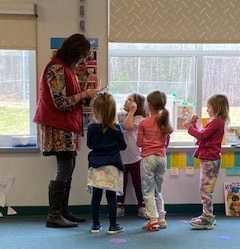
As part of the Maine Department of Education’s celebration of the National Association for the Education of Young Children’s Week of the Young Child, Commissioner Pender Makin visited pre-k and kindergarten classrooms at Oxford Elementary School.

The Week of the Young Child provides an opportunity to shine a light on the importance of early learning and to focus attention on the needs of young children, their teachers, families, and communities.

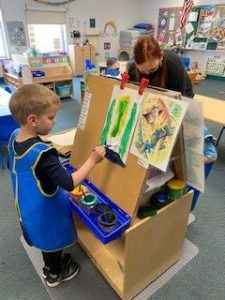
During Makin’s visit, Pre-K students were exploring concepts related to shadows and reflections in centers they could self-select, which included activities such as testing how light can pass through materials, experimenting with materials to see which produce reflections and which do not, and creating pieces of artwork using materials with reflective properties.

In Kindergarten classrooms, children were engaged in a unit of study focused on construction in which they were reading and discussing books related to the topic, exploring engineering concepts through hands-on activities, and working as a classroom community to design a building project that could benefit their community. In one Kindergarten class, students were designing a hotel for homeless families that included a dog park.

Pre-K and Kindergarten classrooms in the Oxford Hills School System utilize whole student, interdisciplinary instructional programs that the Maine DOE, in collaboration with Maine educators, have adapted for Maine using work originally developed by the Boston Public School System.  Both instructional programs are content rich (aligned to Maine’s learning standards) and are designed around opportunity for structured play.

Oxford Elementary’s Literacy Coach, Kim Desjardins pointed out, “When we ask adults what they remember from their Kindergarten experience, most will reply they remember ‘playing’ with blocks or ‘playing’ in the kitchen. The word play is a powerful word that has been lost in our Kindergarten curriculum for many years. Young children are born to play and interact with each other. K For ME encourages students to inquire about the world, participate in deep conversations to problem solve and work with others to develop social skills. Our students love to come to school and learn!”

The Pre-K for ME and K for ME programs are open source and are used in a growing number of Maine schools, including Oxford Hills where Kindergarten teachers were part of a 2-year pilot that helped inform adaptation of the program for use by other Maine schools.

Oxford Elementary Principal, Tiffany Karnes, shared, “It is such a joy to go into a Kindergarten or Pre-K classroom and hear the conversations students are having with each other as they engage in their center work.  Whether it is in the dramatic play area or the block area, students are using their imaginations and incorporating the vocabulary they have learned.  They are building wolf dens when they are learning about animal habitats or dressing up as characters from a book that they have heard during read-aloud and acting out their story.  The level of oral language and increase in vocabulary that we are seeing far exceeds anything we have seen in the past.

Principal Karnes elaborated, “The K for ME curriculum has been a game-changer for our kindergarten students and teachers.  Prior to implementing K for ME, our kindergarten students were struggling with behaviors and were not making the academic progress we wanted.  Students were coming from a play-based Pre-K for ME classroom into a traditional kindergarten classroom and the seat time, the lack of structured play and other academic demands were very stressful for both students and teachers. Once we started to implement K for ME, we saw increased engagement, improved language development, and higher academic achievement.  Students and teachers were happier, and parents commented on how impressed they were with all that their children were learning.”

For more information about the Maine Department of Education’s early learning efforts, including Pre-K for ME and K for ME, contact Lee Anne Larsen, Early Learning Team Coordinator at leeann.larsen@maine.gov.

“Plus, Robots Are Cool” – Robotics and Computer Science in the Pre-K Classroom

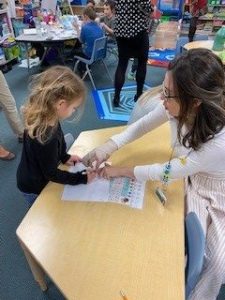
Pictured: A student retells a story from the PreK for ME instructional program.  Sequencing and retelling the events of the story supports literacy skill development while working to program the bot, edit the code, and reprogramming the bot.

April 2nd – 10th is National Robotics Week, a time to focus attention on this exciting, interdisciplinary component of computer science. In Maine public schools, robotics comes to life in a variety of ways. From our high school students participating in robotic competitions, down to the youngest elementary student programming robots to follow a sequence, robotics is a grassroots effort that can be found in many schools, some of whom will be spotlighted throughout this week. National Robotics Week, dating back to 2009, has a simple mission – “to inspire students in robotics and STEM-related fields and to share the excitement of robotics with audiences of all ages.”

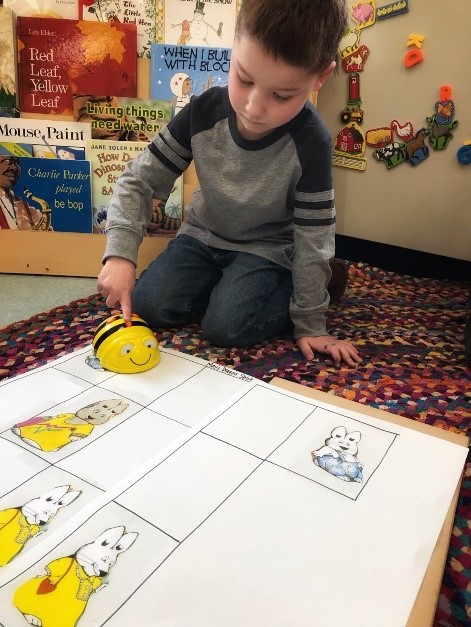
If someone went to observe robots being used in a Pre-K classroom, they would likely see a pair of students working together, either in decided roles or in turns, programming the robot to complete a specific task. Students actively engage as they lean in to push buttons and watch intently as the robot moves around a mat. They are not sitting back and passively watching a screen. “Students will tell me ‘the Bee-Bot isn’t doing what I told it to.’ This is when they learn that the robots don’t have brains and will only do what you tell it to,” says Audra Leland, a Pre-K teacher at the Eddington School. “We work through frustration and learn perseverance.”

Audra was a second-grade teacher at the Enfield Station School when she began using a Bee-Bot that she acquired from the Perloff Family Foundation. She continued to use it with kindergarteners and first graders and created new mats that aligned with the different age levels and classroom content. Some examples of content she used on the mats are: the alphabet, numbers, colors, shapes, nursey rhymes, classmates’ names, and a Thanksgiving Day game called “Now and Then.” When she changed schools and shifted to Pre-K, Audra continued with Bee-Bots in her classroom and added Coding Critters.

Melissa Brown, a Pre-K teacher at the Line Elementary School in Newfield, received two robots, the Bee-Bot and the Sphero-mini, through he Maine Department of Education’s Pre-K for ME curriculum pilot.

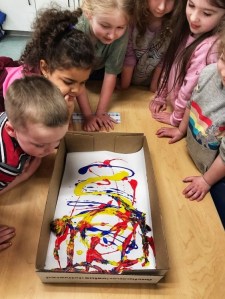
“After reading The Snowy Day from the PreK for ME instructional program, children design a sequence of steps to make tracks on paper and then with the Sphero. Creating a collaborative painting with Sphero not only fosters community within the overall classroom culture but also engages the students in the process of algorithmic thinking, computational processes, and debugging to find and fix errors within the program.” – Melissa Brown

The technology components of the Pre-K for ME curriculum were developed by Dr. Donna Karno of the University of Maine at Farmington, who has long been advocating for technology integration in early childhood education. “Less than 50 percent of early education teachers are currently using technology in their classrooms, in part because of the stigma associated with screen time and children, and in part because of their discomfort and lack of knowledge with setting programs up,” says Dr. Karno. All three educators acknowledge that incorporating these robots and computer science align with much of the skill-building that happens in the early elementary classroom.

Audra Leland’s strategy for starting is to do “unplugged activities” that do not involve any electronics at all. “We start by moving our bodies, following directions. Once they understand that every movement is told and that is what they must do, we take out the Bee-Bots.” This sort of approach to initiating students to computer science is common at the elementary and even middle level. The robots have their value as learning tools, but “the excitement and joy the children show when I take out [the robots] is one reason that I continue to integrate the tools in our learning,” according to Melissa Brown.

While both Pre-K teachers recognize their peers’ unfamiliarity with computer science concepts, they are quick to point out the overlap that exists. Melissa says, “for example, children in our Pre-K classrooms are recognizing and creating patterns with manipulatives, sequencing the events of a story in their literacy work, or sharing social problems and working together to find solutions. Robots simply add another dimension to this work.”

To learn more about opportunities for Robotics in Maine schools, check out Robotics Institute of Maine (RIM). For information about computer science in Maine schools, please check out the Maine Department of Education’s Computer Science page. If you have a robotics success story at your school, email jonathan.m.graham@maine.gov.

Public Pre-K Expansion Distinguished Educator Opportunity 

As part of Maine’s Jobs and Recovery Plan (MJRP), the Maine Department of Education (DOE) was awarded $10 million in American Rescue Plan funding to support the expansion of public pre-k opportunities in Maine.  To assist with the provision of technical assistance and professional learning for the new and expanding pre-k programs being funding through this opportunity, the Maine Department of Education is seeking a Distinguished Educator to be part of its Early Learning Team.  Under the Distinguished Educator program, the Maine DOE contracts with a public school system to borrow an educator for a designated period, in this case the 2022-23 and 2023-24 school years.  Following service in the program, the Distinguished Educator returns to their sending school system.   

Maine educators who meet the qualifications described below are strongly encouraged to consider applying for this opportunity.  Distinguished educators share their expertise with the Maine DOE and other Maine educators while also growing as professionals through a range of new and exciting experiences. The application period for this position will remain open until April 27.  Interested applicants should submit a letter of interest and resume to Lee Anne Larsen, Early Learning Team Coordinator (leeann.larsen@maine.gov).  Candidates selected for interviews will be notified by May 2. 

POSITION DESCRIPTION 

The Public Pre-K Technical Assistance Provider engages in professional work related to planning and providing technical assistance and professional learning for public preschool programs, including programs in partnership with Head Start and private providers.  The position conducts technical assistance visits, including observations of classrooms, provides on-going assistance to programs through one-on-one conversations or group learning opportunities, and reviews data to help support program improvement.  The position is part of the Early Learning Team within the Maine Department of Education’s Office of Innovation.  The position coordinates regularly with the DOE’s Early Childhood Specialist and Early Childhood Monitor. This position requires statewide travel. 

REPRESENTATIVE TASKS of this position include but are not limited to:  

  • Delivering appropriate technical assistance and professional learning to enhance program implementation — may specifically address evidence-based early childhood curriculum, learner-centered instruction, differential learning, assessment, developmental education and/or experiential learning, developing and implementing MOUs with community providers, etc.  
  • Providing interpretation and explanations of statutory provisions to local school authorities, CDS contracted providers, and the public. 
  • Supporting SAU compliance with the Chapter 124 Public Preschool Program Standards and providing technical assistance related to program improvement. 
  • Analyzing data contained in SAU annual reports of pre-k programming. 
  • Other duties applicable to support of public pre-k expansion efforts, as assigned. 

KNOWLEDGE, SKILLS, AND ABILITIES REQUIRED to successfully perform the work assigned: 

  • Experience with the early childhood general education and special education communities in Maine and with public school education in Maine. 
  • Knowledge of current learning research and exemplary early childhood educational instructional strategies in all early learning domains. 
  • Knowledge of current and emerging state and federal legislation, rules and regulations impacting early childhood education, including Department of Health and Human Services (DHHS) childcare licensing and Child Development Services (CDS). 
  • Knowledge of exemplary evidence-based early childhood curriculum, learner-centered instruction, differential learning, assessment, developmental education, and experiential learning, and understanding of the relationships among these areas. 
  • Knowledge of and experience with Maine’s College and Career Ready Learning Results and Maine’s Early Learning and Development Standards.  
  • Knowledge and experience with developing and implementing public pre-k programs in partnership with community providers (e.g. Head Start, Child Care, etc.). 
  • Knowledge of community involvement issues in education policy decisions and operations.  
  • Ability to interpret and explain statutory provisions to local school authorities, community providers, and the public. 
  • Ability to effectively provide information, technical assistance, professional development and program development support and expertise. 
  • Ability to use technology-based communications (i.e., Internet, Web) and e-mail systems and both laptop and desktop computer systems, word processing and data applications. 
  • Ability to communicate effectively orally and in writing.  
  • Ability to effectively facilitate meetings, organize and manage multiple projects.  
  • Ability to apply and facilitate group dynamics and to use exemplary interpersonal skills in order to work collaboratively, develop positive working relationships, and involve stakeholders at the local and state level.   

MINIMUM QUALIFICATIONS:  A Bachelor’s Degree in Early Childhood Education and two (2) years of professional level experience in public pre-k programming is required.  A Master’s Degree in Early Childhood Education and five years of early childhood teaching and/or administrative experience is preferred. CLASS Observer certification at the pre-k level and experience with public pre-k partnership implementation are also preferred. 

Questions may be directed to Leeann.Larsen@maine.gov 

MLTI Launches – Space2Connect! – Student Conference Registration Closing Soon!

Registration is closing on April 8th for 19th Annual MLTI Student Conference, which will be held virtually on Thursday, May 26, 2022, from 8:30am-2:00pm, and will be open to all MLTI 7th and 8th grade students. If you are an MLTI school, you don’t want to miss out on this exciting and innovative day that is planned for MLTI 7&8th grade students!

Conference Sessions

The MLTI student conference will offer a variety of creative and interactive sessions for students. View short trailers of some of the conference sessions below, then head to our student conference website for the full list of sessions and conference details.

Animation, It’s “Wicked Good”!
Bringing Stories Alive
Animate a Rocket Launch
Take a Selfie in Space!
Hello? It’s Me- Student Podcasting

Session Style

We have redesigned the conference to be classroom-based. Workshop leaders will teach your class new skills, provide time for students to practice these new skills, and then support them as they create something new with what they have learned. This new design will allow students to work together as they explore new resources and applications, create with new digital mediums, and collaborate to complete tasks. For more information on our new conference model please watch our video!

This virtual conference will be hosted on Zoom. The sessions will be 90 minutes, with the morning session running from 9:30am-11:00am, and the afternoon session running from 12:00pm-1:30pm. All necessary materials will be provided to schools before the conference so students will have them to create with during the conference.

Registration Information

Registration for the 2022 MLTI virtual student conference will close on April 8, 2022. Please select a lead teacher from your MLTI school to fill out the online registration form. We will be asking for lead teacher contact information, the school information as well as a physical shipping address so we can deliver or ship conference materials directly to the attending school. We will also need the total number of students attending in each grade, and the totals for shirt sizes. We ask that schools complete the registration form by April 8, 2022. For questions regarding registration please reach out to Brandi Cota at Brandi.M.Cota@Maine.Gov.

Important Dates

  • March 10th registration opens
  • April 1st sessions announced
  • April 6th session Q&A with MLTI
  • April 8th Registration Closes
  • April 11th session sign up opens-Form we be sent to registered schools
  • April 28th session sign up closes
  • May 12th session assignments finalized

Further Information

For more information, please visit the MLTI Student Conference page or contact Brandi Cota at Brandi.M.Cota@Maine.Gov.


Health and Physical Education, Visual and Performing Arts, and World Language Standards Updated

The revised Chapter 132: Learning Results: Parameters for Essential Instruction was signed into law March 31, 2022. This revision cycle updated the Health and Physical Education, Visual and Performing Arts, and World Language standards.

The Maine Department of Education (DOE) will be providing guidance and resources to School Administrative Units (SAUs) in making the transition to the revised standards throughout the 2022-2023 school year. There is no pre-determined date when SAUs must make the transition to the revised standards. It is the Maine DOE’s belief that SAUs will use their own professional judgment and phase in the revised standards at a pace that makes sense for their students and for their educational practice.

The proposed health and physical education standards have been revised to identify health education as a strand and physical education as a strand to better delineate the unique standards and performance expectations in each. For the health education strand, the proposed draft is closely aligned to the National Health Education Standards and includes minor adjustments to wording for clarification and the combining or elimination of some language in order to be more clear, concise, and appropriate (for the age level or age span). In addition, content topics and examples were removed from the performance expectations as the committee felt they were limiting the content by implying those were the only topics to be addressed. For the physical education strand, several standards were renamed and/or restructured and the performance expectations reworded to better meet the needs of Maine educators.

The proposed visual and performing arts standards have been adapted from the National Core Arts Standards while still including those items that Maine arts educators felt are specific to their work with Maine students.

The two biggest changes to the document include the addition of media arts standards, a rapidly developing field of the creative economy that includes audio, video, digital design, and mixed media creations, and the realignment of strands that separate each arts discipline into its own collection of unique standards and performance expectations (previously, three of the five arts standards were universal across all arts disciplines; now, they are individualized for each discipline.)  Although some disciplines share the same standards, their performance expectations are unique.

The proposed world languages standards are in alignment to national standards (ACTFL World-Readiness Standards for Learning Languages), which were published in 2012, and are designed to meet the needs of Maine educators. Whereas the current standards include four strands, in the proposed draft, they have been reorganized into five strands, consistent with the five goal areas represented in the national standards. To make this shift, concepts included in the four original strands were retained but categorized differently in order to align with the five goal areas. For example, language comparisons appears in the communication strand in the current standards, while in the proposed draft it appears in the comparisons strand.

Another substantial shift is the inclusion of proficiency levels in addition to grade spans. The current standards represent a full pre-K to grade 12 progression of language learning. The proposed draft also offers this full progression, while at the same time providing multiple entry points by directing educators to begin at the current level of proficiency of their students. For example, if a program begins in kindergarten, the educator will start by addressing the kindergarten/novice low performance expectations. If the program begins in 7th grade, the educator will start with the performance expectations in the same kindergarten/novice low level, in order to appropriately target instruction to students’ current proficiency level.

Finally, a third shift is within the performance expectations themselves. In the current standards, performance expectations direct educators to focus on specific topics and skills within the standard. However, the proposed draft mirrors the national standards in its intention to provide general, universally applicable performance expectations that can be tailored to all languages, whether modern, classical, or signed. Supplemental resources will provide greater guidance on how to tailor them to specific languages, particularly classical and signed languages, which differ from modern languages in terms of uses, communities of speakers/users, and cultures.

It is also important to note that the NCSSFL-ACTFL Can-Do Statements, which include general communication and intercultural communication, provided the basis for the performance expectations in the proposed standards. The performance expectations in the communication strand are based on the can-do statements for interpersonal, interpretive, and presentational communication. For the four remaining strands, performance expectations were established based primarily on the intercultural communication can-co statements.

This revised document is the result of a thorough review process that began in the fall 2019 with multiple opportunities for stakeholder voice, and is the result of expertise from Department staff, representatives from higher education, district and building administration, as well as dozens of Maine educators.

For more information, please visit our standards review process website, or contact Beth Lambert, Director of Innovative Teaching and Learning, at beth.lambert@maine.gov.

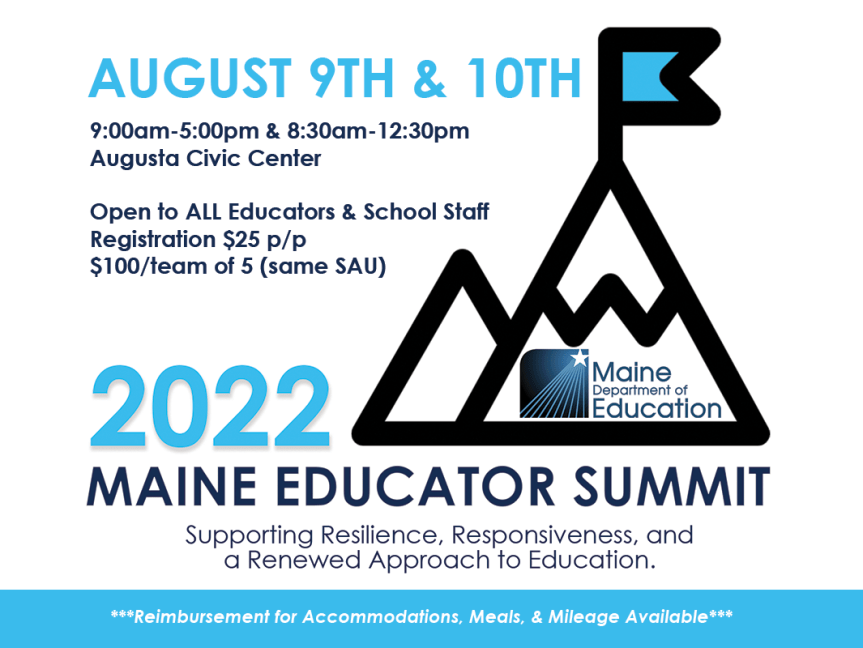
Save The Date: 2022 Maine Educator Summit August 9-10

The Maine Department of Education (DOE) is hosting the 2022 Maine Educator Summit this summer to provide all Maine educators and school staff with opportunities for professional learning, peer networking, and resource materials to further support students impacted by the COVID-19 global pandemic. In sponsoring this event, the Maine DOE aims to further support Maine’s education workforce in the areas of resilience, responsiveness, and a renewed approach to education.

We hope that you and your colleagues will join us for the 2022 Maine Educator Summit at the Augusta Civic Center on August 9-10, 2022. The summit will offer a variety of sessions around topics like social-emotional learning (SEL), school safety, interdisciplinary learning, special education, and more. Participants will be able to join several different learning sessions over the two-day event and the Maine DOE is encouraging teams from each School Administrative Unit (SAU) to register.

Be on the lookout for registration and Summit materials on the Maine DOE website. Reimbursement of accommodations, meals, and mileage is available.                              

Contact hours will also be provided.

If interested in presenting at the summit or for further information about the 2022 Maine Educator Summit, please reach out to Teri Peaslee, Continuous School Improvement Professional Development Coordinator, at (207) 530-7672.

#MEEducatorSummit

Maine DOE welcomes Jim Chasse as MLTI Technology Infrastructure Specialist

The Learning Through Technology team welcomes Jim Chasse as the Maine Learning Technology Initiative (MLTI) Technology Infrastructure Specialist. Jim has served many roles in public education, including teacher, coach, technology coordinator, curriculum leader, principal, and superintendent of schools, where he has led initiatives to advance technology.

As Superintendent in Hermon, Jim worked with the school committee to leverage COVID relief funds to advance the K-12 district to a 1:1 technology platform as a response to deliver remote instruction during the pandemic. As the Orono High School Principal, he implemented the high school’s first 1:1 laptop program, worked with Network Maine to enhance connectivity, and transitioned the district’s antiquated email system to Google Suite. He planned and supported a local student “Geek/Tech Squad” to work with students and staff. Earlier in his career, Mr. Chasse served as the Technology Coordinator for MSAD23/38 (Carmel and Levant), supporting learning through the first year of MLTI, new school construction, web-based student information systems, and 1:1 teacher device integration. He served as principal in Guilford, one of Maine’s nationally recognized school systems for 1:1 technology. He was the Headmaster at Bangor Christian School, a teacher in Hermon, and tennis coach at Bangor High School.

In this role, Jim will work with MLTI school administrators and educators to ensure that their technology infrastructure is robust enough to support the needs of technology integrated classrooms and 21st century learning. He will be available to provide leadership and expertise to SAUs and educators statewide around building and maintaining highly effective technology infrastructure in school buildings. Jim will work with SAUs to leverage funding opportunities for infrastructure improvements and help to build local capacity around school connectivity needs.

Besides being excited about this new job, Jim also enjoys the Maine outdoors, athletics, theater and playing guitar. He and his wife, Charlene (a special education teacher in Belfast), love to spend time with their grandchildren, five and counting!

LRTC Student, Olivia Servidio, Chosen for a Once-in-a-Lifetime Opportunity in Nashville, TN.

Pictured: Pam Abzan the instructor of Lewiston Regional Technical Center’s Medical Science Program, left, stands with her student Olivia Servidio who has been selected for the AspirnautTM Summer Research Internship.

One of Lewiston Regional Technical Center’s very own students, Olivia Servidio, has been chosen for a spot at AspirnautTM Summer Research Internship. This internship is hands-on and a mentored laboratory experience for high school students interested in a career in the fields of science, technology, engineering, or mathematics (STEM).

Participants reside for six weeks on the campus of Vanderbilt University and conduct biomedical research at Vanderbilt University Medical Center in Nashville, TN. Interns are paid a stipend for the time they work in the lab, provided room and board, and given the opportunity to interact with university faculty and administrators.

Students in the past have been involved in research ranging from understanding diabetic kidney disease and breast cancer to designing microfluidic devices with engineers.

Only 20-25 students, from all over the country who apply, are accepted into the program. Students applying need to achieve excellent test scores in science and math and are committed to pursuing a career in the STEM field. The right candidate needs to be curious, resourceful, highly engaged, and resilient.

Olivia Servidio is a bright and driven student and was nominated by her Medical Science teacher, Pam Abzan, to participate in this internship.

RSU 9 Second Graders Win Northeast Toshiba ExploraVision Science Competition

Pictured: Team members Lucinda Perry, Ronnie Yau, and Claire Kiger. 

A team of 2nd graders at the W.G. Mallett School in Farmington was recently named a winner of the Northeast Toshiba ExploraVision Science Competition.

The team, coached by teacher Sue Boyce-Cormier, created the ‘Spider Plant CO2 Collector’. Based on their concerns for the future of the environment and their understanding of how plants can utilize C02, the students invented a device that would potentially attach to the exhaust pipe of cars.

The team will be awarded, virtually, by a Toshiba representative at a school assembly on April 8th and each of them will receive a chrome book. Their design is in the running for the national award as one of just five K-2 teams across the United States. Each winner on the national winning team will be awarded a $10,000 bond.

Additionally, a second team of 2nd graders from Mallett (Della Kangas and Chandler Clark) received Honorable mention, for their invention of ‘The Hive Tracker’.