St. George Opens Nation’s First Pre-K–8 Career and Technical Education/Makerspace Building

In 2020, a small but determined team of educators at St. George Municipal School Unit embarked on a bold innovation journey—one that culminated in a major milestone over the summer. Guided by district leadership and a committee of teachers, families, school board members, and business owners, the team grounded its vision of a new, innovative facility in the community’s past, present, and future.

St. George Municipal School Unit was one of the first recipients of the Maine Department of Education’s (DOE) Rethinking Responsive Education Ventures (RREV) grant, a $16.9 million federal grant awarded to Maine in 2020. The state was one of only 11 to receive the funding, with more than $10 million eventually distributed to 42 school districts. St. George received $350,000 to kick-start its building design process, curriculum development, and capital campaign.

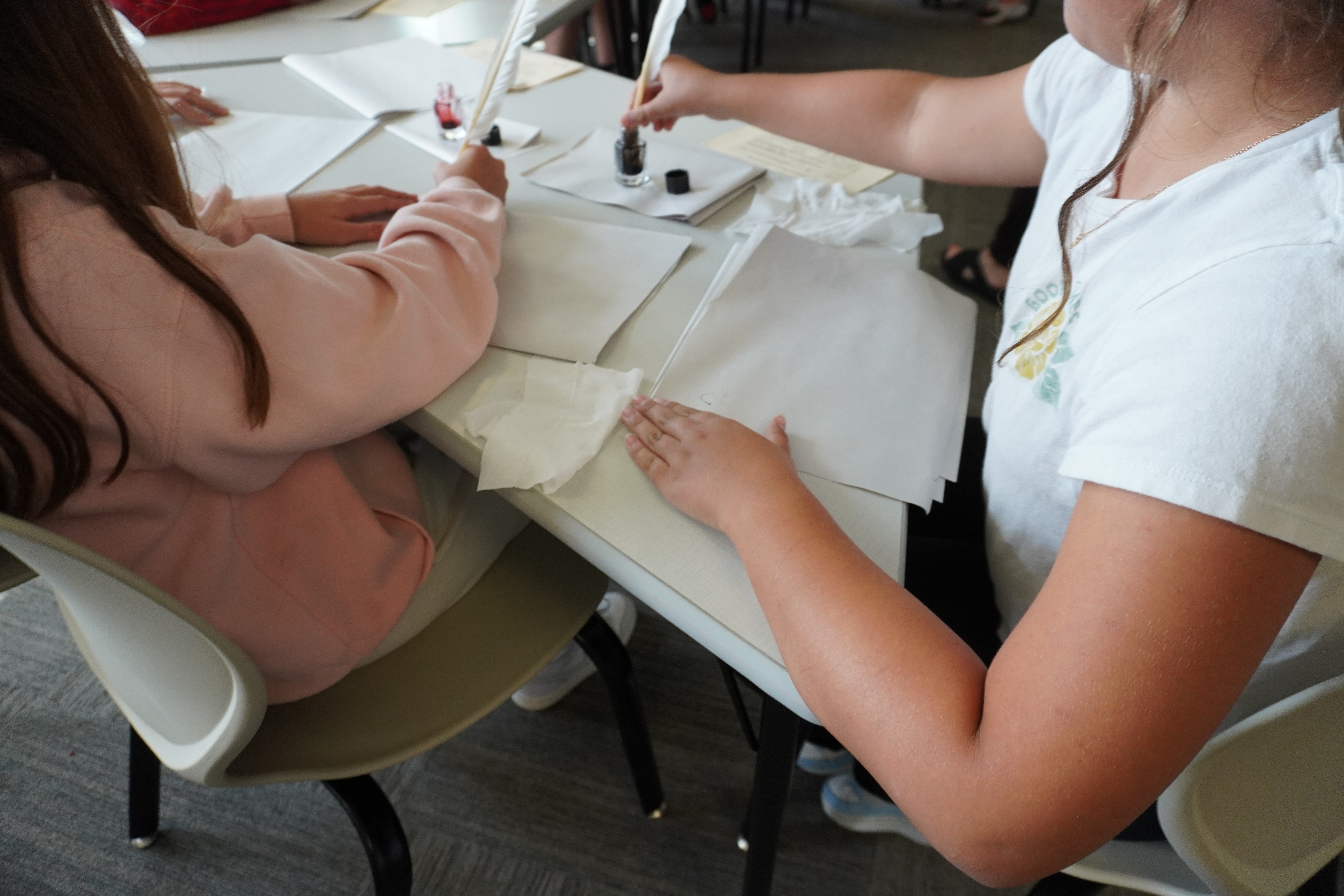
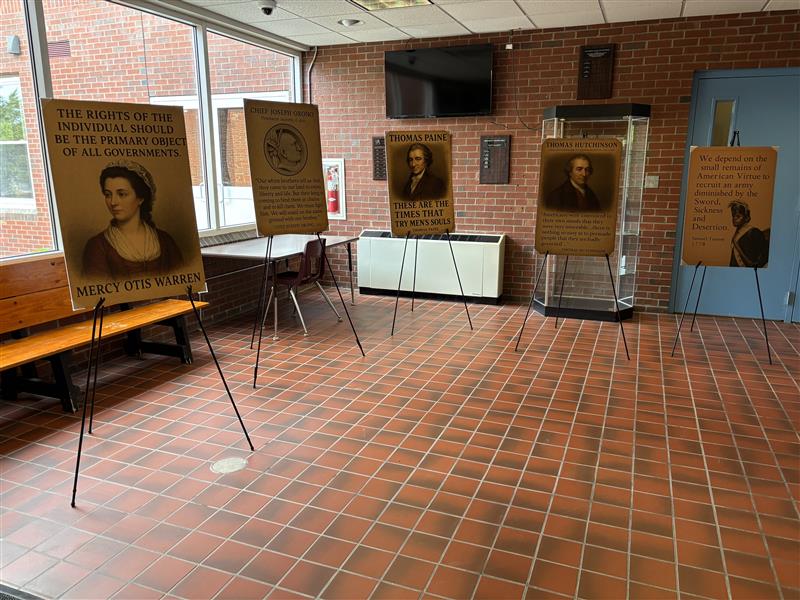
St. George Municipal School Unit’s ambitious goal was to use the RREV grant to help create the nation’s first pre-K—8 Career and Technical Education (CTE)/Makerspace building. This innovative space—the GRACE Innovation Center—would honor the rich heritage of the St. George community, while preparing students for the challenges of today and tomorrow. A key inspiration for the project was the Lillius Gilchrest Grace Institute, a nonprofit founded in 1936 by the Grace family in memory of Lillius Grace, a St. George native.  The Grace Institute offered classes to St. George students in home economics and manual arts for more than 70 years, laying the groundwork for the modern CTE/Makerspace vision.

“Many have been with us since we began this journey more than three years ago,” Mike Felton, former St. George Municipal School Unit superintendent and new GRACE Innovation Center executive director, said of the team members who helped to guide this project. “[They had] a vision for re-engaging students in learning and reimagining public education by returning to our roots—hands-on, minds-on learning connected to career and community.”

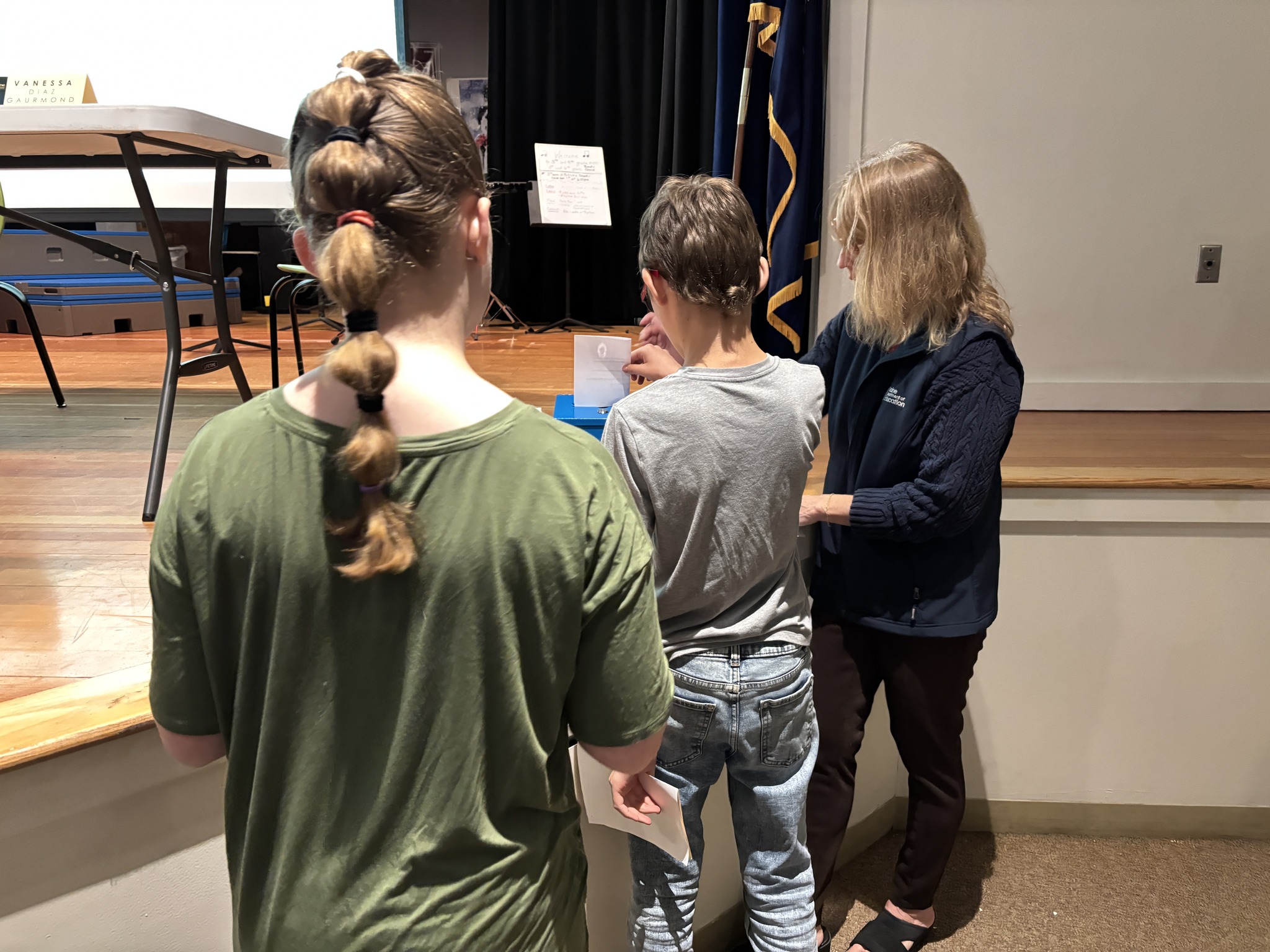
On August 14, this dream became a reality with the grand opening of the GRACE Innovation Center in St. George. The celebration drew in hundreds of community members and special guests, including U.S. Representative Chellie Pingree, St. George school board members, St. George students, and Steel-Pro CEO and president Steve Ladd. Maine DOE Office of Innovation staff who partnered with St. George Municipal School Unit and supported this project were honored to also attend and celebrate the hard work of so many passionate educators and community members.


“Congratulations to the entire St. George team for your vision, dedication, and relentless pursuit of innovation in utilizing this RREV grant to create meaningful opportunities for your students,” Maine Education Commissioner Pender Makin said. “Your work is a shining example of all that is possible when community, history, and forward-thinking education collide.” “This building, this project, this school, this community—it’s about building and creating our future together. Our imaginations will not be limited by what others say is possible. When someone says, ‘Isn’t that a big vision for a small community?’—we know the answer,”  Felton said during the event. “We can give our kids a better today and tomorrow. We can lead the nation in returning to hands-on, minds-on learning and valuing the trades. We can do all that as a small fishing community on a peninsula in Maine. We can do this because we’re a small fishing community on a peninsula in Maine that never forgot our roots and created a new building with an old soul.”

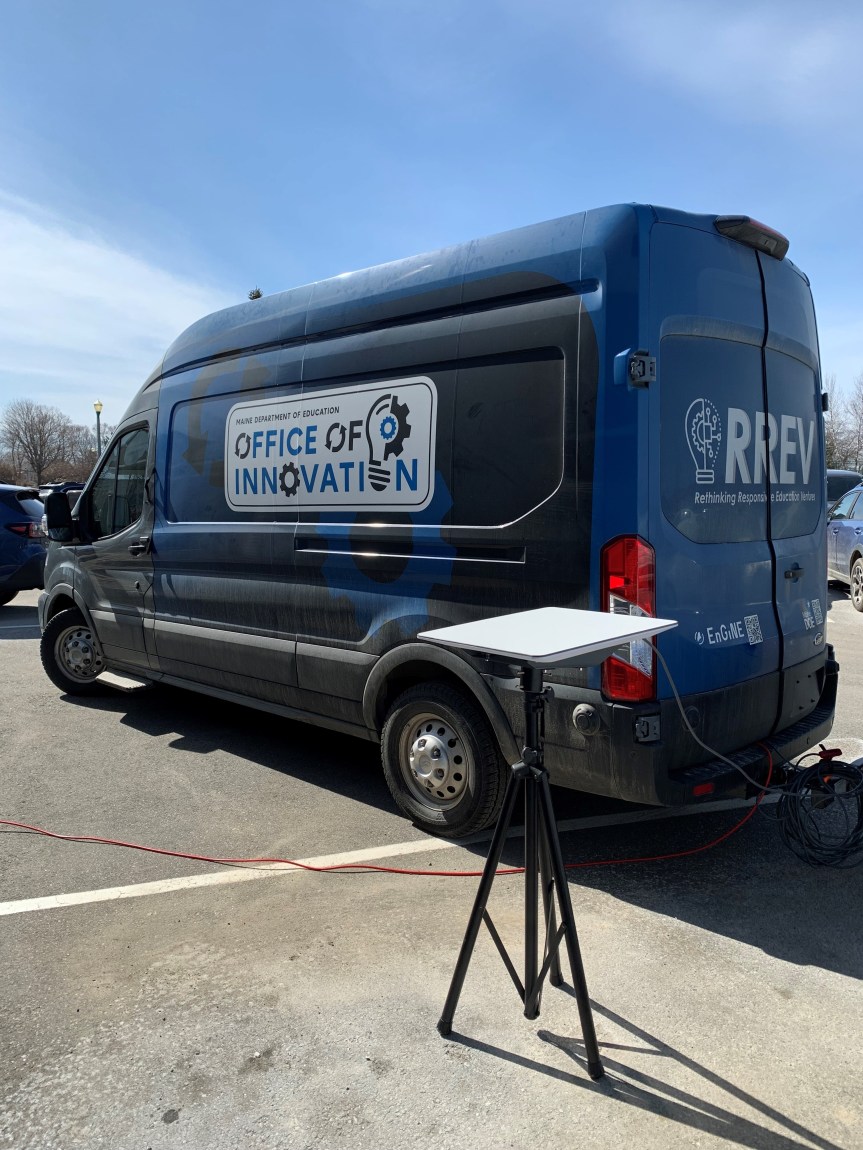
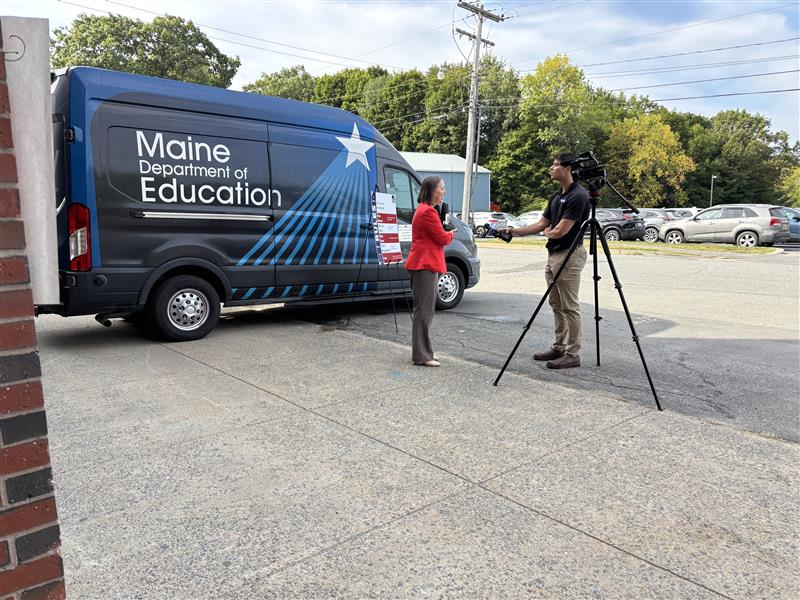
While many additional fundraising efforts helped St. George Municipal School Unit to reach its $4.5 million goal, the RREV grant played a crucial role. It funded educator stipends for work to develop a pre-K—8 CTE curriculum and helped to support architectural designs, site planning efforts, and construction. At the August 14 event, the RREV Mobile Learning Van was present to showcase all of the innovative pilots that RREV supported.

“I’m pretty sure this is the best million dollars that Washington has ever spent,” U.S. Representative Chellie Pingree remarked during the event. “You are truly creating a role model for communities all over the country.”

This story was written in collaboration with St. George Municipal School Unit. To submit a good news story to the Maine DOE, please fill out the good news submission form.

Maine DOE to Host ‘For ME’ (Pre-K through Grade 2) Professional Learning Communities During 2025-2026 School Year

The Maine Department of Education (DOE), in collaboration with teacher leaders from across the state, is once again offering professional learning communities (PLCs) for educators and caregivers implementing the For ME programs, which include Pre-K for ME, K for ME, 1st Grade for ME, and 2nd Grade for ME.

These monthly virtual PLCs are designed to deepen understanding of program design and implementation. Participants will explore units and components in greater depth through real-world examples, shared practices, open discussion, and student work. Whether you are new to a program or have been using it for several years, these PLCs offer valuable support for teachers, ed techs, instructional coaches, and other staff.

Pre-K for ME PLCs
Sessions will be held virtually from 3:30-4:30 p.m. on the first Monday of each month:

  • October 6, 2025
  • November 3, 2025
  • December 1, 2025
  • January 5, 2026
  • February 2, 2026
  • March 2, 2026
  • April 6, 2026

K for ME, 1st Grade for ME, and 2nd Grade for ME PLCs
Sessions will be held virtually from 3:30-4:30 p.m. on the second Tuesday of the month:

  • October 14, 2025
  • December 9, 2025
  • February 10, 2026
  • April 14, 2026

Registration

While regular attendance is encouraged, participants do not need to commit to every session. Access details will be provided upon completion of registration. 

Please register by Friday, September 26, 2025. You may do so using the following links:

Questions?

MEDIA RELEASE: 2026 Maine Teacher of the Year State Finalists Announced

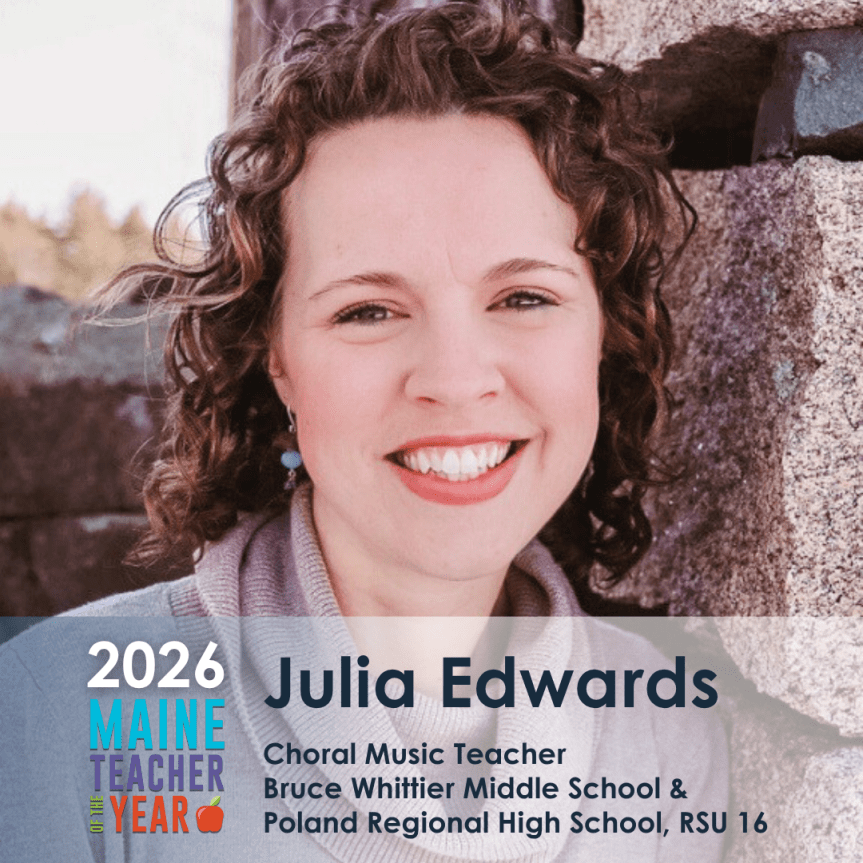
Congratulations to Julia Edwards from Androscoggin County, Bridget Wright from Lincoln County, Benjamin Johnson from Penobscot County, and Dawn Lee from Sagadahoc County.

Augusta, MAINE—Four Maine educators representing counties from the coast to the highlands are state finalists for 2026 Maine Teacher of the Year. Julia Edwards, a choral music teacher at Poland Regional High School; Bridget Wright, an English teacher at Lincoln Academy; Benjamin Johnson, a Latin teacher at Hampden Academy; and Dawn Lee, a school library/media and unified literacy teacher at Morse High School, were selected from the 2025 Maine County Teachers of the Year cohort to move forward in the Teacher of the Year process.

“Congratulations to the four 2026 Maine Teacher of the Year state finalists,” Commissioner of the Maine Department of Education (DOE) Pender Makin said. “Your dedication to your students, innovation in your teaching, and contributions to your communities have all led up to this well-deserved moment of recognition. Thank you for your commitment to public education in Maine, helping to raise our state’s next generation of leaders and thinkers.”  

One of the four state finalists will be named 2026 Maine Teacher of the Year, an honor bestowed annually upon one educator in Maine. This announcement will occur in October after the final stages of the selection process are complete. Maine’s Teacher of the Year serves as an advocate for the teaching profession, as well as Maine schools and students, and represents Maine in the National Teacher of the Year Program.

Each teacher was nominated for this recognition by a member of their community because of their exemplary service in education and dedication to their students. A distinguished panel of teachers, principals, and business community members selected them from a pool of hundreds of other nominated educators. The Maine DOE, Educate Maine, the Maine State Board of Education, and the Maine County and State Teachers of the Year Association (MCSTOYA) announced the state finalists.

“These four state finalists embody the exemplary teaching we see in classrooms across Maine,” Jason Judd, Ed.D., Executive Director of Educate Maine, said. “There are so many inspiring and innovative teachers across Maine, and we look forward to working with and supporting the finalists and all of the 2025 County Teachers of the Year. They are amazing teacher-leaders and ambassadors for their profession, and most importantly, they make a difference in students’ lives every day.”

“The Maine Teacher of the Year state finalists represent the very best of our profession: educators who inspire curiosity, foster a love of learning, and make a lasting difference in the lives of students every day,” Paulette Bonneau, Chair of the Maine State Board of Education, said. “Their dedication and innovation embody the strength of Maine’s schools and the promise of our future.”

“These finalists are all exciting educators, committed to the growth of their students beyond academics,” Becky Hallowell, 2025 Maine Teacher of the Year, said. “They each honor the whole student and find ways to deepen the connection of their students to the community. I have already learned so much from all the finalists and look forward to learning even more about their practice. Maine is fortunate to have these four teachers representing the great work of educators happening across our state.”

“We are excited to celebrate and learn alongside these remarkable finalists, whose voices and leadership continue to strengthen education in Maine,” MCSTOYA co-presidents Hillary Bellefleur and Heather Whitaker said. “They reflect the creativity, commitment, and heart that define our profession. The difference they make in their classrooms and communities is inspiring, and we look forward to championing their work, as they highlight the many strengths and ongoing growth of Maine’s public schools.”

More about the 2026 Maine Teacher of the Year state finalists:

Julia Edwards
Choral Music Teacher, Poland Regional High School
2025 Androscoggin County Teacher of the Year

“What a joy it is to collaborate with stellar peers through the Maine County and State Teachers of the Year program! I am grateful for the opportunity to represent my students, colleagues, teachers, mentors, and family in advocating for Maine schools and music education. Above all, it is inspiring to learn from peers and to witness the work that Educate Maine and the Maine DOE do to amplify the good that is happening in our state’s schools.”

Julia Edwards is the choral music teacher at RSU 16’s Poland Regional High School and Bruce Whittier Middle School in Poland, Maine. She earned her Bachelor of Music degree in Music Education at the University of Massachusetts – Amherst, where she studied oboe and served as a teaching fellow for the Children’s Chorus of Springfield. She returned home to Bridgton, Maine after graduating college to teach elementary music in North Conway, New Hampshire for two years before accepting her current position in the fall of 2012. 

Edwards’ leadership experience at Poland Regional High School includes coordinating the “Roundtable” grade-level advisory program and serving as coordinator for the all-virtual learning program during the hybrid school year. As an advocate for professional collaboration, she served on the District Professional Learning Committee, where she proposed and co-created RSU 16’s annual district-wide conference. She finds the most joy, however, in working with her students. Edwards believes that all students deserve access to an excellent music education, regardless of their background, identity, or geographical location. Cultural curiosity and musicianship are at the core of her teaching philosophy, and she has worked to create many intercultural and intergenerational experiences for her students and community.

In addition to her teaching responsibilities, Edwards has served as a guest clinician and manager for district and state festivals in Maine and has presented on pedagogical topics for state, regional, and national conferences. She recently moved into the role of president for the Maine chapter of the American Choral Directors Association, where she is working to expand community singing opportunities throughout the state. As an advocate for cultural curiosity, Edwards has designed a Cultural Context Curriculum, which helps students to develop tools for ethically and enthusiastically exploring the world around them, as well as skills to be better world citizens. She believes music and community are synonymous, and she loves participating in the music community as a listener and performer. 

Outside of teaching, Edwards enjoys skiing; cross-stitching; playing concerts with her folk band, Bold Riley; and exploring the Maine outdoors with her husband, two children, and rowdy dog, Baxter.

Bridget Wright
English Teacher, Lincoln Academy
2025 Lincoln County Teacher of the Year

“I am honored to be a Maine Teacher of the Year state finalist and am grateful for the support and encouragement I’ve received from my family and school community. As an English teacher, I know that good teaching, just like good writing, is a process that can’t happen in isolation; I look forward to engaging with educators from around the state to continue building a community rooted in collaboration, celebration, and support.”

Bridget Wright is a high school English teacher at Lincoln Academy in Newcastle, Maine. Wright attended the University of Maine at Farmington for both her bachelor’s degree in Secondary Education, English and her master’s degree in Educational Leadership. She is the 2025 Lincoln County Teacher of the Year.

Wright believes that curiosity is essential to lifelong learning and is committed to providing her students space and support to engage in healthy academic risk-taking. She knows that no one becomes a stronger learner by using the same formulaic strategies. Given time and encouragement to explore, especially when it leads to roadblocks and revisions, students end up becoming confident writers, readers, researchers, and critical thinkers.

Teaching writing is one of Wright’s favorite parts of English, and she founded student-staffed writing centers at two schools, including Lincoln Academy. She has developed programming to help others establish writing centers of their own and was featured in Dr. Rich Kent’s second edition of “A Guide to Creating Student-Staffed Writing Centers.” A presenter at multiple conferences across Maine and New England, including the Maine Council for English Language Arts conference, Wright loves collaborating with and learning from other educators. She has been a Civil Rights Team advisor for a decade and is deeply devoted to ensuring students of all identities and backgrounds feel welcome and safe in their school communities. In addition to teaching English, her school’s Flexible Learning Block model allows her to engage students in everything from weaving and knitting to Dungeons & Dragons.

Wright served as a dorm parent for more than seven years, and this experience greatly shaped how she helps students to build community both in and out of school. She has previously served as a leadership team member and department head, as well as Maine Council for English Language Arts board member and secretary. She currently sits on Lincoln Academy’s Governance Committee and runs the Writing Center program in addition to supporting the development of Lincoln’s senior project curriculum.

When not teaching, Wright can usually be found crafting while listening to audiobooks. She loves knitting, spinning, and weaving and is also a sewist who makes her own clothes. She resides in a little house in the woods with her husband, Andrew, and her beloved cat and dog.

Benjamin Johnson
Latin Teacher, Hampden Academy
2025 Penobscot County Teacher of the Year

“Being named a state finalist for Maine Teacher of the Year is a great honor, but I wouldn’t be here without my students. Their curiosity, passion, and voices inspire me daily, reminding me why teaching is a worthwhile profession, and I am honored to represent them and all the great educators across Maine as we celebrate the power of learning that connects classrooms to the wider world.”

Benjamin Johnson teaches Latin and AP Seminar to 9th through 12th graders at Hampden Academy in Hampden, Maine. He holds a Bachelor of Arts in Classics, with a concentration in Latin, and Biology, with a concentration in Microbiology, from Cornell University and a master’s in Latin from the University of Florida. He is the 2025 Penobscot County Teacher of the Year.

Johnson is a strong advocate for giving students an active role in their education. As a Latin teacher, he believes that studying the origins of our modern practices helps students to better understand the world they live in. He emphasizes inquiry, curiosity, and student voice in every lesson. His classroom blends traditional language study with innovative technology, ensuring that tools support the essential relationships between students and teachers. He oversees both Hampden’s and Maine’s Junior Classical Leagues, organizations that provide engaging opportunities for students of the classics, and he regularly leads trips to Italy and Greece for his students.

Johnson is also an innovator in the Latin classroom, and he advocates for the use of technology to supplement and support, rather than replace, the student-teacher relationship. He runs the LatinTutorial YouTube channel with more than 125,000 subscribers, and he has created digital tools such as Latintutorial.com and Hexameter.co, resources used by tens of thousands of learners worldwide. Johnson serves as Instructional Team Leader for World Languages at Hampden Academy and is a leader in his local education association. He recently served on the AP Latin Development Committee and helped to revise the national curriculum and assessment for AP Latin. Johnson also teaches classics and Latin courses at the University of Maine.

When he isn’t teaching, Johnson can be found spending time with his family, biking around Bangor, drinking good coffee, or happily wrangling unruly prepositions to end sentences with.

Dawn Lee
School Library/Media and Unified Literacy Teacher, Morse High School
2025 Sagadahoc County Teacher of the Year

“Growing up, I witnessed the transformative power of education through a family member who learned to read at the age of 76, shaping my belief that education changes lives and strengthens communities. Today, I celebrate how educators across Maine nurture collaboration, curiosity, creativity, community, and innovation, sustaining families for generations. As a Maine Teacher of the Year state finalist, I am grateful for the platform to honor and share these stories and for the steadfast support of my students, colleagues, community, and family, who remind me daily of the inspiring learning unfolding in our schools.”

Dawn Lee is a school library media specialist and teacher at Morse High School in Bath, Maine. She holds a Bachelor of Science in secondary education from Miami University and a Master of Library and Information Science from the University of South Carolina. A passionate advocate for inclusion, Lee is a founding leader of her school’s nationally recognized Unified Literacy program, where students with and without intellectual disabilities connect through the power of reading, writing, and art. Lee’s pioneering spirit led her to create Maine’s first Unified Academics Conference, a statewide platform celebrating inclusive education. Presenting at numerous state and regional conferences, Lee, her co-teacher, and their students have inspired educators and administrators to establish similar inclusive academic programs.

In her role as a school librarian, Lee champions equity through diverse book collections and community programs, including partnerships with the Maine Humanities Council, creating a safe space where all students can learn and thrive. Recognizing the silent struggles that many of her students face, she established the Morse High School Food Pantry in 2008, which has supported students and families experiencing food insecurity for 18 years. What began as a small, staff-supported initiative has grown into a student-led program distributing more than 1,000 pounds of food each month, offering free daily snacks, sponsoring a community fresh produce table, and providing personal hygiene products and school supplies.

Lee serves on her school district’s Community, Connections, and Belonging Committee, contributing to districtwide efforts that foster inclusion and strengthen community engagement. She is a board member of her local public library and the Bath Area Backpack Program, which provides food for Midcoast Maine families, and advises the Can We? Project, supporting high school students in developing communication skills to engage as active citizens. Deeply committed to helping students discover the joy of learning, Lee strives to create student-centered spaces that spark curiosity and encourage exploration. She embraces a pedagogy that centers student voice in the learning design process, ensuring curriculum is meaningful and relevant. Through this approach, her students actively engage in projects that connect them to their community and the wider world, including participation in Wreaths Across America and the Smithsonian Virtual Exchange Program.

Lee’s innovative teaching and leadership have earned her multiple fellowships and grants from the National Endowment for the Humanities, the Library of Congress, and the Smithsonian American Art Museum to support projects that promote inclusive programming, community engagement, and curriculum innovation. In recognition of her dedication to students and community, Lee has received the Dr. Patricia Ames Distinguished Teacher Award, been named the 2025 Sagadahoc County Teacher of the Year, and been honored as a Midcoast Maine Outstanding Woman Community Member.

Outside of the classroom, Lee enjoys absorbing the quiet beauty of an art museum, curling up with a good book, exploring new corners of the world for fresh inspiration, and spending time with her daughter and son-in-law.

More about the Maine Teacher of the Year program:

The Maine Department of Education’s Teacher of the Year program is administered through a unique partnership with Educate Maine, the Maine State Board of Education, and the Maine County and State Teachers of the Year Association. Funding for the program is generously provided by Bangor Savings Bank, Dead River Company, Geiger, Hannaford, the Maine State Lottery, the Silvernail family, and Unum.

For more information about the Maine Teacher of the Year program, and to see a list of Maine County Teachers of the Year and Maine State Teachers of the Year, click here.

Maine DOE Update – August 29, 2025

From the Maine Department of Education


News & Updates

2025-2026 Maine DOE Back-to-School Backpack Resource Available Online

The Maine Department of Education (DOE) would like to wish all students, educators, administrators, and school staff a wonderful back-to-school season! As the 2025-2026 school year begins, please consider perusing the virtual Maine DOE Back-to-School Backpack, which contains information and resources that may be useful to school and district leaders. |  More

Maine DOE Launches Multilingual Resource Kit to Grow Seal of Biliteracy Recognition Across Schools and Communities

The Maine Department of Education (DOE) is proud to launch the Seal of Biliteracy Resource Kit,a comprehensive, multilingual outreach package designed to promote biliteracy, expand participation, and celebrate language diversity across Maine’s schools and communities. Let’s celebrate Maine’s multilingual future, one student, one language, and one Seal at a time! |  More

Celebrating Excellence in Education: Honoring Maine’s Outstanding Teachers

The 2025 Maine Department of Education (DOE) Annual Summit on August 5 and 6 featured a moving celebration of teacher excellence, honoring educators who embody the very best of teaching and leadership. Colleagues, leaders, and supporters from across the state gathered to recognize and celebrate recipients of the Maine History Teacher of the Year, the Milken Educator Award, and the Presidential Awards for Excellence in Mathematics and Science Teaching (PAEMST). |  More


Maine Schools Sharing Success Stories

Stepping Forward: The Importance of Partnerships in RSU 13’s Transition of Early Childhood Special Education Services

When John McDonald took on his role as superintendent of RSU 13 more than a decade ago, a goal of his was to establish a pre-K program to serve young children in the community. A grant of about a million dollars and a partnership with Penquis kickstarted that work, but the process was not seamless. McDonald noted that over the years, classroom numbers fluctuated, and budget woes resulted in some cutting back of services. There was, however, a very positive outcome of this effort. |  More

Westbrook’s Intercultural Community Center Sparks Confidence and Joy with ‘Wonders of Water’ Summer Program

This summer, the Intercultural Community Center (ICC) of Westbrook—proud recipient of a 21st Century Community Learning Centers (21st CCLC) grant—hosted an extraordinarily impactful seven‑week “Wonders of Water” program, welcoming 60 middle schoolers from the Westbrook School Department to a free and transformative aquatic adventure. |  More

Greater Belfast First 10 Team Hosts Playmaker University for ‘Life Is Good’ Project

Laughter and music rang out in the gymnasium at East Belfast Elementary School on August 7 and 8, 2025, as early childhood educators from RSU 71 and Waldo County Community Action Partners Head Start participated in Playmaker University, designed to help early childhood professionals strengthen their relationships with children. |  More

Future Frontliners: High School Students Train to Earn CNA Certification in Groundbreaking Summer Program

This summer, 20 ambitious students from Portland, Deering, and Westbrook High Schools did something extraordinary: They started training to become Certified Nursing Assistants (CNAs) before even entering their junior or senior years. |  More

Submit good news to the Maine Department of Education here.


Professional Learning/Training Opportunities

Literacy Learning Opportunity: Science of Reading Overview and Demystifying Dyslexia Modules Open to Maine School Teams

In the summer of 2024, the Maine Department of Education (DOE) offered educators free access to professional literacy learning through Steps to Literacy modules from the Access and Inclusion Model (AIM) Institute for Learning & Research. Nearly 650 educators completed more than 20,000 hours of professional learning in the science of reading, phonological awareness, phonics, decoding, spelling, language expression, writing, emerging literacy, vocabulary, dyslexia, and English language learning. In the following spring, school teams completed AIM modules and participated in monthly communities of practice. |  More

Maine Engagement and Attendance Center (MEAC) to Offer Monthly Office Hours

You are invited to join the Maine Engagement and Attendance Center (MEAC) in a new series of monthly virtual office hours. These sessions will focus on exploring Tier 1 evidence-based strategies to support increased attendance. Sessions will be held on the third Thursday of each month from 3:30 to 4:30 p.m., beginning September 18, 2025, and running through May 21, 2026. |  More

Beyond the Cohort: Supporting Maine High Schools in Building a Culture of Constructive Dialogue

The Can We? Project, based at Waynflete School, has announced Beyond the Cohort—a yearlong professional learning initiative designed for Maine high schools interested in embedding constructive dialogue as a core part of school culture. |  More

View the Maine Department of Education’s Events Calendar here.


Latest DOE Career/Project Opportunities:

Find education-related jobs in Maine.

Stepping Forward: The Importance of Partnerships in RSU 13’s Transition of Early Childhood Special Education Services

Pre-K students at RSU 13’s Thomaston Grammar School (photo credit: RSU 13)

When John McDonald took on his role as superintendent of RSU 13 more than a decade ago, a goal of his was to establish a pre-K program to serve young children in the community. A grant of about a million dollars and a partnership with Penquis kickstarted that work, but the process was not seamless. McDonald noted that over the years, classroom numbers fluctuated, and budget woes resulted in some cutting back of services. There was, however, a very positive outcome of this effort.

“Ultimately, I ended up with a school board who really understood the benefit of having universal pre-K,” McDonald said.

That mindset presented an ample opportunity for RSU 13 when McDonald learned of the planned transition in Maine of Early Childhood Special Education services for children ages three through five from Child Development Services (CDS) to school administrative units (SAUs) by July 1, 2028. He said he “jumped” at the chance to become a part of Cohort 1 in the 2024-2025 school year, recognizing that this effort would ultimately help his overall student population and special education referrals.

“I just felt like it was a good fit for us and fit right in with our philosophy and our goals,” McDonald said.

A supportive school board invested money in RSU 13’s local budget to support the CDS transition. Now, McDonald is proud to say that RSU 13 offers universal pre-K, with a pre-K classroom available to every school in the district. He said he recognizes that this progress would not have been possible without the strong partnerships that RSU 13 had already established with CDS, Penquis, and the local YMCA.

“On our own, we all have limited resources, and—let’s face it—budgets are tight,” McDonald said. “But we want to provide the best possible educational community that we can for these kids. These partnerships are really all-important, in terms of being able to share resources, share information, share expertise.”

Pre-K students at RSU 13’s South School (photo credit: RSU 13)

“We all went into this with our eyes open, recognizing what the needs are,” Gail Page, Site Director of CDS Midcoast, said. “We knew what we needed to do in order to meet the needs of children. We were all very clear about what our mission was.”

Page said that prior to this transition, there was not enough programming available to meet the needs of local children. Over the past year, however, Page said huge steps of progress have occurred. For example, local children who were receiving tele-speech services are now receiving in-person speech services. Page works closely with Janet Corcoran, RSU 13 Special Education Director, and they do their best to address the needs of every child.

“Our work has really proved that this can be done, and it can be done well,” Page said.

“We’re trying to build something new, and whenever you’re trying to build something new, there are always going to be hitches and things that didn’t go the way you planned—but I think it has gone really well,” Corcoran said.

Corcoran noted that in her close work with Page, she is able to provide honest feedback—and the two work together to determine the questions that they want to ask leaders at the state level, as they continue to improve operations. Despite any hurdles, Corcoran said the universal pre-K model is essential, as it allows students who are receiving Early Childhood Special Education services to interact with and learn from their general education peers.

Corcoran said ultimately, the goal is to graduate students out of special education services, leading to better educational outcomes overall.

“Early intervention is the key,” Corcoran said. “The earlier you can get to students and provide those services, the less likely they’re going to need them long term.”

Pre-K students at RSU 13’s Ash Point Community School (photo credit: RSU 13)

Corcoran also highlighted that what public school offers—social workers, school psychologists, speech and occupational therapists, etc. on-site—is hard to meet elsewhere. Perhaps one of the best outcomes of the transition in RSU 13 thus far has been the reaction from local families.

“I get feedback all the time from families about how appreciative they are that we offer classes and services for these really little kids,” McDonald said. “There are lots of working families where both [parents] work. Child care is very expensive, if it’s even available in this area. They are just so, so appreciative of this.”

RSU 13, CDS Midcoast, and the Maine DOE Office of Special Services and Inclusive Education contributed to this article, written as part of a series highlighting the ongoing efforts of CDS and public schools in providing comprehensive educational services to Maine’s children with special needs. To submit a good news story to the Maine DOE, please fill out the good news submission form.

2025-2026 Maine DOE Back-to-School Backpack Resource Available Online

The Maine Department of Education (DOE) would like to wish all students, educators, administrators, and school staff a wonderful back-to-school season! As the 2025-2026 school year begins, please consider perusing the virtual Maine DOE Back-to-School Backpack, which contains information and resources that may be useful to school and district leaders.

The Back-to-School Backpack covers everything from School & Student Supports (e.g., attendance resources, suicide prevention guidance, special education information) to Health & Safety (e.g., immunization requirements, Maine School Safety Center resources) to School Nutrition (e.g., guidance on administrative reviews and student eligibility) to School Administration and Operations (e.g., McKinney-Vento resources, enrollment information) to Teaching & Learning Supports (e.g., 2025-2026 assessment calendar, details about Extended Learning Opportunities, literacy resources) to Strengthening the Educator Workforce (e.g., certification resources, school job postings).

Good luck in the 2025-2026 school year! Thank you for all that you do for Maine students, schools, and communities.

Beyond the Cohort: Supporting Maine High Schools in Building a Culture of Constructive Dialogue

The Can We? Project, based at Waynflete School, has announced Beyond the Cohort—a yearlong professional learning initiative designed for Maine high schools interested in embedding constructive dialogue as a core part of school culture.

Since 2018, the Can We? Project has supported cohorts of high school students across the state in learning how to engage with differences with respect and empathy. Beyond the Cohort expands this mission by focusing on educators, empowering them with the tools, mindsets, and practices needed to bring constructive dialogue into classrooms and school communities at large.

This new offering provides structured opportunities for teachers to develop and practice the skills of facilitating dialogue across a range of learning environments. The goal is to help schools create environments where students can talk openly and thoughtfully about complex issues that matter to them and their communities.

Beyond the Cohort will be led by veteran educators Derek Pierce and Lowell Libby, both deeply experienced in designing inclusive and responsive school cultures:

  • Derek Pierce is the founding principal of Casco Bay High School in Portland and a former English teacher who helped launch Poland Regional High School.
  • Lowell Libby served as Upper School Director at Waynflete School from 1991-2021 and co-founded the Can We? Project in 2018. His career began with the Upward Bound program at the University of Maine at Farmington.

This program will be hosted by Mt. Ararat High School, a long-time public school partner of the Can We? Project, and will include collaboration with other participating schools across Maine.

Schools and educators interested in joining this statewide movement toward dialogue-rich education are encouraged to reach out and learn more.

For more information, or to express interest in Beyond the Cohort, please contact
John Holdridge, Director of the Can We? Project, at jholdridge@waynflete.org.

Maine Engagement and Attendance Center (MEAC) to Offer Monthly Office Hours

You are invited to join the Maine Engagement and Attendance Center (MEAC) in a new series of monthly virtual office hours. These sessions will focus on exploring Tier 1 evidence-based strategies to support increased attendance. Sessions will be held on the third Thursday of each month from 3:30 to 4:30 p.m., beginning September 18, 2025, and running through May 21, 2026.

Each practice assists in establishing the conditions under which regular attendance can flourish. Whether you’re a classroom teacher, instructional coach, family member, administrator, or community partner, monthly MEAC moments are designed to offer practical insights, the research behind them, and actionable steps for increasing attendance.

Session topics are as follows:

  • September 18 – Create emotionally and physically safe environments
  • October 16 – Build routine, relationships, and relevance
  • November 20 – Establish early warning systems and a team-based response
  • December 18 – Strengthen school-home partnerships
  • January 15 – Use consistent, growth-focused attendance messaging
  • February 26 – Implement positive recognition and motivation strategies
  • March 19 – Engage families through proactive, supportive outreach
  • April 16 – Steps to refocus on increased attendance
  • May 21 – Reflect, recognize, and reset

To join MEAC monthly office hours, please register here.

The Maine Engagement and Attendance Center is part of the Maine DOE Office of School and Student Supports. With questions, please contact Maine DOE Student Engagement Specialist Sarah Nelson at Sarah.Nelson@maine.gov.

Maine DOE Launches Multilingual Resource Kit to Grow Seal of Biliteracy Recognition Across Schools and Communities

The Maine Department of Education (DOE) is proud to launch the Seal of Biliteracy Resource Kit,a comprehensive, multilingual outreach package designed to promote biliteracy, expand participation, and celebrate language diversity across Maine’s schools and communities. Let’s celebrate Maine’s multilingual future, one student, one language, and one Seal at a time!

The Maine Seal of Biliteracy honors graduating high school students who demonstrate proficiency in English and at least one additional language, including American Sign Language, affirming that multilingualism is both a personal strength and a statewide asset for college, career, and civic readiness.

Why the Seal Matters

Fred Ravan, Spanish teacher and president of Educators for a Multilingual Maine, recognizes the value of this earned distinction and shared why it is so meaningful: “It is important to me because it enables my students to showcase their linguistic ability.”

Record Growth in 2024-2025

The previous academic year marked a milestone for the Seal of Biliteracy in Maine:

  • 518 students earned the Seal (the highest number since the program’s launch in 2018).
  • This represents a 32% increase over the previous year.
  • 198 multilingual learners earned the Seal (33% of recipients).

The Maine Seal of Biliteracy Dashboard will be up to date soon, reflecting the 2024-2025 school year.

Success Story: From Student to Educator

Behind every number is a story. Erik Blacksmith, now the Multilingual Learner (ML) Coordinator of RSU 26, earned the Seal as a student: “The Seal of Biliteracy opened up doors for me so that I could pursue the language I wanted at a higher level in college, without having to start over.” Stories like Erik’s show the Seal’s life-changing potential.

A Compass for Implementation: Updated Seal Coordinator Guide

The updated Coordinator Guide provides step-by-step tools for districts to:

  • Identify and support eligible students
  • Administer approved language proficiency assessments
  • Award and record the Seal
  • Celebrate student achievements
  • Submit data securely to the Maine DOE

Using the guide helps to ensure equitable access for all eligible students, no matter where or how they acquired their language proficiency.

Partnership in Action

To expand awareness and access, the Maine DOE has developed a Resource Kit available in 18 languages.

This kit was made possible through the work of Bowdoin Public Service Intern Bobin Park, whose efforts transformed local needs into statewide impact, demonstrating how service learning can advance both equity and engagement.

(Bobin Park at the Maine Education Association Conference, July 2025)

Wendy Van Damme, Bowdoin College Associate Director for Public Service, shared:

“The Bowdoin Public Service Initiative provides opportunities for students to participate in the work of government offices. Interns learn from their supervisors and their experiences at host offices, and they also make unique and creative contributions to the work, drawing on their specific life and academic perspectives.”

The ongoing partnership between the Bowdoin Public Service Initiative and the Maine DOE shows how thoughtfully matched internships can amplify both student growth and state priorities, especially in exciting areas like biliteracy.

Inside the Resource Kit: Multilingual Tools for Schools and Communities

The Resource Kit includes outreach materials in 18 languages, ideal for use at:

  • Schools
  • Libraries
  • Family engagement nights
  • Community events

What’s included:

  • Testing and assessment considerations
  • Multilingual flyers, brochures, and family-friendly overview materials
  • Sample social media templates and promotion tips

This inclusive approach ensures that heritage speakers, multilingual learners, and students who speak less commonly taught languages are seen, valued, and encouraged to participate.

Maine Employers Endorse the Seal: From Classroom to Career

An increasing number of Maine employers now recognize the Seal as a meaningful credential, signaling graduates’ ability to communicate across cultures, which provides a competitive edge in today’s global workforce.

Employers value the Seal because it:

  • Signals a diverse and globally ready workforce
  • Strengthens community and customer connections
  • Promotes equity and inclusion in hiring
  • Validates adaptability, problem-solving, and cross-cultural skills

“We value candidates who demonstrate proficiency in multiple languages and view multilingualism as a powerful asset in today’s workforce,” Amelia Lyons Rukema, CEO of the Maine Mobile Health Program, said.

Sector Spotlights:

  • Tourism and Hospitality: With more than 14 million visitors who came to Maine in 2024, multilingual staff enhance guest experiences and cultural connections.
  • Education: With more than 8,000 multilingual learners in Maine schools, bilingual educators are essential.
  • Skilled Trades: 4.6% of Maine’s workforce is immigrant-based. Language supports safety, retention, and productivity.
  • Healthcare: Multilingual professionals improve communication and patient outcomes.

Join the Conversation: Seal of Biliteracy Virtual Office Hours

Whether you’re confirming eligibility, exploring assessment options, or planning a celebration, you’re not alone. The Maine DOE will host monthly virtual office hours for:

  • School and school administrative unit (SAU) coordinators
  • Educators and administrators
  • Students and families
  • Community and cultural liaisons

Details:

  • Fourth Wednesday of each month from September 24, 2025-June 24, 2026
  • Virtual format (all are welcome!)
  • Registration required: Please register here.

For further information or with questions, please contact Melanie Junkins, Maine DOE Multilingual and Bilingual Education Specialist, at melanie.junkins@maine.gov.

Literacy Learning Opportunity: Science of Reading Overview and Demystifying Dyslexia Modules Open to Maine School Teams

In the summer of 2024, the Maine Department of Education (DOE) offered educators free access to professional literacy learning through Steps to Literacy modules from the Access and Inclusion Model (AIM) Institute for Learning & Research. Nearly 650 educators completed more than 20,000 hours of professional learning in the science of reading, phonological awareness, phonics, decoding, spelling, language expression, writing, emerging literacy, vocabulary, dyslexia, and English language learning. In the following spring, school teams completed AIM modules and participated in monthly communities of practice.

In response to overwhelmingly positive feedback from summer participants, as well as teams that participated in the spring AIM module community of practice project—and because of the Maine DOE’s continued dedication to supporting high-quality, evidence-based literacy instruction in Maine schools—the Maine DOE is pleased to offer a third option for school teams to engage in the Science of Reading and Demystifying Dyslexia professional development and community discussions.

This opportunity will include a grant, up to $4,000 per school, to cover the cost of:

  • School reimbursement for access to AIM Module 1 – Overview of the Science of Reading and AIM Module 6 – Demystifying Dyslexia
  • Time and effort reimbursement stipends of $25 per hour for time spent outside of contractual hours to complete modules and attend four community of practice sessions (either pre-K—grade 3 or grades 4-8)
  • Reimbursement for purchases of items for implementation from a menu of options (e.g., decodable texts, professional texts, literacy materials, etc.)

To be eligible for this grant, please register a minimum of three staff members, including at least one general education teacher, one special education teacher, and one literacy leader (a specialist, administrator, or lead teacher). School teams must not have previously participated in the spring module community of practice project.

Interested applicants from schools with fewer than three school staff members should please contact Maine DOE Special Projects and Educator Supports staff member Dee Saucier at danielle.m.saucier@maine.gov to discuss options. Applications are due Friday, September 12, 2025.

AIM Pathways™ is a unique, interactive digital teacher training platform designed to deliver research and evidence-based content in the science of reading. Each Steps to Literacy module provides teachers with engaging learning opportunities organized in a “learn, practice, apply” introductory cycle and contains teaching techniques, videos, and printable resources from the comprehensive AIM Pathways courses to develop participants’ understanding and application of new techniques into classroom practice.

The modules offered as a part of this grant project include:

  • Module 1: Overview of the Science of Reading (9 hours)
  • Module 6: Demystifying Dyslexia (3 hours)

To register a team for this project, please complete the application form at this link.

For additional information, please contact danielle.m.saucier@maine.gov.