The week of November 8-12 is celebrated nationally as School Psychology Week, a time for schools and communities to celebrate and appreciate the important work school psychologists and other educators do to help all students thrive.
The Maine Department of Education (DOE) thanks school psychologists, counselors, educators, and school support staff for their tireless efforts to support students’ emotional health, especially during this exponentially difficult school year. Your unwavering work in supporting the whole child in every way that you can is seen and appreciated by your community, your school, your students, and by us here at the Maine DOE. Thank you for all you do.
High school students from across Maine came to Thomas College recently to do some experiential learning at one of two Future Academies events the college hosted along with many state-wide partners this fall.
The events are part of an organized effort to provide Maine students with the opportunity to experience not just post-secondary learning, but to get the chance to meet and talk with professionals about their experiences and participate in hands-on style career exploration through four different lenses.
Thomas College Admissions Team
“We would like to thank our partners AT&T and Unum for their generous support of Maine high school students,” said Ed Cervone, Executive Director of the Center for Innovation in Education at Thomas College. Ed helped plan the Teachers Academy alongside Maine Department of Education Teacher Excellence Coordinator Tammy Ranger, and the Maine Teacher of the Year Program.
Students each had the opportunity to spend the day immersed in one of four career paths: teaching, forensic science, business, or technology. Each path provided the students with focused activities that give them a taste for what a career might look and feel like in that occupation.
In the Teacher’s Academy program students had the opportunity to meet Thomas College professors and top Maine educators from the Maine Teacher of the Year Program as part of their day long immersion into a career path in education. 2020 Somerset County Teacher of the Year Jenny France brings her Early Childhood Education students from Somerset County Career and Technical Center, along with other students in the local Jobs for Maine Graduates (JMG) program every year. She says it is a great opportunity to get the students out of the classroom to have a career focused experience. Throughout the day students at the Teacher’s Academy engaged in STEAM activities and got the chance to sit down with Thomas College professors and with local Maine County Teachers of the Year to talk about what it’s like to be a teacher.
Students working on a STEAM activity
students at the Future Teachers Academy
students at the Future Teachers Academy
Jenny France, 2020 Somerset TOY watching students at the Future Teachers Academy
Lindsay Mahoney, 2020 Kennebec County TOY watching students at the Future Teachers Academy
Tammy Ranger, Maine DOE Teacher Excellence Coordinator watching students at the Future Teachers Academy
“Spending time with these aspiring educators was energizing,” said Tammy Ranger, Maine DOE Educator Excellence Coordinator and 2017 Maine Teacher of the Year, after participating in both events. “We appreciate our partnership with Thomas College in providing passionate young people with experiential events like the Future Teacher Academy, which cultivates an interest in teaching, and supports students in their desire to engage in creative and meaningful work that will make a positive and lasting impact.”
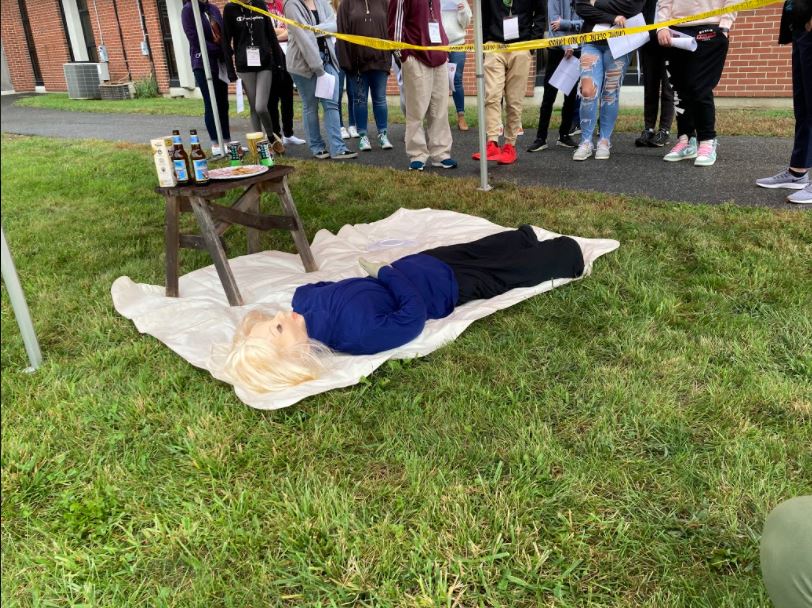
In the Future Crime Scene Analysis program, students had the chance to go through a crime scene with Thomas College professors in the Criminal Justice/Forensic Psychology program. First given a rundown of what police know of a mock crime scene that had been set up outside on campus, students are asked to provide observations about what they see and help gather evidence.
Mock crime scene
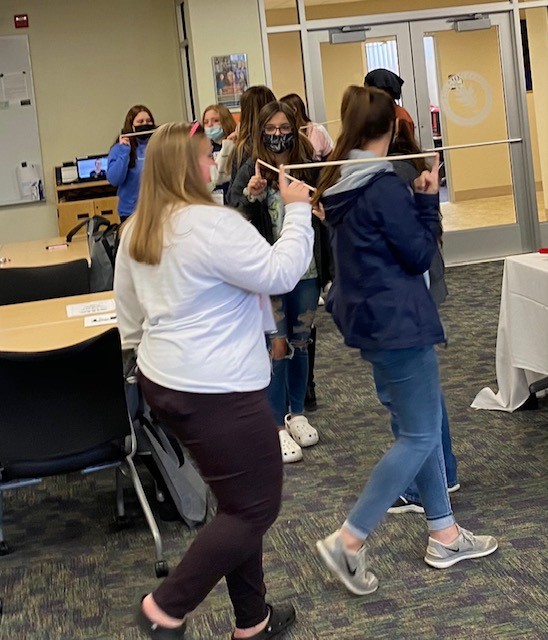
Meanwhile in the Future Business Leaders program across campus, students interested in the Business Administration program took part in an operations management simulation with Dr. Ryan Wheaton, Assistant Professor of Management. In small groups the students first created a plan to make as many paper airplanes as possible in 10 minutes time. After 10 minutes is up and they’ve executed their plan, they re-plan and try again, aiming to beat their first goal.
Students at the Future Business Leaders Academy
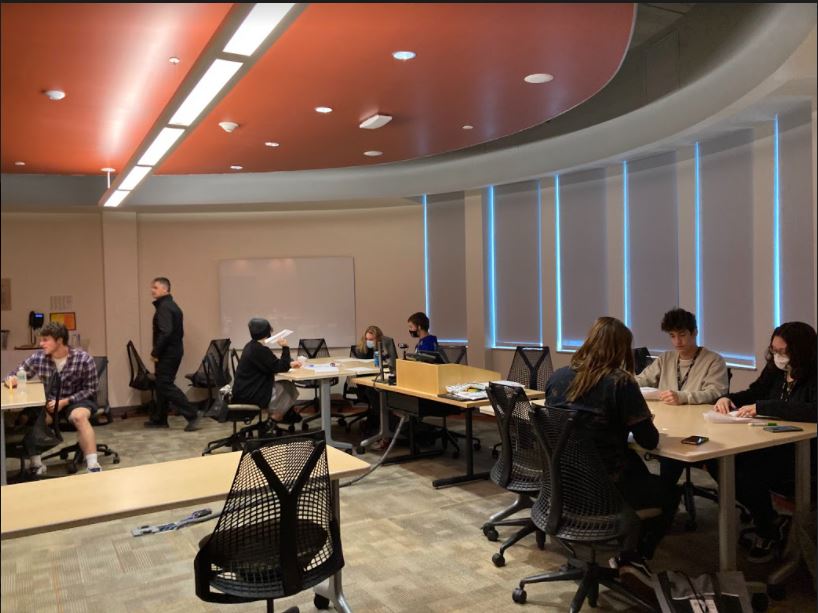
Across the hall in the Future Technology Leaders program, a class full of Waterville high school students were hard at work in an on-campus computer lab learning how to program a Raspberry Pi, a small computer that can be used to learn about programming. Waterville High School teacher, Jamee Luce, who accompanied the students, said she was not going to pass up on the opportunity to bring her students to Thomas for a hands-on experience where they can meet professors and learn about local post-secondary programs that are right in their backyard.
Waterville High School students at the Future Technology Leaders Academy
Raspberry Pi
The first of the two events held on September 30th, drew in more students than anticipated. The second event, held on October 28th, had a waiting list of interested schools ready to get students over to the day-long, popular event.
Both events brought in a total of 136 students from the following schools over the course of the two days: Belchertown High School, Biddeford High School, Bucksport High School, Camden Hills Regional High School, Carrabec High School, Cony High School, Deer Isle-Stonington High School, Dexter Regional High School, Ellsworth High School, Foxcroft Academy, Greely High School, Hampden Academy, John Stark Regional High School, Lawrence High School, Lee Academy, Lewiston High School, Madison Area Memorial High School, Maine Central Institute, Messalonskee High School, Mount Abram Regional High School, Mt. Blue High School, Nokomis Regional High, Piscataquis Community High School, Scarborough High School, Skowhegan Area High School, South Portland High School, Thornton Academy, Waterville High School, and Winslow High School.
“Highly engaging career opportunities like the Future Academies send big ripples of energy in purposeful ways,” said Diana Doiron, Maine DOE Life and Career Ready Education Specialist. “Opportunities for students are increasing and relationships are evolving between Maine schools and a growing body of nonprofit and for-profit organizations all committed to offering young people the ability to get involved in new experiences, extend their connections with others, and comprehend their hopes and dreams.”
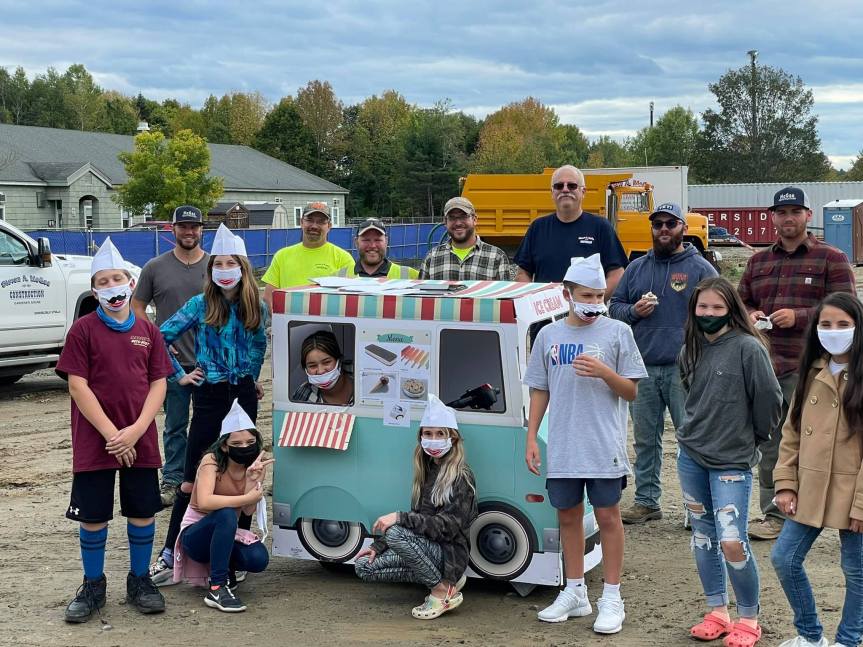
Students in the 21st Century Community Learning Center (CCLC) program at the Boys & Girls Clubs of Kennebec Valley created an ice cream truck on World Kindness Day this past October.
“We drove it to the construction site and gave the construction workers an ice cream and then delivered ice creams to all the kids in the building,” said Holly Jordan, the Teen Center/21st Century Community Learning Center Grant Director at The Boys & Girls Clubs of Kennebec Valley.
Using creative problem solving and innovation, the students used a motorized wheelchair as the movement for the truck and then created an interior base with PVC pipe and plywood to place the ice cream structure on and then made a freezer compartment in the basket area of the wheelchair.
On Monday, November 22, 2021 from 1:00 pm – 2:30 pm and 6:00 pm – 7:30 pm the advisory committee for LD 255 will have their second meeting. The meeting will be facilitated by an independent facilitator and will be recorded.
On Tuesday, November 23, 2021 from 1:00 pm – 2:30 pm and 6:00 pm – 7:30 pm the advisory committee for LD 386 will have their second meeting. The meeting will be facilitated by an independent facilitator and will be recorded.
LD 255, Resolve, Directing the Department of Education To Develop a Plan for the Provision of Early Intervention Services (Emergency), found here and LD 386, Resolve, Directing the Department of Education To Establish the Process for Transitioning the Provision of Early Childhood Special Education Services for Children with Disabilities from 4 Years of Age to under 6 Years of Age from the Regional Child Development Services System to School Administrative Units, found here, passed in the 130th legislature and are focused on several topics regarding CDS. If you’d wish to join as an attendee and listen to the discussion, you can use the following links.
The Maine Department of Education (DOE) would like to thank four Maine educators who recently participated in the recent Multi-State Alternate Assessment (MSAA) Bias/Sensitivity Passage Review.
The MSAA is Maine’s alternate assessment for students with the most significant cognitive disabilities. As a partner in the MSAA Consortium, Maine participates in the ongoing development cycle of these assessments. This participation ensures that Maine continues to strive toward increasing higher outcomes for students with cognitive disabilities, in preparation for a broad array of post-secondary opportunities.
Many thanks to the following panelists for sharing their time and expertise during this review:
Barbara Benjamin-McManus, EL Specialist, Lewiston Public Schools
Shelby Thibodeau, Director of Special Education, Augusta Public Schools
Mark Dennett, Special Educator & Functional Skills Teacher, Augusta Public Schools
Jakoba Morgan, Teacher of the Visually Impaired, Catholic Charities of Maine
Maine educators have multiple pathways to contribute to this work, and their expertise is a valued contribution to this process. Interested in participating on future review panels? Email Jodi Bossio-Smith, state coordinator for the alternate assessments at jodi.bossio-smith@maine.gov.
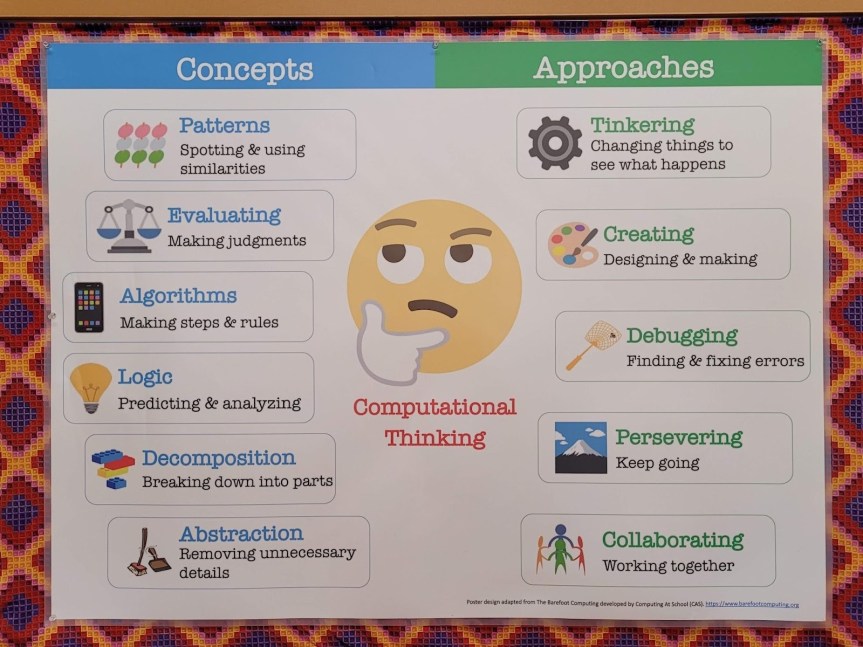
Pictured: Poster in Mr. Kumpa’s room connecting computer science tasks to classroom concepts.
Computer science isn’t so scary, just ask Bob Kumpa’s 8th-grade science students at Brewer Community School in Central Maine. As a precursor to a physics unit, students integrated computer science skills into class by programming an Edison Bot to navigate a maze of their creation.
Students drew any design they desired on a poster with the expectation that they would then program an Edison Bot to navigate through the design. Mr. Kumpa also required the Bot perform actions like going in reverse, spinning, and turning. There was no lack of creativity as students designed themed tracks such as Chutes and Ladders, Super Mario, trick-or-treating, passing on a soccer pitch and even one where the Bot travels the digestive system.
Students Julia Spencer (left) and Delaney McDonough (right) draft out their ice cream maze
Student designs a Mario themed maze
Student designs a Chutes and Ladders’ theme
A finished product of a Candyland themed maze
Eighth grader, Julia Rall, who also programmed her Bot to perform the Star Wars theme song, says the creativity aspect is her favorite. She wasn’t intimidated about the computer science, saying, “I feel like we’ve made it pretty easy. It’s just a lot of kinks that you have to work out.”
Students programmed their Bot either with Block or Python coding included in the program EdScratch. To navigate their design, some students elected to conduct the trial and error method, or, like project partners Julia Spencer and Delaney McDonough, some attempted to precisely measure out the distance and angles ahead of time. Delaney said that she and Julia felt that was the best way to do it because “that way we didn’t have to [unnecessarily] keep doing it over and over again.”
Kumpa told us the experience of perseverance via debugging does not happen by chance, but rather was one of the fundamental parts of the activity. It is those types of skills he hopes will translate to other sciences and other subjects, which is the main reason why he used the Edison Bots in the first place.
The Bots were supplied in 2018 from a grant through the Research in STEM Education (RiSE Center) at the University of Maine, in conjunction with their Maine STEM Partnership division, for a three-year study looking at the impact of computer science. Kumpa, who has done extensive work with the RiSE Center over the past 12 years, described the goal of the study to see if “teaching computer science will improve the learning of other sciences.”
Besides Brewer, there are 18 other schools involved in the study across the state. While Kumpa is focused on connecting computer science to physics, other schools have the option of also integrating computer science into life science or earth science.
Should this study prove fruitful, Kumpa said the hope will be to “allocate dollars towards moving computer science to the younger grades.” Bringing students more exposure to computer science provides not only regular experience with problem solving and critical thinking, but also an opportunity to shake off the intimidating stigma of computer science.
For further information about the Edison Bots or the RiSE Center, please feel free to reach out to Bob Kumpa at rkumpa@breweredu.org.
Looking for ways to connect your students with national issues and events through a local lens? Three Maine agencies have partnered to create “primary source sets,” themed packets of images, documents, artifacts, and sound recordings that open a window into Maine’s past.
The Maine State Museum, Maine State Archives, and Maine State Library have partnered with the Maine Department of Education to offer these free resources to schools and homeschools across the state.
The structure is simple. Each packet provides an introduction with contextual information on the topic. Then, students receive the primary sources – with no explanation of what they are. Students spend time with their source, finding clues, making observations, asking questions, and interpreting what they see and how it might connect to the broader story. The materials are presented like mysteries that the students can solve, with optional analysis worksheets to walk them through the process. They actively do the work of historians.
Only after these steps do they get the “answers,” labels with the names, dates, and facts associated with their sources. Optional reflection questions and activities offer opportunities for additional depth to the lesson, often drawing the line between the historical materials and issues that impact the present.
Sources exploring the history of incarceration in Maine.
What Kinds of People are in Prison?
Life in Prison
Captivity Outside of Prison
Working in Captivity
“Since mass incarceration is such a critical part of our history and our present, we must be able to offer students a way to understand how we got to this point,” said Freedom & Captivity Coordinator Catherine Besteman who worked on some of the materials for this project. “The U.S. is the world’s largest jailer. It is likely that many children have been impacted by the legal system because of the arrest or incarceration of a family or community member. Understanding how the criminal legal system in the U.S. developed, how it has grown, how it impacts families and communities, and what alternatives exist is a profoundly important task for our schools if we are ever to correct the abuses and problems of the past in order to build a healthier future.”
Interested in learning more? Join the next webinar about these great resources. More information can be found below. You can also reach out to Maine DOE Social Studies Specialist Joe Schmidt at Joe.Schmidt@maine.gov or contact Manie State Museum Education Program Specialist Kate Webber at kate.webber@maine.gov.
Part 4: “Maine Pandemics” Primary Source Set Exploring pre-packaged online educator materials on the theme of the history of pandemics in Maine. 3:00-4:30pm ET November 9th (Register for this session)
Due to popular demand, another session has been planned for December! This opportunity is two half-day interactive sessions that are relevant for staff working remotely or in-school.
Wednesday, December 8 from 12:00 to 2:45pm
Wednesday, December 15 from 12:00 to 2:45pm
You and your team can create a positive climate and culture during a pandemic! Participants will:
Learn strategies to build positive climate, improve school culture and decrease chronic absenteeism whether remote, in-person and 6 feet apart,
examine how to build healthy relationships within the school community even when behind the screen (staff with students, staff with staff, and staff with families),
explore strategies for difficult conversations among staff, students, and/or families,
access a framework (including staff survey) to assess your own school climate and culture through consensus decision-making,
leave the workshop with tools to help create a thriving school where all students and staff can feel welcome and be successful.
Everyone is welcome. We strongly encourage schools to register teams of 3 – 5 staff. During the training, you will work closely with your team-whether you are in-person or working remotely. All teams will leave the training with a plan that can be used immediately!
The cost is $85 for each member of the school team (minimum of 3 team members) and $115 for an individual registration. The same team should attend both sessions. The cost covers training and materials. Zoom link will be forwarded after registration. The sessions are limited to 50 participants.
Since 2014, Westbrook Intercultural Community Center (ICC) has offered Power School afterschool and summer learning programs to hundreds of children in Southern Maine. After taking advantage of the 21st Century Community Learning Centers (CCLC) program through the U.S. Department of Education they were able to stabilize funding and improve efforts in a way they never thought possible.
“The 21st Century grant has been huge for us,” said Chris Feely, 21st CCLC Program Director at ICC. “We had previously been living grant to grant, so to speak.” The consistent funding and professional support enabled the Westbrook Intercultural Community Center to expand their staff with qualified individuals, coordinate programming efforts with the local middle school, and cement themselves as a stable resource in the community. From there, Chris says building those important community connections has been the critical component to allowing them to spread awareness and appreciation for the work they are doing in the Southern Maine area.
“We have had over 50 students join the afterschool program this fall,” said Chris. “Our outreach has been so successful that, for the first time ever, we have had to create a waiting list for registered students to enter the program.”
Students learn about their program through word of mouth, which is often within local immigrant communities in the area. The Center also engages in purposeful and coordinated outreach with the Westbrook School Department.
“Specifically, we work with the middle school to identify low-performing students, and then make phone calls directly to parents and guardians promoting our program,” explained Chris.
Regular communication and twice-a-month meetings with school and district administrators Principal Laurie Wood and Superintendent Peter Lancia ensure that updates and needs that support both the program as a whole and for individual students are discussed on a regular basis.
“Central to our collaboration is promoting equity among students, as most of our students are immigrant or first-generation Americans and low-income,” added Chris. “We work with Amanda Atkinson-Lewis, the Equity Resources Coordinator, on identifying ways to support students and have developed a strong relationship with the School Nutrition Director, Mary Emerson, to secure healthy and diverse snacks for our students every day after school.”
Operating During the Pandemic:
Chris recounts that their year-long remote program which took place at the height of the COVID-19 Pandemic from April 2020- to June 2021 had some wonderful highlights and enabled them to accessibly reach many new students.
“Kids could log on every day after school, participate in a brief lesson, and take their time getting homework help in virtual breakout rooms,” said Chris. “The need for academic as well as emotional support became clear, as many students opened up to teachers or would stay to chat after they had completed their homework. We felt closer to our students than ever before.”
While this was a silver lining to the new way the Center had to operate, like many schools and afterschool programs, they came to understand that remote learning did not fit everyone’s strengths or needs and morphed their program to a hybrid model.
“Our hybrid summer program experienced much larger attendance on in-person days, and I think that speaks to the innate need for kids to run around, socialize, and interact,” added Chris.
Although keeping the Center successful has been a lot of hard work, especially with all of the changes that have come as a result of the pandemic, the Intercultural Community Center team strives to make a difference in the lives of students in their community. When asked what the best thing is about working with the students he serves, here is what Chris had to say:
“Far and away, it’s the moments when you see that you’ve made a positive impact on a child. It makes all the planning and day-to-day tumult worth it– when a single mother tells us we’ve saved her daughter’s academic performance after they could no longer afford to pay her tutor; or when a 10-year-old girl who, a month ago, escaped threats on her life in Kabul, is seen laughing with friends and tells us that she loves Power School.”
With authorization of the Pfizer COVID-19 vaccine for children ages 5 to 11, the Maine Department of Health and Human Services (DHHS), in partnership with the Maine Department of Education (DOE), is sponsoring a competition for videos made by and featuring Maine children encouraging other children to get vaccinated.
Videos can include:
Messages children or youth ages 5 to 17 believe will be effective in encouraging other children or youth along with their parents to get a COVID-19 vaccine.
Original music or humor
Information on the vaccine’s safety and efficacy
Discussions of the impact of not getting vaccinated
Information that participants can use in developing these videos can be found at on the US CDC website.
Children can make these videos on their own or as part of a school activity. They can choose whether or not to include their school name.
To enter, contestants must complete the online entry form. Once the form is submitted, contestants will receive an email with instructions for submitting their video.
To be considered videos must be:
30 seconds in length
Shot in portrait mode on a smart phone
Video file must not exceed 32MB
The deadline for submission is 6pm on November 22.
The winners will be announced on December 1, 2021. The selection committee includes the Commissioners of Maine DHHS and DOE, and their communications teams.
The selection criteria will include:
originality and clarity of the message
consistency with public health information on youth vaccination
potential to reach groups that may be hesitant to be vaccinated
Three winners will be selected. The prize will be the use of the videos by Maine Center for Disease Control and Prevention (CDC) on television via press conferences and/or PSAs and social media in promoting vaccination.
Additionally, the school that the winners attend will receive a cash prize to be used for:
supplementing school meals with healthy treats;
purchasing playground, classroom, gym, sports or music equipment; enhancing a school fun day; or
supporting a school field trip for all students.
Other ideas from the winners will be considered as well. If the winners attend different schools, then the prize will be pro-rated for those schools.
If the participants are home schooled, they may designate a public facing non-profit serving all children in the area receive the prize.
Prize amounts will be:
$50,000 for the first-place winner
$25,000 for the second-place winner
$10,000 for the third-place winner
Winners will need to have a consent form signed by parents that allows:













 Maine DOE Newsroom