PRIORITY NOTICE: School Year 2022 Nationwide Waivers Available for Schools and Day Care Facilities to Support Safe Reopening and Nutritious Meals  

Maine Department of Education (DOE) is thrilled to share that USDA has released twelve additional Nationwide Waivers for SY 2022 These are meant to support the safe reopening of facilities while providing nutritious meals for children and adolescents. The new waivers can be accessed here  

Maine DOE’s Child Nutrition team is reading through the waivers carefully in order to provide the best support to the field. As some of these are different from those issued in the past. We support the action of USDA to release waivers to support the safe provision of nutritious meals for Maine students. These waivers will allow students all over the state to access meals and will provide much needed flexibilities during the current public health emergency.    

More information will be provided by Child Nutrition Director Walter Beesley on Wednesday, April 28th at 1:00. Those interested can register for the webinar  

For questions regarding these USDA nationwide waivers, contact Walter Beesley, Child Nutrition Director, at 207-624-6875 walter.beesley@maine.gov.  

**** 

In accordance with Federal civil rights law and U.S. Department of Agriculture (USDA) civil rights regulations and policies, the USDA, its Agencies, offices, and employees, and institutions participating in or administering USDA programs are prohibited from discriminating based on race, color, national origin, sex, disability, age, or reprisal or retaliation for prior civil rights activity in any program or activity conducted or funded by USDA.  

 Persons with disabilities who require alternative means of communication for program information (e.g. Braille, large print, audiotape, American Sign Language, etc.), should contact the Agency (State or local) where they applied for benefits.  Individuals who are deaf, hard of hearing or have speech disabilities may contact USDA through the Federal Relay Service at (800) 877-8339.  Additionally, program information may be made available in languages other than English. 

 To file a program complaint of discrimination, complete the USDA Program Discrimination Complaint Form, (AD-3027) found online at: https://www.usda.gov/oascr/how-to-file-a-program-discrimination-complaint, and at any USDA office, or write a letter addressed to USDA and provide in the letter all of the information requested in the form. To request a copy of the complaint form, call (866) 632-9992. Submit your completed form or letter to USDA by: 

 (1)     mail: U.S. Department of Agriculture
          Office of the Assistant Secretary for Civil Rights
          1400 Independence Avenue, SW
          Washington, D.C. 20250-9410;
 (2)      fax: (202) 690-7442; or  
 (3)      email: program.intake@usda.gov. 

This institution is an equal opportunity provider.
The Maine Human Rights Act prohibits discrimination because of race, color, sex, sexual orientation, age, physical or mental disability, genetic information, religion, ancestry or national origin.
Complaints of discrimination must be filed at the office of the Maine Human Rights Commission, 51 State House Station, Augusta, Maine 04333-0051. If you wish to file a discrimination complaint electronically, visit the Human Rights Commission website at https://www.maine.gov/mhrc/file/instructions and complete an intake questionnaire. Maine is an equal opportunity provider and employer. 

Continuous Improvement in Education: Supporting Innovation in Maine Webinar Series

The Regional Educational Laboratory Northeast and Islands in partnership with the Maine Department of Education and the Region 1 Comprehensive Center is excited to announce the Continuous Improvement in Education: Supporting Innovation in Maine Webinar Series.   This webinar series is designed to help build the capacity of Maine educational leaders and teachers to understand and apply the principles and practices of continuous improvement. Participants will learn about identifying areas for improvement, implementing intended improvements, collecting data related to implementation, making sense of these data, and using the evidence in making improvement decisions.

The Regional Educational Laboratory Northeast and Islands works to bridge the worlds of educational research with educational practices in the field by supporting collaborative research partnerships between educators.  The REL is designed to support educators through training, applied research studies, technical support and coaching.   Please join us to learn more about how we are working to support Innovational Educational practices in Maine.

We encourage all educators to register for this unique opportunity to build capacity for innovative educational practices.

Sign up here to be a part of this important conversation. 

Session 1 – April 29, 2021, 3:30–4:45 p.m. Eastern
Session 2 – May 19, 2021, 3:30–4:45 p.m. Eastern

Even if you cannot attend the live sessions, register at the link above to receive an email when the recordings of the webinars are available online.

For more information, contact Martin Mackey, Maine Department of Education, Office of Innovation at Martin.Mackey@Maine.gov.


MEDIA RELEASE: Mills Administration Updates COVID-19 School Health Advisory System

For Immediate Release

Androscoggin, Kennebec, Oxford and Somerset counties yellow; Franklin and York counties closely monitored
Administration launches new school testing program. 

AUGUSTA — The Mills Administration today released an update to its color-coded Health Advisory System that classifies counties’ relative risk of COVID-19 transmission to assist schools as they continue with their efforts to deliver instruction and support students safely.  

Maine’s Department of Health and Human Services (DHHS) and Center for Disease Control and Prevention (Maine CDC) assessed COVID-19 data and trends for all counties and released the following designations: 

  • YELLOW:  Androscoggin has experienced a sharp rise in cases over the last two weeks, with a new case rate more than double the statewide average. Kennebec, Oxford and Somerset counties all have new case rates that exceed the state average, and both Oxford and Somerset counties have two-week positivity rates that exceed the state average.  
  • CLOSELY MONITOR:  Franklin County has a rising new case rate and York County’s positivity rate is increasing.  
  • All other counties remain green.   

These designations are made out of an abundance of caution and for the consideration of school administrative units in their decisions to deliver instruction. DHHS and Maine CDC continue to review evidence that indicates lower transmission of COVID-19 in schools compared to the general population.  

Over the last 30 days, the rate of new cases for school staff and students has risen to 45 per 10,000, but remains about 40 percent lower than a new case rate of 74 per 10,000 for the general population.   

This continues to demonstrate that in-person learning in schools that follow public health precautions can be conducted safely, without increased transmission of COVID-19, when schools use proven health and safety protocols and resources. 

The Health Advisory System categorizations are defined as follows: 

  • RED: Categorization as “red” suggests that the county has a high risk of COVID-19 spread and that in-person instruction is not advisable.
  • YELLOW: Categorization as “yellow” suggests that that the county has an elevated risk of COVID-19 spread and that schools may consider additional precautions and/or hybrid instructional models to reduce the number of people in schools and classrooms at any one time. 
  • GREEN: Categorization as “green” suggests that the county has a relatively low risk of COVID-19 spread and that schools may consider in-person instruction, as long as they are able to implement the required health and safety measures.  Schools in a “green” county may need to use hybrid instruction models if there is insufficient capacity or other factors (facilities, staffing, geography/transportation, etc.) that may prevent full implementation of the health and safety requirements. 

The county-level assessments are based on both quantitative and qualitative data, including but not limited to recent case rates, positivity rates, and syndromic data (e.g., symptoms of influenza or COVID-19). Those data are publicly posted every week on the Maine CDC website. DHHS and Maine CDC also consider qualitative factors, such as the presence of outbreaks that may potentially affect school-age children. 

The Health Advisory System reflects ongoing analysis of evolving data, and serves as one piece of information that school and district leaders can use to make decisions about how to deliver education during the school year. The qualitative and quantitative considerations and data used by the CDC in determining community transmission risk levels for schools can be located here: How County Risk Levels for Maine Schools are Determined 

The Health Advisory System can be found on the Maine DOE website in Part I of the Framework for Reopening Schools and Returning to In-Person Classroom Instruction: https://www.maine.gov/doe/framework/part-I

Maine schools have been safely open since the fall by adhering to the six requirements for returning to in-person instruction and by following the protocols for identifying close contacts that are found in the Standard Operating Procedure for a positive case in schools, regardless of their county color designation. Additionally, many schools have utilized BinaxNOW rapid antigen testing, provided at no cost to the schools through Maine DHHS, to quickly confirm and isolate positive cases in schools, and some schools are piloting expanded use of the tests in the coming weeks.  

COVID-19 testing remains critical to identify infected individuals early, often before symptoms appear. As such, Maine DHHS and Maine Department of Education (DOE) announced a new  pooled PCR testing program that will launch in May, which will be available to any PK-12 school administrative unit or private school.  

Pooled PCR testing allows schools to test large groups of students and staff on a weekly basis. Pooled testing involves collecting swabs from small groups of students, usually students in a class cohort or homeroom, combining the test samples in a “batch” or “pool,” and then testing the pooled sample with a PCR test. If pool results are positive, the individuals in that pool are retested using BinaxNOW or PCR testing. The positive individual(s) would then be sent home in order to begin their isolation period and limit the number of additional people infected. 

Maine DHHS and DOE have invited school and school administrative unit leaders and school nurses to attend one of two informational webinars on the pool testing program next week to learn about adopting  this strategy  for the remainder of the current school year, summer programming as well as the 2021-2022 school year.  

Maine people can help keep schools safe by following the health and safety precautions, including wearing masks, keeping physical distance and practicing hand hygiene. They can also help keep schools safe by  following Maine’s travel guidelines, including testing and quarantining for unvaccinated people who have visited certain states. Please be sure to communicate with school leaders about any travel, symptoms, or questions.  

The next update will be provided on May 7, 2021. Updating this advisory on a two-week basis aligns with the incubation period for COVID-19 and allows for greater stability in the trend data for small counties.   

### 

Funding Opportunity: 2021 NASA Teams Engaging Affiliated Museums and Informal Institutions

The NASA Office of STEM Engagement invites proposals from museums, science centers, planetariums, NASA Visitor Centers, youth-serving organizations, libraries, and other eligible nonprofit institutions via the 2021 NASA Teams Engaging Affiliated Museums and Informal Institutions (TEAM II) Notice of Funding Opportunity, NH21ZHA002N.

The 2021 TEAM II NOFO is an omnibus solicitation, offering distinct program elements to which eligible IEIs may propose, issued as appendices to the NOFO.  Initially, two program elements are offered, Standard Awards for TEAM II (STAT) which is analogous to previous TEAM II NOFOs, and Community Anchor Awards for TEAM II (CAAT).

Community Anchor Awards for TEAM II (CAAT)

  • 2021 TEAM II NOFO pre-proposal webinar (optional overview):  May 4, 2021
  • 2021 TEAM II CAAT pre-proposal webinar (optional in-depth walk-through): May 5, 2021
  • Full proposals are due: June 17, 2021
  • Individual award range: $20K – $25K
  • Period of Performance: 1 – 2 years

Standard Awards for TEAM II (STAT)

  • 2021 TEAM II NOFO pre-proposal webinar (optional overview):  May 4, 2021
  • Notices of Intent Due (optional but strongly encouraged):  May 26, 2021
  • Full proposals are due: July 19, 2021
  • Individual award range: $500K – $800K
  • Period of Performance: 2 – 4 years

For general inquiries, contact: TEAMII@jpl.nasa.gov.

For more information regarding these opportunities and scheduled information sessions, please visit the 2021 NASA TEAM II NOFO landing page on the NASA Solicitation and Proposal Integrated Review and Evaluation System (NSPIRES) website and click on ‘List of Open Program Elements’.

Reminder of Resources for Positive Behavioral Intervention and Supports (PBIS)

The Maine Department of Education continues to partner with the University of Maine system to provide Positive Behavioral Intervention and Supports (PBIS) training and coaching. PBIS is a multi-tiered approach to supporting the social, emotional and behavioral development of students in preK-12 settings. The purpose of PBIS is to improve the social, emotional and academic outcomes for all students, including students with disabilities and students from underrepresented groups.

An information session for SAUs and schools interested in joining a new PBIS cohort will be held April 30 at 12 pm. To learn more and access the remote meeting, contact Tracy Whitlock at tracy.w.whitlock@maine.gov.

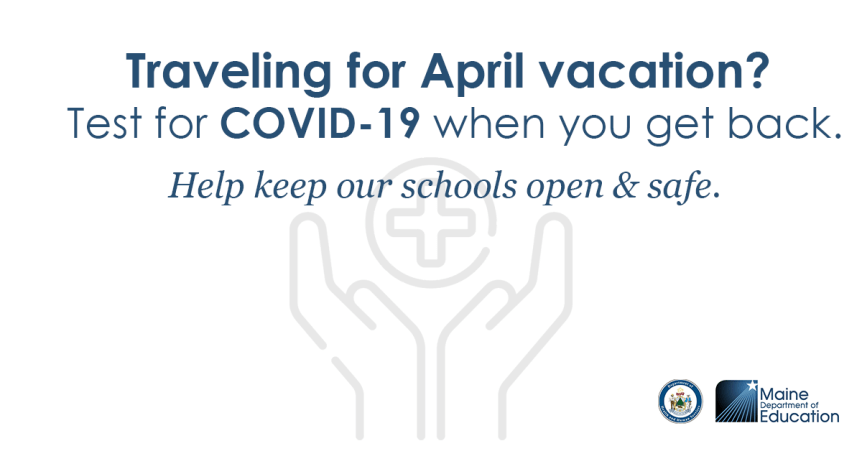
PRIORITY NOTICE: Reminder to April Vacation Travelers – Test for COVID-19 Upon Return

Maine Department of Health and Human Services (DHHS) Commissioner Jeanne Lambrew released an important reminder in the Bangor Daily News recently for Maine students and families traveling during April vacation, and noted that our case numbers, and the number of young people getting sick from COVID-19 is on the rise.  The Maine Department of Education would like to underscore her important message to all members of Maine’s school communities, as we urge everyone to help keep our students and schools safe after April vacation week.

COVID-19 is a well-known world traveler. Variants of concern previously identified from the United Kingdom, Brazil and South Africa have been detected in Maine. People traveling have been known to cause outbreaks, often unknowingly, once they return home if they’re not yet experiencing symptoms.

This is why testing for COVID-19 remains critical. Getting a test is simple, free and protects you, your family and your community. It identifies people infected by the virus early, often before symptoms appear. And getting a test when you have a fever, headache, chills, fatigue or difficulty breathing allows you to determine if you have allergies, a common cold or if this is the highly contagious and serious virus. If you test positive, you can isolate to limit the number of additional people infected. You can save lives.

For these reasons, Maine currently requires people traveling to states outside of New England to “test or quarantine.” This means that you must quarantine for 10 days upon return to Maine unless you obtain and receive a negative COVID-19 test from a sample taken no longer than 72 hours prior to arrival. Maine strongly urges testing prior to arrival; however, for people who test upon arrival in Maine, it is important that you quarantine while you await your test results.

This is especially important for families traveling during the April vacation. COVID-19 transmission in Maine schools is lower than in the rest of the population, thanks to the health and safety protocols Maine schools have consistently followed since last summer. That said, children are still catching and spreading the virus. And a COVID-19 vaccine has not yet been authorized for children under age 16.

The best type of COVID test is a molecular or “PCR” test. The results may take a little longer, but PCR tests have proven to be highly accurate. Rapid “antigen” tests work well for people with symptoms. Such tests may also be used several days in a row — called “serial” testing — as a screening tool. A number of Maine school districts will be offering rapid tests at the end of next week before school resumes on April 26 and again early that week as a way to screen for COVID-19 as people return from the break.

COVID-19 testing in Maine is free of charge. It is available at locations throughout the state, from health care clinics to pharmacies. Learn where you can get a test by visiting the state’s Keep Maine Healthy website or calling 211.

Being fully vaccinated — meaning two weeks after your final dose — exempts you from the need to get a COVID-19 test or quarantine if you travel. You also don’t need to test if you have had COVID-19 in the last 90 days and recovered. We urge everyone age 16 and older to get vaccinated now. Appointments can be found by visiting VaccinateME.Maine.gov, or calling Maine’s Community Vaccination Line at 888-445-4111.

In addition to testing and vaccination, please continue to take the simple steps that have protected the health and safety of Maine people throughout the pandemic: Wearing a mask, physical distancing, washing hands and staying home if you don’t feel well. These measures remain vital whether you’re at home, out in your community or traveling for a well-deserved vacation during the break from school next week.


Get to Know the Maine DOE: Meet Pender Makin

Maine DOE Team member Pender Makin is being highlighted this week as part of the Get to Know the Maine DOE Team Campaign. Learn a little more about Pender in the question and answer below.

What are your roles with DOE? 

It’s my honor to be serving in the role of Commissioner of Education. My duties span all of the statutory requirements in Title 20-A, and our team members at DOE all contribute to this work.

What do you like best about your job?

What I like most is knowing that my efforts are on behalf of something so deeply important. I believe that public education is the most critical underpinning of democracy and that all students deserve equitable opportunities and access to high quality learning environments and educational programs.  This past year has been extremely difficult – but, even on my most discouraging day, when I’m feeling exhausted and depleted, I feel extremely blessed to be spending my energy, efforts, and time engaged in such meaningful work.

How or why did you decide on this career?

It was more of a 3-decade journey than a decision … When I was an Ed Tech III, I aspired to become a teacher so that I could really make a difference for students. Once I became a teacher, I wanted to make bigger changes and continued my education so that someday I could be a building principal. As a principal, I had the opportunity to better understand how certain practices, systems, and policies impact the experience of students in the classroom, and I did my best to influence these in a positive direction. Later, when I became a district leader, I worked within that scope of influence, and when this opportunity was presented to me, I saw it as a chance to really make a difference for Maine students and for public education in general.

What do you like to do outside of work for fun?

I love to play piano and/or ukulele and sing out loud with friends (I sure miss that in this pandemic!) I also love: to be at the beach during all seasons, in all weather; snuggling with my dogs; playing cribbage with my husband; and helping my parents with their gardening and other chores.

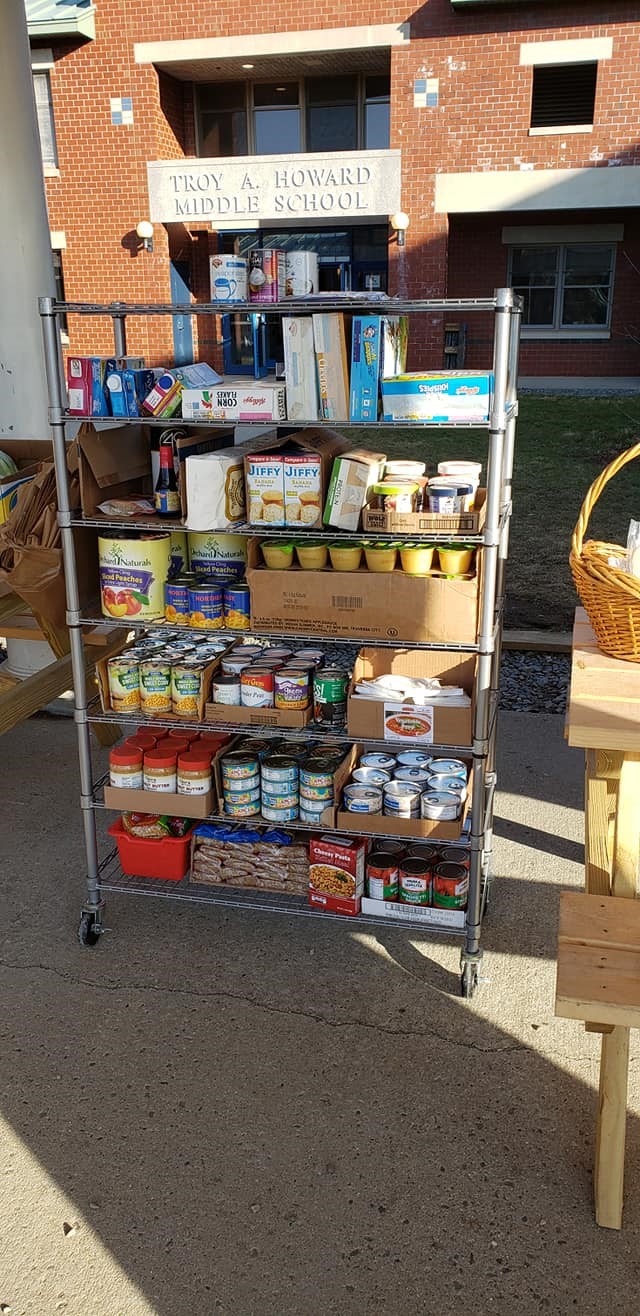
Troy Howard Middle School Expands Food Pantry with Community Caring Cart

Like many school districts across Maine, RSU 71 provides a school food pantry program to ensure there are free food options for families to take home with them as an added service to those in need.

“The District has been feeding families in need since, well, forever,” said Carrie Robinson, Front Desk Secretary at Troy Howard Middle School (THMS) in Belfast.

While there is no data point in Maine that details just how many schools offer this type of service, it is abundantly clear that there are a wide range of efforts on all levels throughout Maine and often times they can be found at the local school.

“When our school buildings were closed last spring at the onset of the pandemic, our school nurses partnered with food services and transportation to send home weekly boxed meals and produce,” said Shannon Robbins, School Nurse at A Ames – Gladys Weymouth Elementary Schools in RSU 71. “In fact, we sent home over 22,000 pounds! Families shared with us how much it meant to have these necessities delivered to their homes when it felt too scary to shop in town.”

It’s worth noting that school food pantries and backpack programs are a volunteer effort at most schools and go above and beyond the complimentary school meals that students receive while learning at school and remotely. With the help of several USDA waivers during the pandemic, school nutrition programs have been allowed to be flexible and adaptive in the way school meals are served and most have been able to offer these services at no charge to families.

Suffice it to say, pantry and backpack programs are becoming an important addition to many school communities across Maine and at Troy Howard Middle School they have recently undergone an expansion to reach more families.

Although the district’s nurses, administrators, and guidance staff usually have a good idea of who needs help, they have found that it is still difficult to know if they’ve provided the service equitably.

“We really just never know who is in need,” explained Robyn Mailloux, THMS Nurse.

That is when they came up with the idea to offer the Community Caring Cart as a service to anyone who wants or needs something – they can just come pick it up. Instead of handing a backpack full of food and supplies to a specific student or families, now the cart is available in public areas at school that are easy for parents and students to just take what they need.

“Over the course of the year, I’ve been surprised at what has disappeared from the hallway shelf and who has been taking it,” said Mailloux. “You just don’t know what people’s stories are.”

In addition, there are bags available for people to donate items if they wish and the team is also working on some grab and go bags that are quick and easy to take.

“Anything taco related flies off the shelves, as does of course easy to make staples, mac and cheese and canned soups and fruits,” said Robinson. “Since we are at a middle school level many of our students have some basic cooking skills so they will grab things they can make for themselves. Any time we have fresh produce it goes well, the kids actually like fresh stuff!!!!”

“Lightweight, prepacked goods such as cereal, pasta or rice mixes, soups are very popular. We have also offered fresh produce from Maine farmers including potatoes, apples, carrots- families loved these,” adds Robbins.”

Knowing that food programs are a service provided in many community and schools throughout Maine, we asked the RSU 71 team if they have any advice for schools that are thinking about starting or expanding food pantry programs at their schools.

“I would remind any schools that are trying to do anything like this that you never really know who needs the help so get the word out every way you can,” offers Robinson.

“Partner with your community resources – we couldn’t do this without GBAM (Greater Belfast Area Ministerium Food Cupboard), GSFB (Good Shepard Food Bank), and our area boosters, such as Bell the Cat (a local restaurant) and individual donors,” said Robbins adding that when RSU 71 School Food Pantry began in 2019, they received a generous grant from the Sadie and Harry Davis Foundation that has enabled them to expand their support during the pandemic.

The Maine Department of Education would like to take a moment to thank the dedicated team at RSU 71 as well as the countless school staff members, volunteers, and community partners across Maine working tirelessly to provide services to the families in their communities through food programs and other similar efforts, especially throughout the past year. Your dedication and selflessness does not go unnoticed by the Department or the grateful people that benefit from your work.

Information for this article was provided by RSU 71 as part of the Maine DOE Maine Schools Sharing Success Campaign. The Maine Schools Sharing Success Campaign is an avenue for Maine schools to celebrate successes and share innovative ideas, practices, and models that can be adapted and easily implemented by other Maine schools. Stories are not an endorsement of specific materials, services, or practices and are not intended to promote learning programs that are of cost to students, families, or schools. To submit a story or an idea, email it to Rachel at rachel.paling@maine.gov.


Nominations Open for Governor’s Volunteerism Awards

There are many different types of positions that help our schools operate day to day, serving as a vital part of Maine’s communities, including our beloved school volunteers! Now is the time to recognize these wonderful human beings for all of the selfless things they do for their community. In addition, there are many youth across our state that take community service learning to a whole different level by taking an active role volunteering in their community and making a real difference.The Governor’s Awards for Service and Volunteerism have celebrated and recognized the role of citizen volunteers in the success and vitality of Maine communities since 1987.  The awards seek to inspire others to be active in civic life and follow in the footsteps of those recognized.Use one of the links below to access nomination instructions and additional information for each form of recognition. All nominations are due April 30 by 5 p.m.

Adult Roll of Honor

Youth Roll of Honor

Competitive awards: Individuals, teams and organizations 

Volunteers make the hearts of Maine communities beat!

Early College Online: UMF Course Gives Mt. Blue Senior the Chance to Research and Share Family History

Early College student Sylvie Haslam, a senior at Mt Blue High School recently published the first part of a three part story on University of Maine at Farmington (UMF) Professor and Author Luann Yetter’s website as part of an Early College course she took this past summer at UMF.

“Sylvie was just one of many high school students, statewide, really, who took advantage of the opportunity to take classes last summer, when the pandemic hit and UMF moved their summer classes online,” said Clarissa Thompson, Early College Campus Coordinator and Associate Professor of Secondary and Middle Education at UMF.

Early college courses are available to Maine high school students at University of Maine System Schools and Maine’s Community Colleges as well through Maine’s Aspirations Program, which is administered by the Maine Department of Education. Students may now apply for early college opportunities at all of Maine’s colleges and universities using one common application portal, this new tool is a significant usability upgrade for students and families navigating early college options in Maine.

The UMF course that Sylvie took is called, Local Stories/Your Stories. Along with classmates from across Maine, she dove into her own local town and family history as material for creative nonfiction, engaging in personal interviews, genealogies, and looking through old newspapers (among other things) to create a vivid story of her personal history.

“This is a great example of the types of expanded opportunities our high school students have as part of the Aspirations program,” said Amy Hubbard, Executive Director of Early College at University of Maine System.

As an introduction to Sylvie’s story, Professor Yetter writes:

Last summer when I taught my class on writing local and family history I got to read some wonderful work. One of the projects I know will be of interest to my readers is this one by Mt. Blue High School senior Sylvie Haslam. Sylvie’s family history in Weld is interwoven with the Cushman family, prominent in the 1800s, and with artist Seavern Hilton who made his mark in the mid twentieth century. Join us as Sylvie explores Weld history, family history and the folk art that traveled far beyond the village of Weld. I have divided her fascinating account into three parts. In Part I, below, we are introduced to the Michael Graham farm and the Cushman family, whose ties to the land go back to the mid-eighteen hundreds. I’m sure you will agree that Sylvie is a talented writer. This high school student has a great future ahead of her!”

Read Part One of Sylvie’s story here: The Shop Land, Part I

UMF and the other University of Maine System campuses, as well as Maine’s Community College System campuses offer a wide range of classes that Maine high school students have continued to participate in online.

“Students have really jumped at the opportunity to take them,” adds Thompson. While participation had been growing steadily before the pandemic, early college programming helped provide additional options for students as high schools adjusted to online and hybrid schedules. Students who participate in early college are more likely to attend college, have higher grades in college, and are more likely to graduate on time.

For more information about early college options at UMF specifically, contact Clarissa Thompson at clarissa.thompson@maine.edu.

Information for this article was provided by the University of Maine System and the University of Maine at Farmington as part of the Maine DOE Maine Schools Sharing Success Campaign. The Maine Schools Sharing Success Campaign is an avenue for Maine schools to celebrate successes and share innovative ideas, practices, and models that can be adapted and easily implemented by other Maine schools. Stories are not an endorsement of specific materials, services, or practices and are not intended to promote learning programs that are of cost to students, families, or schools. To submit a story or an idea, email it to Rachel at rachel.paling@maine.gov.