The Maine Department of Education invites school districts to nominate graduating high school seniors for the U. S. Presidential Scholars Program. Each district may nominate one senior who is a U.S. citizen or legal permanent U.S. resident and has demonstrated excellence in a Career and Technical Education (CTE) program and one senior who had scored exceptionally well on either the College Board’s SAT or the ACT of the American College Testing Program. Application materials will be sent directly to superintendents and CTE directors by Wednesday, October 28. Applications are due to the Maine DOE by Friday, November 13.
Students chosen as U.S. Presidential Scholars receive an expense-paid trip to Washington, D. C. in June, and are presented the U.S. Presidential Scholars medallion at a ceremony sponsored by the White House, in commemoration of their achievements. During their visit to Washington, scholars have access to important national and international figures, including government officials, educators, authors, musicians, scientists and other accomplished people.
Tracy Williamson, music educator at Gorham Middle School, has been selected as 1-of-25 semifinalists for the GRAMMY Association’s Music Educator of the Year. A total of 25 music teachers from 24 cities across 16 states, have been announced as semifinalists, selected from more than 1,989 initial nominations submitted from all 50 states
The Music Educator Award recognizes current educators who have made a significant and lasting contribution to the field of music education and who demonstrate a commitment to the broader cause of maintaining music education in the schools. The recipient will be recognized during GRAMMY Week 2021.
The award is open to current U.S. music teachers, and anyone can nominate a teacher — students, parents, friends, colleagues, community members, school deans, and administrators.
Each year, one recipient is selected from 10 finalists and recognized for their remarkable impact on students’ lives. They will receive a $10,000 honorarium and matching grant for their school’s music program. The nine additional finalists will receive a $1,000 honorarium and matching grants. The remaining fifteen semifinalists will receive a $500 honorarium with matching school grants.
The matching grants provided to the schools are made possible by the generosity and support of the GRAMMY Museum’s Education Champion Ford Motor Company Fund. In addition, the American Choral Directors Association, National Association for Music Education, NAMM Foundation, and National Education Association support this program through outreach to their constituencies.
The finalists will be announced in December, and nominations for the 2022 Music Educator Award are now open. To nominate a music educator, or to find more information, please visit www.grammymusicteacher.com.
Do you have National Board Certified Teachers on your staff? Awesome! We are sending along a reminder to those fortunate superintendents, or directors of a publicly-supported secondary school or CTE region, with eligible staff who have attained National Board for Professional Teaching Standards Certification prior to July 1, 2020. Please let us know so we can provide you with their legislatively allocated salary supplement.
In order to qualify for the salary supplement, eligible staff must be currently employed by a Maine public school, or by a publicly-supported secondary school or CTE region in Maine. Eligible position titles include classroom teacher, special education teacher, literacy specialist, long-term substitute teacher, library media specialist, guidance counselor, and teacher leaders with certification from the National Board for Professional Teaching Standards, or its successor organization.
Salary Supplement amount: Despite enacting language regarding a $5,000 supplement for those teaching in a school with a Free and Reduced Lunch Rate (FRLR) 50% and higher, no additional funds were appropriated to provide full funding for that, or full funding of the $3,000 for those under the 50% FRLR; therefore, both supplements will need to be prorated. Estimated* prorated amounts:
Teaching in a school with a Free and Reduced Lunch rate 50% and higher: $3,350
Teaching in a school with a Free and Reduced Lunch rate below 50%: $2,022
*Please note these are estimated amounts. Final salary supplement totals will depend on the number of qualifying teachers in each category. We expect to have that information published on our web site the week of Dec. 7. The submission form and further information is available on our National Board Certification Salary Supplement web page: https://www.maine.gov/doe/educators/cert/nationalstandards/salary
The U.S. Department of Education requires state educational agencies, when seeking waivers from statutory or regulatory requirements, solicit public comment on the application, respond to public comments, and provide evidence of the available comment period. A copy of the letter seeking waiver from §8401(b) of the ESEA as amended by ESSA can be downloaded with key elements of the request included below:
Federal program affected by the requested waiver
Section 1111(h) of the ESEA, as amended by the ESSA, requires State and LEA report cards to include information on student achievement on the academic assessments in reading/language arts, mathematics, and science described in section 1111(b)(2) at each level of achievement (as determined by the State under section 1111(b)(1)) for all students.
Maine is seeking a waiver from public reporting for the general and alternate science assessments. Maine’s 2021-2022 ESEA Data Dashboard (Report card) will continue to publicly report alternate assessment results for mathematics and English language arts. Maine will continue to report the math and ELA/Literacy assessment results to parents through individualized student reports .
Maine will continue to meet all other reporting requirements. Maine specifically requests a waiver from the public reporting of both the general and alternate science assessments performance only.
Sections impacted include:
Section 1111(b)(2)(B)(iv)
Section 1111(b)(2)(B)(xi) (disaggregation of alt. science data by subgroup)
Section 1111(h)(1)(A)
Section 1111(h)(2)(iii)
Impact to Student Achievement
There will be no impact to assessing student achievement as all eligible students will continue to participate in the general science and science alternate assessment where applicable. The waiver will permit Maine to not publicly release student general and alternate science assessment achievement data. The Maine Department of Education will only report participation rates related to the administration of the general and alternate assessment in grades 5, 8, and the third-year high school during the 2021 spring administration. During the 2022 spring assessment administration, Maine will participate in the science alternate assessment on-line operational alternate assessment. Standard setting and post equating in the summer of 2022 would allow for reportable student achievement levels and scores that fall.
Monitoring
Assessment administration will follow all assessment administration policies and protocols. Schools will be provided science data within the confidential reporting platform. Individual Student Reports (ISRs) will be available for bulk download in order to share applicable math and ELA/Literacy student performance with parents/guardians or caretakers.
Continuity of Services to Students
Public Comment
Maine has solicited public comment regarding a request for a waiver from public reporting. This public comment was announced through the Departments Newsroom, social media accounts and through relevant Listservs. Public comment was solicited between October 16th and November 14th, 2020 for a period of 30 days. A summary of comments and the Department’s response is attached with the waiver request. All comments, in support of or against the waiver request should be submitted to Janette Kirk at Janette.Kirk@maine.gov.
AUGUSTA — The Mills Administration today released an update to its color-coded Health Advisory System that classifies counties’ relative risk of COVID-19 transmission by color and that is provided to assist schools as they continue with their plans to deliver instruction and support students safely this fall. The Maine Department of Health and Human Services (DHHS) and Maine Center for Disease Control and Prevention (Maine CDC) assessed the data and trends for the counties. Based on this assessment, York County will be moved from yellow to green. All other counties remain green.
The move was made as York County demonstrates improved metrics, including a falling case rate per 10,000 of 4.67 and a lower positivity rate of 0.9 percent. Maine DHHS and CDC continue to closely monitor Androscoggin County, along with Kennebec and Somerset Counties.
The Health Advisory System categorizations are defined as follows:
RED: Categorization as “red” suggests that the county has a high risk of COVID-19 spread and that in-person instruction is not advisable.
YELLOW: Categorization as “yellow” suggests that that the county has an elevated risk of COVID-19 spread and that schools may consider additional precautions and/or hybrid instructional models as a way to reduce the number of people in schools and classrooms at any one time.
GREEN: Categorization as “green” suggests that the county has a relatively low risk of COVID-19 spread and that schools may consider in-person instruction, as long as they are able to implement the required health and safety measures. Schools in a “green” county may need to use hybrid instruction models if there is insufficient capacity or other factors (facilities, staffing, geography/transportation, etc.) that may prevent full implementation of the health and safety requirements.
The county-level assessments are based on both quantitative and qualitative data, including but not limited to recent case rates, positivity rates, and syndromic data (e.g., symptoms of influenza or COVID-19). Those data are publicly posted every week on the Maine CDC website. DHHS and Maine CDC also consider qualitative factors, such as the presence of outbreaks that may potentially affect school-age children.
The Health Advisory System reflects ongoing analysis of evolving data and serves as one piece of information that school and district leaders can use to make decisions about how to deliver education this fall. The qualitative and quantitative considerations and data used by the CDC in determining community transmission risk levels for schools can be located here: How County Risk Levels for Maine Schools are Determined
The Health Advisory System can be found on the Maine DOE website in Part I of the Framework for Reopening Schools and Returning to In-Person Classroom Instruction: https://www.maine.gov/doe/framework/part-I.
The next update is scheduled for Friday, October 23, 2020.
Open to Maine high school sophomores, juniors, and seniors, this free, virtual Future Teachers Academy will be held on Oct. 20, 1:00 – 3:00 pm and Oct. 21, 2:00 – 4:00 pm. The event is for students who are interested in exploring the field of education.
During the academy, students will have the opportunity to imagine themselves as a future educator as they: design a game idea for a future classroom, problem-solve challenges, and collaborate with peers throughout the state.
Any students who are interested in creativity, leadership, and making a positive difference in the world through education are encouraged to attend the academy. The Future Teachers Academy is a collaboration between Thomas College, The Maine State Teachers of the Year program, and the Maine Department of Education. #TeachMaine #LoveTeaching
In 2020-21, the State will provide each qualifying school administrative unit with the funding necessary to achieve the minimum salary for certified teachers established in Title 20-A, §13407.
A “qualifying school administrative unit” means a school administrative unit the commissioner determines to have a locally established salary schedule with a minimum teacher salary of less than $35,000 in school year 2019-20. The requirement to pay the $35,000 minimum is not contingent upon receipt of the State’s adjustment to subsidy.
The minimum salary law does not distinguish between full-time and part-time teachers. Full-time teachers must be paid a minimum salary of $35,000. The minimum amount will be prorated for part-time teachers in proportion to their full–time equivalency (FTE).
Method of Allocation of State Funds to Qualifying School Administrative Units:
The commissioner shall allocate funds provided to qualifying school administrative units per Title 20-A, §15689, sub-§7-A,(B), in accordance with the following:
The amount of increased funds provided to qualifying school administrative units under this subsection must be the amount necessary to fund the incremental salary increases specified in this subsection.
The number of teachers eligible for incremental salary increases in a qualifying school administrative unit for a fiscal year must be based on the information supplied to the department pursuant to section 13407 in that fiscal year.
The increased funds provided under this subsection must be issued to qualifying school administrative units as an adjustment to the state school subsidy for distribution to the teachers. Qualifying school administrative units shall use the payments provided under this subsection to provide salary adjustments to those teachers eligible for incremental salary increases. The department shall collect the necessary data to allow the funds to be included in a qualifying school administrative unit’s monthly subsidy payments beginning no later than February 1st of each fiscal year.
Verification of Minimum Teacher Salary Report Instructions:
The Minimum Teacher Salary Report is available in the NEO Staff Module under the Reports section. The report is based on a snapshot of staff data entered by each school administrative unit for the FY 20 School Year from October 2019.
This report should be reviewed by the Business Manager and then Certified by the Superintendent by November 30, 2020.
Note: School administrative units that do not operate a school will have a blank report and do not need to certify the report.
If you have questions about the report, or believe information is missing or is incorrect, please contact Paula Gravelle at paula.b.gravelle@maine.gov or 207-624-6792.
Staff Eligibility for New Minimum Salary Requirements:
Certified teachers in teaching positions employed by a qualified school administrative unit (as defined by 20-A, M.R.S. §1 (26) and 20-A, M.R.S. §15689 (7-A).) This includes teaching positions paid with federal funds, and state or local grants, in classrooms or specialized areas (i.e. special education, EL, etc.). Also included are school counselors, and library/media specialists.
The following are the staff positions eligible for the minimum salary supplement:
Classroom Teacher
School Social Worker
Gifted and Talented Teacher
Special Education Teacher
Guidance Counselor
Substitute Teacher – Long-term*
Librarian/Media Specialist
Title I Teacher
Literacy Specialist
*only for substitute classroom teachers replacing another teacher currently on leave.
Method of Payment to a Qualifying School Administrative Unit:
Once the Minimum Teacher Salary report has been certified by the Superintendent, an adjustment to the unit’s ED 279 Report (Section 5B) will be issued and payment included in the remaining monthly subsidy checks. The adjustment to subsidy must occur no later than February 1st of each fiscal year.
Method of Payment to Eligible Certified Teachers:
The method of payment is at the discretion of the school administrative unit. The adjustment amount is subject to all normal withholding requirements for tax and retirement purposes.Page Break
Frequently Asked Questions:
1.) Is teacher defined in statute?No
Teacher vs teacher contract? For purposes of the distribution of the minimum teacher salary adjustment, eligible staff are those employed by a SAU, in a teaching position, and are certified (the certification may be conditional).
Are federally paid teachers included?Yes
State grant paid teachers?Yes
Does “teacher” reference both classroom and specialists ?Yes,.
What if a teacher works through an ESC or AOS?AOS yes, ESC no as it is not a SAU
What if other position types are locally considered teachers by the contract (librarians, Speech, etc.)?This is not the original intent in determining the amount of the appropriation needed but we are exploring the impact of expanding to those staff members employed under a teacher contract.
What about CTE teachers?Teachers in CTE Centers only are eligible.
If CTE teachers are included, what about those at a region (not a SAU) – CTE Regions are not SAUs therefore, they are not eligible under the enacted law.
What about Charter School teachers?Yes
What if they are not certified?To be eligible, the teacher must be certified.
What about MSSM teachers?No, MSSM is not a SAU.
What about MECDHH teachers?No, MECDHH is not a SAU.
What about EUT teachers?No, EUT is not a SAU.
What about CDS teachers?No, CDS is not a SAU.
What about the teachers at Long Creek?No, Long Creek is not a SAU.
What about teachers at the Long–Term Drug Treatment Programs?Yes, if the teacher meets all the eligibility criteria under 1 (a).
What about Special Education teachers at a regional program? Yes, if the teacher meets all the eligibility criteria under 1 (a).
What about teachers at regional alternative education programs?Yes, if the teacher meets all the eligibility criteria under 1 (a).
Or Waterville where the teachers are Waterville employees, but the program is run by a different agency?Yes, if the teacher meets all the eligibility criteria under 1 (a).
What about PreK teachers at programs not directly operated by the SAU?No, as the teacher would not meet the eligibility criteria of being employed by a SAU.
2.) Is this prorated? Yes
What if a teacher works in multiple school districts? The proration will be calculated and distributed accordingly.
Part time teachers? The proration will be calculated and distributed accordingly.
3.) Data Collection
How to collect FY 2020 salary schedules – DOE will not need to collect individual SAU salary schedules; SAU Superintendents will receive a report of eligible staff from the NEO system and will be asked to certify the report.
4.) Funding for the difference between $35k and their actual salary for the school year
What happens if they negotiate their contract and make no increase to their salary schedule – the enacted statute directs SAUs to do so and DOE will trust that the SAUs follow statute.
Is the calculation only based on their base salary (many teacher contracts include stipend negotiations within them) –Yes.
What about teachers who work during the summer – the minimum teacher salary adjustment will be based on the base, contract salary as reported in NEO.
Do we need to ensure they provided it to the teacher?The enacted statute directs SAUs to do so and DOE will trust that the SAUs follow statute.
Is this being coded as salary, or do we want districts to differentiate it?There is no reason for DOE to require a SAU to code this differently.
Are the districts supposed to be providing it to them throughout the year, or lumpsum?The distribution of the adjustment is at the discretion of the SAU.
Will this affect the MSRS contributionsespecially in the case of federally and state grant paid teachersYes, when the salary is increased by the SAU via the local contract, the increase will impact the amount of the contribution to MePERS.
Are you opening a new Pre-K program or expanding an existing program in FY22? – Maine Department of Education will provide funding for FY22 for new or expanded Pre-K programs!
If your SAU is opening or expanding a Pre-K program in the 2021-2022 school year, you are eligible to receive funding on your FY22 ED279 for children you enroll in these new or expanding Pre-K programs in 2021. This means you will receive the funding for enrollment in the same year that you enroll the Pre-K children, without a year delay.
Beginning in FY19, the Essential Programs and Services (EPS) funding formula added an allocation for Pre-K programs’ estimate student count. The Pre-K program estimate count allocation is intended to provide funding for Pre-K programming in advance of actual student enrollment, helping to offset the upfront costs associated with expanding or starting Pre-K programs. This Pre-K program allocation was first authorized into law on July 1, 2018 to begin in FY19 and continue indefinitely.
If you are expanding and would like to receive an FY22 estimate Pre-K allocation, please notify the Maine DOE by completing the FY22 Estimate Pre-K Count Data Form before October 30, 2020. There are 3 questions to be answered:
Choose your SAU from a list
Do you have an existing Pre-K program (FY21)? – Yes/No
Provide your SAU’s Pre-K Estimated Increase Count (new slots available in new or expanding program)
SAUs completing the form must also complete the Pre-K Program Application with DOE’s Early Childhood Team by April 30, 2021 and obtain program approval.
The FY22 Estimate Pre-K Count Data Collection form is meant to capture the FY22 estimate for new and expanding Pre-K program enrollment. The estimate student count data, in addition to the current (FY21) enrollment in an existing Pre-K program, will be used to provide funding on the FY22 ED279. SAUs’ Pre-K total enrollment number, as reported and verified October 1, 2021, should match the combined existing and estimated increase total that was used to calculate funds in the ED279. After October 1, 2021 an audit adjustment, based on actual enrollment reported in NEO on October 1, 2021, will be made to the Pre-K allocation assigned on the FY22 ED279. Please note that this may increase or decrease funding.
This information has been provided by the Maine Department of Agriculture, Conservation, & Forestry.
IAQ and IPM strategies for Microbial Pests
October is bringing predictably cooler temperatures, which means we’ll all be spending more time indoors. Indoor air quality (IAQ) is well known to affect human health and academic performance, but the pandemic has brought renewed attention. Now is a good time to take a second look at both ventilation systems and cleaning/disinfecting protocols to make sure all processes are working optimally and that staff have completed the necessary training.
Ventilation and Filtration
Our understanding of coronavirus has evolved in the past ten months, and we now know that people can become infected merely by sharing air, especially in close quarters. While wearing masks, installing barriers, reducing occupancy, and holding classrooms outdoors are good strategies, schools are also implementing additional ventilation and air filtration processes to reduce risk of disease transmission while also improving overall indoor air quality. Ventilation and filtration of indoor air may be at least as important, if not more so, than surface disinfection for reducing the risk of COVID-19 transmission1,2. And, with increased use of cleaning and disinfectant products, it is especially important to ensure that indoor spaces are adequately ventilated.
The simplest way to increase ventilation is to open screened windows and doors for cross-ventilation of indoor spaces, if doing so does not compromise safety or interfere with normal operation of ventilation systems. This is less ideal as temperatures drop, but may offer a temporary way to improve IAQ (and reduce risk of coronavirus transmission) in buses and some classrooms.
Environmental engineers also recommend increasing settings on mechanical ventilation systems to six to nine fresh air exchanges per hour, if possible. When more people are in a space, the air exchange rate should be at the higher settings. The American Society of Heating, Refrigeration and Air Conditioning Engineers (ASHRAE) provides detailed checklists and comprehensive guidance on ventilation and filtration to help schools slow transmission of viruses and improve indoor air quality via HVAC systems in ‘Reopening of Schools and Universities’. Consult with your HVAC specialist before making any changes to operation of your HVAC system.
Selecting the right cleaning and disinfecting products and using them correctly is critical to the health and safety of the people in your care—including your own staff. Some products may pose unnecessary health risks, may be ineffective against coronavirus, and/or are not permitted for use in Maine schools. Avoid learning after the purchase, that the sales rep was misinformed about Maine’s regulations or was making false claims.
Before purchasing any products, obtain and read both the product label and Safety Data Sheet (SDS) and verify that the products under consideration are permitted for use and will be appropriate for the intended purpose. For disinfectants and sanitizers, the product label has instructions on how and where to use the product, what PPE may be required, the required contact time, and more. You must read and follow the label! Disinfectant labels are legal documents that clearly state, “It is a violation of Federal law to use this product in a manner inconsistent with its labeling.” The SDS has additional chemical safety information but lacks the critical information found only on the product label. Obtain the product label from your distributor or contact the Maine Board of Pesticides Control.
Because many disinfecting and sanitizing products share similar trade names, refer to the product’s unique identifier—the EPA Registration Number (EPA Reg. No.) found on the label. Keep a copy of both the product’s label and the SDS in your school’s pest activity logbook, along with a written record of were, why, how and by whom, these sanitizing or disinfectant pesticides are used in your schools.
Using Electrostatic or Other Powered Sprayers? Governor Mills issued Executive Order 7 FY20/21, temporarily suspending some pesticide applicator licensing requirements, thus permitting the unlicensed use of powered sprayers for routine disinfection by qualified staff. To qualify for this temporary exemption personnel must complete School Disinfectant Applicator Training and the associated on-line exam to receive a certificate.
Non-school employees, including contracted cleaning services and bus drivers are not included in this license exemption and must have a full Commercial Pesticide Applicator’s license for powered disinfectant application. All other pesticide applications on school properties, powered or not, also require a Commercial Pesticide Applicators license. Contact the Maine Board of Pesticides Control for more information.
All School IPM Coordinators must complete the Initial Training Module and the Comprehensive IPM Training one time.
The next Comprehensive IPM Training will be offered via webinar Friday October 30, 8:00-11:00 AM. REGISTER NOW. Note: This webinar will be recorded and available for on-demand viewing later.
Initial IPM Training, provides an overview of Maine’s School IPM requirements (always available on-demand).
After completion of these two trainings, you must also earn one hour of IPM continuing education/year. Credit can be earned by viewing webinars, presentations and videos related to school IPM such as the webinars listed below.
Additional Training Opportunities
October 20, 2020, 1:00-2:30 PM ET. Cleaning up after Rodent Infestations. Register Now.
October 22, 2020, 1:00-2:30 PM ET. New Tools to Assess and Address IAQ Health and Safety. Register Now.
A group of Nokomis High School students known as the “Tech Sherpas” have been around the state, nation, and globe presenting to groups of students, teachers, and experts about the technology they are using in school and beyond.
Led by Kern Kelley, a long-time teacher at Nokomis High School and district-wide tech integrator, the Tech Sherpas are all part of Mr. Kelley’s and Mr. Brown’s Broadcasting classes which maintain a school TV station, live stream school events, create video tutorials, and dabblein a host of other cool things like robotics, 3D printing, drones, and more.
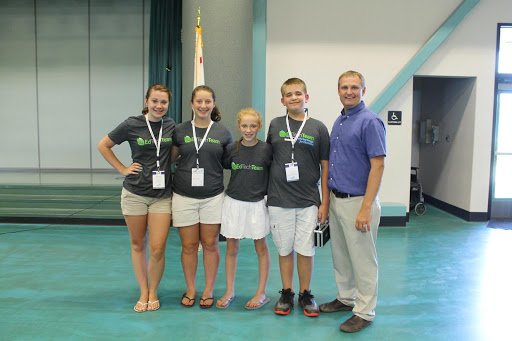
Kern Kelley with student presenters in Porterville, California
A presenter and tech professional development expert himself, Mr. Kelley moonlights as a speaker on a global level, something he has always incorporated with his students and career as an educator. What started out as taking students along to take part in his presentations has evolved into students presenting around the world.
Starting in 2012 on a train ride back from the New York Google Offices at a presentation with Mr. Kelley, the students came up with the idea of taking their skillset on the road more formally and the Tech Sherpas were born. Since then they have grown both in size and knowledge with every passing year and every advance in technology. Pre-COVID-19, the Tech Sherpas had traveled to places like Japan, Ottawa, Hawaii, Pennsylvania, and Chicago presenting to large audiences on topics like Google Slides, Google Meets, Google Classroom, and Flipgrid among others.
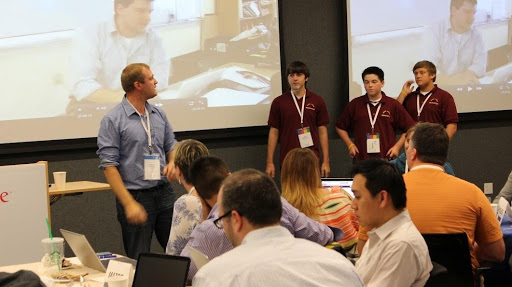
Kern Kelley presenting with Kris Redman Jared Gay and Chandler Cossar at the New York Google Offices in 2012
After the pandemic forced schools to adapt in the way that education is provided, Mr. Kelley and the Tech Sherpas didn’t miss a beat. What was once in-person presentations all over the world has now become a busy job of booking virtual meetings and presentations to keep up with the ever-changing needs of educators, students, people of all walks of life who need to learn, keep up with, and use technology in their everyday lives.
Nokomis High School Senior Rachel Wilcox has been a Tech Sherpa since she set foot in the Nokomis Warrior Broadcasting class her freshman year. Now a senior and finishing her final year of high school during a pandemic, Rachel is the project manager working behind the scenes to coordinate the Tech Sherpas’ virtual presentations.
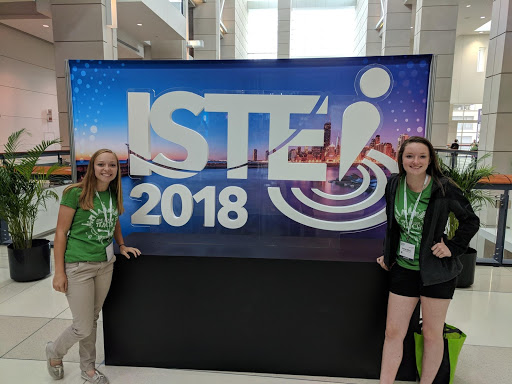
Rachel Wilcox and Britney Bubar presenting at ISTE in Chicago
“I like it,” said Rachel in a virtual interview. “I want to go to college for business management, so this is a good step in that direction,” she added. Rachel is in charge of organizing the Tech Sherpas into groups in terms of their readiness to present with the technology they feel most comfortable teaching others. She also works with outside organizations to schedule the presentations, lines up the students to present, coordinates the practice sessions, and participates in the actual event by doing a pre-event tech check, and helping to host the meeting. During the event, Rachel is usually working with a moderator who watches the meeting chat during the presentation, in addition to the presenters.
One of their most recent endeavors was a student-led presentation at the Virtual End of Summer Fest for the Google Waterloo Engineers. It was an opportunity for Google engineers to see creative uses of their tools by ‘real’ people. The topic was using Google Slides to Create Animations, like this one. The Tech Sherpas worked with EdTechTeam Canada for the event which featured the skills of Tech Sherpa, Kaiden Kelley who also happens to be Mr. Kelley’s son.
Kaiden Kelley presenting to Google Engineers
“When presenting, I’m there to share my skills with the teachers,” Kaiden said of his experiences presenting with the Tech Sherpas. In the event with Google engineers, he shared the skills, tips, and tricks that he learned from using Google Slides on various projects over the years. Be began working with the tool in 2012 and has experienced a myriad of changes and upgrades from Google that he has been able to navigate and use in his everyday work.
A pro at presenting, Kaiden said he doesn’t get nervous anymore during presentations and that the most memorable part of the presentation to Google was seeing everyone “come in” to the virtual meeting from all over the world. The successful presentation has led to further talks with Google Canada about more presentations by the Tech Sherpas.
“We are in a world now that everybody has experienced video conferencing,” said Mr. Kelley. “We will never again live in a world where that has not happened.” Mr. Kelley hopes to give his students as much experience as possible doing video conferencing knowing that when they graduate from high school they will need to be ready with skill sets that allow them to compete for jobs and post-secondary opportunities all over the country, and potentially enabling them to work and learn from right here in Maine.
While Mr. Kelley is excited about the incredible opportunities his students have experienced during the pandemic, he is quick to explain that using video conferencing is not necessarily better education for students, “it is a tool that we can use to keep providing opportunities for kids.”
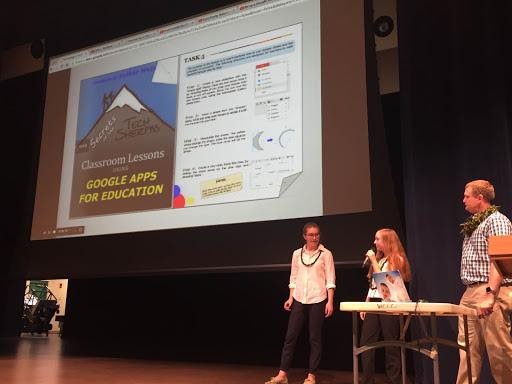
Austin Taylor and Brittney Bubar presenting at the Hawaii Island TechEd Conference
Other ongoing projects of the team include helping Mr. Kelley on professional learning opportunities for teachers in Maine. One is an opportunity for educators in any part of the State to explore distance learning tools for students and teachers with the help of the United Technologies Center Adult Education and the Tech Sherpas (Learn more about this opportunity here).
Another is a similar “adopt a teacher” project at Nokomis where the students help resident educators with any technology needs they may be having as they navigate hybrid and remote teaching this year. It not only helps boost technology opportunities for students at Nokomis, but also bolsters relationship building, presenting, and teaching skills for the students. Their hope is to expand on these efforts to expand these types of opportunities for students and teachers state-wide



 Maine DOE Newsroom