
The Gilder Lehrman Institute of American History is seeking nominations for the Maine History Teacher of the Year. State History Teachers of the Year receive $1,000, an archive of materials for their school’s library, and an invitation to attend a 2020 Gilder Lehrman Teacher Seminar. The deadline for 2020 nominations is March 31, 2020. Nominate someone online or check out their website for more information.
Category: News & Views
Free Training Available for Administration of State Assessment
In preparation for the 2020 Maine Educational Assessments (MEA) for Mathematics and English Language Arts/Literacy for grades 3-8 (eMPowerME) and 3rd year of high school assessment administration (SAT), the Department, in collaboration with Cognia, eMetric and College Board, will be holding half-day regional training sessions on the following dates:
· February 12th, 2020 in Orono, Black Bear Inn https://cvent.me/mqXAeX
· February 13th, 2020 in Portland, University of Southern Maine-Portland Campus https://cvent.me/mqXAeX
· February 13th, 2020 in Portland, University of Southern Maine-Portland Campus https://cvent.me/mqXAeX
- February 12th, 2020 in Orono
Morning sessions will include eMPowerME administration content, and afternoon sessions will include SAT administration content.
The intended audience for the sessions is District Assessment Coordinators (DACs), Technology Coordinators (ITCs), School Test Coordinators (STCs), and/or SAT Test Site and Services to Students with Disabilities (SSD) Coordinators.
1. Morning sessions (9:00 am -12:00 noon) will focus on Grades 3-8 Mathematics & ELA/Literacy (eMPowerME) online assessment.
The morning sessions are intended for Maine District Assessment Coordinators (DACs) and one other designated participant (such as Technology Coordinators or School Test Coordinators) with a limit of TWO registrants per district. Should additional space become available, districts will be notified and contacted in the order in which requests were received. Content includes: New Features for 2020 administration; Portal Overview; User Management; Kiosk Overview; and Live Demonstrations.
2. Afternoon sessions (1:00 pm -3:30 pm) will focus on 3rd year of High School Mathematics & ELA/Literacy (SAT) paper assessment.
The afternoon sessions are intended for Maine District Assessment Coordinators (DACs), high school SAT Test Center Supervisors and/or SAT SSD with a limit of THREE registrants per district. Content includes: Overview of SAT 2020 administration; Key Dates for Schools; Training for Coordinators; Materials Shipment Process.
- Laptops/computer devices are NOT required as during these training sessions you do not need to be logged into either the eMPowerME or SAT portals.
- If you are unable to attend one of the in-person trainings, a recording of the 2/13 training at USM Portland will be posted on the eMPowerME Help and Support Site https://maine.onlinehelp.cognia.org/training/
Additional questions regarding the training workshops can be directed to Nancy Godfrey, Assessment Coordinator at Nancy.Godfrey@maine.gov.
Important Reminder: Due Date Approaches for Quarter 2 (Q2) Attendance, Behavior, Bullying, and Truancy Data Review
The Department of Education offers quarterly windows for districts to review, for accuracy and comprehensiveness, the data that has been entered and reported to us. It is our hope that review of this data on a more regular basis will save district personnel time and work at the end of the year, and that it will provide time for analysis and to make any necessary corrections.
The certification period for Quarter 2 (Q2), which includes attendance, behavior, bullying, and truancy opens January 1st. Review and certification are required by January 15th. Superintendent certification is required for all quarterly reports.
Attendance data certification can be found here, and guidance on reporting attendance can be found here.
Behavior data certification can be found here, and guidance on reporting behavior can be found here.
Bullying data certification can be found here and guidance on reporting bullying can be found here.
Truancy data certification can be found here, and guidance on reporting truancy can be found here.
If you have difficulties navigating to Synergy or NEO, please call the Helpdesk at 624-6896 or email at medms.helpdesk@maine.gov
All due dates for reports are listed on the MDOE reporting calendar. All quarterly reports are based on the following months:
Quarter Two (Q2) – As of Jan 1 (to include Oct through Dec) – due Jan 15
Quarter Three (Q3) – As of April 1 (to include Jan through March) – due April 15
Quarter Four (Q4)– As of July 1 (to include Apr through June) – due July 15
Quarter One (Q1)– As of Oct 1 (to include July, August, Sept) – due Oct 15
Truancy Requirements and Reporting: FREE Q&A Webinar
In order to assist SAUs with their legislatively mandated student truancy data reporting, the Maine Department of Education Data and School and Student Supports Teams are jointly offering a free webinar to review the requirements, and answer questions from the field as they relate to the truancy reporting process. The webinar is strongly encouraged for those responsible for the compilation and entry of required student truancy data. The Truancy Q&A Webinar will be held on Wednesday, January 22nd from 10:00 am to 11:00am.
Webinar registration link:
https://attendee.gotowebinar.com/register/5230591621775051019
Truancy definitions and guidelines on reporting truancy can be found here.
Instructions on how to report incidents of truancy can be found here.
If you have any questions, comments or concerns in regards to this webinar, or in regards to how to enter incidents of truancy, please call the Helpdesk at 624-6896 or email at medms.helpdesk@maine.gov .
If you have any questions, comments or concerns in regards to what constitutes a reportable truancy incident, please call Gayle Erdheim at 624-6637 or email at Gayle.Erdheim@maine.gov .
Maine DOE Releases RFP for 21st Century Community Learning Centers Program
The Maine Department of Education is pleased to announce the release of a request for proposals (RFP) seeking bids from interested parties to implement comprehensive 21st Century Community Learning Centers (21st CCLC) programming in 2020-2021. It is anticipated that roughly $2M will be available to issue grant awards later this year.
Authorized under Title IV, Part B of the Elementary and Secondary Education Act, as amended by the Every Student Succeeds Act (ESSA) Act of 2015, the 21st CCLC program provides competitive grant funding to support before school, after school, and summer learning programs that focus on improving the academic performance of students in pre-Kindergarten through grade 12.
The primary purpose of Maine’s 21st CCLC program is to provide funding for school and community partnerships to establish or expand community learning center programs. These programs provide students in high-need, economically-disadvantaged communities with academic tutoring and enrichment opportunities designed to complement their school-day academic program. In addition, these programs can provide a broad array of additional support services related to overall student health and well-being.
Local 21st CCLC programs – which can be located in elementary schools, secondary schools or similarly accessible community facilities – provide high quality support services to students during non-school hours. As such, these programs also support working parents and families by providing safe, supportive learning environments for students at times when school is not in session.
The request for proposal (RFP), which includes information regarding eligibility, program requirements, and more, is available here . An informational webinar for this RFP will be posted to the Department’s on application website January 16, 2020. It is strongly recommended that interested parties view this presentation, in its entirety, prior to submitting a proposal for 21st CCLC program funding.
Below is the anticipated timeline for the Department’s current 21st CCLC grant competition:
| Date | Task |
| January 2, 2020 | RFP Released to Public |
| January 16, 2020 | Informational Webinar Posted Online |
| February 20, 2020 | Deadline for Submission of Questions in Response to RFP |
| March 3, 2020 | Interested Parties Submit Letter of Intent to Apply |
| April 2, 2020 | Proposal Deadline |
| April 2020 | Formal Peer Review of Proposals |
| May 2020 | Grant Award Notifications |
| July 1, 2020 | Grant Award Start Date |
Please be advised that the dates above are subject to change. Interested parties must consult the RFP document for the most accurate dates and deadlines regarding this opportunity.
For more information on the 21st Century Community Learning Centers (21st CCLC) Program, contact State Coordinator, Travis Doughty, at travis.w.doughty@maine.gov.
Unified Guidance regarding LD 1370
In the first session of the 129th legislature, LD 1370, An Act To Address Dangerous Behavior in the Classroom, was passed. In a collaborative effort to provide unified guidance to our profession and colleagues, the leaders of Maine Department of Education(DOE), Maine Education Association (MEA), Maine Principals Association(MPA),Maine School Superintendents Association and Maine School Board Association (MSSA/MSBA), and Maine Administrators of Services for Children with Disabilities(MADSEC) have met and reached consensus on the following:
Unified Guidance on LD1 370
- Dangerous Behavior – student behavior that presents a risk of injury or harm to others; this applies to all students, including those with 504 plans or IEPs.
- Procedure –
- A school employee reports behavior, invoking the process;
- Administrator/designee investigates the incident and reaches out to bargaining unit leadership, who will appoint an individual.
- The administrator/designee reviews report with the appointed staff person.
- If incident is substantiated as dangerous behavior, the administrator/designee consults with the staff member who was subjected to the behavior (if applicable) in the development of a response plan aimed at supporting safer behaviors. *If the plan is not in alignment with an existing 504 plan or IEP, the administrator/designee will provide the appropriate team with information from the consultation with impacted staff person. The team will consider appropriate revisions to the 504 plan or IEP, as needed.
- Staff Sick Leave –
- A physician’s note must verify that time out of work is necessary due to injury caused by substantiated dangerous behavior by a student.
- Paid leave will be provided without impacting the employee’s existing benefits.
- If the necessity of time out of work, due to injury caused by substantiated dangerous behavior of a student, cannot be verified by a physician’s note, paid leave will be adjusted accordingly.
We are grateful for the partnership and stewardship of these organizations.
Media Release: Ever Wonder How You Can Thank That Amazing Teacher? Nominate!
AUGUSTA – As part of the Maine Department of Education’s ongoing efforts to highlight Maine’s outstanding teachers, nominations are now open for the 2020 County Teachers of the Year and 2021 Teacher of the Year. Members of the public are encouraged to nominate educators who demonstrate a commitment to excellence and nurturing the achievement of all students.
Nominations can be made through the Maine Teacher of the Year Website starting today, January 3, 2020 and will be open through 5:00 pm on Feb. 3, 2020.
To be considered for the County and Maine Teacher of the Year award, a person must:
- Hold the appropriate professional certification for their position
- Be employed by a Maine public school
- Be actively teaching students at least 50% of full-time at the time of nomination and during the year of recognition
- Have been teaching for a minimum of five years – three of which are in Maine
- Remain teaching in the County for which they are selected during year of recognition
The 2020 County Teachers of the Year serve as advocates for teachers, students, and the efforts underway in Maine’s public schools to prepare students for success in college, career and civic life. In addition, County Teachers of the Year will serve as advisors to the Department of Education and to a regional group of students who comprise the Student Cabinet and Student Advisory. The 2020 County Teacher of the Year cohort will be recognized at an event at the Hall of Flags in Maine State Capitol and at an end of the year Teacher of the Year Gala. They will also receive on-going professional learning in addition to other state and county level leadership opportunities.
Maine’s recently named 2020 Teacher of the Year, Heather Whitaker, an Alternative Education teacher at Gorham Middle School was selected from over 300 entries and included recognition as the 2019 Cumberland County Teacher of the Year. In addition to Whitaker, the other 2020 state finalists include Robert Taylor, a Mathematics and Science teacher at Spruce Mountain Middle School and 2019 Franklin County Teacher of the Year, and Tom Gray a Social Studies, English, and Gifted and Talented teacher at Camden Hills Regional High School and the 2019 Knox County Teacher of the Year.
The 2021 Maine Teacher of the Year will be selected from the 16 county honorees. The field will be narrowed to eight semi-finalists, and then three state finalists before the Maine Teacher of the Year is announced by Maine’s Education Commissioner at a surprise school assembly in the fall.
On behalf of, and in partnership with Maine Department of Education, the Maine Teacher of the Year program is administered by Educate Maine, a business-led organization whose mission is to champion college, career readiness, and increased education attainment. Funding is provided by Bangor Savings Bank, Dead River Co., Geiger, Hannaford, the Maine Lottery, and Unum, with support from the State Board of Education and the Maine State Teacher of the Year Association.
Through the generous support of Maine businesses, there is no cost to the local district when the Teacher of the Year is out of the classroom on their official duties, which includes travel throughout the state and nation, a week at NASA Space Camp, and a visit to the White House.
For more information about the Maine Teacher of the Year program, visit the Maine Teacher of the Year website.
Student Cabinet Meets with Commissioner Makin to Discuss Education in Maine
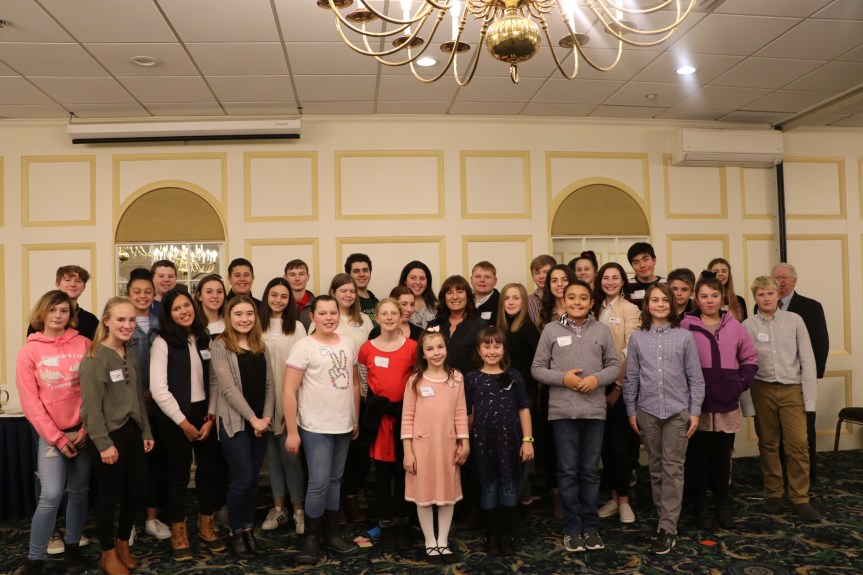
Students from across Maine met with Maine Department of Education (DOE) Commissioner Pender Makin in Augusta for an all-day summit on December 20th. The students were each selected from a pool of nearly 300 applicants to be part of the Maine Department of Education’s first Student Cabinet. The 12/20 meeting was the first of four meetings to take place this school year.
The Maine DOE and the Maine State Board of Education, with special help from the Board’s two student representatives, Jaylee Rice and Casey Maddock put together the Student Cabinet as a way to include student voice in decision making at the state level. The Cabinet is made up of students from all 16 counties in Maine in grades 4th through 1st year of college, who were selected based on their thoughtful responses on the application distributed to the public by the Maine DOE this past fall.
During the day-long meeting, students had the opportunity to connect with one another through team-building activities, along with values-based activities to help them identify the importance of their own values and that of others, including the populations they represent. The bulk of the work was done in the second half of the day, as students worked in like-age groups to categorize important topics in education for the Commissioner to be aware of, topics for discussion, and topics to act on.


The day ended with a round table discussion about the topics discussed within each of the groups. From the master list of topics, the students each got the opportunity to vote on the topics they felt were the most important to explore further as a group. Addressing issues of mental health and trauma for students, ensuring inclusive and welcoming schools for all, and ensuring equitable opportunities for all Maine students were goals the group identified as most important.


Three additional follow up meetings are being planned for the winter and spring, in addition to an online discussion board where student cabinet members will have the opportunity to engage with one another and invite other students from their region to join in county level discussions.
Maine DOE Student Cabinet Members:
| Name | County |
| Klara | Androscoggin |
| Cadence | Androscoggin |
| Nicholas | Aroostook |
| Damon | Aroostook |
| Fiona | Cumberland |
| Leela | Cumberland |
| Katelyn | Cumberland |
| Josh | Cumberland |
| Monica | Franklin |
| Mackenzie | Franklin |
| Sarah | Hancock |
| Avahnnah | Hancock |
| Rhayna | Kennebec |
| Cecilia | Kennebec |
| Emmett | Knox |
| Isaiah | Knox |
| Emma | Lincoln |
| Zaid | Lincoln |
| Alexi | Oxford |
| Connor | Oxford |
| Maya | Penobscot |
| Sam | Penobscot |
| Brooke | Piscataquis |
| Isabel | Sagadahoc |
| Madison | Sagadahoc |
| Savea | Somerset |
| Annabelle | Somerset |
| Gaby | Waldo |
| Stephanie | Waldo |
| Matthew | Washington |
| Sarah | York |
| William | York |
Get to know the DOE Team: Meet Pam Ford-Taylor

What are your roles with DOE?
I am the DOE School Enrollment Specialist for K-12. This includes approving public and private schools, managing home instruction, coordinating Commissioner waivers and Superintendent agreement appeals, and conducting policy and analysis work related to student enrollment and eligibility.
What do you like best about your job?
Everything! I was a university system employee for years (I loved that too). It’s great to be part of the executive branch of government where we get to share the privilege of shaping education for all of our children and youth. I also appreciate so much all of the excellent, dedicated and collaborative colleagues in the Department.
How or why did you decide on this career?
I’ll answer by sharing a favorite statute, from § 5001-A(7): “Compulsory education is essential to the preservation of the rights and liberties of the people and the continued prosperity of our society and our nation. Maintaining regular student attendance is necessary to achieve the goal of an educated citizenry.”
What do you like to do outside of work for fun?
Hike the woods and fields with my cattle dog, Nancy; spend time with my husband and children camping (or doing anything); global travel; read; cook. I have a first grandchild too, very sweet!
WIDA Early Years Online Learning Modules (to Support Multilingual Children) Available at No Cost to Teachers and Administrators
The Maine Department of Education would like to remind Maine’s early care and education community that they are able to access to the WIDA Early Years online learning modules. These modules focus on supporting young multilingual children, ages 2.5 to 5.5 years and are available at no cost to teachers and administrators. Multilingual children, commonly referred to as dual language learners, are children who are developing more than one language.
Each self-paced, interactive module provides opportunities for reflection and offers suggestions for applying content to local practice. The following modules are available:
- Dual Language Learners and their Families
- WIDA Early English Language Development Standards Framework
- Dual Language Learners with Disabilities
- Scaffolding Language Learning
- Promising Practices
A description of each module, frequently asked questions, and instructions for creating a user account and registering for the modules can be found in the documents listed below:
- WIDA Early Years Online Learning Modules
- WIDA Early Years Online Modules: Frequently Asked Questions
- Online Modules: Instructions for Creating User Accounts and Registering
Access the modules: WIDA Early Years online modules (visit and create your user account)
If you are a program leader, administrator, trainer, or coach, we hope you will utilize these modules as a resource to support the professional learning needs of those serving multilingual children. The modules can be used in staff development sessions and/or shared with individual educators or teams of educators, such as professional learning communities.
Contact hours are available upon completion of a module. To receive a contact hours certificate, please download the certificate of completion generated by the WIDA Early Years online system and email it to april.perkins@maine.gov.
Additionally, the Department has purchased a set of WIDA Early Years Promising Practices Implementation Kits to assist districts in refining their programs for young multilingual children. These kits serve as a program self-evaluation tool, highlighting several evidence-based, highly effective strategies for supporting children’s development of multiple languages. Several districts with a significant number of dual language learners will receive these kits. A district that does not receive its own kit may request to borrow one from the Maine Department of Education.
WIDA Early Years resources have been provided to Maine educators through Title III, CDS, Head Start and public pre-k funds.
If you have any questions about these resources, or to request to borrow a WIDA Early Years Promising Practices Implementation Kit, please contact Maine DOE Director of ESOL/Bilingual Programs & Title III April Perkins at april.perkins@maine.gov or (207)624-6627.
 Maine DOE Newsroom