
In an effort to increase high quality CTE programs, Maine needs your input. The Maine Department of Education-Career and Technical Education Team has posted the proposed performance indicators for public comment as part of the Strengthening Career and Technical Education for the 21st Century Act(Perkins V). The performance indicators, referenced as Perkins V Accountability Measures, can be found on the DOE-CTE web site as well as a survey to allow for feedback. These will be posted for 60 days to allow for public comment, after which recommendations will be reviewed by the CTE Team. For more information, contact Dwight Littlefield at dwight.littlefield@maine.gov.
Category: News & Views
Opportunities to Lead and Participate In the 17th Annual MLTI Student Conference
Each year, the Department of Education’s Maine Learning Technology Initiative (MLTI) hosts the MLTI Student Conference. Over 1000 students and their teachers gather to engage in a day of learning and creating with technology. This year the event will be held at the University of Maine in Orono on Thursday, May 21st, 2020 from 8:30am – 3pm. Details about opportunities to lead and participate in the day are below.
Last year, the Department received a significant amount of positive feedback regarding the new registration process. Educators said that knowing which sessions their students were going to ahead of time reduced uncertainty related to whether sessions would fill, the shuffling of chaperones, and how to prepare student devices for full participation in the session. They also really appreciated having name tags printed with all the session choices for each student. However, there was some feedback that the pressure to sort out student choices before registration filled created some frustration. We have worked to space out the registration process a bit more this year and hope you will mark the following dates on your calendar!
- January 27th, 2020: Session descriptions posted
- (Time to check in with students)
- March 2nd, 2020: Registration open (up to 40 students per school)
- March 30th, 2020: Registration open for schools that want to add additional students (beyond the 40).
- Larger schools typically have developed a process to select the 40 students who are able to be registered in the first round (student leadership, fundraising, etc.). We encourage you to think about this now!
- April 10th, 2020: Last day to register
- April 14th, 2020: Final lists sent to schools for review
- April 17th, 2020: Last day to make changes to registration
- April 20th, 2020: File with T-shirt order and nametags sent to UMaine.
- While you can substitute students after this date, we will ask that they take the nametag and t-shirt of the student they are replacing. Late registration may be possible if there is space, though we can’t guarantee a personalized name tag and t-shirt.
Teacher Leaders
Applications Due Tuesday, October 22nd, 2019
Link to Application: http://bit.ly/MLTI-sc-2020-teacher-app
Teacher Leaders will:
- select the conference theme,
- develop/lead UBER Session,
- select session proposals, a -shirt winner, and student band(s)
- setup before the conference, lead/facilitate during the day, and clean up after the event
Teacher Leaders will meet virtually ten (10) times and will need to have four (4) days outside of the classroom. Dates are below. Teacher leaders will receive travel reimbursement (mileage and hotel) and meals when they gather in person. They will also be eligible to earn up to 45 contact hours for their participation throughout the year.
- Virtual Meetings on Wednesdays 3-4:30pm: 10/30, 12/18, 1/8, 1/22, 2/5, 2/26, 3/25, 4/8, 4/29, 5/13
- All Day Meetings: Friday, December 6th, 2019 and Friday, March 13th, 2020 (location TBD)
- Conference Setup: Wednesday, May 20th, 2019 (University of Maine in Orono)
- Conference Leadership: Thursday, May 21st, 2020 (University of Maine in Orono)
Sessions will be one-hour long, must involve some form of creating, making, and doing, and should leave participants excited about what they learned and eager to share their experiences with others. Presentations that incorporate students as leaders or co-leaders with educators will be given priority!
Important Dates
- Monday, November 4th, 2019 – Call for Proposals open and theme announced
- Tuesday, January 7th, 2020 – Proposals due
- Monday, January 13th, 2020 – Sessions selected
- Friday, January 17th, 2020 – Sessions confirmed by presenters
- Monday, January 27th, 2020 – Sessions posted
Spread the word – if you know of someone doing fantastic work involving technology with making, doing, or storytelling please encourage them to submit a proposal or send an email with suggestions to MLTI.Project@maine.gov!
MLTI T-Shirt Design Competition
We encourage all students to submit designs to the MLTI T-shirt Design Competition. A panel of teacher leaders will narrow the list to five possible options and then will encourage other students to vote to pick the winner. Up to twenty (20) student artists will also win free registration to the conference.
Eligibility requirements, submission guidelines, and judging criteria will be posted on the DOE website in November.
Important Dates
- Monday, November 4th, 2019 – Competition begins
- Monday, February 24th, 2020 – T-shirt designs due
- Monday, March 2nd, 2020 – T-shirt voting begins (with registration)
- Friday, April 10th, 2020 – T-shirt winner announced
Musical Performance Opportunities
We will be looking for students to perform the National Anthem as well as music during other parts of the day—such as the UBER Session. More information will be available in November!
Important Dates
- Monday, November 4th, 2019 – Call open and theme announced.
- Monday, February 24th, 2020 – Applications due
- Friday, April 10th, 2020—Schools notified of application status.
Transportation
We encourage you to start planning for conference transportation soon and to consider sharing buses with other attending schools. If you need assistance with this, please contact MLTI.Project@maine.gov
For more information or answers to questions, please contact MLTI.Project@maine.gov or visit the MLTI Student Conference website.
PRIORITY NOTICE: Proposed Revisions for Rule Chapter 180 (Educator Effectiveness Rules); Hearing on October 28, 2019
The Department is proposing revisions to Rule Chapter 180: Performance Evaluation and Professional Growth Systems to reflect recent statutory changes and feedback from conceptual conversations.
This proposed rulemaking provides a sunset for Section 7, Student Learning and Growth Measures, which are no longer a requirement. School administrative units will have flexibility in developing multiple measures on the local level. Section 13, subsection 3 has been revised to reflect, “A majority of the steering committee members must be teachers and must be chosen by the local representative of the applicable collective bargaining unit if the teachers in the school administrative unit are covered by a collective bargaining agreement.” Redundant and unnecessary language has been deleted.
The Department will be developing guidance to be available on the PEPG General Resources web page.
Find the details for proposed changes for Rule Chapter 180 on the Maine DOE Proposed Rule & Rule Changes webpage (proposed rules are listed in order by rule number).
Public Hearing Information for Rule Chapter 180:
October 28, 2019 from 10:00am- 11:30am
Room 500 in the Cross State Office Building, 111 Sewall Street, Augusta, Maine
All are welcome to attend and no RSVP is required. Anyone unable to attend the public hearing may send written comments.
Comment Period Deadline: November 22, 2019
Comments can be submitted to Jaci Holmes at jaci.holmes@maine.gov
PRIORITY NOTICE: Proposed Revisions for Rule Chapter 40; Hearing on October 28, 2019
The Department is proposing revisions to Rule Chapter 40: Medication Administration in Schools to reflect recent statutory changes.
This rule provides directions to public and private schools approved pursuant to 20-A MRSA §2902 in the administration of medication within schools. It is to assist school administrative units in implementing the provision of the medication statute [20-MRSA §254(5)(A-D)] that provides direction for training of unlicensed school personnel in the administration of medication, requires that students be allowed to carry and self-administer prescribed emergency medications; specifically, asthma inhalers or epinephrine auto-injectors with health care provider approval and school nurse assessment demonstrating competency and authorizes any student who attends public school to possess and use topical sunscreen product while on school property or at a school-sponsored event without a note or prescription from a health care provider if the product is regulated by the federal Food and Drug Administration for over-the-counter use for the purpose of limiting skin damage from ultraviolet radiation. In addition, refinements have been made to the proposed rule related to medications related to the care of students with insulin dependent diabetes.
Find the details for proposed changes for Rule Chapter 40 on the Maine DOE Proposed Rule & Rule Changes webpage (proposed rules are listed in order by rule number).
Public Hearing Information for Rule Chapter 40:
October 28, 2019 from 1:00pm- 2:30pm
Room 500 in the Cross State Office Building, 111 Sewall Street, Augusta, Maine
All are welcome to attend and no RSVP is required. Anyone unable to attend the public hearing may send written comments.
Comment Period Deadline: November 22, 2019
Comments can be submitted to Jaci Holmes at jaci.holmes@maine.gov
Maine Officially Launches Harvest of the Month Program
The Maine Department of Education’s Child Nutrition Program is excited to announce the official launch of Maine’s Harvest of the Month (HOM) Program. The program was piloted in schools in Spring 2019 with participation from over 165 schools state-wide. The full roll out of the program begins this fall for School Year 2020.
PROGRAM BACKGROUND
Harvest of the Month (HOM) is a nationwide marketing campaign promoting the use of seasonally available, local products in schools, institutions, and communities. Each month, a different local product is highlighted and participating entities pledge to serve the product and promote it through educational materials and activities. The program launched in California and has been replicated by dozens of other states across the country. With Maine’s participation, all New England states now have Harvest of the Month programs.
FARMERS AND LOCAL PRODUCERS
One of the major goals of the Maine HOM program is to support Maine farmers and producers, and therefore Maine’s local economy. To help School Food Service Directors successfully source each month’s product, a list of participating producers has been created to help them connect with local farmers, providers, and distributors. Farmers and producers who provide HOM products to schools have the chance to be highlighted on the DOE website, HOM social media, etc. We would like to add more producers to the list for School Year 2020!
SCHOOL FOOD SERVICE
Participating School Food Service Directors are asked to take a pledge to serve the monthly HOM product at least two times per month in their cafeterias. In addition to this, they pledge to display HOM promotional materials, such as posters, fun facts, and stickers for students who have tried the HOM product. Featured recipes are also provided each month. They also agree to participate in evaluations so that local produce procurement can be tracked and to analyze the success of the program. Local products may be sourced directly from farms, farmer cooperatives, and distributors. When buying produce directly from a farm or farmer cooperative, School Food Service Directors may take advantage of the Local Produce Fund, which reimburses $1 for every $3 spent on local produce.
Agriculture and Education in Partnership
The Maine Department of Education and Maine Department of Agriculture, Conservation and Forestry have been exploring more ways to connect farmers and food producers with their local school districts. “School food service programs and local farms can go hand and hand, which is why the Maine Bureau of Agriculture, Conservation and Forestry is pleased to collaborate with DOE’s Harvest of the Month program,” according to Nancy McBrady, Director of the Bureau of Agriculture, Food, and Rural Resources. “This program allows participating schools to purchase local, nutritious foods which helps boost farm incomes while educating students about local agriculture. The program directly links School Food Service Directors with participating farmers and producers in their community and the Bureau is thrilled that the Local Produce Fund can assist School Food Service Directors in ordering even more local produce. The Bureau encourages local producers to sign up to be a Harvest of the Month source for schools today!”
IF YOU ARE INTERESTED IN BEING A HOM SOURCE FOR SCHOOLS,
CONTACT:
Robin Kerber
Farm and Sea to School Coordinator
robin.kerber@maine.gov
OR SIGN UP HERE ( www.maine.gov/doe/harvestofthemonth/producers)
Maine Schools Join Others Around The Nation to Recognize National School Bus Safety Week October 21-25
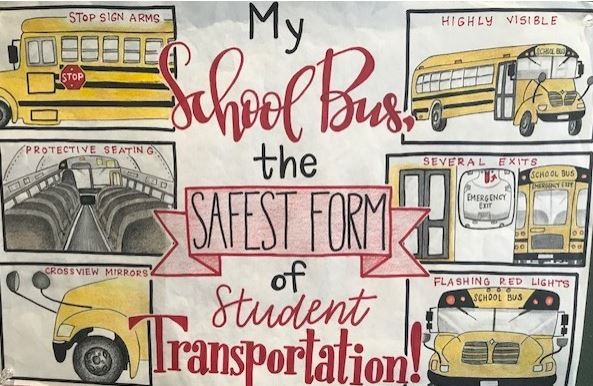
National School Bus Safety Week, scheduled October 21-25 this year, is a public education program that promotes school bus safety.
Nationally, each day about 480,000 school buses travel the nation’s roads transporting about 25,000,000 students to and from schools and school-related activities. This makes school buses the largest mass transportation program in the nation.
2019 National School Bus Safety Week theme: “My School Bus, The Safest Form of Student Transportation!” The theme is derived from the Poster contest the year before. The 2018 winning poster, depicted above, was drawn by Shivangi Ojha, an 8th Grader at Belton ISD in Temple, Texas.
In Maine, there are about 3,000 school buses traveling about 30,000,000 miles per year and delivering about 140,000 students. While national ridership of school buses is about fifty percent, about eighty percent of Maine students ride the school bus. Local school transportation teams throughout Maine will educate the public about school bus safety and local transportation safety training during National School Bus Safety Week.
Transportation is a great equalizer in education, providing students from all economic backgrounds with the opportunity to learn and succeed. Additionally, as pointed out by the National Highway Traffic Safety Administration U.S. Department of Transportation, “School buses are by far the safest way for children to get to and from school.”
School buses are specifically designed and engineered for safety in order to protect occupants against crashes and incidents on the road. Nearly every part of a school bus has higher standards of safety when compared to ordinary cars. The following school bus safety features are not found on any other passenger vehicle:
- School bus seats are above the crash line so that the impact of a vehicle colliding with a school bus hits beneath the seated passengers
- Passenger seating and crash protection are required for school bus seating systems
- A steel cage around the fuel tank that provides bus fuel system integrity
- Emergency exits are provided by way of doors, windows and roof hatches
- Bus body joint strength that specifies the minimum strength of the joints between panels of the bus body and the body structure
- Rollover protection that specifies the minimum structural strength of buses in rollover-type crashes
More information about National School Bus Safety Week can be found here: https://www.napt.org/nsbsw
For information about school transportation policy, contact Transportation and Facilities Administrator Pat Hinckley at pat.hinckley@maine.gov
The National School Bus Safety Week public education program is sponsored by the National Association of State Directors of Pupil Transportation Services (NASDPTS), National School Transportation Association (NSTA), National Association for Pupil Transportation (NAPT), Pupil Transportation Safety Institute (PTSI) and school bus manufacturers and suppliers.
Carrie Ricker Elementary School Integrates Culture into the Curriculum

As a new addition to the community and to the school, Principal Dani Finn noticed that the students at Carrie Ricker Elementary were curious about her and her background. Being a native of the Hawaiian Islands, she was eager to share her culture and experiences outside of Maine with the students, and has found that they were just as eager to learn.
Principal Finn has since begun a “Cultural Competencies Series” which brings speakers with a wide variety of cultural backgrounds to the school to talk with students about where they are from and how that is both similar and different from the traditions found here in Maine and in the United States.
Drawing from the diverse pool of backgrounds of the various people who live right here in Maine, in the communities surrounding the Litchfield area and beyond, Principal Finn is able to welcome many folks to her school, presenting new and rich learning opportunities to the students.

On September 26th, Hawo Abdille, Lewiston Public Schools English Language Learner (ELL) Intake Coordinator visited Carrie Ricker Elementary School to talk with 3rd graders and share her knowledge, upbringing, culture, and experiences as a native of Somalia.
As up-beat music played through the loud speakers, about seventy-five 3rd graders filed into the multi-purpose room, greeted by a wide-smiling Howa, bopping to the music and saying hello to each of the students as they took their seats. Howa was playing a video of people doing a traditional dance at a Somali wedding. She started by introducing herself and where she was from, providing a little bit of background about herself and how she moved from Somalia to the United States at the age of nine, eventually settling into the Lewiston area with her family.
First showing the students where Somalia is located on a map, Howa also shared that, like here in the U.S., people in Somalia celebrate many different holidays both religious and cultural, and have other unique customs that they treasure and look forward to. She covered a broad range of topics, everything from the way people dress to what they eat, a popular topic among the students! Students were excitedly raising their hands to ask her more and more questions.

“Does it snow in Somalia?” One student inquired. “Do you celebrate New Year’s Eve in Somalia?” Another student asked.
The patient and experienced Howa answered as many questions as she could while also carrying on with her presentation. Howa is an alumna of Lewiston Public Schools, and now proudly serves the students and families who move to the Lewiston area as they transition into the community and enroll their children in school.
 As the 30-minute presentation came to a close, the students didn’t seem to fall short of yet more questions for Howa. Principal Finn asked them, “Do we want to invite Howa to come back again?” A question to which the students replied with a resounding, “YES!” Happy to oblige their invitation, Howa promised to bring Somalian food next time she comes.
In talking with Principal Finn briefly after the presentation and before she had to rush off to dismiss students for the day, she excitedly shared her success with the Cultural Competencies Series, adding that she was lucky to have the full support of her Superintendent Andrew Carlton and has been collaborating with RSU 4 Director of Curriculum, Assessment, & Instruction Kathy Martin to help integrate further cultural learning opportunities into the curriculum in multiple content areas. The series is meant to provide students with a starting point to a world of culture, knowledge, and experiences beyond their classroom walls.
Principal Finn has plans to bring a broad range of cultural speakers in to talk with all grade levels, all year long and going forward for as long as she can keep students engaged and find speakers willing to participate.
In seeing how incredibly interested and excited the students were to meet Howa, it seems like the Cultural Competencies Series could be the start of a long-standing tradition at Carrie Ricker Elementary School.
This article was written by Maine DOE staff member Rachel Paling in collaboration with Carrie Ricker Elementary School. If you would like to invite the Department to your school to write an article, or if you would like to send along a good news item for the Maine DOE Newsroom email Rachel at rachel.paling@maine.gov.
Old Town Elementary School Celebrates School Garden

Information for this article was submitted by Jeanna Tuell, Principal of Old Town Elementary School.
Old Town Elementary School has developed a beautiful and effective school gardens that students and teachers alike can use as a space to learn, grow, and experience the outdoors.
Described as an outdoor learning classroom, for several years the students have planted and harvested food to give to their school community. In addition, the students have the benefit of using the space as an outdoor environment to explore and experience a variety of other topics.


In September, the School hosted a garden party for their students and families. Families were able to take a tour of the garden, harvest some of the vegetables, and have a wonderful Saturday pressing apples and tasting new recipes.


MLTI Bridge Year
The Maine Department of Education, through the Maine Learning Technology Initiative (MLTI), has been providing 7th and 8th grade students and teachers access to, and support for, educational technology since 2002. While the goal has remained constant – provide State support for access to technology-enhanced education experiences for all students – the program has changed in many ways and will continue to grow and evolve in the future. The Department remains committed to this goal.
As many school administrative units (SAUs) are aware, the final contracts for the existing MLTI program are set to expire on June 30, 2020. During the 2020-2021 academic year, the Department has designed a “bridge year,” to provide support for devices, infrastructure, and professional learning while we continue to work with stakeholders to design what is the next phase of the MLTI program. With the support of the 129th legislature, the Department has designed the bridge year to mitigate and minimize disruption to SAUs. The details of the bridge year are the following:
- The Department will purchase all of the MLTI devices at the end of the lease.
- The Department will transfer ownership to SAUs in cohort 4 (lease begun in 2016) for 7th & 8th grade and staff devices in July 2020. JAMF licenses on these devices will continue at no charge to SAUs through June 30, 2021. Systems Engineering will continue to support the WiFi infrastructure of 7th and 8th grade classrooms during the bridge year.
- SAUs who are currently leasing additional devices (elementary or high school student and staff devices) from the Department will have the option to buy out their devices from the Department at the 2015 rates, $28/ iPad and $48/ laptop in July 2020. JAMF licenses will be available on these devices for the cost of $6/ iOS device and $12/MacOS.
- No new grants will be awarded during the 2020-2021 academic year.
- The Department will provide statewide and regional professional learning,
- The Department will host the MLTI student conference in May 2021.
Over the past several months, the Department has hosted “Think Tank” conversations regionally around the state to reflect on the past 17 years of the MLTI program and envision innovative ideas about the possibilities for the next 20 years of the program. We will continue to use the additional time afforded by the “bridge year” to meet with stakeholders throughout the state. Discussions will include topics such as portable computer devices, device management and deployment, software, wireless networking, technical support, and professional development, as well as financial models to support these efforts. The Department will also convene a workgroup to synthesize this information and help to create a plan for the state.
Below is the estimated timeline for MLTI through 2021.
- June 2019 – August 2020: The Department holds meetings with stakeholders regarding the future of MLTI (post SY 2020-2021) and convenes a workgroup to develop a State plan
- July 2020 – June 30, 2021: Bridge Year
- October 2020: The Department announces plan for MLTI post SY 2020-2021 (including the release of any necessary RFPs)
- July 2021: launch of MLTI 2.0
For more information about the Maine Learning Technology Initiative, contact Beth Lambert, beth.lambert@maine.gov, 207-624-6642.
WCC Educator Profile: Lewis Collins

Washington County Consortium (WCC): Washington County Educator Profile, submitted by Sarah Woog, Executive Director of the WCC.
Meet Lewis Collins, Superintendent of Moosabec CSD and Union 103
Moosabec CSD and Union 103 is a school district in Washington County nestled in the coastal communities of Jonesport and Beal Island. It includes Jonesport-Beals High School, Jonesport Elementary School, and Beals Elementary School. The district is a relatively small district, one familiar to many of us, with generations of pride in its schools, combined classrooms, contract disputes, packed gyms for basketball games, and a part time superintendent. These characteristics represent significant strengths and challenges, and Lewis (Lew) Collins is excited to leverage the strengths of the district to meet the challenges of a small rural district in Maine.
Lew started as Superintendent of Moosabec CSD and Union 103 in July of this year, and shortly began listening to the staff at the schools and community members he signed on to serve. He sees listening as one of the most important things he can do this year, and recognizes that the voice and values of the people in the district will help him determine how to best support them and increase student outcomes. Lew plans to spend much of his time this year “going into schools, getting diverse perspectives, listening to staff and teachers.” So far, he likes what he’s hearing and said the district’s greatest strengths are “first, its kids; and next, its staff, who are completely dedicated to student success.”
Complete dedication to student success has been a hallmark of Lew’s long career in education. He began his career in Camden, NJ, where he was a teacher at an alternative education school for adjudicated youth. He’s proud of the on-the-job training the school provided, and the work-study with pay opportunities the students were able to take advantage of. The school, and Lew’s work within it, supported students in discovering, defining, and pursuing their own paths to success, paths that took them off the troubled roads they had already traversed, and supported them on a journey toward meaningful and fulfilling lives.
This theme of supporting students in finding fulfillment and success determined by their own passions and values is one with which many educators in Washington County can relate. This theme is evident in the current work being done to expand Career and Technical Education opportunities, and is pervasive in all of our schools. We all know the lobsterman’s daughter who takes a half day work-study her senior year to work on the boat, or the third-grader who designs a four-wheeler for his lego-engineering project. In fact, in Lew’s own district, students at Beals Elementary learn science by posing hypotheses and designing experiments in their own backyards, working with the Downeast Institute (DEI) to address the green crab problem, or to determine the best conditions under which mussels may thrive.
Lew is continuing his listening tour of his district. It’s important work. He is excited to see how his “understanding of the needs of his district translates into success for kids.” I have a sneaking suspicion he’ll find the needs and values that surface are already familiar to him, are harmonious with his own values and experiences, and provide a rich foundation for inspiring and supporting student success. And Lew, as you listen to the folks in Washington County you are here to support and serve, I hope one message is loud and clear: Welcome. It’s good to have you.
 Maine DOE Newsroom