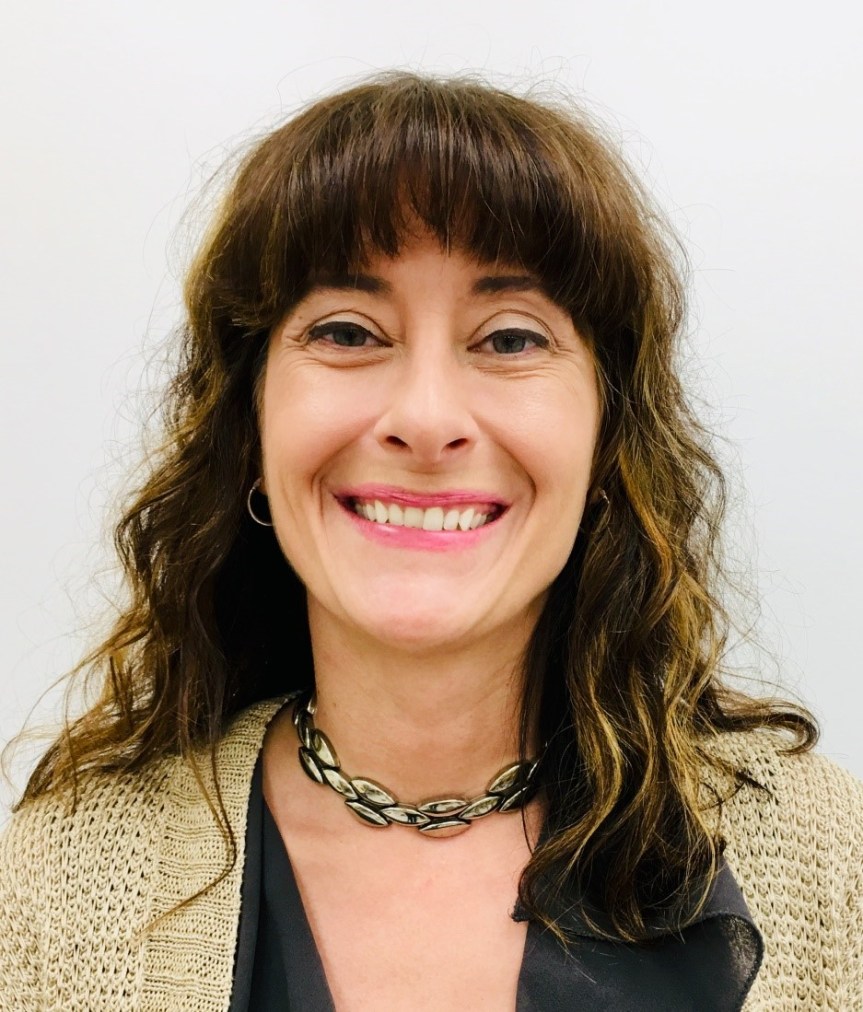
Employee of the Week: Susan Berry

Maine DOE Health Education and Health Promotion Coordinator Susan Berry is being highlighted this week as the Maine DOE’s Employee of the Week! Learn a little more about Susan in this brief question and answer:

What are your roles with DOE?

I provide statewide leadership and guidance in school health education and healthy school environment policies, best practices, programs, and professional development to school districts, health education teachers, physical education teachers when needed, and other school personnel who address health related issues. This includes technical assistance in the design, development and delivery of quality comprehensive school health education curriculum, instruction and assessment for PreK through diploma.

I provide leadership, professional development, and technical assistance to school districts on schoolsite health promotion and wellness for staff and students to develop, support and/or enhance healthier lifestyles and learning environments.

I provide Maine schools, administrators, school board members, educators, staff, and communities with guidance, technical assistance, information and resources on school health and health education related laws and policies that assist in the prevention of unhealthy and risky behaviors and promotes health enhancing practices.

I coordinate and collaborate with the Maine Center for Disease Control and Prevention (CDC) and other state and non-governmental organizations to support local school districts in implementing health promoting policies, programs and best practices including, but not limited to staff and student wellness; prevention of and education around suicide, substance use and tobacco, child sexual abuse and physical activity, nutrition, and obesity/overweight

I provide leadership and knowledge on school and student health, and health education related topics to inform the legislative process and implement new laws including

What do you like best about your job?

I enjoy delivering professional development to teachers and school personnel that expands best practices in health education, health promotion and prevention of risky behaviors among children, adolescents, and school personnel. I like developing and assisting in the implementation of laws, policies, and programs that protect and enhance health, reduce risky behaviors, and promote healthy practices.

How or why did you decide on this career?

I chose to work in health education because as a young adult I observed people engaging is risky behaviors and learned that prevention through health education knowledge and skill development can enhance and/or save lives.

What do you like to do outside of work for fun?

I enjoy sewing, building flower gardens, playing with my grandchildren, and I’m looking forward to enjoying my new camper with my husband and adult children!

Portland Public Schools’ Casco Bay High School Wins ‘Schools of Opportunity’ Gold

Submitted by Tess Nacelewicz, Communications Coordinator, Portland Public Schools

The Portland Public Schools’ Casco Bay High School (CBHS) is one of only seven schools from across the country this year to receive recognition as a “School of Opportunity.” The designation honors excellent public high schools that engage in research-based practices that build on students’ strengths and create rich, challenging learning opportunities for all students.

The recognitions are given in “silver” and “gold” categories. CBHS has been awarded the top honor: a 2018-2019 Gold Recognition. CBHS held a school assembly last month to inform the school community and celebrate.

After an extensive application review and culminating site visit, a team from the Schools of Opportunity high school recognition program reported to Casco Bay officials that they were “particularly impressed with the broad and rich learning opportunities that Casco Bay offers all students, and the myriad ways you extend students’ learning options through authentic, community-focused activities, meaningful assessments of students’ understanding, and relevant, inquiry-based professional development for your staff.”

Casco Bay Principal Derek Pierce said, “I am beyond proud to work in a community of teens and adults that’s committed to finding, supporting and growing the greatness in each of us, while also harnessing our collective power and voices to narrow the gap between the world we have and the world we need.”

Portland Superintendent Xavier Botana said, “Our Portland Promise talks about the importance of reducing the opportunity gaps that some of our students experience, as a way of helping all of our students achieve their potential. Casco Bay High School was conceived on this idea. I am grateful, but not surprised, that Casco Bay has been selected as Maine’s first ever School of Opportunity. Every day, Casco Bay’s staff works to help every student to aspire to and follow the roadmap to their greatest self. Congratulations, Casco Bay High School! All of Portland’s public schools join you in celebrating this accomplishment.”

Casco Bay and the six other 2018-2019 recipients, join 45 other public high schools that are part of the Schools of Opportunity network, an initiative of the National Education Policy Center (NEPC), based at the University of Colorado Boulder.

The NEPC started the Schools of Opportunity recognition program to honor public high schools in the United States. Test scores are NOT part of the rigorous application process, which includes in-depth narratives, supporting documentation of practices, and site visits.

Instead of test scores, the designation’s criteria draw upon the principles of “Closing the Opportunity Gap,” a 2013 book jointly edited by Prudence Carter, who is the dean of the University of California, Berkeley, Graduate School of Education, along with NEPC’s director Kevin Welner. The book describes research-based policies and practices with the potential to increase students’ opportunities to learn and thrive in school.

Project manager, Dr. Adam York, reports, “These schools have each demonstrated, with ample evidence, deep care and commitment to their students through equitable learning opportunities and strong positive school cultures.”

In recognizing seven new “Schools of Opportunity,” NEPC is calling attention to the kinds of approaches that can and do increase learning opportunities.

Here’s a summary of the types of opportunities the NEPC found at Casco Bay that benefit learning for all students:

Casco Bay High School’s overall educational philosophy focuses on flexible learning time to support learning expeditions that incorporate field work, culminations, week-long intensives twice a year, outside speakers, “weekly exceeds” reading and math for students to seek structured challenge beyond the core curriculum, crew meeting, and annual transformative learning experiences (Freshmen Quest, Sophomore Solo, Junior Journey, and Senior Quest).

Students have multiple expedition opportunities and a rich interdisciplinary program of project-based learning. Each year culminates in multiple exhibitions, with students sharing their work with each other and the local community. Exhibitions include themes such as Africa Rising, Income Inequality, and the Chemistry of Climate Change that allow students freedom to pursue their interests within a broader framework of social justice.

The curriculum includes ample opportunities for struggling students to catch up or for all students to enrich their experiences. In addition to within-school and after-school supports, students can earn course credits in Frost School (December), Mud School (late March), and Summer School.

The challenging, interdisciplinary curriculum works because of the collaboration and leadership of Casco Bay’s teachers. Professional development is focused on equity and Casco Bay responds to teachers’ and students’ needs. Casco Bay’s staff and administration show an amazing dedication to self-reflection as a vehicle for self-improvement.

Although Casco Bay was already exemplary in many of the Schools of Opportunity criteria, they chose to use the application process as a chance to reflect on how they can improve, which means that we can look forward to even greater things from Casco Bay High School moving forward.

Casco Bay High School is the Portland Public Schools’ newest high school, founded in 2005. The high school is a Mentor school within the EL Education network and is recognized as a national leader in project-based and “deeper” learning. It is intentionally smaller, with less than 100 students per grade level, so staff can get to know each student deeply. The 2018-2019 enrollment is 387 students.

More details are available at the project website, including expanded profiles of each of these remarkable schools, including CBHS at: http://schoolsofopportunity.org/

For an Washington Post article on these Schools of  Opportunity, including CBHS, titled “Here are 7 ‘Schools of Opportunity’ that ‘show us a way forward,’” go to: https://www.washingtonpost.com/education/2019/05/20/here-are-schools-opportunity-that-show-us-way-forward/?utm_term=.67bb282babd1

Collaborating Across Districts to Integrate Computer Science into K-8

Submitted by Josh Young, Educational Technology Coordinator, Mount Desert Island Regional School System – AOS 91

This past week the Mount Desert Island School district (AOS 91) hosted teams from Dexter (AOS 94) and Bethel (SAD44) to continue conversations about what the integration of computer science could look like in rural Maine districts.  This initiative, Integrate-2-Innovate (i2i), is facilitated by the Maine Math and Science Alliance (MMSA) and the Education Development Center (EDC) and funded by the National Science Foundation’s Computer Science for All program.

The 30 educators included Kindergarten, 4th grade teachers, middle school science and math teachers, principals, and curriculum coordinators.  They started the day exploring the practices of computer science, math, and science and commonalities between them.  To try and understand how these practices already exist in classrooms, we spent the afternoon observing seven classrooms throughout the MDI district.  MDI - Computer ScienceIn visiting our colleague’s classrooms, we wanted to understand the dynamics and context of this district/classroom; understand how math and science are generally taught in this district/classroom; envision how computer science might integrate into an activity like the one we are observing; and, of course, build the capacity, trust, and relationships between our districts as we learn together.
We observed 7th and 8th graders working on engineering a design challenge for building a bridge, a number taught in a 4th grade classroom where kids were trying to solve a problem using modelling, algorithmic and procedural thinking, and much more.

As we all gathered back together after the classroom observations, we heard from local businesses about how computer science is used in their organizations, which gave us some real-world, relatable examples of computer science to share with our students and communities.  Educate Maine and MMSA worked with the MDI school district to arrange for presentations from the MDI - Computer Science2Jackson Lab and Acadia National Park about how Computer Science fits into their work, the kinds of CS jobs available locally at all levels from right out of high school to PhDs, and what these professionals think students  need to be successful in Maine’s workforce.  These employers were very clear that learning how to work as a team to problem solve and deconstruct problems is extremely important. When current coding experts were asked what to teach kids they said, Don’t teach them to code in specific languages too early, instead support them in how to think about data – how data are structured, classified, categorized – introduce basic statistical concepts early. The coding languages we have now could be totally different than what we will have 10 years from now.


As we begin to unpack what computer science can really look like at the K-8 level and how it can fit into our existing learning standards, we are building on our shared experience and the expertise we all have as teacher leaders in rural districts.  We are excited about the recent advances the Maine Department of Education and the legislature have recently taken to advance computer science and we hope that this is just the beginning of a concerted statewide reform to provide equitable access to computer science learning opportunities to all students K-12.


MEDIA RELEASE: Six Summer Interns Descend on the DOE

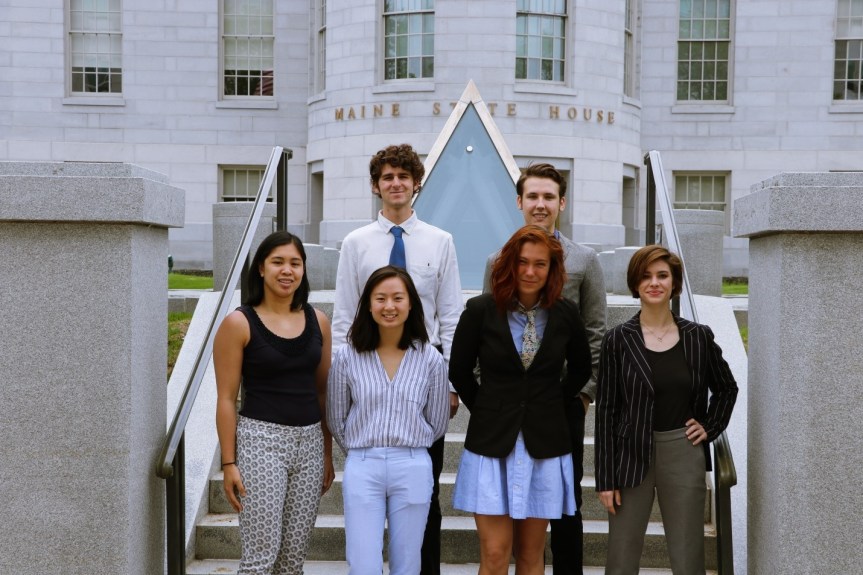
The Department of Education officially welcomed six summer student interns on May 28th. The students were selected for internship positions with the Department by the University of Maine’s Margaret Chase Smith Policy Center through their Maine Government Internships program.  Throughout the summer, the students will assist in the daily operations of the Maine DOE at the Augusta headquarters.

“We are delighted to welcome these precocious leaders to our Department of Education team. We are excited to have their energy and voices as a part of our work, and look forward to wonderful things from each of them, for the summer and beyond,” said Pender Makin, Maine Department of Education Commissioner.

Katherine Gunther is a senior majoring in graphic design and architecture. She studies at Roger Williams University in Bristol, Rhode Island. Katherine is excited to pursue a career in design, specifically publication. Passionate about photography, illustration, and videography, she hopes to use these skills in her future projects. Working with the Department of Education, Katherine will be creating videos and generating educational materials to explain the inner workings of our school budgets. Katherine is originally from Farmington.

Simon Handelman is a rising junior at the George Washington University in Washington D.C. where he studies political science, history, and English. He is excited to gain a deeper and more practical understanding of local government and politics. As an intern for the Commissioner’s Office in the Department of Education, Simon will work on communications between the DOE and the citizens of Maine. Here he will explore all the exciting things Maine students and teachers do. Coming from a family of educators, he welcomes the opportunity to celebrate education. When he is out of the office, Simon likes to hike the mountains of Maine, visit the Portland Museum of Art, and explore communities across the State via road trips with his friends. This summer is shaping up to be an enriching experience for Simon, and he cannot wait to see where government work will take him. Simon is originally from Freeport.

Ariel Lam is a rising senior at Bates College.  She is double majoring in Sociology and Mathematics with an Education minor.  This summer Ariel will be working on financial accounting for local school systems and researching school program funding schemes. Ariel is originally from New Jersey.

Katherine Sawyer is a rising 2L at the University of Maine School of Law. During her internship with the Department of Education, she will be assisting with school enrollment. Katherine grew up in Minot, Maine, and enjoys doing CrossFit workouts, snowboarding, and playing tennis.

Griffin Tibbitts is a student at McGill University in Montreal majoring in history and minoring in biology. He hopes to use his degree to study law in graduate school, specializing in the ethics and the legality of emerging biotechnologies. At the Department of Education he is working as a data analyst and instruction assistant, making training videos for school staff. Griffin is originally from Bath.

Emmeline Willey is an incoming junior at the University of Maine at Orono. She is a Media Studies major with Psychology and Education minors. In her free time, she enjoys pursuing projects as the current Chair of Services with Student Government, and being a fool with her Improv Comedy club. Emmeline can be found frequently playing ragtime on public pianos. She will be working to publicize events, gather information, and streamline communications within the Department of Education this summer as an intern in the Commissioner’s Office. She has been inspired since high school to pursue the improvement in quality of student life at our public schools, something she hopes to continue doing in the future through personal outreach and firsthand involvement. Emmeline is originally from Monmouth.

Seeking Innovative Educational Leaders to join Maine’s Leadership Development Program

The Maine Department of Education is excited to announce the launch of Maine’s Leadership Development Program (Maine LDP), an initiative designed to build and strengthen instructional leadership skills among Maine’s educational leaders at the school, district, and state levels. In our ongoing efforts to support and foster the educational expertise in Maine, educators who aspire to do the same are invited to take advantage of this high impact opportunity!

The launch phase will focus on building a strong foundation for making the program widely accessible. The Maine DOE has partnered with the National Institute for School Leaders (NISL) to prepare the first cohort of candidates to become certified trainers and facilitators of future cohorts, providing a unique and rewarding leadership opportunity. The Maine DOE’s ESEA Federal Programs, School Turnaround, and Higher Education and Educator Support Services teams are collaborating to provide the executive leadership training to instructional leaders across Maine. Maine’s LDP brings together the Maine DOE’s successful Transformational Leaders’ Network with NISL’s nationally recognized Executive Development Program (EDP).

Maine’s LDP is delivered through a blended learning model and includes study, inquiry, and hands-on activities with practical applications that meet the rigorous expectations for today’s educational leaders. In the first cohort, NISL experts will deliver the Maine LDP curriculum and provide additional training for Maine LDP facilitators. Successful graduates from the initial cohort will deliver the Maine LDP curriculum to future cohorts regionally. Completion of the program can contribute to credit hours for participants pursuing an advanced degree or contact hours for re-certification purposes.

Benefits for Maine Schools

  • Prepares educational leaders to lead for excellence and equity
  • Increases student achievement, fosters a culture of high expectations
  • Enhances teacher recruitment, retention, and quality

Program Curriculum

  • Nationally researched, evidenced-based, and locally delivered in a cohort model
  • Improves the practice of leadership, transforms instruction and student achievement in schools
  • Consists of 12 two-day units, delivered in 12 to 15 months
  • Bridged with online coursework, readings and job-embedded application of key concepts

Characteristics of Ideal Candidates

  • A belief in and commitment to improving instruction and increasing student achievement
  • Experience (five years) in a leadership role at the school, district, and/or state level and background as a classroom teacher. Ideal candidates include, but are not limited to, principals, assistant principals, instructional coaches, deans, Title I directors, department leaders, ESEA coordinators,  special education directors, English Learner directors, assistant superintendents, instruction and curriculum directors, and superintendents.
  • Excellent communications skills; able to effectively facilitate professional development for peers
  • Demonstrated skills in mentoring and coaching
  • Experience as a successful practitioner—able to translate concepts to actions, theory to practice, and programs to craft
  • Able to participate in the entire NISL program and become certified as a Maine LDP facilitator
  • Likely to live and work in Maine for the next five years

The Department encourages experienced educational leaders to consider applying to join the initial cohort of candidates to become certified Maine LDP facilitators of future cohorts. Please visit http://www.maine.gov/doe/educators/maineldp for more information and email nisledp.doe@maine.gov  with any questions. The schedule and application can be found here.

FREE Facilitated School Team Problem Solving Opportunity!

We are very excited to announce that the Maine Teacher Leadership Committee (Teach to Lead® Maine), in collaboration with the Maine Department of Education, United States Department of Education, and the University of Maine Farmington, will be hosting the second annual Powered By Teach to Lead® Summit on August 16, 2019.   This event encourages teams of teachers and administrators to identify a problem of practice or area of need in their school/district and develop a concrete plan to solve the identified problem/issue at their school.  Each team will be paired with a critical friend who will serve as a facilitator throughout the day.  All active Maine educators are welcome to submit ideas as individuals, but we strongly encourage schools/districts to bring a team of stakeholders to make the best progress at the Powered By Teach to Lead® Summit.  Examples of problems of practice that teams identified for the 2018 summit included: trauma-informed schools, development of a makerspace, teacher-led professional development, arts education, and more!

Please consider joining us for this FREE event on August 16th, 2019 at University of Maine Farmington.  As space is limited for this event, idea submissions will be reviewed by a team of education professionals, and invitations for participation, with registration details, will be emailed to those accepted.

Teach to Lead® Maine is a statewide effort, uniting educators, policy-makers, and the greater community around the common vision that every Maine student will benefit from the purposeful involvement of teacher leaders who collaborate in guiding the continuous improvement of schools and the teaching profession.  For more information about teacher leadership, please visit the Maine Department of Education’s website.

Application Link: http://tinyurl.com/poweredbymaine
Flier PDF: https://drive.google.com/file/d/1OAoAx94jopzyGiss5GJISMu9-8lyo0A5/view?usp=sharing
Twitter Handle: @TeachtoLeadME

Emily Gribben
Educator Effectiveness Coordinator
Maine Department of Education
(207) 624-6748

Maine FFA Convention Attracts 200 Members and Guests

Pictured: Awards Banquet Head Table:  National FFA VP Ridge Hughbanks, Convention Sentinel Ava Cameron, Reporter Olivia Tardie, Treasurer Alli Kenney, Secretary Camryn Curtis, State Vice President James Hotham, State President Graham Berry.

This year’s Maine FFA (formerly known as “Future Farmers of America”) annual Convention included 200 middle and high school FFA members, assisting judges, helpers and guests from the education and private sectors.  Participating schools included:  Region 4 United Technologies Center (Bangor), Ashland Middle/High Schools, Caribou Technology Center, Central Aroostook Junior & Senior High Schools, Easton Junior/Senior High Schools, Hodgdon Middle/High School, and Presque Isle Regional Career & Technical Center.   Maine FFA chapters include nearly 500 students across the state from Sanford to Caribou, enrolled in courses related to agriculture and natural resources in such areas as agriculture, forestry, horticulture, agricultural mechanics, nursery and landscapes, integrated sciences and others.  The two-day event featured recognition for past year accomplishments, competitions, scholarships and educational tours, with over $10,000 in awards and scholarships presented.

During the Convention Awards Banquet, guest speakers included Dan Chuhta, Deputy Commissioner for the Maine Department of Education, Chandler Vaughan, National FFA Alumni Council Representative, and Ridge Hughbanks, National FFA Organization Central Region Vice President.  Speakers addressed areas related to providing FFA opportunities to as many students as possible, taking advantage of one’s education, and participating in community related endeavors, an important activity of the FFA.  Students were excited to receive awards for their work of the past year, distinguishing themselves in independent projects (“Supervised Agricultural Experiences”), as well as advancing in areas related to technical and community development achievements through “State FFA Degrees” and the “State FFA Stars” program.

Students were excited to participate in events such as Agricultural Sales, Horse Evaluation and Veterinary Science, which allowed them to showcase and further develop their leadership abilities, as well as learning more about a topic of interest.  Educational tours to areas such as UMaine’s Pulp and Paper Process Development Center further enhanced the opportunities available to students.  Leadership and sportsmanship abilities, important to FFA, were evident in bestowing awards such as the Best FFA Chapter Spirit award, this year won by Region 4 United Technologies Center students, Bangor.

The FFA is one of the largest student leadership organizations in the United States, with over 600,000 members, and the Maine FFA Convention was directed by its State FFA Officer team under the leadership of President Graham Berry and Vice President James Hotham, with support from Doug Robertson, State Advisor in the Maine Department of Education and Faith McLaughlin, Maine DOE staff support specialist, as well as volunteering students and numerous other partners working on a volunteer basis.  Events were hosted at the University of Maine, Orono’s campus, as well as at Eastern Maine Community College.

For more information on technical and science programs eligible for FFA chapter membership for grades 7-12, please contact Maine FFA State Advisor, Doug Robertson in the Maine Department of Education:  doug.robertson@maine.gov  (207) 624-6744  and refer to the Maine FFA Association website:  https://www.maine.gov/doe/learning/ffa

Maine Students Bring a Slice of the Future to our State House

Pictured: Team Northern Force from Gorham/Falmouth, with their robot Geffrey

Eight middle and high school teams from across the state assembled at the Capitol building on Wednesday morning to receive praise from their community leaders. The students were congratulated for their exceptional performances at FIRST competitions across the state and nation. FIRST (For Inspiration and Recognition of Science and Technology) is a non-profit organization that allows students to compete in science, technology, and engineering-based challenges. The high school teams at the Capitol competed in the FIRST Robotics Competitions in Maine. A few teams even represented the state at the World Championship in Detroit, Michigan earlier this spring, where there were over 3,000 teams present from countries all across the world. The World Championship can be viewed here: https://www.youtube.com/watch?v=sLmn5CbNr3Y

IMG_0881
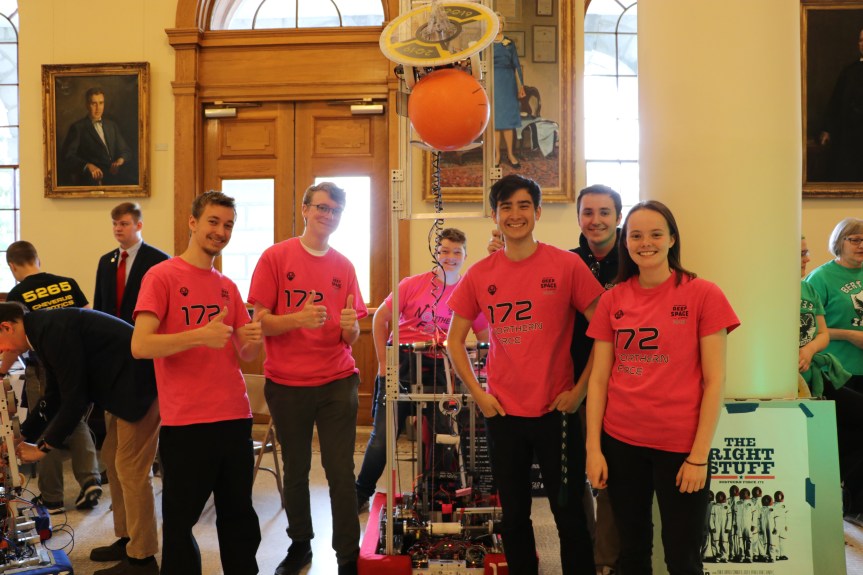
Pictured: Team Radical Impact from Cheverus with their robot

These precocious high schoolers were asked to design robots that could compete in a game requiring multiple complicated maneuvers. Robots must be piloted blind for several minutes at the beginning of each competition. Each team chose a different way to overcome this challenge, many opting for robot-mounted cameras. Next, each team had to pickup and carefully drop large dodgeballs in holes cut into a model rocket and space station, for points. In the course of the competition robots had to move up and down over physical obstacles, and place Velcro covers over the holes.

IMG_0887
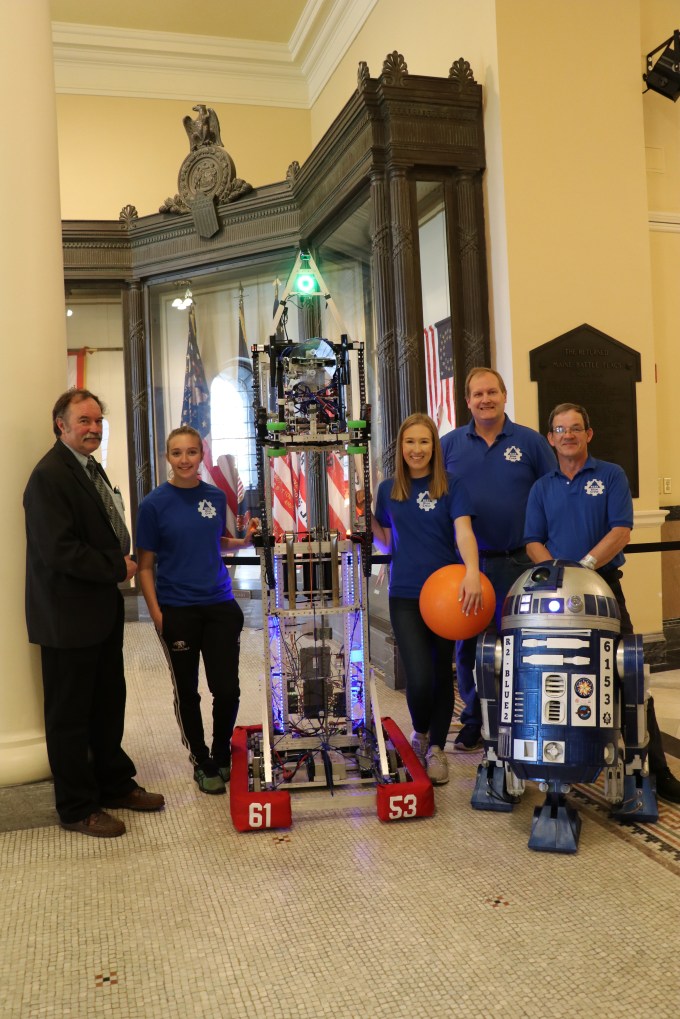
Team Blue Crew of Farmington, with robot R2D2
IMG_0892
Team Iron Tigers from Gardiner with robot Christa

Students were excited to share their experiences at the FIRST meets. Tasked with building and programming the robots, the students learned valuable skills like digital modeling, 3D printing, coding, wiring, and engineering. Because they were asked to design the robots themselves, students also worked on interpersonal, leadership, and problem solving skills. One student, a freshman at Cheverus, is already reaping the rewards of coding know-how. Members of his school’s coding club saw him working on Java Script in the library, they were so impressed he was invited to join.

IMG_0886
Student from the Maine School of Science and Mathematics with robot Dozer
IMG_0873
Team B.E.R.T. 133 of Bonny Eagle, Standish, with their robot WALL-E

However, many of the teams were comprised of more than their building team, one student explained that although there were ten students involved in the construction of the robot, their total headcount was around twenty-five students, with the rest heavily involved in fundraising, advertising, and outreach. Students involved in this process not only picked up important communication skills and experience, but learned how to market their club and raise money for competitions. Students also have the opportunity to meet and interact with peers who have similar interests from across the country, with one young engineer commenting that they had made and kept friends from Tennessee and Australia.

IMG_0877
Student from The Outliers from Portland
IMG_0885
Team from Cape Elizabeth with robot Wacky Boi

FIRST strives to promote STEAM engagement among young students as well, inspiring growth of the field for the future. They include Robotics Competitions such as the ones in which these students competed, as well as a separate LEGO League for ages 9 to 14, from which some students were also in attendance. The organization prioritizes the involvement of underrepresented, underserved, and vulnerable youths. Of all students involved in FIRST, 43% are female; 72% are from economically disadvantaged families; over half of all students are from ethnic minorities. 87% of participants in the program go on to take more advanced math and science courses; students who competed were also more than twice as likely as others to show increased interest in pursuing STEAM fields.

IMG_0883
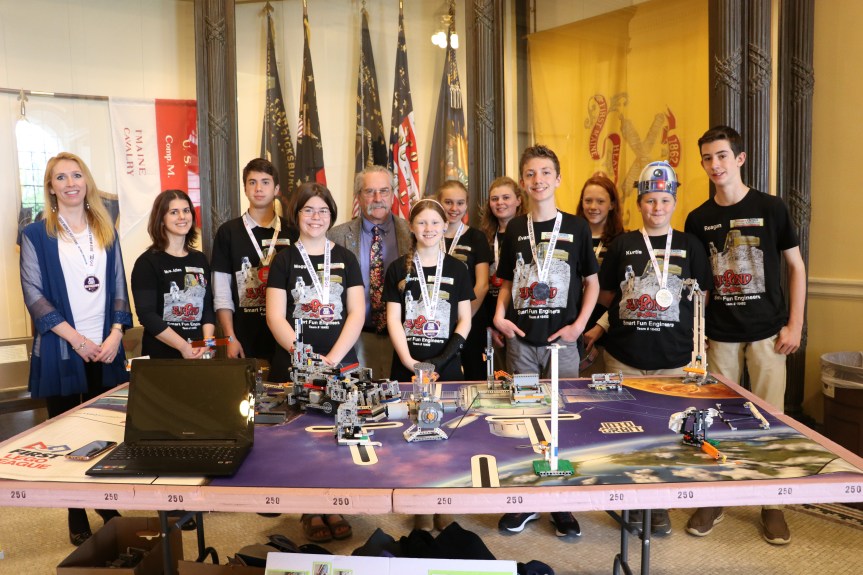
Pictured: Team SmartFun Engineers from Farmington and their LEGO robot, Stanley
IMG_0890
Pictured: Steve Martin, Senior Member and organizer of the event, showing a map of FIRST involvement in the State of Maine

Students shared overwhelmingly positive remarks about their experiences, and showed great passion for their robots and the competitions. Many were only Freshmen, and all expressed that they intend to continue participating in competitions and to pursue STEAM fields in their future. FIRST competitions provide a great opportunity to middle and high school students who are looking to get hands-on experience with a wide array of skills before they even graduate. Interested readers can visit www.firstinspires.org to get involved and learn how to help aspiring scientists and engineers pursue their passions, by investing in our future.

This story was written by Maine DOE Interns Emmeline Willey and Simon Handleman in collaboration. If you have a story idea or would like to submit a written story for the Maine DOE Newsroom, email Rachel Paling at rachel.paling@maine.gov.

Augusta Teacher’s Commitment to Inclusion Recognized Internationally

Students in the EL (English Learner) program at Augusta’s Cony Middle and High School have a lot to look forward to: Their teacher Karina Escajeda’s visionary grant applications secured her funding with which to attend two international schools where she will gain valuable insights for her classroom and community. Karina will attend Egypt’s Dahab School of Arabic Language and will be in residence at Aristotle University in Thessaloniki, Greece. All through the month of April, praise flowed into Karina’s inbox. These prestigious grant programs pledged thousands to make possible her language and cultural studies abroad.

Following her time in Egypt, Karina plans on bringing her knowledge of the Arabic language back to Cony (her alma mater) where she will foster stronger relationships with EL students, many of whom come from refugee backgrounds. When she is not studying in Dahab, Karina plans to visit additional cultural and historical sites across the country such as Cairo, Luxor, and Aswan. Karina is rightly committed to the belief that students from Iraq and Syria add valuable elements to school culture.

For this initiative and foresight the Fund for Teachers emailed Karina on April, 4 to commend her for “bold vision” which “stands out.” This $5,000 grant was not the only source of praise and money for Karina: NEA’s Learning & Leadership Grant pledged $2,000 to Karina on April, 22. They thanked her for “hard work and commitment to the importance of high quality public education.”

In addition to her upcoming time in Egypt, Karina will study refugee integration efforts in Greece through the Fulbright Distinguished Award in Teaching. She will be part sponsored by, and lecture in, Aristotle University’s Applied Linguistics Program from January to June of next year (2020). This University’s teacher training program provides Greek teachers with the necessary skills to create inclusive communities for growing populations of refugee students. Karina has identified many similarities between the ways in which Maine and Greece welcome their refugee populations: “In both places, new residents are struggling to adapt to new homes that are almost entirely monolingual.”

The prestigious Fulbright Commission sent out a press release on April, 23 in which the U.S. Department of State (a major grant contributor) awarded Karina five months of independent study in Greece. The goal of the Fulbright Distinguished Awards in Teaching Semester Research Program is to build international relationships that work to solve global challenges. Karina will join an alumnus among whom there are over 50 Nobel Laureates, over 80 Pulitzer Prize winners, and over 30 former heads of government or state.

Suffice it to say the Augusta public school system is more than proud. We can all appreciate Karina’s “commitment to push the boundaries of [her] own learning,” as put by the Fund for Teachers. She will bring these new and enlightening experiences from Egypt and Greece back to her own community, and the students for whom she worked so hard to secure these grants. Congratulations Karina, and Cony Middle and High School.

This story was written by Maine DOE Intern Simon Handleman in collaboration with Karina Escajeda. If you have a story idea or would like to submit a written story for the Maine DOE Newsroom, email Rachel Paling at rachel.paling@maine.gov.

Employee of the Week: Rick Bergeron

Maine DOE Federal Reporting Coordinator, Rick Bergeron is being highlighted this week as the Maine DOE’s Employee of the Week! Learn a little more about Rick in this brief question and answer:

What are your roles with DOE?

My title at the department is Data Reporting Coordinator. I am responsible to report education data to the USDOE through their reporting collection systems. In addition, I also assist with other internal and external data requests as needed.

What do you like best about your job?

I have been called a data geek in the past. I enjoy working with data and reporting it out for policy makers to make decisions on education.

How or why did you decide on this career?

Before coming to work for the State, I have 25 years in the restaurant industry. Working with computers was always a hobby. As I got older I realized that the physical demands of restaurant work was not something I could see myself doing all my life so one day I took the plunge and took a job with a company in Lewiston as their Microsoft Office trainer. I took classes on the side and started developing Microsoft Access and SQL server databases. My first position with the State of Maine was with the Bureau of Insurance in 2003. I came to work with the Dept of Education in 2007 as a Statistician and have worked my way through a few different positions.

What do you like to do outside of work for fun?

I have been married 38 years to my wonderful wife Tamra. Together we have two grown children. My daughter is a teacher in Milwaukee with two daughters of her own and my son is in the Air Force stationed at Patrick AFB in Cape Canaveral, FL. In addition to being “papa” whenever I can visit my grandkids, my wife and I like to travel whenever we can. We recently moved to Chelsea about a year ago. Previous to that we lived in Poland Springs for 35 years. I also serve my community by being an active Freemason and Shriner.