PRESS RELEASE: Maine DOE Awarded $2.88M Grant to Support School Emergency Operations Plan Initiative

Update: Schools will receive an invitation from the Department to participate in grant activities this spring. 

The Maine Department of Education has been awarded a 5-year grant from the Office of Elementary and Secondary Education, U.S. Department of Education. The funding will go towards an initiative called Maine Grant for School Emergency Management aimed at helping Maine schools by providing training and technical assistance in the development and implementation of high-quality school emergency operations plans (EOPS).

This project is grounded in the belief that multihazard emergency planning for schools helps schools and communities prepare for, respond to, and recover from critical incidents. The Maine Grant for School Emergency Management project is the next step of work that began with a Maine School Security Report that was initiated by the Maine Legislature.

The primary goals of the Maine Grant for School Emergency Management project are to:

  1. Provide schools, especially those identified as high need in rural areas, with high-quality EOP training at no cost.
  2. Ensure that local educational agencies have access at no cost to a new customizable EOP template that can be easily updated and includes technical guidance.
  3. Provide high-quality EOP technical assistance clinics at no cost that will be delivered to develop a team of education sector professionals who are committed to work with schools.

The grant allocation is over five years:

Year 1: $614,773
Year 2: $567,920
Year 3: $567,920
Year 4: $567,920
Year 5: $567,920
Grant Total:  $2,886,453

The grant activities, as awarded, are one hundred percent federally funded. No project costs will be financed by non-governmental sources.

The Department of Education takes school safety, security, emergency management, and preparedness seriously and is continually taking steps to improve it.

Further questions and inquiries can be send to Pat Hinckley, Maine DOE Transportation and Facilities Administrator at pat.hinckley@maine.gov.

Learning Through Technology Survey

The Maine Department of Education is seeking input to inform the work of leveraging technology to improve student learning. The survey should take no more than 5 minutes to complete. Maine DOE leadership will be reviewing the results as it plans for continued support of technology integration in Maine schools.  The survey will remain open until December 21, 2018.

Learning Through Technology Survey

For additional information, please contact Lee Anne Larsen (leeann.larsen@maine.gov) or Beth Lambert (beth.lambert@maine.gov) on the Standards and Instructional Support Team.

Using Assessment to Strengthen Instruction in English Language Arts, Mathematics, and Science, K-8

As part of its 2018-19 Assessment Literacy series, the Maine Department of Education will present full-day workshops to continue supporting educators in examining eMPower ELA and math, and MEA science assessment data, connecting that data with locally generated assessment information, and identifying high impact instructional strategies that foster student engagement and achievement of learning standards.

State level assessment provides school systems with a useful lens through which educators can evaluate the effectiveness of curricula and instructional practices. This information can help educators improve programming to increase the number of students meeting expectations for learning standards in English language arts (ELA), mathematics, and science. The availability of released item data and sample state assessment items, coupled with local level assessment information, enables educators to dig more deeply into what instructional practices are benefiting student learning as well as where adjustments could be made to result in greater positive impact.

Join Maine DOE ELA, Math, and Science specialists as they provide professional learning and resources that:

  • Connect state eMPower and science assessment to instructional practices
  • Delve into the roles cognitive demand and stamina play in instruction and assessment
  • Explore protocols for linking state level data analysis with local level data analysis

Participants will select one of 3 content areas in which to focus their learning during the day: English language arts, mathematics or science.  Schools are strongly encouraged to register teams of 3 so that they will have representation in each of the 3 featured content areas. An alternate option is for educators to come as a team representing one content area (e.g. science teachers from a middle school).  Time will be provided during the day for teams to share their learning across content areas and to collaboratively plan for how to disseminate the day’s content back in their respective schools. Lunch will be provided during each full day session which will run 8:30 am – 3:30 pm. Contact hours will be provided.

Cost is $40 per individual or $100 per 3-person team. Registration requires a credit card.  

Workshop Locations/Registration Links Workshop Dates
Keeley’s Banquet Center, Portland January 15, 2019
Snow Date: February 1, 2019
Jeff’s Catering, Brewer January 24, 2019
Snow Date: January 31, 2019
University of Maine at Presque Isle January 29, 2019
Snow Date: January 30, 2019

For further information, please contact Lee Anne Larsen, Acting Deputy Director of the Office of Learning Systems at 207-624-6628 or leeann.larsen@maine.gov.

Maine DOE to Provide Complimentary 2018-19 Law Books to Superintendents

The Maine Department of Education (DOE) acquired enough copies of the Maine Education and School Statutes 2018-2019 Edition law book from the publisher, Swan Island Press, to distribute one, at no charge, to each superintendent of schools in Maine.

The law books are in the mail and should be received soon. To purchase additional copies of this law book directly from Swan Island Press, please contact Aaron Chase of Swan Island Press at info@swanislandpress.me.

Resources to Support the Observance of Alcohol Awareness Day

Alcohol is the most frequently used substance by adolescents in Maine. Almost one of every four Maine high school students used alcohol in the past 30 days, and more than one third of those students reported binge drinking (2017 Maine Integrated Youth Health Survey). Alcohol consumption by students is impacted by factors such as low perception of harm, low perception of getting caught, and ease of access.

Schools and community organizations are encouraged to work together to address alcohol issues. In alignment with Maine statute, schools across Maine can raise awareness about alcohol use and abuse by observing Alcohol Awareness Day on Monday, December 3 (or another designated day in December). The statute indicates Alcohol Awareness Day shall be observed by studying for at least 45 minutes, a constructive approach toward the use of alcohol and the problems and dangers of alcohol abuse upon the individual, the family and society.

Consider using one or more of the following resources to prepare a message or lesson to enhance your existing health education curriculum:

It is important for Maine students to receive education and awareness about alcohol, tobacco and other drug use as part of comprehensive school health education, Pre-K through High School, and in alignment with the Maine Learning Results: Parameters for Essential Instruction, Health Education StandardsSelecting Evidence-Based Substance Use Prevention Programs: A Guide for Maine Schools Grades K-12 may help determine the most appropriate program for a school community.

There is also a guide to help schools create, update, and enforce a substance use policy. The guide, “Substance Use Policy: A Comprehensive Guide for School Policy Development provides practical suggestions for a complete policy, based on research and best practices.

For assistance or additional resources, contact the Maine Center for Disease Control and Prevention, Tobacco and Substance Use Prevention and Control Program at 287-8901, TTY 711 or email: TSUP.DHHS@maine.gov.  You can order a limited quantity of free alcohol use prevention pamphlets through the Prevention Store http://www.mainepreventionstore.org./

Webinar: Adverse Childhood Experiences, Education and the Workforce

The Maine School Councilor Association (MESCA) is sponsoring a free professional development webinar called, Adverse Childhood Experiences, Education And The Workforce: Building Resilience In Students. Please find the details below.

Description: National statistics tell us that if a child has experienced 4 or more adverse life events, they are 32 times more likely to have behavior problems in school. There is increasing evidence that early life stressors, such as abuse and/or witnessing intimate partner violence, cause enduring brain dysfunction that, in turn, affects health and quality of life throughout the lifespan. The “stress response” can cause the areas of a student’s brain that control fear to become over developed, overpowering other areas of the brain that are required for positive academic learning. Adverse experiences have the power to undermine the development of language skills, attention to classroom tasks, and the ability to remember new information.

The good news is the presence of a supportive adult or environment provides a powerful buffer to students from the intense stress or anxiety that may occur when they are exposed to violence and trauma. This workshop will introduce participants to the impacts of exposure to adverse experiences, will offer examples of how and why this impact manifests itself as behaviors, and will share resilience building strategies.

Presenter: Allegra Hirsh-Wright, LCSW, RYT, Training Manager/Project Coordinator for Department of Clinical Innovation, Maine Behavioral Healthcare

Webinar Date & Time: December  20, 2018 at 12:00 PM

Register here: https://bit.ly/2PXK5nU

This free professional development webinar sponsored by the Maine School Councilor Association (MESCA) will be recorded and stored on the Reach Higher Maine Google Classroom.

What Does Accountability Mean for a School?

Maine’s Model of School Support includes five indicators that focus on key areas of school and student success, adhere to the requirements of the Every Student Succeeds Act (ESSA), and directly align to Maine’s Priorities and Goals. Below is the list of indicators of school success:

  1. Chronic Absenteeism (K-12)
  2. Academic Progress (Grades 3-8 Only)
  3. Progress in English Language Proficiency (ELP) for English Learners (K-12)
  4. Academic Achievement (Grades 3-8, High School)
  5. Graduation Rate (High School Only)

Eligible individual student populations (where there are ten or more students of a specific student population) are also measured to identify where targeted support is needed. Student populations include: economically disadvantaged, students with disabilities, English learners, and students who are white, black, Asian, Native Hawaiian/Other Pacific Islander, Native American, Hispanic, or two or more races.

To determine each school’s performance on the indicators listed above, Maine uses data collected from public schools on an annual basis to provide each school with a performance rating on each applicable indicator.

School Indicators & Performance Levels

The chart below summarizes the indicators used in Maine’s Model of School Support for Maine’s public elementary, middle, and/or high schools. In addition, the criteria surrounding the performance levels for each indicator has been provided.

Indicators Performance Level
Emerging Developing Meeting Excelling
Chronic Absenteeism All eligible student group populations have a chronic absenteeism rate of 10% or higher. At least one eligible student group has a chronic absenteeism rate of less than 10%. All eligible student groups have a chronic absenteeism rate of less than 10%. All eligible student groups have a chronic absenteeism rate of 5% or less.
Academic Progress – English Language Arts All eligible student groups have score of less than 100. At least one eligible student group has a score of at least 100. All eligible student groups have a score of at least 100. All eligible student groups have a score of at least 150.
Academic Progress – Math All eligible student groups have a score of less than 100. At least one eligible student group has a score of at least 100. A scores of at least 100 for all eligible student group A scores of at least 150 for all eligible student group
Progress in English Language Proficiency  The average progress towards the student’s annual target is less than 65% The average progress towards the student’s annual target is between 65% and 80% The average progress towards the student’s annual target is between 80% and 95% The average progress towards the student’s annual target is greater than 95%
Academic Achievement – Math All eligible student groups did not make annual targets At least one eligible student group made its annual target All eligible student groups made their annual targets All eligible student groups exceeded their annual targets by at least 10%
Academic Achievement – English Language Arts All eligible student groups did not make annual targets At least one eligible student group made its annual target All eligible student groups made their annual targets All eligible student groups exceeded their annual targets by at least 10%
Graduation Rate – 4YR All eligible student groups did not make annual targets At least one eligible student group made its annual graduation target All eligible student groups made their annual graduation targets All eligible student groups have met or exceeded the long-term goal of 90%
Graduation Rate – 5/6YR All eligible student groups did not make annual targets At least one eligible student group made its annual graduation target All eligible student groups made their annual graduation targets All eligible student groups have met or exceeded the long-term goal of 92%

Based on student population performance within the school, each school will achieve performance level for each indicator that is applicable to the grade span (elementary/middle or high school). An example of performance levels for indicators is provided below:

report card

A school’s performance in the above indicators will determine the level of support available to the school.
tiers of supportTiers of Support

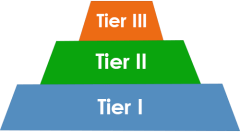
Maine has developed three Tiers of Support designed to direct various levels of assistance from the Maine DOE.

Tier III supports are designated specifically for schools experiencing the most significant challenges across all eligible student groups, and who also receive Title I funding.

Tiers I and II are designed to support both Title I and non-Title I schools.

Support levels are determined based on eligible student groups (individual student populations with at least ten [10] students). Tier III supports are determined based on the performance of all eligible student groups while Tiers I and II are based on individual student groups. Student populations with fewer than 10 students are not included as part of the indicators for the school, this is consistent with federal FERPA regulations.

Below is a detailed summary that describes how a school’s level of support is determined, and the various supports that are available at each Tier.

Tier I
Additional Targeted Supports and Intervention
Tier II
Targeted Supports and Intervention
Tier III
Comprehensive Supports and Intervention
Any school with one or more eligible student group/s not meeting state expectations across all indicators in one or more content areas Any school with one or more eligible student group/s not meeting state expectations in the same indicator for three (3) consecutive years Schools that receive Title I funding and where all eligible student groups are not meeting state expectations in all indicators in one or more content areas.
Professional development will be available regionally and statewide at no cost. With access to a regional school leadership coach, schools will be responsible for developing and implementing a school level plan, in partnership with stakeholders, to include at least one evidence-based intervention.   Professional development will be available at no cost and driven by the needs of school staff and students. Tier II supports will be available during the 2019-2020 school year. With the support of a school leadership coach, schools will be responsible for developing and implementing a school level plan, in partnership with stakeholders, to include at least one evidence-based intervention. Schools will also have access to additional federal funds to support the implementation of a school leadership team and a school plan. Professional development will be available at no cost and driven by the needs of school staff and students.

Example scenarios demonstrating how a school is identified to receive support will be provided in the next room article.

Further questions should be directed to Janette Kirk, Acting Director, Office of Learning Systems at janette.kirk@maine.gov.

Information and Resources About Maine’s New Tobacco Retail Sales Law

The Maine CDC Tobacco Prevention Program has released information and resources about on Tobacco 21 (T21), Maine’s new tobacco retail sales law.

Tobacco 21 is Maine’s new retail tobacco sales law that went into effect July 1, 2018. A person may not sell, offer to sell, furnish, or give away a tobacco product to any person under 21 years of age unless the person had turned 18 years of age by July 1, 2018. People who were 18-year-olds as of July 1, 2018 can still buy tobacco products. With the passing of the law, it updated enforcement and compliance activities by the removal of all Minor In Possession or Possession Use and Purchase (MIP/PUP) language in state code. By eliminating the MIP/PUP language it concentrates enforcement and compliance activities on the source of tobacco rather than the youth purchasing.

Further questions should be directed to Emily Moores, Tobacco Prevention and Control Manager, Maine CDC at Emily.Moores@Maine.gov or 207-287-3268.

Dropout Reporting Opens November 26, 2018

This is a reminder that Dropout reporting begins the Monday following Thanksgiving weekend. The report will be open from November 26, 2018 to December 14, 2018. This report is located in the “Graduation Data” module in NEO, along with the Graduation reports from the 2017/18 school year. The module is located here: https://neo.maine.gov/doe/neo/graduation

The reporting process will follow the same structure as graduation reporting. Individual reports must be completed for each school in the district that has grades anywhere from 7 to 12. Once all the reports are completed, the reports need to be submitted to the Maine DOE. Maine DOE staff will then review/approve each report and submit them back to the School Administrative Unit for certification. Certification must be done by the Superintendent. Once the ‘Certify’ button is pressed on the summary screen, this will complete the dropout reporting process. Detailed instructions for this process can be found here.

Since dropouts could not be calculated until after the October 1 enrollments have been completed, it was necessary to remove the dropout rate reporting out of the graduation rate reporting process.

Some things to note for this process:

Dropouts are:

  • Students who are part of the 2017/18 Cohort that were enrolled in the 2017/18 school year and were exited with a code indicating that the student was expected to return in the 2018/19 school year, but for whom there have been no enrollments in the 2018/19 school year so far.
  • Students in grades 7 through 12 who exited in 2017/18 with a code that correlates to being a dropout.


Future Dropouts are:

  • Students in grades 7 through 12 who are part of a Cohort after the 2017/18 Cohort that were exited in the 2017/18 school year with a code indicating that the student was expected to return in the 2018/19 school year, but for whom there have been no enrollments in the 2018/19 school year. If no enrollments appear in the 2018/19 school year for them, they will receive a dropout count during the 2019 dropout reporting period.


If you have questions regarding the process for dropout reporting, contact Trevor Burns 207-624-6678

What Is Progress in English Language Proficiency? #success4ME

Maine defines English language proficiency (ELP) as sufficient skill in English necessary to meaningfully access the curriculum. As part of Maine’s Model of School Support, part of Maine’s rollout of the Every Student Succeeds Act (ESSA), this indicator of school success focuses on English learners and measures the progress they make toward English language proficiency each school year. ESSA requires that each state include an indicator that gauges, “progress in achieving English language proficiency as defined by the State and measured by the assessments within a State-determined timeline for all English learners.”

What does this look like in Maine?

English learners are students who have a primary or home language other than English and are in the process of learning English. Around 3% of Maine’s students are English learners and their schools support them in learning English to succeed academically. They may receive English language support services inside or outside of their regular classes, through programs specifically for English language development, or through a variety of other supports. It usually takes 4-7 years for an English learner to become proficient in English, but this can vary depending on many factors.

Each year, English learners are administered ACCESS for ELLs, an assessment that measures a student’s ability to listen, speak, read, and write in English. A student’s overall score ranges from 1.0-6.0. In Maine, English language proficiency is defined as level 4.5, so the progress in English language proficiency indicator measures how much progress a student makes each year toward reaching level 4.5. A school’s score for progress in English language proficiency is based on the average percentage made towards the annual target for each student, where there are at least ten (10) English learners.

School level descriptors for progress in ELP is as follows:

Emerging Developing Meeting Excelling
The average progress towards the students’ annual target is less than 65% The average progress towards the students’ annual target is between 65% and 80% The average progress towards the students’ annual target is between 80% and 95% The average progress towards the students’ annual target is greater than 95%

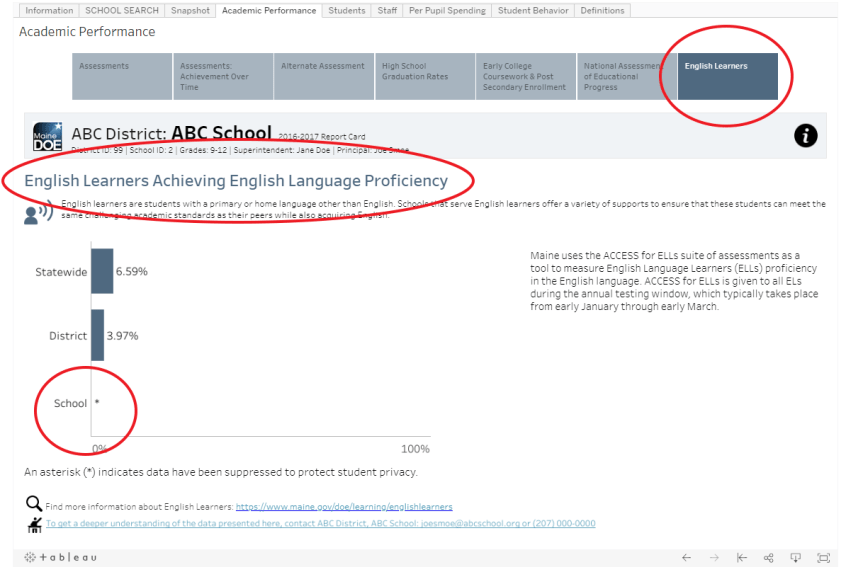
How progress in ELP will be presented on the report card:

ELPreportcard1.png

In the example provided below, there are less than 5 students who are English learners and therefore the data has been suppressed (notated by a *).

ELPreportcard2

ELPreportcard3