Regional school calendars due by May 4

School administrative units and private schools approved for tuition purposes are expected to establish regional school calendars, in coordination with their local secondary career and technical education school, by May 4, 2018.  

The Legislature enacted that requirement as part of Public Law 2011, Chapter 686, which expands access to career and technical education in Maine and ensures that students completing career and technical education (CTE) coursework have greater access to post-secondary opportunities.  Specifically, the law addresses scheduling conflicts that pose barriers to students by requiring that those school districts and private schools approved for tuition purposes that share a CTE school adopt a regional school calendar with no more than five dissimilar days. Implementation of the law is intended to promote collaboration among local school administrative units that may benefit other forms of inter-administrative unit collaboration beyond CTE.  The law became effective Aug. 30, 2012, and establishing the regional calendar is a condition for eligibility for state subsidy. 

For 2018-19, both regional school calendars and individual calendars for each school administrative unit must be submitted by the director of the local CTE Center/Region to the Department of Education no later than May 4 for a decision on approval by June 8. Guidance and templates can be accessed electronically at www.maine.gov/doe/regionalcalendar/. 

Given the coordination required for fulfillment of this law, the Maine DOE recommends that school districts initiate discussions as soon as possible, including representatives from all affected secondary schools and their associated career and technical education center or region.  

For more information including guidance, templates, a waiver process and a link to the complete law, please visit  www.maine.gov/doe/regionalcalendar/ or contact Doug Robertson (doug.robertson@maine.gov) at 624-6744 or Margaret Harvey (margaret.harvey@maine.gov) at 624-6739. 

PRIORITY NOTICE: Proposed changes for Certification and PEPG Rules; Hearings on Dec. 27

As part of the Maine Department of Education’s efforts to streamline certification processes for Maine educators; align certification rules with current statute; and ensure that new and conditionally certified teachers have access to high quality peer support, the Department is proposing revisions to Rule Chapter 180: Performance Evaluation and Professional Growth Systems, revisions Rule Chapter 115: Certification Authorization and Approval of Educational Personnel; and repeal of Chapter 118: Purposes, Standards and Procedures for Educational Personnel Support Systems.

Find the details for proposed changes for Rule Chapters 115, 118, and 180 on the Maine DOE Website. Provided below are hearing dates, details about the comment period and highlights about the proposed changes.

Hearing for Rule Chapters 115 and 118:
December 27, 2017 from 12:00 – 2:00 PM.
Room 103 A and B in the Cross State Office Building, 111 Sewall Street, Augusta, Maine
Comment periods:
Chapter 115 Proposed Section 14: November 17, 2017 – December 18, 2017
Full revisions for Chapter 115 and Rule Chapter 118: December 6, 2017 – January 18, 2018

Hearing for Rule Chapter 180:
December 27, 2017 from 2:00 – 3:00 PM.
Room 103 A and B in the Cross State Office Building, 111 Sewall Street, Augusta, Maine
Comment period:
Rule Chapter 180: December 6, 2017 – January 18, 2018.

Comments can be submitted to Jaci Holmes at jaci.holmes@maine.gov

Highlights:

Chapter 180
Some of the more significant changes are contained in a new Section (11): Peer Support and Feedback, and accomplish the following:

  1. Retain a peer level of peer support and feedback for all teachers and principals.
  2. Establish a mentor/coach component for all newly hired and conditionally certified teachers.
  3. Differentiate peer support requirements to provide greater support for new and conditionally certified teachers.
  4. Provide greater, more structured support for conditionally certified special education teachers.
  5. Provide the SAU with flexibility in establishing mentor and coach qualifications as well as assigning mentors and coaches to better target educator needs.
  6. Sharpen the line between peer support components and evaluation components

Chapter 115
The Department has updated the rules consistent with recent statutory changes and removed redundancy and unnecessary language. The format is being refined to be clear and concise. In brief, the following are some of the more significant changes:

  • Consolidates the number of credentials available to three: a clearance, a certificate, and a conditional certificate.
  • Eliminates Rule Chapter 118: Education Personnel Support System. Rather than having two different support systems under two different rules, there will just be one under Rule Chapter 180. Also, some aspects of Rule Chapter 118 will be merged into Rule Chapter 115.
  • Creates a pathway to become a teacher based on work experience. A person will be able to use work experience to address knowledge areas that are required for an endorsement.
  • Refines and reformats the rule to be more logical and sequential. There has been confusion about sections of the rule and this should help to make it more clear and efficient.
  • Part I will be repealed and replaced, Part II will be revised in legislative format

Chapter 115 (Regarding Administrative Hold)
This rule creates a category within Section 14 of Chapter 115, Part I for Administrative Hold. The agency proposed rule would require all credential holders to provide the Department with an address at which the Department may contact them with respect to their credential. An administrative hold will be used in cases where information about certified individuals comes to the attention of the Department and the Department contacts the credential holder at the address on file and receives no response.  In those situations, the Department will place the credential on administrative hold until such time as the holder responds. Emergency Rulemaking for Chapter 115 (Regarding Administrative Hold) went into effect November 20, 2017.


PRIORITY NOTICE: Deadline for Part I Application for Regional Service Centers is November 30

As a reminder, the deadline for school administrative units to submit the Part I Application for a Regional Service Center (i.e. School Management and Leadership Centers) is November 30, 2017.

The short online Part I Application is conceptual in nature and does not take long to complete. Part I must be submitted online by the close of business on Nov. 30, 2017. Districts that take part in completing and submitting Part I as proposed members are not obligated to be part of a Regional Service Center but, if submitted by November 30, Part I of the application will allow the Department to budget for those members accordingly.

The Part II Application, which is due by April 15, 2018, includes specific information related to the structure and governance of the service center; the purposes, functions, programs and services to be provided by the service center; how any savings resulting from the formation of the service center will be used; and a copy of the proposed interlocal agreement.

Part I Online Application: https://mainedoe.co1.qualtrics.com/jfe/form/SV_cMahjxe4SEnyp1j

For more information about Regional Service Centers and the Department’s other regionalization initiatives, visit the EMBRACE Regionalization Information Center or contact Jennifer Pooler at Jennifer.G.Pooler@maine.gov.


Family Code Night Comes to Maine

Next week, children and their parents will come together to learn how to code. It’s Computer Science Education Week (December 4-8), and 75 sites across Maine will host Family Code Nights. Specially designed for elementary-aged students, these events use Hour of Code puzzles that introduce programming principles through fun games.

While many schools do Hour of Code, Scratch, and other web-based computer science activities, Family Code Night is unique. It was started in the San Francisco Bay area by a parent of an elementary student. He saw the importance of involving parents in the activities because they can advocate for their children to continue learning to code after the event is done. Maine has many opportunities for youth to explore coding, including summer camps, app challenges and family events. You can find them on the STEM Resource Bank at steminme.org.

Volunteers at Family Code Nights include teachers, librarians, parents and other community members. Many sites are enlisting the help of teens who have experience with coding. Family Code Night provides an event kit that includes everything needed to plan and host the event, so leaders do not need to be experts at coding to run a successful evening!

Family Code Night is a national movement supported in Maine by The Reach Center, a program of Maine Mathematics & Science Alliance. Visit mmsa.org/familycodenight to see a list of sites hosting events, which includes schools, libraries or community organizations representing each county.

For more information contact Maine Department of Education Science and Technology Content Specialist, Shari Templeton at Shari.Templeton@maine.gov or (207) 624-6880.

Maine Delegates and State Advisor Participate in National FFA Convention


On October 25-28, 2017, the National FFA Organization (formerly known as “Future Farmers of America”) celebrated its 90th National Convention in Indianapolis, Indiana.  The FFA was established in 1928 as the leadership organization representing students enrolled in agriculture and natural resources programs.  At the middle and secondary levels, current membership is over 500,000 and over 60,000 members attended the Convention.  Representing Maine as delegates participating in business sessions and voting on all proposed changes were Maine FFA President Kaley Norsworthy and Maine FFA Vice President Isabelle Wright.  Delegates actively debated and made proposals on areas related to the content of competitions, providing additional opportunities to students and accommodating students with special needs.  Accompanying Maine’s delegates was State Advisor Doug Robertson of the Maine Department of Education, who was chosen as one of this year’s recipients for the Honorary American FFA Degree.  Honorary Degrees are presented to individuals who have provided exceptional service on a national level to agriculture, agricultural education, or FFA. 

Maine’s Agriculture and Natural Resources Students Learn About Leadership and Service

FFA
Community Service – Students, led by State FFA Vice President Isabelle Wright, enact food security simulation

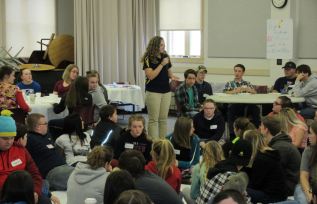
Student leaders of the Maine FFA Association (formerly known as “Future Farmers of America”) conducted leadership workshops for over 150 students on November 13 & 17, 2017 in locations of Augusta and Presque Isle.  Maine FFA serves middle and secondary students enrolled in programs related to agriculture and natural resources, providing them with leadership training, competitions, scholarships, travel opportunities and the chance to get recognition for their work.  At the leadership workshops, through talks and hands-on activities, students examined topics of personal authenticity, opportunities in FFA, and community service.  Exemplifying the area of community service, participants brought to the workshop donations to a local food pantry.  At the Presque Isle workshop, students also discussed issues of food security in the world.  Maine’s student State Officers, Kaley Norsworthy (President), Isabelle Wright (Vice President) and Micayla Driscoll (Secretary-Treasurer) entirely developed and presented both workshops.  Accompanying the officers was Doug Robertson, State FFA Advisor from the Maine Department of Education.  At the conclusion of the workshop, students discussed possible follow-up service activities they might undertake in their local communities.  Maine FFA involves over 500 students in leadership development and the chance to access the many opportunities and resources of the National FFA Organization.  For further information, please contact:  Doug Robertson, State FFA Advisor, doug.robertson@maine.gov  207-624-6744

FFA
Competition – Students participate in “Family Feud” activity with host “Steve Harvey”
FFA
Human Knot – Students engage in teamwork to extricate themselves from entanglement.

PRIORITY NOTICE: EPS Oct 1 Enrollment/Special Ed (EF-S-05) Reporting Certification due by November 22

The Maine Department of Education is asking all districts for verification and certification of the EPS Oct 1 Enrollment/Special Ed (EF-S-05) Report to be completed by Wednesday, November 22, 2017.

At this time, all issues within the Synergy student data information system, and in the NEO Student Reports module have been resolved. We acknowledge the implementation process has caused significant delays in reporting and much frustration. However, as many of you are aware, the timeline for calculating the EPS Subsidy using this data is limited by statute. The Department is asking districts to verify and certify their data within this time frame to help ensure the legislative deadline is reached.

Districts can access their report within NEO Student Reports, October EPS Student Count – and we ask that all your data is reviewed, verified, corrected and certified by end of day on Wednesday, November, 22, 2017.

We thank school districts and their staff for their patience as we have worked through the implementation of the Synergy student data information system. Should you have any further questions or concerns contact the Maine DOE Helpdesk at 624-6896 or at medms.helpdesk@maine.gov.

Resources for Alcohol Awareness Day, December 4, 2017

Community groups and schools across the state will be raising awareness about alcohol use and abuse on Monday December 4, Alcohol Awareness Day and throughout Maine’s Alcohol Awareness Week December 4 through 8.

The State of Maine recognizes the need for schools and community organizations to address alcohol issues through Maine statute. The statute reads, in part: “Alcohol Awareness Day, the first Monday in December, shall be observed by studying, for at least 45 minutes, a constructive approach toward the use of alcohol and the problems and dangers of alcohol abuse upon the individual, the family, and society.”

Teachers seeking assistance in planning an Alcohol Awareness Day activity may contact the Maine Center for Disease Control and Prevention, Tobacco and Substance Use Prevention and Control Program at (207) 287-8901, TTY 711 or email: TSUP.DHHS@maine.gov. Pamphlets may be requested through our new Prevention Store in limited quantities at www.mainepreventionstore.com.

It is important that Maine students be provided with age-appropriate education and awareness about alcohol, tobacco and other drug use. This should be part of a comprehensive school health education, Pre-K through High School curriculum alignment to the Maine Learning Results for Health Education. Activities scheduled for Alcohol Awareness Day and/or week should be part of the curriculum,

This Alcohol Awareness Day, consider using one or more of the following resources to prepare a message or activity to enhance your existing health education curriculum.

  • “When you say No to Alcohol, what are you saying yes to?”. This online video that includes a discussion guide provides profiles of five Maine students who discuss their interests as well and reasons for choosing not to drink. The simple message of the video for middle and high school students is that despite assumptions, not all students drink.

The Maine CDC Tobacco and Substance Use Prevention and Control Program also offers a guide to help schools create, update, and enforce a substance use policy.  The guide, “Substance Use Policy: A Comprehensive Guide for School Policy Development was updated in 2016 and provides practical suggestions for a complete policy, based on research and best practices.

Due Date for Graduation and Dropout Reporting Extended to 12/21

The Department of Education has extended the due date for the Graduation and Dropout report to December 21, 2017.

Districts will gain access to the graduation module in NEO on December 4, 2017 and will have access to complete Graduation and Dropout report through December 21, 2017. Please note that there will be multiple districts that are required to submit these reports for the first time. If your district has never completed this report, be sure to check DC & R to see if it is now required.

Instructions for completing this report:

  • The reports can be accessed through DC & R or through NEO directly.
  • As a reminder, along with the attending district reporting requirements there are now responsible district reporting requirements as well.
  • Login issues: If you can log in to NEO but do not see the graduation tab or if you find that you cannot login; you will need a NEO access request form to be filled out and then signed by the superintendent. Send completed forms to the MEDMS help desk.

If you need assistance with the Graduation reports or have questions you may email Travis Wood, or call 624-6742; or email Leda Cunningham, or call 624-6897.

For other questions about NEO or the Graduation module contact Maine DOE Help Desk at MEDMS.Helpdesk@maine.gov or 207-624-6896.

Maine DOE joins the nation in celebration of “American Education Week”

In a Presidential Memoranda from The White House on Friday, November 10th President Donald Trump proclaimed November 12 – November 18, 2017 as American Education week. 

“As we celebrate American Education Week, we are reminded of the vital importance of education for our children, for our communities, and for our world.” 

The Maine Department of Education joins The White House and education communities around the nation to recognize and celebrate the hard work and determination of Maine students, their families, educators and schools as they strive for achievement and success. 

See the full proclamation on The White House website.