Students at Indian Island and Sipayik Elementary Schools Learn About Coding Through ‘Scratch Day’ Activities

Students at Indian Island School (home of the Penobscot Nation) and Sipayik Elementary School (located at one of the sister reservations of the Passamaquoddy Tribe) now know a bit more about coding, thanks to their recent participation in the nationwide “Scratch Day” initiative.

Scratch Day revolves around Scratch, a free, creative coding platform that serves as an online community for kids, cultivating creativity, systematic reasoning, and collaboration. The Scratch Foundation, a nonprofit 501(c)(3), houses Scratch and funds projects and resources across the country to ensure they are available to all children.

Recently, the Scratch Foundation selected Maine Indian Education’s two schools as one of six partner organizations, providing them with a generous donation to support their Scratch Day events. The schools also received significant support from Scratch Foundation team members Dr. Jarvis Bailey and Jacy Edelman, with monthly check-ins related to Scratch Day planning.

Ultimately, the Tech Team at Indian Island School and Ellen Nicholas at Sipayik Elementary School planned amazing Scratch Day learning opportunities for their students. Dedicated colleagues worked to facilitate and support Scratch Day stations, where students engaged in activities like creating and playing games using Scratch. Mark Goff, Community Moderator for the Scratch Foundation, also attended the Scratch Day programming.

Overall, staff members at each school noted that students seemed very captivated by Scratch Day, and all who participated had a good time.

“The students were incredibly engaged with Scratch and Scratch Jr. and created their own projects that immersed them in the foundations of coding,” Beth Clifford, Maine Indian Education Curriculum Coordinator said. “We see these experiences as wonderful opportunities to share digital tools that expand students’ repertoires for expressing creativity, for enjoyment, and for opening doors to possible career aspirations.”

Information for this story was provided by Maine Indian Education. To submit good news from your school, fill out the Maine DOE good news submission form.

Organizations Needed to Provide Complimentary Meals to Children this Summer

With assistance from the U.S. Department of Agriculture (USDA), Maine public schools have long offered a nutritious breakfast and lunch meal program to thousands of income-eligible children in Maine during the school year. To extend this program into the summer months, the Maine Department of Education (DOE) Child Nutrition team is seeking organizations that would like to participate in the federally-funded SUN Meals program – formally known as the Summer Food Service Program (SFSP) – which provides children healthy, free meals when school is not in session.

In the summer of 2024, 101 SUN Meals sponsors were approved to operate 413 summer meal sites across all of Maine’s 16 counties. There is, however, still a long way to go toward feeding all of Maine’s eligible children in the summer, and community partners are working to maximize the number of sponsors utilizing the available SUN Meals program funds.

“Having access to nutritious food is an essential component of a happy and healthy childhood, providing kids with the fuel they need to thrive both inside and outside of the classroom,” Pender Makin, Commissioner of the Maine DOE, said. “The Maine Department of Education is grateful to organizations that participate in the SUN Meals program, with the understanding that the guarantee of the basic right to food for children should not be restricted to the school calendar year. We encourage other organizations to also consider participating in 2025 to help meet this need for kids statewide.”

The SUN Meals program may be offered statewide in areas or at sites where more than 50 percent of children are eligible for free or reduced meal benefits under the National School Lunch Program or where census data supports the need. Organizations that provide services in rural communities or near migrant farm workers and tribal populations are urged to participate. SUN Meals sponsors are also needed to provide grab-and-go or home-delivered meals (termed “SUN Meals To-Go”) in approved rural locations.

The Maine DOE encourages any eligible organization to consider providing this much-needed service to Maine children. Eligible sponsoring organizations include schools, nonprofit residential summer camps, government agencies, tax-exempt organizations, and faith-based organizations. Approved sponsors will be reimbursed for eligible meals for children during the long summer break.

Interested organizations should begin planning now for a successful summer, as applications for participation open in March. Potential sponsors are required to receive training from the Maine DOE, and that will occur in person in Augusta at a date to be announced.

Maine DOE staff members are available via phone and email to answer any questions pertaining to summer meals and will also assist during the onboarding process for sponsors. For more information about the Maine DOE’s SUN Meals program, please contact Nicholas LaBreck, Maine DOE Child Nutrition Supervisor, at nicholas.j.labreck@maine.gov, or call 207-557-3283. You may also visit the Maine DOE website.

Federal Non-Discrimination Statement
In accordance with federal civil rights law and the U.S. Department of Agriculture (USDA) civil rights regulations and policies, this institution is prohibited from discriminating on the basis of race, color, national origin, sex (including gender identity and sexual orientation), disability, age, or reprisal or retaliation for prior civil rights activity.

Program information may be made available in languages ​​other than English. Persons with disabilities who require alternative means of communication to obtain program information (e.g., Braille, large print, audiotape, American Sign Language), should contact the responsible State or local Agency that administers the program or USDA’s TARGET Center at (202) 720-2600 (voice and TTY), or contact USDA through the Federal Relay Service at (800) 877-8339.

To file a program discrimination complaint, a Complainant should complete a Form AD-3027, USDA Program Discrimination Complaint Form which can be obtained online at https://www.usda.gov/sites/default/files/documents/USDA-OASCR %20P-Complaint-Form-0508-0002-508-11-28-17Fax2Mail.pdf, from any USDA office, by calling (866) 632-9992, or by writing a letter addressed to USDA. The letter must contain the complainant’s name, address, telephone number, and a written description of the alleged discriminatory action in sufficient detail to inform the Assistant Secretary for Civil Rights (ASCR) about the nature and date of an alleged civil rights violation. The completed AD-3027 form or letter must be submitted to USDA by:

(1) mail:
U.S. Department of Agriculture
Office of the Assistant Secretary for Civil Rights
1400 Independence Avenue, SW
Washington, DC 20250-9410; or

(2) fax:
(833) 256-1665 or (202) 690-7442; or

(3) email:
program.intake@usda.gov

This institution is an equal opportunity provider.

State Non-Discrimination Statement

The Maine Human Rights Act prohibits discrimination because of race, color, sex, sexual orientation, age, physical or mental disability, genetic information, religion, ancestry or national origin.

Complaints of discrimination must be filed at the office of the Maine Human Rights Commission, 51 State House Station, Augusta, Maine 04333-0051. If you wish to file a discrimination complaint electronically, visit the Human Rights Commission website at https://www.maine.gov/mhrc/file/instructions and complete an intake questionnaire. Maine is an equal opportunity provider and employer.

Upcoming Information Session on Implementing Positive Behavior Interventions and Supports (PBIS)

Is your school administrative unit (SAU) and/or school interested in implementing Positive Behavior Interventions and Supports (PBIS)? If so, consider joining a Tier 1 PBIS Listen and Learn information session on Tuesday, January 28 at 1 p.m. via Zoom.

PBIS is “an evidence-based, tiered framework for supporting students’ behavioral, academic, social, emotional, and mental health that creates safe, positive, equitable schools, where every student can feel valued, connected to the school community, and supported by caring adults.” (Center on PBIS, 2022).

Maine PBIS offers a three-year intensive training and coaching model to support SAUs and schools in implementing Tier 1 PBIS with fidelity. Currently, more than 70 schools are in Maine PBIS cohorts.

You may register for the January 28 information session here. You may also explore the following links to learn more about PBIS:

For more information, please contact Anne-Marie Adamson at Anne-Marie.Adamson@maine.gov.

FREE Professional Learning Series: Building Linguistically-Responsive Individual Education Plans (IEPs) for Multilingual Learners

To support educators across Maine who work with multilingual learners with disabilities, the Maine Department of Education’s (DOE) Office of Special Services and Inclusive Education (OSSIE) and Office of Teaching and Learning (OTL) are collaborating to facilitate a six-session professional learning series entitled, “The Intersection of English Language Acquisition and Individualized Education Programs”.

Designed for Special Education teachers, Case Managers, and English for Speakers of Other Languages (ESOL) teachers, this professional learning community will foster collaboration and collective efficacy to address students’ linguistic, cultural, and academic strengths through the intersection of language acquisition and disability.

Participants will work toward developing linguistically-responsive Individualized Education Plans (IEPs) through the integration of Individual Language Acquisition Plans (ILAPs) for multilingual students.

Session topics include:

  • Foundational Knowledge: Legal Regulations, Civil Rights, and Data Overview
  • Collaboration and Integration of IEPs and Individual Language Acquisition Plans (ILAPs)
  • IEPs for Multilingual Learners: Section 3 Special Factors
  • Linguistically-Appropriate Goals, Services, and Accommodations
  • Test Participation Guidance and Accommodations

Each session will be artfully facilitated by Leora Byras, Education Specialist, Maine DOE OSSIE, and Melissa Frans, Teacher Leader Fellow for Multilingual Learners with Disabilities, Maine DOE OTL.

Two contact hours per session will be awarded to account for essential pre-work. Participants, including school and district teams, are encouraged to attend all six sessions and, upon completion, will receive a free anchor text: IEPs for ELs and Other Diverse Learners.

With practical guidance and checklists, this book provides educators with research-based strategies and examples that empower them to write effective IEPs for K-12 EL learners.” (Corwin Publishers, 2017.)

Sessions will be held virtually from 3:30-4:30 p.m. on:

  • Tuesday, January 21, 2025
  • Thursday, February 27, 2025
  • Tuesday, March 18, 2025
  • Tuesday, April 29, 2025
  • Thursday, May 22, 2025
  • Tuesday, June 10, 2025

To register for this event, please use this registration link.

If you have any questions, please contact Leora Byras (Leora.Byras@maine.gov) or Jane Armstrong, Maine DOE ESOL State Specialist (Jane.Armstrong@maine.gov).


Maine DOE Invites Learners, Educators, and Community Members to Participate in the 10th Annual Read to ME Challenge

For the 10th consecutive year, the Maine Department of Education (DOE) is partnering with schools and community organizations across the state to promote the Read to ME Challenge. This month-long public awareness campaign, held every February, encourages reading and literacy development among Maine children.

The Read to ME Challenge inspires adults to read to or with children for at least 15 minutes during February, fostering a love for reading and supporting literacy growth. Participants are encouraged to capture these moments in photos or videos and share them on social media platforms like Facebook, Instagram, and Twitter/X with the hashtag #ReadtoME. They can also challenge their social media connections to join in as well, amplifying the initiative’s reach across Maine.

This campaign is open to everyone and provides an excellent opportunity for schools, child care programs, libraries, and community organizations to plan creative ways to participate. Past participants have included college and high school sports teams, civic organizations, library programs, recreation departments, and educational groups, many of which have hosted inspiring events to engage children in reading.

The 10th Annual Read to ME Challenge will officially launch on Monday, February 3, 2025 and will run through Read Across America Day on March 2, 2025.

To learn more about the Read to ME Challenge, please visit the Maine DOE website. Stay tuned for details about special opportunities to celebrate the 10th anniversary, as well as information about the campaign’s kick-off event.

For questions, please contact Maine DOE Director of Early Learning Lee Anne Larsen at Leeann.Larsen@maine.gov.

To share photos/videos of your Read to ME Challenge participation, please contact Maine DOE Communications Outreach Manager, Rachel Paling, at Rachel.Paling@maine.gov. You may also do so on social media, using the tags @MaineDepartmentofEducation1! on Facebook and @mainedepted on Instagram.

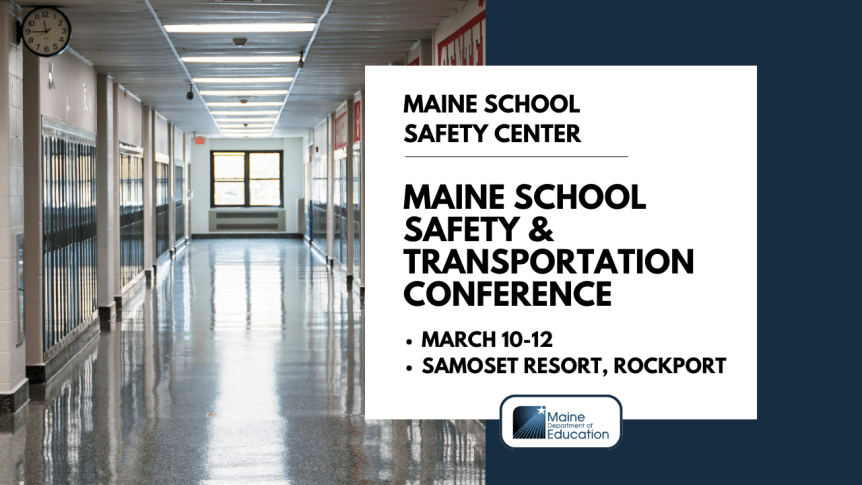
Save-the-Date for Maine School Safety & Transportation Conference

Please join the Maine Department of Education (DOE) Maine School Safety Center for the first School Safety & Transportation Conference from March 10-12, 2025 at the Samoset Resort in Rockport, Maine.

This event will bring together educators, transportation professionals, safety experts, and policymakers to discuss and explore innovative strategies, best practices, and emerging technologies to improve school safety and transportation systems.

Why Attend?

  • Learn from leaders: Gain insights from keynote speakers, panel discussions, and breakout sessions led by experts in school safety and transportation.
  • Network with peers: Connect with professionals and stakeholders from across Maine to share challenges, solutions, and success stories.

Who Should Attend?

This conference is designed for:

  • School and district administrators
  • School board members
  • Facility directors
  • Transportation directors and staff
  • School support staff (e.g., counselors, social workers, nurses, office staff, etc.)
  • Staff and team leadership
  • Safety and security personnel, including school safety specialists
  • Law enforcement and administrators
  • School resource officers
  • Juvenile community corrections officers
  • First responders and local/county EMAs

Please be on the lookout for upcoming communication regarding registration, which opens in mid-January. The first 150 attendees to register will receive a scholarship for registration, meals, and lodging. More information, including a full agenda, speaker lineup, and travel information, is also coming soon.

Let’s work together to create a culture of care and safety in our schools, as well as more efficient transportation systems for our students. We look forward to seeing you in March of 2025!

Maine Solutionaries Project Celebrates Success and a Bright Future Ahead

Every day, communities encounter new challenges that bring with them opportunities to make a positive impact. Since 2024, the Maine Solutionaries Project, a groundbreaking collaboration between the Maine Department of Education (DOE) and the Institute for Humane Education (IHE), has been working to address situations like these through the educational sphere.

The Solutionaries Project is an initiative that the Maine DOE’s Interdisciplinary Instruction team has spearheaded, reflecting a commitment to innovative and impactful educational practices. To date, 255 teachers and 7,500 students – hailing from all sixteen of Maine’s counties – have participated in Solutionaries Projects, and future enrollment numbers are increasing daily.

Far from being yet another “thing” for teachers to work into their lessons, the Solutionaries Project is a framework built to empower students through critical thinking skills and solution-driven, inquiry-to-action projects. Students define a problem, research the underlying issues, identify the people concerned, and create a practical and workable solution for it. Examples include everything from food waste to human rights and equity.

On Sunday, December 15, 2024, educators, change-makers, scientists, artists, and community members gathered at IHE’s home base in Surry, Maine to celebrate how the Solutionaries Project applies to the real world.

Kicking off the celebration, New York Times journalist Andy Revkin spoke about his decades as a climate reporter and how he has seen the changing environmental status of the globe reflected in the work emerging from student involvement within the Solutionaries Project. Revkin spoke at length about the importance of empowering future generations to better understand the issues facing them and make new choices.

Notable artist and humanitarian Robert Shetterly also lauded the program. The creator of Americans Who Tell the Truth spoke about the world influencers he has interviewed and the connections in philosophy to the work being done through the Solutionaries Project.

“The needs facing students today are increasingly pressing and complex,” Maine DOE Interdisciplinary Instruction Team Leader Kathy Bertini said. “Students deserve an education that equips them. Thoughtful and deliberate instruction in inquiry to action is critical. The Solutionaries framework is an invaluable tool for giving teachers and students access to that way of thinking and problem-solving.”

“I would recommend this program to anyone looking to incorporate out-of-the-box, responsive teaching into their curriculum; to anyone looking to motivate and encourage students to change our world for the better,” Erika Leighton, a teacher at Harriet Beecher Stowe Elementary School in Brunswick, said.

The Maine Solutionaries Project is continuing into 2025, offering multiple cohorts – including cohorts that focus on integrating literacy and numeracy throughout the Solutionaries Framework.

To learn more about the upcoming Maine Solutionaries Project cohorts, please visit the Maine DOE Newsroom. You may also contact Kathy Bertini at Kathy.Bertini@maine.gov or Erik Wade, Interdisciplinary Instruction Specialist at Erik.Wade@maine.gov.

The Interdisciplinary Instruction team is a part of the Maine DOE Office of Teaching and Learning.

Grants for Afterschool and Summer Learning Programs Now Available; Applications Due April 2, 2025

The Maine Department of Education (DOE) is pleased to announce the release of a request for proposals (RFP) seeking bids from organizations interested in implementing comprehensive afterschool and summer learning programs in 2025-2026. It is anticipated that roughly $2.5 million will be available to issue grant awards this spring.

Authorized under Title IV, Part B of the Elementary and Secondary Education Act, as amended by the Every Student Succeeds Act (ESSA) Act of 2015, the 21st Century Community Learning Centers (21st CCLC) program provides competitive grant funding to support before school, after school, and summer learning programs that focus on improving the academic performance of students in pre-K through grade 12.

The primary purpose of the 21st CCLC program is to provide funding for school and community partnerships that establish or expand community learning center programs. These programs provide students in high-need, economically-disadvantaged communities with academic tutoring and enrichment opportunities, designed to complement their school-day academic program. In addition, these programs can provide a broad array of additional support services related to overall student health and well-being.

Local 21st CCLC programs – which can be located in elementary schools, secondary schools, or similarly-accessible community facilities – provide high-quality support services to students during non-school hours. As such, these programs also support working parents and families by providing safe, supportive learning environments for students at times when school is not normally in session.

The request for proposal (RFP), which includes information regarding eligibility, program requirements, and more, is available on the Maine Office of Procurement Services website (Search for RFP #202412216.)

An informational webinar for this RFP will also be posted to the Maine DOE Grants4ME website on January 22, 2025. It is strongly recommended that interested organizations view this presentation in its entirety prior to submitting a proposal for 21st CCLC program funding.

Below is the anticipated timeline for the Maine DOE current 21st CCLC grant competition:

  • January 8, 2025 – RFP released to public
  • January 22, 2025 – informational webinar posted online
  • February 5, 2025 – deadline for submission of questions in response to RFP
  • February 26, 2026 – interested organizations submit intent to apply form
  • April 2, 2025 – proposal deadline
  • April 2025 – formal peer review of proposals
  • May 2025 – grant award notifications
  • July 1, 2025 – grant award start date

Please be advised that the dates above are subject to change. Interested organizations must consult the RFP document for the most accurate dates and deadlines regarding this opportunity.

For more information about the 21st Century Community Learning Centers (21st CCLC) Program, please contact State Coordinator Travis Doughty at travis.w.doughty@maine.gov.

Quarter 2 Reports Open: Attendance, Behavior, Bullying, Truancy

Attendance, Behavior, Bullying, and Truancy reports for Quarter 2 (October, November, and December) are now open. Validation of these reports is due on Wednesday, January 15, 2025.

These reports must be reviewed and validated. Superintendent validation is required for all quarterly reporting.

Software issues in Quarter 1 prevented Daily Attendance from loading into NEO reports; therefore, Quarter 1 validation will be included in the Quarter 2 validation period for both Daily Attendance and Truancy, so data listed in this report for Attendance and Truancy must include all data from July 1 to December 31.

Reporting resources:

For questions about quarterly reporting, please contact MEDMS.Support@maine.gov or call 207-624-6896.


Rescheduled Webinar: Creative Connections – Showcasing Student Artwork in the Community

Discover practical strategies for displaying student art in public spaces to celebrate creativity and strengthen community ties. This engaging webinar, hosted by Maine Department of Education (DOE) Arts Integration Teacher Leader Fellow Joshua Chard, will explore ideas like partnering with local businesses, hosting gallery nights, creating murals, and using digital displays to highlight student talent.

Participants will benefit from:

  • Real-world examples and tips for successful implementation.
  • Interactive discussions to inspire innovative approaches.
  • A downloadable checklist for actionable insights.

This session is designed for educators, administrators, and community leaders seeking to promote youth creativity and engagement. Joshua Chard will be joined by special guest Emily Serway, a National Board Certified Art Educator, to share expertise and inspiration.

Date: Wednesday, January 29, 2025 Wednesday, February 27, 2025
Time: 3:15 p.m.
Location: Join online via Zoom here. (No preregistration is required.)

Bring student art into your community with confidence and creativity. Don’t miss this opportunity!

The Teacher Leader Fellow Program is part of the Maine DOE Office of Teaching and Learning. For further information, please contact Joshua Chard at joshua.chard@maine.gov.