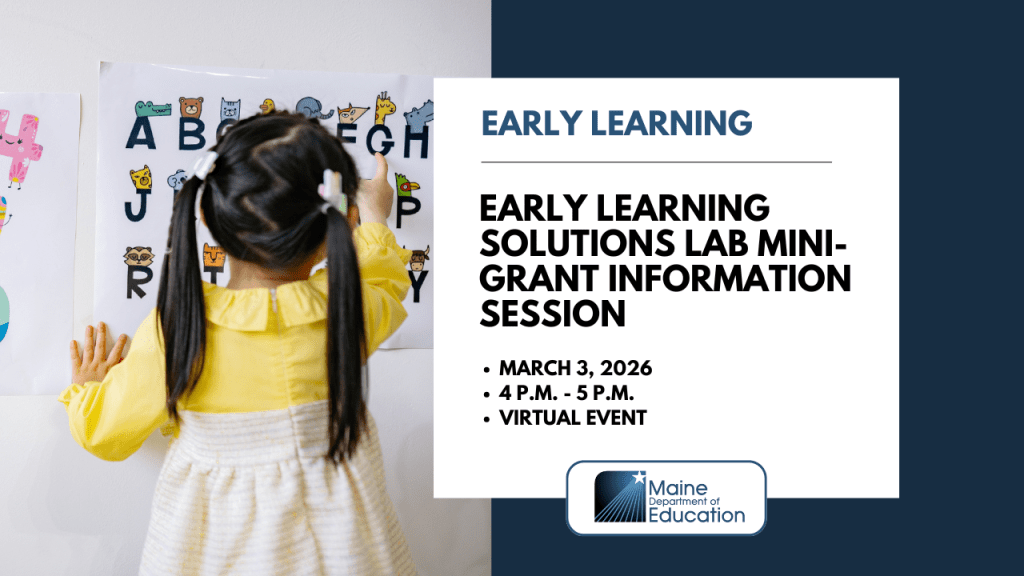
The Early Learning Team within the Maine Department of Education (DOE) Office of Teaching and Learning, in partnership with the Maine Department of Health and Human Services (DHHS) Office of Child and Family Services, is offering a joint professional learning opportunity, designed to strengthen community-centered mixed-delivery systems.
The landscape of early childhood education in Maine is evolving. The continued expansion of public pre-K programs, along with recent legislation transitioning Free and Appropriate Public Education (FAPE) responsibilities for children ages three to five from Child Development Services (CDS) to public schools, underscore the growing need for a strong, coordinated mixed-delivery system. This kind of system—one that intentionally connects public schools and community-based early care and education providers—helps all children have equitable access to high-quality early learning opportunities from birth through the early elementary years.
Building and sustaining a mixed-delivery system requires communities to move beyond siloed approaches and work collaboratively across schools, Head Start programs, private centers, and family child care homes. Together, partners can expand access, respond to diverse family needs, and create more seamless experiences for young children and the adults who support them.
Community of Practice
Early childhood administrators and educators from both public schools and community-based programs are invited to participate in a three-session Community of Practice (CoP) to help establish the relationships and shared understanding needed to strengthen local systems. Through this CoP, participants will:
Explore the benefits of high-quality early childhood education delivered through mixed-delivery systems.
Learn how mixed-delivery models support children, families, and communities.
Examine examples of successful approaches currently being implemented across Maine.
CoP sessions will be offered at two different times to support participation across the early childhood ecosystem:
Option 1: 12:30-1:30 p.m. on Tuesdays, March 17, 24, and 31, 2026
Option 2: 3:30-4:30 p.m. on Wednesdays, March 18, 25, and April 1, 2026
Interested individuals should complete the CoP registration form, which will remain open through March 13, 2026, and will help organizers understand participant backgrounds and questions related to mixed-delivery systems.
Early Learning Solutions Lab Mini-Grant
Community teams that complete the three CoP sessions will also be eligible to apply for an Early Learning Solutions Lab mini-grant. The Solutions Lab provides continued shared learning, targeted technical assistance, and funding to support the implementation of activities that strengthen local mixed-delivery systems. This work requires close collaboration between school administrative units (SAUs), community-based early care and education providers, and organizations that serve children and families.
Solutions Lab participants will meet monthly from May through December 2026 and may also engage in individualized coaching sessions, as needed. Reimbursement will be provided for related travel and participation in meetings outside of contracted hours.
Each participating community will form an Early Learning Solutions Team, responsible for developing and implementing a coordinated plan that supports children, families, and educators in the community. Once plans are finalized, teams will be eligible to receive additional funding to support the implementation of planned activities through December 2026.
With questions or for additional information, please contact Sue Gallant, Maine DOE Early Childhood School-Community Specialist, at Sue.Gallant@maine.gov or Michelle Belanger, Maine DOE Pre-K Partnership Specialist, at Michelle.Belanger@maine.gov.
This opportunity is funded through Maine’s Preschool Development Grant (PDG). Funds received from the U.S. Department of Health and Human Services Administration for Children and Families support the full implementation of this project. The total award is $1,933,007, of which 100% is federally funded. The contents are those of the author(s) and do not necessarily represent the official views of, nor an endorsement by, the Administration for Children and Families or the federal government.
At Eliot Elementary School (EES), a dedicated team of educators is working intentionally to build trust and strong relationships with students from the moment they arrive, helping children to feel known, valued, and supported and want to come to school. This pre-K–grade 3 school serves approximately 275 students and is committed to fostering a safe, inclusive environment. With dedicated educators, supportive families, and strong community connections, EES is a place where students and staff grow together each day.
“I get to see my friends and teachers while learning and playing,” an EES student said about what makes them feel excited or happy to come to school each day. Another EES student added, “I decide if I make good choices or bad ones, and teachers will help me.”
In recent years, chronic absenteeism was an increasing concern for EES. Before the pandemic, chronic absenteeism rates ranged from approximately 9-12 percent. Following the disruptions of remote and hybrid learning, however, the rate rose sharply, peaking at 23 percent during the 2022-2023 school year. The good news: Chronic absenteeism rates dropped to 11 percent in the 2023-2024 school year, fell to six percent in the 2024-2025 school year, and has remained between five and six percent so far in the 2025-2026 school year.
This meaningful change began when the district openly acknowledged chronic absenteeism as a districtwide challenge. Principal Ann Shisler served EES as a classroom teacher for 31 years and is now in the second year of her current role. She brings a deep respect for the school’s history and a strong connection to its community to her work—reflected in the ways that she has worked to address this challenge.
“Sharing the school’s absenteeism rate monthly—paired with small, clear pieces of information about why attendance matters—helped families understand the impact without feeling blamed or overwhelmed,” Shisler explained.
At the core of EES’ approach to addressing chronic absenteeism is a simple belief: When children feel safe, cared for, and connected, they want to come to school.
“Instead of viewing absenteeism as a problem tied to specific students or families, the school began seeing it as something the entire school could influence and improve together,” Shisler said.
Shisler said one of the most impactful strategies has been strengthening daily connections with students. EES’ goal is for every child to have at least two trusted adults they can rely on. Currently, 93 percent of EES students report feeling safe at school, and 96 percent say they enjoy coming to school.
“Because we know our students so well, we can respond with care and understanding,” Shisler said. “Often, we’re able to support students in quiet, thoughtful ways—sometimes, without them even realizing, while meeting each child where they are.”
Each morning, students enter the building in a calm, structured manner and are greeted by three to five staff members before reaching their classrooms. Students may stop in the cafeteria to pick up breakfast, if they choose, and then head directly to their classrooms, creating a predictable and welcoming start to the day. Arrival is staggered over approximately 20 minutes, reducing congestion and supporting a smoother, quieter transition into the building.
Staff greetings include the use of eye contact, students’ names, and positive comments or gestures—small moments that collectively make a powerful difference. As a result, the school has seen increased student engagement, reciprocal greetings, and a warmer, more regulated start to each day, setting a positive tone for learning.
Having an established morning routine also reinforces shared expectations and provides leadership opportunities for students. Schoolwide expectations are revisited daily: taking care of oneself, taking care of others, taking care of property, listening and following directions, and staying safe. Student-led morning announcements give children a sense of voice and ownership, fostering pride and responsibility within the school community.
Students who have participated in these morning announcements said:
“Sharing the school rules every day—it’s a reminder that helps little kids.”
“We get to use the phone as a speaker.”
“We get to share information and jokes.”
Connections are further strengthened through lunch groups, small-group projects, and mentoring opportunities.
“The positive relationships fostered between students and staff through morning greetings and small group work are for all students at EES,” an EES educator said. “Many times, building relationships with the students who need them the most is the hardest. EES has seen an improvement in classroom behavior directly related to the relationships built outside the classroom.”
Currently, 10 EES students participate in the Hawk Buddies program, which pairs elementary students with high school mentors. Additionally, approximately 20 EES students work individually or in small groups with specialists in art, physical education, music, and library. These supports are fluid and can be adjusted throughout the year, based on student needs.
“I’m pleased with the relationships I’m fostering in the small groups I have each week, outside of my library classes,” another EES educator said. “I have noticed that behaviors have decreased during class time and that I can more easily get [students] back on track when they’re not following directions, etc. I believe they know they can trust me and that they can come to me when they’re struggling, sad, or upset—and, conversely, they like to share when things are going well.”
Enrichment opportunities also play a key role in promoting engagement and attendance at EES. The school’s parent group, PEEPS, generously funds all enrichment experiences—more than $18,000 annually—making learning engaging and exciting for students. These experiences include an annual STEAM (Science, Technology, Engineering, Arts, and Mathematics) Day facilitated by the Portsmouth Naval Shipyard, as well as other whole-school and grade-level activities that provide students with meaningful opportunities to look forward to throughout the year.
The school’s Multi-Tiered System of Supports (MTSS) plays an important role in supporting students’ academic, social, and behavioral needs. Each week, a team consisting of the principal, guidance counselor, reading interventionist, special education teacher, and grade-level staff meets to review academic, social-emotional, and attendance data. Unlike prior years, when MTSS discussions focused on a limited number of students brought forward by classroom teachers due to concerns, the team now reviews data for all students on a rotating basis by grade level. This proactive approach allows for early identification, prevention, and timely support, ensuring that needs are addressed before challenges escalate and that every student is considered in the process.
EES has also made significant investments in staff professional learning. Thirteen staff members recently participated in state-funded The Regulated Classroom training, representing more than $20,000 in professional development, provided at no cost to the school. This training has strengthened staff understanding of co-regulation, trauma-informed practices, and how to create calm, supportive learning environments.
Additional efforts, including student leadership roles, school jobs, service-learning projects, and the presence of the school’s therapy dog, Ria, further enhance students’ sense of belonging.
To maintain family partnerships, the school sends a monthly memo that shares attendance data and reinforces the importance of consistent attendance. A recent January memo celebrated maintaining a six-percent chronic absenteeism rate, thanked families for thoughtful decision-making surroudning absences, and emphasized the importance of the winter months for academic and social-emotional growth. EES values families’ partnerships in keeping children home when they are sick, while being mindful of nonessential absences—recognizing that both health and consistent attendance are essential to student success.
The impact of these efforts at EESis clear: Student engagement has increased, and attendance has improved significantly. A recent survey highlighted a strong sense of community, warmth, collaboration, and trust between families and the school. Families describe EES as kind, data-driven, and a place where children are excited to learn and belong.
“Daily routines, including greetings and small group connections, have created a stronger, more authentic community within EES,” an EES educator said. “Adult-student relationships are stronger than ever, allowing students to feel safe and connected, creating an environment where students want to be and are ready to learn.”
For schools seeking to address chronic absenteeism, the experience at EES reinforces a clear takeaway: Strong, authentic relationships with students and families matter. When children feel seen, supported, and connected, attendance improves naturally. Relationships are not a program; they are the foundation.
This article was submitted by Eliot Elementary School. To submit a good news story to the Maine DOE, please fill out the good news submission form.
Get to know 2026 Maine Teacher of the Year Julia Edwards, a choral music teacher at RSU 16’s Bruce Whittier Middle School and Poland Regional High School. Julia shares more about herself in this Q&A, as she begins her year of service.
What or who inspired you to pursue a career in education, and how did you ultimately decide to teach music?
In high school, I attended a camp and took a leadership class called, “I Will Get Things Done” with my friend, David Cranson. The message of the day was: “When we have abundance, it is then our responsibility to share.” That stuck with me. At the core of my teaching philosophy is this concept of “abundance;” music has given me countless opportunities, connected me to incredible people and places, and helped me find my place in the world. If I can take that abundance and share it with others, I see no other way to spend my career.
This “abundance” stems from the fact that my entire family considers music a second language. In fact, in many ways, it feels like our first language. It is the one thing we all share on both sides of our families, so my sister and I grew up attending rehearsals, concerts, and musical community events. While I also had a deep interest in science growing up, I realized I couldn’t just have music as a hobby; it needed to be my day job. I have never truly been a performer at heart, so my love of science, desire to share, and passion for music led me to pursue a degree in music education.
Role models I have had throughout this process include my grandfather, Floyd Corson, who began the music education program at Westfield State University and taught high school chorus for years; my elementary music teacher, Lynn Songdahl Sweet, who nurtured my curiosity and enthusiasm and gave me so many opportunities to grow; and Dr. Deanna Joseph, who was the first professional conductor I could truly see myself in—and who challenged me to lean into developing my own leadership skills in college. There are hundreds more, but this trifecta truly made “more” seem possible to me in a crucial way.
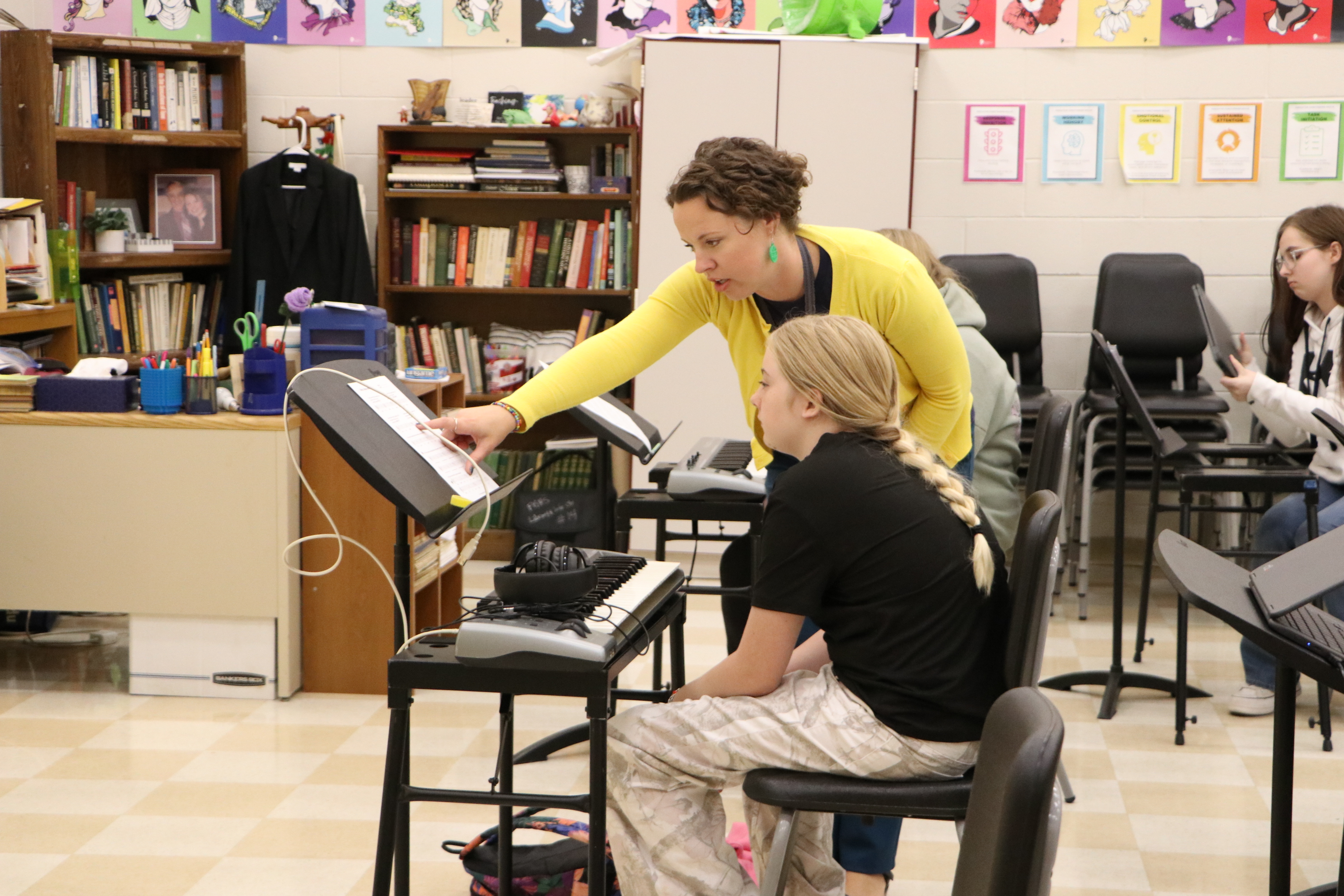
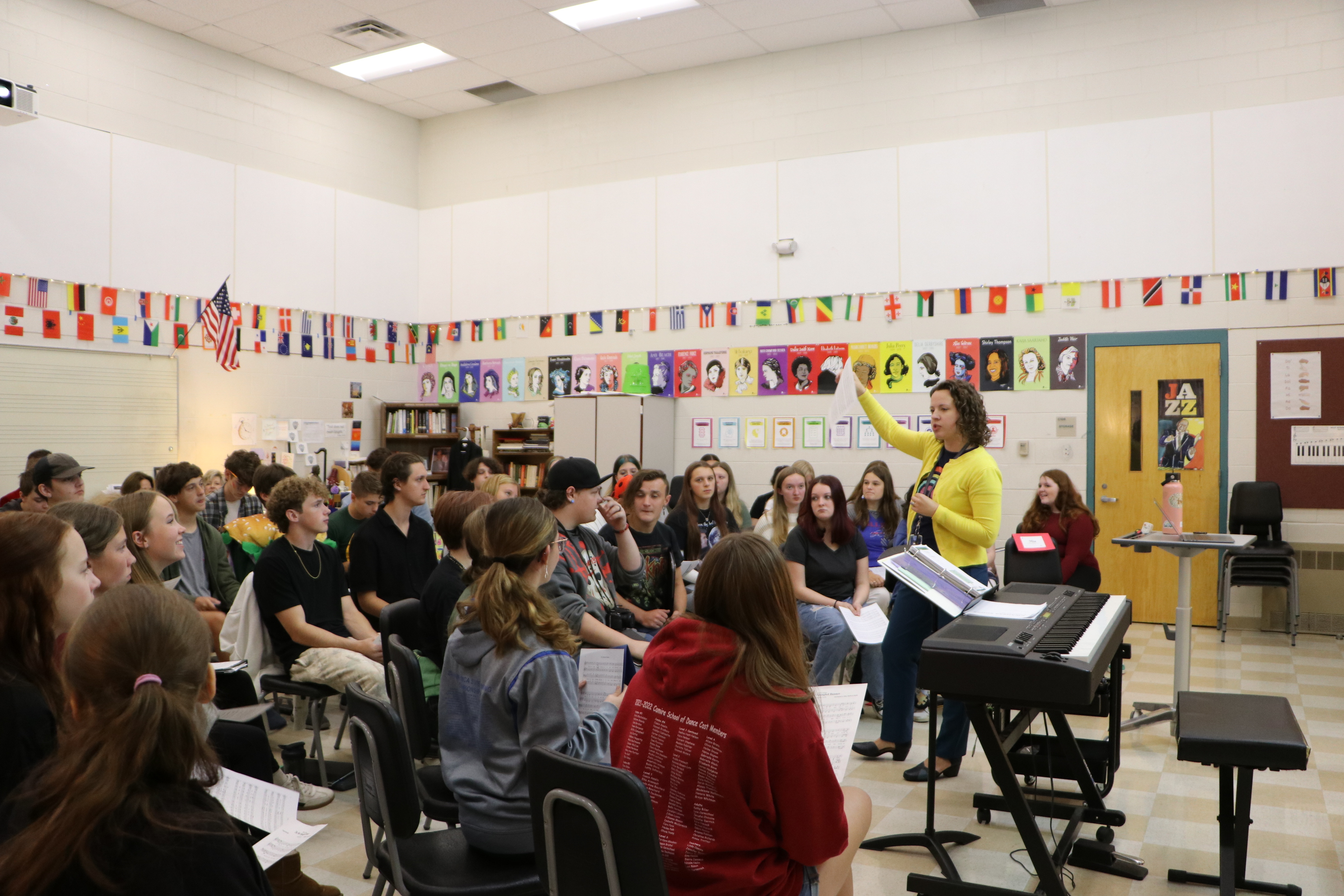
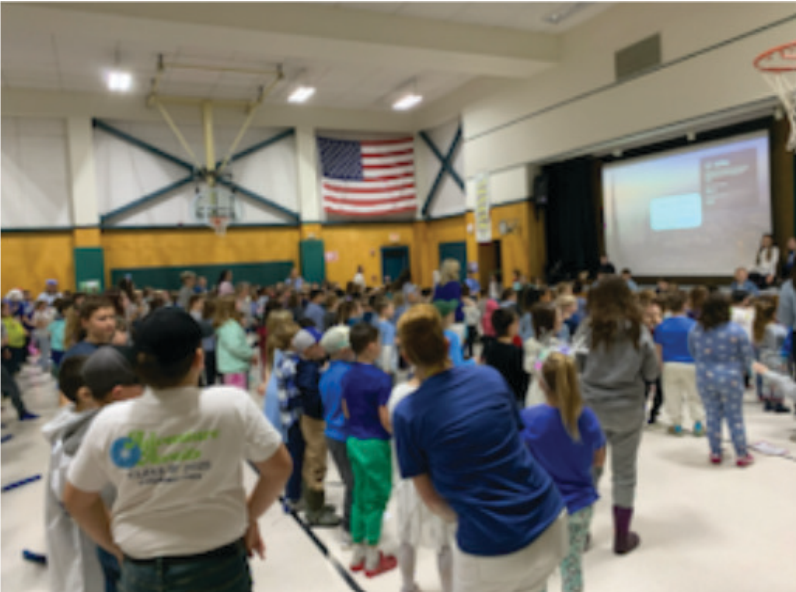
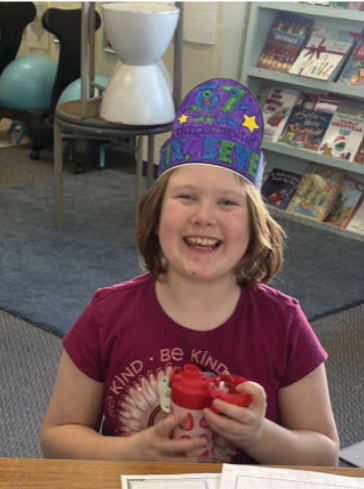
Images taken in Julia’s classroom during the Teacher of the Year selection process.
With many years of experience in the classroom now under your belt, what continues to bring you joy and purpose in your work as an educator?
Most of the folks I know who teach—and especially those who have taught for a long time—tend to respond to this question with two answers: The first is that teaching is always changing, growing, and moving. Students and best practices are constantly evolving, which makes this career quite dynamic and challenging in ways that are really engaging. The second is that it can be deeply rewarding to witness one’s students grow.
While both of these answers hold true for me, there is something else I’ve been noticing in what drives me. I like to think of myself as a mirror; so often, my students don’t realize the extent of what they are capable of or how much joy they bring to their community or what good people they are. If I can help them to see the good in themselves—academically, musically, and socially—then perhaps they will be a bit more willing to use that good to better their communities and world. This happens through skill-building and performance and assessment—but the end goal really is to watch my students leave my door for the last time with a deeper appreciation for the world and the desire to exist in it with the tools and commitment to make it better.
As 2025 Androscoggin County Teacher of the Year—and now as 2026 Maine State Teacher of the Year—you have spoken about the importance of music in education. Why do you continue to advocate for the preservation of the arts in education?
Music is found in everything we do. Our physiological existence has rhythm. Our earliest artifacts of human existence show evidence of rhythm. Language has cadence and melody. We mark our most important moments with music (for example, imagine a wedding or graduation without it). Everywhere around the world, music and the arts are what form the constant undercurrent of cultural identity. While I could profess its importance in an academic setting, there is no need; the science is irrefutable in consistently revealing that music and the arts are not supplementary to a quality education; they are fundamental to it.
For every argument against funding music education, there is a clear rebuttal. Cost per student, test scores, scheduling, etc., all fall short as reasons when you look at the benefits of music education. We have identified social-emotional learning, executive functioning, community engagement, and critical thinking as skills that students are in dire need of at this point in time. All of those skills have been among the benefits of music education for centuries and will continue to be. The more we lean into embracing and promoting the role of the arts in developing such skills, the better our students—and communities—will be.
On a personal level, I think the most important reason why we need to support the arts in education is that our communities so desperately need the arts right now. Music is the most powerful way to engage folks across generations and cultural differences, and our communities deserve more opportunities to share positive common experiences.
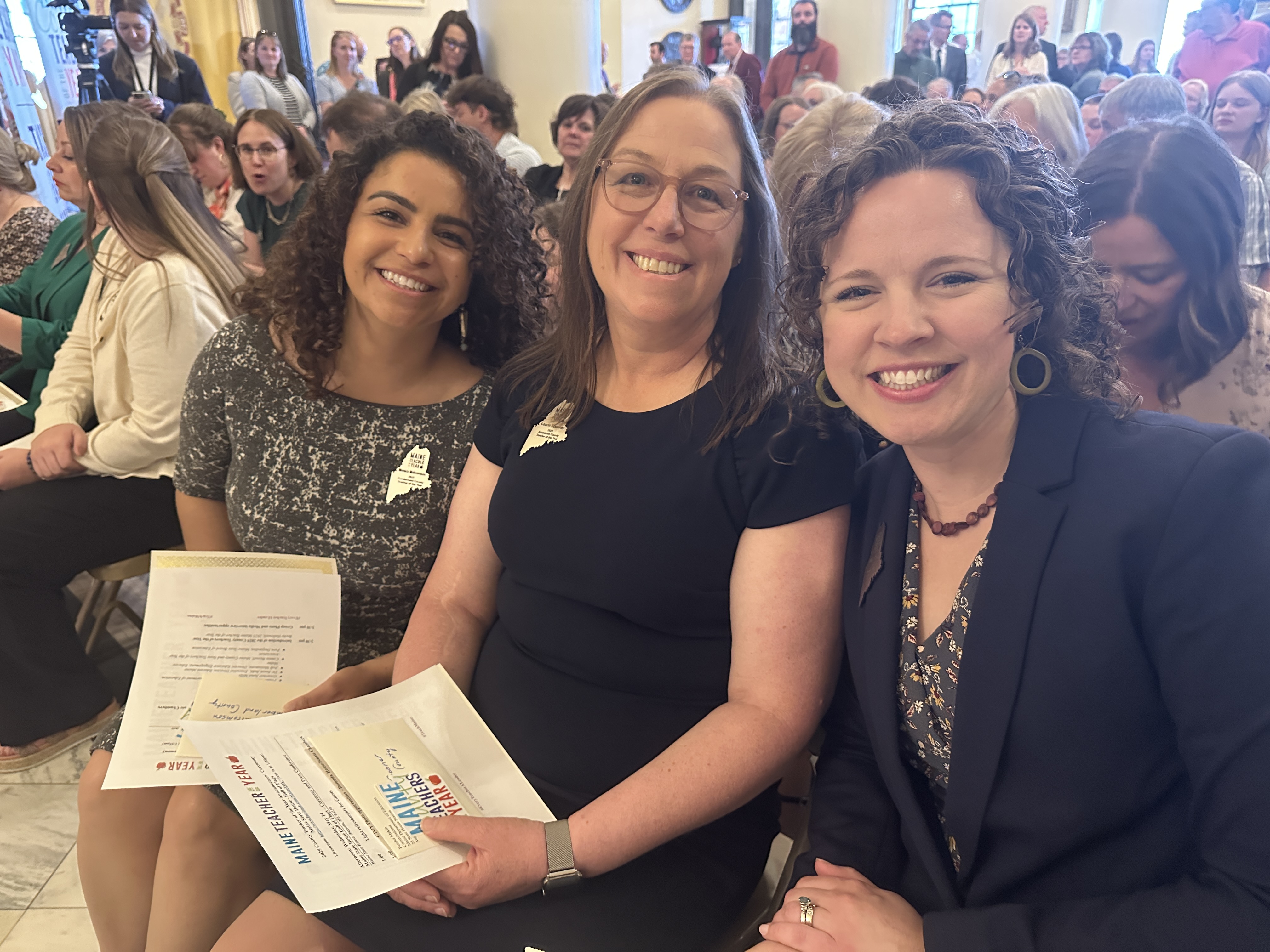
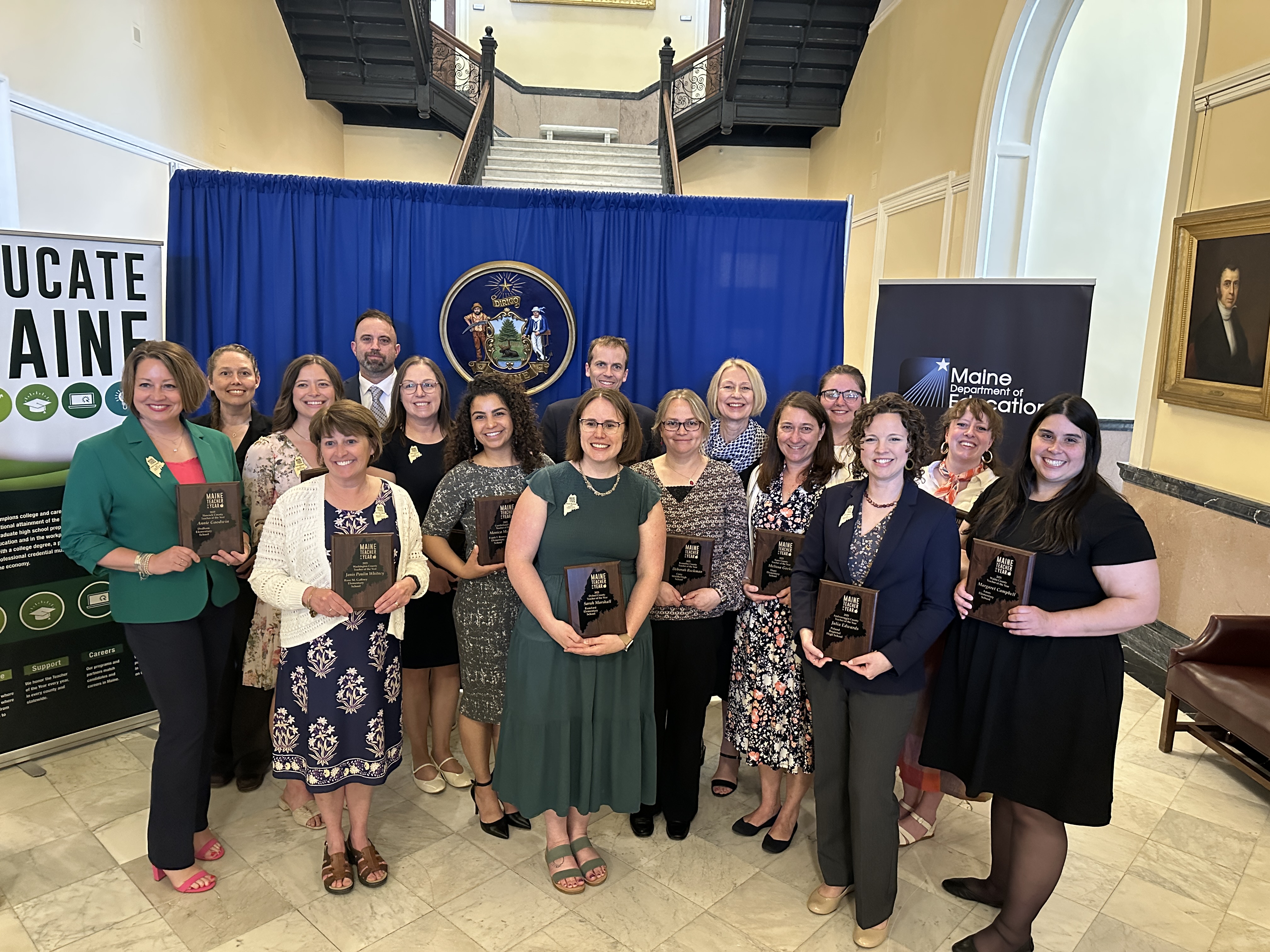
Images taken at the 2025 County Teacher of the Year announcement in May of 2025, where Julia was named 2025 Androscoggin County Teacher of the Year.
In your opinion, what makes your school community—and the students you work with—unique?
RSU 16 is home to a large handful of folks who have been County Teachers of the Year, Maine Teacher of the Year finalists, Maine State Teachers of the Year, and Principals of the Year. Folks visit from across the state and remark how special our district is. Part of this is administrative balance—the support of teachers and students, balanced with respect for teacher autonomy and efficacy—and part of it is the set of values that our schools were founded on. More than anything, I think what makes our community and district so special is similar to what makes Maine great: We show up.
I really believe that the community where I teach does a lovely job of demonstrating that folks from different backgrounds and experiences can find common ground to invest in their community. I have always been impressed by the way my students treat each other in general—holding the door for each other, demonstrating an interest in each other’s passions, cheering each other on in their endeavors, and showing an interest in the world at large. The teachers in our schools are some of the most innovative, engaged professionals I’ve ever met. When you work with students and fellow teachers like this, it’s easy to get through the days and trust that any struggles will be met with creative problem-solving and positive outcomes.
Looking back on your career so far, what is one lesson that has had a lasting impact on how you approach teaching and working with students?
It’s simple: Show up. When I was student teaching, I had one particularly bad day. I was “off” and struggling to reach students with the way that I was teaching. My cooperating teacher said a few things that made me question whether I should teach at all. At the time, I was the teaching fellow for a community children’s choir, which had rehearsal that afternoon. I called the director and told him I couldn’t come in that evening, vaguely explaining what had happened. His response was to ask me essentially this: “Is your need to go home and sit in your grief greater than the children’s need to have a stable adult consistently showing up for them? Perhaps you’ll find it’s good for the kids andfor you if you show up anyway, even though you’re feeling discouraged.” So, I showed up. We had an amazing rehearsal, and many of the students made remarks about how much they’d learned or the fun that they’d had. I felt like a teacher again. I felt joy in teaching again. It reminded me that the most important thing we can do as teachers—as adults—is to show up consistently and to remember that we are connected to each other in ways that can make us capable of both saving our community and being saved by it.
Additionally, what is one of your favorite memories from your classroom?
This will always be a difficult question to answer. We have a lot of fun in the music room! I’ve also spoken before about how much I love our Community Service Day and bringing students to the local memory care facility. The first time we did that was life-changing, and seeing the impact it had on my students and on the residents was a gift that I hold dear.
My favorite concert/community moment happened when two seniors performed, “If I Can Dream,” a song about Martin Luther King, Jr. that was popularized by Elvis. One student sang the Elvis solo, while the other signed the song. What’s important to know about this situation is that the student who was signing had found out only a few years prior that she had degenerative hearing loss and would eventually be naturally deaf. She began learning ASL for basic communication but didn’t know how she would continue her love of singing. She decided to learn how to create signed lyrics (which often differ from conversational ASL) for her senior capstone project.
So, we had a duet of sorts—one student belting out Elvis with all of the charisma and passion he could muster, and the other student creating beautiful, signed gestures to communicate the powerful lyrics. While it was an impactful performance, that’s not what made it my favorite memory; the applause was.
I have never been someone to work for the applause, nor are my students, but this moment was special. Folks erupted in response to the performance by clapping, hooting, and cheering for the soloists. Then, one person (my signer’s father) began the ASL sign for applause. The auditorium fell silent, as more and more people caught on, enthusiastically shaking their palms back and forth in the air, in a giant wave of deaf applause. My signing student felt so seen and appreciated in her growing identity as a member of the deaf community—all while participating fully in her music community. The best part was that I had to turn her around to see all of her peers behind her, applauding her in silence. When I say music is for everyone, I mean it.
During your tenure as 2026 Maine Teacher of the Year, what key themes or priorities are you most excited to elevate on behalf of educators across the state?
Beyond my reminder that, “Music can do that!,” I think on a broader scope, I want to remind folks of just how much quality there is in Maine’s public schools—both in students and teachers. We are humble folk, but we are capable folk, and it’s exciting to be reminded of that in every way as I work with folks outside of our state.
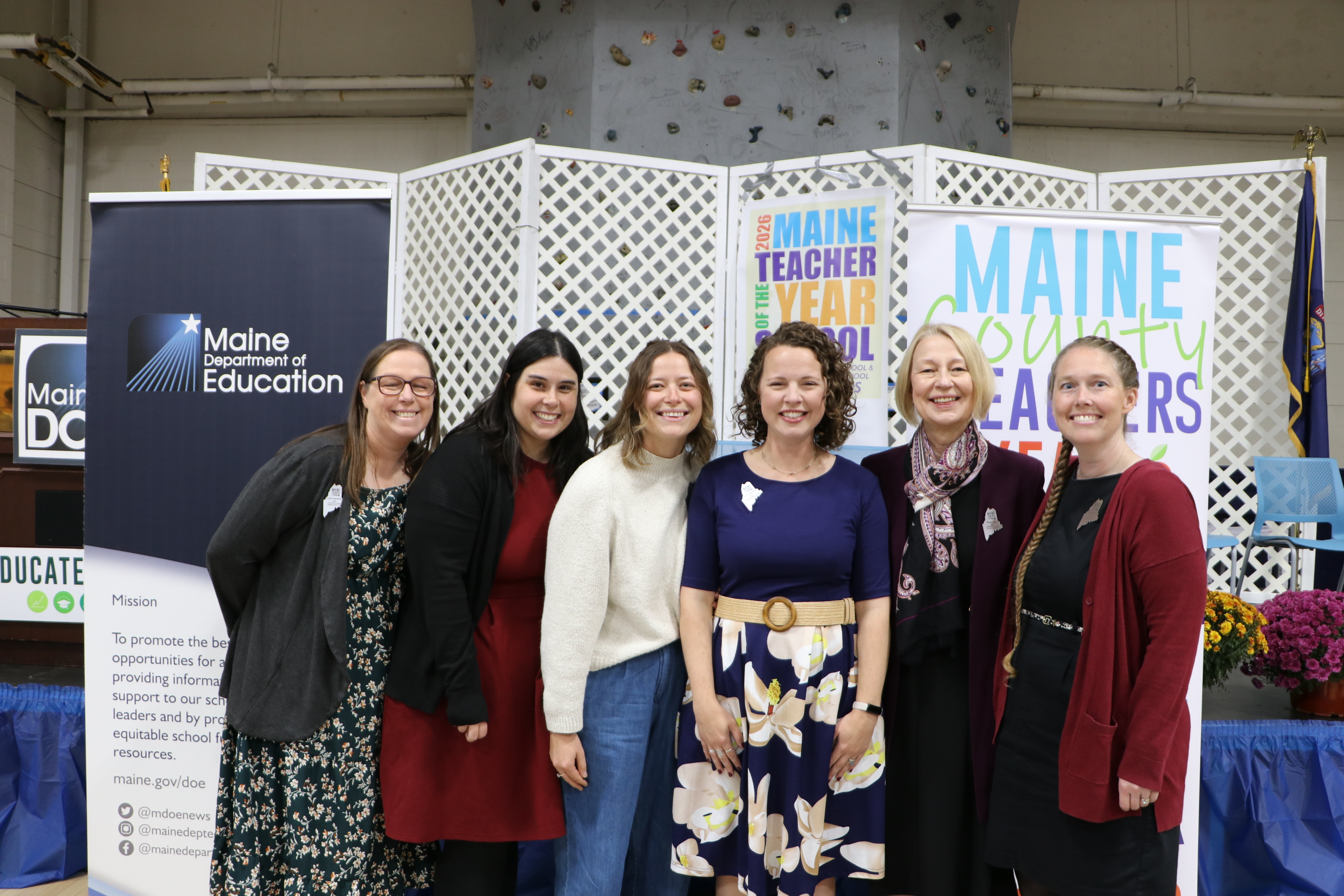
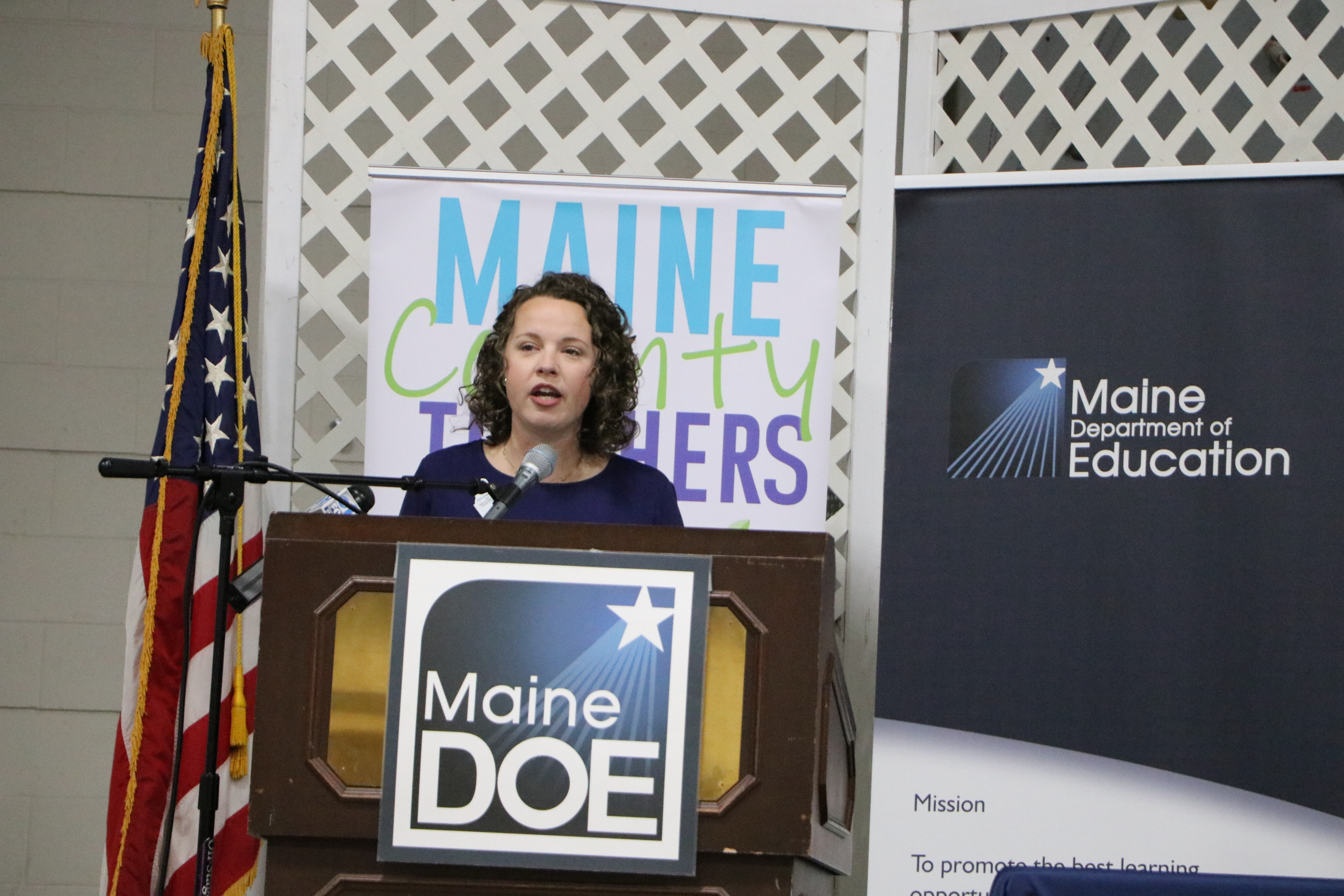
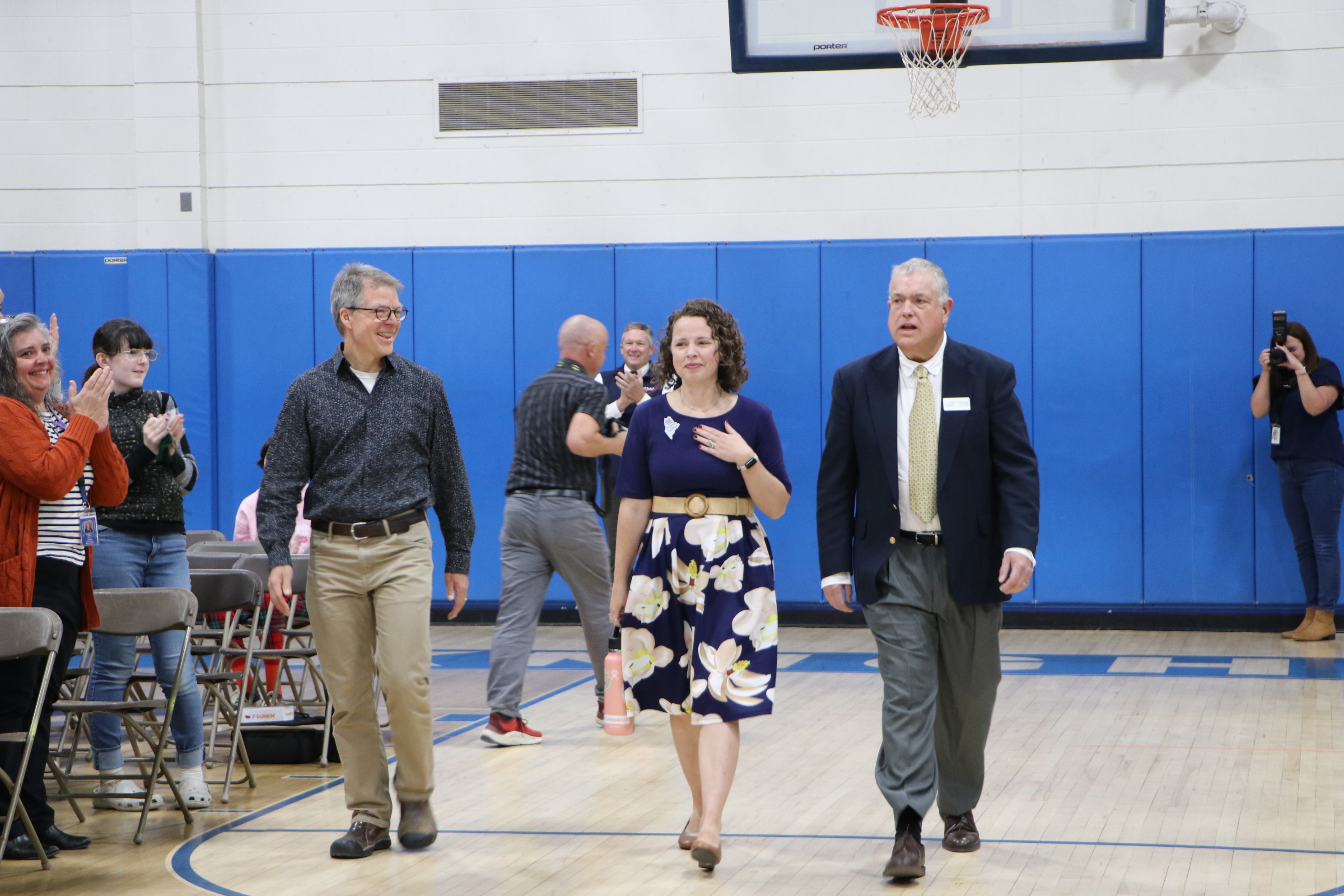
Images taken when Julia was named 2026 Maine Teacher of the Year in a surprise celebration at Poland Regional High School/Bruce Whittier Middle School in October of 2025.
From your perspective, why is public education such a vital part of Maine’s communities and the future of our state—and nation?
If you think about it, public schools are such special places. Where else do we meaningfully build a space that is designed to include every person who walks through its doors, regardless of their resources, circumstances, beliefs, or perceived aptitude? To teach at a public school means to greet every single student who comes through your classroom with the intent of finding the level of skill and understanding that they possess and raising it to meet their potential. Public school teachers have so much faith, trust, and persistence. We actively seek what students are capable of and employ countless tools to help them reach the full extent of their capabilities.
Public education in Maine is special because I think we strike a nice balance of incorporating national learning standards while honoring the roots and values of our state and its inhabitants. I loved taking Maine Studies in middle school and hearing about how folks include Maine history and culture in their classrooms.
Nationally, I truly believe we cannot have a functioning democracy without a comprehensive public education system. There is something to be said for a common understanding amongst citizens that unites them in their American identity. In some ways, this is logistical and procedural—like understanding the Constitution—but in most ways, this is cultural by finding a shared language in our lessons and references and knowing where our common ground lies.
For those who may be considering a career in teaching, what would you like them to know about the profession?
I have been fortunate to have the right things line up in my career: equal amounts of love for both the subject I teach and for the students I teach, administration that is supportive while preserving my autonomy in the classroom, colleagues who challenge my thinking and whose company I enjoy, students who want to learn what I’m teaching, and a community who shows up.
Teaching is hard work; I won’t pretend otherwise. And, indeed, it is getting more difficult, as we navigate the rapidly changing landscape of technology, shifts in child development, cultural paradigms, and school structure challenges—such as class size and political divide. There is so much beauty, though, in navigating those challenges and changes with people who are excited to be a part of a positive school community. It feels good to be involved in the process of providing students with tools to be good citizens and good people.
Iris Dement has a song that states, “I’ve been workin’ on a world I may never see.” Teaching is just that for me. So much of the growth happens in moments that we as teachers don’t get to witness, but the faith and trust that it requires can be exhilarating.
What else would you like to share with educators, students, or community members who are following your journey as 2026 Maine Teacher of the Year?
I want folks to know how much power they have in helping to nurture future generations by collaborating with schools, demonstrating support for teachers, and asking good questions. Gratitude goes a long way, as does clear communication—on the part of educators, students, and community members. The 2025 County Teachers of the Year cohort’s message is that, “Great schools make great communities, and great communities make great schools.” I’d love to see us all find more ways to collaborate between schools and communities, and I’m excited to see how music can be one part of that important mission.
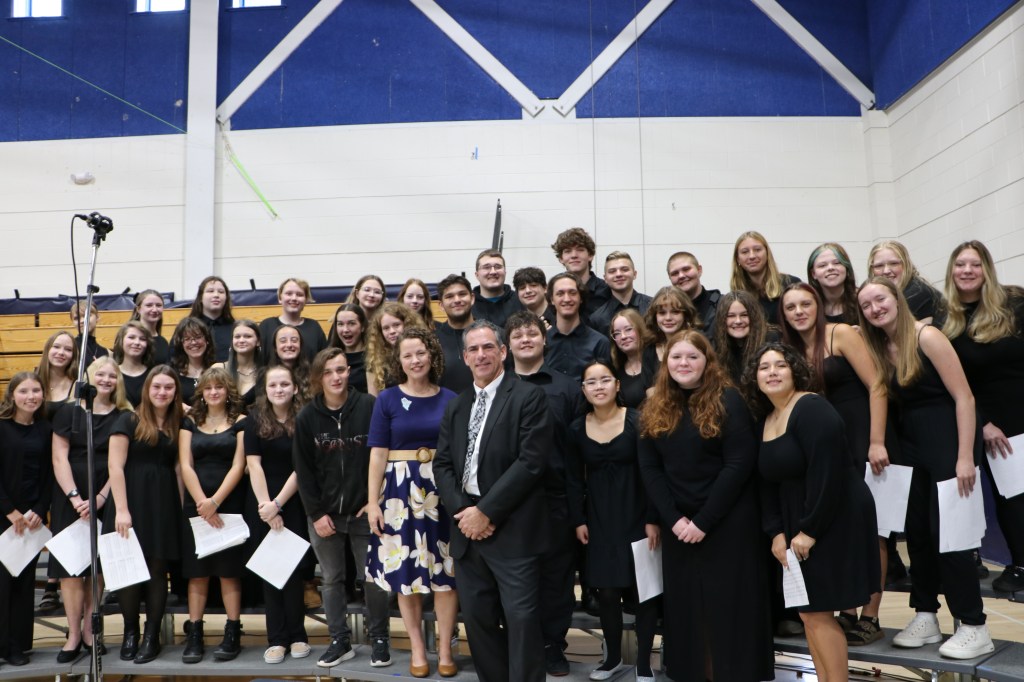
Julia poses with colleague, Larry Williams, Poland Regional High School Band Teacher, and her choral students during the 2026 Maine Teacher of the Year announcement.
The Maine Department of Education (DOE) is joining Volunteer Maine in encouraging schools across the state to submit nominations for the 2026 Governor’s Awards for Service and Volunteerism, which recognize outstanding individuals, teams, and organizations that are making a meaningful impact through volunteer service. Nominations are open now through March 9, 2026.
Since 1987, the Governor’s Awards for Service and Volunteerism have celebrated and recognized the role of citizen volunteers in the success and vitality of Maine communities. School leaders are encouraged to help identify and recognize students, educators, staff members, families, volunteers, and community partners who step up to serve when and where they are needed. Sharing this opportunity within your school community can help to ensure that Maine’s dedicated volunteers receive the recognition they deserve.
Several award categories are available, including opportunities specifically well-suited for school communities:
Youth Roll of Honor (non-competitive)
Nominees must be 18 years old or younger.
Nominees must have volunteered at least 50 hours in the prior year.
Maine Volunteer of the Year: Recognizes an individual who has demonstrated exceptional commitment to improving lives and communities through volunteer service in Maine.
Young Maine Volunteer of the Year: Recognizes a volunteer under the age of 20 who exemplifies active citizenship and community leadership.
Outstanding Volunteer Team: Recognizes a team of volunteers that has made a significant community impact. (Please note: Fundraising activities are not eligible.)
Outstanding Business Volunteer Program: Recognizes employers that foster strong workplace volunteer programs and cultures of service. (Please note: Fundraising activities and donations are not eligible.)
Outstanding Non-Profit Volunteer Program: Recognizes volunteer programs operated by non-profits, schools, municipalities, or government units that have driven meaningful community improvements.
The Governor’s Awards for Service and Volunteerism provide an opportunity to shine a light on the individuals and groups who strengthen communities across Maine. School leaders are encouraged to submit nominations and share this opportunity widely to help ensure that deserving volunteers are recognized.
The awards ceremony will take place on Saturday, May 9, 2026, from 1 to 3 p.m. at Camp Chamberlain, Maine National Guard Joint Force Headquarters, located at 23 Blue Star Avenue in Augusta.
Pursuant to S.P. 182, L.D. 396, Resolve 2025, Chapter 110, the Maine Department of Education (DOE) is now accepting applications for a competitive, one-time funding opportunity for Maine school administrative units (SAUs) that are interested in collaborating to change school start times so that secondary schools begin at 8:30 a.m. or later.
To learn more about this grant opportunity, access the Maine DOE Office of Teaching and Learning grant page here for the recording of the Information Session and slide deck.
The anticipated timeline for this RFA is as follows:
February 27, 2026 – RFA open in VSS
March 30, 2026 – applications due via VSS (by 4 p.m.)
March 31 to April 27, 2026 – formal review period
April 27, 2026 – grant award notifications
June 1, 2026 – grant award contract start date
September 10, 2026 – grant award contract end date
November 1, 2026 – reporting requirements due (by 4 p.m.)
SAUs may access the Request for Applications (RFA) through the State of Maine’s Vendor Self-Service System (VSS). All applications and questions related to this RFA must be submitted through VSS. The Maine DOE strongly encourages SAUs to confirm that they can access VSS well in advance of the application deadline of March 30, 2026. (Please refer to this priority notice for additional information and training materials related to VSS.)
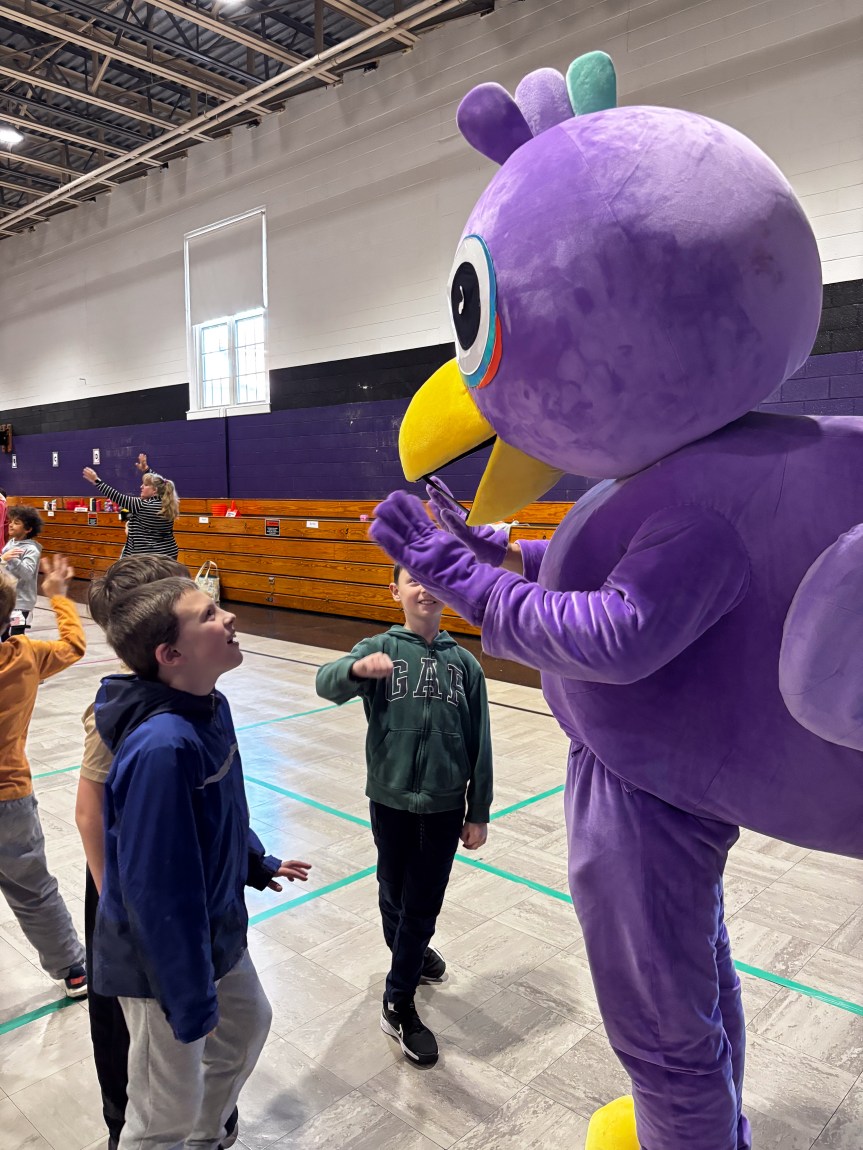
The 2026 Read to ME Challenge, a month-long public awareness campaign designed to support literacy development among Maine children, is officially underway. Maine Department of Education (DOE) Commissioner Pender Makin launched the challenge on Monday, February 2, 2026, with a read-aloud to second- and third-grade students at the Tremont Consolidated School library in Bass Harbor. | More
Throughout Maine, schools and school administrative units (SAUs) are finding new and creative ways to help students explore careers, connect learning to real-world experiences, and prepare for life beyond the classroom. To better understand and strengthen these efforts, educators and education leaders are invited to participate in a brief Career Exploration Survey. | More
The Maine Department of Education (DOE) is pleased to share information about new funding opportunities and resources for Maine schools, as it pertains to energy savings. The following three items are intended to help school administrative units (SAUs) maximize their energy efficiency, save money, and reduce air pollution. | More
Do you know a Maine high school junior who’s passionate about science and curious about the ocean? Applications are now open for a no-cost, immersive ocean research experience through the Keller BLOOM Program, offered by the Bigelow Laboratory for Ocean Sciences. | More
Regional School Unit (RSU) 22 (Hampden, Newburgh, Winterport, and Frankfort) is making significant strides in creating a positive, student-centered culture, thanks to the Positive Behavioral Interventions and Supports (PBIS) framework. | More
The Maine Department of Education (DOE) is offering a new, six-part professional learning series titled, “Beyond Compliance: Integrated Supports for Multilingual Learners with Disabilities,” to be facilitated by Maine DOE Teacher Leader Fellow Melissa Frans. | More
Since 2018, the Maine Department of Education (DOE) has adapted and piloted the For ME Instructional Programs for early elementary grades (pre-K to grade 2), based on the Boston Public Schools’ evidence-based Focus Curricula. These open-source, developmentally appropriate instructional programs are interdisciplinary and align with Maine’s learning standards. | More
Registration is now open for the second annual Maine Inclusive Education Conference, scheduled for Wednesday, April 8, 2026, at the Augusta Civic Center. | More
Throughout Maine, schools and school administrative units (SAUs) are finding new and creative ways to help students explore careers, connect learning to real-world experiences, and prepare for life beyond the classroom. To better understand and strengthen these efforts, educators and education leaders are invited to participate in a brief Career Exploration Survey.
The Career Exploration Survey is designed to identify which SAUs and Career and Technical Education (CTE) schools are currently engaged in career exploration activities—and to gather insights into what is working, what is needed, and where additional support could make the biggest impact. Responses will help to inform statewide efforts related to resources, professional development, and technical assistance for pre-K–12 students and school staff.
Throughout the survey, participants will see the term “Extended Learning Opportunities (ELOs)”. ELOs refer to learning experiences that take place outside of the traditional classroom, with a strong emphasis on community-based career exploration. These experiences may be credit-bearing and serve as an umbrella for many types of career exploration activities and work-based learning experiences. Participation in the survey is especially encouraged for those coordinating ELO programs, transition programs, alternative education programs, and other programs impacting career exploration in Maine.
By sharing your perspective, you will be contributing to a clearer picture of career exploration in Maine and helping to shape future support that responds directly to the needs of schools, educators, and students. Whether your SAU is deeply engaged in this work or just beginning to explore possibilities, your voice matters.
With questions, please contact Maine DOE Extended Learning Opportunities Coordinator Lana Sawyer at lana.sawyer@maine.gov /or Maine DOE Social Emotional Learning Specialist Aubrie Howard at aubrie.howard@maine.gov.
The Maine Department of Education (DOE) is offering a new, six-part professional learning series titled, “Beyond Compliance: Integrated Supports for Multilingual Learners with Disabilities,” to be facilitated by Maine DOE Teacher Leader Fellow Melissa Frans.
When students are both multilingual learners and students with disabilities, the supports they receive sometimes operate in parallel rather than in partnership. In Maine during the 2024-2025 school year, 17 percent of identified multilingual learners were also identified as requiring special education services. This data underscores the importance of coordinated, interdisciplinary approaches that address language development and disability-related needs together rather than separately.
This new professional learning series will promote a collaborative, integrated approach and support educators in designing cohesive systems that build on student strengths while aligning ,supports across language development and disability services. Participants will move beyond compliance-driven practices toward meaningful, coordinated action that addresses the full range of student strengths and needs.
Through active, collaborative learning, teams will:
Build unified support systems.
Integrate asset-based instructional models.
Co-create and apply practical resources.
Exchange feedback and strategies.
Engage in professional dialogue grounded in real-world practice.
Audience Interdisciplinary teams are strongly encouraged to attend together. This opportunity is relevant for:
Classroom teachers.
Special educators.
ESOL (English for Speakers of Other Languages) specialists.
Instructional coaches.
Interventionists.
Special education and multilingual directors/coordinators.
School and school administrative unit (SAU) administrators.
Schedule Virtual sessions (via Zoom) will be held on the following Wednesdays from 3:30 to 5 p.m.:
March 4 and 18, 2026
April 1 and 15, 2026
May 6 and 20, 2026
Participants may earn 12 total contact hours, including nine hours of live participation and three hours of supplemental work. Registration is required; please register here.
This series reflects the Maine DOE’s ongoing commitment to helping schools implement cohesive, student-centered systems that integrate language development and disability-related supports. Offered through the Teacher Leader Fellows program within the Office of Teaching and Learning, it is part of the Maine DOE’s broader effort to strengthen instructional leadership statewide.
The Maine DOE Multilingual Learner Dashboard offers educators and leaders an interactive view of key data to inform decisions and strengthen support for multilingual learners statewide.
For more information or with questions, please contact Jane Armstrong, Maine DOE ESOL State Specialist, at Jane.Armstrong@maine.gov.
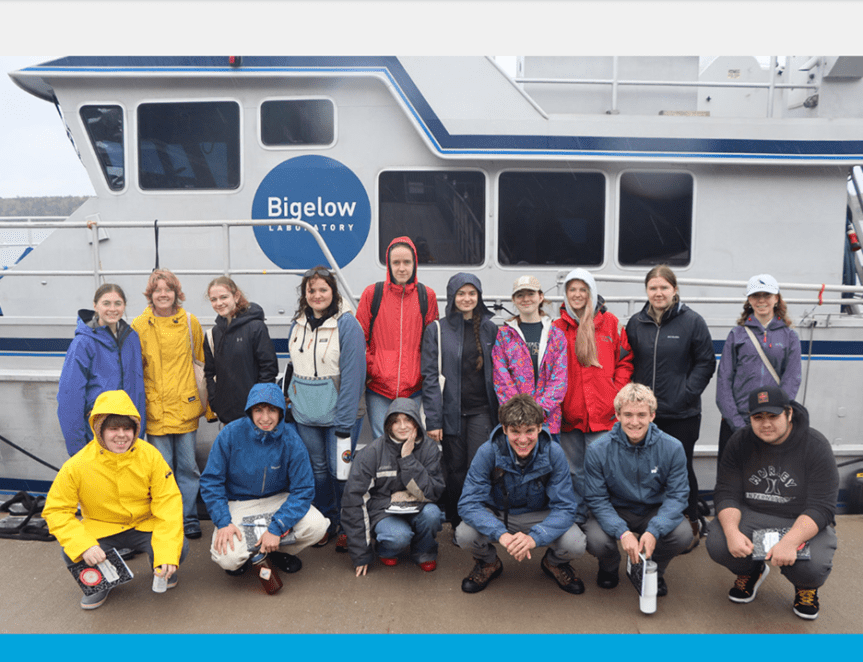
Do you know a Maine high school junior who’s passionate about science and curious about the ocean? Applications are now open for a no-cost, immersive ocean research experience through the Keller BLOOM Program, offered by the Bigelow Laboratory for Ocean Sciences.
The Keller BLOOM Program runs May 17-22, 2026, and gives selected students the chance to spend a week living and learning on Bigelow’s East Boothbay campus, working alongside professional scientists using advanced equipment and real research techniques.
Founded by Bigelow scientist Maureen Keller, the Keller BLOOM Program is designed to introduce students to hands-on ocean science, from field sampling and data collection to laboratory investigation and analysis. Participants explore the biological, chemical, and geological characteristics of Maine’s marine environment and learn firsthand what a career in ocean science can look like.
Current Maine high school juniors — including those who are homeschooled — are encouraged to apply. No previous research experience is required, and there is no cost to participate; Bigelow provides chaperoned room and board for the week.
Sixteen students from across the state will be selected, with representation from Maine’s various counties being a priority. During the program, students may participate in field activities, laboratory investigations, and discussions with scientists about careers, ethics, and real-world ocean research.
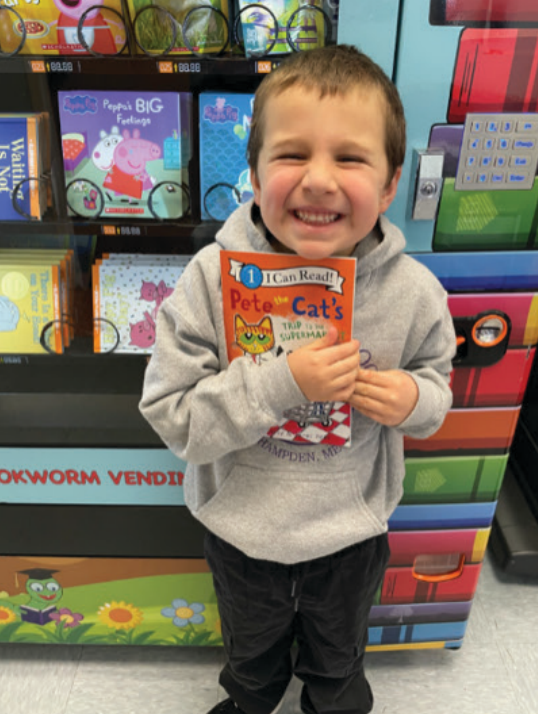
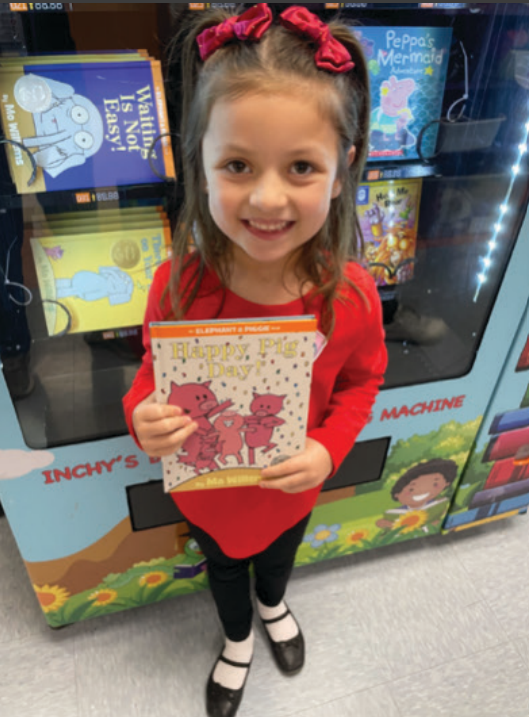
(Pictured: A student getting a book from the book vending machine, part of RSU 22’s PBIS reward system.)
Regional School Unit (RSU) 22 (Hampden, Newburgh, Winterport, and Frankfort) is making significant strides in creating a positive, student-centered culture, thanks to the Positive Behavioral Interventions and Supports (PBIS) framework.
RSU 22’s PBIS journey began in the 2021-2022 school year following the disruptions of the COVID-19 pandemic and the subsequent year of hybrid learning. Seeking consistency in student behavior support systems, district leaders joined a statewide PBIS training cohort. What began as a post-pandemic response has since evolved into a coordinated, district-wide effort; now, RSU 22 is consistently recognized statewide for its pre-K-grade 12 PBIS framework. In 2025, the district earned the silver District of Distinction recognition from the Northeast PBIS Network, highlighting its commitment to safe, supportive, and inclusive learning environments.
RSU 22’s PBIS implementation varies across its six schools, with four schools actively implementing Tier 1—or universal—support practices and the other two schools engaged in advanced tiers work. The district continues to support schools at different stages of readiness, while maintaining district-level coordination and data collection.
At the core of this work is a belief that students do best when common expectations are clear, explicitly taught, and positively reinforced. Each school takes the time to explain what these expectations look like and practice them with students. When students show that they understand and follow expectations, adults notice and acknowledge their efforts with specific praise and, in some cases, small rewards, such as a ticket or token that the student can use for a book vending machine or a schoolwide raffle. Being recognized for doing something well helps students to feel proud of their efforts and encourages them to continue making positive choices. Each school designs its recognition approach in ways that are developmentally appropriate and meaningful for students.
Data has driven much of RSU 22’s progress; each school distributes a PBIS School Climate Survey twice a year to students (grades 3 and up), staff, and families. This data highlights trends, celebrates strengths, and informs needed improvements. In the fall of 2025, families across the district continued to praise a strong commitment to safety, with four of six schools identifying student safety traveling to and from school as a top strength. Families also highlighted the clean and organized learning environments that teachers in the district maintain. Across all groups—students, staff, and families—this data revealed a consistent opportunity to strengthen student recognition practices, which the district is actively addressing.
RSU 22 not only shares survey results with families but acts on them, building trust and transparency. In a fall 2025 letter to families, Director of Curriculum Jennifer Nickerson shared: “[The] feedback directly influences our improvement efforts and helps shape the future of our schools.” She also added: “The [PBIS] framework works, but it takes consistency, measurement, and a shared belief that all students can succeed when they feel supported.”
PBIS is a nationally recognized, evidence-based framework designed to create positive school climates by teaching and reinforcing clear behavioral expectations. It helps schools to improve student behavior, promote academic success, and build supportive environments where all students feel safe, respected, and empowered to thrive. To learn more about PBIS in Maine, visit the Maine DOE website.
This article was developed in collaboration with RSU 22 and the Maine PBIS program, a partnership between the Maine DOE Office of Special Services and Inclusive Education and the University of Maine System. This article is part of a series highlighting the successes of Maine schools that are in the process of implementing, or that have implemented, PBIS in their schools. To submit a good news story to the Maine DOE, please fill out the good news submission form.



 Maine DOE Newsroom