Inclusive Classroom Book Study for Maine Early Care and Education Professionals (serving Birth-Grade 3)

The Maine Department of Education (DOE) has partnered with Maine Roads to Quality Professional Development Network and the Maine Department of Health and Human Services (DHHS) Office of Child and Family Services to offer a no-cost book study for Maine early care and education professionals (serving children birth-Grade 3) interested in creating more inclusive classrooms.

In the early childhood classroom, inclusion means that all children, regardless of their individual characteristics, have equitable access to educational opportunities and environments where they are equally safe, valued, and respected.  Early care and education programs that prioritize inclusion benefit everyone, including children, teachers, parents, and communities.

This book study is one of the professional growth opportunities available at no cost to Maine early care and education professionals as part of the Maine Inclusion Initiative funded through Maine’s Preschool Development Renewal Grant. Participants in the book study will read and reflect on Inclusion Includes Us: Building Bridges and Removing Barriers in Early Childhood Classrooms (Huber, 2023). The book study will occur over a 6-week span, meeting weekly for 75 minutes. Three 6-week sessions are being offered as options (see schedule below).

This professional learning opportunity is open to all early care and education professionals from public and private preschool schools, early elementary schools, childcare centers, and family childcare providers.

Session Options

Session 1:
May 13 – June 24 (no session May 27th)
Mondays 5:45 – 7:00

Session 2:
Aug 13 – Sept 17
Tuesdays   3:45-5:00

Session 3:
October 16-Nov 20
Wednesdays 12-1

To apply to be part of one of the above book study sessions, please fill out the following form found at this link: Inclusion Book Club. Space is limited, so please complete the application by April 30, 2024.   Applications will be processed, and participants will be notified by May 3rd. Books will be shipped to participants and contact hours will be provided for the time in the book study.

If you have questions or need additional information, please reach out to Nicole Madore, Maine DOE Early Childhood Specialist at Nicole.Madore@maine.gov or Renee Reilly, Maine DOE PDG Manager at Renee.A.Reilly@maine.gov.

Upcoming Data Reporting Webinars

The Maine Department of Education (DOE) Data Team has scheduled  the following data reporting webinars for this spring.


Maine Schools Webinar – April 30th at 10:00 am – Register Here

Maine School Approval provides Maine DOE the attestation from districts that all Maine statutory requirements are being met by each LEA. This report offers an opportunity to update the LEA & school contact information to ensure that MDOE has the most current information. Student enrollments cannot be uploaded/entered into Synergy until Maine Schools is complete. This webinar will review the requirements for the Maine Schools process.


ESEA Demographics Report Webinar – May 14th at 10:00 am – Register Here

The ESEA Demographics Report is an aggregation of students enrolled on 05/27 for participation in state assessments during the current assessment administration. This report includes student demographic categories for assessment and accountability purposes. This webinar will review reporting requirements and navigation of the ESEA Demographics Report in NEO.


EOY Reporting Webinar – May 21st at 10:00 am – Register Here

Daily Attendance, Truancy, Behavior, and Bullying reports are due for final certification at the end of the school year. This data is aggregated for public reporting after certification and reported in multiple locations including the Maine Department of Education Data Warehouse, ESSA Dashboard, and federal reporting. This report will review requirements for each of these four (4) reports and navigation of the reports in NEO.


EOY Enrollment Exits Webinar – May 28th at 10:00 am – Register Here

All students, even those intending to return next year, must be exited from Synergy at the conclusion of the school year. This webinar will review recommendations for properly exiting students at the conclusion of the school year and the process for exiting students from State Synergy.


Special Education Exit Report Webinar – June 4th 10:00 am – Register Here

Students who have exited special education services during the reporting period (July 1, through June 30) must have special education exit information (a special ed exit date and exit reason) added to their Special Education enrollments in Synergy State Edition. School Administrative Units (SAUs) are required to certify the exit data using the Special Education Exit Report found in NEO. This webinar will review the requirements and process for Special Education Exit Reporting.


Questions about data reporting webinars can be sent to Alexandra.Cookson@maine.gov

Approval of FY 2024 School Revolving Renovation Fund Applications

The Maine Department of Education (DOE) has awarded $28.6 million in School Revolving Renovation Fund (SRRF) loans to 12 school administrative units.

The loans will be used to complete 23 health, safety, and compliance projects. The projects include structural roof repairs, indoor air quality improvements, ADA upgrades, and life safety renovations.  A portion of each loan is considered a grant and is forgiven while the remaining balance of the loan is paid back at a zero percent interest rate.

The complete list of approved projects can be viewed here (PDF).

For additional information about the SRRF program please visit the Maine DOE website or contact Ann Pinnette at 215-3809 or ann.pinnette@maine.gov.

Bangor High School Student Named ‘Educators for a Multilingual Maine’ Student of the Year

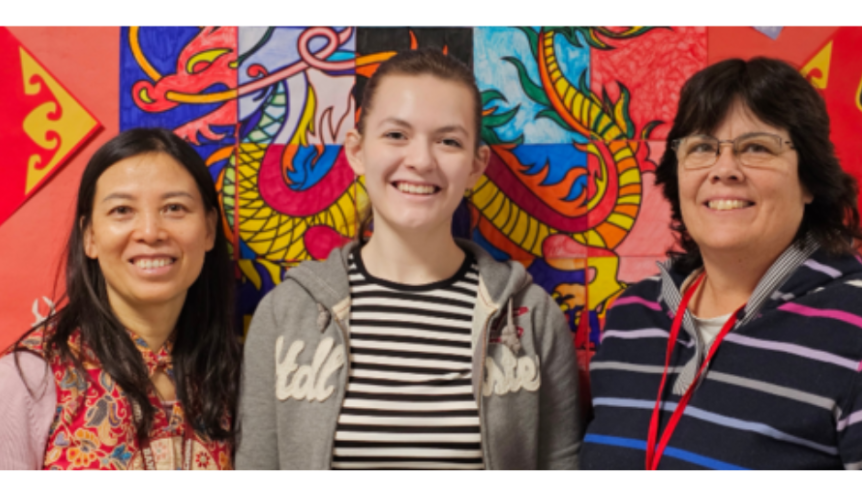
(Pictured L to R: Bangor High School (BHS) Chinese Teacher Lily Crane, BHS Senior and EMME Student of the Year Amanda Tomlinson, and BHS American Sign Language Teacher Kathy Rice.)

Educators for a Multilingual Maine (EMME) has announced that Bangor High School student Amanda Tomlinson will receive the EMME 2024 Student of the Year award.

EMMC said in a media release: “This recognition is a testament to Amanda’s exceptional dedication and achievements in her academic endeavors and extracurricular engagements. According to Bangor High School teacher Lily Crane, Amanda epitomizes the qualities of a well-rounded student who discovers immense joy and passion in her scholarly pursuits and outside activities.”

Amanda’s remarkable commitment to language studies is a shining example of her unwavering determination and perseverance. Throughout her educational journey, Amanda has demonstrated an outstanding aptitude for languages. She has completed an impressive four years of Chinese language study and two years of American Sign Language at Bangor High School. Her exceptional linguistic skills were further validated when she took the Avant test in Chinese last Spring and will be honored with the prestigious Maine Seal of Biliteracy in May 2024.

“Amanda’s exemplary performance in the World Language Department, coupled with her outstanding contributions to the school community, make her the unequivocal choice for the EMME 2024 Student of the Year,” said Fred Ravan, Vice President of EMME.

The State Seal of Biliteracy (SSB), which acknowledges students proficient in two more languages, is now available in all 50 states and D.C. Learn more about this award for multilingual students and check out OELA’s updated SSB infographic! To learn more about Maine’s Seal of Biliteracy, visit the Maine DOE dashboard.

From all of us at the Maine Department of Education, congratulations to Amanda!

Educators for a Multilingual Maine (EMME) is a non-profit organization whose purpose is to promote and improve the teaching and study of languages and cultures of the world. EMME also strives to further the common interests of teachers, students, and others in Maine, for whom languages play an important role. EMME was formerly known as FLAME, the Foreign Language Association of Maine.

Learn more about EMME or the Student of the Year award, please visit the EMMC website or reach out to EMMC at communications@emmaine.org.

A Reminder to Maine Home Instruction Parents and SAUs Regarding Annual Assessment Requirement

A reminder to those families who have opted for home instruction during the 2024-2025 School Year that, per Title 20-A: 5001-A , an annual assessment of academic progress is required.   

Notice and Assessment Requirement 

Parents providing home instruction are required to submit a Notice of Intent to Provide Home Instruction within 10 days of starting a home instruction program and then again, each year by September 1 for continuing/subsequent year students. This notice must contain, among other things, a “statement of assurance that indicates that the home instruction program will include an annual assessment of the student’s academic progress that includes at least one of the forms of assessment described [in statute].” The continuing/subsequent year home instruction notice submission deadline (September 1) occurs after the conclusion of the previous school year, which is defined as the period July 1 – June 30. Please note that parents of ongoing home instruction students may choose to deliver instruction on a schedule which does not coincide with the reporting period; however, the school year definition is always used for the purposes of counting the required 175 instructional days. Since the annual assessment is designed to assess academic progress, the assessment should be administered toward the end of the school year for which progress is being assessed. 

An annual assessment can be a teacher letter written by a Maine certified teacher who performs a home instruction student portfolio review and looks at items in the portfolio such as the attendance record, lesson plans and sample work, to ascertain whether adequate progress has been made by the student. A different, but equally acceptable, assessment method could be to administer a standardized achievement test such as the California Achievement Test, or the Stanford or Iowa Achievement Test, and submit a copy of the test summary page. Or the student could, with prior permission and according to established local unit policy and protocol, participate in school administrative unit testing. Please see the full range of assessment options as outlined in the attendance statute, Title 20-A: 5001-A.    

Assessment Submission for Students Discontinuing Home Instruction 

“If the home instruction program is discontinued, students of compulsory school age must be enrolled in a public school or an equivalent instruction alternative… The receiving school shall determine the placement of the student. At the secondary level, the principal of the receiving school shall determine the value of the prior educational experience toward meeting the standards of the system of learning results as established in section 6209.” 

For parents who discontinue the home instruction program and re-enroll a student in a public or equivalent instruction school before completing the school year, an assessment may not have been completed yet. The receiving school, according to their policy, may choose to review student assessments or portfolio materials that might aid them in determining placement and/or credit value for students transferring in from home instruction programs. Parents of students who will not be returning to home instruction (graduated or enrolling in school) may provide notification and submit final assessments to the superintendent’s office. 

Assessment Submission for Student Continuing Home Instruction 

For continuing/subsequent year students in home instruction, the completed home instruction assessment must be submitted together with the Notice of Intent/Subsequent Year Letter (they may not be submitted separately, or by anyone other than the parent submitting the Notice) via the Home Instruction Portal, or by submitting with the paper Notice of Intent to Provide Home Instruction to the Superintendent of their resident school administrative unit. Either method will serve as the single notification needed to both the resident Superintendent and the Maine Department of Education, as required by law, and will prompt an acknowledgment to parents who supply a valid email address. 

More information, Notice of Intent to Provide Home Instruction forms, and other resources regarding home instruction are available on the Maine Department of Education Home Instruction webpage. 

Please note that the State does not issue transcripts or diplomas for home instruction students. 

Educational Resources for Earth Day Participation

This year, Earth Day recognition falls on the first day back from April vacation. Embrace the energy of the return to school by having students participate in an Earth Day activity in your classroom, school, or community.

The Maine Department of Education’s (DOE) Interdisciplinary Instruction team has created an Earth Day 2024 website with curated resources for incorporating Earth Day activities and lessons into the classroom.

If you want more information, a specific resource, or a thought partner, please contact Erik Wade at erik.wade@maine.gov.

Week of the Young Child: Family Friday

Every family is unique.  Every family knows their children best. Families are a child’s first and most important teachers.  Having a strong partnership with the caregivers, parents, and family members of the children in your setting is very important in being able to support them to meet their full potential. Elevating family voice, honoring lived experiences and empowering families in offering solutions from family guided needs for child care and educational experiences that are child-centered all aid a whole family approach to early care and education.  Collaborative and strengths-based engagement, partnership and communication through early childhood professionals, school settings and families build positive and goal-oriented support networks for each of Maine’s earliest learners.

Statewide programs that support family engagement:

Maine’s Head Start State Collaboration Office (HSSCO) is located in the Department of Education as part of the Early Learning Team and is funded through a federal grant from the Office of Head Start, Administration for Children and Families, U.S. Department of Health and Human Services. More information on our eleven Head Start Grantees and three Tribal Head Start Programs can be found here.

Child Care Affordability Program (CCAP) : helps eligible families pay for a portion of child care costs during the time the parent/guardian is working, going to school, or participating in a job training program. CCAP is also available for eligible families where the adult(s) are retired (as defined by the SSA). Apply today by submitting an application available on the CCAP website.

McKinney Vento is a federal Homeless Assistance Act. This law helps students whose housing situations are impacting their education. All students are guaranteed the right to a free, appropriate, public education. More information and who to contact for help can be found on the Maine DOE’s School and Student Supports team site.

WYOC 2024 Raffle Winner: The growing years child care in Saco

Maine Department of Education Launches Maine’s Whole Student Pandemic Response Page

The page showcases programs created with Federal Emergency Relief Funding and elevates the voices of the educators and students they support.

The Maine Department of Education (DOE) has launched a new webpage to showcase how the Maine DOE used federal emergency relief funding to invest in Maine’s Whole Student Pandemic Response. The effort highlights the initiatives the DOE created with federal funding and the impact on students, educators, schools, and communities. View the new webpage here.

A circle with a thick navy outline and a picture of students hands on top of one another over snow.The Maine Department of Education (DOE) prioritized a Whole Student Approach using federal emergency relief funding to help students, educators, and schools respond and recover from the COVID-19 pandemic. The DOE’s Whole Student Approach was developed in partnership with educators, administrators, parents, students, and educational organizations. It seeks to create vibrant school environments where all students are safe, healthy, supported, engaged, challenged, and prepared. Together, these six tenets form the foundation for students’ success in school, life, careers, and as citizens of our great state.

The DOE has invested federal emergency relief funding in efforts to bolster literacy, provide hands-on outdoor learning opportunities, expand engaging project-based learning, bring interdisciplinary computer science education to every Maine school and grade level, expand pre-k, support student and educator wellbeing, ensure safe and healthy schools, and so much more.

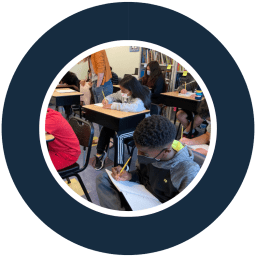
The new landing page on the Maine DOE website features descriptions of the programs the Maine DOE created with federal emergency relief funding and stories from educators, students, and schools showcasing the impact of the programs and the continued efforts to support schools with the lingering impacts of the pandemic. The webpage includes details on the total federal emergency relief fundingA large circle with a thick navy line around it, and a picture of students working at their desks wearing masks . received by the Maine DOE and links to a federal relief funding dashboard featuring reimbursements made to school administrative units (SAUs) for their pandemic-related investments.


The Maine DOE will continue to update Maine’s Whole Student Pandemic Response page to feature how emergency relief funding continues to be used to support students, schools, and educators in Maine. We will also feature how schools and SAUs have used the funding they received.

Click Here to Visit Maine’s Whole Student Response Page

If you have a story of how your school or SAU used Federal Emergency Relief Funding, please share it here. We’d love to feature your efforts.

American Rescue Plan Act (ARP) funding supports Maine’s Whole Student Pandemic Response efforts.


Ninth Annual Maine Farm to School Cook-off Slated for May 7th

(Pictured: Student Caleb Pratt representing RSU 54 in last year’s cook-off)

The Maine Department of Education (DOE) Child Nutrition Program is kicking off its 9th annual Maine Farm to School Cook-off in May. The cook-off aims to showcase the culinary skills of school nutrition professionals and students while promoting locally grown products in school meals. Teams representing schools across Maine, consisting of one student and one school nutrition professional, will compete to be the 2024 Farm to School Cook-off Champion! This year, one competition will be held at Central Maine Community College on May 7, 2024, from 11 am-2 pm. The competition will be live-streamed for those who would like to watch remotely and support the school teams.

Teams of school nutrition professionals and students representing Auburn, Lewiston, and RSU 75 will participate in this year’s event. Each team will prepare two lunch meals (one vegetarian and one non-vegetarian) within a specific time frame using at least three ingredients that are grown, raised, caught, or manufactured in the State of Maine and meet National School Breakfast and Lunch Program requirements as well as one USDA food. Local chicken breast donated by Maine Family Farms in Portland, ME, and local tofu from Heiwa Tofu in Rockport, ME, will be used as “challenge” ingredients in the competition. All recipes will later be shared in a Maine farm-to-school cookbook.

A panel of judges for the cook-off will include a student/student representative, school nutrition director, and professional chef. The dishes will be scored based on presentation, taste, creative use of the challenge ingredients, and feasibility for use in a school kitchen. Other criteria will include teamwork, food safety, and time management.

For more information on Maine’s Farm and Sea to School program, visit https://www.maine.gov/doe/schools/nutrition/programs/farmtoschool.

Members of the media are welcome to attend the cook-off but need to confirm prior to the day of the event. For more information and to confirm coverage, contact Marcus Mrowka at marcus.mrowka@maine.gov.

Hancock Grammar School Hosts a Literacy Night at Sea

“How will you top this next year?” one family asked as they left the Hancock Grammar School’s Family Literacy Night recently.

On March 27th, Title 1 staff from Hancock Grammar School (HGS), Renee Clark and Yasmin Beal,  hosted an over-the-top (under-the-sea) literacy event that gathered 400 students, family members, and community members. Considering HGS has about 170 students, that is a pretty good haul!

The day began with Alexandra Hinrichs, an award-winning author from Bangor, visiting the school to read her book The Lobster Lady.  The book tells the story of Virginia Oliver, who is still lobstering at 103 years old.  Oliver was featured in a Boston Globe story that quickly became a meme. One student said, “I have never met a published author.”  By meeting published authors, students can see that writing and telling their essential stories is a future path for them.

After reading her book, Hinrichs spent the day helping students write their own stories from special memories and dreams of becoming future authors.  Another student shared, “I enjoyed learning how you became an author!” Later, during the Literacy Night event, the Briar Patch Bookstore in Bangor brought several copies of Hinrichs’ book.  Ms. Hinichs generously stayed for the event to sign them and talk with families.  The Briar Patch also donated several copies of the book to students who could not attend the after-school event.

Background knowledge is a critical component of good literacy instruction. With that in mind, the Title 1 team organized several events to support and engage their budding readers and authors.  In addition to talking with the author, the community showed up in a big way to teach students about lobstering and ocean life.

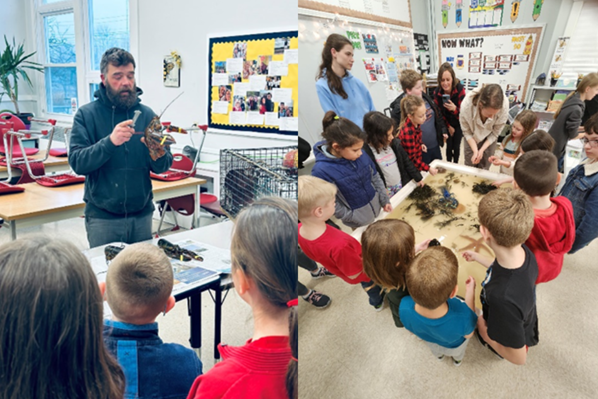
As a sternwomen, Virginia Oliver bands and measures lobsters. She also figures out which ones are bearing or females laying eggs and determines which lobsters to throw back and which are keepers.  This is how the lobstering community works to make their industry sustainable.  To give the students that experience, the school got a few lobsters.  Lobsterman Cameron Hardison brought a trap and equipment to band and measure lobsters. He taught students how to measure lobsters and figure out if the lobsters were male or female.  Students were even able to practice measuring and banding lobsters!  One student commented, “I enjoyed the lobster education and learning how to band and measure lobsters.”
literacy night

When Virginia Oliver hauls a trap, she sees a lot of other sea life. The Downeast Institute, based on Beals Island, showed up with an incredible touch tank. Students could touch and learn about lobsters, seaweed, starfish, and crabs.  The Downeast Institute even brought a very rare blue lobster!  HGS teachers were on hand to help students handle the creatures with care and provide support for those students who needed a little extra encouragement. As always, the teachers go the extra mile for their students!

The Family Literacy Night was extra special for the Thomas family. Pete Thomas, the great-grandfather of one of the students, loves to do woodworking. He made wooden lobster boat ornaments for students to take home as a souvenir. On display, Mr. Thomas brought a blue ribbon small wooden lobster boat that he made. There were three generations of the Thomas family participating that night, which is pretty amazing!

literacy night

Once students looked at mini-versions of lobster boats, it was time to get aboard the real deal. Roger and Lance Kennedy and Jenna Colby came with their lobster boat, the F/V Break N’ Even. Students learned important vocabulary like F/V, which stands for Fishing Vessel.  Students went over the boat from stem to stern. The Kennedys and Colby showed students the different parts of a trap, their buoys, and how to haul traps from the ocean.  It gave the students a real sense of Virginia’s job.
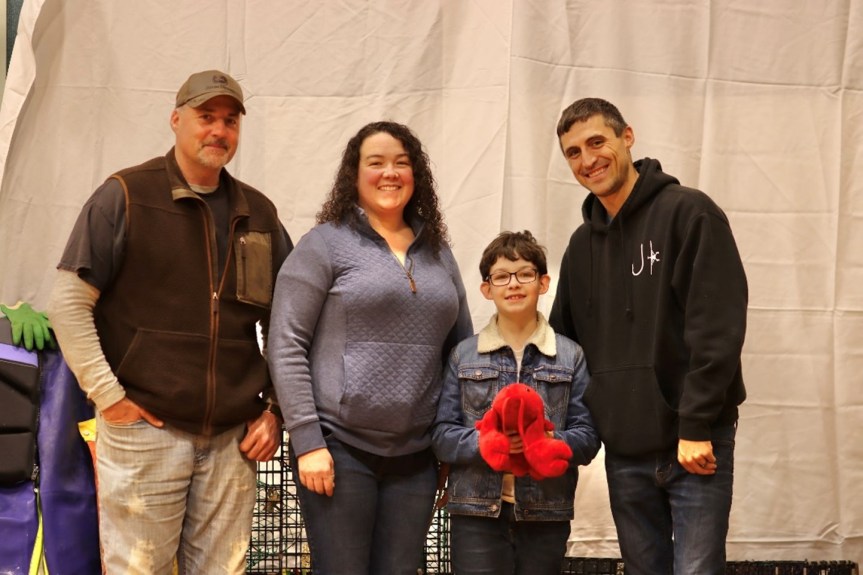
Virginia isn’t the only person famous for lobstering. Jacob Knowles is a fifth-generation lobsterman and social media celebrity who has about 1.6 million followers on YouTube.  That’s as many followers as the entire population of Maine! Jacob came to family literacy night to meet with families and share some of his fishing knowledge with everyone.  Students commented “It was an epic night!!”

After such an amazing night of literacy, learning, and lobster, it was time to head home.

One family shared, “I love all the fun new things you all are doing at school! Sounds so engaging and fun for the students and staff.”

Another family said, “Thank you for a great evening. The boys had a good time. We ended our evening with books from the book fair and a book from the author! The Black Sheep food truck, thanks for the grub was nice to not make supper!”

Everyone agreed this Family Literacy Night was a keeper!