Celebrating Women in CTE: Meet Computer Tech Powerhouse Madison Jackson

The Maine Department of Education, in collaboration with Career and Technical Education (CTE) schools throughout Maine, is celebrating CTE month this February by highlighting some of the amazing women who have found their path in life through career and technical education. We hope their stories inspire you the way they have inspired us.

As a junior in high school, Madison Jackson had no idea what she wanted to do when she graduated.

“I was worried about it because everyone else already knew,” remembers Jackson as she one day decided to check out the list of class options at her local Career and Technical Education (CTE) center, Capital Area Tech Center (CATC) in Augusta.

Initially, Jackson wanted to be a Game Warden but remembers seeing computer technology on the list of pathways at CATC and thinking, “Oh, that’s like video games, that will be fine,” she recalled. “That’s not what it turned into at all,” she added.

As a 2023 graduate from Cony High School, Madison Jackson grew up around technology, but she never dreamed it would one day be her job.

“We had the old Windows 7 and I loved playing games on that,” she said. “I remember getting a new iPad and I thought it was the most glorious thing.”

Jackson was mesmerized by people who could build computers but when she first got started, she felt like she was picking up the hardware side of things slower than her all-male classmates. Eventually, she realized her true passion was software, cybersecurity, and networking. From there, her abilities and talent have grown into an exciting career path.

For Jackson, going to school at CATC was very different from traditional high school. It felt like she finally had a choice in the classes she took every day and for that reason, she looked forward to the school day. “We had stuff to get done, but we had the freedom to get it done, in our own time,” remembers Jackson as she explained how much better the learning environment was for her at CATC.

Jackson said one of the things she is most proud of during her time at CATC was making her original CTE teacher, Michael Fraser, proud.

“I didn’t know who he was, we started a bond, and we became buddies,” said Jackson. “He was really proud of me for succeeding to [Skills USA] nationals. I didn’t make it far, but it was just seeing him hug me and be proud of me and everything I do, even if I didn’t turn out on top. Of course, I’m proud of myself, but he was always there for the students.”

Fraser said he is proud of everything Jackson has accomplished, but that they are her accomplishments.

“I am just her biggest fan,” said Fraser. “I remember specifically the day she was hooked, it was the first time she placed on that SkillsUSA stage, at the state conference, a confidence switch flipped in her that diminished any of her doubts about success in cybersecurity. From that point on, there was no stopping her,” he added.

Jackson said that being the only girl in her classroom both years was another major factor in propelling her to succeed in computer technology.

“It gave me initiative, not to be better, but that if I can do this it will be amazing,” she said.

This year Jackson is enrolled in the Cybersecurity-Digital Forensics program at Central Maine Community College (CMCC). While she is currently working on completing her 2nd semester in college, she also has a job working in her school’s IT department. She says she is still one of just a few women in all her courses, but she is looking forward to seeing change in the coming years.

“I earned a semester’s worth of college credits at CATC,” she added. “I don’t think a lot of kids know that they are actual credit.” Jackson’s teacher showed her how to take advantage of dual enrollment at UMA and because of that, she will be able to graduate early from CMCC.

“Students are presented with many opportunities here at the technical center and Madison Jackson was the student to take advantage of everything she could,” said Fraser. “Seeing her continued growth in this industry is what makes my job worthwhile, knowing she found her career interest is what we strive for with all of our students.”

Jackson has big plans to continue pursuing her education right in central Maine before jumping into the workforce. “I hope to go to UMA [the University of Maine at Augusta] and get my bachelor’s and master’s degrees,” she said. Meanwhile, she is doubling down by applying for internships as well.

Jackson has the following advice for other high school students, especially young women, who may be thinking about enrolling in a CTE course.

“Take a chance on any single class. I’ve seen girls in firefighting, welding, and construction,” she said. Jackson shared that the key to finding a sense of belonging is trying to find someone to connect with. “It’s easy to be by yourself as the only girl. Find a connection. I still have friends from my classes. I just took a chance.”

Interdisciplinary Resource Highlight for Black History Month: Side x Side

The Maine Department of Education (DOE) Interdisciplinary Instruction team has curated resources of content and instructional approaches to help educators include and highlight the important contributions of Black and African-American Mainers in authentic ways.  These project-based strategies include finding local historical figures and guest speakers, researching local history, and bridging content areas.

Incorporating artistic approaches into the teaching of African American Studies of Maine can provide an authentic learning experience for all students. Here are specific instructional strategies using art integration practices:

  1. Visual Storytelling through Artifacts
    1. Strategy: Invite students to explore artifacts and primary sources related to African American history in Maine. Ask students to select or create visual representations of these artifacts, accompanied by short narratives or stories highlighting their historical significance.
    2. Implementation: Students can use a variety of artistic mediums such as drawings, paintings, 3D printing, or digital media to create visuals/artifacts. This approach helps students connect emotionally and intellectually with authentic African American historical artifacts.
  2. Historical Timeline Murals
    1. Strategy: Have students create a collaborative historical timeline mural that illustrates key events, figures, and milestones in African American history in Maine. Each student or group can contribute a section to the mural, incorporating visual elements and brief descriptions.
    2. Implementation: Students can use a large wall space or poster boards to construct the timeline mural. This hands-on project allows students to synthesize information and visually represent the chronological progression of African American history in Maine.
  3. Story Quilts
    1. Strategy: Students can explore the tradition of quilting in African American culture by having students create story quilts that represent different aspects of African American history of Maine. Each quilt square can depict a specific event or theme.
    2. Implementation: Combine the individual quilt squares to form a larger quilt that tells a comprehensive narrative. This tactile and collaborative approach allows students to express their creativity while delving into historical content.
  4. Digital Exhibitions
    1. Strategy: Task students with researching and curating a digital exhibition that showcases images related to African American artwork and exhibits in Maine. Students can provide an interactive tour that highlights African American art images and artist backgrounds.
    2. Implementation: Display the digital artifacts in your classroom or school. Encourage students to write reflections on their interactions with the digital experience.
  5. Interactive Digital Maps
    1. Strategy: Have students create interactive digital maps that highlight the important locations, events, and communities in the history of African Americans of Maine. Utilize multimedia elements such as images, audio recordings, interviews, or personal narratives at each map point.
    2. Implementation: Students can use digital platforms or physical maps to create an interactive project. This strategy encourages geographical awareness and helps students understand the spatial context of Maine’s historical events.
  6. Community Art Installations
    1. Strategy: Have students organize art installations that represent African American history in Maine. Collaborate with local artists and students to create public art pieces that reflect the diversity and contributions of the Maine African American community.
    2. Implementation: Students can participate in the planning, designing, and execution of the art installations that serve as public educational displays.

Side x Side is a Portland-based organization that ignites academic excellence in education through comprehensive integrated arts-based programs, bringing critical thinking, creativity, and innovation into the classroom. Through community partnerships with the University of Southern Maine, local school districts, organizations, artists, professionals, and colleges, Side x Side integrates science, technology, literacy, and the humanities with the arts to enhance the school curriculum.

Side x Side provides free monthly webinars for educators on the first Wednesday of the month from 7-8 pm.  These webinars offer innovative approaches to engage students in diverse modalities of expression, such as visual storytelling to interactive projects, after gaining insights into learned information.

For more resources on an interdisciplinary approach to teaching Black History click on this link.

For more information about interdisciplinary instruction, please contact Kathy Bertini, Interdisciplinary Instruction Coordinator at kathy.bertini@maine.gov


Seeking Educators to Join the Maine Solutionaries Project

Students currently in Maine classrooms will graduate into a world filled with complex, interrelated challenges. Maine educators need access to innovative tools to foster students’ critical thinking and problem-solving skills and equip learners with the skills needed to analyze and address multifaceted issues. To ensure that Maine educators have what they need, the Maine Department of Education’s (DOE) Office of Innovative Teaching and Learning is collaborating with the Institute of Humane Education (IHE). Together, both teams are excited to offer Maine’s educators a unique opportunity to delve into professional learning centered around IHE’s Solutionary Framework and Solutionary Micro-credential Program, as well as access to other customized instructional resources.  

The partnership between IHE and the Maine DOE seeks to inspire and support educators to cultivate a generation of Solutionaries, change makers capable of effectively addressing and resolving real-world problems. The expanded Maine Solutionaries Project will provide high quality cohort-based professional learning opportunities for teachers to learn how to facilitate inquiry-to-action projects with their students and make available resources to support real-world, transdisciplinary, project-based learning. 

“I am so delighted that we have this opportunity to partner with the Maine Department of Education to bring the Solutionary Framework to teachers and students throughout Maine” says Zoe Weil, IHE’s co-founder and president and author of the book used in the course, The World Becomes What We Teach.  

The Maine DOE believes it is important for students to develop the agency, optimism, and skills they need to address problems they care about in their schools and communities. Solutionary teaching and learning is a highly engaging flexible approach to improving students’ knowledge, skills, and confidence. 

Use this Maine Solutionaries Project registration link to sign up for this exciting project.

Interested in learning more? The Maine DOE and IHE are scheduling two informational webinars for educators. 

Wed March 6 3:30-4:30  https://mainestate.zoom.us/webinar/register/WN_jBR-2FQzRS6TchfaCdsEZQ 

Tuesday March 12 3:30-4:30  https://mainestate.zoom.us/webinar/register/WN_6zCY94ZNTGCjhBQBS6Tdjg 

 During the webinars you will be able to:

  • Learn more about the Maine Solutionaries Project 
  • Preview the Solutionary Framework, a flexible process to guide inquiry to action projects 
  • Find out how you can participate in one of the cohorts focused on topics like Climate Change, Food Waste, Plastics Pollution and Water Quality. 
  • Discover the ability to earn educator stipends and additional funding to support Solutionary student projects 

The Maine DOE utilized federal emergency relief funding to offer this program to Maine educators. 

For questions related to the Maine Solutionaries Project, please contact Kathy Bertini, Interdisciplinary Instruction Team Coordinator, Office of Teaching and Learning/Innovation, at kathy.bertini@maine.gov.  

Virtual Reality Transforms Learning at Cony Middle and High School #TeachWithTech

Funded by the Maine Department of Education (DOE) Teach With Tech Grant, Cony Middle and High School has embraced a new approach to education through virtual reality (VR) technology. The school’s acquisition of VR headsets and software from Class VR, a London-based company, is reshaping the learning experience for both students and educators.

Katelyn Rodriguez, Director of Technology Integration for the Augusta School Department, applied for the Teach With Tech Grant last school year with the goals of bringing the world into the classroom and fostering experiential learning.

By leveraging VR technology, students at Cony are exploring artifacts and places beyond their geographical and economic reach, and opening their minds to new possibilities.

Recently, 7th-grade science classes utilized VR/AR content to expand on their human anatomy unit. Students were able to visualize AR objects of the human skeletal system, muscular system, and nervous system. They looked at the human heart and digestive system using the Merge Cubes acquired during COVID-19. Students enjoyed being able to look around and even go inside the human heart and digestive system. The real breakthrough occurred as students made observations and asked questions about what they were experiencing, promoting engaging discussions and a deeper understanding of the complex anatomy concepts. Megan Allen and Allison Hunt, with the assistance of Katelyn Rodriguez, took the lesson one step further by allowing students to play in a VR simulation of the digestive system. They became a piece of pizza that traveled down the esophagus, into the small intestine, then the large intestine, and beyond.

The Teach With Tech Grant has propelled Cony Middle and High School into a new era of learning. VR technology has not only enhanced students’ understanding of complex subjects, but has also inspired educators to rethink traditional teaching methods. The immersive learning experiences enabled by VR are set to shape the educational landscape at Cony for years to come.

For Cony students, the classroom is no longer confined by walls but extends to virtual realms, providing an enriched and dynamic educational experience.

Part of the Maine DOE Maine Learning Technology Initiative (MLTI), the Teach With Tech Grant was awarded to MLTI schools in the spring of 2023 and is available again this spring. This grant provides supplemental technology and related professional learning to support innovative teaching and learning with technology. Learn more here.

This story was submitted to the Maine Department of Education by Cony Middle/High School. To submit a story from your school, fill out our good news submission form.

Maine Flood Resources and Assistance Hub 

Governor Mills’ Office launched a Maine Flood Resources and Assistance Hub website to help Maine people find information, resources, and assistance to stay safe and recover from interior and coastal flooding caused by recent storms. You can access the Hub here 

The Hub includes resources on federal disaster assistance, insurance, unemployment support, cleanup and safety, food assistance, shelters, mental health supports, and more. The site will continue to be updated regularly.  

The Maine Department of Education (DOE) is sharing these resources in the event that your school sustained damage during recent storms and for schools to share with staff, students, and families who may have been impacted. 

The Maine Emergency Management Agency (MEMA) has worked with the Maine DOE to create a flier with QR codes for easy access to information and resources that can be included in school newsletters or provided to families in your school community. You can download the flier here 

Celebrate the 4th Annual International SEL DAY on March 8th: Today’s Students, Tomorrow’s Leaders

(PDF version of this graphic).

The Maine Department of Education (DOE) is excited to share information on the 4th annual International Social Emotional Learning (SEL) Day, Friday, March 8th. The theme of this year’s event is Today’s Students, Tomorrow’s Leaders. Want to join in the celebration?  Start making your plans now!

Some ideas to consider:

In addition to these national efforts, Maine DOE is encouraging educators to connect the SEL theme to Youth Art Month, being celebrated throughout March.  Consider how to showcase student artwork, music, dance, poetry, videos, essays, or more by encouraging participation.  Showcase your selections on district media and tag us @mainedoe or #SELDay.

As you consider your SEL Day participation, please be mindful of inclusivity for all students, families, and educators. Some questions for your planning team to consider:

  • How can activities be framed to support inclusion for all?
  • What is needed to ensure that timely and accurate translations are available for multilingual families?
  • How can activities be designed to provide access for all reading abilities?
  • What barriers might there be to participation, and can those barriers be proactively addressed?

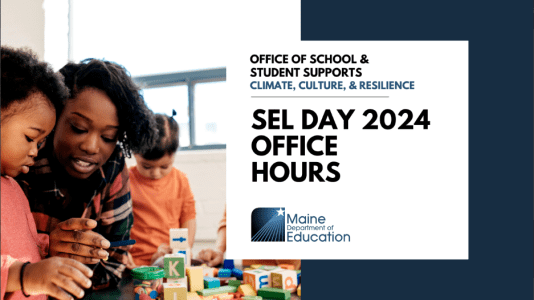
Please join the Maine DOE for SEL Day Toolkit Office Hours.

SEL Day Office Hours

We will use this time for Maine educators to collectively explore the #SELday Toolkit and to share ideas, activities, and events for SEL Day celebration.

More SEL Day Resources:

For more details on the day or on inclusive ideas, send questions to DOESchoolandStudentSupports@maine.gov.


Nominations Open for Alternative Educators of the Year

The Alternative Education Association of Maine is looking for nominations for the Alternative Educators of the Year. The Association is looking to recognize one or more individuals for their outstanding work in Alternative Education.

Please consider someone who has:

  • Demonstrated a positive impact on the academic programming for Alternative Education students or at-risk students.
  • Been an advocate for Alternative Education at local or state levels.
  • Helped develop and/or maintain an effective Alternative Education program.
  • Shown a dedication to Alternative Education through a commitment to professional growth and development.

If you know of someone who fits any of these criteria and would like to nominate them, please take a moment and fill out the form below and help us recognize those deserving educators whose work helps some of our most in-need students.

Alternative Educators of the Year Nomination Form.

For further information reach out to Alternative Education Association of Maine Presented Lenny Holmes at lholmes@bonnyeagle.org.

Scholarship Opportunities Available for Maine School Counselors and School Social Workers

The Maine Department of Education (DOE) recognizes the importance of supporting student mental health. Data from the U.S Center for Disease Control and the Maine Integrated Youth Health Survey reflect increased student mental health needs.

In 2023, Maine DOE received a five-year Expanding Access in School Environments (EASE) grant to increase school-based mental health staff and services in Maine schools. The Maine DOE will spend the next year providing opportunities to the current workforce of school counselors and school social workers to build upon their expertise and to promote evidence-based practices in Maine schools. This emphasis on school-based mental health workforce development strengthens the quality of mental health services in schools.

The following scholarship opportunities are being presented to school counselors and school social workers working in Maine schools:

  • With the goal of increasing the number of school counselors benefiting from access to their professional communities, Maine school counselors (up to 31) will be given scholarship opportunities to obtain full membership in the American School Counselor Association (ASCA). This membership opportunity will connect more Maine school counselors with their professional community, providing access to additional networking, training, evidence-based practice resources, and research. Eligible ASCA members will also be able to pursue national school counselor certification through ASCA. Once the application is created, it will be distributed through a Maine DOE school-based mental health listserv.
  • With the goal of increasing the number of nationally certified school counselors (ASCA) supporting Maine schools, the Maine DOE will provide scholarships to qualified school counselors (up to 10) to participate in the ASCA national certification process. At this time, ASCA has reported that Maine does not have any ASCA national certified school counselors working in Maine schools. Once the application is created, it will be distributed through a Maine DOE school-based mental health listserv.
  • With the goal of increasing the number of school social workers benefiting from access to their professional communities, Maine school social workers (up to 31) will be given scholarship opportunities to obtain full membership in the School Social Work Association of America (SSWAA). This membership opportunity will connect Maine school social workers with their professional community, providing access to additional professional networking, training, evidence-based practice resources, and research. Eligible members will also be able to pursue advanced national certification through the SSWAA National Certified School Social Work process. Once the application is created, it will be distributed through a Maine DOE school-based mental health listserv.
  • With the goal of increasing the number of nationally certified school social workers (SSWAA) supporting Maine schools, the Maine DOE will provide scholarships to qualified school social workers (up to 10) to participate in the SSWAA National Certified School Social Work process. This advanced national certification process requires applicants to link their school practices with the national school social work practice model. This funding support may result in a 1000% increase in National Certified School Social Workers in Maine schools and place Maine among the national leaders in national school social work certification. Once the application is created, it will be distributed through a Maine DOE school-based mental health listserv.

To be eligible for these opportunities, school counselors and school social workers must meet the eligibility requirements for each individual activity, be employed as a school counselor or school social worker in a Maine school, hold 075 certification from the Maine Department of Education (school counselors), or hold a valid social work license from the Maine Social Work Licensing Board (school social workers). Interested school counselors and school social workers must use the forthcoming application to request access to these scholarship opportunities. Each of these opportunities will be provided on a first come, first serve basis.

For more information, contact kenneth.a.rautiola@maine.gov.

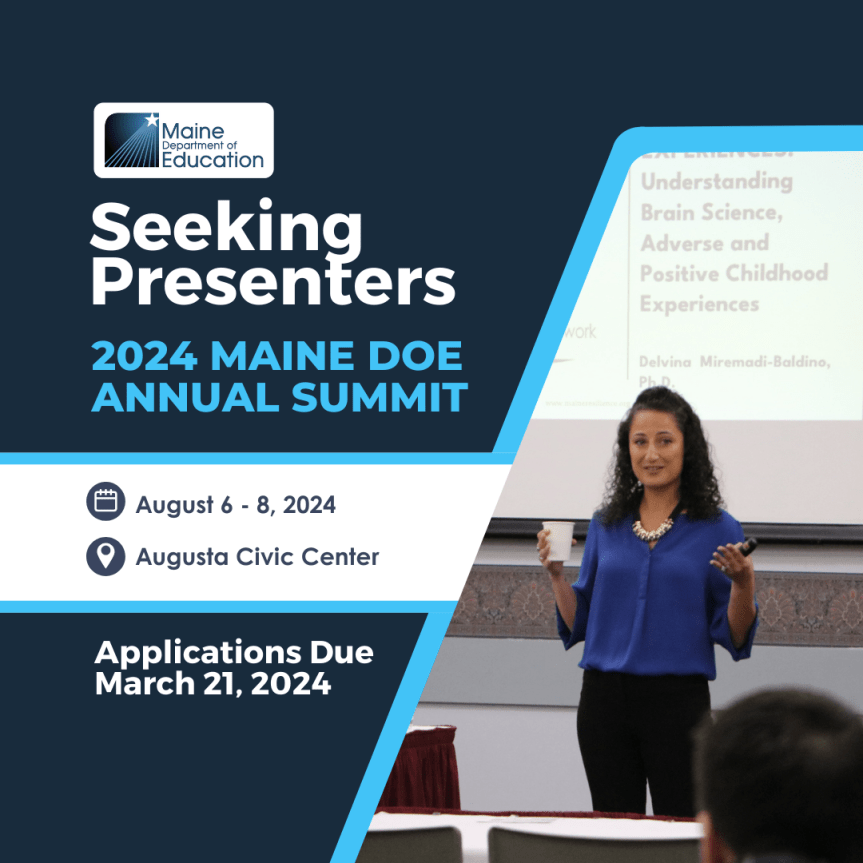
Seeking Presenters for 3rd Annual Maine DOE Summit. The Theme is Supporting the Whole Student and School Community

The Maine Department of Education is excited to announce that the 3rd Annual Maine DOE Summit is scheduled for August 6 through August 8, 2024, at the Augusta Civic Center.

We are currently seeking presenters from Maine’s educators, school safety personnel, first responders, and other agencies that are involved with supporting students.

This year’s theme is Supporting the Whole Student and School Community. Knowing that there are many inspirational, innovative, and inclusive practices being performed in our public schools, we have opened the applications to the entire Maine public education workforce.  We encourage schools that have shared their stories through the Maine Department of Education to apply as well.  We intend to showcase practices being used every day in our schools and use this to inspire other schools.

We are also excited to be able to offer an honorarium to eligible presenters. More information regarding this is contained within the application linked below.

Maine Department of Education staff providing support for Maine teachers and students will also be presenting at the Maine DOE Annual Summit to provide a launching point for continuing support throughout the 2024-2025 school year.

Apply to be a presenter here.  (Applications close on March 21, 2024)

For more information regarding this event please contact Teri Peaslee, Summit Coordinator at Teri.peaslee@maine.gov or 207-530-7672.


AmeriCorps NCCC’s Summer of Service Program

Volunteer Maine (Maine Commissioner for Community Service) shares that AmeriCorps NCCC has announced that its “Summer of Serviceprogram is returning this year. This shorter summer session returns with projects focused on climate mitigation, affordable housing, and the option to serve where the need is greatest.

Deploy to Aurora, Colo., or Vinton, Iowa, for three months of training and service. Program benefits include food, lodging, a modest living allowance, uniforms, and program-related travel expenses are all covered by AmeriCorps NCCC. In addition, members will receive a post-service education award.

Explore Summer of Service opportunities here (PDF) or visit the AmeriCorps Summer of Service website.

For more information about volunteer opportunities in Maine visit Volunteer Maine’s website.