Two Request for Proposals Now Open for Workforce Innovation and Opportunity Act (WIOA) Grant Funding

The Maine Department of Education (DOE) is pleased to announce the release of two requests for proposals (RFP) as required by the Workforce Innovation and Opportunity Act (WIOA), to award multi-year funding to eligible agencies for the provision of WIOA Title II Adult Education and Family Literacy Act (AEFLA) 231 services and the provision of WIOA Title II Adult Education and Family Literacy Act (AEFLA) Section 243, Integrated English Literacy and Civics Education/Integrated Education and Training (IELCE).

It is the purpose of Maine Adult Education under WIOA to provide adult education and literacy services that align with the goals in the State of Maine Unified Plan and encourage the growth of educational opportunities and, where applicable, to ensure career, citizenship, and college readiness for all Maine adults (Maine Education and School Statutes 20-A, 8601).

Signed into law in 2014, the Workforce Innovation and Opportunity Act (WIOA) requires the alignment of workforce, education, and economic development systems to support access to high-quality, comprehensive, and accessible workforce services for all individuals, including those with significant barriers to employment. Title II of WIOA retains and expands the purposes of the Adult Education and Family Literacy Act (AEFLA), which aims to help adults, including immigrants, acquire the skills and knowledge necessary to obtain employment, become full partners in the educational development of their children, improve economic opportunities for their family, and aid in the transition to postsecondary education and training.

The request for proposal (RFP), which includes information regarding eligibility, program requirements, and more, is available here.

Below is the anticipated timeline for the Department’s current AEFLA grant competitions:

Timeline AEFLA 231
(Link to RFP here: 202312252)
AEFLA 243 (IELCE)
(Link to RPF here: 202401001)
RFP Released to Public January 23, 2024 January 17,2024
Bidders Conference February 5, 2024 n/a
Deadline for Submission of Questions in Response to RFP February 9, 2024 January 25, 2024
Proposal Deadline March 7, 2024 February 29, 2024
Grant Award Notifications May 2024 May 2024
Grant Award Start Date July 2024 July 2024

Please be advised that the dates above are subject to change. Interested organizations must consult the RFP document for the most accurate dates and deadlines regarding this opportunity.

For more information on AEFLA 231 and 243 , contact State Adult Education Director Megan Dichter at megan.dichter@maine.gov.

Major Capital School Construction Funding Opportunity 

Maine school administrative units (SAUs) may apply for major capital school construction projects through the application posted on the Office of School Facilities website. The application deadline is August 30, 2024.

This new rating cycle provides an opportunity for SAUs to apply for state support to undertake a major capital construction project. If a SAU applied during the last cycle in 2017-2018, they will need to reapply if they wish to be included in this rating cycle.

The Maine Department of Education (DOE) will review completed applications and create a needs-based priority list that will be used to designate projects for funding. The process is governed by Chapter 61 State Board of Education Rules for Major Capital School Construction Projects.

Questions regarding the application should be directed to Scott Brown, Maine DOE’s Director of School Construction, at scott.brown@maine.gov. Questions and answers will be posted here.

Media Release: One Week Left to Nominate a Teacher for Maine Teacher of the Year

Nominate Someone Today at mainetoy.org/nominate

Current County Teachers of the Year Release Video Encouraging Nominations 

Maine communities have one week left to nominate a teacher for 2024 County Teacher of the Year and 2025 State Teacher of the Year. Maine’s County and State Teachers of the Year serve as advocates for teachers, students, and public education in Maine.

The Maine Department of Education (DOE) and Educate Maine announced that nominations were open at the start of the month and have already received hundreds of nominations from across the state. Maine’s current County Teachers of the Year released a new video on social media encouraging people to nominate an outstanding teacher today. You can view the video here.

“Maine is home to amazing teachers who educate, inspire, innovate, nurture, and go above and beyond each and every day for their students, schools, and communities. The Maine Teacher of the Year program recognizes the extraordinary contributions of educators across our state and gives them a megaphone to share the great things happening in Maine public schools. Please nominate an outstanding teacher in your life today,” said Maine Education Commissioner Pender Makin.

Nominations can be made through a form on the Maine Teacher of the Year Website through 5:00 pm on January 31, 2021. Nominations will be accepted from students, parents, caregivers, community members, school administrators, colleagues, college faculty members, and associations/organizations (self-nominations, and nominations from family members are not accepted).

Requirements:

  • Hold the appropriate professional certification for their teaching position;
  • Be a certified, in good standing, PK-12 teacher in a state-accredited public school, including a career and technical education and adult education center, a public charter school, or a publicly supported secondary school (a private school that enrolls 60 percent or more publicly funded students, sometimes referred to as “town academies”);
  • Be actively teaching students at least fifty percent of the workday at the time of nomination and during their year of recognition.
  • Maintain their teaching position and remain in the county for which they are selected throughout the year of recognition.
  • Have a minimum of five years of teaching – three of which are in Maine.

“I can’t begin to tell you what an incredible journey this has been for me. More than once I’ve said, ‘Every educator should have this experience.’ Everyone knows an outstanding teacher. Nominate them and change their lives,” said Sharon Gallant, teacher at Gardiner Area High School and 2023 Kennebec County Teacher of the Year.

“Being nominated for Lincoln County Teacher of the Year began a journey that changed my life and celebrated my school and my district. There are so many astoundingly wonderful teachers in Maine. Nominate one and start the journey afresh,” said Edith Berger, a teacher at Miller School in RSU 40/MSAD 40 and 2023 Lincoln County Teacher of the Year.

“This process has been one of the most unimaginable ones I’ve ever had the opportunity to be a part of. I’m endlessly thankful to be a part of this outstanding family since May 10th, 2023. These people are extraordinary in every way possible. I’m sure you know a wonderful educator–nominate them today! Help recognize the stellar work happening in Maine classrooms,” said Miranda Engstrom, a teacher at Lamoine Consolidated School and 2023 Hancock County Teacher of the Year.

“This experience has completely changed the way I think about myself as a teacher. It forced me to step out of my comfort zone, helped me find my voice, and introduced me to some of the most amazing educators and friends that I have ever met. I’m so excited to meet, support, and learn from the 2024 cohort of Maine County Teachers of the Year,” said Lacey Todd, a teacher at Mountain Valley Middle School and 2023 Oxford County Teacher of the Year.

“Life changing. Seriously life changing. Nominate an amazing teacher today,” said Joshua Chard, a teacher at East End Community School in Portland and Maine’s 2024 Teacher of the Year.

Beyond serving as advocates for education, Maine’s County and State Teachers serve as advisors to the Maine DOE and state-level education stakeholders across Maine.  Additionally, County and State Teachers of the Year join a cohort of teacher leaders who actively work together for the betterment of education in Maine. They also receive ongoing professional learning and participate in many state and county leadership opportunities.

The 2024 County Teachers of the Year will be announced in May. The 2025 Maine Teacher of the Year will be selected from the 16 county honorees. Through a selection process designed by educators, the field will be narrowed to semi-finalists and then state finalists before the Maine Teacher of the Year is announced by Maine’s Education Commissioner at a school assembly in the fall. Each year, State and County Teachers of the Year are honored at the annual Teacher of the Year Gala also held in the fall.

On behalf of, and in partnership with Maine Department of Education, the Maine Teacher of the Year program is administered by Educate Maine, a business-led organization whose mission is to champion college, career readiness, and increased educational attainment. Funding is provided by Bangor Savings Bank, Dead River Co., Geiger, Hannaford, the Maine Lottery, the Silvernail Family, and Unum, with support from the State Board of Education and the Maine State and County Teacher of the Year Association.

“Educate Maine is proud to administer the Maine Teacher of the Year program in partnership with the Maine Department of Education,” said Dr. Jason Judd, Educate Maine Executive Director. “Our County and State Teachers of the Year represent the outstanding work taking place in classrooms across our state. This program is dedicated to celebrating educators, enhancing their recognition, cultivating a network of teacher leaders, and amplifying their voices to strengthen the teaching profession in Maine.”

The Maine Teacher of the Year program is committed to a nomination and selection process that ensures people of all backgrounds are represented.  Educate Maine and the Maine Department of Education champion that commitment by encouraging the nomination of educators from all culturally diverse experiences and backgrounds.

Through the generous support of Maine businesses, there is no cost to the local district when the Teacher of the Year is out of the classroom on their official duties, which includes representing educators state-wide and nationally through safely distanced in-person and virtual events that highlight the important work of Maine schools, communities, and educators.

For more information about the Maine Teacher of the Year program, visit the Maine Teacher of the Year websiteHelp us promote the Teacher of the Year Program by using the promotional materials on our website!

Opportunity for Students in Grades 8 – 11: Applications Open for FEMA Youth Council

Do you know any teens who want to build leadership skills while making a difference in their community? The United States Federal Emergency Management Agency (FEMA) is now accepting applications for its Youth Preparedness Council.

The Youth Preparedness Council supports FEMA’s commitment to involve youth across the U.S. in preparedness-related activities. It also provides youth with an opportunity to present their perspectives, feedback, and opinions to FEMA officials.  Youth Council members regularly meet with FEMA staff and attend the annual Youth Preparedness Council virtual summit.

The Maine Department of Education encourages you to share this opportunity with students in grades 8 – 11.

Learn more by visiting the Youth Preparedness Council | FEMA.gov

Scarborough HS Learning Commons Gives Students the Power to Reframe Discussion on Social Awareness and Society

(Pictured: Scarborough High School Students pose with Maine Department of Education Director of Strategic Partnerships Ayesha Hall.)

Scarborough High School’s school library, the Learning Commons is celebrating current fiction to encourage curiosity, discover ideas and perspectives, and inform self-understanding and awareness of the world we live in. It was part of this learning journey that students recently engaged in a book event that helped empower them to reframe the way we think about the society we live in.

Two years ago, School Librarian Deirdre Dupree had the idea of creating book events to encourage, support, and celebrate reading. In the first year implementing the book events Dupree, along with Library Ed Techs Mackenzie Crouse and Jeff Ertman began by using, among other standards, the CASEL framework beginning with self. They held four events throughout the year using memoirs, set the book event “curriculum” with an essential question, and solicited staff from different departments to help them facilitate and deliver their curriculum.

Held during one of the school’s four blocks in the school day, students participate through two pathways, either teachers can sign up to bring their class to the event or students who have a scheduled study hall during the block the book event is taking place can sign up to attend individually.

This year the team moved on to social awareness and society and have been working with folks who have expertise on these two social issues. Recently they called on Maine Department of Education Director of Strategic Partnerships Ayesha Hall, a school psychologist and former SEL & Equity Resource Coordinator for Lewiston Public Schools to help them host their most recent event.

With 70 students and staff present, the group embarked on a guided discussion of the young adult book, “The Unkindness of Ghosts” by Rivers Solomon.

As part of this discussion, students were asked the question: Is it important for societies to be fair?

As the conversation began, Hall explained what happened next, “Students were like ‘What kind of question is this? The only people who would answer no to this question are the individuals who benefit from the unfairness in the first place.’,” remarked Hall. “I was blown away…”

Getting curious, Hall asked the students to pose a more appropriate question to which the students worked together to come up with the following: How do we break down/analyze systems to ensure they are equitable?

The discussion helped the students reframe the question in a way that digs deeper into the question of equity in society but also helps work toward a solution.

“Engaging with literature allows readers to empathize with the experiences of characters in humanizing ways. This allows for reflection and understanding while honoring each individual’s journey as we move in the world,” Dupree concluded.

“It was an honor to host the conversation with them!” Hall added.

Dupree says the Scarborough Learning Commons’ next event is tentatively scheduled for the end of March.

Seeking Student Submissions for MLTI Student Conference 2024 T-Shirt Design Competition

The Maine Department of Education’s (DOE) Learning Through Technology team is seeking student artwork for this year’s in-person MLTI Student Conference that will be held at UMaine on May 23rd.  Past winners from Gray-New Gloucester High School, Waterville Junior High School, Auburn Middle School, and Southern Aroostook Community School have been able to see their designs exist beyond their computer screens. This contest is open to all students in MLTI school districts.

This year’s theme is “Camp MLTI,” so judges will be looking for an entry that focuses on camping. This t-shirt will be worn by more than one thousand students and educators who will be joining us at this annual event. The winners will be recognized during the event. Submissions are due no later than February 1st. Winners will be announced within two weeks of submission.

Click here for more information, including the submission guidelines and link to submit.

For questions about the MLTI Student Conferences, please contact the MLTI Project Manager, Bethany Billinger, bethany.billinger@maine.gov

‘Curious About College’ Program Gives Adult Learners a Taste of Post-Secondary Education

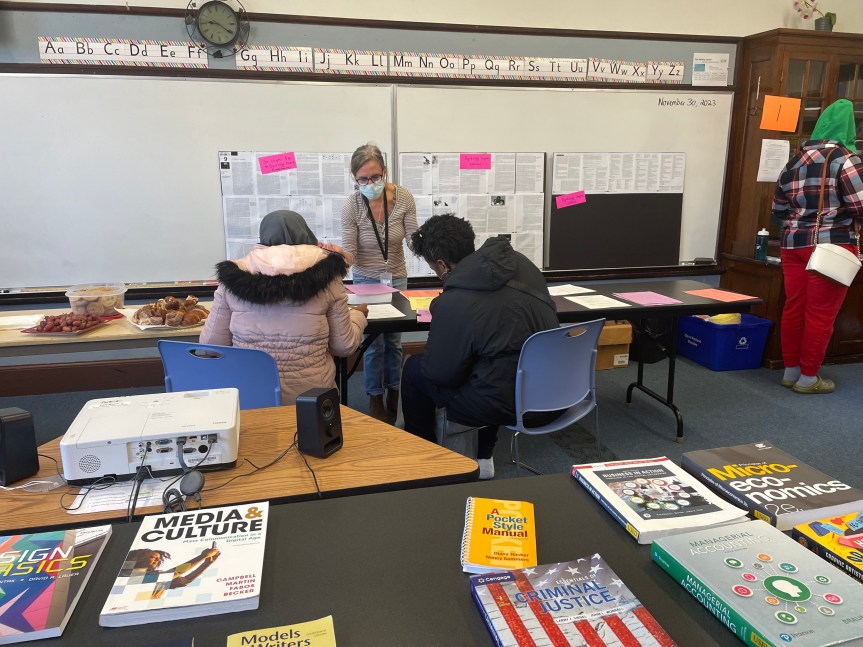
(Pictured: Heather Wood, Dean of Instruction at Portland Adult Ed helping students at a reading and writing station during a recent “Curious About College” workshop.)

Portland Adult Education recently launched a new program, “Curious About College,” that aims to empower adult learners interested in embarking on their higher education journey. Adult Education in Maine has offered Maine College and Career Access (MCCA) programming since 2001 (formerly called College Transitions) to provide readiness for pathways to postsecondary education and careers. With increased enrollments in community colleges across the state and the opportunity of “free college,” student preparedness programs and collaborative partnerships are needed now more than ever.

Anja Hanson, Academic Advisor at Portland Adult Education shares some history and context about “Curious About College”:

We started meeting last year because we felt that prior orientations, meetings, and classes didn’t fully communicate to students what we wanted learners to understand about college in the U.S. This is true for both first-generation and multilingual students. Why should they understand? Preparing for college is so abstract, complicated, and baffling. 

Simulated College Experience

We wanted to find a way to make it more concrete. This is how “Curious About College” came to be. We wanted students to do all of the following:

    • Handle current college textbooks 
    • See the pages of a single psychology textbook chapter spread out on a wall
    • Listen to a lecture and take notes 
    • Find information on a syllabus 
    • Figure out which math class their degree program would require at SMCC 
    • Plan a week’s schedule that includes all the obligations that work and family demand of adult students
    • Know what fees they would have to anticipate 

Since most of our students are planning on attending SMCC, we used materials in current use there, and we set up 6 stations so that students could engage in activities and ask questions. We gave them checklists to take notes on what they noticed or learned. What we observed last spring and during our recent fall session is that students at various levels of English proficiency and sophistication about college can all get something from this event.

Hanson shared that as they moved about the room, students helped each other. They looked overwhelmed. They looked intrigued. It’s not as though they could learn everything they needed to know in this brief event, but they could discover that they had more to learn, which is precisely what they must understand if they want to go to college.

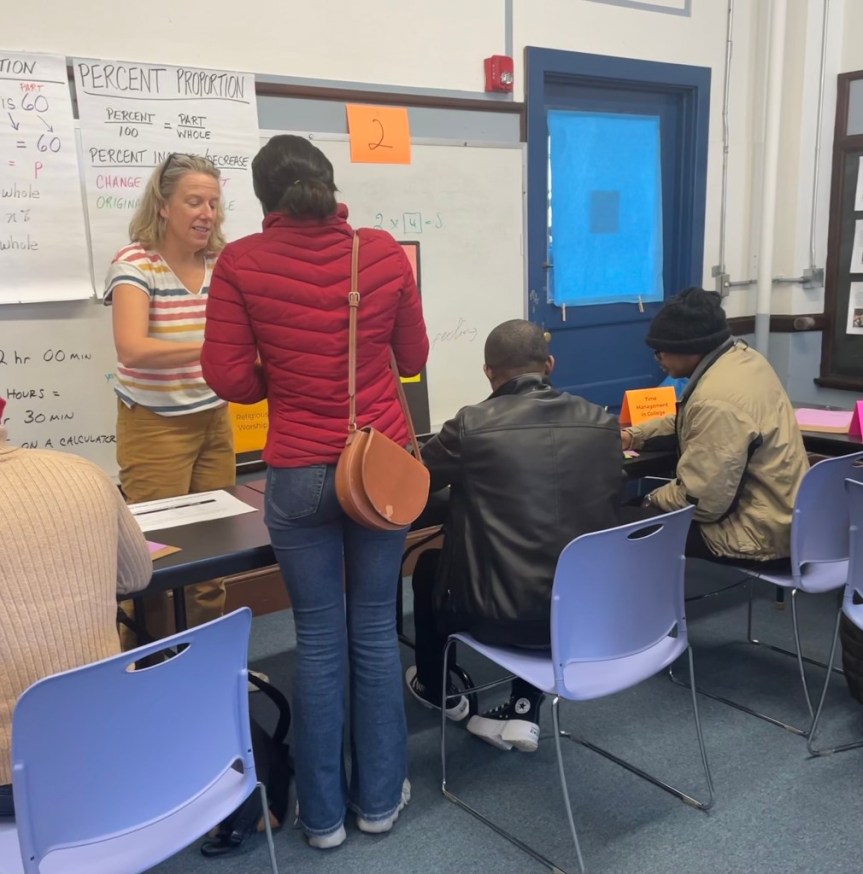
This photo is from a Time Management station 15 minutes after the event officially ended. Hanson shared that, “it suggests something about how much students need opportunities like these to grapple with what their dreams and goals will demand. We’d love to see other high schools and adult education programs offering Curious About College events.”

Alice Shea (College and Career Success Coordinator) at a time management station.

Feedback from Learners

Students observed how fast the English lectures were when they had to take notes while translating mentally. They noted the amount of time they’d need to commit for reading, planning and completing assignments, the costs of textbooks, how all the programs require math, and the heavy amount of writing. One learner noted that every [degree] program at SMCC requires math. After the event, some learners reflected that it would not be easy, but with practice, they can succeed while others decided they were not ready yet. All learners left the event more aware of college requirements and what it would require to be successful.

Empowering Adult Learners

“Curious About College provides a strong foundation where I can discuss the realities of college and the college system with students, said Alice Shea, College and Career Success Coordinator at SMCC. “I would love it if all students entering college had the opportunity to experience Curious About College. The event empowers students to understand their strengths and limitations and make decisions that will help them be successful in the college system. It takes me out of the role of ‘advising’ students and moves me into the role of a professional colleague engaging in a guided conversation with a student where they decide what works best for them.”

Shea is one of seven College and Career Success Coordinators (CCSC) located at each Maine community college and employed by local Adult Education programs funded by the Maine Jobs Recovery Plan. These roles serve prospective and current community college students as they work toward their goals at the college. Priorities for the CCSCs are Adult Education learners and enhancing the collaboration between Adult Education and their respective community colleges.

Current and Future Endeavors

Portland Adult Education, Hanson, and Shea seek to expand this opportunity for learners in their community and are demonstrating a mock event for other Adult Education programs in Cumberland County to see the model in action. Shila Cook, ABE/ELL Coordinator at Westbrook Adult Education, and colleagues are holding a Curious about College event for Westbrook High School students and Adult Education learners in late January.  Shea’s College and Career Success Coordinator colleagues across the state are working on similar programming to support their adult learners in their college endeavors. At Eastern Maine Community College, Brian Loring, the Success Coordinator there, will offer monthly sessions to interested Adult Education learners, especially HiSET graduates at EMCC. At Kennebec Valley Community College, Carolyn Haskell and colleagues are preparing a “Brighter Futures Day” for March. This is an event for Adult Education learners to come to campus and learn more about what being a student there requires as well as their opportunities and resources. This semester, Adult Education’s MCCA through Turner Adult Education, will hold their class at Central Maine Community College to immerse learners in the college environment.

Learn more about the College and Career Success Coordinators.

Learn more about Portland Adult Education.

Learn more about the Maine Community College system.

Learn more about the Maine Jobs Recovery Plan.

Positive Behavioral Interventions and Supports (PBIS) Listen & Learn

Is your school administrative unit (SAU) and/or school interested in implementing Positive Behavioral Interventions and Supports (PBIS)?

PBIS is “an evidence-based, tiered framework for supporting students’ behavioral, academic, social, emotional, and mental health that creates safe, positive, equitable schools, where every student can feel valued, connected to the school community and supported by caring adults.” (Center on PBIS, 2024).

Maine PBIS offers a 3-year intensive training and coaching model to support districts and schools in implementing Tier 1 PBIS with fidelity. To learn more about Maine PBIS and the training model please join the Listen and Learn Session and explore the resources below.

PBIS Listen and Learn Session
February 1, 2024, 1-2 PM
Register here

APPLY BY MARCH 8, 2024

For questions, reach out you the PBIS team at PBIS@maine.edu.

Media Release: Mills Administration Announces $10 Million in Literacy Grants for Maine Schools 

Grants Support the Development, Expansion, and Enhancement of Evidence-Based Core Literacy Instruction and Targeted Interventions for Maine Students 

The Mills Administration announced a $10 million literacy grant opportunity for schools to support the development, expansion, and enhancement of evidence-based core literacy instruction and targeted interventions for Maine students. These literacy grants through the Maine Department of Education (DOE) are intended to build the capacity of year-long, core literacy instruction for all students and support core literacy instructional components, including phonics, phonemic awareness, fluency, vocabulary, and comprehension.

Grant funds can be used by schools to compensate educators for participating in evidence-based literacy professional learning opportunities and internal instruction and program review processes, for professional learning opportunities on evidence-based literacy practices, to train instructional coaches, and to purchase evidence-based literacy materials.

       “Literacy is a foundational skill that enables students to thrive in school, work, life, and as citizens in our democracy. This investment in literacy will help schools and educators provide all students in Maine with evidence-based core literacy instruction and interventions. It’s an investment in the future of our state,” said Maine Education Commissioner Pender Makin.  

The grants were developed following the work by a Maine DOE workgroup of literacy specialists to analyze early literacy programs in Maine to understand better which assessment measures, programs, resources, evidence-based practices, and educator supports have yielded strong student growth. The Maine DOE workgroup created recommendations, which were provided to the Maine Legislature in December 2022. This $10 million grant initiative was designed out of LD 1526, which was passed by the Legislature and signed by the Governor, to increase student reading proficiency in Maine.

       “The literacy grant the DOE is providing is giving schools the opportunity to participate in the much needed and requested professional development around the science of reading. These funds will allow us to provide vital training in this area and the opportunity to purchase classroom materials for literacy instruction. In RSU14, this means we can train more staff than we budgeted for using local funds. We are grateful to have this opportunity to support our staff,” said Christine Hesler, Director of Curriculum for RSU14.

       “The Maine DOE literacy grant is a great opportunity for many districts to reach their goal of all students becoming readers. Through providing professional development, purchasing additional resources and materials that are focused on research-based literacy strategies, this goal is attainable.  These funds will supplement the financial investment districts already commit to literacy instruction,” said Deb McIntyre, Executive Director of the Maine Curriculum Leaders Association.

The grants also build off extensive efforts by the Mills Administration to strengthen child literacy skills in Maine, including investing $10 million through the Governor’s Maine Jobs and Recovery Plan to create and expand pre-k programs across Maine. In 2022, the Maine DOE released, Literacy for ME 2.0, a revamped state literacy plan grounded in research-based literacy practices and organized around key components central to building comprehensive literacy programs.

Recognizing the vital importance of foundational literacy development and in response to school system inquiries related to early literacy program development, the Maine DOE and a team of Maine educators and educational partners, developed guidance to support School Administrative Units in designing and implementing systematic and explicit early literacy instruction. This guidance is designed as a supportive tool for early elementary educators, administrators, and literacy leadership teams to reflect on current practices and to potentially adjust educational design to support high-quality and evidence-based early literacy learning for all PreK to Grade 3 students. The Maine DOE also provides interdisciplinary instructional programming and resources around literacy for pre-K, kindergarten, and first grade.

The Maine DOE has obtained a preschool development grant through the federal government to support   professional learning in birth through grade three literacy practices grounded in science and the Department is working to secure access to on-demand literacy modules that cover a wide variety of literacy content grounded in science for elementary educators, including content related to brain development, instructional practices connected to the essential components of reading and writing, dyslexia, and multilingual learners.

Last month, the Mills administration expanded the state’s partnership with Dolly Parton’s Imagination Library, with 4,500 eligible Maine children currently receiving free, high-quality, age-appropriate books through the program. The Maine DOE recently announced a partnership with I’m Your Neighbor Books to provide Welcoming Libraries to 16 schools across Maine, with each library containing 60 books featuring stories of immigrant families and the diversity of America. The Maine DOE also hosts the Read to ME Challenge every February to encourage adults to read aloud to children and Read to Ride Summer, a contest that qualifies students who read at least 500 minutes over the summer a chance to win one of 48 donated bikes and helmets.

The DOE has also created several literacy-related educator groups, for educators and education organizations across Maine to share and develop resources and guide the state’s literacy work, including the State Literacy Team, Maine Association for Improving Literacy (MAIL) Network, State Dyslexia Advisory Group, Screening Project & Dyslexia Plan, and the Higher Education Pre-Service Literacy Faculty Group. These groups also share information, facilitate text studies, and offer training related to dyslexia awareness, the Science of Reading, the neuroscience of the reading brain, systematic and evidence-based Tier I instruction to lower special education referral rates, support for striving readers, alignment and collaboration between general and special education for IDEA, and inclusive literacy instruction for students identified as having specific learning disabilities.

Literacy grants will be allocated to school administrative units (SAUS) and Education in Unorganized Territory (EUT) schools based on a formula model and the Maine DOE will be contacting SAUs & EUT directly through the Grants4ME platform with more information about their participation in the literacy grant program. Federal emergency relief funding was used to support these grants.

Getting to Know Community Schools in Maine: Welcome to Cape Cod Hill Community School

Nestled in the woods off a back road in western Maine you will find Cape Cod Community School. Part of the Regional School Unit (RSU) 9 of the Mount Blue area, Cape Cod Hill takes a different approach to serving its community. It is one of just a handful of Community Schools located in Maine.

A community school model, as defined by the Coalition for Community Schools, is both a place and a set of partnerships between the school and other community resources. Community schools exist in all regions of the United States and their numbers are growing fast.

In Maine, the community school model was first recognized by Maine Legislative Action of the First Regular Session of the 127th Legislature (2015-2016), in the budget bill Public Law 2015, chapter 267. At that time, the Maine DOE was authorized to fund a limited number of community schools, established under 20-A MRSA Chapter 333. Currently, three schools in Maine receive funding from the Maine Department of Education (DOE) to support their community school strategies: the Gerald E. Talbot School in Portland, Old Town Elementary School in Old Town, and the Cape Cod Hill Community School in New Sharon.

In its second year of implementation, Cape Cod Hill Community School has already put a lot of resources and strategies into place with big plans for many more to follow. Principal Carol Kiesman along with Social Worker Amanda Clark and School Nurse Jesstine Meader are the force behind these big changes and they work as a team to tackle the role of Community School Coordinator. An essential part of the success of a community school.

To accomplish a community school model, the team at Cape Cod Hill has garnered countless resources through ongoing partnerships throughout the Franklin County region and beyond to offer students and their families support beyond academics. Resources like behavioral health by way of counseling services for families and children through an outpatient counselor who comes to the school to see children in addition to case management through Maine Behavioral Health Organization. Also now available are dental health services offered to every child right at school, food and nutrition resources available through the school’s food pantry, and many more partnerships that bring in community members, resources, and services that benefit students and families.

“In the past things were more academic-centered, this is more community-centered,” explains Kiesman. “This is looking at the whole child and what can we offer to the children and the families besides academics. Yes, academics are huge, they are important, but we know that there is more to children’s lives than just academics.”

One of the most successful and new programs started by the school is its no-cost before and after-care program which runs from 7:00 am to 4:30 pm on school days. The program allows parents to work without having to find care for their children for those couple of hours before and after school that never seem to line up just right with the average workday. This program has been a game-changer for many of their families and the fact that there is no income threshold makes it that much more accessible for everyone. The Community Schools grant funding provided by the Maine DOE made this program possible.

Pictures from the Before and After-Care Program:

One of the ongoing programs the team has up and running is its food pantry, which also serves as a clothing and book pantry as well as bringing much-needed resources to the community. The pantry has been around for a while but the team at Cape Cod Hill has gotten innovative in maximizing its impact in recent years by creating discrete access to the pantry via a side door to the school, giving community members a way to grab what they need without having to make a grand entrance. They’ve also been able to utilize the help of community partners like Good Shephard Food Bank who help with food donations and have welcomed help from community members who come in regularly to keep the pantry organized and stocked with foods and other resources that families need and want.

Other ongoing partnerships include Franklin County Adult Ed providing monthly classes at Cape Codd Hill Community School on things like cyber security, social-emotional learning topics, and multi-tiered systems of support/response to intervention components that can be implemented at home. They have also invited the Franklin County Sheriff’s Department over for monthly “lunch and jokes” in which members of the Sheriff’s Office get to dine with the students at lunchtime and exchange good-humored stories and jokes.

“We are going beyond our four walls,” said Clark. “Maine schools are providing a lot of these things and they are doing amazing work. I think, for us, the community school initiative and model gave us that extra layer of support to be able to provide the things we felt like we were missing.”

Community schools foster a shared vision for student success and thoughtfully engage the community in making the vision a reality. Over time, community schools become the center a of community where everyone belongs, works together and thrives. They become the hub of their neighborhoods and communities, uniting families, educators and community partners toward student success.

To hear directly from the team at Cape Cod Hill Community School, check out this 5-minute video interview where Kiesman and Clark talk about their journey to becoming a community school and their plans for the future:

Maine DOE has welcomed Community Schools Consultant Ann Hanna, who has joined the Maine DOE Office of School and Student Supports. Hanna proudly served as the principal of the Gerald E. Talbot Community School in Portland where she led the school through a transformative process to become a Community School. Hanna will be working on advancing Community School strategies in interested schools across Maine by providing technical assistance and support as needed.  The Maine DOE is also working on the next application for funding for SY 24-25, and information on that will be shared via Newsroom in the coming days.

To learn more about community schools in Maine, please contact Ann Hanna, at ann.c.hanna@maine.gov.