Maranacook Middle School Students Share Their Experiences Participating in “Ice Day”

The following article is a combination of three articles written by Maranacook Middle School Students Sabrina Foth (grade 6), Veda Tibbetts (grade 8), and Lucas Giles (grade 7) following the ice harvesting event.

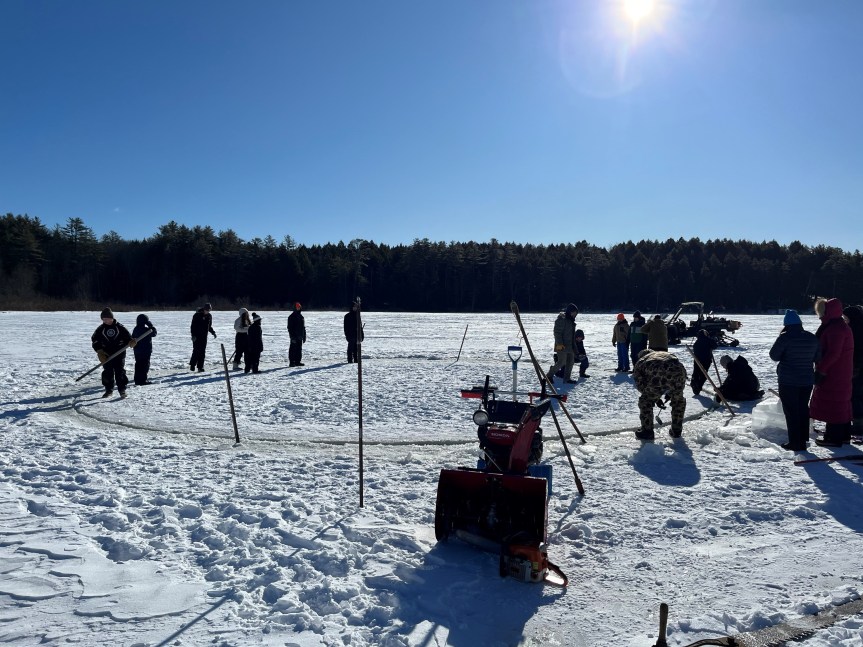
On Wednesday, February 5, the awesome Acadia team from Maranacook Middle School embarked on an adventure to Maranacook Lake for a super fun day of winter activities on the ice! The air was crisp, and everything sparkled under the bright winter sun. (Sabrina Foth, grade 6)

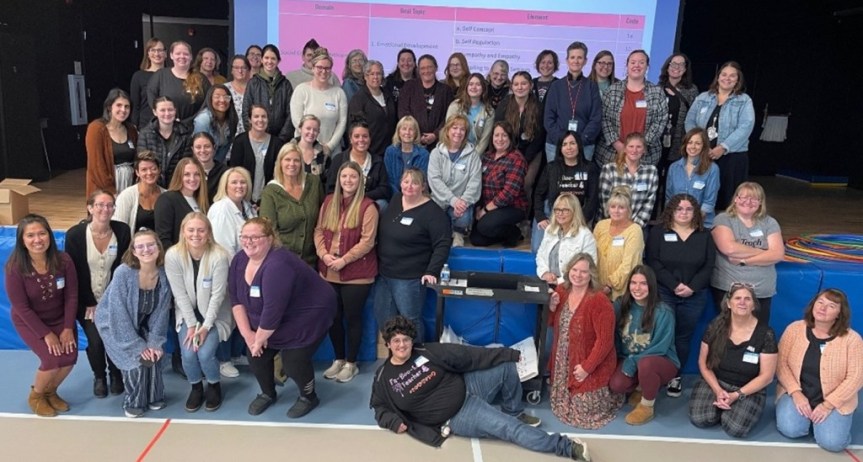
The Acadia team consists of 70+ Maranacook Middle School students, ranging from sixth to eighth grade, guided by 3.5 teachers who deliver an integrated curriculum through student-derived and student-chosen themes. (The Acadia team is pictured above in a group picture taken at the event)

Despite the biting cold, seventh grader Lillian Moran expressed her gratitude for the warming tents available on-site, saying, “The cold was really bad, but I am grateful they had warming tents.” The middle schoolers bundled up in winter coats, hats, and gloves before trekking to Maranacook Lake. Thanks to the efforts of Maine Gear Share, Teens To Trails, and generous community members, warm winter attire was provided to ensure that all students were properly equipped to combat the chilly weather and wind. (Veda Tibbetts, grade 8)

Dan Holman, the Acadia team leader from Maranacook Community Middle School, explained the educational significance of the day: “It’s a bit of a celebration of what we’ve been learning, which is about resources and some of the science and math of pi and density. We’ve been looking at Maine industries, both present and past, which included the logging and ice industries.” The “Ice Day” event was not only a fun day outdoors but also an opportunity for students to demonstrate their knowledge; they even sculpted a pi symbol from the ice they harvested. (Veda Tibbetts, grade 8)

Along with middle school teacher Mr. Holman, fellow educators Jean Roesner, Tom Radcliff, and Dan Brannigan have been hosting an ice harvesting event for students for the past three years.

This exciting day featured five engaging activities: ice harvesting, ice carving, ice fishing, and two sessions led by community outdoor educators. The combination of learning and outdoor fun made for an unforgettable experience. (Veda Tibbetts, grade 8)

The students had the chance to try ice harvesting, which they found incredibly cool. Armed with sturdy saws, they worked hard to cut through the thick, shiny ice, laughter and cheers echoing as they sliced through. Once they broke the ice into big blocks, the group donned special creepers—metal spikes that attached to their boots—to prevent slipping. Their teamwork was impressive, with some students using picks to lift the heavy ice blocks while others pulled with all their strength. They showcased remarkable collaboration and effort throughout the task! (Sabrina Foth, grade 6)

It was so cool to see and participate in using saws to cut out the ice and drag it up. This was very important back in the day before refrigerators and freezers were invented. It was super interesting to learn about how they kept the ice cool with sawdust. The Acadia team was able to acquire some sawdust from a local sawmill, and we will be preserving the ice with it, just like they did back then. In ideal conditions, sawdust can keep ice frozen for up to 6 months, which will be important for what we have planned in the future. (Lucas Giles, grade 7)

The team then learned about a serious issue—habitat loss. They discovered the importance of taking care of the environment and how they can help nature survive despite human activities. Engaging displays and discussions sparked their thoughts on ecology. (Sabrina Foth, grade 6)

Next up was ice fishing, which thrilled the students! They learned how to fish on the ice, keeping a sharp lookout for colorful flags that would pop up when a fish was beneath the surface. (Sabrina Foth, grade 6)

According to many students, one of the coolest parts of the day was the ice carousel. The ice carousel we created is a giant circle of free-floating ice that spins around when you push it. It was big enough for half of our team, about 35 people, to stand on it at once! (Lucas Giles, grade 7)
During the event, participants had the opportunity to delve into the fascinating world of nature. They learned valuable skills for distinguishing between various species of trees and identifying different animals in their natural habitats. This hands-on experience enriched their understanding of the ecology surrounding them, fostering a deeper appreciation for the biodiversity that exists in their environment. With each lesson, they grew more adept at recognizing unique characteristics, making them more attuned to the intricacies of the world outside their windows. (Sabrina Foth, grade 6)

This event would not have been possible without the help of the community. Our chaperones included grandparents, parents, and former students. More help from the community consisted of the Readfield Fire Department, a game warden, a forester, and a few people from the United States Geological Survey (USGS), who all helped make the day happen. Thanks to them, we participated in several fun and educational activities. (Lucas Giles, grade 7)

Here’s some of what other students had to say about “Ice Day”:

  • Samuel Saunders, 11, said, “It was super fun, and my favorite was the ice carousel because of the way it spun. It was like walking on a treadmill.”
  • Johnathan Woessner, 13, said, “This experience was very memorable because this is only the second one ever done.”
  • Johnathan Perry, 12, thought the event was fun and interesting: “I think it was really fun. It was a great learning experience, and it was fun to explore Maine’s history and what it used to be. It’s fun to learn about and be able to do it in-person.”
  • Izabell Loiko, 13, said, “Doing this for free is a once-in-a-lifetime experience. It was so much fun hanging out with the whole team on the lake.”
  • Benjamin Alexander, 12, shared how hard it was to cut through the ice: “Sawing through the ice is tough. But with everything, it doesn’t matter how hard things get. You just have to keep pushing sometimes.”
  • Augustus Villareal, 13, said, “The ice harvest was awesome! It was fun working together, learning about history, and enjoying winter.”
  • Destiny Beane, 12, said, “This is a really good learning opportunity, but it is also so much fun.”
  • Brody Heminger, 13, added, “It’s a great experience to have.”
  • Dylan Stephan, 12, noted, “The best activity was the ice harvest. It was fun to pull up ice and cut it.”
  • Eighth-grader Veda Tibbets talked about how cold it was but also how awesome the experience was: “The ‘Ice Day’ was one I will always remember. It was really cold, but it was one heck of an experience. I think everyone should have a chance to bear the cold to harvest natural ice that wasn’t made in your freezer.”
  • “I think it’s a really, really good learning opportunity to get out here and be able to learn back then before we had refrigerators and freezers,” seventh-grader Jonathan Woessner said.
  • “I liked the ice carousel because it was fun and enjoyable,” Ryleigh Bolton, 13, expressed.
  • “I think this was a great experience of what they did in the olden days,” Austyn Ivey, 11, declared.

The goal for this event was to use what was learned…. Be outside, and have a lot of fun. Judging by the students’ enthusiasm and engagement, I think the goal was met. (Veda Tibbetts, grade 8)

As for what’s next:

The ice harvest may be done, but we aren’t. Mr. Holman told us that later this school year, we’ll have a few activities that involve the ice. Some that he stated include ice sculpting for art classes and using it to demonstrate phase change. The activity that Acadia is most excited about, however, is our celebration where we’ll make ice cream and use the ice we harvested to keep it cool. These activities will be a fun way to remember everything we learned and experienced. (Lucas Giles, grade 7)

This ice harvest was something special, and we’re lucky to have had the chance to do it. We learned so much about Maine’s history, the environment, and how to work together as a team. It’s something none of us will ever forget! (Lucas Giles, grade 7)
Meet Lyseth Elementary Environmental Literacy Teacher and School Garden Coordinator Leigh Quigley

Throughout the years, Portland Public Schools (PPS) has implemented an Outdoor and Experiential Learning program in all of its 10 elementary schools. Over time, this program has evolved from focusing solely on school gardens, to including the habitat of the living schoolyard, to now, incorporating a deeper, systematic implementation of Environmental Literacy that aligns with students’ learning standards and grade-level curriculum.

Now, a  few of the PPS elementary schools have an Environmental Literacy Teacher, whose role is unique to itself and the school where the teacher is based. At Lyseth Elementary School, the Environmental Literacy Teacher and School Garden Coordinator is Leigh Quigley,  a passionate gardener who brings much personal experience and excitement to her role. She assists with the school garden program, established with support from parent volunteers and the local non-profit Cultivating Community, which helped to build and implement an elementary garden curriculum.

“My role as Environmental Literacy Teacher/School Garden Coordinator is to help teachers build capacity toward integrating the natural world into PPS Wabanaki and Life Science units, as well as other areas of the curriculum in which it benefits students to incorporate the schoolyard into their studies,” Quigley explained.

To do so, Quigley incorporates environmental and science education, socio- and eco-justice, Indigenous knowledge, biodiversity, natural resources, climate change, sustainability, and more into all that she does with students.

Additionally, the collaborative teaching model of the Outdoor and Experiential Learning program offers embedded professional development designed to uplift and support classroom teachers as they work to provide equitable access to the natural world for all children through the PPS curriculum. The Environmental Literacy Teachers also help to run year-round Wabanaki fieldwork for k-5 students.

“I directly teach specific Science and Wabanaki units/lessons,” Quigley said. “I also support teachers with their English Language Literacy curriculum by creating avenues for students to bridge the topics they are learning about in class through added exposure to the topics (or related topics) via an environmental/ecological/scientific/Indigenous lens.”

This fall, Quigley held a schoolwide garden celebration with students, teachers, families, and community members. Students harvested fall produce from the garden, planted overwintering crops like garlic, weeded and redesigned outdoor learning spaces, and helped tuck the garden in for the winter.

Leigh brings a lot of love to her work and encourages students to grow and cultivate a lasting relationship with nature.

“In this role, I have the utmost pleasure of seeing struggling students take on leadership roles and experience success in activities and tasks that are completely new to them,” Quigley said. “It is extremely gratifying. The real reason behind my position is fostering academic, social, and emotional growth and success in students, while helping them build a (hopefully) positive, lifelong relationship with the natural world.” This experience-based, hands-on learning approach helps students to build relationships, reciprocity, respect, and responsibility for the Earth’s ecosystem and for each other. It also offers a level playing field that welcomes and supports every student, no matter their background, experience, or abilities.

Some of Quigley’s favorite student reactions thus far include:

  • “Look at this! This is OUR garden.” (This comment came after a weeks-long student clean-up project in the fall.)
  • “I love Tuesdays. That’s when I have Garden class.”
  • “Do we get to go outside today?!”
  • “Did we really harvest over 100 lbs. of carrots?!”
  • “Working in the garden makes me feel good.”
  • “Do we have to go back inside already?” (This comment came after a 45-minute class outdoors.)
  • “Look what I found!” (Quigley mentioned that this is a common remark among students when they find things like worms, roly-polys, grubs, millipedes, animal tracks in the snow, and animal nests.)

Mt. Ararat Middle School Teacher Brings Real-World Problem Solving into the Classroom

The Maine Department of Education’s (DOE) Interdisciplinary Instruction Team is proud to highlight a transformative shift taking place at Mt. Ararat Middle School, where student-centered learning is redefining how students engage with their education.

Mt. Ararat Middle School educator Gretchen Feiss has brought real-world problem solving into her classroom through the Maine Solutionaries Project, empowering students to tackle complex global and local challenges. This approach shifts students from being passive learners to active changemakers, equipping them with the skills and mindset to make a meaningful impact.

For Feiss, the transition to Solutionary learning stemmed from a belief that students learn best when their education connects to real-world issues they care about. Traditional instruction often leaves little room for students to explore their own questions, and Feiss wanted to change that. By allowing students to identify problems, research solutions, and take meaningful action, she has transformed the classroom into a space where learning has a direct, real-world relevance.

Feiss said at times, guiding students through inquiry to action comes with challenges.

“They struggle with identifying good questions to ask but also with imagining solutions and strategies,” Feiss explained. As a mentor, Feiss helps students to sharpen their research skills, ask deeper questions, and think critically about the information they find. For seventh graders with limited experience in research and problem-solving, this support is essential.

As students pursue diverse projects, keeping up with their progress and providing guidance can be challenging. One innovative solution Feiss has used is introducing artificial intelligence tools, like ChatGPT, to help students identify key contributors working on their chosen topics. Many middle schoolers are unfamiliar with the organizations and individuals addressing social and environmental challenges, and AI provides an entry point to discovering these connections.

Beyond academic skills, Feiss has witnessed a shift in how students perceive learning itself.

“I think they see it less as something that is done to them and more as something driven by their choices,” she said. By giving students the independence to explore their interests, they have developed a sense of ownership over their education, leading to deeper engagement and more meaningful learning experiences.

One of the most exciting aspects of Solutionary learning is its connection to the real world. Feiss encourages students to reach out to experts, helping them craft professional emails and messages. These efforts have had a powerful impact. One student group received a response from the head of a wildlife protection organization in Uganda, making their research feel far more relevant. These experiences help students see that real people are working on the issues they care about — and that they, too, can be part of the solution.

Despite any challenges her classroom has experienced, one thing is clear: Student-centered learning is making a difference. By equipping students with the tools to research, communicate, and take action on issues they care about, Feiss is helping to shape a generation of informed, engaged citizens. As the classroom continues to evolve into a space where students don’t just acquire knowledge but use it to create change, the possibilities for their futures are limitless.

To learn more about the Maine Solutionaries Project’s upcoming cohorts, including a literacy-focused cohort and a numeracy-focused cohort, please visit the Maine Solutionaries Project webpage or contact Kathy Bertini, Maine DOE Interdisciplinary Instruction Coordinator, at kathy.bertini@maine.gov, or Erik Wade, Maine DOE Interdisciplinary Instruction Specialist, at erik.wade@maine.gov.

The Interdisciplinary Instruction Team is a part of the Maine DOE’s Office of Teaching and Learning.

The Maine Solutionaries Project funds received from the U.S. Department of Education (USED) support the implementation of this project. The project has an award totaling $1.34 million, of which 100% is federally-funded and directly attributed to project implementation. The contents are those of the Maine Solutionaries Project and do not necessarily represent the official views of, nor an endorsement, by the USED or the U.S. Government.


Reeds Brook Middle School Student Wins MLTI Maine Winter Classic T-Shirt Design Contest

The Maine Department of Education (DOE) is extending a big congratulations to Sophia Smith, a 7th-grader at Reeds Brook Middle School in Hampden, whose design was selected to represent the 2025 Maine Learning Technology Initiative (MLTI) Maine Winter Classic!

This statewide event, scheduled for the week of March 3, will bring together more than 50 schools and 5,000 students and educators from grades 3-12.

In January, the Maine DOE’s MLTI team opened its annual T-shirt design contest to all MLTI schools, challenging students to unleash their creativity and design the official T-shirt for the 2025 Maine Winter Classic.

Smith’s winning design, Winter Harmony, beautifully captures the event’s winter theme and meets all contest requirements.

“I was inspired by a snowy day or a snowstorm, with snowflakes swirling and icicles hanging from the logo,” Smith shared. “I thought adding those elements would really make the design pop.”

Smith said she created her artwork using the FlipaClip software.

Smith’s design will be featured on T-shirts sent to schools around the state. While event registration has officially closed, educators and schools can still sign up to participate, although some supplemental materials may no longer be available.

If you would like more information about the 2025 Maine Winter Classic, you may click here. For questions about the Maine Winter Classic or other MLTI events, please contact MLTI Project Manager Bethany Billinger at bethany.billinger@maine.gov.

MLTI is part of the Maine DOE’s Office of Teaching and Learning.


Outdoor Learning Educators Share Expertise With Panel Presentation at RSU 16 in Poland

Pictured left to right – RREV Panelists Katie West (Portland), Robin Chernow (MSAD 28), Margaret Sobol (Falmouth), Maggie Corlett (RSU 10), Justin Deri (Falmouth) and Sarah Timm (MSAD 17)

On Monday, January 27, five educators from schools that received funding from the Maine Department of Education’s (DOE) Rethinking Responsive Education Ventures (RREV) project participated in two panel presentations at RSU 16 in Poland. The panels, led by representatives from the Maine DOE’s RREV Research and Design (R&D) team, consisted of educators from schools in MSAD 28 (Camden), MSAD 17 (Oxford Hills), RSU 10 (Rumford), Falmouth, and Portland who shared their RREV pilot projects and ongoing efforts in experiential outdoor learning.

In August of 2020, the Maine DOE was awarded $16.9 million from the U.S. Department of Education’s Rethink K-12 Education Models funding. Maine was one of 11 states to receive funding, which was used to launch the RREV project, a multi-pronged solution with a primary goal of generating innovative remote learning models to provide equitable access to high-quality remote learning opportunities for all students.

The federal RREV funding ended in July of 2024, but the Maine DOE RREV R&D team is continuing the momentum of this work by promoting collaboration and sharing events that bring RREV awardees together with other educators who are interested in developing innovative and responsive learning opportunities for their students.

These panel presentations at RSU 16 are one example of that continued effort. In December, the Maine DOE published a Newsroom story that showcased RSU 16’s inaugural Outdoor Learning Day event. Afterwards, Jill Mathieu, RSU 16’s Director of Curriculum, Instruction, and Assessment, reached out to the Maine DOE to seek a way to provide additional support for RSU 16 educators interested in developing ongoing outdoor learning opportunities for their students. The Maine DOE’s RREV R&D team subsequently contacted all of its outdoor learning RREV awardees and set up these panels.

These discussions provided an enriching peer-to-peer learning opportunity for both RREV panelists and educators from RSU 16, with many ideas, suggestions, and lessons shared. The group will continue to stay connected through EnGiNE, an online collaborative portal created by the Maine DOE for Maine educators.

You may learn more about the innovative pilots produced through the RREV awards here.

RREV awardees are always interested in sharing their learning through online and in-person panel presentations. There will also be additional RREV Learning Tours scheduled throughout this school year. Learning Tours are typically conducted on-site at a RREV school, and educators from across Maine are invited to see the RREV pilot project’s programming in-action with students and educators. A list of upcoming tours is available on the Maine DOE website.

For further information, or to schedule a panel opportunity, please contact Elaine Bartley, Maine DOE RREV R&D Project Director, at elaine.bartley@maine.gov.

The Power of Two Hours Spent in the Woods: How One Maine School Counselor Is Offering an Alternative to Detention

Leslie Trundy is in her twentieth year working as a school counselor. She says she absolutely loves her job at Morse High School in RSU 1.

“I am so grateful to be a consistent adult in the lives of young people and to support them and their families through goal attainment and the challenges they face growing up,” Trundy said. “One of the things I like the most about my job is the ability to connect the right student with an enrichment activity that fosters their growth and passion.”

An avid hiker, Trundy personally finds much happiness in outdoor recreation. For her, the outdoors has been a constant source of enjoyment and a place to find solace.

“In the summer of 1996, I spent six and a half months hiking from Georgia to Maine and knew in my bones that walking could be an incredible form of meditation and clearing the carburetor of our minds. It was on the Appalachian Trail that I decided I would earn the credential to become a school counselor,” Trundy explained.

Last fall, Trundy attended the Teens to Trails Fall Leadership Conference, where she participated in a workshop titled “Mindfulness Outdoors: Whole Body Health Benefits,” presented by Megan-Mack Nicholson from the Lennox Outdoor Leadership Center.

Photo taken on a sunrise hike with Teens to Trails.

In the workshop, Trundy and other participants learned about leading youth outdoors, meditation, and how to support youth who may find meditation to be challenging. The presenter also shared stories from her readings about the value of time spent in the woods and how healing it can be for mental health.

“This resonated with me,” Trundy noted. “I thru-hiked the Appalachian Trail in my mid-twenties and grew up involved with Girl Scouts and skiing in Northern Michigan. I’ve also seen this work as a mom and Scout leader. No matter the weather, time outside transforms.”

With the Morse Outing Club in its fourth year, Trundy began to brainstorm ways to bring the power of hiking in the woods to even more students. At Morse High School, students who have been given detention may sometimes replace that time with community service. Trundy thought that the administrators at her school might let her try offering a hike in the woods as an alternative, too, capturing a population of students who may be less likely to join an outdoor club out of interest.

“Students don’t benefit from more time indoors, and I wanted to offer them a mindset shift through walking outside,” Trundy said. “I wanted to give them my attention and ear if they want it and be a trusted adult they know they can speak to when they’re ready.”

With quick approval from her administration, Trundy’s first hike of this nature was on October 3, shortly after she came up with and proposed the idea. She has been taking students on hikes ever since then. While most students still choose to serve their detention, there are also students who opt into the hike on almost all of the walks.

“Sometimes they want to walk with a friend, and sometimes they desire to come along for the time outside,” Trundy said. “In total, I’ve walked 34 miles with students. My smallest group was three students, and the largest was 13.”

Trundy says that every hike has had memorable moments, but her top three favorites include:

  • A time three boys sang an a-cappella version of “I Want It That Way” by the Backstreet Boys as the group crossed the bridge back onto campus in November.
  • The first snowfall on December 5 when Trundy outfitted everyone in ponchos and confidently declared, “Yes, we are going to go on the hike!” The whole group had been before, and Trundy expressed it was magical to see the same trail transformed by the snow coating the bare tree limbs and falling gently into the open body of water. She said there was a little bit of slipping and a lot of laughter.
  • The moment a boy noticed how Trundy waited until the group stopped for a snack, before telling them her “why.” He remarked that it was clever because everyone was quiet and eating and, therefore, could receive her message and hear a poem by Wendall Berry or Mary Oliver.

“I’m planting acorns, and the soil, sun, and water need to be just right!” Trundy explained metaphorically of how she approaches these hikes with students.

Trundy said she hopes to keep these walks going no matter what the weather is. This year, the Morse Outing Club has a membership with Maine GearShare, and Trundy plans to borrow crampons and other warming gear when the trail becomes icy. She has also considered borrowing the school van to drive students to a different section of the trail at some point.

“I hope to see if the walks make a difference. It often takes time to know this,” Trundy said.

She noted some students who are going out on hikes are in grade 9, and she is curious to see their reflections when they are seniors.

“I know this time matters to me, and I’m grateful to share it with them,” Trundy said. “Last week, an older boy thanked me and declared, ‘That was awesome.’”

Portland High School Hosts After-School CNA Class for Students, Thanks to Community Partnerships

(Pictured: Scarborough High School students participated in the Portland High School Extended Learning Opportunities CNA program.)

A new after-school program has given Portland-area students the opportunity to become Certified Nursing Assistants (CNAs), thanks to a partnership between Portland High School Extended Learning Opportunities, Fallbrook Commons (formerly Saint Joseph’s Rehabilitation and Residence), and the Boys and Girls Club of Southern Maine.

At age 16, Portland High School students can earn their CNA certificate through Portland Arts and Technology High School (PATHS), the local Career and Technical Education (CTE) center. For years, however, these students have expressed interest in having that same opportunity through a class that takes place after school. This is the first program to meet that request.

Many high school students already work part-time, after-school jobs – often not in fields related to the career they hope to pursue. This program changes that trajectory, helping to strengthen the current healthcare workforce and allowing high school students to jump-start their healthcare careers and gain valuable experience.

Between the 2024 spring and summer sessions, this program graduated 25 fully-licensed CNAs, directly addressing the healthcare workforce shortage in Maine. Saytun Abdullahi, a junior who took the classes, says she has been interested in becoming a CNA since her freshman year.

“I liked how informative our teacher is,” Abdullahi said of the program. “She would go over something in class several times just to prepare us for the test.”

Abdullahi currently works as a CNA at Maine Medical Center.

“The class gave me a lot of understanding on how the healthcare field works, what CNAs do, and how they are helpful to the healthcare field,” Abdullahi expressed.

The after-school program also welcomes students from the surrounding area. Joel Rogers, a Portland High School alum and administrator at Fallbrook Commons, designed the class based on previous success he had working with adult multilingual learners in CNA programs. In addition to funding the teachers and materials, Fallbrook Commons paid the students to participate in this class and is committed to making the program as accessible as possible. The Boys and Girls Club of Southern Maine hosted the class.

“This program could be a model for other similar programs throughout the state and has the potential to make a great impact,” Andrea Levinsky, Extended Learning Opportunities Coordinator at Portland High School, said.

This program took students 170 hours to complete, and Levinsky and her colleagues are currently in the process of planning the next class.

To learn more about this program, or if you are a provider interested in supporting the next session, please reach out to Andrea Levinsky at levina@portlandschools.org. For more information about Extended Learning Opportunities, please reach out to Lana Sawyer at lana.sawyer@maine.gov.

Scarborough High School students participated in the Portland High School Extended Learning Opportunities CNA program.

Solutionary Learning Transforms Classrooms at Oxford Hills Middle School

The Maine Department of Education (DOE) Office of Teaching and Learning is proud to highlight a transformative shift taking place at Oxford Hills Middle School. Through inquiry- and project-based learning, the school is fundamentally changing how students engage with their education.

Oxford Hills Middle School teachers Liz Coen and Courtney McLellan recently participated in the Maine Solutionaries Project, an inquiry-to-action instructional design framework developed by the Institute for Humane Education in collaboration with the Maine DOE. Motivated by a desire to increase student engagement, these educators focused on how to encourage students to ask their own questions, seek answers, and solve real-world problems.

“We wanted them to feel empowered and motivated to make change,” Coen and McLellan explained.

This innovative model has redefined the role of teachers. Rather than simply delivering content, Coen and McLellan now act as facilitators, dedicating significant time to preparation before each project they conduct.

“Beyond typical planning, we spend time connecting with community partners to understand the topic better and explore what’s possible for students,” the duo shared.

Building a network of experts willing to collaborate with students has become a crucial component of their planning process. Once projects begin, Coen and McLellan lead their students by asking guiding questions, providing constructive feedback, and supporting collaboration and group dynamics.

The current project these students are working on, centered around the theme of waste, allows them to select a topic within the broader subject. Many of them have chosen to conduct surveys or interview community partners, creating meaningful connections between their work and the world beyond the classroom. This element of choice and real-world interaction has provided more meaning and authenticity to their learning.

“Having that contact with people outside of school makes their learning more impactful,” Coen and McLellan added.

The shift to Solutionary learning has led to a noticeable improvement in student engagement at Oxford Hills Middle School. Students are now posing thoughtful questions and taking ownership of their learning. For example, during a visit with a guest speaker from EcoMaine, students actively participated, asking insightful questions that demonstrated their curiosity and comprehension.

One particularly-memorable example involved a student who became deeply invested in finding alternatives to Styrofoam after learning about its inability to decompose. One weekend, he tested an alternative material and returned to school eager to share his findings, including his setbacks and plans for improvement. His enthusiasm even inspired a previously-disengaged classmate to join the effort.

“Now, he’s revisiting the process to better understand the problem, creating surveys, interviewing community partners, and diving deeper into research,” Coen and McLellan shared.

This experience highlights a core strength of the Solutionary approach: encouraging students to revisit problems and identify root causes, rather than jumping to solutions prematurely. This iterative process fosters critical thinking, resilience, and a deeper understanding of the issues being explored.

The transformation at Oxford Hills Middle School demonstrates the power of Solutionary learning. By empowering students to lead their education, educators like Coen and McLellan are cultivating a generation of engaged, motivated, and solution-oriented learners.

To learn more about the Maine Solutionary Project’s upcoming cohorts, including a literacy-focused cohort and a numeracy-focused cohort, please visit the Maine Solutionaries Project webpage or contact Kathy Bertini, Maine DOE Interdisciplinary Instruction Coordinator, at kathy.bertini@maine.gov or Erik Wade, Maine DOE Interdisciplinary Instruction Specialist, at erik.wade@maine.gov.

The Maine Solutionaries Project funds received from the US Department of Education(USDOE) support the implementation of this project. The project has an award totaling 1,344.000.00 of which 100% is federally funded and directly attributed to project implementation. The contents are those of the Maine Solutionaries Project and do not necessarily represent the official views of, nor an endorsement, by the USDOE or the U.S. Government.

Maine Schools Implement First 10 Community Schools Model Using Maine Preschool Development Grant

The Maine Department of Education (DOE) Early Learning Team is supporting a First 10 Community Schools pilot through Maine’s Preschool Development Grant. It is designed to bring together school administrative units (SAUs), families, early childhood programs, and community organizations to create a system that helps young children to learn and thrive during the first 10 years of their lives.

The First 10 Community Schools model is a specialized community school approach that involves children and their families even before they reach public school age. Providing resources during this critical period of development for kids has proven to support learning and wellbeing into adulthood. First 10 was developed by the Education Development Center (EDC) under the leadership of Dr. David Jacobson. Participating teams in Maine benefit from EDC coaching, which helps communities to tailor strategies to meet their own unique and individual needs.

Over the past two years, seven SAUs in Maine have been awarded grants to establish teams, hire outreach coordinators, and implement strategies to increase access to quality programming, comprehensive supports, parent education, and coordinated transitions for children and families into public school. The initial cohort of grantees began its work in the summer of 2023 and is now in the second year of implementation.

In July of 2024, a second cohort of schools and communities in Maine was also awarded funding to implement the First 10 Community Schools model. These participants, which include Cape Cod Hill School (RSU 9), Wiscasset Elementary School, North and Bloomfield Elementary Schools (MSAD 54), and Deer Isle-Stonington and Sedgwick Elementary Schools (RSU 76), are currently mapping assets, identifying needs, and building relationships with community partners.

The Maine DOE is excited to share some highlights from the first cohort’s progress:

Sanford Pride Elementary School – Sanford Pride Elementary School (pre-K-grade 4) has implemented multiple strategies to support school transitions for children and families and build family partnerships. One key initiative involves the public school’s collaboration with community-based early childhood educators.

In October, educators from local child care centers, Head Start, and home-based programs joined Sanford School Department educators for a day of joint professional learning. During the event, First 10 Community Schools Outreach Coordinator Shana Palmer provided an overview of Sanford’s efforts to implement the First 10 Community Schools model, and Louisa Anastasopoulos from EDC led a session on the social-emotional and literacy learning domains in the Maine DOE’s Early Learning and Development Standards.

Educators are now participating in cross-site visits to continue fostering collaboration and enhance cohesiveness across the early childhood landscape.

East Belfast and Kermit Nickerson Elementary Schools (RSU 71) – RSU 71 works closely with Waldo Community Action Partnership (CAP) around preschool programming, and that partnership has expanded to include the First 10 pilot at East Belfast Elementary School.

Last year, they launched the First 10 Community School initiative with a Wicked Winter Family Fair, featuring a lasagna dinner, an introduction to The Basics parenting framework, and fun crafts and games for families. This partnership has continued through “play-and-learn” events for children from birth to age three and their families.

This year, RSU 71 and Waldo CAP have strengthened their collaboration by securing funding for a First 10 Community Schools Outreach Coordinator position. The RSU 71 Leadership Team is excited to welcome Kristie Hamlin from Waldo CAP as the new coordinator.

Limestone Community School and Dawn F. Barnes Elementary School (Caswell, ME) – These rural pre-K through grade 8 schools share a superintendent and regularly collaborate to maximize resources for student learning and enrichment. Their role as community hubs was celebrated in August during a Community Fair and Open House on the Limestone campus. The event, featuring a barbecue, touch-a-truck activities, and a fair, drew in more than 350 attendees. It also served as a warm welcome for Cody Closson, the new First 10 Community Schools Outreach Coordinator for the region.

Closson has since built relationships with students, families, and staff members, while creating a Family Resource Space on the Limestone campus. This space includes resources for students and families, as well as the First 10 team’s top ten books for pre-K and Kindergarten.

The Early Learning Team at the Maine DOE is a part of the Office of Teaching and Learning. For more information about the First 10 Schools and Communities pilot, please contact Sue Gallant, Maine DOE First 10 Community Schools Specialist, at Sue.Gallant@maine.gov.

Mountain Valley High School Health Teacher Kristen Allen Named 2025 SHAPE America Eastern District Health Teacher of the Year

On December 16, 2024, the Society of Health and Physical Educators (SHAPE America) announced that Mountain Valley High School Health Education Teacher Kristen Allen was selected as the Eastern District Health Teacher of the Year. Kristen has taught health education at Mountain Valley High School in Rumford for more than 18 years.

Allen’s Eastern District Health Teacher of the Year journey began when she was named the 2022 High School Health Education Teacher of the Year by the Maine Association for Health, Physical Education, Recreation, and Dance (AHPERD).

All of the Maine AHPERD Teacher of the Year awardees are eligible to submit application materials for Eastern District Teacher of the Year. The Eastern District, one of SHAPE America’s five districts, includes all New England states, plus Delaware, the District of Columbia, Maryland, New Jersey, New York, Pennsylvania, Puerto Rico, and the Virgin Islands.

“I want my students to be able to navigate life in a way that enhances their health and the health of those around them,” Allen said. “I want my students to remember that the skills they learned and practiced in my classroom, like decision-making, communication, and self-management, can be applied in the real world to improve relationships, manage emotions, and know where and when to go for help.”

Allen earned her Bachelor of Arts degree in Community Health Education from the University of Maine at Farmington and her master’s degree in public health from the University of New England in Biddeford. In addition to teaching and coordinating extracurricular groups at Mountain Valley High School, Allen also teaches School Health Education courses at the University of Maine at Farmington.

“The choices students make each day eventually turn into habits and their lifestyle. Establishing healthy habits at a young age will not only lead to a longer life but a better quality of life,” Allen said.

“When one of our teachers is recognized on a national level, there is a strong sense of Falcon pride,” Thomas Danylik, the principal at Mountain Valley High School, said.

Danylik noted that Kristen builds strong relationships in her classroom, and students are drawn to her, with a desire to continue that mentorship outside of the classroom through extracurricular activities.

“This speaks volumes about the kind of teacher Allen is and how much respect our students have for her,” Danylik said.

Allen is now an official candidate for National High School Health Teacher of the Year. These awards will be announced at the SHAPE America Convention, scheduled for April 1-5, 2025, in Baltimore, Maryland.

For more information about SHAPE America, you may click here.