‘Curious About College’ Program Gives Adult Learners a Taste of Post-Secondary Education

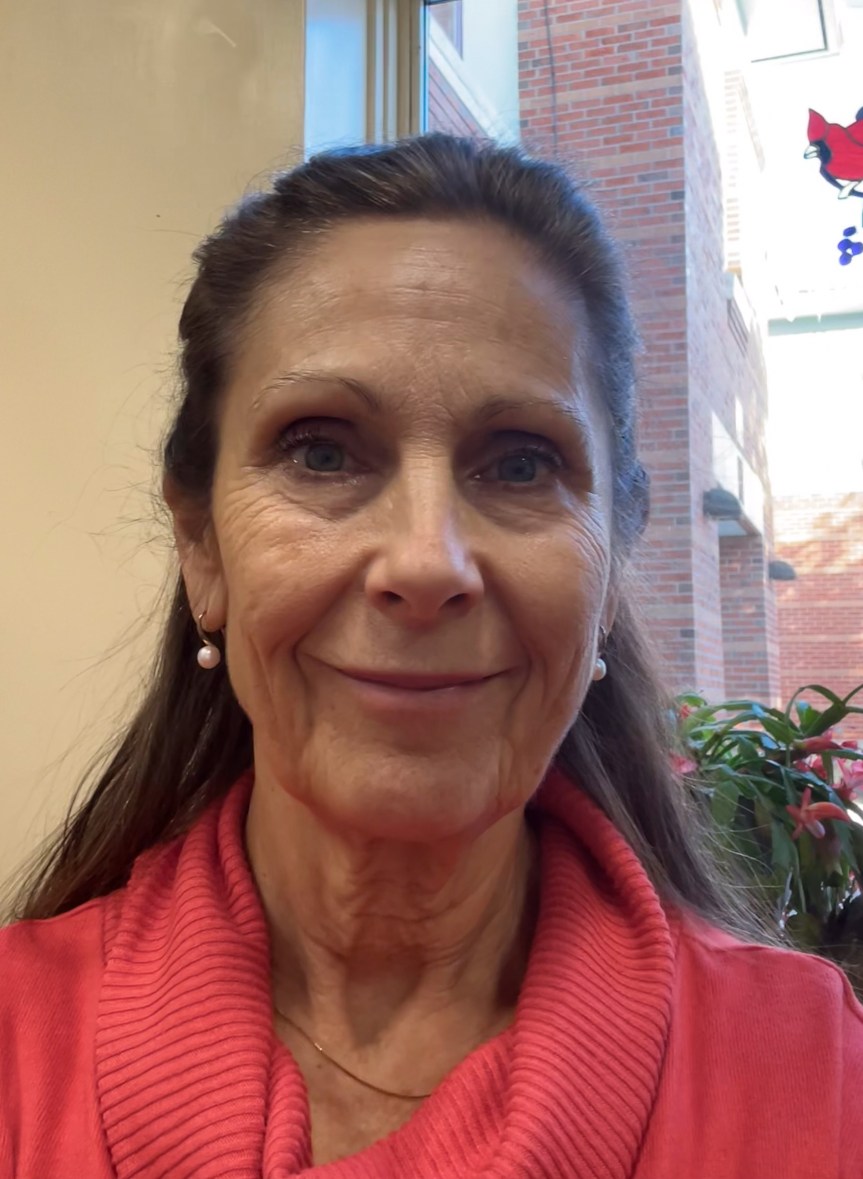
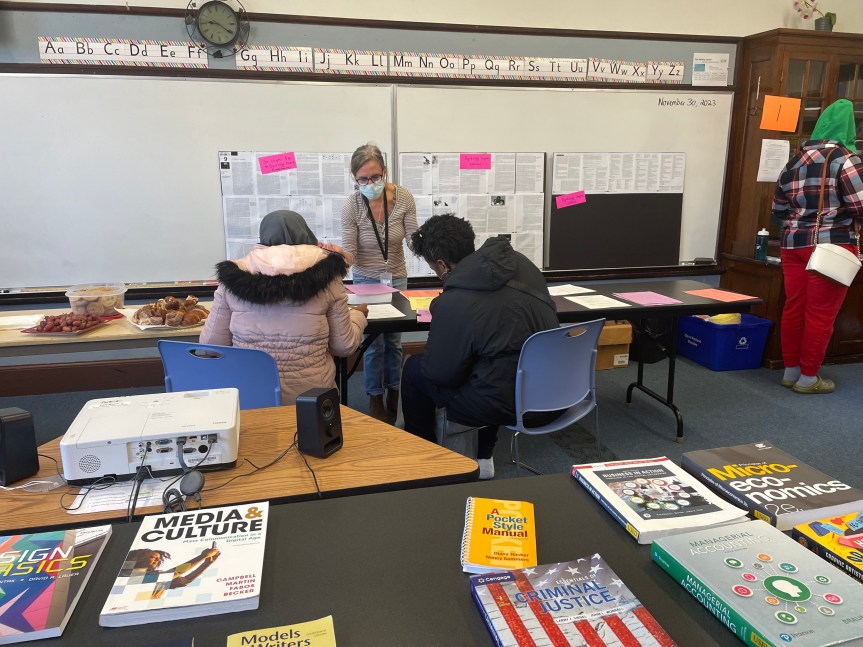
(Pictured: Heather Wood, Dean of Instruction at Portland Adult Ed helping students at a reading and writing station during a recent “Curious About College” workshop.)

Portland Adult Education recently launched a new program, “Curious About College,” that aims to empower adult learners interested in embarking on their higher education journey. Adult Education in Maine has offered Maine College and Career Access (MCCA) programming since 2001 (formerly called College Transitions) to provide readiness for pathways to postsecondary education and careers. With increased enrollments in community colleges across the state and the opportunity of “free college,” student preparedness programs and collaborative partnerships are needed now more than ever.

Anja Hanson, Academic Advisor at Portland Adult Education shares some history and context about “Curious About College”:

We started meeting last year because we felt that prior orientations, meetings, and classes didn’t fully communicate to students what we wanted learners to understand about college in the U.S. This is true for both first-generation and multilingual students. Why should they understand? Preparing for college is so abstract, complicated, and baffling. 

Simulated College Experience

We wanted to find a way to make it more concrete. This is how “Curious About College” came to be. We wanted students to do all of the following:

    • Handle current college textbooks 
    • See the pages of a single psychology textbook chapter spread out on a wall
    • Listen to a lecture and take notes 
    • Find information on a syllabus 
    • Figure out which math class their degree program would require at SMCC 
    • Plan a week’s schedule that includes all the obligations that work and family demand of adult students
    • Know what fees they would have to anticipate 

Since most of our students are planning on attending SMCC, we used materials in current use there, and we set up 6 stations so that students could engage in activities and ask questions. We gave them checklists to take notes on what they noticed or learned. What we observed last spring and during our recent fall session is that students at various levels of English proficiency and sophistication about college can all get something from this event.

Hanson shared that as they moved about the room, students helped each other. They looked overwhelmed. They looked intrigued. It’s not as though they could learn everything they needed to know in this brief event, but they could discover that they had more to learn, which is precisely what they must understand if they want to go to college.

This photo is from a Time Management station 15 minutes after the event officially ended. Hanson shared that, “it suggests something about how much students need opportunities like these to grapple with what their dreams and goals will demand. We’d love to see other high schools and adult education programs offering Curious About College events.”
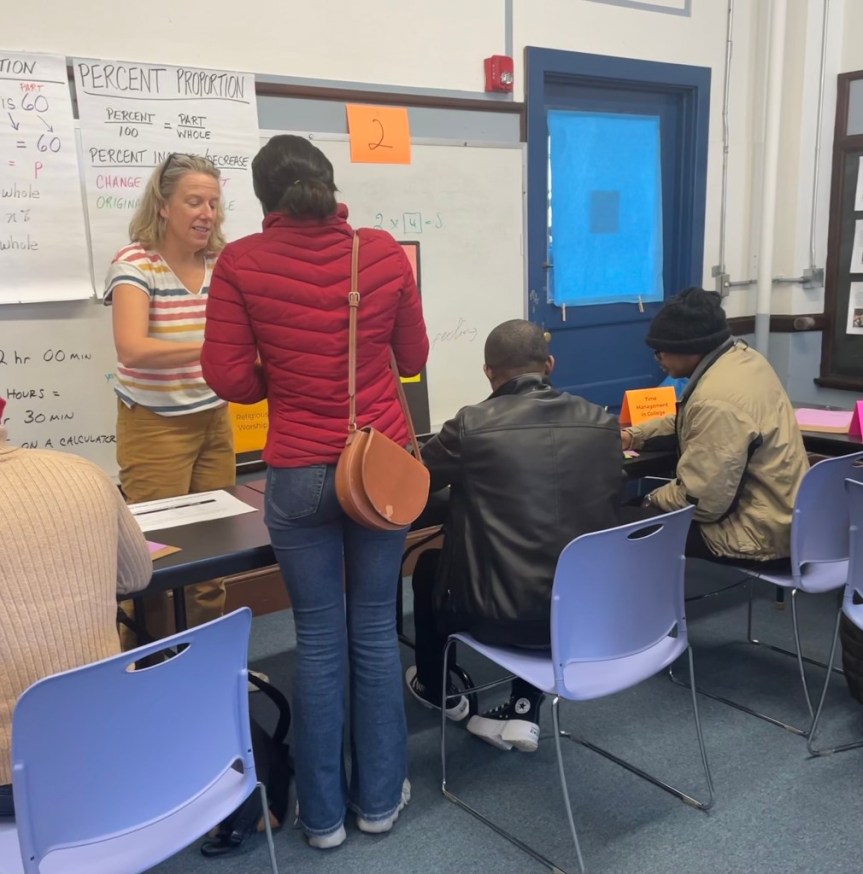
Alice Shea (College and Career Success Coordinator) at a time management station.

Feedback from Learners

Students observed how fast the English lectures were when they had to take notes while translating mentally. They noted the amount of time they’d need to commit for reading, planning and completing assignments, the costs of textbooks, how all the programs require math, and the heavy amount of writing. One learner noted that every [degree] program at SMCC requires math. After the event, some learners reflected that it would not be easy, but with practice, they can succeed while others decided they were not ready yet. All learners left the event more aware of college requirements and what it would require to be successful.

Empowering Adult Learners

“Curious About College provides a strong foundation where I can discuss the realities of college and the college system with students, said Alice Shea, College and Career Success Coordinator at SMCC. “I would love it if all students entering college had the opportunity to experience Curious About College. The event empowers students to understand their strengths and limitations and make decisions that will help them be successful in the college system. It takes me out of the role of ‘advising’ students and moves me into the role of a professional colleague engaging in a guided conversation with a student where they decide what works best for them.”

Shea is one of seven College and Career Success Coordinators (CCSC) located at each Maine community college and employed by local Adult Education programs funded by the Maine Jobs Recovery Plan. These roles serve prospective and current community college students as they work toward their goals at the college. Priorities for the CCSCs are Adult Education learners and enhancing the collaboration between Adult Education and their respective community colleges.

Current and Future Endeavors

Portland Adult Education, Hanson, and Shea seek to expand this opportunity for learners in their community and are demonstrating a mock event for other Adult Education programs in Cumberland County to see the model in action. Shila Cook, ABE/ELL Coordinator at Westbrook Adult Education, and colleagues are holding a Curious about College event for Westbrook High School students and Adult Education learners in late January.  Shea’s College and Career Success Coordinator colleagues across the state are working on similar programming to support their adult learners in their college endeavors. At Eastern Maine Community College, Brian Loring, the Success Coordinator there, will offer monthly sessions to interested Adult Education learners, especially HiSET graduates at EMCC. At Kennebec Valley Community College, Carolyn Haskell and colleagues are preparing a “Brighter Futures Day” for March. This is an event for Adult Education learners to come to campus and learn more about what being a student there requires as well as their opportunities and resources. This semester, Adult Education’s MCCA through Turner Adult Education, will hold their class at Central Maine Community College to immerse learners in the college environment.

Learn more about the College and Career Success Coordinators.

Learn more about Portland Adult Education.
Learn more about the Maine Community College system.

Learn more about the Maine Jobs Recovery Plan.

Getting to Know Community Schools in Maine: Welcome to Cape Cod Hill Community School

Nestled in the woods off a back road in western Maine you will find Cape Cod Community School. Part of the Regional School Unit (RSU) 9 of the Mount Blue area, Cape Cod Hill takes a different approach to serving its community. It is one of just a handful of Community Schools located in Maine.

A community school model, as defined by the Coalition for Community Schools, is both a place and a set of partnerships between the school and other community resources. Community schools exist in all regions of the United States and their numbers are growing fast.

In Maine, the community school model was first recognized by Maine Legislative Action of the First Regular Session of the 127th Legislature (2015-2016), in the budget bill Public Law 2015, chapter 267. At that time, the Maine DOE was authorized to fund a limited number of community schools, established under 20-A MRSA Chapter 333. Currently, three schools in Maine receive funding from the Maine Department of Education (DOE) to support their community school strategies: the Gerald E. Talbot School in Portland, Old Town Elementary School in Old Town, and the Cape Cod Hill Community School in New Sharon.

In its second year of implementation, Cape Cod Hill Community School has already put a lot of resources and strategies into place with big plans for many more to follow. Principal Carol Kiesman along with Social Worker Amanda Clark and School Nurse Jesstine Meader are the force behind these big changes and they work as a team to tackle the role of Community School Coordinator. An essential part of the success of a community school.

To accomplish a community school model, the team at Cape Cod Hill has garnered countless resources through ongoing partnerships throughout the Franklin County region and beyond to offer students and their families support beyond academics. Resources like behavioral health by way of counseling services for families and children through an outpatient counselor who comes to the school to see children in addition to case management through Maine Behavioral Health Organization. Also now available are dental health services offered to every child right at school, food and nutrition resources available through the school’s food pantry, and many more partnerships that bring in community members, resources, and services that benefit students and families.

“In the past things were more academic-centered, this is more community-centered,” explains Kiesman. “This is looking at the whole child and what can we offer to the children and the families besides academics. Yes, academics are huge, they are important, but we know that there is more to children’s lives than just academics.”

One of the most successful and new programs started by the school is its no-cost before and after-care program which runs from 7:00 am to 4:30 pm on school days. The program allows parents to work without having to find care for their children for those couple of hours before and after school that never seem to line up just right with the average workday. This program has been a game-changer for many of their families and the fact that there is no income threshold makes it that much more accessible for everyone. The Community Schools grant funding provided by the Maine DOE made this program possible.

Pictures from the Before and After-Care Program:

One of the ongoing programs the team has up and running is its food pantry, which also serves as a clothing and book pantry as well as bringing much-needed resources to the community. The pantry has been around for a while but the team at Cape Cod Hill has gotten innovative in maximizing its impact in recent years by creating discrete access to the pantry via a side door to the school, giving community members a way to grab what they need without having to make a grand entrance. They’ve also been able to utilize the help of community partners like Good Shephard Food Bank who help with food donations and have welcomed help from community members who come in regularly to keep the pantry organized and stocked with foods and other resources that families need and want.

Other ongoing partnerships include Franklin County Adult Ed providing monthly classes at Cape Codd Hill Community School on things like cyber security, social-emotional learning topics, and multi-tiered systems of support/response to intervention components that can be implemented at home. They have also invited the Franklin County Sheriff’s Department over for monthly “lunch and jokes” in which members of the Sheriff’s Office get to dine with the students at lunchtime and exchange good-humored stories and jokes.

“We are going beyond our four walls,” said Clark. “Maine schools are providing a lot of these things and they are doing amazing work. I think, for us, the community school initiative and model gave us that extra layer of support to be able to provide the things we felt like we were missing.”

Community schools foster a shared vision for student success and thoughtfully engage the community in making the vision a reality. Over time, community schools become the center a of community where everyone belongs, works together and thrives. They become the hub of their neighborhoods and communities, uniting families, educators and community partners toward student success.

To hear directly from the team at Cape Cod Hill Community School, check out this 5-minute video interview where Kiesman and Clark talk about their journey to becoming a community school and their plans for the future:

Maine DOE has welcomed Community Schools Consultant Ann Hanna, who has joined the Maine DOE Office of School and Student Supports. Hanna proudly served as the principal of the Gerald E. Talbot Community School in Portland where she led the school through a transformative process to become a Community School. Hanna will be working on advancing Community School strategies in interested schools across Maine by providing technical assistance and support as needed.  The Maine DOE is also working on the next application for funding for SY 24-25, and information on that will be shared via Newsroom in the coming days.

To learn more about community schools in Maine, please contact Ann Hanna, at ann.c.hanna@maine.gov.

Interdisciplinary Unit Prompts Nokomis Students to Create Small Businesses to Raise Money for Class Activities

On an abnormally warm December day at Nokomis Middle School in Newport, the 8th-grade class is having a fundraiser called “The Maine Sampler.” This fundraiser is more than students asking for money; it is an interdisciplinary unit that spans multiple disciplines and allows students to practice their communication skills, perseverance, creativity, and reflection.

Every year before the winter holidays, students work with their Social Studies and ELA teachers to develop a creative Maine-made product they will mass produce and sell to the public. Social Studies teachers Dan Decker and Lucas Jewett work with students for five weeks to apply their knowledge of economics to an authentic entrepreneurship experience. They start by picking partners and developing ideas. Dan explained, “Students tend to focus on baked goods, but we encourage them to reach out to family and friends with unique skills.” Lucas added,  “We encourage them to be mindful of their partners, too. Going into business as an adult requires you to be mindful of who you pick as a business partner.”  Students take this advice to heart because all the money they make will be used for field trips, their 8th-grade trip, and the 8th-grade recognition event. Once the teams decide on an idea, they calculate the cost of materials and set their prices. Parents provide all the supplies, but there is also financial assistance for any family that needs it. Students’ “homework” is to mass produce their products.

As they develop their business plans in social studies, they are working on advertising and marketing in ELA. Their teachers, Sarah Murray and Mariah McGuire support advertising through student-created web pages that describe their products and create aesthetically pleasing and informative posters for their tables. Each website includes images and descriptions of the product, a mission statement, and important background information.

On the day of the event, students gather in the gym to set up their tables, decorate them with handmade posters and accessories, and lay out their products. Members of the public and students in the 5th, 6th, and 7th grades will wander around purchasing the student-made products with tickets that they purchase at the ticket table. With the support of math teachers Makenzie Wheeler and Sue Orcutt, students at the ticket table convert every dollar into a ticket that can be used to purchase items or enter raffles. During the two and a half hours, students will communicate with adults and peers to explain and sell their products.

“This is a way to promote a business I already have,” Bentley Lane explained. “When my grandfather and I go hunting, we find deer antlers. He taught me how to process and mount them, and I have built a business selling them.”

Naomi Millet expressed similar feelings about learning about business and economics work. “Learning the economics of selling things is interesting.” Naomi also added she liked being creative, seeing her ideas become products, and working with her friends.

After the event, students will focus on reflection and application. Dan and Lucas will work with students to reflect on the event through the social and financial lens. They will also create opportunities for students to look at applications of their learning beyond the Maine Sampler event. Bentley has already started applying what he has learned. “I like this type of learning because I am applying what I learn to my current business.”

To view the students’ products, follow this link to the “The Maine Sampler.”

New Extended Learning Opportunities (ELO) Program at Buckfield Jr/Sr High School Expanding Thanks to School and Community Partners

Gretchen Kimball has been working on getting a new ELO program up and running at Buckfield Jr/Sr High School this school year. Serving the communities of Hartford, Sumner, and Buckfield, Kimball has her plate full working with all interested students to coordinate extended learning experiences that enrich their learning.

“I sincerely enjoy when students drop by to tell me their first meeting with their community mentor (game warden, child psychologist, athletic trainer, etc.) went well and they’re excited to get on with the learning,” said Kimball.

Some of the latest successes she is celebrating are helping several special needs students begin their internships at a local convenience store, in addition to coordinating three honors students internships with the school’s athletic trainer.  She has also been working with the Buckfield Jr/Sr High School Alternative Education program where students are working with a race car fabricator, a dentist, and a Maine game warden. Most recently, Kimball has helped a few more students begin an EMS internship with the local Rescue/Fire Station.

“It’s just a smattering of what’s happening but the kids are engaged in their learning, and it gives me hope for future success,” said Kimball.

In addition to the internship opportunities, Kimball says she has a lot of students taking advantage of JMG’s Maine Career Badge this trimester. “I have career presentations lined up every other Friday through March at the middle school level, and we’re exploring the opportunity for a mini-career fair put on by high school students for an audience of middle school students,” she explained.

Looking even further ahead, in conjunction with the Guidance Department, Kimball is working with Central Maine Community College (CMCC) Department Chair of Public Service & Social Sciences Matt Tifft. She’s exploring ways in which she can build ELOs around their sociology, psychology, and conservation law classes at CMCC.

“There’s student interest, but there are no social sciences offered at our school,” explains Kimball. “I’m hoping this will fill a niche!”

Kimball would like to thank the following people and organizations for contributing to the success of students and the Buckfield Jr/Sr High School ELO Program: Korah Soll- Rural Aspirations, Sandra Fickett- Tilton’s Market, Tom McKenney- Maine State Game Warden, Dr. Convey- Oxford Hills Dental, TJ Brackett- Brackett Racecar Fabrication, and JMG (Jobs for Maine Grads).

Extended Learning Opportunities (ELOs) are hands-on, credit-bearing courses outside of the traditional classroom with an emphasis on community-based career exploration. These opportunities are personalized for students and help them explore options for their professional lives. They help students engage in learning through instruction, assignments, and experiential learning. The Maine Department of Education (DOE), along with state-wide partner Jobs for Maine Graduates (JMG), have made a concerted effort to provide working models, support, and funding opportunities for Maine schools to set up ELO programs within their school communities. To learn more about Maine’s initiatives with extended learning opportunities, visit: https://www.maine.gov/doe/index.php/learning/elo or reach out to Maine DOE ELO Coordinator Rick Wilson at rick.wilson@maine.gov.

‘Box of Maine’ Connects Old Town Elementary Student with Maine Studies Curriculum Through Their Taste Buds

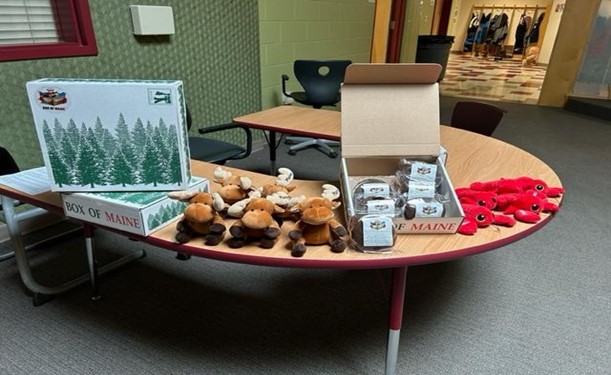
A few years ago 4th grade teacher Todd Rand had an idea to support the Maine Studies Curriculum at Old Town Elementary by bringing a taste of Maine into the classroom. He connected with small business owner, Daniel Finnemore and the Box of Maine Company to supply his students with monthly “Tastes O’Maine” to expand the students’ understanding of the products, businesses, and culture Maine has to offer.

Todd Rand approached the school’s Parent Teacher Club (PTC) to support purchasing a monthly subscription to the Box of Maine for every fourth grader at Old Town Elementary School. The PTC jumped at the opportunity to help bring the Maine Studies Curriculum alive.

Each month Box of Maine ships the boxes filled with a specific item for the students to sample. Todd has worked with the company to feature connected curriculum items to align with the lessons being taught for the month. For example, when the 4th graders celebrated Maine’s birthday in March of 2023, the students were supplied with whoopie pies, Maine’s finest dessert to celebrate the occasion.

The partnership with the Box of Maine has added a new dimension to the celebration of Maine and students are exposed to many new experiences through the monthly boxes.

This story was contributed by Old Town Elementary School. To submit a good news story or idea to the Maine DOE please email Rachel Paling at rachel.paling@maine.gov.


Students Practice Real-world Science Through Salmon Spawning with State Biologists

The fishery on Mill Street in Raymond was swimming with hands-on science in late November as ecology and recently arrived immigrant students from Windham High School (WHS) helped Maine Inland Fisheries and Wildlife (IFW) scientists weigh, measure, and spawn Sebago Lake land-locked salmon from Panther Run.

The students assisted IFW field biologists express eggs from female salmon that were immediately fertilized by the male salmon. They helped to weigh, measure, and return the fish into the Sebago Lake watershed.

The aim of salmon spawning along the shores of Sebago Lake is to support Maine ecology and replenish healthy salmon numbers for fishing purposes. The late chilly November morning provided the students with an essential hands-on adventure, giving them a chance to see ecological purposes and science at work.

“When students graduate from WHS, we hope they are leaving with skills and practices of science that they can carry into any field they enter,” WHS science and ecology teacher, Lindsay Hanson said. “The experience highlighted the importance of asking good scientific questions, analyzing and interpreting data, and constructing explanations in science.”

Hanson continued, stating that students observed these skills being used in a real way. “We were able to listen to the IFW biologists discussing new trends they were seeing in this salmon population and posing new questions they would later investigate using the data they were gathering. Scientific curiosity at work.”

It was also a special treat for the new Maine students from Angola, The Democratic Republic of Congo, and France who all had a chance to connect their learning [of Maine] outside of the classroom setting.

“It provided the opportunity to see how academic language and the content and skills they learn in school are used professionally,” Elizabeth Moran, RSU14’s Teacher of English to Speakers of Other Languages (TESOL) said.

Moran also said that her students were excited to hold the fish, strip the salmon for fertilization, and help collect data.

“They enjoyed being a part of the actual process of helping to produce the next generation of salmon in Maine,” she said. “This kind of work is authentic and contagious, and it inspires students to learn in a creative and fun way.”

The spawning of salmon from Sebago Lake has been happening for many years and occurs every fall in conjunction with the fish’s natural cycle to swim upstream. In this case Panther Pond from Sebago Lake.

“During the second week of November, we open up the dam on Panther Pond to draw the fish up the river from Sebago Lake,” Stephen Twemblay, IFW Fish Culturalist supervisor said. “Since they can’t get through the dam, the salmon swim up a fish ladder into the fish hatchery. We then separate the male and female fish. Both are differentiated by fin clip class [fins clipped in different areas depending upon the year, denoting the age of salmon]. We do this so we always know how old that fish is to provide the best genetic variable.”

After the eggs are spawned and counted, they are transported to the fish hatchery in Casco where they are incubated through the winter. In the spring, most of the salmon are returned to Sebago Lake to keep up with the demand for fishing. The rest of the eggs are sent to other hatcheries around the State and to other State agencies in the U.S.and Canada as needed.

This real-world experience showed students the various ways science plays a role in our lives.

“I always tell my students that loving science doesn’t mean you need to be a scientist,” Hanson said. “There are environmental lawyers, policymakers, and computer engineers working in science-based companies, etc. Pairing an interest in science with a focus on another sector can be an avenue to explore. It is difficult for students to see how science incorporates into real-life situations or see what careers related to science might look like. Most scientists don’t wear lab coats and it was great to see that scientists also wear Muck boots and go fish.”

This story was provided by Lorraine Glowczak, Director of Community Connections & Storytelling Ambassador for RSU 14. To submit a story or an idea, email Rachel Paling at rachel.paling@maine.gov.

Cushing Community School Opens Their Doors for Family Appreciation Week and More!

What started as a focus on decreasing chronic absenteeism among students, increasing literacy initiatives that involved families, and a long-term look at how to undo the distancing between schools and their families caused by COVID-19 precautions, turned into a slew of wonderful traditions that will help build stronger connections with families for years to come at Cushing Community School.

It was the teachers and staff members who came up with the idea to supplement their family engagement strategies with a Family Appreciation Week this fall, an approach that was slightly different than what they had tried before. Knowing how hectic life can be for students and their families during the school year, Cushing Community School Principal Dawn Jones explained that her staff worked as a team to make the week less about the school asking families to do something and more about the school doing something for their families.

On Monday families were invited to stick around at drop-off to get a coffee and have a pastry with school staff. While the students went inside to start their day, this was a time for the adults to connect. “It was so good, we really want to do it again,” said Jones.

For Tuesday the school asked students to make something to thank their parents for helping them as learners and sent them home in backpacks.

Wednesday was a special treat as families were invited to join their students for lunch. Keeping it simple, the school said to bring a lunch and “just eat with us.”

“When the kids are in high school and thinking back on this, they are going to say, ‘Remember when our parents came for lunch?’,” remarked 3rd Grade Teacher Nicole McLellan.

“It was really fun,” added Jones.

Thursday was a math night where families were invited to the school for math games and sent home with goodie bags with lots of fun math ideas to do at home.

“I thought it was great to engage with parents and not just in an academic setting. We could have conversations about other things. This can help if you have something challenging to talk about later on,” said Cushing Community School Teacher Janelle Poland.

On Friday the school hosted a raffle in which families were invited to participate in throughout the week with a family game as the big prize.

“It launched us into a year of family engagement allowing us to continue to build those really important relationships with families,” said Jones.

Cushing Community School has continued to ramp up their family engagement strategies in other ways this year as well by hosting a Fall Family Fun Night which entailed a flashlight walk-along through their outdoor story path and ended in the school’s outdoor classroom with hot cocoa for everyone. Also in the works is a family sing-along during the upcoming holiday concert.

This story was written as a collaboration between Cushing Community School and the Maine Department of Education’s Office of School and Student Support. If you are interested in sharing your school’s successful family engagement strategies through the Maine DOE Newsroom, fill out this good news submission form or contact rachel.paling@maine.gov. To inquire about more resources on family engagement from the Maine DOE, please contact Melanie Junkins at melanie.junkins@maine.gov


Upper Kennebec Valley High School Students Test Their Outdoor Skills in the Woods

In an effort to introduce students to a more hands-on outdoor learning experience at Upper Kennebec Valley High School, Mr. Davis’s Maine Woodsmen course and Mr. Atwood’s Wildlife Studies course collaborated in spending an entire day in the woods dedicated to exploring skills not otherwise practiced in a classroom.

The Wildlife Studies class was tasked with the assignment of venturing into the Davis Land Trust to collect cameras and document the wildlife activity therein.

The job of the Maine Woodsmen class was to provide the comforts of a warm fire, good food, and comfortable accommodations upon Mr. Atwood’s class arrival.

Students enjoyed hot cocoa, bacon, eggs, and English muffins, for breakfast and chicken quesadillas for lunch.

This story was provided by Upper Kennebec Valley High School, MSAD 13/RSU 83. To send good news stories and ideas to the Maine Department of Education visit our submission form.

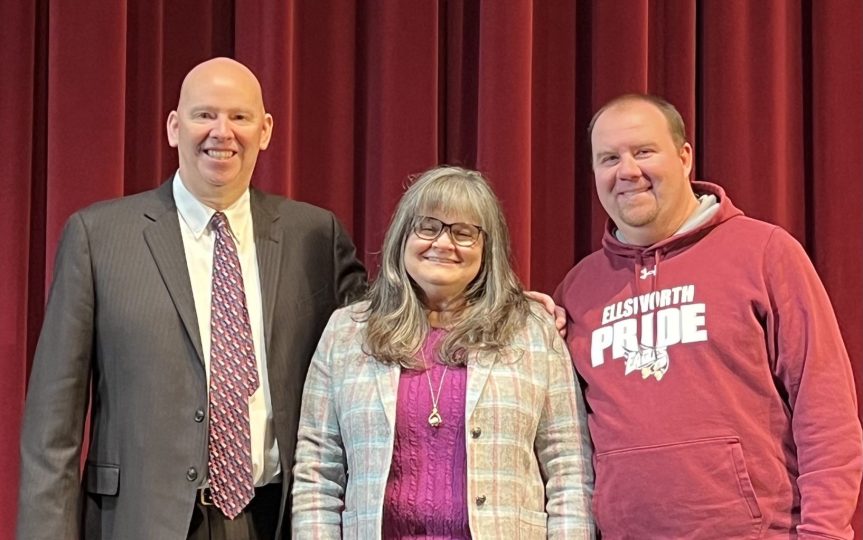
Rebecca Wright of Ellsworth High School Named Assistant Principal of the Year

The Maine Principals’ Association (MPA) has announced that Rebecca Wright, Assistant Principal of Ellsworth High School in Ellsworth, has been named Maine’s Assistant Principal of the Year. She will be honored by the MPA at its annual awards banquet at the Augusta Civic Center on Thursday, May 23, 2024.

Mrs. Wright received this award because of the contributions she has made over her career at Ellsworth High School. She has a strong ability to build partnerships in the community and maintains those relationships that benefit all the students in her building.

In announcing Mrs. Wright’s selection as 2024 Maine’s Assistant Principal of the Year, MPA Executive Director, Dr. Holly Blair noted, “The MPA is pleased to recognize Rebecca Wright as Maine’s Assistant Principal of the Year. Her incredible commitment to students and staff is tremendous. She takes an active role in not only her school but also throughout the state of Maine. Mrs. Wright’s reflective and collaborative approach to leadership is exactly what we look for in building administrators.”

Mrs. Wright graduated from the University of Maine Orono with a Bachelor of Arts Degree in 1982. She continued at UMaine and obtained her Master of Arts degree in 1985. Finally, she attended Endicott College and graduated with her Master’s in Education in Educational Leadership in 2020.

Mrs. Wright started her educational career as a k-8 Music Teacher for Veazie School. She then moved to Ellsworth High School and from 1986 – 2017, she served as an English, Theatre, Vocal Music, Dance, VPA Academy Coordinator, Drama and Show Choir Director. In 2017, she became the Assistant Principal of Ellsworth High School. Mrs. Wright has also been the Theatre Methods Instructor for the Maine Educators Consortium since 2019.

This article and photos were provided by the Maine Principal’s Association.

Commissioner Makin Meets with Westbrook High School Future Teachers Academy Students

Commissioner Pender Makin met with the inaugural class of the Future Teachers Academy at Westbrook High School this week. The Academy allows students to explore the teaching profession while still in high school. The experience includes a faculty-directed seminar to explore issues around teaching and education and field-based experiences in school settings. Students spend time every week with a host teacher and prepare and teach their own lesson plans.

Students in this initial cohort are gaining classroom experience in first grade, fourth grade, fifth-grade physical education, ninth-grade science, and ninth-grade social studies.

The Academy provides students with hands-on experience in Westbrook classrooms to explore the ins and outs of teaching, college credit, and a special diploma certificate. Students will continue to receive mentoring support once they graduate, opportunities for student teaching while in college, and the promise of an interview for a Westbrook teaching position when they are ready to pursue their career in education.

The Westbrook Teachers Academy is a fantastic example of Maine “grow your own” efforts to build and sustain the teacher workforce and nurture the passion that students have for teaching.