Celebrating Playful Learning in Pre-K Expansion Classrooms

Laughter and rich conversations fill the air as teachers join students in purposeful play in Pre-K Expansion Grant classrooms across the State. Play based learning promotes engagement, curiosity and creativity.  When teachers join children in their play they can scaffold learning opportunities, model language, introduce complex vocabulary and prompt deeper thinking through effective questioning.  Play provides an opportunity for social learning and the development of executive functioning skills.  In play, both the heart and the mind of the child are nurtured, reducing behavioral issues and supporting wellbeing while building the skills they need to be successful in school and beyond.

Pre-K children engage in a variety of different types of play in centers or interest areas in their classroom.  Real-life imaginary play is incorporated into the dramatic play and building areas in Appleton’s new Pre-K classroom.  This type of play allows children to think beyond the confines of their classroom and use their imaginations as they explore ways to use the materials they have to represent what they see in their minds. This type of play not only fosters creativity, but it also lays the foundation for symbolic representation with letters and numerals.

Creativity and problem solving are integral parts of play in the art area.  Children in the Greenville Pre-K classroom use art materials to express themselves and create projects based on a story their teacher has read to them.  Concepts of color, shape, texture, and position are built through conversations about their work.     Teachers support children in developing important problem-solving skills when they join children in their play, and help to build growth mindsets by letting children try out their own ideas, and by encouraging them to try again if they are not successful.
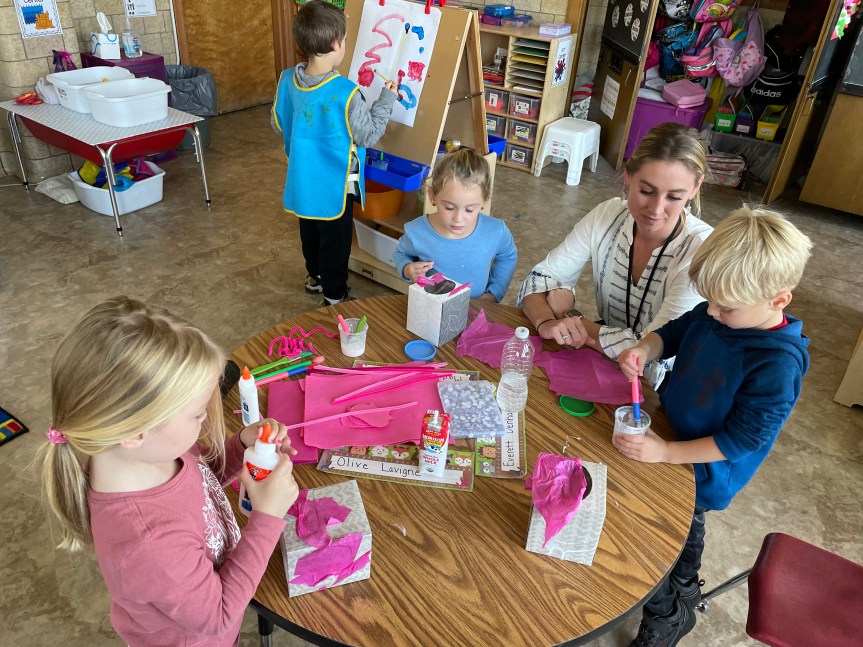
Education Technician, Erin Denham, supports Pre-K children as they problem solve how to attach the curly pipe cleaner tails to their pig pinata.

Teachers do a lot of work behind the scenes to make play purposeful.  They carefully plan centers and other learning activities around central themes and make intentional connections between the activities to help children see the purpose in what they are doing.  While there is always a place for intentional instruction, Pre-K teachers work to bring playful elements to their lessons.

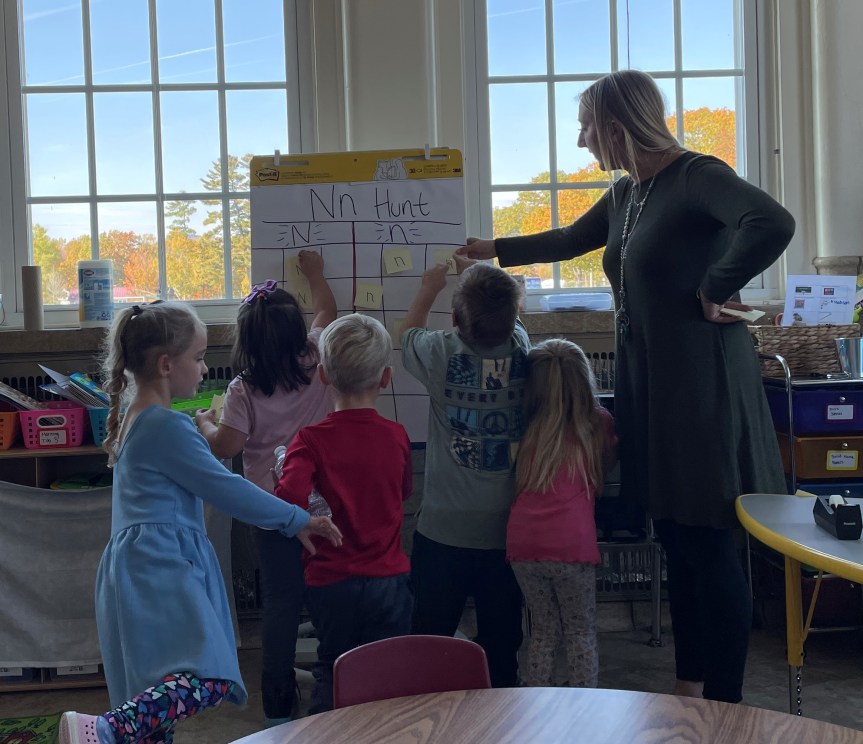
Greenville teacher, Allison Boulier, builds letter identification skills by having her class go on a letter hunt.
Teacher, Monica Jodrey from Cave Hill School in RSU 24 integrated science, math, fine motor and language development into a pumpkin exploration that kept her whole class engaged for the afternoon

Pre-K classrooms are busy places.  Play affords the opportunity to support learning across all domains and can even make “down time” a productive learning opportunity.  Pre-K teacher, Marion Freehill, from Peninsula School in RSU 24, captured the enthusiasm her class had for their fire fighter puppets.  You can also see the work her students have created to reflect on their play during centers time.  Capturing their thoughts in writing helps them to see their ideas as important and is the first stage in them seeing themselves as writers.
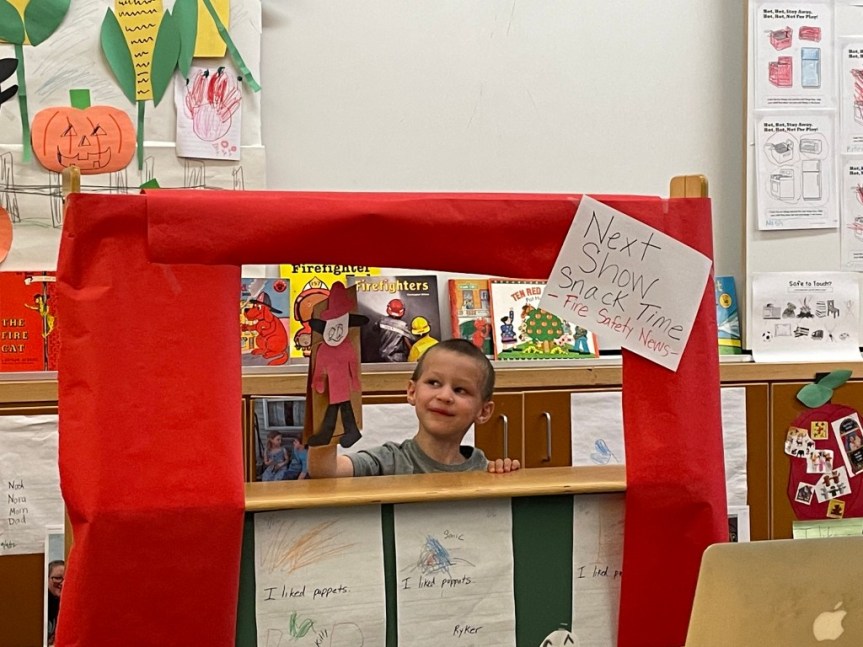
Pre-K students enjoy putting on a puppet show at snack time each day.

If you wonder about the value of children spending most of their day playing in our Pre-k classrooms, don’t worry!  In the words of Maria Montessori, “Play is the work of the child”.  Even the American Academy of Pediatrics agrees.  In 2018 they released a clinical report advising that doctors write prescriptions for play.  In the report they said, “Play is not frivolous; it is brain building” and lauded play as being fundamentally important to learning problem solving, collaboration and creativity.   But perhaps Lenore Skenazy, president of the non-profit Let Grow which promotes childhood independence and resiliency, put it best, “Play turns out to be so stunningly essential to childhood it’s like love, sunshine and broccoli all juiced together”.

The classrooms included in this article are all beneficiaries of the Maine Jobs and Recovery Plan’s Pre-K Expansion Grant.  The grant supports districts beginning new Pre-K classrooms or expanding the hours or number of days they serve students in existing programs.  Ten districts across the state were recipients in the first round of grants.  Round two awards will be announced soon.

If you have questions or would like more information about Public Pre-K, the Pre-K Expansion Grant or the importance of play in early education, please contact Sue Gallant Maine DOE Pre-K Expansion Consultant at Sue.Gallant@maine.gov and/or Nicole Madore Maine DOE Early Childhood Specialist at Nicole.Madore@maine.gov.
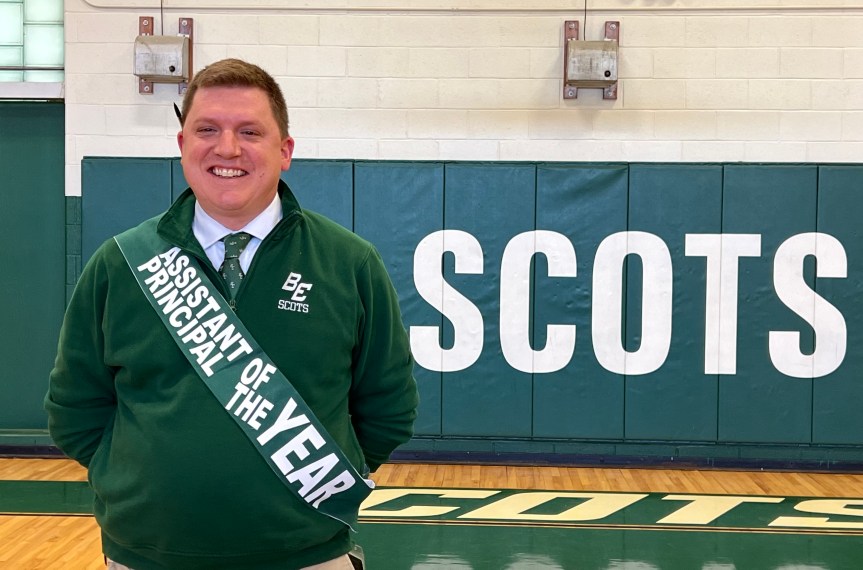
Lowell Oyster Named 2023 Maine’s National Outstanding Assistant Principal of the Year

The Maine Principals’ Association (MPA) is pleased to announce that Lowell Oyster, Assistant Principal of Bonny Eagle Middle School in Buxton, has been named Maine’s National Outstanding Assistant Principal of the Year.  He will be honored by the MPA at its annual awards banquet at the Spring Conference on April 27, 2023, at the Samoset Resort in Rockport, Maine.

Mr. Oyster received this award because of his strong emphasis on community outreach.  He has the ability to build connections across diverse stakeholders and goes to extraordinary lengths to meet the needs of students and staff.  He loves being an assistant principal and believes it is the best job in the world.

In announcing Mr. Oyster’s selection as 2023 Maine’s National Outstanding Assistant Principal of the Year, MPA Executive Director, Dr. Holly Blair noted, “The MPA is pleased to recognize Lowell Oyster as Maine’s National Outstanding Assistant Principal of the Year.  He is a reflective educational leader who people seek out and look to for guidance and leadership.  Mr. Oyster focuses on the strengths of the people he works with to lift and accentuate each team member, making the overall school community stronger.”

Mr. Oyster received his Bachelor of Science Degree in Elementary Education from the University of Maine, Orono, in 2005.  In 2007, he earned his Master of Science Degree in Middle Level Education also from UMaine.  He then obtained his Certificate of Advanced Studies from the University of Southern Maine in 2015.

Mr. Oyster started his educational career as a math/science teacher at Bonny Eagle Middle School in 2007.  During this time, he took on the following school and/or district level leadership positions: Clan Leader, Symposium Leader, Math Meet Coordinator, Continuous Improvement Team member, Certification Steering Committee member, and was the 7th grade Baseball Coach.  In 2017, Mr. Oyster became the Assistant Principal of Bonny Eagle where he has served in this capacity ever since.

Mr. Lowell Oyster is a member of the Maine Principals’ Association and National Association of Elementary School Principals (NAESP).

The Maine Principals’ Association is a professional association representing Maine’s Pre-K-12 educational leaders. The Association dates its history back to 1921 and focuses its work on promoting the principalship, educational leadership, and promoting and administering interscholastic activities in grades 9-12.

Beech Hill School Student Council Demonstrates a Passion that is Immeasurable and Contagious

Beech Hill School’s Student Council is a group of students who care about culture and community and want to serve in an important leadership role.  Members of Student Council strive to consistently demonstrate their school’s four core values: respect, responsibility, caring, and honesty.  They exhibit positive attitudes, work with others, and possess the desire to make Beech Hill School and the community a better place for all.

Students are not turned away from membership in the school’s Student Council. There is no election process, and interested students may join at the start of each trimester. School staff identify and build on the strengths of any 4-8th grade leader.

Student Council students will do anything to help out!  Their typical responsibilities include leading daily morning announcements, helping younger students in the lunchroom, organizing spirit weeks, facilitating monthly spirit day assemblies, planning service learning projects, fundraising, and designing ways to encourage social/emotional wellness. Students are especially focused on activities that increase diversity awareness and promote inclusion.

Beech Hill School Student Council members are also ambassadors of school spirit.  School spirit can become the difference between just being at a school and being at their school. Showing school spirit demonstrates a passion that is immeasurable and contagious and sets the tones for other aspects of Beech Hill School.

The last Tuesday of every month is designated as School Spirit Day. On these days, students and staff are invited to wear school colors and/or their favorite Beech Hill School gear to show their school pride.  Student Council holds an assembly on each School Spirit Day for activities like promoting a message or event, showcasing a talent, recognizing a team and/or appreciating the work of an individual or group. During this time, they also celebrate birthdays of the month and hold a “green card” prize drawing. Green cards are awarded to individual students for demonstrating their school values throughout the school day.

The fundraisers that Student Council members host throughout the school year fund projects and/or initiatives, including (but not limited to) the BHS High School Scholarship Fund,  BHS School Spirit Day Carnival, SPCA of Hancock County, Walmart Giving Tree, and Emmaus (Ellsworth) Homeless Shelter. Fundraisers include game concessions, Read-a-thons, family movie nights, and other events that connect people in the community.

This story was submitted by Beech Hill School as part of the Maine Schools Sharing Success Campaign. To submit at story or an idea, email rachel.paling@maine.gov.

Student Voice and Choice a Big Part of Brewer High School Extended Learning Program

“We are seeing dramatic improvement in attitude and effort on the part of our students,” said Brewer High School’s Extended Learning Opportunities (ELO) Coordinator Kevin Napolillo. “They feel that their career goals are finally being addressed and can see the value of what they are doing.”

Along with a growing number of schools and districts across Maine, Brewer High School has established an Extended Learning Opportunities (ELO) Coordinator to work with students to set up intentional career/work experiences and coordinate efforts for students to experience and learn about different jobs, career paths, and work opportunities available here in Maine and beyond.

“We have set up extended learning opportunities in the areas of auto mechanics, child psychology, and marine biology just to name a few,” said Napolillo. “We have also established a CNA [Certified Nursing Assistant] training program with a local nursing home.”

Napolillo says that the best part of his job is, “Observing the signs of realization when a student becomes aware that the school personnel will find out their likes and foster their desires for careers.”

In an effort to keep the program student directed, Napolillo has also worked to establish a relationship with the local Chamber of Commerce to develop relationships with local business owners.

It takes those strong local and State partnerships to develop and sustain a successful Extended Learning Opportunity programming and to that end, Napolillo would like to extend a debt of gratitude to: Walker’s Garage-Brewer, Brewer Center for Health and Rehabilitation, and Bangor Region Chamber of Commerce.

Extended Learning Opportunities (ELOs) are hands on, credit bearing courses outside of the traditional classroom with an emphasis on community-based career exploration. These opportunities are personalized for students and help them explore options for their professional lives. They help students engage in learning through instruction, assignments, and experiential learning. The Maine Department of Education (DOE), along with State-wide partner Jobs for Maine Graduates (JMG), have made a concerted effort to provide working models, support, and funding opportunities for Maine schools to set up ELO programs within their school communities. To learn more about Maine’s initiatives with extended learning opportunities, visit: https://www.maine.gov/doe/index.php/learning/elo or reach out to Maine DOE ELO Coordinator Rick Wilson at rick.wilson@maine.gov.


Aroostook County Teachers of the Year Lead Effort to Face Regional Teacher Shortages

Aroostook County Teachers of the Year (CTOY) Leslie Marquis (2017), Bill Guerette (2018), Kim Barnes (2019), Jocelyn Saucier (2020), and Heather Anderson (2022), along with Maine Teachers of the Year (TOY) Elaine Hendrickson (2001) and Alana Margeson (2012) came together to plan, The Future of Aroostook County Education Symposium, or otherwise known as FACES, on November 17th at Caribou Community School.

Current teachers, ed techs and paraprofessionals, interested high school students, pre-service teachers, administrators, career/guidance counselors, community partners, policymakers, and higher education representatives enjoyed an evening of conversation, collaboration, and visioning to address the critical need to both draw and keep dedicated educators in our schools as we face an unprecedented time of teacher workforce shortages in Aroostook County, Maine, and nationally.

Maine DOE Educator Excellence Coordinator Emily Doughty, Educate Maine Program Specialist Kaitlin Young, and Valley Unified School District Superintendent Ben Sirois served as keynote speakers to ground conversations about teacher recruitment and retention. Delta Kappa Gamma Society of Women Educators also supported the evening event.

“In true Aroostook County fashion, we ‘rolled up our sleeves’ and dug into the what, why, and how of teacher recruitment and retention,” said 2019 Aroostook CTOY and 8th grade Teacher Kim Barnes.

New STEAM Lab at Glenburn School Making a Big Impact

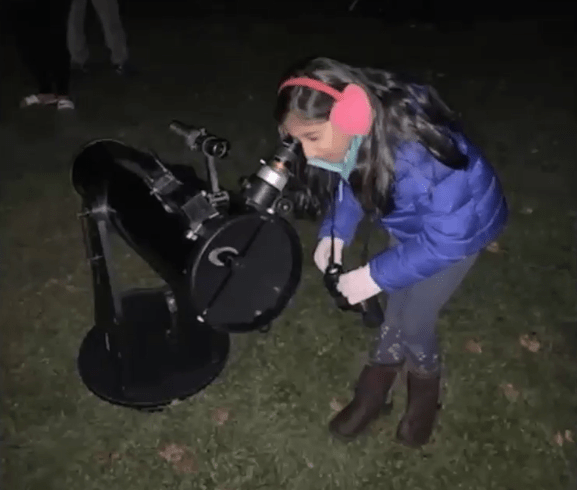
(Pictured: A Glenburn student looks through the telescope at the Star Party.)

Establishing a culture of creation, innovation and hands-on learning is becoming a focal point at Glenburn School. The driving forces toward that goal are a couple of long-time educators – Technology Integrator, David Davis, and Technology Director, Ken Worster. Last year the administration implemented a plan to repurpose a science lab to house materials for a new STEAM (Science, Technology, Engineering, Arts, Math) Lab. Worster advocated for functional space for technology creation since the one-to-one devices had made the traditional computer lab unnecessary. Davis credits his administrative team at Glenburn for its support of this initiative and feels “fortunate that [his] administration had the vision of technology integration” in order to bring this plan to life.

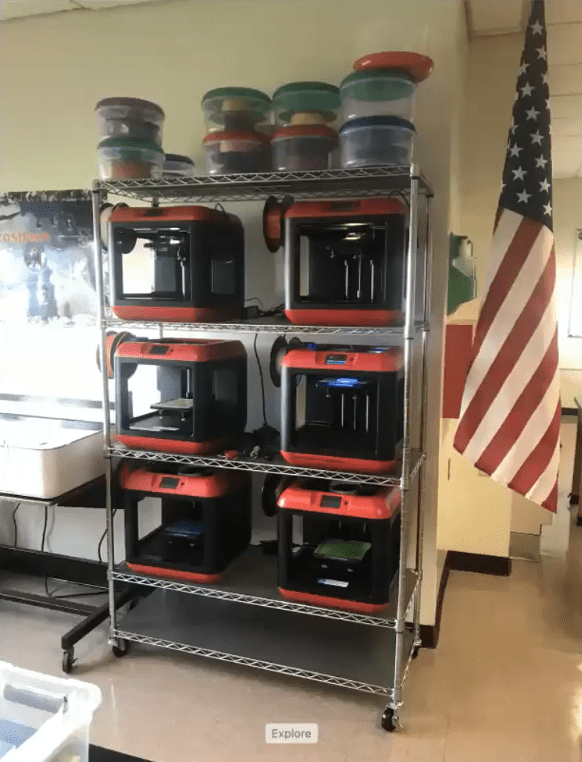
The STEAM Lab consists of several technology tools including a laser cutter, green screen, a fleet of iPads, a recordable microscope, over a dozen 3-D printers, codable robots, and more. Davis and Worster’s hope is to establish the lab as an integral part of the curriculum for educators. Worster mentioned that the immediate goal is to have teachers “looking at their content and bringing it to David in a way where they can have that conversation about how they can integrate our technology.”

Even in the Lab’s infancy, Davis is already seeing its impact in the classrooms, most notably in the sixth and seventh grade English Language Arts classes. In those classes, students have been able to dive deeper into their reading by designing and printing 3-D objects or characters from their books, by recreating scenes with green-screen video, and by etching “plaques” with the laser cutter that outline the author’s biography.

Additionally, Davis and Worster envision enhanced student engagement through the STEAM Lab by incorporating it into science classes across the school. Davis integrated an astronomy theme and tiered the work for the various grade levels. Students in kindergarten through second grade used the online platform Wixie to design constellations that were then etched with the laser cutter, students in third through fifth grade also used the laser cutter to design the phases of the moon, and finally, sixth through eighth grade students created a 3-D model of a footprint that incorporating each student’s constructed quote acting as if they were to be the first ones stepping onto Mars.

Glenburn Engraving
(Left to Right) Constellations designed in grades K-2, moon phases etched in grades 3-5, 3-D printed footprint in grades 6-8.

Davis and Worster concluded the unit by coordinating with the Challenger Learning Center and the Versant Power Astronomy Center at the University of Maine to host a “star party” outside at the school. The night was a huge success with over 200 family members attending. It allowed students the chance to stargaze with a telescope which Worster noted was the first time for most of them.

Even with the initial success of the STEAM Lab, Davis and Worster know that it will take time for the innovative culture to spread throughout the school. While they admit the program is not without its wrinkles, they are hopeful that a steadfast dedication to technology integration will create breakthroughs for their staff. Davis knows that it pays off to start small and have it build from there, “If I could just get [the teachers] there once or twice, it will take on a life of its own.”

Glenburn Printers
Sets of 3-D printers at Glenburn School

This story was written and coordinated by MLTI Ambassador Rob Dominick as part of the Maine Schools Sharing the Success Campaign. To learn more, or to submit a story or an idea for a story, email rachel.paling@maine.gov.


How Morse High School is Bringing Career Exploration, Experience, and Learning to Its Students

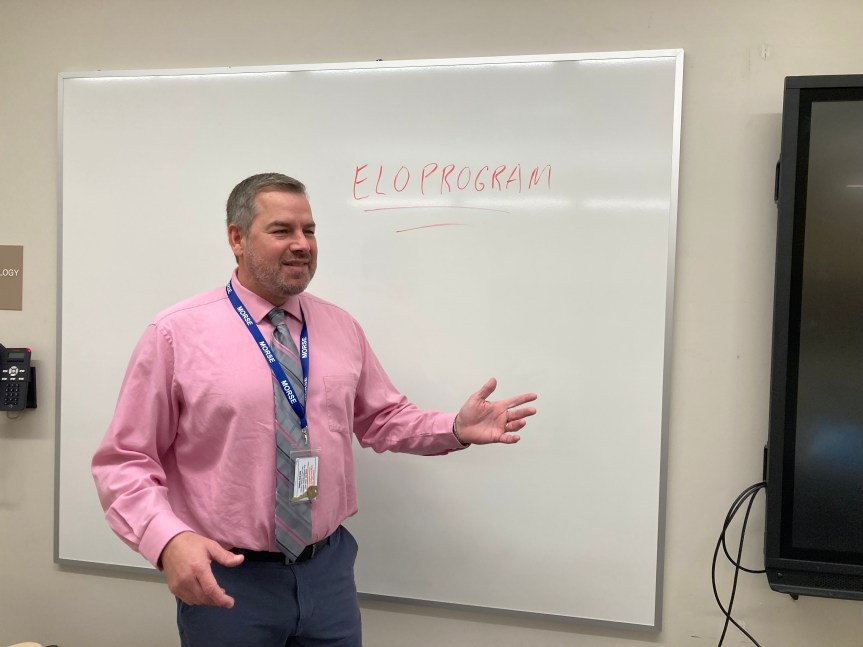
“My role is to provide students at Morse High School with meaningful, real-life work/career exploration experiences to better prepare them for Maine’s workforce,” said Morse High School Extended Learning Coordinator Scott Stinchcomb.

Stinchcomb is one of a growing number of Extended Learning Opportunities (ELO) Coordinators working in schools and districts across Maine who all aim to set up intentional career/work experiences and coordinate efforts for students’ to experience and learn about different jobs, career paths, and work opportunities available here in Maine and beyond.

“The best part of my day is supporting students and listening to their workplace experiences and to see them growing and developing in real time,” he added.

As part of the Maine Jobs and Recovery Plan (MJRP), Governor Mills recently announced $25 million toward paid work experiences for Maine students during a visit to Morse High school. “The energy and positive enthusiasm surrounding this event was amazing,” said Stinchcomb. “It also brought much attention to the value and importance of our Extended Learning Opportunities Program.”

Morse High School has only recently gotten its extended learning program up and running but they have already placed 10 students into career exploration. So far, Stinchcomb has really enjoyed working to set up placements for his students within the local business community – he says the support has exceeded his expectations. He explains that these employee related experiences allow Morse High School students the opportunity to acquire and develop crucial career ready skills to ensure their success.

“This experience is helping me by giving me a better idea of where my future career opportunities stand,” said Libbi Wallace, a senior at Morse High School and participant in the ELO Program. “I am able to test the waters and see if this is something I could do for the rest of my life,” added Wallace who hopes to one day open and operate an early childhood education program.

In addition to placing students, Morse High School is also planning bus tours for students to visit multiple businesses and they are also in the process of planning a Career Fair, Financial Fitness Fair, and Hiring Fair for the Spring. They are also planning on inviting in potential speakers and exploring many more career exploration experiences for students this year.

According to Stinchcomb however, they definitely couldn’t do it all alone. Morse High School is working with a collaborative including Mt. Ararat, Brunswick High School, the Southern Mid Coast Chamber, Mid Coast Youth Center, Retail Association of Maine, the Maine Department of Education, Maine Tourism Association, Jobs for Maine Grads (JMG), and the Maine Department of Economic and Community Development.

“It has been a very effective and productive model to support these ELO Programs,” added Stinchcomb who also wants to thank Bath area business/community partners Terri Crocker of the Creative Play Childcare, Hair Creations, Riverview Physical Therapy, Mid Coast Youth Center, Darlings (Brunswick), and Bath Animal Hospital to name a few businesses. He is also grateful to a number of individuals such as Patrick Manual (RSU1), Eric Varney (Morse HS), Maria Morris (JMG), Rick Wilson (Maine DOE), Doug Ware (Mt. Ararat), Cory King (Southern Mid Coast Chamber) and the entire Regional Collaboration Group. Along with state-level leaders who have helped secure funding for the ELO Program.

“The benefits emerging is the undeniable strengthening of our future Maine workforce and ensuring the success of our students, our local businesses, and the State of Maine economy,” said Stinchcomb.

Extended Learning Opportunities (ELOs) are hands on, credit bearing courses outside of the traditional classroom with an emphasis on community-based career exploration. These opportunities are personalized for students and help them explore options for their professional lives. They help students engage in learning through instruction, assignments, and experiential learning. The Maine Department of Education (DOE) has made a concerted effort to provide working models, support, and funding opportunities for Maine schools to set up ELO programs within their school communities. To learn more about Maine’s initiatives with extended learning opportunities, visit: https://www.maine.gov/doe/index.php/learning/elo or reach out to Maine DOE ELO Coordinator Rick Wilson at rick.wilson@maine.gov.

Oxbow Outdoor RREV Pilot Creates New Spaces and Opportunities for RSU 9 Students 

Mount Blue Campus Instructors Jake Bogar and Travis Tierney were awarded funding for a RREV Pilot in August 2021 for an outdoor education project that aims to get students off screens and outside of traditional school building walls for a revolutionary new way of learning.

RREV stands for Rethinking Responsive Education Ventures and is an ongoing initiative of the Maine Department of Education (DOE) to fund innovative and responsive education pilots that allow educators to think outside the box, and outside Maine’s traditional education systems to respond to the unique needs of their students.

It was through this partnership with RREV, that the Oxbow Outdoor Pilot was born. It came about as a pushback toward the abundance and reliance on digital screens. “Research and other nationwide studies showed a need for outdoor and experiential learning to promote social and emotional wellbeing. This need, coupled with our uniquely situated geography/landscape of woods, waters, and mountains will seek to positively influence student and community outcomes,” as explained in the pilot’s description.

Serving students in grades 9-12 on the Mount Blue Campus, which houses Mount Blue High School and Foster Career and Technical Education Center, part of Regional School Unit (RSU) 9, the pilot will provide an interdisciplinary outdoor education program that supports student wellness and achievement. The goals of the program are to expand student-centered learning opportunities in a variety of outdoor settings; increase student engagement, motivation, and voice; provide flexible time frames based on students’ needs; collaborate with students to develop and monitor learning plans; and implement a challenging, meaningful, proficiency-based education system that transcends from the classroom into the community and the world.

“There are so many socio-economic barriers for students when it comes to participating in and accessing outdoor learning, leadership, and experiences. Our current system of traditional learning, traditional assessment, reliance on digital technology, has left many students wanting outdoor and experiential learning,” the pilot description explains.

Although the project aims to mainly serve students on the Mount Blue Campus, Bogar and Tierney expect it will reach further across their district by creating mentoring, educational, and outdoor learning experiences for younger students in the 6 other schools that RSU 9 serves.

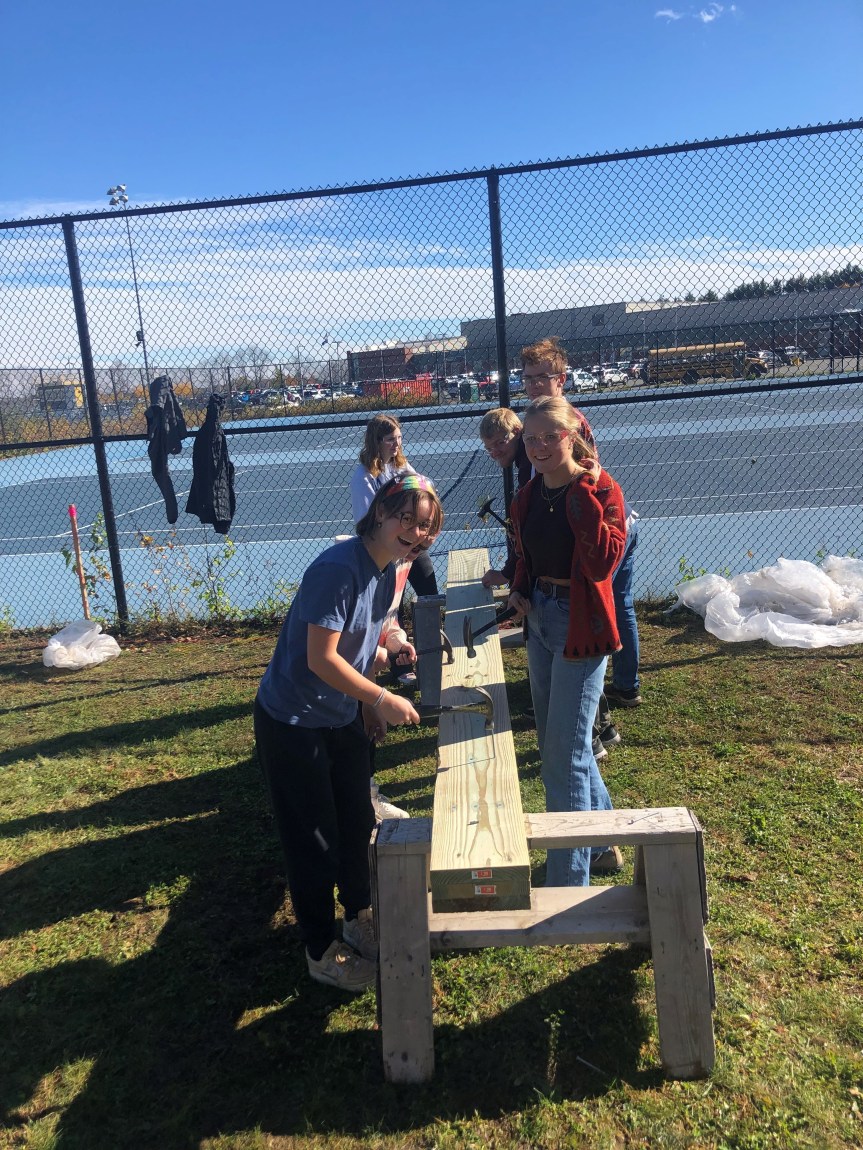
One year into their project the team is well out of the planning stages and are beginning implementation with the help of their students. Seen in these pictures, Pre-Engineering students and Outdoor Leadership students collaborate on building and setting beams for the new yurt on the campus.

“New skills and ownership in the project have been a joy to watch,” said Tierney.


Like with any plan that bucks the traditional system and sets a new course (especially for a future generation of leaders), it’s not all smooth and seamless success for the Oxbow Outdoor Pilot team. Bogar and Tierney have jumped their fair share of hurdles and taken on a lot of extra work to see this project through. They report, however, that in the end it will all be worth it when they’ve set up a sustainable program that gets students learning outside and experiencing the dimensional and rich outdoor landscape of their region.

Once they are fully operational, the program will allow for two cohorts to move through the program each school year with the opportunity to earn certification in Industry Safety, Wilderness First Aid, Canoeing, and working toward their Maine Guide certification.

Bogar and Tierney tell us that there will be more to come and that things are moving fast, so stay tuned!

RREV is an initiative of the Maine Department of Education, funded by the Education Stabilization Funds through the US Department of Education’s Rethink K-12 Education Models, that bolsters Maine educators’ innovative efforts to support their students with agile, effective, and resilient learning experiences that improve learning outcomes for all students.  

Martin Mackey, the former RREV Project Director who tragically passed away in April of 2022, embodied the RREV spirit: to think and act boldly to meet the needs of students. His passion was to “change lives.” As such, he challenged each and every RREV participant to do just that as they designed pilot ideas that would ultimately have a lasting systemic impact on students.  After 18 months of leading RREV, Martin’s passion had been passed on to over 200 educators who had participated in innovation professional development. From those educators, over 40 Pilot ideas were brought to fruition and have received over $8 million in RREV awards. Through their pilot ideas, these educators have pledged to commit themselves to innovation. 

The Maine DOE encourages all schools and districts across the State of Maine to learn more about these innovative educators and their RREV pilots through the RREV website and the online RREV collaborative platform known as EnGiNE. It is through EnGiNE that we all hope to continue the Martin Momentum to change students’ lives through innovative and responsive educational programs. 

Innovation and Interdisciplinary Learning Has Students Doing Math in Orono’s Webster Park

Would you go to the park to do a little innovative learning connecting math, science, and art using the sun? Students from nearby schools did just that on October 21, 2022!

A unique partnership between the University of Maine and the Town of Orono made it possible for students, and members of the public, to go to the park and explore multiplication and division using the sun. The interactive sculpture, the SunRule, was unveiled in a public ceremony in October.

The project was a part of UMaine’s MIRTA accelerator program that is designed to advance research to commercialization with a focus on innovation and real-world connections. This type of work brings to light the connections within and across the content areas (math, science, and art) and community partnerships that opens doors to student curiosity, engagement, wonder and joy for learning.

The concept for the sculpture began as an email between UMaine Associate Professor of Mathematics Education and Instructional Technology, Justin Dimmel, and Associate Professor of Mathematics Education, Eric Pandiscio, in 2019 just before the pandemic started! The concept went from SunRule 1.0 (a sawhorse with dowels) to cardboard boxes and then was shared with UMaine Associate Professor of Art, Greg Ondo, and Sculpture Studio Technician, Sam Hoey. With the artistic influence of artwork using sunlight and further planning, a prototype sculpture was created and then a final sculpture of granite and bronze was produced and installed in Webster Park on North Main Avenue in Orono.

Using the sunlight to measure the shadow of an object is something that has been done in math classes for a very long time. The SunRule concept uses the sunlight, not the shadow, to show the continuous nature of multiplication by using a scaling model, showing that for every discrete number (1, 2, 3, etc.) and all those in between, there is a product.

You can read more about the SunRule at UMaine News.

Using Book Creator & Educational Technology Tools to Engage Students in Reading

The Gorham Middle School (GMS) library website is a rich resource for students to discover and access reading materials from their home or classroom using their MLTI iPads. Librarian Suzanne Liacos-Dix has created an extensive collection of Book Talk videos, a Google Classroom stream, and a selection of Google Forms to engage students in sharing their literary passions with others. This year, in collaboration with 7th grade teacher, Sherry Coyne and the GMS technology integrator, Terri Dawson, the library website has a new feature to help engage students in Silent Sustained Reading (SSR).

The GMS library website features a link to join a Google Classroom where Mrs. Dix streams library announcements like new book arrivals, book fair information, and author visit events. She has also created a Google Form where students can request a featured “Favorites Shelf” to display their top picks as well as a form to request new books to be added to the library. The forms are student-friendly and provide students an opportunity to have a voice in the library collection. The Google Classroom stream allows students across grade levels to have conversations that they might not otherwise from expressing excitement about a new book release or sharing thoughts on upcoming events with others. The stream is also an opportunity for Mrs. Dix to help students learn how to communicate effectively with others and become good digital citizens. Mrs. Dix says there is a long waiting list for the Favorites Shelf that just started this September. It has been extraordinarily popular with the students!

Like many middle schools, Gorham Middle School has a Silent Sustained Reading period during the day to allow students to dive into a book of their choice for a set amount of time. Sometimes getting students to actively engage in SSR can be a challenge. Sherry Coyne, a 7th grade teacher on the Little River team reached out to Mrs. Dix about an idea she had heard about that might help support students who have a difficult time with the SSR period. Mrs. Dix talked to the technology integrator and a new, creative solution was born: Meet a Book Mondays. Using Book Creator, an app for web browsers and tablets that “enables students to create and read multimodal digital books,” ¹ along with audio recording and image editing tools on the MLTI teacher MacBooks, Mrs. Dix and Mrs. Dawson created a comic book style book that is full of book previews, character descriptions, book release announcements, audio recordings of chapters and more. The book has a vibrant and fun design to grab student interest.  The Meet a Book Mondays book is projected for the class all together during SSR. Students fill out a feedback form on their iPads and draw whatever comes to mind as they listen. The following day, students have the option to read the books that they learned about. Students can come back to Meet a Book Mondays any time as it is readily accessible via their iPads. Mrs. Coyne has seen a positive result since introducing the project to her students, they are more engaged and she feels like the SSR time is becoming more valuable to students. They are already exploring a new Google Maps project based on the response from students on a particular book that they learned about through Meet a Book Mondays. They plan to virtually follow and map out a character’s journey around the world. After hearing about the success on the Little River team, other teachers are beginning to use the Meet a Book Mondays book with their classes for SSR as well!

Mrs. Dix’s library website and the Meet a Book Mondays Book Creator Project are great examples of blending educational technology tools into every day learning to provide accessibility and actively engage students in a creative way. Using their MLTI devices to create and access content, both teachers and students are connecting and discovering new resources to support reading. You can see the Gorham Middle School Library website and the ongoing Meet a Book Mondays project here: https://sites.google.com/view/gorhammiddle/home

¹University of Massachusetts Amherst. (n.d.). Learner-Centered Tools, Book Creator. Online Tools for Teaching and Learning. Retrieved October 18, 2022 from https://blogs.umass.edu/onlinetools/learner-centered-tools/book-creator/.