Maine Schools Champion Re-opening Amid COVID-19

Heading into the 2020/2021 school year with cautious optimism, Maine’s amazing educators have rolled up their sleeves and worked together to ensure students have access to high quality learning even during a pandemic – and it the outcome is astounding.

Most schools welcomed students back for in-person and remote learning over the past couple weeks. Despite the collective breath holding (across the world), here in Maine it has gone quite well. Administrators, board members, educators, and staff alike have spent the summer working tirelessly to arrange and re-arrange their back-to-school plans this fall to comply with COVID-19 safety requirements and ensure the safety of everyone at school, while at the same time going about the important business of educating their students.

Superintendent and mascot pictured wearing masks outside Lewiston High School
Jake Langlais, Interim Superintendent of Lewiston Public Schools and the Blue Devil, LPS Mascot (Lewiston High School Guidance Department on Twitter)

Some schools even went the extra mile to put together safety videos to help families and students understand what school will look in and around their buildings this fall: Brewer School Department Reopening Video (Brewer School Department), How to Go to School in a Pandemic (Lincoln Academy), and Day in the Life of an RSU 23 Student (RSU 23).

Numerous news outlets all over the state reported smooth sailing for the first week of school: a goal that was not an easy feat this year. Check out what re-opening looked like in these news articles from around Maine:

Despite pandemic, Midcoast districts report strong start to school year (Times Record)

Carolyn Nichols, a biology teacher at Morse High School in Bath, was surprised, but happily so, by how well the first day of school went. 

 “The kids were respectful and took the coronavirus precautions seriously,” she said. “I haven’t slept in a week, but I’m impressed with how well it went. 

Portland students go back to school with lots to learn (Portland Press Herald)

“It’s a good challenge,” said Sam Regios, the [Presumpscot Elementary School] fifth-grade English language arts teacher, reflecting on the start of the school year as her students worked quietly from behind their masks. “I think it challenges the creativity of teachers and school districts. (I’m) accepting it with open arms.”

RSU 24 schools reopen under hybrid model (Ellsworth American)

“I am not nervous about starting,” the longtime educator [Roxanne Renwick of Peninsula School] said late last week. “I have been blessed with a strong administration and team of colleagues working together to be prepared the best we can.

“We may not have all the solutions for every situation, but we are ready to be flexible and team-oriented to do the best for our students and our community.”

After delayed start, school year gets underway for Augusta’s elementary students (Central Maine)

“Long-term substitute teacher Amie Frake was among the educators greeting students — and making sure they were walking in the correct direction, wearing their masks properly and staying 6 feet apart.

“The kids are doing really, really well,” she said. “It’s exciting for them to be here again. It’s been six months since most of them have been here, so it’s good to see them.”

Back to school: Hallowell-area students resume in-person learning (Central Maine)

Among those in cohort A are Millie Rauch’s three elementary-age children, who will be starting prekindergarten, first grade and third grade. Her older daughter, Hannah, is in sixth grade at the middle school.

Rauch walked with her three elementary schoolers Tuesday morning.

“We are looking forward to it,” she said. “I think they have taken all the right precautions. The classes are smaller, and they have the right hygiene techniques in place. We were a little nervous, but mostly excited to return.”

Maine students return for first day of in-person learning since pandemic shut down schools (Portland Press Herald)

During a walk-through at Bonny Eagle High School Tuesday morning, Buxton-based School Administrative District 6 Superintendent Paul Penna said no major issues had come up at the start of the first day for students.

“It’s pretty organized,” Penna said. “We’ve done a lot of ground work. We’ve been doing Zoom meetings with families all summer. We’ve had ongoing … meetings about what our plan is, what it’s going to look like, what you need to tell your kids when you come to school. None of it is really that new, it’s just a matter of doing it.”

Principals: First day of classes for RSU 9 deemed a success (Sun Journal)

“In a meeting earlier this evening with other administrators, I think that I can speak for all of the elementary school principals in saying that it actually went really well,” Mallett Elementary School Principal Tracy Williams said. “Our kids came to school with masks on, they were happy, there was a lot of laughter seeing their friends, teachers were positive and upbeat. We did all of the things that we usually do everyday except with a lot of cleansing and wearing masks and keeping distances apart.”

Smooth start to the school year in Scarborough, South Portland (Portland Press Herald)

Nearby, Jenny McGillicuddy was seeing her son, Leopold, 8, off as well. She said she was “feeling really calm” about the coronavirus threat, citing information the school shared with parents on how it would be encouraging social distancing, wearing of masks, and other precautions.

“From what I’ve heard, I feel confident in the Brown School’s ability to keep kids safe,” she said.

Sometimes it takes a global pandemic to break down the barriers that hold us back from jumping into any situation just to get the job done. From PPE (personal protective equipment) to physical distancing, there is always something to think about to make sure everyone is safe. One solution that many schools have been dabbling with is outside learning: a creative solution that provides students with an environment that is rich with learning opportunities, comfortable, and helps to prevent the spread of COVID-19. Many schools have set up everything from outdoor learning experiences to complete outdoor classrooms.
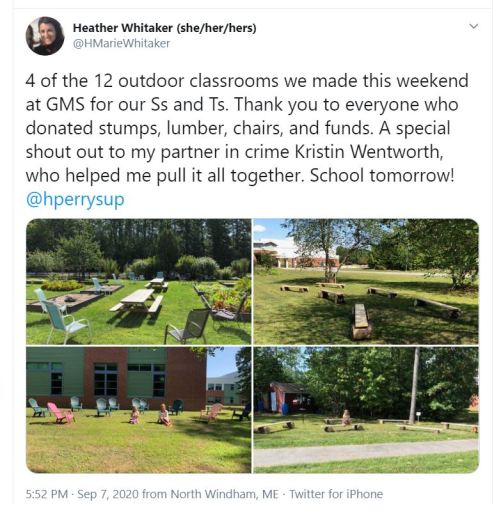
social media post about outdoor classrooms at Gorham Middle School
(Heather Whitaker, 2020 Maine Teacher of the Year/Gorham Middle School Teacher on Twitter)

The articles below detail what this looks like in just a few schools, but many more have worked quickly and efficiently to set up outdoor learning spaces prior to opening. Thank you to the countless community partners all over Maine who’ve stepped up to help make this possible.

Fireplaces and log forts are part of this Washington County school’s outdoor classroom (Bangor Daily News)

A different type of learning is taking place at East Grand School in Danforth, one that doesn’t happen within the confines of a traditional classroom.

In a wooded area behind the school, children run around freely and build forts out of logs and planks. Kids in pre-kindergarten enjoy the fresh air while working on coloring projects. Older students sit around an outdoor fireplace and learn about social studies.

Outdoor classrooms taking shape (Times Record)

The [Brunswick] school district is partnering with local organizations like Teens to Trails and the New England Mountain Bike Association to help plan, clear, construct and implement open-air classrooms and gathering spaces in an attempt to reduce the risk of spreading COVID-19. 

School opens with a new look (Castine Patriot)

Opening Adams School to face-to-face learning involved much preparation and innovative thinking by faculty and staff. Students were met upon arrival and instructed as to which door to enter to go directly to their classroom. Tented classrooms scattered on campus utilize five Easy-Up tents supplied by the Hatch Fund, which also supplied COVID-responsible physical education games and activities.

We tell our children to look for the helpers in times of crisis, it’s for their physical and mental safety but as adults, we forget that it’s good for us too. Take RSU 14 Superintendent Chris Howell for example. Due to some unforeseen transportation snags during the first week of school, one of his students couldn’t get there one day, so what did Superintendent Howell do? He picked up that student himself. In a world before COVID-19 this may not have been a viable solution, but right now that doesn’t matter. What matters is that everyone is a team player in the effort to get kids to school and learning and this is just one example of the pure heroism happening by school staff around the state.
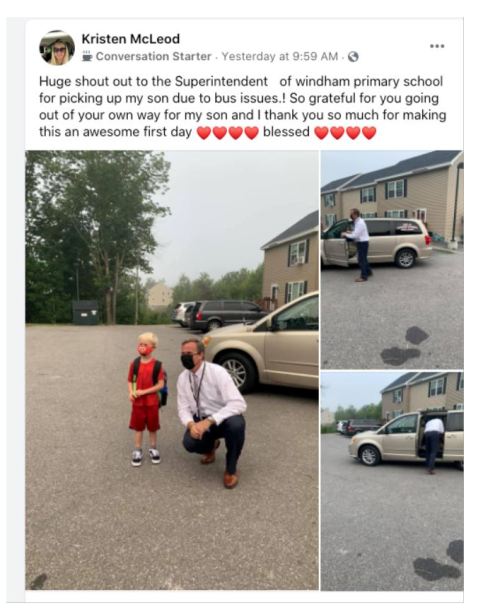
Social media post
(Submitted by Kate Leveille, RSU #14 School Board Member)

Along with school staff and educators, community and state partners are also jumping in to help schools, families, and youth complete hybrid assignments remotely, stay connected even when at home, and provide childcare when needed. These selfless acts also help to solidify the relationships that lead to the strong community and state bonds that we take pride in here in Maine, and that we hope to sustain for generations to come.

Boys & Girls Clubs adapt programs to help local schools during pandemic

The clubs, which have been closed for nearly six months, will operate during school hours this fall as remote learning hubs, paid for with federal coronavirus relief funding. They will offer academic support, technology resources, nutritious meals and safe spaces where members can do schoolwork.

—–

School officials in Portland and South Portland sought the remote learning partnerships with the Boys & Girls Clubs of Southern Maine. Similar agreements are being discussed with the Auburn and Lewiston school systems.

social media post thanking community partner for donation
(Portland Public Schools on Twitter)

The Maine Department of Education has also focused efforts toward providing not only guidance on safety protocols, in addition to the latest COVID-19 resources for schools, and a responsive, working Framework for returning to school this year, but there has also been an intensive summer-long effort to launch a library of asynchronous learning modules that are aligned to Maine’s Learning Results through a project called MOOSE (Maine Online Opportunities for Sustained Education) and coming soon will be an additional library of social emotional learning (SEL) modules to supplement SEL curriculums statewide.

A lot of time, dedication, and planning went into ensuring students could go back to school in person and learn remotely this fall. We owe these heroes an enormous dept of gratitude for this important work. While this is only the start of an extraordinary year, we trust our school leaders, our educators, our fearless school staff members to keep students and staff safe while providing quality education to Maine students. Thank them today and every day.

social media post by OOB superintendent thanking staff and students for a great week
(Superintendent of Schools in RSU 23 on Twitter)

____________________________________________________________________________________

Are you thinking of someone in particular that has gone above and beyond in your school district? Nominate them for an award!  

Information for this article was gathered through recent news articles, social media posts, and communications with Maine schools. To be featured in future articles of this nature, email stories, pictures, and ideas to Rachel at rachel.paling@maine.gov.

 

Five Portland Public Schools Students Named National Merit Semifinalists

Five high school seniors in the Portland Public Schools have been named Semifinalists in the 2021 National Merit Scholarship Program. These academically talented students now have the opportunity to compete for about 7,600 National Merit Scholarships worth more than $30 million that will be offered next spring.

The five Semifinalists are Portland High School seniors Liam Foley and Andrew Leonard; Deering High School students Aidan Blum Levine and Matthew Keast; and Casco Bay High School student Oscar McNally.

“Congratulations to these exemplary students!” said Superintendent Xavier Botana. “This is the highest number of National Merit Semifinalists from the Portland Public Schools in more than five years. The credit goes to not only these hardworking students but to their teachers and other supporters, including their parents. I wish them the best as they continue on in this competition.”

These students are among 68 Maine seniors named as Semifinalists in the 2021 contest. There are approximately 16,000 Semifinalists nationwide. Semifinalists were selected from a pool of more than 1.5 million high school juniors that entered the 2021 competition by taking the 2019 Preliminary SAT/National Merit Scholarship Qualifying Test.

Of the 16,000 Semifinalists, about 15,000 are expected to advance to the Finalist level of the competition. To become Finalists, Semifinalists must have an outstanding academic record throughout high school, be involved in school and community activities, show leadership abilities, be endorsed by a high school official, write an essay, and earn SAT or ACT scores that confirm their  earlier performance on the qualifying test. Of those Finalists, about half will win a National Merit Scholarship and become National Merit Scholars.

Three types of National Merit Scholarships will be offered in the spring of 2021. The National Merit Scholarship winners will be announced in four nationwide news releases beginning in April and ending in July. These scholarship recipients will join approximately 353,000 other distinguished young people who have earned the Merit Scholar title.

This story was submitted by Tess Nacelewicz Communications Coordinator for Portland Public Schools as part of the Maine Schools Sharing Success Campaign. To submit a story or an idea, email Rachel at rachel.paling@maine.gov.

UMFK and Region Two School of Applied Technology Partnering to Provide Students with First Year of a Nursing Degree

Imagine being a high school student enrolled in the Health Sciences Program at the Region Two School of Applied Technology knowing you can graduate from high school with the first year of a Bachelor of Science in Nursing Degree from the University of Maine at Fort Kent complete.  A new collaboration between the UMFK’s Nursing Program, Region Two School of Applied Technology in Houlton, and UMFK’s Rural U Early College and Concurrent Enrollment Program now makes that opportunity possible for these high school students.

The new program, called Rural U Nursing: Health Sciences Alliance Program brings together the strengths of the programs mentioned above and provides students the opportunity to earn 24 or more university credits, one full academic year of credits that serve as the first year of a Bachelor of Science Degree in Nursing at UMFK.  Students completing the program can come into UMFK’s Nursing program as 2nd year students.  UMFK’s Nursing program is also available at the University of Maine at Presque Isle adding yet another option after high school for these students.

“We are so pleased to partner with Region Two to bring freshman level college courses to high school students who are interested in pursuing a nursing degree,” states Dr. Erin Soucy, UMFK’s Dean of Undergraduate Nursing.  Dave Keaton, Director of the Region II School of Applied Technology adds, “What a tremendous opportunity for our Intro to Medical Professions students and for the workforce in Aroostook County!”

Credits earned in this program will include articulated credit UMFK grants for Maine CNA Certification earned at Region Two, credits from a concurrent enrollment NUR 200 Introduction to Professional Nursing to be taught at Region Two by Health Sciences Instructor Amber Sloat, credits for Anatomy and Physiology I and II classes taught at the Houlton Higher Education Center, and early college and concurrent enrollment classes earned through UMFK’s Rural U program.  While this program provides an accelerated pathway to a nursing degree, students will not be charged tuition for any of these credits; thus also providing a more affordable pathway to a BSN degree. Scott Voisine, UMFK’s Dean of Community Education adds, “All early college programs like Rural U give students a chance to experience college learning and earn credits more affordably, but this new collaboration takes it one step further provides a direct onboarding of students into a rigorous and rewarding career pathway at UMFK.”

Rural U Nursing is a direct response to the need to increase the number of nurses in Aroostook County, in Maine, and in the Region.  Students will be able to begin the program immediately this fall.

This story was submitted by Dave Keaton, Director of the Region Two School of Applied Technology as part of the Maine Schools Sharing Success Campaign. To submit a story or idea, email it to Rachel at rachel.paling@maine.gov.
MSAD 11 Launches 8 Committee Return to School Planning Process in Response to COVID-19

As with many schools around the State of Maine, the nation, and across the globe, planning for the 2020/2021 school year has been an almost impossible task with not knowing what will be around the corner during the COVID-19 pandemic. Among those in the trenches of planning is the fearless team at MSAD 11/RSU 11. They have worked tirelessly this summer at engaging their community and being transparent in the processes as they work to respond to the pandemic situation.

“I believe that it is critical that schools continue to highlight their strengths and I’m especially proud of the collaborative work of the district and the process that (MSAD 11 Superintendent) Pat Hopkins has led us through in this district,” said MSAD 11 Director of Curriculum and Instruction Angela Hardy.

The team worked on a process for redesigning their school system by August 24 which included the launch of an 8 committee Return to School Planning Process. A Steering Committee was formed to facilitate the process after first developing a set of guiding principles for their work. The committees were composed of 100 people representing all levels of staff, the School Board, parents, and community members. Seven subcommittees meet weekly or more, led by administrators throughout the summer, to focus on their charge: Facilities/Safety; Food Service; Resources; Transportation; Communications; Core Instruction/SEL/Technology; and, Athletics. Every subcommittee has staff, parent/community, and administrator representation and reported out at the Steering Committee. “MSAD 11 is as prepared as it can be because of the trust our community has of our educators and the commitment our principals and directors have toward the health and well-being of their staff and students. The leadership’s willingness to listen to concerns and their drive to come to creative, thoughtful solutions in a collaborative manner is paramount to this process.” stated the Director of Curriculum.

“Beginning in the spring, Supt Hopkins has kept staff informed at every step as we went through ‘remote learning’ and the end of the 2019-2020 school year.  When it became obvious that we would not be returning as normal in the fall, a Return to School Committee was put together.  This committee included 20 teachers and additional staff members from a group of employees,” said Dean Hall, President of the MSAD 11 Teachers’ Association, GRMS Social Studies Teacher.  “All staff had a chance to serve and those who did serve had a real voice in developing the plan we will be using to start the school year.”

The Steering Committee, the decision making body which recommends to the Administrative Team or School Board next steps, met weekly and livestreamed each meeting and posted the recording on their YouTube page and Return to School Planning website.

The district has also held virtual district-wide staff meetings to respond to staff questions and concerns as they arose. In addition, the superintendent met weekly with every president of each Association to co-design a COVID staff handbook.

“We would like to thank MSAD 11 for their continued commitment to the safety of their students, staff, and surrounding community,” said Chad Greenleaf, President of the Educational Technicians & Administrative Assistants Association. “I applaud the district leaders for their willingness to extend an offer of teamwork. Through the collaborative process that involved representatives from every area of expertise within the school district and community, we were able to assemble a comprehensive yet flexible plan.”

To further engage with community stakeholders, MSAD 11 administrators collaborated with their regional representative from Maine Roads to Quality and hosted a virtual meeting with MSAD 11/RSU 11 daycare providers to help them navigate the district’s online resources and information and to collaborate towards solutions that will support families as they return to school in a hybrid/blended/cohort-based learning model. They plan to continue meeting virtually as the school year progresses to keep open lines of communication and revisit issues that arise.

Virtual parent meetings have also been on-going as the school year starts, with each building principal and the directors of special services to walk parents through the start of the school year, share the district’s newly designed district-wide student handbook, and explain the schedule in greater detail.

“The MSAD 11 community should know their voices were heard. They can be proud of the result we were able to attain through this process,” added Greenleaf. “We remain committed to our student’s education and well-being regardless of the challenges ahead.”

This story was written collaboratively between distinct staff at MSAD 11/RSU 11 and Maine Department of Education staff as part of the Maine Schools Sharing Success Campaign. To submit a story or an idea please email it to Rachel Paling at rachel.paling@maine.gov.

Joe Mason of Asa Adams Elementary School Honored as Maine School Custodian of the Year

Joe Mason of Asa Adams Elementary School in Orono has been awarded as the Maine School Custodian of the Year and will be the recipient of the A. Burleigh Oxton Award for Excellence.

Joe credits the “Read ME Agriculture” program as a factor that lead him to reach out to the community more for volunteers and also working with staff to coordinate readings, he says, “This is one of the many things that really made my role as a custodian expand to also become involved in doing something other than just cleaning for the kids, but actually getting to ‘teach’, if you will.”

Joe started as a custodian at Asa Adams Elementary School in Orono in September of 2014. He became Greenhouse Coordinator 3 1/2 years ago and it was at that time he learned about the MAITC “Read ME Agriculture” program. Not long after that he had the school lined up for the ‘Applesauce Day’ reading, and has continued with the program since then.

In addition to the annual readings, he also works with some kids who help water the plants in the school’s greenhouse. He’s worked with small groups of students in the past couple of years to do things like build bee boxes for Mason bees, start marigold seeds, and grow edible pea shoots.

Outside of work Joe is also an avid home gardener, and loves to pickle things: cucumbers, zucchini, fiddleheads, carrots, asparagus, and green beans. He is also a passionate disc golf player (and a state winner three times!), and has helped get the sport incorporated into the PE program at his school.

Congratulations to Joe on this well deserved award!

This story is courtesy of Maine Agriculture in the Classroom (MAITC). Learn more about MAITC by visiting their website at https://www.agclassroom.org/ME/

St. George School 2nd Grade Teacher Shares, “Student Voices: An Alphabet Book of Remote Learning”

A driving force behind all learning opportunities in Alison Babb-Brott’s second grade classroom is the power and importance of student voice. When students feel confident and empowered, their initiative, engagement, and quality of work all begin to increase. And as these habits of scholarship all start to increase, so do Ms. Babb expectations. It is this symbiotic relationship that underlies all of the work they do in second grade.

With so much lost to remote learning, Ms. Babb wanted to create an authentic, motivating project for her students that would lend itself not only to their voices, but also to their desire and ability to create.

She designed this project to give her students a space to reflect on the transition to remote learning and an opportunity to channel feelings of grief and powerlessness into a collaborative art project.

The students spent the final weeks of remote learning thinking, writing, sharing, revising, and drafting, and drawing to create letter pages that commemorate their remote schooling experiences.

The effort they put forth to create such a high quality product, especially given the many challenges to remote creation, is a credit to who they are as scholars.

Student Voices: An Alphabet Book of Remote Learning

“I hope my students will share this book with friends and family near and far, and that copies will eventually make their way onto bookshelves and coffee tables at home; reminding them of what they are capable of, no matter the circumstances,” said Babb-Brott.

This story was submitted by Alison Babb-Brott, a Second Grade Teacher at St. George School in St. George as part of the Maine Schools Sharing Success Campaign. In addition to being a second grade teacher, Babb-Brott is also the 2020 Knox County Teacher of the Year and was recently named a 2021 Teacher of the Year State finalist.

To submit a good news story or idea to the DOE, email Rachel Paling at rachel.paling@maine.gov.

MEDIA RELEASE: Music Education Provides a Note of Hope for Many Amid COVID 19

As schools head back into session in the midst of a global pandemic, we face a never-ending torrent of restrictions and requirements to keep all people safe while still providing and getting quality education. A well-rounded and comprehensive education consists of many necessary components to keep students engaged and learning. This includes a robust music education programming, a fact that educators alike are well aware.

“The skills we learn in music lead to experiences that are creative, aesthetic, and uplifting,” said Sandy Barry, Maine Music Educators Association (MMEA) President and Middle School Band Director at Mahoney Middle School in South Portland. “A music classroom embodies the best of 21st century skills, including problem solving, critical thinking, collaboration and interdependent learning.”

Yet on the minds of musicians (and music educators) around the world is the heartbreaking truth that singing and playing wind instruments while near other people is now considered a risk in transmitting COVID-19.  While we mourn the absence of live concerts and impromptu choir practice in the halls, or even just singing at the top of our lungs in the car with our friends, music educators are busy trying to orchestrate a very different but essential music education program this school year.

“Preserving access to music education for all of our students during this difficult time is crucial.  As we reimagine music education along with our students, it is important to focus on all that we can do in the music classroom, even though group singing and wind playing looks different right now,” said Ben Potvin, MMEA Past President and Grades 3-5 Classroom Music, Band, and Chorus at Mast Landing School in Freeport (RSU5). “Maine’s music educators are up to the challenge of fostering connections with our students and maintaining safe, high-quality music instruction.”

With hard work and a deep commitment to ensuring quality music instruction continued, Maine’s music teachers took on the challenges posed by COVID-19. “I am in awe of the creative and innovative ways in which our music, and all our visual and performing arts, educators have re-imagined their craft,” said Commissioner of Education, Pender Makin.  “Music is one of the core expectations for our schools exactly because it nurtures this kind of flexible problem solving and creativity, skills that are vital for our classrooms and for the 21st century.”

Even when schools had no choice but to deliver remote education in the spring, music educators still found a way to encourage and engage students from home and students blossomed with the opportunity to get more of want they wanted.

“Because I had more time and flexibility in my schedule when we were distance learning, I was able to focus on my own musical goals and develop a more consistent practice routine,” said Delia Harms, a Junior from Massabesic HS in Waterboro who plays the bassoon in the school band, the Portland Youth Wind Ensemble, and the Symphony Orchestra. “I had time to really dig into more challenging music, but also to focus on returning to the basics and developing fundamental skills. Though it was different, every moment that I was able to connect with others about music, through recordings or on zoom, it brought back some of that excitement and connection that music has always created. It has been inspiring to see the resilience and commitment of my musical community that has allowed them to persevere through these difficult circumstances to continue making music.”

For many, the chance to continue having a creative space to practice and learn music through education programming provides solace during an uncertain time.

“Access to music education is incredibly important for a number of reasons, especially now, but the first one that comes to mind is to create a support system for kids” said Colette (Coco) Carrillo, a Junior from Waterville High School who is an active member of the school choral program.” So many people I know see their school’s music programs as a creative outlet and a safe place that they don’t have anywhere else in the school. It offers them an activity that can not only relieve their stress but can also build so many skills for their futures. Whether it’s in person or online, kids in music programs do those activities for a reason. They want to share their passion with friends, learn new material, and improve their skills. Getting rid of those programs or lowering the standard will harm their academic minds as well as their artistic minds.”

Finding a new way to learn during the pandemic has been a challenge for everyone, and the reinvention of how we educate students and how we prioritize what we need to do has provided a valuable lesson in and of itself.

“When schools began to shut down, the music department was arguably hit the hardest, as playing/ singing together does not lend itself to virtual mediums very well due to the fact that digital latency prevents synchronization,” said Tyler Lucca, a Junior from Yarmouth High School who plays the trombone in the school’s honors level Wind Ensemble and Jazz Band, and sings in the honors level Chamber Choir. “This made making music with my peers nearly impossible, at least in the traditional way, and it showed me how important these classes that we took for granted truly are.”

Music education is essential to a robust educational experience and while it may look very different this year, and possibly for years to come, it is more than just another education standard to meet or a lesson plan to fit into the schedule. It’s an emotional state, it’s a way to cope, and for many it’s a vital part of what makes them who they are.

###

MSAD 54 Serves 500k Meals, Travels 48k Miles to Feed Kids During Pandemic

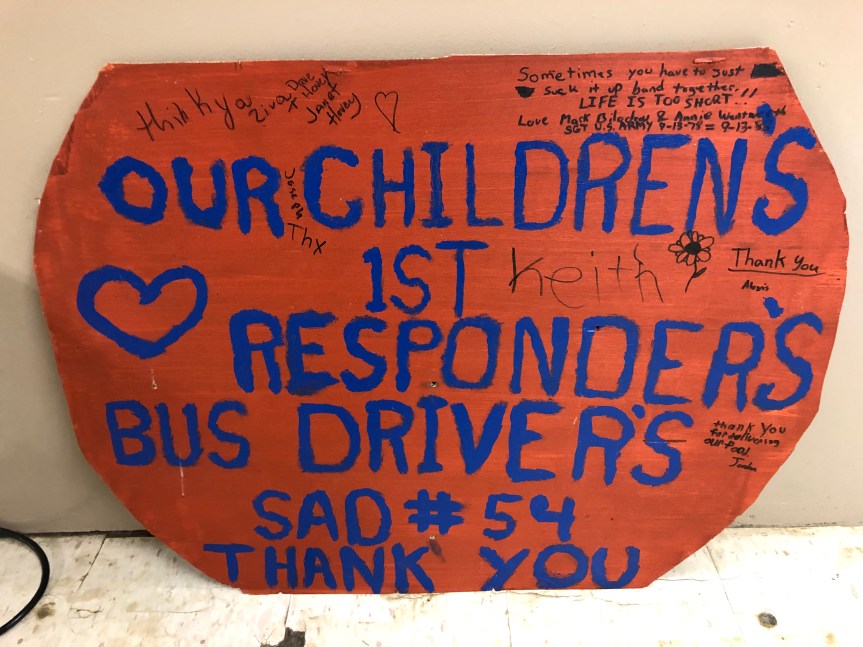
Our MSAD 54 family has had great success in feeding our students during the COVID-19 pandemic. With the help of our transportation department, administration, ed techs and of course or school nutrition team we were able to serve close to 500k meals and traveled 48k miles between the months of March-June.

We received many words of appreciation, cards, photos of the children, and signs around the towns thanking us for all that we have done. It has been a great and humbling experience for all of us that have been involved over the last couple of months.

This story was submitted by Jana Wacome, Director – School Nutrition, RSU 54/MSAD 54 as part of the Maine Schools Sharing Success Campaign. To submit a story or an idea, email it to Rachel Paling at rachel.paling@maine.gov.

Efficiency Maine Helps Brighten More than 50 Maine Public Schools with Incentives to Support Lighting Upgrades

More than 50 Maine public schools are upgrading the quality of their interior and exterior lighting through a special Efficiency Maine initiative.

The principal goal of Efficiency Maine’s School Lighting Retrofit initiative is to reduce electric energy consumption from Maine K-12 municipal schools and to accelerate the conversion to efficient LED lighting. The offer supported project work for electricians and encouraged schools to complete the lighting conversions over the 2020 summer while school buildings are unoccupied.

“We were very glad to see broad participation stretching from Kittery to Calais to the County,” said Michael Stoddard, executive director of the Efficiency Maine Trust.

Eligible electrical efficiency lighting retrofit projects include interior and exterior lighting upgrades in classrooms, hallways, lobbies, entryways, stairways, auditoriums, libraries, cafeterias, offices, gymnasiums, parking lots, and public restrooms.

“This grant program will help 50 schools across the state to have better lighting while conserving energy and reducing costs,” said Dan Burgess, director of the Governor’s Energy Office. “This initiative not only helps our state meet its energy goals, but it allows schools to use the savings to support students and teachers in other important ways.”

Limestone Community School in Limestone is among the schools that has benefited from the incentive program. The school received more than $38,000 in incentives to upgrade lighting in its classrooms, auditorium, library, offices, bathrooms and parking lot. The school will see an estimated annual savings of more than $19,000 (129,975 kWh) and will realize a return on investment in an estimated 2.3 years.

 According to Superintendent Bill Dobbins, they are elated with the results and already have received inquiries from other district schools interested in pursuing similar projects.

“We viewed this project as a way to create a better atmosphere for the educational growth of our children,” explained Dobbins. “Efficiency Maine’s School Lighting Retrofit program enabled us to combine and accelerate two projects that our budget alone couldn’t accommodate in the same year. We were able to complete it using less money from Limestone taxpayers and while the children weren’t in school. We’re hoping the new brighter, uniform lighting will make it easier for them to do their schoolwork. In the meantime, we’ve already heard from our local police department that it’s easier for them to patrol the school grounds because the exterior lighting is so improved.”

St. John Valley Technology Center in Frenchville is equally satisfied. The school contributed approximately $20,000 to the project and Efficiency Maine contributed $13,000 to upgrade lighting in its entryways, hallways, and gyms. The school will see an estimated annual savings of nearly $7,000 (46,163 kWh) and will realize a return on investment in an estimated 2.8 years.

“There’s no question, improving lighting enhances the ability of students to learn,” said Kevin Lavoie, director of St. John Valley Technology Center. “We’re reducing our carbon footprint because LED lighting is more energy efficient. This program also has reduced the tax burden on our community and has created jobs for Maine’s workforce. That’s a triple win as far as we’re concerned. In addition, we’re especially pleased we could complete the project this summer.”

Songo Locks Elementary School and the Educational Services building for the Lake Region Vocational Center in Naples have brighter futures, as well. Together, the schools received more than $10,000 in incentives to upgrade exterior lighting and will see an estimated annual savings of more than $5,000 (39,481 kWh).

 Andrew Madura, director of Transportation, Facilities and Food Services for Naples schools, is confident the projects will help the schools save money and energy. Two years ago, Madura managed an interior lighting project using incentives from Efficiency Maine, which resulted in a 20% to 25% reduction in energy consumption for those measures.

“We’re constantly looking for ways to be more efficient,” explained Madura. “With a limited budget, this program was very helpful. We were able to complete both projects without allocating additional capital funds. It has particularly benefited the Educational Services building, which houses our buses and equipment. The exterior lighting at the building is on constantly in the evenings for security purposes, making the energy consumption fairly high.

“The nighttime staff have noticed and appreciate the improved lighting,” said Madura. “Aesthetically, it’s much more attractive. It’s also more controlled lighting, ensuring that our residential neighbors don’t experience light spill. Overall, we now have better lighting that requires less maintenance and uses less energy. To me, that’s an efficiency trifecta.”

Louis DiFrederico, facilities manager for the Millinocket School Department, managed projects at Stearns Junior – Senior High School and Granite Street Elementary School. DiFrederico already is a firm believer in the savings he can derive from Efficiency Maine initiatives, having managed a similar lighting upgrade 10 years ago with incentive funds. This time around, the projects improved lighting in the gymnasiums and corridors at the high school and upgraded lighting in the elementary school classrooms, hallways, cafeteria, and lobby. By matching Efficiency Maine’s incentives, DiFrederico estimates the school department will save $7000 a year for the elementary school and $6000 a year for the high school.

“Given the nature of limited school budgets and funding, I had to look for creative ways to get the job done,” explained DiFrederico. “This was a relatively easy process that was readily available and translated into real dollar savings up front and long-range. Without Efficiency Maine’s incentives, I would not have been able to complete these projects.”

DiFrederico was especially keen after he did the math. He calculated that by upgrading the lighting in all the elementary school classrooms energy load dropped from 1100 watts per classroom to 400 watts. Together, both projects will save an estimated 87,000 kWh annually.

“It used to cost $1.33 a day to light each elementary school classroom and now it costs 48 cents,” he said. “The new LED fixtures not only provide better light, but they look better, and provide a modern update to the buildings. Teachers and staff have also thanked me for brightening their classrooms and the building. To me, those benefits are a win-win for the district.”

Efficiency Maine accepted applications for the School Lighting Retrofit Funding Opportunity Notice (FON) between February 10, 2020, and June 1, 2020. The funding opportunity is now closed. Funding was calculated based on the amount of electricity saved by each project in the first year and was subject to caps of 80% of the total project cost and $100,000 per school district.

Efficiency Maine’s Prescriptive Program, which funded the school initiative, offers fixed incentives to reduce the cost of projects and to improve energy efficiency for businesses, municipalities, schools and higher education facilities, manufacturing and other industrial facilities, other non-residential facilities, and multifamily and condominium buildings with five or more units.

To learn more about the Efficiency Maine Prescriptive Program and how to maximize its benefits visit https://www.efficiencymaine.com/at-work/ci-prescriptive-incentive-program/.

About Efficiency Maine Trust
Efficiency Maine Trust is the independent administrator for programs to improve the efficiency of energy use and reduce greenhouse gases in Maine. The Trust does this primarily by delivering financial incentives on the purchase of high-efficiency equipment or changes to operations that help customers save electricity, natural gas and other fuels throughout the Maine economy. The Trust is a quasi-state agency governed by a Board of Trustees with oversight from the Maine Public Utilities Commission. Visit www.efficiencymaine.com for more information.

Mountain Valley High School Rolls Out the Bikes!

Every year when students enrolled in Todd Papianou’s Lifetime Pursuits physical education class at Mountain Valley High School when they return from April vacation, they are given the opportunity to choose their next unit. The Lifetime Pursuits course is an outdoor skills based class, and in the spring, students are able to choose between kayaking, canoeing, and biking. This year, things looked a little bit different.

About 15 years ago, in a combined effort between RSU 10 and the Dirigo District (RSU 56), Todd Papianou, a physical educator at MVHS, applied for and was awarded a federal physical education program grant, specifically, the Carol M. White Physical Education Grant. With the award from the grant, he and a group of physical educators were able to purchase 110 bicycles to be shared between 4 schools.

Papianou collaborated with the Bike Coalition in conjunction with the DOT to pilot bike education curriculum in Maine. With the Coronavirus impacting schooling and forcing a switch to distance learning, Todd jumped at the opportunity to adjust his bike curriculum and continue to make it accessible during this period of remote learning. His adjusted unit has a focus on bike awareness and commuter safety. To make this work, he has implemented a new plan that uses content, videos, and teaching tools produced by the League of American Bicyclists.

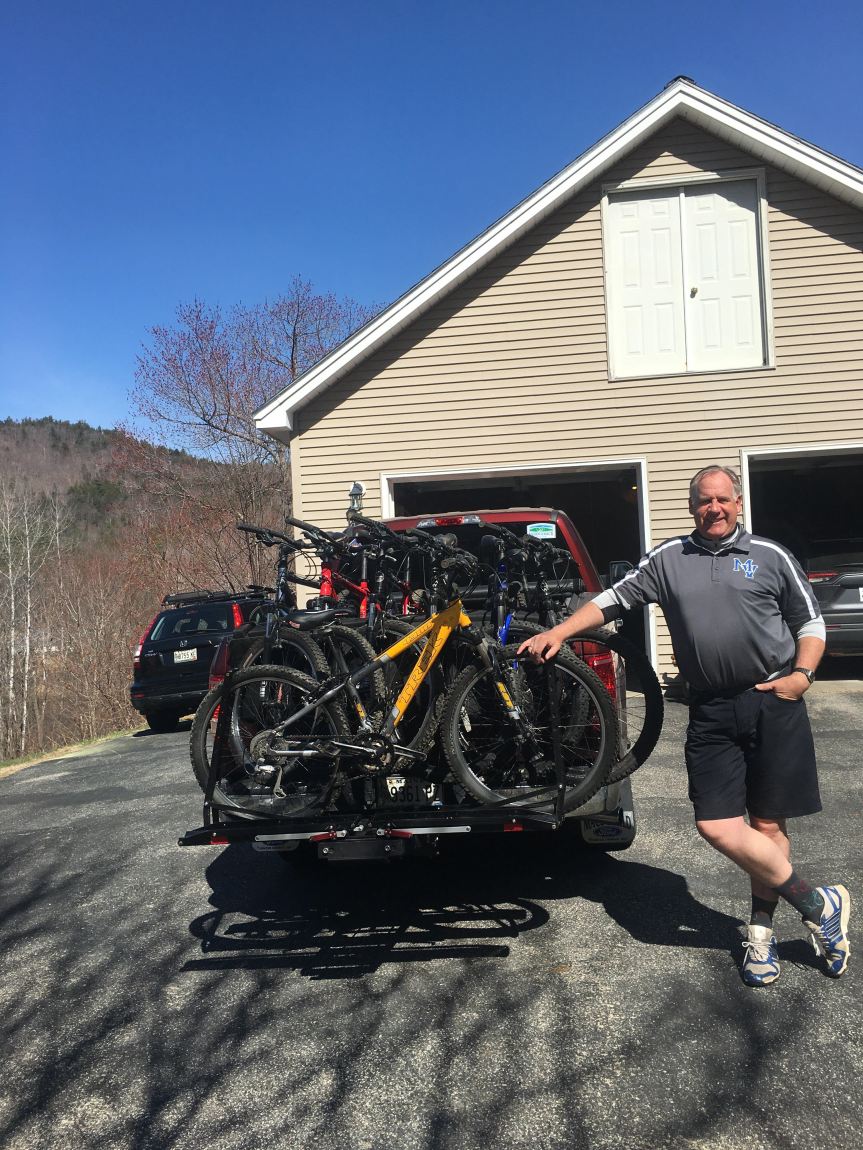
Papianou knew that he wanted to get the bikes out to students, but was not able to at first. The school was being deep cleaned and he couldn’t get in. After a conversation with his principal, Matt Gilbert, they decided that it was time to “roll out” the bikes. After gaining permission from the principal, Todd rushed home, got his trailer, and headed back to the school so that he could load up the bikes. He brought all 25 bikes home and stored them in his barn which became a makeshift bike shop. He then tuned each bike before sending them out to his students.

Over the course of two days, Todd Papianou and Matt Gilbert drove around delivering bikes to students by placing them at the end of each student’s driveway. Todd said that the bike roll out was exciting and that he was happy to see both students and parents (from a distance) while dropping off the bikes. He has received a lot of positive feedback from parents who were grateful that their children now had an additional option to get outside and to get active.

Todd has taken advantage of new technology to assist in the bike roll out and distance learning. He set students up with an app called Strava, which tracks ride analytics including distance and time. This data was shared between himself and his students so that he could see the progress they were making. In relation to using this new technology, Todd said “Being ready for the past decade with a comprehensive ‘Commuter Bike/Trail Bike Unit’ online already makes me feel proud that I had the foresight to prep and commit myself to Senator King’s vision to transition our learning/teaching delivery to include technology.”

To wrap up the school year, Todd planned an in-person assessment day for his students to show of their new skills, demonstrate bike control, and return the bikes. On this day, Todd focused on discussing what worked and what didn’t work in regards to remote instruction with his students. Todd said that both personally and professionally, the biggest takeaways from distance learning were that “nothing replaces instantaneous feedback, discussion, and banter…[and that] teachable moments arise and present themselves.” In a time where many of us have been stuck at home, Todd provided an option to get outside and be active for his students, his determination and innovation made the bike roll out highly successful.

This article was written by Maine DOE Intern Aidan Sachs in collaboration with Todd Papianou, a physical educator at MVHS as part of the Maine Schools Sharing Success Campaign. To submit a story or an idea email it to Rachel Paling at rachel.paling@maine.gov.