Maine School Nutrition Teams Sharpen Skills Through No-Cost Regional Culinary Trainings

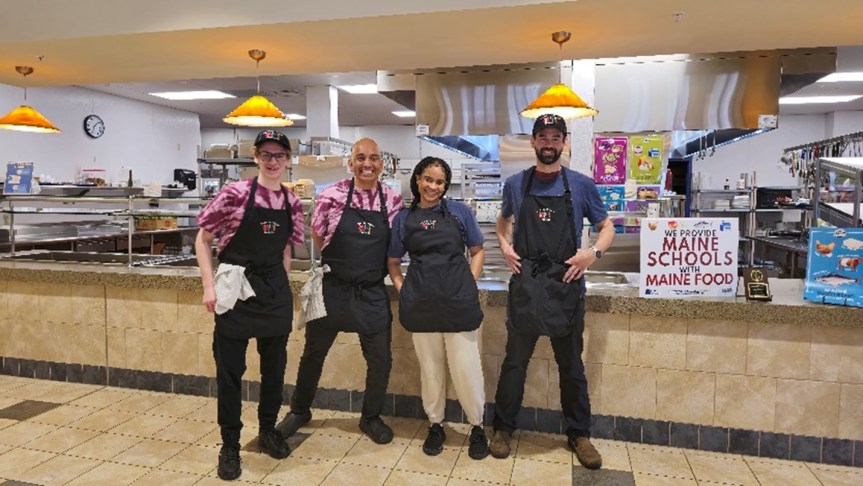
With the support and participation of the Maine Department of Education (DOE) Child Nutrition Team, Full Plates Full Potential, in collaboration with the MaineHealth Center for Health Improvement, hosted another successful season of the Culinary Skills for School Meals training over the summer. This learning opportunity is a five-day, hands-on training, designed to strengthen the culinary skills of school nutrition professionals.

Culinary Skills for School Meals has been offered annually during the summer months since 2023, attracting an increasing number of participants every year and expanding its reach across Maine. Funded by U.S. Department of Agriculture (USDA) grants, Full Plates Full Potential collaborates with the Healthy Eating Active Living Team, a program of the MaineHealth Center for Health Improvement, to host these no-cost events in regional locations across Maine.

This year, trainings were held at Kennebunk High School, Edward Little High School in Auburn, Mount Blue in Farmington, and Presque Isle High School. The four trainings reached 98 participants from 32 school districts, with Auburn and Presque Isle hosting for the first time.


During the training, participants acquired techniques and kitchen efficiency skills, all aimed at enhancing the quality and appeal of school meals and increasing students’ consumption of fruits, vegetables, whole grains, dairy products, plant-based proteins, and lean meats.

In a 2024 post-training evaluation, participants were asked to share their experiences and describe any changes they had made since completing the culinary training. Examples of feedback include:

  • “[I] learned knife and culinary skills, recipe ideas, and ways to cook and serve veggies to increase appeal.” – middle school cafeteria staff 
  • “[I’m] expanding my thinking outside of the box and jazzing up ho-hum items simply and nutritiously.” – middle school cafeteria staff 
  • “There are many ways to prepare an item (fruits, vegetables).” – elementary school cafeteria staff 
  • “[I learned] how easy it is to enhance flavors with simple seasonings and techniques.” – elementary school cafeteria staff 
  • “[I’m] definitely letting the kids try something before just jumping off the deep end and hoping they like it.” – high school cafeteria staff 
  • “It helped me to gain confidence.” – elementary school cafeteria staff

Planning is underway for the 2026 training dates and locations. For more information, please visit www.letsgo.org/culinaryskills.

This story was submitted by the MaineHealth Healthy Eating Active Living Program. To submit a good news story to the Maine DOE, please fill out the good news submission form.

Maine DOE Child Nutrition Programs Unaffected by SNAP

In anticipation of questions from the field, the Maine Department of Education (DOE) would like to assure school administrators that Child Nutrition Programs will continue to operate as usual. While the U.S. Department of Agriculture has notified states that Supplemental Nutrition Assistance Program (SNAP) benefits will not be issued for November, this does not affect school meal programs. Child Nutrition Programs and SNAP are administered separately, and school meal operations will not be affected by changes to federal SNAP benefits.

Additionally, the Child and Adult Care Food Program (CACFP) At-Risk Afterschool Program will continue for those Maine schools currently enrolled. Existing program rules remain in effect; meals must be consumed on-site and in a congregate setting to ensure that students receive the full benefit of these services.

The Maine DOE has advised local Child Nutrition Directors to anticipate a potential increase in participation in school breakfast and lunch and the CACFP At-Risk Afterschool Program following the expected changes to SNAP benefits.

School administrators may utilize this customizable Community (Food) Resources Template when responding to families who may be experiencing gaps in nutrition assistance, due to the ongoing federal shutdown. For families seeking additional food support, please consider sharing The Emergency Food Assistance Program (TEFAP) Map, organized by county, from the Maine Department of Agriculture, Conservation, and Forestry. In addition, 211Maine.org contains information about other available resources.

With questions, please contact Jane McLucas, Maine DOE Director of Child Nutrition, at jane.mclucas@maine.gov.

Thank you for your continued support in ensuring that all Maine students have access to nutritious meals every school day.

Maine Celebrates National School Lunch Week and Farm to CACFP Week, with Apple Crunch Day Slated for October 15

National School Lunch Week and Farm to CACFP Week will both be celebrated the week of October 13-17, 2025!

This year’s National School Lunch Week theme, “Taste the World: Your School Lunch Passport!”, invites students to explore global flavors and celebrate nutritious meals that fuel learning.

Farm to CACFP Week highlights how the Child and Adult Care Food Program (CACFP) connects participants with local food, nutrition education, and gardening experiences.

Maine is grateful to have strong programs like the National School Lunch Program (NSLP) and Farm to CACFP that help to nourish students and families across the state. These initiatives ensure that every child and adult in care settings has access to nutritious meals that fuel learning, growth, and overall well-being.

The goal of National School Lunch Week, established by the School Nutrition Association, is to highlight the importance of healthy school meals, encourage student participation in the NSLP, and share with families the many benefits of school nutrition programs. Since its creation in 1946, the NSLP has evolved to offer balanced meals that include fruits, vegetables, whole grains, lean proteins, and fat-free or low-fat milk—all within age-appropriate calorie ranges and limited in unhealthy fats and sodium.

Here in Maine, all students attending schools that participate in the NSLP receive breakfast and lunch at no cost to them, ensuring equitable access to nutritious meals. When every student chooses school lunch, the entire school community benefits.

Similarly, Farm to CACFP Week celebrates the childcare centers, Head Start programs, family childcare homes, afterschool programs, and adult care centers across Maine that foster healthy habits and support local agriculture. Throughout the week, participating programs are encouraged to:

  • Serve and incorporate local foods in CACFP meals and snacks.
  • Engage participants in taste tests, cooking demos, food-themed stories, or gardening activities.
  • Highlight Maine farms and producers through guest visits or virtual tours.

Together, these programs exemplify Maine’s commitment to feeding both bodies and minds—connecting nutrition, education, and local food systems to strengthen communities statewide.

This year, a special highlight to celebrate nutrition in Maine is Apple Crunch Day, slated for Wednesday, October 15, 2025. This is an engaging and fun event where children and adults across the state are invited to take big, crunchy bites out of fresh, local apples at the same time. This simple activity celebrates Maine’s apple harvest and sparks curiosity about where our food comes from. It also offers an excellent opportunity for students to explore the role that apples play in Maine’s agricultural heritage and the many apple varieties that thrive in Maine’s orchards. 

Several schools across Maine are planning to participate in Apple Crunch Day! For additional information about the event, please contact Maine DOE Farm and Sea to School Coordinator Katie Knowles at katie.knowles@maine.gov. Consider sharing pictures/videos of how your school celebrated Apple Crunch Day with Rachel Paling, Maine DOE Communications and Outreach Manager, at rachel.paling@maine.gov.

For more information about the National School Lunch Program or the Child and Adult Care Food Program (CACFP), please visit the Maine DOE Child Nutrition website or contact the Maine DOE Child Nutrition Team at child.nutrition@maine.gov.

ADMINISTRATIVE LETTER: Details Surrounding Participation in the National School Lunch Program

Administrative Letter: #1
Policy Code: EFG/EFC

To: School Administrative Unit Administrators, Special Purpose Private School Administrators, and Public Regional Program Administrators
From: Jane McLucas, Maine Department of Education Child Nutrition Director
Date: August 6, 2025

The National School Lunch Program (NSLP) is a federally assisted meal program operating in public and nonprofit private schools and residential childcare institutions (RCCIs). It provides nutritionally balanced, low-cost, or free lunches to children each school day. In Maine, with legislative support, Healthy School Meals for All have been available since 2021. State funding covers the portion of the meal cost that is not covered by federal funds for students attending a public school or certain private schools participating in the NSLP and School Breakfast Program (SBP).

School Food Authorities (SFA) receive cash subsidies, as well as nutritious, 100-percent domestic foods—known as USDA Foods—for each reimbursable meal that they serve. In exchange, SFAs must serve meals that meet the Federal meal pattern guidelines and offer them at a free or reduced price to all eligible children. SFAs can also be reimbursed through NSLP for snacks served to children who participate in an approved afterschool program.

SFAs determine which meal programs to offer (breakfast, lunch, and/or snack) and select their operational model (self-operation, meal contracts, or commercial food service) with guidance from the Maine Department of Education (DOE) Child Nutrition team. Once operating their meal program(s), SFAs can submit claims for reimbursement monthly through the Child Nutrition program.

The Maine DOE recommends that meal provision for students attending programs outside of the school administrative unit (SAU) be addressed in the Memorandum of Understanding (MOU) between the SAU and any Special Purpose Private School (SPPS) or regional program.

Eligible SAUs (e.g., traditional and public charter schools), SPPS, regional programs, and Career and Technical Education (CTE) programs interested in joining the NSLP will be assigned a Maine DOE Child Nutrition team member for onboarding support. The onboarding process typically takes between four and six months and includes submitting required state and federal documentation, attending a two-day, in-person “New Director Bootcamp,” selecting a program model, determining staffing needs, and meeting all compliance requirements before receiving approval to participate.
 
If you are interested in learning more about the NSLP and the steps required to participate, please reach out to the Maine DOE Child Nutrition team at child.nutrition@maine.gov or 207-624-6842.

SUN Bucks EBT Benefit Available to Maine Families Again This Summer

Most eligible children will receive these benefits automatically, but some families will need to apply.

In the summer, many children lose the free and reduced-price meals that they get at school. SUN Bucks provides families with a $120 EBT benefit for each eligible school-aged child to buy groceries when school is out of session.

SUN Bucks is designed to supplement families’ grocery budgets over the summer. Most eligible children will receive these benefits automatically, but some families will need to apply. This program occurs in addition to free meals that children of all ages may access at summer meal sites in their communities.

How SUN Bucks Works

Families will receive a one-time EBT benefit of $120 per eligible child for the summer. The benefits may be used at authorized retailers, such as grocery stores and farmers markets, to purchase healthy foods, such as fruits, vegetables, meats and other protein sources, whole grains, and dairy.

  • For children already eligible for SNAP, SUN Bucks will be loaded onto the household’s existing EBT card (also called the Pine Tree Card).
  • For children who don’t receive SNAP but did previously receive P-EBT or SUN Bucks, the benefit will be loaded onto the previously-issued card.
  • For children who don’t receive SNAP and didn’t receive SUN Bucks or P-EBT previously, a new Pine Tree Card will be issued.

If a family had an EBT card previously and lost it, a replacement card must be ordered by calling 800-477-7428.

Automatic Enrollment for Most Families

Most children will be automatically enrolled for SUN Bucks and do not need to apply if:

  • They completed an application for school meal benefit and were found eligible.
  • They are aged 6-16 and part of a household that already participates in SNAP, FDPIR, TANF, MaineCare at 185% FPL, or are identified as foster, homeless, or migrant by the Office for Family Independence (OFI) or Office of Child and Family Services (OCFS).

Automatically-enrolled households will receive a letter in late spring, and benefits will start in June.

Manual Application for Some Families

Families who haven’t received a letter in the mail by mid-June notifying them of automatic enrollment should consider applying manually for SUN Bucks if:

  • Their child attends a school that offers the National School Lunch or School Breakfast Program.
  • The household meets the requirements for free or reduced-price school meal benefit.

To learn more about eligibility and how to apply, visit the Department of Health and Human Services (DHHS) SUN Bucks webpage.

Guidance for Special Provision Schools

  • Community Eligibility Provision: If students are not part of a household that already participates in SNAP, FDPIR, TANF, MaineCare at 185% FPL, or identified as foster, homeless, or migrant by OFI or OCFS, but they do meet the requirements for free or reduced-price meal benefit, they will need to apply for SUN Bucks.
  • Provision 2: If students are not part of a household that already participates in SNAP, FDPIR, TANF, MaineCare at 185% FPL, or identified as foster, homeless, or migrant by OFI or OCFS, but they do meet the requirements for free or reduced-price meal benefit, most will need to apply for SUN Bucks. 

How to Help to Spread the Word

Schools may help to spread the word by sharing information with families about theSUN Bucks program and how they may receive benefits for their children. Suggestions include:

  • Encourage families with children who will automatically be enrolled to make sure their mailing address is up to date by calling OFI at 855-797-4357.
  • Tell families to keep an eye out for a letter notifying them of automatic enrollment, a new card in the mail, or a balance increase on their existing card in early June.
  • Encourage families who haven’t received notice of automatic enrollment by mid-June, but who may have eligible children, to apply.

Please use the below flyers to help spread the word about this important program and direct families to OFI’s SUN Bucks webpage for more information about the program and how to apply. Families may also call OFI at 855-797-4357 and select option 5 to speak with an Eligibility Specialist about SUN Bucks.

SUN Bucks Info Sheet (English) (PDF)

العربية | Français | Español | Português | Lingala | Soomaali | Русский | 简体中文 | Tiếng Việt | Kiswahili | ខ្មែរ | Kinyarwanda  

Thank you for helping to raise awareness about this program and ensure that Maine children get the nutrition they need to thrive this summer.

School Nutrition Teams Compete in 10th Annual Maine DOE Farm to School Cook-off

March kicked off the Maine Department of Education (DOE) Child Nutrition Team’s 10th Annual Maine Farm to School Cook-off. This event aims to showcase the culinary skills of school nutrition professionals, while promoting locally-grown products in school meals. School teams competed in different regions across the state, and the top team from each region will compete in the state finals in Augusta on April 17th. There, the 2025 Farm to School Cook-off Champion will be crowned!

This year, the following three regional competitions took place:

  • York Regional Competition at Kennebunk High School on March 18
    • Teams competing included RSU 21 (Kennebunk) and MSAD 60 (North Berwick).
  • Aroostook Regional Competition at Madawaska Middle/High School on March 20
    • Teams competing included Madawaska Public Schools, MSAD 27 (Fort Kent), and MSAD 33 (Frenchville).
  • Western Regional Competition at Oxford Hills Comprehensive High School on March 25
    • Teams competing included MSAD 17 (South Paris) and MSAD 52 (Turner).

Competing cook-off teams consisted of one Child Nutrition employee and one person from the school administrative unit (SAU)—student or staff member. Teams were tasked with preparing breakfast and lunch meals using local ingredients and USDA foods. Local eggs donated by Maine Family Farms and local fish donated by Maine Coast Fishermen’s Association were included as challenge ingredients in the competition. (All recipes will later be shared in a Maine Farm to School cookbook!) 

A panel of judges for the cook-off consisted of a student/student representative, school nutrition director, and professional chef. The dishes were scored based on presentation, taste, creative use of challenge ingredients, and feasibility to be used in a school kitchen. Other criteria included teamwork, food safety, and time management.

Congratulations to MSAD 60 (The Flavor Knights), MSAD 27 (Fire & Ice), and MSAD 52 (Leavitt Lunch Crew), who won the regional competitions and will be advancing to the finals on April 17!

MSAD 60 prepared a USDA Pancake Breakfast Bake for breakfast, using local sausage and Maine maple syrup. For lunch, those involved served fish tacos and corn salsa.

MSAD 27 prepared a hashbrown egg bake for breakfast and cheddar bacon ranch baked fish for lunch.

MSAD 52 prepared a breakfast frittata with vegetables and baked stuffed haddock for lunch, along with apple crisp.

For more information about the Maine Farm and Sea to School program, please visit the Maine DOE website.

Maine DOE Partners with Culinary Institute of Child Nutrition and RSU 14 to Host School Nutrition Staff Training

On February 18 and 19, Chef Patrick Garmon from the Culinary Institute of Child Nutrition and Chef Ryan Roderick from RSU 14 joined the Maine Department of Education (DOE) Child Nutrition Team to provide in-depth training to school nutrition staff in Maine.

Over these two days of training in Augusta, 35 participants divided their time between hands-on training in the Maine DOE culinary classroom and traditional classroom learning.

In the culinary classroom, participants focused on vegetable preparation methods, proper food handling, food safety, and efficient use of equipment. Time in the classroom was spent learning about organizational techniques to maximize efforts, as well as better ways to market food to students by optimizing their serving lines and making foods served look more appealing.

The event was a wonderful opportunity for the Maine DOE to collaborate with the Culinary Institute of Child Nutrition and local school administrative units (SAUs) to provide cutting-edge and practical training for Maine school nutrition staff. The Maine DOE Child Nutrition Team hopes to provide similar opportunities in the future.

To learn more about the resources and training opportunities provided by the Maine DOE Child Nutrition Team, please visit the team’s webpage or contact the team.

Organizations Needed to Provide Complimentary Meals to Children this Summer

With assistance from the U.S. Department of Agriculture (USDA), Maine public schools have long offered a nutritious breakfast and lunch meal program to thousands of income-eligible children in Maine during the school year. To extend this program into the summer months, the Maine Department of Education (DOE) Child Nutrition team is seeking organizations that would like to participate in the federally-funded SUN Meals program – formally known as the Summer Food Service Program (SFSP) – which provides children healthy, free meals when school is not in session.

In the summer of 2024, 101 SUN Meals sponsors were approved to operate 413 summer meal sites across all of Maine’s 16 counties. There is, however, still a long way to go toward feeding all of Maine’s eligible children in the summer, and community partners are working to maximize the number of sponsors utilizing the available SUN Meals program funds.

“Having access to nutritious food is an essential component of a happy and healthy childhood, providing kids with the fuel they need to thrive both inside and outside of the classroom,” Pender Makin, Commissioner of the Maine DOE, said. “The Maine Department of Education is grateful to organizations that participate in the SUN Meals program, with the understanding that the guarantee of the basic right to food for children should not be restricted to the school calendar year. We encourage other organizations to also consider participating in 2025 to help meet this need for kids statewide.”

The SUN Meals program may be offered statewide in areas or at sites where more than 50 percent of children are eligible for free or reduced meal benefits under the National School Lunch Program or where census data supports the need. Organizations that provide services in rural communities or near migrant farm workers and tribal populations are urged to participate. SUN Meals sponsors are also needed to provide grab-and-go or home-delivered meals (termed “SUN Meals To-Go”) in approved rural locations.

The Maine DOE encourages any eligible organization to consider providing this much-needed service to Maine children. Eligible sponsoring organizations include schools, nonprofit residential summer camps, government agencies, tax-exempt organizations, and faith-based organizations. Approved sponsors will be reimbursed for eligible meals for children during the long summer break.

Interested organizations should begin planning now for a successful summer, as applications for participation open in March. Potential sponsors are required to receive training from the Maine DOE, and that will occur in person in Augusta at a date to be announced.

Maine DOE staff members are available via phone and email to answer any questions pertaining to summer meals and will also assist during the onboarding process for sponsors. For more information about the Maine DOE’s SUN Meals program, please contact Nicholas LaBreck, Maine DOE Child Nutrition Supervisor, at nicholas.j.labreck@maine.gov, or call 207-557-3283. You may also visit the Maine DOE website.

Federal Non-Discrimination Statement
In accordance with federal civil rights law and the U.S. Department of Agriculture (USDA) civil rights regulations and policies, this institution is prohibited from discriminating on the basis of race, color, national origin, sex (including gender identity and sexual orientation), disability, age, or reprisal or retaliation for prior civil rights activity.

Program information may be made available in languages ​​other than English. Persons with disabilities who require alternative means of communication to obtain program information (e.g., Braille, large print, audiotape, American Sign Language), should contact the responsible State or local Agency that administers the program or USDA’s TARGET Center at (202) 720-2600 (voice and TTY), or contact USDA through the Federal Relay Service at (800) 877-8339.

To file a program discrimination complaint, a Complainant should complete a Form AD-3027, USDA Program Discrimination Complaint Form which can be obtained online at https://www.usda.gov/sites/default/files/documents/USDA-OASCR %20P-Complaint-Form-0508-0002-508-11-28-17Fax2Mail.pdf, from any USDA office, by calling (866) 632-9992, or by writing a letter addressed to USDA. The letter must contain the complainant’s name, address, telephone number, and a written description of the alleged discriminatory action in sufficient detail to inform the Assistant Secretary for Civil Rights (ASCR) about the nature and date of an alleged civil rights violation. The completed AD-3027 form or letter must be submitted to USDA by:

(1) mail:
U.S. Department of Agriculture
Office of the Assistant Secretary for Civil Rights
1400 Independence Avenue, SW
Washington, DC 20250-9410; or

(2) fax:
(833) 256-1665 or (202) 690-7442; or

(3) email:
program.intake@usda.gov

This institution is an equal opportunity provider.

State Non-Discrimination Statement

The Maine Human Rights Act prohibits discrimination because of race, color, sex, sexual orientation, age, physical or mental disability, genetic information, religion, ancestry or national origin.

Complaints of discrimination must be filed at the office of the Maine Human Rights Commission, 51 State House Station, Augusta, Maine 04333-0051. If you wish to file a discrimination complaint electronically, visit the Human Rights Commission website at https://www.maine.gov/mhrc/file/instructions and complete an intake questionnaire. Maine is an equal opportunity provider and employer.

Maine Department of Education Celebrates National School Lunch Week by Recognizing Child Nutrition Programs

On Wednesday, Oct. 16, the Maine Department of Education (DOE) gathered with other child nutrition leaders at Connors Elementary School in Lewiston to celebrate National School Lunch Week (Oct. 14-18, 2024). Special guest Alberto A. Gonzalez, Jr., Senior Advisor for External Engagement at the U.S. Department of Agriculture’s (USDA) Food and Nutrition Service, attended, as did USDA Northeast Regional Office officials and others.

During the event, attendees visited classrooms and the school garden. They also partook in a delicious lunch, served by the Connors Elementary School nutrition team.

Afterwards, nonprofit Full Plates Full Potential recognized a historic $7.4 million USDA School Food System Innovation Grant, which is funding seven projects based in Maine. All of them are designed to strengthen partnerships between school nutrition departments and local food producers.

Wednesday’s visit ended with a roundtable discussion with Mr. Gonzalez, Jr., the grantees, local school nutrition directors, and representatives from the Maine DOE.

This grant reconfirms a strong commitment in Maine to provide healthy food to children. Recently, Maine became the second state in the country (of just eight total) to offer meals at no charge to public school students, as part of the state’s initiative to end hunger by 2030. That effort has helped to eliminate stigma and increase participation in meal programs statewide.

The Maine DOE is proud of other programs with similar goals that it oversees through the USDA. To celebrate National School Lunch Week, you can read more about the impact of some of those programs below and by clicking here.

National School Lunch Program

The National School Lunch Program provides low-cost or free healthy meals to children. More than 575 schools in Maine participate, providing lunch to our state’s 172,624 students. Last year, participating schools statewide provided more than 18,482,570 lunches to pre-K through 12 students. Learn more.

Farm and Sea to School

The Farm and Sea to School Program promotes the use of Maine-grown, raised, and caught ingredients in delivering meals to students throughout the state. In the 2022-2023 school year, 119 school administrative units (SAUs) in Maine used money from the Local Foods Fund and the Federal Local Foods for Schools Program to buy local foods from across all sixteen counties. Some of the top foods purchased included apples, proteins, potatoes, tomatoes, and root vegetables. Learn more.

Culinary Classroom

The Culinary Classroom promotes scratch cooking throughout all Child Nutrition programs. The Maine DOE has a training kitchen located in Augusta and offers culinary training throughout the year. Recorded trainings are also available to Child Nutrition staff. Learn more.

Harvest of the Month

The Maine Harvest of the Month campaign helps to promote the use of seasonally-available, local products in schools, institutions, and communities. Schools pledge to participate by offering the featured food on their school menu twice a month. The Maine DOE provides posters, stickers, recipes, and a newsletter to support the use of these local products. Learn more.

USDA Awards 7.4 million in School Food System Innovation Grants in Maine

The U.S. Department of Agriculture (USDA) recently awarded a total of $7.4 million in School Food System Innovation Grants to seven organizations in Maine through its partner Full Plates Full Potential. The grant funding is part of USDA’s $100 million Healthy Meals Incentives Initiative, which empowers schools to continue serving delicious, healthy meals through regional school food systems.

Congratulations to all the award winners! Their projects will help schools overcome barriers to purchasing Maine-based foods for their school meal programs and establish long-term solutions and best practices that can be replicated in other regions.

Maine Grant Awardees:

  • Auburn Public Schools, Maine – School-Based Food Hub
  • Five Pillars Butchery, Maine – Halal Meal Production Lab
  • Maine Coast Fishermen’s Association, Maine – Fisherman Feeding K-12 Mainers
  • Maine Food Strategy/Maine Food Convergence, Maine – Local Food Switchboard
  • Peak Season, Maine – Streamlining Access to Maine Grown K-12 Products
  • RSU 54/MSAD 54, Maine – Somerset County Farm to School Initiative
  • The Good Crust, Maine – Good Grains on the Go

For more information, you can read the USDA News Release. Full Plates Full Potential is a non-profit dedicated to ending childhood food insecurity in Maine. To learn more about them, visit their website – Full Plates Full Potential Website.