Lincoln Academy Students are Building a Greenhouse to Support Their Free Summer Program

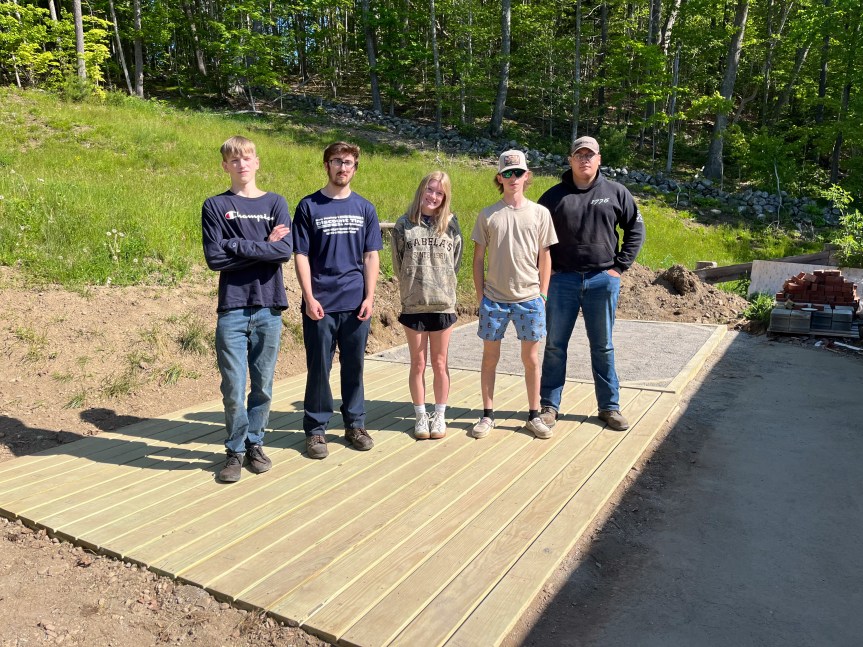
(The Lincoln Academy edLab students who built the greenhouse deck and foundation to support their outdoor learning space.)

The greenhouse will be a part of Lincoln Academy’s Maine Outdoor Learning Initiative program, LA Launch.

Lincoln Academy’s edLab students have been building a greenhouse to support the school’s new LA Launch Program. This free summer program, funded by the Maine Department of Education’s (DOE) Maine Outdoor Learning Initiative, will support rising 9th graders preparing to enter high school.

The Maine Outdoor Learning Initiative is a statewide effort to increase access to engaging, hands-on outdoor experiences and career exploration for middle and high school students throughout the state. The initiative, created by the Maine Department of Education, was born from a promise made during Governor Mills’ 2022 State of the State Address to provide children with more opportunities to get outside and engage with Maine’s natural beauty following the pandemic.

Students in edLab, Lincoln’s alternative education program, took the lead on the construction project with the help of edLab Director Jody Matta and their teachers. As part of the project, edLab teachers and students researched the town of Newcastle zoning process and received guidance from Town Planner Michael Martone. Students prepared and applied for the building permit. With assistance from the facilities department at Lincoln Academy, edLab students wrestled with the many rocks at the site and dug the foundation area. Along with the base for the Maine Garden Products greenhouse, they also built a deck to be used as an outdoor education space.

“It was a great opportunity for us to learn about the process involved in constructing a new building,” said edLab student Ariel Cowan. “It is information that we will be able to use in the future.”

“Our students worked hard on the greenhouse project, and I am proud of their work,” said Matta. “We look forward to utilizing the greenhouse as a learning space in the future.”

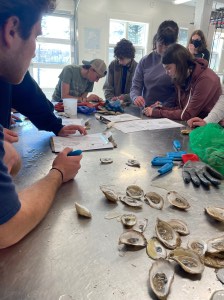
High school students sit at a metal table covered in oyster shells, paper, clipboards, pens and plastic gloves. Some students are inspecting the oysters while others write on their clipboards.
As part of the LA Launch program, students will learn about oyster aquaculture at the University of Maine’s Darling Marine Center.

The LA Launch program is designed to support students as they transition to high school and help them connect with Lincoln Academy while they learn more about their community and the importance of connection in a marine ecosystem.

“The greenhouse is a great resource that will allow LA Launch participants to explore and experiment, which will supplement our field trips to meet with community members and learn more about fishing, aquaculture, boatbuilding, and outdoor recreation,” said Lincoln Academy’s Director of Applied Learning Maya Crosby.

Crosby worked with Heather D’Ippolito, Lincoln Academy’s Director of Community Engagement and Development, to build the LA Launch program and apply for the Maine Outdoor Learning Initiative funding. Lincoln Academy was one of more than 60 organizations that received funding through the Maine DOE grant, thanks to an expansion of the program announced by the governor.

The Maine Outdoor Learning Initiative grant covers participants’ transportation and the school is providing lunch. Families interested in enrolling their rising ninth graders in LA Launch should reach out to the program director, Andrew Jonash, at jonash@lincolnacademy.org or visit the Summer at Lincoln Academy page.

Sign Up for the Free Summer Launch Program Here

Maine Garden Products will deliver the greenhouse in mid-July and place it on the prepared base. The project will be completed by the end of July, before the LA Launch program starts in August.

If you live outside the Lincoln Academy district or want an alternative summer program, check out the Maine Outdoor Learning Initiative’s search program table. Over a hundred free summer programs are happening all over the state!

The Maine Outdoor Learning Initiative was created with Federal Emergency Relief Funding and is a part of Maine’s Whole Student Pandemic Response. Please visit the Maine DOE Website to learn more about Whole Student Pandemic Response and the many other programs that make it up.

No Cost Educational Trip Leader Permit Training Available at Maine DOE Annual Summit

Does your school unit sponsor outdoor learning opportunities in one of the following categories? 

  • Overnight trips away from potable water 
  • Use of non-motorized watercraft on Maine’s waterways 

Answering yes to either statement indicates that your school unit requires a school employee or approved volunteer to hold an Educational Trip Leader (ETL) permit to lead outdoor educational trips. Per the Maine Department of Inland Fisheries and Wildlife, an educational institution conducting an outdoor educational trip that would normally require a registered Maine guide (trips overnight away from potable water and/or trips that occur on Maine’s waterways) shall provide for every 12 trip participants at least one educational trip leader who holds a valid educational trip leader permit and who is associated with the educational institution. If the person who is conducting the trip holds a valid Maine Guide’s license, then the educational trip leader permit is not required.

On August 6-8, during the 2024 Maine DOE Annual Summit, 18 educators in Maine have the opportunity to receive free Education Trip Leader (ETL) training. The course, Educational Trip Leader Permit and Wilderness First Aid (WFA), is being taught by Sarah Hubert, Registered Maine Guide, and Jeremy Hargreaves, owner of Northeast Whitewater. 

The Maine Department of Education (DOE) is partnering with Teens to Trails, Northeast Whitewater, and Camp Mechuwana to provide this hands-on training and certification. 

Registration for the course is a 3-day commitment, as participants will be immersed in integrating the curriculum and training over the three days. Participants will need to provide their own overnight camping and personal gear and can sleep in their own tent or in a lean-to on the shores of Camp Mechuwana on the nights of Tuesday, August 6th, and Wednesday, August 7th 

For more information about the Educational Trip Leader Permits, please visit the Maine Department of Inland Fisheries and Wildlife (ETL Permits) or call (207) 287-8000.  

For questions regarding the Educational Trip Leader Permit/Wilderness First Aid course for the 2024 Educator Summit, contact Dr. Carolyn Gross (carolyn.gross@maine.gov /207-441-9043). 

For general information about the 2024 Educator Summit, please visit the 2024 Maine DOE Annual Summit Event website. 

In 2021, Chapter 927: Guides, Youth Camp Trip Leaders and Education Trip Leaders guidance was established by the Maine Legislature and the Maine Department of Inland Fisheries and Wildlife. An Educational Trip Leader Permit is required for schools and postsecondary institutions in the state of Maine that sponsor trips on waterways and lack of potable water. Read more about this legislation at Chapter 927: Guides, Youth Camp Trip Leaders and Educational Trip Leaders. 

Bucksport Eighth Graders Unplug and Help Out During Camping Trip at Birch Point Beach State Park

(Bucksport eighth graders had the opportunity to watch the aurora borealis over the ocean.)

This May, eighth graders from Bucksport Middle School left the screens behind for a weekend of learning and service at Birch Point Beach State Park in Owls Head. Miles Bisher, Bucksport Middle School’s social studies teacher and outdoor club advisor, brought his students out as part of the Teens to Trails’ Life Happens Outside® Challenge, one of the Maine Outdoor Learning Initiative’s 2024 programs.

The Maine Outdoor Learning Initiative is a state-wide effort to increase access to engaging, hands-on outdoor experiences and career exploration for middle and high school students throughout the state. Since its creation in 2022, the program has brought thousands of students on outdoor adventures inspired by educators like Bisher.

“When I was in high school, my outing club advisor took our club on extended camping trips, and those experiences had a profound impact on my life by exposing me to new experiences outside with peers, in settings that would challenge me physically and mentally, and allow me to grow as a person and develop some resiliency and adaptability in the face of adversity. I wanted to offer a similar experience to my 8th graders,” explained Bisher. “Additionally, the prevalence of screen time and phone/social media usage for teens has skyrocketed, while teen time spent outside and synchronous, in-person time with friends has plummeted, and I wanted to show students the innumerable benefits of flipping those two trends.

Teens to Trails Program Manager Samantha Andrews accompanied the group from Bucksport on their trip. Teens to Trails is a nonprofit organization whose mission is “connecting Maine teens to life-changing experiences.” Their Life Happens Outside® Challenge is a weeklong competition for middle school communities. To compete in the challenge, students track every minute spent outside – whether on a dedicated trip like Bisher planned or doing everyday actions like walking the dog or taking out the trash. The challenge takes place May 10-17, and at the end of the week, the eight schools with the most outside minutes logged win $1,000 to apply to future outdoor activities.

“Teens to Trails hears from healthcare experts, parents, and teachers that teenagers feel better on the inside when they spend time outside,” said Executive Director Alicia Heyburn in a recent press release. “We heard so many amazing stories from students and faculty about the positive impact spending a week outdoors can have.”

Bucksport students were a testament to this effort: “I felt like I didn’t need my phone even after we left and felt better and more in the present,” said one student. It made me feel so much better. I felt more energized and like I had time to do things again,” said another. I had some of the best nights of sleep I’ve had in a long time.”

This is Teens to Trails’ first year working with the Maine Outdoor Learning Initiative, and the Challenge is just one of four free programs they are offering students. The initiative, created by the Maine Department of Education, was born from a promise made during Governor Mill’s 2022 State of the State Address to provide children with more opportunities to learn about and explore Maine’s natural beauty and resources after two years of the pandemic.

“Teens to Trails and Bucksport Middle School are grateful to Maine Outdoor Learning Initiative for supporting a student opportunity to enjoy a weekend of coastal camping. The experience also marked the first overnight trip for this great group of middle schoolers,” said Jennifer Hazard


During their trip, Bucksport Middle School students worked together to complete many important projects, such as cleaning up debris on Birch Point Beach State Park’s trails, replacing picnic tables, and burning branches off fallen trees. There were also opportunities for fun, such as exploring Owls Head Lighthouse and hiking Mt. Megunticook. Students were even lucky enough to watch the colors of the Northern Lights reflect over the water. Experts from the Maine Bureau of Parks & Land visited on Saturday evening to teach students about the solar system and constellations and allowed them to see the moon through a high-power telescope.

When asked about their favorite parts of the trip, students most noted their appreciation for being away from technology and, of course, the best part of any camping trip: s’mores.

“The air in the morning with the ocean a bit away and the smores and the energy that came along with it,” one student told Bisher about their favorite part of the trip.

Another noted, “It was probably one of the best camping experiences that someone could experience. I felt like I always had something fun going on, and it was nice talking to people I usually wouldn’t.”

Bucksport middle schoolers can identify the importance of engaging with nature. “Outdoor experiences like this are important for teenagers because they don’t realize how fun or relaxing it is to do these things until they actually do it,” explained one student, “we are constantly on our phones and so disconnected from the real world. Most kids don’t get to have that experience.”

Bisher agrees with the sentiment: “Outdoor education and experiences are not just important but absolutely critical for the holistic development of children and adolescents. Kids need to take risks, be challenged, face and overcome adversity, learn to be adaptable and flexible, disconnect from screens and the online world, and reconnect with the physical world of nature with their friends. Everything is more real and authentic outside, and students need that, now more than ever.”

There are still dozens of free Maine Outdoor Learning programs happening this summer. If you or a student you know is looking for a fun way to spend the summer outside, please visit our searchable program table by tapping or clicking here.

The Maine Outdoor Learning Initiative was created with Federal Emergency Relief Funding and is a part of Maine’s Whole Student Pandemic Response. Please visit the Maine DOE Website to learn more about Whole Student Pandemic Response and the many other programs that make it up.

No Cost ‘Envirothon KickStarter Kits’ Available to Maine Educators/Schools

Do you want to engage students in learning about Maine’s Natural Resources? Do you want to promote outdoor education? Do you want access to environmental science equipment? Do you want to provide students with more opportunities to master the Maine Science and Technology Learning Results Standards? The Envirothon KickStarter Program may be for you.

Through a collaboration between the Maine Association of Conservations Districts and the Spruce Mountain High School Envirothon Team, an Envirothon KickStarter Program is available to organizations that have not had teams compete in the last 2 years.

Available through a Diversity Grant from the U.S. Forest Service, the National Conservation Foundation, and the NCF Envirothon, the KickStarter Kits are intended to provide resources to help new advisors teach students content and skills related to preparing for an Envirothon Competition.

The Kits will include materials such as a Biltmore Log Scale Stick, Trees of Maine book, soil testing materials, water data sampling materials, and other supplies for environmental science. It is expected that organizations receiving Envirothon Starter kits will organize a team to compete in the 2024 or 2025 Envirothon and the kits will be available this spring through 2025 or until the funds are depleted.

Additionally, as part of the Envirothon KickStarter program, there will be online training for any advisors and students to help them learn about Envirothon, including newly formed and veteran teams. Teachers may receive contact hours towards recertification for participation.

For more information about Envirothon or the Envirothon KickStarter Program, you may email Spruce Mountain High School Envirothon Advisor Rob Taylor at rtaylor@rsu73.com.

More information on the Envirothon and how to register:

A Day on Fahi Pond Ice Fishing with Upper Kennebec Valley High School’s Wildlife Studies and Maine Woodsmen Classes

On February 9th, 2024 Mr. Atwood’s Wildlife Studies class and Mr. Davis’s Maine Woodsmen class ventured out to Fahi Pond in Embden, Maine for a day of ice fishing and outdoor skills practice.

Mr. Atwood’s class was tasked with the assignment of manually drilling half a dozen holes in the sixteen-inch ice to set traps for a chance to catch some local fish.  Everyone took turns dragging and/or carrying all the necessary equipment out onto the ice.  Hauled in by manufactured and makeshift sleds alike, a camp for the day was soon on its way.

While the Wildlife Studies students were learning how to bait their hooks and set traps from Mr. Atwood, the Maine Woodsmen class, with help from their teacher, Mr. Davis, were in full swing setting up their fifteen-foot, pop-up ice fishing shack and preparing their kitchen within.  The woodsmen students took turns cooking meals, cleaning, and serving everyone food and drinks. The morning started with a breakfast of chocolate chip pancakes, sausage, and locally harvested maple syrup with orange juice, milk, and hot chocolate.

When students weren’t busy tending to traps or providing creature comforts to their peers, everyone was able to relax and enjoy the calm sunny weather and one another’s company. Several students tried their hands at drilling holes for jigging both outside and inside the shack as well as making a comfortable campfire.  As everyone began to cool down, it was soon time for lunch, and once again, the woodmen students were busy in the kitchen. This time making a meal of grilled cheese sandwiches and tomato soup that really hit the spot.

Though only one flag flew and not a fish was caught, the day was a great success.

This story was submitted by MSAD 13. To submit a good news story to the Maine Department of Education, fill out this submission form.

A Celebration of Outdoor Learning

(A group photo of  the Celebration of Outdoor Learning attendees.)

The Maine Department of Education (DOE) joined Maine environmental education organizations at the State House’s Hall of Flags in celebration of outdoor learning and the release of the 2022 Census of Community-Based Outdoor and Environmental Learning. 

Olivia Griset, the Executive Director of the Maine Environmental Education Association (MEEA), helped organize the event with Teach Maine Outside, a collaborative project between MEEA, the Maine Math and science Alliance, and the Nature Based Education Consortium.

“The goal of the event is to really showcase the importance of environmental education and outdoor learning in Maine,” explained Griset. “We wanted to create a space to share our new amazing census report, where we study the field and try to understand what the needs of educators are, as well as just create a space to shout out all of the amazing statewide networks that exist, invite students and teachers to celebrate their hard work to get people learning outside.”

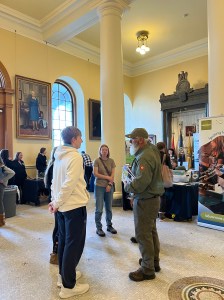
In a crowded room, a group of teenagers speak to two uniformed Maine Game Wardens.
Outdoor Education students connect with Maine Game Wardens at the Celebration of Outdoor Learning.

Students from throughout the state came to connect with their peers, explore the State House, and attend a panel of young professionals in environmental policy. At the panel, students discussed translating their love for nature into tangible actions for meaningful change through advocacy. Students also had an opportunity to share their outdoor education experiences.

Liam Lemire, a sixth grader from Lillian Parks Hussey School in Augusta, reflected on his experience learning about ecosystems at an after school snowshoeing program.

“We learn how one thing in the outdoors connects to everything else, and how if one thing goes away, it will change the whole outdoors,” he said.

After the panel, ten speakers shared their passion for outdoor education. Among the speakers were four Maine DOE representatives. First up from the DOE was Chief Innovation Officer Page Nichols, who expressed her pride in the Maine DOE and Mills Administration’s dedication to outdoor learning. Nichols informed attendees that “the Department of Education has invested nearly $20 million to support the expansion of nature-based programming and climate education. In 2022, with support from a number of other state agencies, we updated the 2011 environmental literacy plan to help advance environmental literacy for Maine students. The updated plan also positions the state to receive federal funding to further support this important work.”

Climate Education Specialist Teddy Lyman spoke after Nichols, thanking the crowd for their attendance, updating them on the success of the Climate Education Personal Development Grant, and announcing a new task force.

“This task force will spend the spring designing the future of climate education for the department over the next four years so we’ll have meetings both in person and virtually. And if you are a partner to education groups, if you are a teacher, if you are a school administrator, and if you are a youth, we would love to have you participate in this task force,” he said. You can click here to complete the taskforce form.

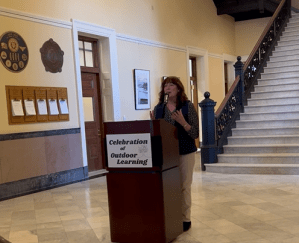
Commissioner Pender Mekin stands at a wooden podium with a white sign that says “Celebration of Outdoor Learning” in green. The Commissioner is speaking and holding her hands up in emphasis.
Maine Department of Education Commissioner Pender Makin speaking at the Celebration of Outdoor Learning.

Following Lyman, Brianne Lolar, a Panawahpskek citizen and the DOE Wabanaki Studies Team Leader, took center stage to illustrate the critical role Maine’s indigenous people play in climate education.

“Wabanaki traditional ways teach us to honor and strengthen our relationships with the environment as well as the people around us,” shared Lolar. “This is not easy work by any means, but together we will be stronger for our use across Wabanaki homelands.”

Lastly, Commissioner Makin used her time at the podium to emphasize the significance of encouraging young people to spend time outdoors.

“There is something qualitatively important about being in nature and just being outdoors. There are neurological impacts of 30 seconds of listening to the sound of birds or nature in general that are so critically needed by all kids,” said Makin.

Learn more about Maine’s Outdoor Learning Opportunities here.

Media Release: Maine DOE Awards $300,000 in Climate Education Professional Development Grants 

Grants Allow Maine Schools to Partner with Climate and Environmental Community Organizations to Strengthen Climate Education for Students 

The Maine Department of Education (DOE) awarded $300,000 in climate education professional development grants to support partnerships between 14 school administrative units (SAUs), schools, and community organizations to strengthen climate education opportunities for students across Maine.

Grant funding will allow educators to learn from experts and organizations that have created, sustained, and grown outdoor and environmental education opportunities and programs that are tailored to their local region’s assets and needs. Educators will be able to bring what they’ve learned back to their classrooms and schools to expand innovative and engaging climate education opportunities to more Maine students.

“These grants provide Maine educators and schools with the tools, resources, and partnerships they need to provide students with engaging, hands-on climate and environmental education. From the mountains to the coast, Maine has enormous natural resources for students to explore and learn from so they can be effective environmental stewards and leaders,” said Maine Education Commissioner Pender Makin. 

School Union 93, Central High School in Corinth, Fryeburg Academy, Greenville Consolidated School, Saco, Biddeford and Dayton Schools, RSU 12, and Vinalhaven and North Haven Schools all received grants in this first round of funding. They plan to engage in the following programming:

  • All five schools in School Union 93 will partner with Maine TREE and the Woodlawn Museum this spring on interdisciplinary climate education instruction, a district-wide climate education plan, and professional learning about Project Learning Tree for Pre-K through 8th grade students.

  • Central High School will partner with Hirundo Wildlife Refuge to run professional development programming on Pushaw Stream. Teachers will learn about forest ecology, macroinvertebrate sampling, as well as receiving Educational Trip Leaders and Wilderness First Aid certifications. These will all be combined to enable Central High School teachers to guide students on and around the Pushaw Stream waterways.

  • Fryeburg Academy will partner with a wide range of community-based organizations throughout the Western Maine Region and New Hampshire, with teachers working with partners individually and in small groups to design projects and curriculum for students in and out of the classroom.

  • Greenville Consolidated School will partner with the Rural Aspirations Project to create elementary and middle school place-based science maps, align their curriculum, and design middle school climate intensive units.

  • Saco, Biddeford, and Dayton Schools will collaborate with the Ecology School, with one cohort of teachers meeting virtually during the spring to cover climate change-specific content areas and align them with the curriculum and a teacher institute in June that will bring together teachers from all three schools to cover climate change content and design curriculum for the fall.

  • Sheepscot Valley RSU 12 educators will participate in a three-day professional development workshop with community partner Friends of Cobbossee Watershed. Educators will adapt and align existing watershed-specific curriculum with school standards and develop a rich foundation of region- and lake-specific environmental and climate content knowledge for use in the classroom.

  • Teaching Resilience: Professional Development for Climate Curricula is a program Vinalhaven and North Haven Schools have designed with community partner Hurricane Island Center for Science and Leadership. This program will build teacher capacity and curriculum for both schools to engage meaningfully with local community partners on student projects.

“Teachers of School Union 93 are excited to collaborate with community partners to develop and deliver a professional development program to educate teachers on climate change, its impact on the environment and surrounding peninsula, and how to instruct students to explore climate-related topics. This work will result in a Union-wide climate education plan that will serve as an everlasting resource for the schools on the peninsula,” said Dawn McLaughlin, Assistant Superintendent of School Union 93.  

“Maine (TREE) is ecstatic to work with School Union 93 to bring climate and forest-based education to schools on the Blue Hill Peninsula. This collaboration between the School Union, Maine TREE, and Woodlawn Museum will provide a long-lasting impact on the students in the region and provide a model for how to develop regionally designed climate education programming for students in rural parts of Maine,” said Logan Johnson, Executive Director of the Maine Timber Research & Environmental Education Foundation (Maine TREE).

“Although educational research shows that an interdisciplinary and project-based approach offers many advantages, especially when it comes to the study of global issues such as climate change, there are significant challenges to meaningful implementation in the classroom, coordination across the faculty, and engagement with the community. At Fryeburg Academy we immediately recognized the value of this grant for closing some of those gaps,” said Dylan Harry, Director of Outdoor Learning and Research Center at Fryeburg Academy. 

“Teaching students about the environment that they live in is vital. Part of that teaching comes in the form of climate education.  Climate changes greatly impact each and every one of us in one way or another. Having the opportunity for hands-on, experiential learning brings these issues to the forefront for students. I am excited to work with a team of local experts, both environmental and educational, on designing a curriculum that brings more awareness of Climate Change and its impact on our lakes, ponds, and rivers to the students,” said Jana Diket, Middle School Teacher at Windsor Middle School.

“The Friends of the Cobbossee Watershed is really pleased to be partnering with RSU 12 and the Maine State YMCA Camp on this Climate Education Professional Development.  With the challenges we are experiencing due to the effects of climate change, we are excited to bring together educators from across the region to form a network for ideas and best practices. Utilizing the watershed lands and waters as the classroom brings the power of experiential and hands-on teaching pedagogy into the hands of the teachers on the front lines,” said Tom Mullin, Executive Director of Friends of Cobbossee Watershed. 

“RSU 64 in Corinth is excited and grateful to have received funding to provide professional development to our staff through the Climate Change Grant offered by Maine DOE.  We will be holding training in Wilderness First Aid and for the certification as an Educational Trip Leader for up to 20 of our staff and from RSU 34 as well. This is a critical need for us because we have a very active outdoor community in our towns and we want to capitalize on those interests by opening the door to water-based activities for students,” said Dr. Rad Mayfield, Principal of Central High School.  

“The Climate Education Professional Development Partnership offers our schools an amazing opportunity for teacher collaboration and student learning.  Vinalhaven School, North Haven School, and the Hurricane Island Center for Science and Leadership will all work together, thanks to the financial support from the [Maine DOE] Office of Innovation. I look forward to seeing the project implementation in the coming months,” said Monte Selby, Superintendent of Vinalhaven School.

Maine continues to be a leader in outdoor learning and climate education. The Maine DOE’s Rethinking Responsive Education Ventures (RREV) initiative, funded through a $16.9 million federal grant, has supported the expansion of outdoor education classrooms, programs, professional learning, partnerships, and spaces across the state. Schools across Maine utilized federal relief funding to expand outdoor learning spaces and programs. Governor Mills’ Maine Outdoor Learning Initiative has provided thousands of Maine middle and high school students with coastal and inland forestry learning and career exploration opportunities during the summer. The Maine DOE recently hired a Climate Education Specialist to support and expand this work with educators, schools, and community partners across the state. You can learn more about the Maine DOE’s climate and outdoor education work here.

The grant initiative was designed out of LD 1902, which was passed by the Legislature in 2022 and signed by the Governor to establish a pilot program to encourage climate education in Maine public schools. Priority was given to communities historically underserved by climate education, socioeconomically disadvantaged communities, and interdisciplinary, place-based, and project-based learning activities. A second climate education RFA will be announced early in 2024.

Students Practice Real-world Science Through Salmon Spawning with State Biologists

The fishery on Mill Street in Raymond was swimming with hands-on science in late November as ecology and recently arrived immigrant students from Windham High School (WHS) helped Maine Inland Fisheries and Wildlife (IFW) scientists weigh, measure, and spawn Sebago Lake land-locked salmon from Panther Run.

The students assisted IFW field biologists express eggs from female salmon that were immediately fertilized by the male salmon. They helped to weigh, measure, and return the fish into the Sebago Lake watershed.

The aim of salmon spawning along the shores of Sebago Lake is to support Maine ecology and replenish healthy salmon numbers for fishing purposes. The late chilly November morning provided the students with an essential hands-on adventure, giving them a chance to see ecological purposes and science at work.

“When students graduate from WHS, we hope they are leaving with skills and practices of science that they can carry into any field they enter,” WHS science and ecology teacher, Lindsay Hanson said. “The experience highlighted the importance of asking good scientific questions, analyzing and interpreting data, and constructing explanations in science.”

Hanson continued, stating that students observed these skills being used in a real way. “We were able to listen to the IFW biologists discussing new trends they were seeing in this salmon population and posing new questions they would later investigate using the data they were gathering. Scientific curiosity at work.”

It was also a special treat for the new Maine students from Angola, The Democratic Republic of Congo, and France who all had a chance to connect their learning [of Maine] outside of the classroom setting.

“It provided the opportunity to see how academic language and the content and skills they learn in school are used professionally,” Elizabeth Moran, RSU14’s Teacher of English to Speakers of Other Languages (TESOL) said.

Moran also said that her students were excited to hold the fish, strip the salmon for fertilization, and help collect data.

“They enjoyed being a part of the actual process of helping to produce the next generation of salmon in Maine,” she said. “This kind of work is authentic and contagious, and it inspires students to learn in a creative and fun way.”

The spawning of salmon from Sebago Lake has been happening for many years and occurs every fall in conjunction with the fish’s natural cycle to swim upstream. In this case Panther Pond from Sebago Lake.

“During the second week of November, we open up the dam on Panther Pond to draw the fish up the river from Sebago Lake,” Stephen Twemblay, IFW Fish Culturalist supervisor said. “Since they can’t get through the dam, the salmon swim up a fish ladder into the fish hatchery. We then separate the male and female fish. Both are differentiated by fin clip class [fins clipped in different areas depending upon the year, denoting the age of salmon]. We do this so we always know how old that fish is to provide the best genetic variable.”

After the eggs are spawned and counted, they are transported to the fish hatchery in Casco where they are incubated through the winter. In the spring, most of the salmon are returned to Sebago Lake to keep up with the demand for fishing. The rest of the eggs are sent to other hatcheries around the State and to other State agencies in the U.S.and Canada as needed.

This real-world experience showed students the various ways science plays a role in our lives.

“I always tell my students that loving science doesn’t mean you need to be a scientist,” Hanson said. “There are environmental lawyers, policymakers, and computer engineers working in science-based companies, etc. Pairing an interest in science with a focus on another sector can be an avenue to explore. It is difficult for students to see how science incorporates into real-life situations or see what careers related to science might look like. Most scientists don’t wear lab coats and it was great to see that scientists also wear Muck boots and go fish.”

This story was provided by Lorraine Glowczak, Director of Community Connections & Storytelling Ambassador for RSU 14. To submit a story or an idea, email Rachel Paling at rachel.paling@maine.gov.

Upper Kennebec Valley High School Students Test Their Outdoor Skills in the Woods

In an effort to introduce students to a more hands-on outdoor learning experience at Upper Kennebec Valley High School, Mr. Davis’s Maine Woodsmen course and Mr. Atwood’s Wildlife Studies course collaborated in spending an entire day in the woods dedicated to exploring skills not otherwise practiced in a classroom.

The Wildlife Studies class was tasked with the assignment of venturing into the Davis Land Trust to collect cameras and document the wildlife activity therein.

The job of the Maine Woodsmen class was to provide the comforts of a warm fire, good food, and comfortable accommodations upon Mr. Atwood’s class arrival.

Students enjoyed hot cocoa, bacon, eggs, and English muffins, for breakfast and chicken quesadillas for lunch.

This story was provided by Upper Kennebec Valley High School, MSAD 13/RSU 83. To send good news stories and ideas to the Maine Department of Education visit our submission form.

Apply Today for the 2024 Maine Outdoor Learning Initiative. Applications Due By January 12

Apply Now! Schools and community-based organizations can now apply for the 2024 Maine Outdoor Learning Initiative grants through the Maine Department of Education (DOE). These grants support hands-on, engaging, interdisciplinary outdoor learning and career exploration opportunities that connect students with Maine’s amazing natural environments and landscapes.

Created by Governor Mills, the Maine Outdoor Learning Initiative has included thousands of students throughout the state in its Coastal Ecology and Inland Forestry Programs over the last two years. Read about past programs here: Maine Outdoor Learning Initiative: Past Programs | Department of Education.

The Maine DOE is excited to build on these successes to reach more students in this expanded program. The 2024 Maine Outdoor Learning Initiative Request for Applications (RFA, also known as grants) is available here: Grant RFPs and RFAs | Division of Procurement Services (maine.gov).  See RFA 202311223. 

Schools, private and nonprofit organizations, municipal Parks and Recreation Departments that are current members of the Maine Recreation and Park Association, and public libraries can apply.  In this sense, “schools” include school administrative Units (SAUs), Career and Technical Education (CTE) Centers or Regions, Education in Unorganized Territories (EUTs), charter schools, and approved private schools located in Maine.  See the RFA for explicit information and definitions on eligibility and allowable uses of funding. 

Grant awards will range from $25,000 to $999,999 with a total of $2,000,000 available. The 2024 Maine Outdoor Learning Initiative grant requires a marketing and outreach plan for reaching students from disadvantaged backgrounds as well as an emphasis on Maine DOE’s Whole Student Framework 

This funding can potentially be used to facilitate outdoor learning programs before, during, or after school; on weekends; during school breaks and/or over the summer. Applications will also be considered for schools and organizations who wish to use the funding to enhance or expand existing outdoor programming. Grants are expected to be awarded in the early spring. All programing must be completed by September 1, 2024. 

This 2024 Maine Outdoor Learning Initiative opportunity is funded in its entirety by the American Rescue Plan Elementary and Secondary School Emergency Relief (ARP ESSER) fund. Learn more about the Maine Outdoor Learning Initiative