Reminder: BARR Information Sessions Wednesday and Thursday

Join the Maine DOE to learn more about a funding opportunity for Maine schools to become BARR (Building Assets, Reducing Risks) schools. 

Using American Rescue Plan, state reservation funds, the Maine Department of Education (DOE) will cover all costs of implementing the program for schools new to BARR, and all costs of continued implementation support to existing BARR schools. Additionally, the DOE will provide travel reimbursement and educator stipends associated with participation in the program.  Applications are due by May 26, 2023. Click here to apply.

Sign up for an informational session on: 

Wednesday, May 17, 2023 | 4:00 ET | REGISTER 

or  

Thursday, May 18, 2023 | 4:00 ET | REGISTER 

Join Beth Lambert, Acting Chief Innovation Officer and Director of Innovative Teaching and Learning at the Maine DOE to learn more about this opportunity to implement the BARR system in your school(s). We’ll also be joined by Rob Metz and Jennifer Fox from the BARR Center who will provide an overview of BARR and other Maine educators who are excited to share their experiences and the impact it has had on their schools: 

  • Jennifer Mull-Brooks, Principal, Congin Elementary School 
  • Greg Henderson, School Counselor and BARR Coordinator, Mt. Blue High School 
  • Shelly Lajoie, Counselor and BARR Coordinator, Noble High School 
  • Josh Tripp, Principal, Bucksport High School 

You can also read more about the BARR program here.

BARR was developed over 20 years ago by a high school counselor who felt ineffective because more than 40 percent of her 9th grade students were failing at least one core course and were at risk for not graduating on time. She learned from her school’s principal that this was not just her high school’s problem, but it reflected a troubling national trend. Using strategies from the fields of business and medicine, Executive Director Angela Jerabek created the BARR model and implemented it in the fall of 1998. By spring 1999, 9th grade student failure rate had decreased from 44% the previous year to 20%. Teachers worked together and knew each student – not just from an academic perspective, but from a personal perspective – their interests, strengths, hopes, and dreams. 

Careful implementation and evaluation continued for over 20 years, all with the same findings – students passed more classes, pursued more advanced courses, and graduated on time. The focus of BARR is not just for some students, but all students. Teachers reported increased collaboration, satisfaction, and their ability to use data effectively. School culture and climate was improved. Today, BARR operates in over 250 schools throughout the nation and works in all grade levels, K-12, including in dozens of schools here in Maine.   

“There is no question that BARR has had a positive impact on the students and staff at Sacopee Valley Middle School. We are intervening with students earlier, our meetings are more efficient, and most importantly, our relationships are stronger. Honestly, I couldn’t imagine our school without BARR. It is not a flavor of the month intervention — it is now part of our fabric and is here to stay,” said Amy Vacchiano, counselor and BARR Coordinator at Sacopee Valley Middle School. 

The BARR system uses eight interlocking strategies that build intentional relationships (staff to staff, staff to student, and student to student) and utilizes real-time data to enable schools to achieve concrete academic, social, and emotional outcomes for each and every student. To learn more about BARR visit: https://barrcenter.org/about-barr/barr-model/. 

To be eligible, a school must meet one of the following: 

Learn more about BARR at http://www.barrcenter.org. 
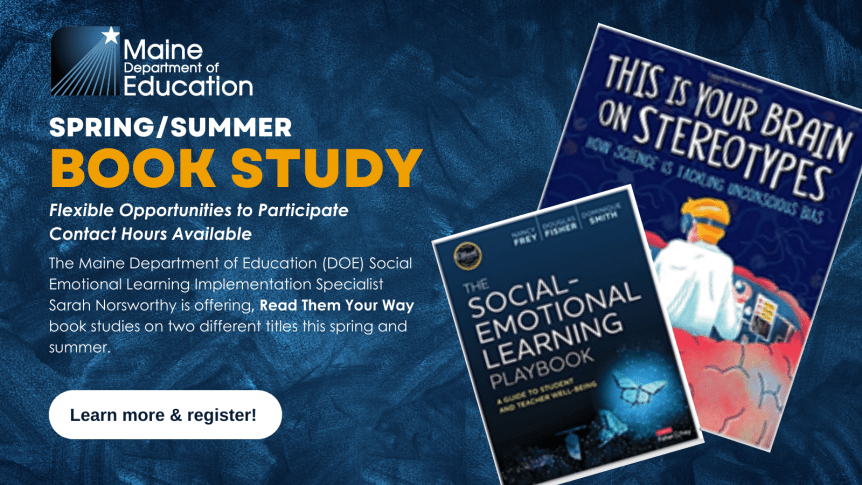
Spring/Summer Book Study Opportunities: ‘Social Emotional Playbook,’ and ‘This Is Your Brain On Stereotypes’

The Maine Department of Education (DOE) Social Emotional Learning Implementation Specialist, Sarah Norsworthy is offering, Read Them Your Way book studies on two different titles this spring and summer.

  • The Social Emotional Playbook, written by Douglas Fisher, Nancy Frey and Dominque Smith is described by publisher Corwin as an “interactive playbook (which) provides the language, moves and evidence-based advice you need to nurture social and emotional learning in yourself, your students and your school.”  The book is divided into six modules.  This text is designed for educators.
  • This Is Your Brain On Stereotypes written by Tanya Lloyd Kyi and illustrated by Drew Shannon is described by publisher Kids Can Press as being, “an essential overview of the science behind stereotypes, from why our brains form them to how recognizing them can help us be less biased…This timely and hopeful book addresses the issues of discrimination, racism, sexism, ableism, and homophobia and offers concrete suggestions on how to make change.  It uses scientific inquiry and loads of relatable and interesting examples to explore these uncomfortable topics in age-appropriate ways.  Chapters, sidebars, and colorful illustrations break the text into manageable chunks.  Besides the many ways this book could be used to inspire frank and in-depth discussions on the importance of addressing stereotypes and bias, it also links to many science and social studies curriculum topics.  Backmatter includes an extensive list of sources, suggestions for further reading and an index.”  This text is designed for educators and is recommended for students 11 and up.

Read Them Your Way

  1. Choose to organize a professional community read. Maine DOE facilitation of a live, interactive, inquiry based discussion is available. Discussions of The Social Emotional Learning Playbook would be facilitated over six weeks, one week per module. Discussions of This Is Your Brain On Stereotypes would be facilitated over one session.
  2. Read individually, at your own pace, and post your thinking on a shared jamboard with other education professionals across Maine. Comment on the thoughts of others w/ MDOE moderation.
  3. Read on your own and join in a live discussion.
    • One session LIVE, interactive, inquiry based discussions of The Social Emotional Learning Playbook will be hosted by the MDOE at 4pm on 6/1, 6/29, 7/20 & 8/17. Register here. Breakout groups will be by module, as engagement allows.
    • One session LIVE, interactive, inquiry based discussions of This Is Your Brain On Stereotypes will occur at 4pm on 5/31, 6/28, 7/19 and 8/16. Register here. Breakout groups will be used depending on engagement.

Contact hours are available for all opportunities.

Questions?  Please contact Sarah Norsworthy, SEL Implementation Specialist at sarah.norsworthy@maine.gov

Media Release: Maine Department of Education Awards $900,000 in RREV Funding to Support Education Innovation

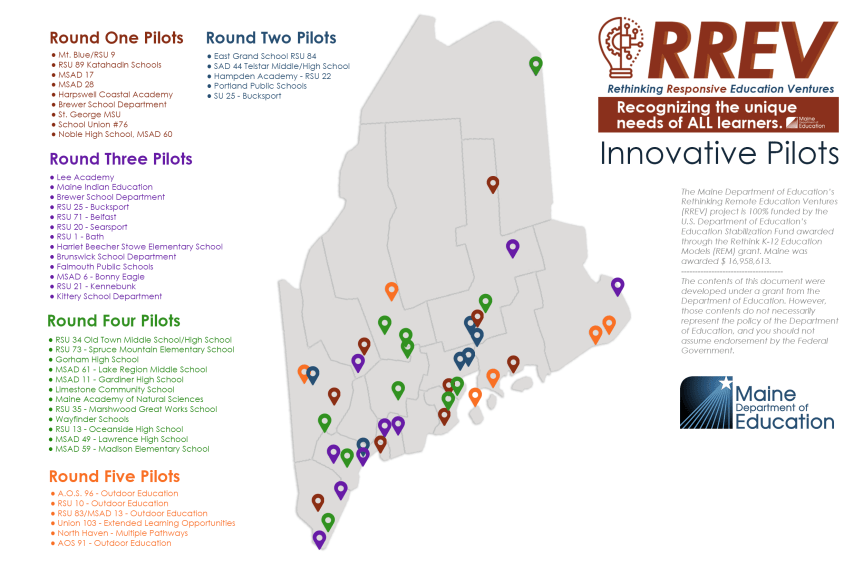
The Maine Department of Education (DOE) today awarded an additional $900,000 in Rethinking Responsive Education Ventures (RREV) funding to support education innovation at Rose M Gaffney Elementary School in Machias, Upper Kennebec Valley Jr/Sr High School, North Haven Community School, RSU 10 schools, Union 103 schools, and Trenton Elementary School. These federal funds will be used to invest in strategies to engage students through outdoor learning, extended learning opportunities, and creating multiple education pathways.

RREV investments now total $8.5 million to 45 awardees. The Maine DOE was awarded $16.9 million from the U.S. Department of Education’s Rethink K-12 Education Models Funding. As one of 11 States to receive funding, Maine created RREV to support the work of visionary educators to develop innovative pilot programs around remote and outside of the classroom learning, including professional development and pilot design classes. Courses in innovative design process are available through several of Maine’s public and private universities at no cost to Maine educators who wish to participate. In addition to the innovative pilot development classes, the Department is also offering asynchronous, innovative principles webinars which are available to all educators in self-paced, independent modules.

“We are going to be creating kits that teachers can grab and go and take to their outdoor learning space. The kits provide engaging activities to supplement classroom learning. Our goal is to increase the amount of outdoor learning happening at school so that we will see happier kids, kids who are more focused and engaged, and kids who appreciate and respect the environment around us. We’re eager to build a large collection of kits that will be fun and engaging,” said Rose M Gaffney Elementary School 5th Grade Teacher Kelly Woodward.

“Caring for honeybees has the potential to deepen our students’ connection with nature and drive their passion for making positive changes for their future and the future of our planet. It also has the potential to build a unique partnership with the community that will help build engagement. We believe that this pilot program, using an apiary and partnering with the Western Maine Beekeepers Association, will have a positive impact on attendance, engagement, and wellbeing for our 4th and 5th graders,” said RSU 10 teacher Maggie Corlett.

“We are using our RREV pilot to step up our programming on outdoor education, wildlife studies, and agricultural studies. We will use these funds to heat our greenhouse so that our egg studies can continue in the greenhouse year-round, we’re establishing a property use agreement with a local nonprofit ski mountain so that our outdoor studies class will have access to a satellite campus and 50 acres of wilderness to explore, and we will purchase boats and equipment for our wildlife studies program,” said Upper Kennebec Valley Jr/Sr High School Principal James Tyler.

“Our purpose was to spark innovation with our students and provide engaging and inspirational opportunities where they can take ownership of their learning. We built off a lot of programs we already have going and wanted to make them even more engaging and available to all of our students. Students will get to see a new greenhouse where they can watch their projects literally grow from seed to product and be able to work them into recipes in a kitchen and sell to their own community members. We will also have a trail built around the school where students can create products and have opportunities for community members to come and participate as part of the school,” said Jonesport-Beals High School Co-Teacher Leader & English Teacher Becky Coffin.

“We have a makerspace building on our school’s campus and we want to transform that into a lifelong learning hub for our k-12 students to use during the day and bring in adults from our community for classes at night. We have an hour and fifteen-minute ferry ride to get here so we have to do a lot for ourselves. We have to train and uplift from within at the grassroots level. Our RREV grant is going to support this lifelong learning hub to work with our town administration to diversify our workforce and help prepare young people and adults for the different kinds of work and professions that we need,” said North Haven Community School Principal Shaun Johnson.

“We named our initiative TREE—Trenton Rethinking Experiential Education—and it’s a k-8 initiative to get our kids outside learning in the community, not just on our school property. We want to think about how all of our students get their needs met want to increase independence, peer relationships, self-awareness, and kids overall mental health,” said Trenton Elementary School teacher Snow Ross.

Schools will use this funding in a variety of innovative ways, including:

  • Rose M Gaffney Elementary School in Machias will create and implement pre-k through 8th grade outdoor education lessons. These lessons will provide learners with the opportunity to use the trail system behind the school and materials to continue their classroom learning in an outdoor setting. The school’s team observed that academic work in an outdoor setting helped learners to be more engaged, happy and focused. By increasing the amount of outdoor learning, students will be supported in their social and emotional growth. RREV funding will be used to create kits with engaging activities for educators to use in an outdoor learning environment and the school will work alongside community partners such as Downeast Coastal Conservancy to implement the lessons.
  • Upper Kennebec Valley Jr/Sr High School will grow their innovative outdoor-based education program to increase student engagement and better prepare students for their lives after high school. By participating in the program, students will develop and exercise a host of skills including problem solving, critical thinking, creativity, communication, collaboration, marketing, salesmanship, and financial management. Valley Outdoors will partner with Baker Mountain, a community non-profit, to ensure all students in grades 5-12 have access to nature-based learning opportunities. Under the guidance of teaching staff, students will be able to use the base lodge and over 50 acres of trails and wooded land at Baker Mountain to engage in project-based learning activities. In addition, the school will scale up current greenhouse operations, expand hands-on project offerings, and develop water exploration and research activities for our wildlife studies program. The SAU anticipates 100% of the student body will be able to engage in at least one integrated unit of study.
  • North Haven Community School will partner with their town administration to support their efforts of economic diversification and workforce development, chiefly in response to the impending impacts of climate change and sea level rise on the long-term viability of the fishing and lobstering industry. In coordination with the community, North Haven Community School will develop programming to support lifelong learning outcomes for both K-12 and adult learners, housed in their auxiliary classroom space dubbed the “Projects Building.”
  • RSU 10 will pilot a program to support students struggling with adverse childhood experiences. The work will provide strategies to enhance engagement, improve attendance, foster resilience skills, and promote positive behaviors. Meroby Elementary and Mountain Valley Middle School will team up to develop and expand The MV Bee Academy in the RSU#10 School District. A bee apiary and storage facility will be built to provide the infrastructure needed for beekeeping experiences. 4th and 5th-grade students will work closely with a local bee club. As their knowledge base grows, these children will mentor other grade levels and share their knowledge with community members. To maintain the sustainability of this program, students will develop a small business. In it, they will sell queen bees, honey, wax products, and other bee-related items.
  • Union 103 schools will support creative opportunities and innovative practices for students and teachers at all of their schools. All students and staff will have access to a new greenhouse which will foster creativity and learning through aquaponics and aquaculture. With an outdoor lab, students will also take part in a space dedicated to learning in ways not yet offered inside the four walls of a classroom, such as a native pollinator garden, raised beds, and fruit trees. A new learning lab with access to a multipurpose classroom will provide a much-needed creative and innovative space for students. This space will provide students and teachers with flexibility to help spark creativity and experiential learning as they continue to foster initiatives throughout the year with involvement in marine science activities with Downeast Institute and author visits each year. All students will also have the opportunity to explore a new walking path and outdoor learning trail around Beals Elementary School.
  • Trenton Elementary School’s TREE-Trenton’s Rethinking Experiential Education is a K-8 initiative that embeds outdoor learning into a child’s school experience that increases independence, peer relationships, self-awareness, and overall mental health. The school will integrate therapeutic services, STEM based learning, and outdoor collaborative experiential learning into the student experiences. They will use field work and place-based learning in the living world in each child’s school day. Students will participate in engaging, outdoor experiences that will help them to build social connections and increase their self-esteem while reconnecting with our natural world. The aim is to increase student attendance, engagement, and self-regulatory skills.

The RREV initiative was also granted a no-cost-extension year, meaning that all 45 pilots will have an extra year to utilize their available funding for their innovative pilots.

For more information on RREV and the pilots, visit https://www.maine.gov/doe/rrev. 

Interviews are available with RREV grant recipients upon request as well as the recording of the announcement featuring RREV grant recipients discussing their projects. 

Family Engagement Grant Opportunity Information Sessions

Through the Centers for Engaging Families across Maine (CEFAM), ParentPowered will be offering an informational session about their evidence-based family engagement messaging curriculum titled Ready4K.  In partnership with the Maine Department of Education’s (DOE) Climate, Culture, and Resilience Team, this five-year grant is slated to provide a limited number of schools the opportunity to implement Ready4K.   

ParentPowered delivers an evidence-based family engagement curriculum that is delivered directly to families via text message, serving families from birth through middle school (8th grade) with trauma-sensitive tips and activities that are leveled for the child’s age and stage of development.  

The curriculum is aligned with the Maine Learning Results and leverages the unique parent-child relationship – making sure that the skills are always oriented around parents’ strengths – to help children thrive in all areas of life- academically, socially, emotionally (and so much more!). 

There is also an additional support stream that links families with critical local resources and supports to help ensure they have housing, food assistance, healthcare care and other essentials. 

Links to the webinars can be found below. School administrative units (SAUs) only need to attend one session in order to apply for the opportunity for selection. After the webinar, Family Engagement/Cultural Responsibility Specialist, Melanie Junkins, will provide a link for the application. 

March 30, 2023 10:30am 

Or 

March 30, 2023 3pm 

Contact for information: Melanie Junkins (melanie.junkins@maine.gov)

Happy International SEL Day – All day workshops available!

March 10, 2023 is International SEL (social emotional learning) Day! Maine educators and school staff support students each day to meet their goals for a successful future.

Watch this video on how Maine educators, school staff, and community members are building connections with students and each other.

Developing and practicing healthy Social and Emotional Teaching and Learning has been researched to show benefits in:

  • Teaching and Learning Academic Content
  • Protecting Mental Health
  • Fostering a Sense of Belonging
  • Growing Curiosity
  • Deepening Collaborative and Individual Problem-Solving Skills
  • Strengthening Our Knowledge Of Ourselves And Others

As a reminder here are resources for educators on SEL4ME. SEL4US offers free registration (link below) for a full day of professional development and additional SEL offerings.


Resources for Celebrating SEL International Day on March 10th

Maine educators and school staff dedicate their lives towards the betterment of youth, equipping each child, Pre-K through 12th grade, with the necessary tools and supporting students each day to meet their goals for a successful future.

March 10, 2023 is International SEL (social emotional learning) Day. Developing and practicing healthy Social and Emotional Teaching and Learning has been researched to show benefits in:

  • Teaching and Learning Academic Content
  • Protecting Mental Health
  • Fostering a Sense of Belonging
  • Growing Curiosity
  • Deepening Collaborative and Individual Problem-Solving Skills
  • Strengthening Our Knowledge Of Ourselves And Others

The Maine Department of Education has resources for educators on SEL4ME. SEL4US offers free registration (link below) for a full day of professional development and additional SEL offerings.


Winter/Spring Social Emotional Learning Implementation Office Hours and Professional Learning Opportunities

Please join Maine Department of Education (DOE) Social Emotional Learning (SEL) Specialist Sarah Norsworthy for the following SEL Implementation Professional Learning Opportunities being offered this winter and spring. Professional learning about SEL Implementation will occur in 4 strands, read & discuss, thinking routines, picture books and EdTech.

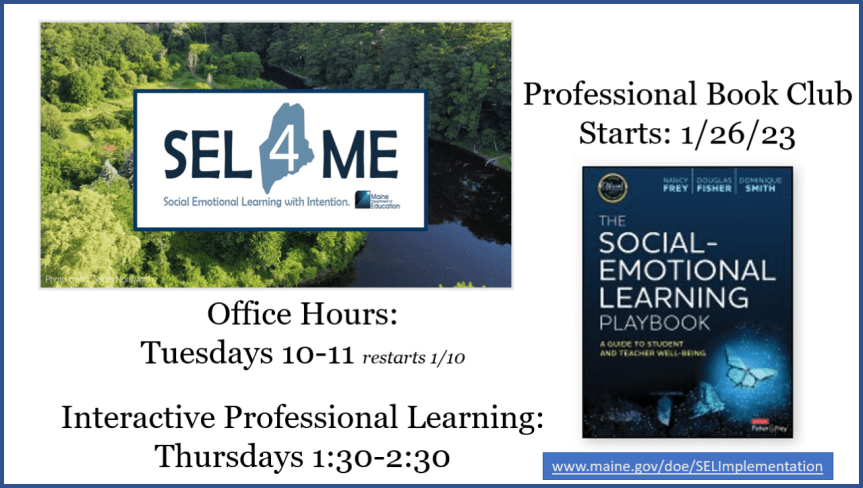
  • Weekly Open Office Hours: Tuesdays from 10:00-11:00 AM – Drop in with questions, comments, or for connection. Offered virtually – Pre-Register here Via Zoom Link
  • Weekly Interactive Professional Learning Opportunities: Thursdays from 1:30 – 2:30 PM – Offered Virtually – Pre-Register here Via Zoom Link. Each session will start with 20 minutes of focused learning followed by a conversation on classroom application. More info is available on the SEL Implementation Webpage. Upcoming sessions include:
    • 1/5/23 – Using Pear Deck To Build Belonging/Social Awareness
    • 1/12/23 – Picture Book Spotlight: Learning About Ourselves & Others. My Name Is An Address – A pronunciation guide is linked here. We will explore this book and talk about extending it within classrooms. Bring a copy – if you can.
    • 1/19/23 – Thinking Routine Spotlight: Developing Belonging, Social Awareness & Curiosity
    • 1/26/23 – Book Group: The Social Emotional Learning Playbook Module 1. Join ready to discuss module 1. Educators are encouraged to join with colleagues to continue the conversation within your schools.

Join the SEL Listserv for regular updates, and bookmark the SEL Implementation Webpage – resources and information are being regularly added.

For more information contact Sarah CB Norsworthy, Maine DOE SEL Implementation Specialist at sarah.norsworthy@maine.gov.

Student Mental Health Support Modules

The Maine Department of Education’s SEL4ME platform is now hosting over 100 free, PK-12th grade modules focused specifically on supporting student mental health and wellness. While schools and districts are faced with significant educational and developmental priorities for many children and students associated with the pandemic, there is a need for balanced programming that supports learning, while also supporting their social, emotional, and behavioral adjustment.

The following resources can be incorporated into existing Social Emotional Learning, School Counseling and Health programs as well as part of an overall MTSS approach, and are accessed through a free registration of the SEL4ME platform.

Mental Health Modules: https://www.maine.gov/doe/mentalhealthmodules

More information on SEL4ME and login: https://www.maine.gov/doe/sel/sel4me

For more information, reach out to Bear Shea, Maine DOE Mental Health / School Counselor Specialist at w.bear.shea@maine.gov.

Orono Middle School Teachers use Federal Funding for Summer Program Focused on Social Emotional Student Needs

A new summer program was created at Orono Middle School that focuses more on the social emotional needs of our students while integrating academics into fun and engaging opportunities for learning. The program was open free of charge to any student that wished to participate. The program had a profound impact on students and teachers alike modeling, establishing, and strengthening relationships, and setting foundations for the critical learning that awaits as we start a new school year. 

The program began during the summer of 2021. Orono Middle School teachers and staff developed and coordinated a unique summer program at Orono Middle School. That year, COVID funding definitely played a key role in launching the program which included the purchase of materials for a wide variety of activities, as well as the creation of a new school-community garden. The program allowed students to select from a variety of activities offered each day in a heterogeneous group format and each day, students were given a healthy bagged lunch free of charge.

Due to the success of the program and remaining funds, we were fortunate to keep the same program this summer. Though we had minimal funding for supplies, we were able to use supplies from last summer and/or supplies from our classroom. With one year under our belts, this summer proved to be even more successful with nearly 30 participants each week! We know that funding for summer programs is typically allocated to students with identified needs in their IEP, however, this program was developed to have an impact on ALL–and that impact was significant! The program met the social, emotional, mental, and physical needs of the students as well as applying academic skills and helped to support many students to become more confident and prepared for the academic school year.

The Program was flexible allowing students to attend when it best fit their schedule. Many students attended every day; some made it for 2 weeks and, for others, just a few days. Regardless of when they attended, joining was seamless and students were able to be with different peers in activities they chose to explore. Organizers also made the program Intentional with Purposeful Learning Experiences. The activities were organized and well planned to provide a positive learning experience for each student. The daily choices (3-5 per 3 separate sessions) were organized to include a wide array of activities and skill level entry points to make the experience equitable for all students.

Activities offered during the 5-week program included:  fishing, nature walks and hikes, cooperative games, cooking, gardening, 3-D printing, tabletop games, weight lifting, design + make buttons, hike in Bangor City Forest, coding, art projects, engineering challenges, construct + paint bird houses, dissect owl pellet, theater games/activities/performances. pressed flower projects, design + make comics, reading + discussing comics, intramurals, volunteering at The Bangor Humane Society, and design + paint stepping stone for school garden.

Parents were very grateful for the program’s flexibility, structure and daily activity options. Here are some of their comments:

He seems to look forward to going to school in summer, which is not his usual attitude about it! Thank you for your planning and working with these kids, I think this enrichment is excellent.” 

Student” had a really good time.  So good, in fact, that we’re talking about shifting our plans around this summer to try to get her more time there, although we haven’t figured out how possible that is yet.  But regardless, I hope it speaks highly of what an excellent experience you all crafted there this past week!” (She was able to make it back for the last 1.5 weeks). 

The main benefit for my child was to meet some of the teachers and students in the Orono school system. She is transferring from Old Town this fall. I think she enjoyed the art and cooking activities the most. The biggest benefit was to build her confidence going into the upcoming school year.”

“As a result of strengthening her friendships with her peers at the summer program, she gained the self-confidence to walk around town by herself and with her friends.”

“She got to do lots of fun activities  while getting her reading instruction” 

“I can’t say enough good things about this experience for my daughter.  She is excited and confident about attending middle school now.  She found a new activity that she is excited about (weightlifting!) . . .This is probably the most positive and important experience that we’ve ever participated in at RSU 26.  I can’t stress enough how much we loved this program.  She actually skipped a week at a basketball camp that we had already paid for to attend this, and I decided that was okay because she was having such a great experience!”

Middle school students are striving for independence and they want to have a say in what they do. They thrive in a place where they feel they belong and have a purpose. The grade-level lines are blurred in the summer program. They are just kids who have similar interests and/or who are eager to try new things. Groups are almost always multi-grade. The sessions were designed to foster independence with students completing their own weekly schedule and becoming strong self-advocates when they needed help. Students gained confidence by taking risks and trying new activities. They broke away from their typical peers having the confidence and feeling safe to try new things on their own. Students applied problem-solving skills in each session whether it was adjusting a recipe or figuring out an engineering challenge. Students worked with each other to build structures, complete physical tasks, prepare original productions, and collaborative problem-solving. One thing’s for sure, “summer school” at Orono Middle School definitely doesn’t mean what it used to!

Special thanks to Jessica Archer (science teacher) who was the program coordinator and to the teachers leading the various activities including Deb White (social studies teacher) Julie Anthony (art) Chris Gray (science and social studies) Tracy Deschaine (math) and education technicians Rob Saintard and Teena Thibodeau. Thank you for all you do!

SpiritSeries Maine ARP Grant Opportunity to Support Academic and Social Emotional Learning Loss

We are excited to kick off the Maine Department of Education – SPIRIT SERIES partnership with SpiritCorps, their three week, project-based, writing and self-discovery program designed for students from 7th to 10th grade.

“I’ve been having wonderful conversations with teachers and administrators around the state about SpiritCorps and its power to support, engage and inspire students while bringing joy back to teaching. It is a great vehicle to help address both academic and social-emotional learning loss and build 21st century skills, such as critical thinking, creativity and collaboration.” – Christina O’Neal, Director of Program Partnerships for SPIRIT SERIES

The personal stories of Courage, Conscience and Compassion that students craft, record on video and share with their classmates can be a profound experience, building confidence, strengthening connection and fostering community. Our 2022-23 calendar is filling up fast, but plenty of slots remain available. Participating schools are given a 100% scholarship in the first year, thanks to DOE partnership and a federally funded DOE grant. SPIRIT SERIES has successfully delivered programming in Maine since 2014, serving over 6,000 students in more than 20 partner schools. We now look forward to bringing our interdisciplinary storytelling program to schools across the state. “I would absolutely recommend Spiritcorps to any educator. It was easy to use. It was fun for the students. It was great! I think that the process is so well organized…It was so easy from an educator’s perspective to integrate this curriculum into my classroom and have it feel organic.” – Scott Arritt, Gr. 7/8, Durham Community School

To learn more about the program, take a look at this short video Introduction to SpiritCorps. For further information and/or to schedule an engagement at your school, make an appointment with us on our calendar (scroll below video) or email Christina directly at coneal@spiritseries.org.