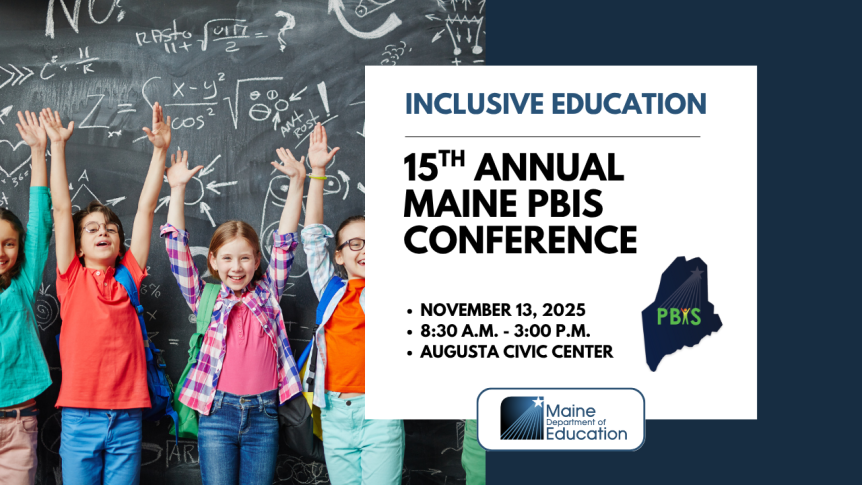
The Maine Department of Education (DOE) and the Maine Positive Behavioral Intervention and Supports (PBIS) State Team are excited to announce that registration is now open for the 15th Annual Maine PBIS Conference, which will take place on Thursday, November 13, 2025, from 8:30 a.m. to 4 p.m. at the Augusta Civic Center. Early-bird pricing is available through October 15, 2025.
This annual event brings together educators, school and district leaders, and student support professionals from across Maine to celebrate their progress and deepen their practice in building positive, equitable school climates where every student can thrive.
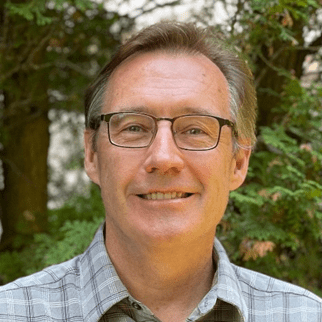
This year’s conference will feature a keynote address from Dr. Steve Goodman, a nationally recognized leader in schoolwide systems of support. Dr. Goodman’s keynote is titled, “Better Together: Integrating Academics and Behavior Support in MTSS.”
Dr. Goodman is a research specialist at the University of Connecticut, a partner with the Center on PBIS, and a co-investigator with the Integrated Multi-Tiered Systems of Support (MTSS) Research Network. He previously served as director of Michigan’s MTSS Technical Assistance Center and currently serves on state, national, and international advisory boards for the implementation of MTSS.
With more than 65 publications and extensive experience working with educators across the nation and in ten other countries, Dr. Goodman will bring powerful insights into how schools can integrate academic and behavioral supports within an MTSS framework to ensure the success of all students.
About the Conference
For 15 years, the Maine PBIS Conference has provided a space for educators to share successes, learn from one another, and explore new strategies to improve student outcomes. Participants gain tools and inspiration to enhance their PBIS implementation and foster school cultures grounded in safety, support, and belonging.
Educators are encouraged to register early and join colleagues from across the state for this day of professional learning, collaboration, and celebration.
Please visit the Maine PBIS Conference website to register or learn more about how you can contribute to the conference’s success.
With questions, please contact the Maine PBIS team at pbis@maine.edu.
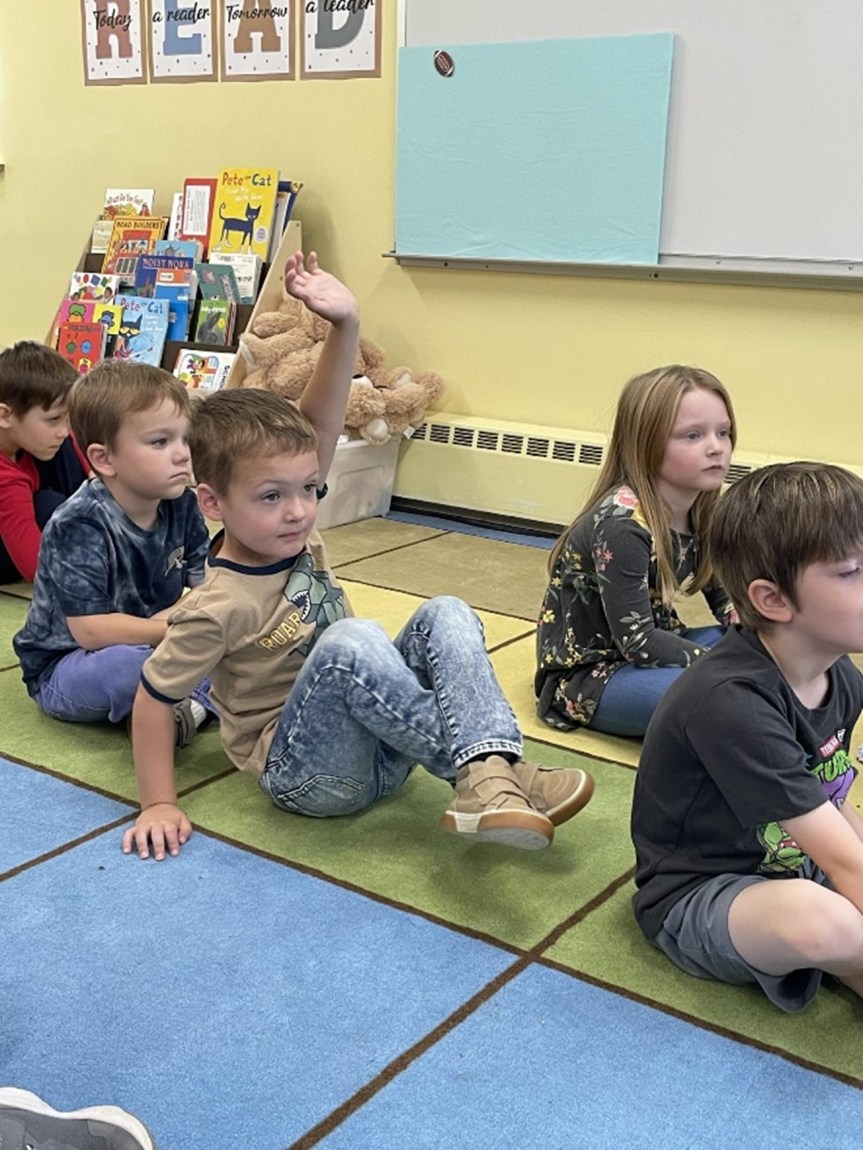
Pre-K students at RSU 13’s Thomaston Grammar School (photo credit: RSU 13)
When John McDonald took on his role as superintendent of RSU 13 more than a decade ago, a goal of his was to establish a pre-K program to serve young children in the community. A grant of about a million dollars and a partnership with Penquis kickstarted that work, but the process was not seamless. McDonald noted that over the years, classroom numbers fluctuated, and budget woes resulted in some cutting back of services. There was, however, a very positive outcome of this effort.
“Ultimately, I ended up with a school board who really understood the benefit of having universal pre-K,” McDonald said.
That mindset presented an ample opportunity for RSU 13 when McDonald learned of the planned transition in Maine of Early Childhood Special Education services for children ages three through five from Child Development Services (CDS) to school administrative units (SAUs) by July 1, 2028. He said he “jumped” at the chance to become a part of Cohort 1 in the 2024-2025 school year, recognizing that this effort would ultimately help his overall student population and special education referrals.
“I just felt like it was a good fit for us and fit right in with our philosophy and our goals,” McDonald said.
A supportive school board invested money in RSU 13’s local budget to support the CDS transition. Now, McDonald is proud to say that RSU 13 offers universal pre-K, with a pre-K classroom available to every school in the district. He said he recognizes that this progress would not have been possible without the strong partnerships that RSU 13 had already established with CDS, Penquis, and the local YMCA.
“On our own, we all have limited resources, and—let’s face it—budgets are tight,” McDonald said. “But we want to provide the best possible educational community that we can for these kids. These partnerships are really all-important, in terms of being able to share resources, share information, share expertise.”
Pre-K students at RSU 13’s South School (photo credit: RSU 13)
“We all went into this with our eyes open, recognizing what the needs are,” Gail Page, Site Director of CDS Midcoast, said. “We knew what we needed to do in order to meet the needs of children. We were all very clear about what our mission was.”
Page said that prior to this transition, there was not enough programming available to meet the needs of local children. Over the past year, however, Page said huge steps of progress have occurred. For example, local children who were receiving tele-speech services are now receiving in-person speech services. Page works closely with Janet Corcoran, RSU 13 Special Education Director, and they do their best to address the needs of every child.
“Our work has really proved that this can be done, and it can be done well,” Page said.
“We’re trying to build something new, and whenever you’re trying to build something new, there are always going to be hitches and things that didn’t go the way you planned—but I think it has gone really well,” Corcoran said.
Corcoran noted that in her close work with Page, she is able to provide honest feedback—and the two work together to determine the questions that they want to ask leaders at the state level, as they continue to improve operations. Despite any hurdles, Corcoran said the universal pre-K model is essential, as it allows students who are receiving Early Childhood Special Education services to interact with and learn from their general education peers.
Corcoran said ultimately, the goal is to graduate students out of special education services, leading to better educational outcomes overall.
“Early intervention is the key,” Corcoran said. “The earlier you can get to students and provide those services, the less likely they’re going to need them long term.”
Pre-K students at RSU 13’s Ash Point Community School (photo credit: RSU 13)
Corcoran also highlighted that what public school offers—social workers, school psychologists, speech and occupational therapists, etc. on-site—is hard to meet elsewhere. Perhaps one of the best outcomes of the transition in RSU 13 thus far has been the reaction from local families.
“I get feedback all the time from families about how appreciative they are that we offer classes and services for these really little kids,” McDonald said. “There are lots of working families where both [parents] work. Child care is very expensive, if it’s even available in this area. They are just so, so appreciative of this.”
RSU 13, CDS Midcoast, and the Maine DOE Office of Special Services and Inclusive Education contributed to this article, written as part of a series highlighting the ongoing efforts of CDS and public schools in providing comprehensive educational services to Maine’s children with special needs. To submit a good news story to the Maine DOE, please fill out the good news submission form.
(Students from the Winslow High School Cheerleading Team pose with Maine Secretary of State Shenna Bellows.)
The Maine Department of Education (DOE) Office of Special Services and Inclusive Education held its second annual “I Belong” Youth Summit at Central Maine Community College on Thursday, May 29. This event brought together students from across the state with individualized education plans (IEPs) for a day dedicated to empowerment, connection, and celebration of student voice. Student participants ranged in age from 10 to 22 years old.
The summit is an initiative that happens through the Transition Maine program, which was developed by the Office of Special Services and Inclusive Education to provide accessible and inclusive transition services for students moving from high school into adulthood. The Executive Student Transition Committee, a team of students who assist with the Transition Maine program, plays a large role in the organization of this event, designed to amplify the voices of youth with varying abilities.“To see our students meaningfully engage and included in hands-on activities to help them imagine their future makes me and our team very proud,” Executive Student Transition Committee Co-Chair Connor Archer said, reflecting on the success of the summit. “As someone who received special education services right here in Maine, I know how unique and powerful this experience is.”
Secretary of State Shenna Bellows kicked off the summit by speaking with students about Maine’s new accessible voting machines, known as the ExpressVote.
The system allows voters to mark their ballots using a touchscreen or keypad, and it includes audio instructions for those who are visually impaired. It then prints a paper ballot that can be scanned and counted. Bellows emphasized the importance of civic participation and ensuring that all Mainers, including those with disabilities, have full access to the process.
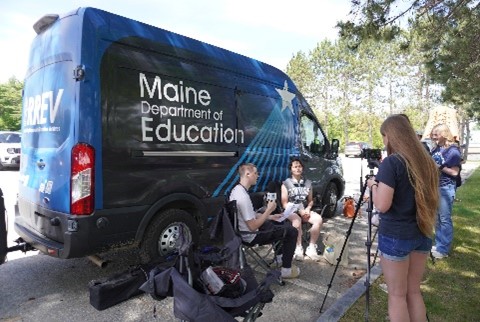
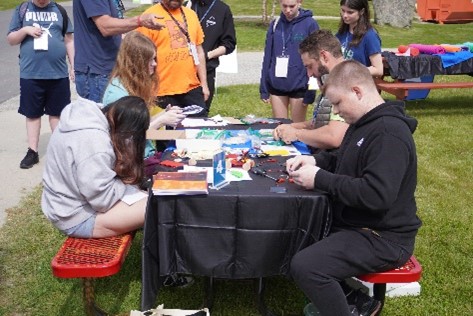
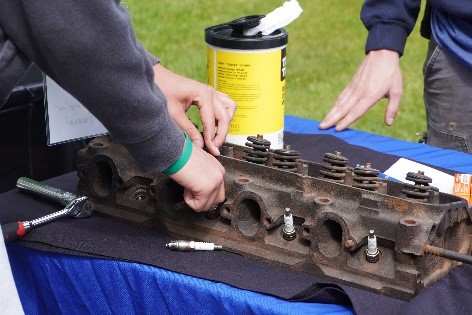
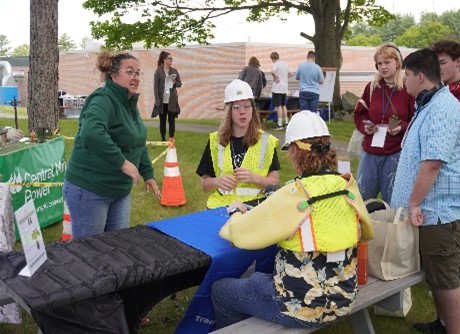
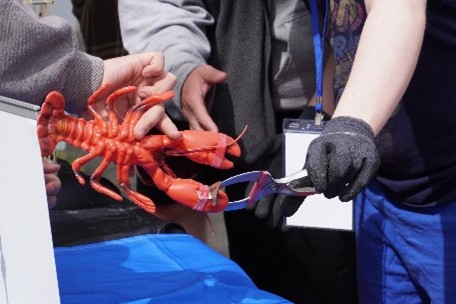
The daylong event allowed students to discover post-secondary opportunities through engaging, hands-on activities. Career paths in trades, culinary arts, agriculture, health care, media, and more were highlighted throughout the day. Students practiced knife skills with chefs, pulled lobsters from traps, and planted vegetables. They participated in Central Maine Power’s “Safety City” demonstration, regarding safety around power lines, and joined the Maine DOE Rethinking Responsive Education Ventures (RREV) team, along with the Student Leadership Ambassadors of Maine (SLAM) from Nokomis High School, for mock media interviews, designed for those interested in journalism and broadcasting.
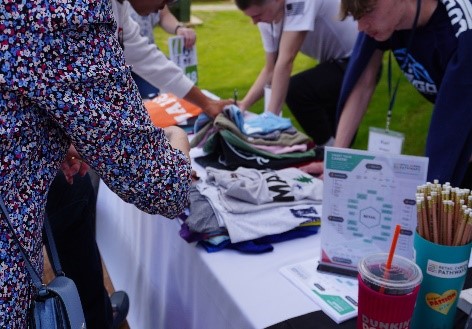
L.L. Bean introduced the students to the world of retail through an interactive clothing activity that focused on merchandising and apparel knowledge. The iconic “Bootmobile” was also on display, drawing students in and sparking conversations about careers in retail and outdoor recreation.
“I want to become an EMT. If that doesn’t work out, I want to work in a mortuary,” Abagail Giles, a student from Stearns High School, shared in an interview with NEWS CENTER Maine.
Educators and business partners at the summit emphasized the importance of creating inclusive pathways to employment.
“There is a ton of value, skill, brainpower, and I think it’s essential not to exclude a segment of the population,” Kim Cotta, Talent Development Manager at Darling’s Auto Group, said.
Titus O’Rourke, the Transition Specialist with the Maine DOE, emphasized the goal of the event in an interview with NEWS CENTER Maine: “[These students] belong in every single career pathway, and it’s important for students to understand what is available to them.”
By connecting students with real-world experiences and professional mentors, the “I Belong” Youth Summit helps to ensure that all Maine students with IEPs have the tools and confidence they need to shape their futures.
The third annual “I Belong” Youth Summit is set to take place in the Bangor area next spring. Due to the strong student participation from across the state for this event, Transition Maine and the Executive Student Transition Committee have plans to expand the “I Belong” Youth Summit.
For more information about the Maine DOE Transition Maine program, click here. Educators interested in connecting with someone about the Transition Maine program may contact her Titus O’Rourke at titus.orourke@maine.gov.
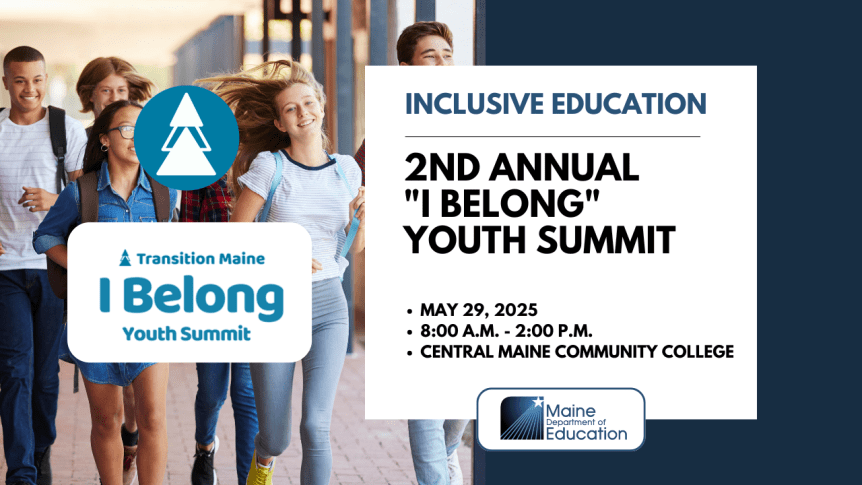
Are you ready to open doors to boundless possibilities for your students? Consider registering for the Maine Department of Education (DOE) Office of Special Services and Inclusive Education’s (OSSIE) second annual ‘I Belong’ Youth Summit, scheduled for Thursday, May 29, 2025, from 8 a.m. to 2 p.m. at Central Maine Community College.
This Summit invites schools across Maine to join a transformative initiative, designed specifically for students with disabilities who are at the age of transitioning from school to their future. This dynamic gathering goes beyond traditional career fairs to offer meaningful exploration, skill-building, and work-based learning opportunities, tailored to each student’s interests and abilities.
Making a Difference Together
By participating in this summit, you become part of a statewide movement to reshape post-secondary pathways for ALL Maine students with disabilities. Your involvement creates ripple effects of opportunity:
Students discover career paths they may never have considered, building confidence and practical skills for their future.
Educators gain valuable resources, evidence-based practices, and direct connections with industry partners.
Businesses develop tomorrow’s workforce, while fulfilling community engagement goals.
Join the Movement
Help your students find where they belong in Maine’s future workforce. The ‘I Belong’ Youth Summit provides a student-centered environment for youth to explore career pathways at their own pace, connect with potential employers, and envision new possibilities for their lives after school.
Don’t miss this opportunity to be a part of something extraordinary! Together, we can create a more inclusive, opportunity-rich future for Maine’s students with disabilities.
Maine middle and high schools may register their students here if they plan to bring them to the second annual ‘I Belong’ Youth Summit.
For more information, please contact Maine DOE Transition Specialist Titus O’Rourke at titus.orourke@maine.gov.
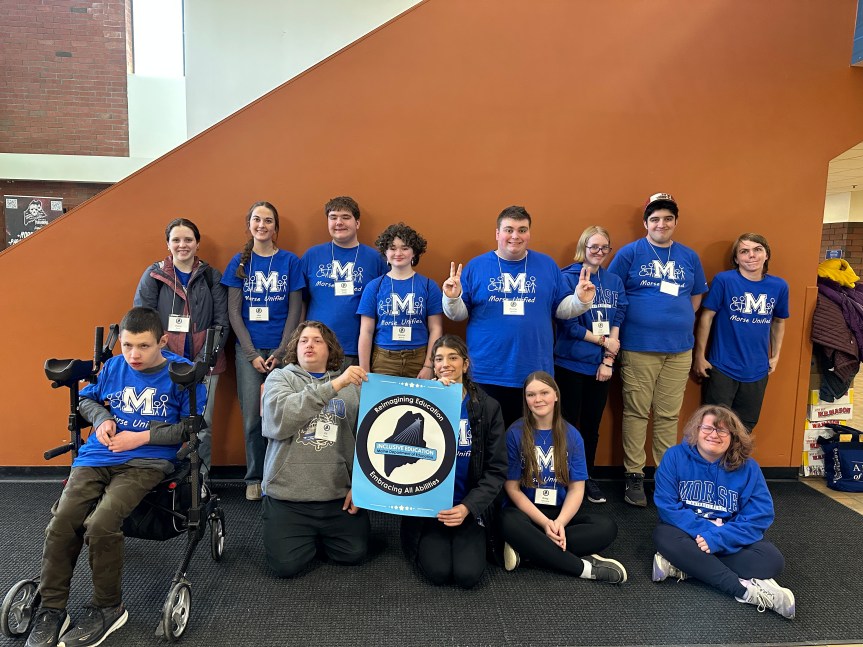
(Pictured: Students from Morse High School’s Unified Literacy Program.)
The Maine Department of Education (DOE) Office of Special Services and Inclusive Education successfully hosted the state’s first-ever Inclusive Education Conference on Thursday, April 10, 2025, at the Augusta Civic Center. The groundbreaking event, themed “Reimagining Education: Empowering All Learners, Embracing All Abilities,” brought together voices from across Maine to celebrate and advance inclusive practices in education.
Hundreds of participants—including students, families, educators, administrators, university faculty, and Maine DOE staff—came together for a day of learning, collaboration, and inspiration. Through powerful presentations, engaging panels, and personal storytelling, attendees shared their experiences and insights about inclusion in Maine schools and communities.
The conference focused on providing school communities with practical tools to support and empower every learner, with a special emphasis on students with disabilities. Attendees explored strategies to embrace diverse abilities, promote equity, and ensure that all students are equipped to thrive in inclusive and meaningful educational environments.
Concurrent sessions covered topics such as unified literacy, mental health, trauma, multitiered systems of support (MTSS), support for multilingual learners with disabilities, inclusive post-secondary education, inclusive early childhood education, and the importance of inclusion in state assessment, as well as engaging and supporting families through positive math experiences. Many sessions were led by representatives from the Maine DOE along with state partners from Disability Rights Maine, Special Olympics Maine, the Maine Department of Health and Human Services (DHHS), Best Buddies, Maine Parent Federation, University of Maine System, school administrative units (SAUs) with inclusive models, and students with lived experience.
The conference also featured several student and educator panels, including one about extended learning opportunities with representatives from the Association of People Supporting Employment First (APSE), the Noble High School ELO program, Mid-Coast School of Technology (MCST), and Portland Arts and Technology High School (PATHS). There was also an SAU) panel, featuring leaders from MSAD 11, RSU 52, and RSU 71. Morse High School students and their teachers lead a panel about unified literacy; Ames Elementary and Kingfield Elementary Schools hosted panels about their schools’ journeys to inclusion; and students from the Maine DOE Executive Student Transition Committee—a part of the department’s Transition Maine initiative—hosted a panel discussion about student advocacy.
A highlight of the event was a keynote address from Dr. Katie Novak, an internationally-renowned education consultant and advocate for Universal Design for Learning (UDL), who inspired the audience with her message on transforming systems to meet the needs of all learners.
Maine Education Commissioner Pender Makin also stopped by the event to provide a special lunchtime keynote address. She thanked educators for attending the conference and for their expertise and collaboration. She also addressed the importance of inclusion for all students by taking a moment to acknowledge the meaning of DEI—diversity, equity, and inclusion.
“Maine’s inaugural Inclusive Education Conference comes at an opportune moment to remind us all of the importance of diversity, equity, and inclusion in public education,” Commissioner Makin said. “Diversity makes all of us stronger by ensuring representation of background and perspective; equity allows everyone the opportunity to be the best that they can possibly be, no matter their circumstance; inclusion means that all voices deserve to have a seat at the table, and that no one is left behind or forgotten.”
The Maine DOE plans to host an Inclusive Education Conference annually, building on the success of this year’s conference. For more information and resources on inclusive education in Maine, please visit the Maine DOE website, or contact Maine DOE Special Projects and Educator Supports Coordinator Tracy Whitlock at Tracy.W.Whitlock@maine.gov.
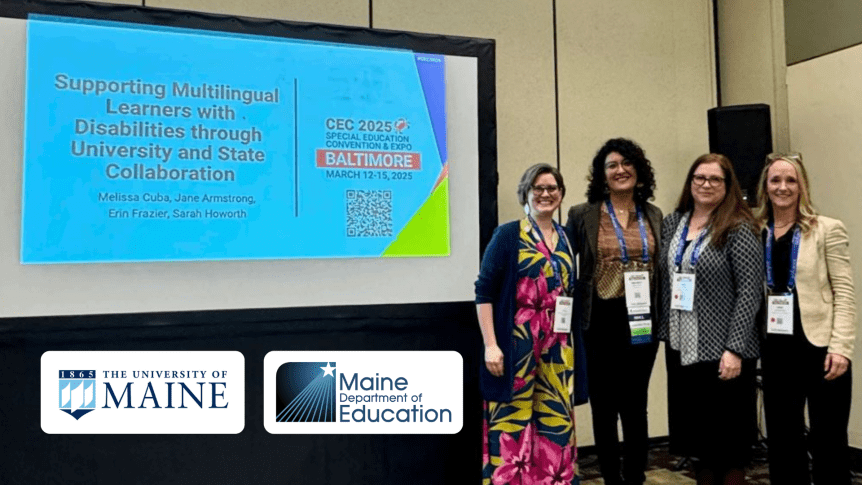
Pictured: From left to right: Associate Professor of Special Education Dr. Sarah Howorth, Assistant Professor of Special EducationDr. Melissa Cuba, Director of Maine DOE Office of Special Services and Inclusive Education Erin Frazier, and Maine DOE State ESOL SpecialistJane Armstrong presenting at the National Council for Exceptional Children (CEC) Conference in Baltimore, Maryland.
In a powerful display of statewide collaboration, representatives from the University of Maine (UMaine) and the Maine Department of Education (DOE) joined forces in March to present at the 2025 National Council for Exceptional Children (CEC) Conference. The session, Supporting Multilingual Learners with Disabilities through University and State Collaboration,spotlighted Maine’s groundbreaking efforts to support multilingual learners (MLs) with disabilities, showcasing the newly-updated Identifying and Serving Students Who Are Multilingual Learners with Disabilities: Policy and Resource Guide, alongside innovative university programming that prepares educators to support MLs with disabilities.
The presentation was led by Dr. Melissa Cuba, UMaine Assistant Professor of Special Education, and supported by Dr. Sarah Howorth, UMaine Associate Professor of Special Education, in partnership with Maine DOE Director of the Office of Special Services and Inclusive Education Erin Frazier and the English for Speakers of Other Languages State Specialist, Jane Armstrong.
Together, the group highlighted the unique context of the state, tracing the evolution of collaborative efforts, and showcased key contributions to address the dual needs of language acquisition and disability support, including UMaine’s Graduate Certificate in Multilingual Special Education, Maine Access to Inclusive Education Resources (MAIER), and the comprehensive policy and resource guide for educators on identifying and serving MLs with disabilities.
UMaine’s Multilingual Special Education program is uniquely designed to prepare educators to effectively support MLs with disabilities through a blend of linguistic, cultural, and special education expertise. What sets this 15-credit online graduate program apart is its interdisciplinary curriculum, which includes courses that target language development, such as:
ERL 531: Linguistic Diversity, Multilingualism, and the Classroom
ELL 570: Methods of TESOL (Teaching English to Speakers of Other Languages)
ELL: 572: Second Language Acquisition
It also offers specialized training through:
SED 502: Strategies for Culturally and Linguistically Diverse Students with Disabilities
SED 545: Intervention for Reading Difficulties
If working with children birth to five, SED 545 is combined with SED 529: Developmentally Appropriate Reading Instruction for Diverse Young Learners. Together, these courses provide a rich foundation in language development, culturally-responsive pedagogy, and targeted academic interventions, empowering educators to create inclusive and effective learning environments for diverse student populations.
The collaboration with the presentation and the co-construction of this iterative guidebook reflects Maine’s growing commitment to inclusive and equitable education, with a focus on multilingualism, disability inclusion, and culturally-responsive practices. The collaboration also underscores the valuable role of higher education institutions like UMaine in supporting these efforts, through research, educator preparation, and training informed by real classroom experiences.
The Maine guidebook serves as a vital resource for school administrative units (SAUs), offering practical tools, guidance, and examples to ensure that linguistic diversity and disability are not barriers to learning but rather opportunities to build inclusive, responsive educational environments.
“This work is a reflection of Maine’s commitment to inclusive education that sees and supports the whole child,” Frazier said. “By bridging the expertise of higher education and state systems, we are empowering educators to confidently identify, support, and celebrate multilingual students with disabilities.”
This work aligns with and strengthens Multi-Tiered Systems of Support by ensuring that academic, behavioral, and social-emotional supports are responsive to the diverse identities and experiences of all students.
As part of the Maine DOE’s commitment to inclusive and equitable education, Teacher Leader Fellow Melissa Frans, has played a vital role in co-facilitating a dynamic six-part professional learning series, designed to support educators working with MLs with disabilities. Through her leadership, Frans has further illuminated the critical intersection between language acquisition and disability services, emphasizing the importance of collaborative practices with linguistically-responsive IEP development. You can see the recordings of this webinar series on the Maine DOE Multilingual Learners with Disabilities webpage.
As Maine experiences growing linguistic and cultural diversity in its schools, this guidebook, along with the collaboration behind it, provides a model of proactive, inclusive, and research-informed practices that other states may consider replicating. Additionally, the Maine DOE Event Calendar has an array of opportunities available to support educators in fostering inclusive and effective learning environments.
For further information or questions about multilingual programming, please contact Maine DOE State ESOL Specialist Jane Armstrong at Jane.Armstrong@maine.gov. For further information or questions about the guidebook, please contact the Maine DOE Office of Special Services and Inclusive Education Director Erin Frazier at Erin.Frazier@maine.gov.
Are you ready to open doors to boundless possibilities for your students? Consider registering for the Maine Department of Education (DOE) Office of Special Services and Inclusive Education’s (OSSIE) second annual ‘I Belong’ Youth Summit, scheduled for Thursday, May 29, 2025, from 8 a.m. to 2 p.m. at Central Maine Community College.
This Summit invites schools across Maine to join a transformative initiative, designed specifically for students with disabilities who are at the age of transitioning from school to their future. This dynamic gathering goes beyond traditional career fairs to offer meaningful exploration, skill-building, and work-based learning opportunities, tailored to each student’s interests and abilities.
Making a Difference Together
By participating in this summit, you become part of a statewide movement to reshape post-secondary pathways for ALL Maine students with disabilities. Your involvement creates ripple effects of opportunity:
Students discover career paths they may never have considered, building confidence and practical skills for their future.
Educators gain valuable resources, evidence-based practices, and direct connections with industry partners.
Businesses develop tomorrow’s workforce, while fulfilling community engagement goals.
Join the Movement
Help your students find where they belong in Maine’s future workforce. The ‘I Belong’ Youth Summit provides a student-centered environment for youth to explore career pathways at their own pace, connect with potential employers, and envision new possibilities for their lives after school.
Don’t miss this opportunity to be a part of something extraordinary! Together, we can create a more inclusive, opportunity-rich future for Maine’s students with disabilities.
Maine middle and high schools are invited to fill out a school interest form, if they are planning to bring students to the second annual ‘I Belong’ Youth Summit. (Registrations for individual students will be sent directly to schools that complete the interest form.)
For more information, please contact Maine DOE Transition Specialist Titus O’Rourke at titus.orourke@maine.gov.
Math4ME is a free, three-year, whole-school project, designed to support all educators (i.e., classroom teachers, special educators, ed techs, and interventionists) to strengthen math proficiency for all learners with a specific focus on increased math proficiency for students with math individualized education plan (IEP) goals.
Administered by the Maine Department of Education (DOE), this project focuses on building positive math school communities and classrooms, mathematical content, and pedagogical skills; and supporting inclusionary practices, increased family engagement, and formative assessment, including the Early Mathematics Diagnostic Interview (EMDI).
For more details about the Math4ME project, check out this informational video.
For questions or more information, please contact Maine DOE Math4ME Distinguished Educator Susan Hogan at susan.hogan@maine.gov or Maine DOE Interdisciplinary Instruction Specialist Jen Robitaille at jennifer.r.robitaille@maine.gov.
The Maine Department of Education (DOE) and the University of Maine at Farmington (UMF) are partnering to support a cohort of Maine public schools in becoming Inclusive Education Model sites for the state. This project is intended to provide participating Maine schools with five years of support to develop and implement sustainable, inclusive, and integrated multi-tiered systems of support for all students.
Maine Inclusive Education Model Schools will:
Build leadership and staff capacity through ongoing coaching and professional learning.
Implement data-driven decision-making to increase equity, access, and achievement outcomes for the most-marginalized students.
Prioritize collaborative and inclusive service delivery.
Commit to increasing the amount of time all students with disabilities spend in general education settings.
Ground standards-based curriculum and instruction in universal design for learning (UDL) principles.
Who can apply for Cohort 1 (2025-2030)
The Maine DOE and UMF are currently seeking applications from public elementary school leaders serving students in pre-K through grade 5 who are deeply committed to inclusion and are ready to reimagine and realign their schools to better meet the diverse needs of all learners. Secondary schools will be able to apply for subsequent cohorts.
What participating Cohort 1 schools will receive
Pilot schools participating in Cohort 1 will receive five years of support from inclusive education experts to implement pilot project goals. Supports will include:
A summer orientation in year one.
Access to annual summer inclusion institutes in years two through five.
Leadership support and staff professional development from inclusive education experts in years one through five.
A network of pilot school cohort leaders and staff.
Commitments for pilot schools include:
Leadership development and coaching.
Participation in professional development and coaching.
Realignment of school schedules and service delivery models to more effectively and inclusively meet the needs of all learners.
Hiring or reassigning of a current educator to serve as the school inclusion facilitator to support sustainability.
Serving as a model inclusion school (e.g., being available for on-site visits from educators and families, participating in video recordings of classroom practice, doing interviews, etc.)
Participating in a research study conducted by Drs. Kate MacLeod and Jessica Apgar of UMF.
Please join the Maine DOE and UMF for a virtual information session on February 26, 2025, from 2-3 p.m. via Zoom to learn more before submitting your materials. You may register here in advance for the meeting. After registering, you will receive a confirmation email containing information about joining the meeting.
Applications are welcome from all interested public elementary school leaders in Maine who have started the work of improving inclusive education in their schools.
If you would like to receive an application, please complete this form. Once you’ve completed the form, you will receive the application from Dr. Kate MacLeod (kate.macleod@maine.edu). The application deadline is March 14, 2025.
School finalists will be selected for site visits and interviews, and three elementary schools representing diverse demographic and geographical regions will be accepted into Cohort 1.
For further questions, please reach out to Tracy Whitlock, Maine DOE Special Projects Coordinator for the Office of Special Services and Inclusive Education, at tracy.w.whitlock@maine.gov.
Join the Maine Department of Education (DOE) for the state’s first Inclusive Education Conference on Thursday, April 10, 2025, at the Augusta Civic Center. The conference theme is “Reimagining Education: Empowering All Learners, Embracing All Abilities.” It will provide school communities (educators, administrators, families, and students) with the tools necessary to empower every student, particularly those with disabilities, by embracing diverse abilities and ensuring that all students have the support they need to build inclusive, meaningful futures.
The Maine DOE Office of Special Services and Inclusive Education and the University of Maine at Farmington are hosting this conference. The keynote speaker will be Katie Novak, an internationally renowned education consultant, author, graduate instructor at the University of Pennsylvania, and a former Assistant Superintendent of Schools in Massachusetts. Dr. Novak’s keynote address will focus on an introduction to inclusive education practices and structures in schools. She will also hold three sessions on Universal Design for Learning (UDL).
The conference will feature students, families, educators, administrators, university faculty, and Maine DOE staff from across the state, as well, who will share their expertise and experiences with inclusion in schools and communities.
Please gather a team of your school colleagues and meet us in Augusta this spring! The cost of the daylong conference (8:30 a.m.-4 p.m.) is $175 and includes lunch, as well as a wealth of information and resources.
Register here. (Please note that technical issues with the event registration website have been resolved.)





 Maine DOE Newsroom