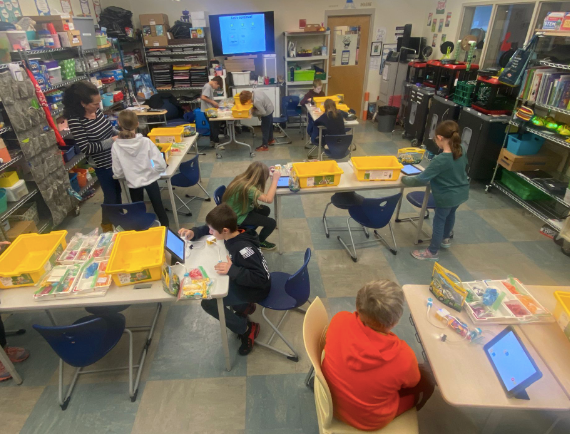
(Pictured: Students in the Maker Space with Lego SPIKE kits and iPads, which were purchased through the Maine Department of Education’s TeachWithTech grant)
Students at Chelsea Elementary School were overjoyed at the sight of twenty new Lego sets as they walked into the classroom this year.
Through the Maine Department of Education’s TeachWithTech grant, Chelsea Elementary School was able to receive twenty Lego SPIKE Essentials Kits. These Lego sets were accompanied by iPads, which were preloaded with the SPIKE app.
#TeachWithTech provides additional supplemental technology to schools that are part of Maine Learning Technology Initiative (MLTI), to support the initiative to teach and learn with technology. The grant encourages school districts to think of how to create transformative learning experiences for students with technology.
Rosie Del Tejo Williamson (Learning Commons Teacher) and Helen Wright (Learning Commons Education Tech) hoped that students would be able to work independently but were available for assistance.
As soon as the students walked into the MakerSpace room, their excitement was palpable as soon as they and noticed the Lego and iPad setup. They immediately dove into exploration. Despite having no prior experience with the SPIKE app or Lego Spike Essentials, students confidently used coding to bring their Lego creations to life. When difficulties occurred, many students were adept at experimentation and troubleshooting, and many helped their peers. Williamson and Wright were impressed by the students’ confidence in this new situation, as well as their enthusiasm for learning in action.
6th grade students have the opportunity for leadership
6th grade and Pre-K students collaborate
Williamson and Wright are grateful that TeachWithTech allowed their students to have this transformative learning experience and hope to continue to use technology for engaging learning.
The #TeachWithTech grant is available to any school district that is a part of the Maine Learning Technology Initiative. Priority is given to applicants who focus on greatest student impact, serve socioeconomically disadvantaged districts, prioritize student populations traditionally underrepresented in technology, and demonstrate a commitment to pursuing high-quality teaching and learning through technology.
Every year, the Maine Administrators of Services for Children with Disabilities (MADSEC) announces Honorees of the Year, who are individuals who work in the field of Special Education within Maine schools.
The Maine Department of Education (DOE) joins MADSEC in congratulating the 2023-24 awardees in addition to thanking all educators within the Special Education division. Congratulations to Angela, Kendra, Scott, and Erin, and read more about them below.
Angela Moore, Special Education Administrator of the Year, Brewer School Department
Kendra Perry, Special Education Teacher of the Year, Bangor Regional Therapeutic Day Program
Scott Flagg (OT), Special Education Professional of the Year, Brewer School Department
Erin Dupee (Ed Tech III), Special Education Support Staff of the Year, Old Orchard Beach High School
To learn more about MADSEC, these awards, and the honorees, visit their website:
Working with the students is what Kristen Levesque, Principal of Turner Elementary School in MSAD 52, describes as the absolute best part of her job. However, she knows that to successfully reach students meaningfully at school, everyone in the building needs to feel safe.
“I wanted to make sure I was providing students and staff with the best care possible in regard to safety,” said Levesque.
Kristen Levesque is one of the 114 dedicated people working in schools and districts across Maine who have taken the School Safety Specialist course offered by the Maine Department of Education’s Maine Schools Safety Center (MSSC). The course helps fulfill State statute Sec. 1. 20-A MRSA §1001, sub-§16 (LD892), which states there must be a “designated employee having oversight regarding school safety.”
After completing the 8-week, asynchronous course in April 2023, Levesque instituted many changes that have had a big impact on the Turner Elementary School community.
One of the most impactful changes has been leading the charge on completing the CSTAG assessments to ensure safety. CSTAG stands for Comprehensive School Threat Assessment Guidelines, and it is a comprehensive approach to early identification of students who may be on the pathway to violence by assessing problem behavior and offering interventions before the behavior escalates. CTSAG training is part of the MSSC’s larger Maine Safe School’s Initiative.
“The use of the CSTAG for threat assessments has greatly increased the feeling of safety within the school, and this has been communicated by staff,” Levesque explained.
In addition to the changes she has implemented at the school level, the district has been doing meaningful work with the district safety committee, including work to revise emergency handbooks.
Levesque extends a thank you to all staff in MSAD 52, including Superintendent Cari Medd, Asst. Superintendent Theresa Gillis, School Resource Office Sheriff Ham, and School Technology Director Walter Morris.
The School Safety Specialist course is a program of the Maine DOE’s Maine School Safety Center and is available at no cost to Maine schools. Cohorts start at the beginning of every month and complete in 8 weeks. All work is done asynchronously through Eastern Maine Community College (EMCC) and the Federal Emergency Management Agency (FEMA) and takes approximately 20-25 hours to complete.
For more information, visit the Maine DOE website, fill out an interest form, or reach out to Maine DOE School Safety Training Coordinator Wendy Robichaud at Wendy.Robichaud@maine.gov.
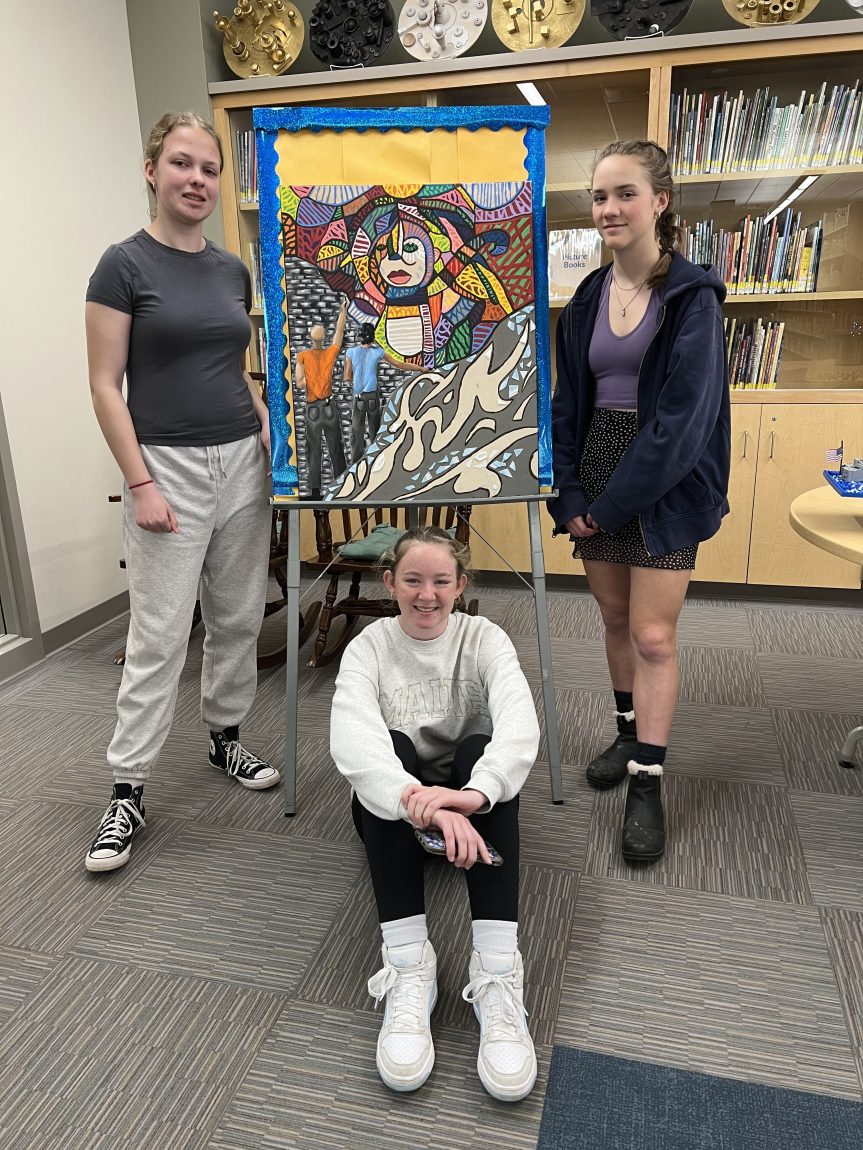
(Pictured: Morse High School freshman Rose Strelneck, Isla Polizotto, and Hannah Keller with their painting, a reimagined version of a FAMA mural done in Paris.)
Three students from Morse High School have won the 2024 French American Friendship Contest sponsored by The French Consulate in Boston.
This esteemed competition, open to high school students studying French and their teachers across New England, is a testament to the enduring bond between France and the United States.
Organized by the Cultural Service of the Consulate General of France in Boston and the Lounsbery Foundation, the contest blends education with enjoyment, inviting participants to explore the historical, cultural, artistic, and personal dimensions of Franco-American relations. This year’s theme commemorated significant milestones, including the 200th anniversary of Lafayette’s final journey to the United States and the 80th anniversary of the Normandy landings.
The highlight of the contest is undoubtedly the grand prize: a one-week trip to Paris and Normandy, generously funded by the Lounsbery Foundation. During the trip, the winners will immerse themselves in the rich tapestry of French history and culture. From cruising along the Seine River to admiring the iconic Eiffel Tower from the Trocadero esplanade, their itinerary promises a blend of iconic landmarks and poignant historical sites, including the Musée des Armées, Pointe du Hoc, and the Caen Memorial Museum.
The winning trio spearheaded the creation of the FAMA mural painting. Comprising three talented freshmen—Rose Strelneck, Isla Polizotto, and Hannah Keller.
Congratulations to Rose, Isla, and Hannah for their outstanding accomplishment!
This story was submitted by Morse High School French teacher, Rebecca Deschaine. To submit a good news story to the Maine Department of Education, please use our submission form.
The Mount Desert Island Regional School System’s (MDIRSS/AOS #91) Filabot Full Recycling initiative is creating new opportunities and ways of engaging in innovative educational practices in environmentally and economically conscious ways that foster interdisciplinary collaboration, improve engagement, increase student motivation, promote the growth in critical thinking skills, and stimulate thinking about ecologically sustainable practices in a high-tech world.
Funded by a $35,322 #TeachwithTech grant from the Maine Department of Education (DOE), the initiative is part of a project led by MDIRSS/AOS #91 IT Lead Luis Jones-Rodriguez, working with MDIRSS K-8 Educational Technology Lead Cindy Lambert and Pemetic Elementary School IT Integrator Mike Brzezowski, to reignite the district’s use of 3D printers for curricular purposes in ways that are more economical, ecological, and innovative. The district is one of 33 schools or school districts that received this grant.
What could be more fun and engaging than learning some of the principles of the scientific method and physics by making and launching your own rocket? While many students have done some iteration of the bottle rocket task using a plastic soda bottle and some type of launcher, students at the Pemetic Elementary School can design and create their own rockets using the school’s 3D printers, marrying curriculum, practical application, and innovation.
“The 3D printed rockets are part of science class. This year they will do data collection on a standard ‘control’ rocket and be introduced to a few physics’ principles. Next year they learn more about the principles governing rockets and will create a modified design to compete in either an accuracy or a distance challenge,” said Brzezowski.
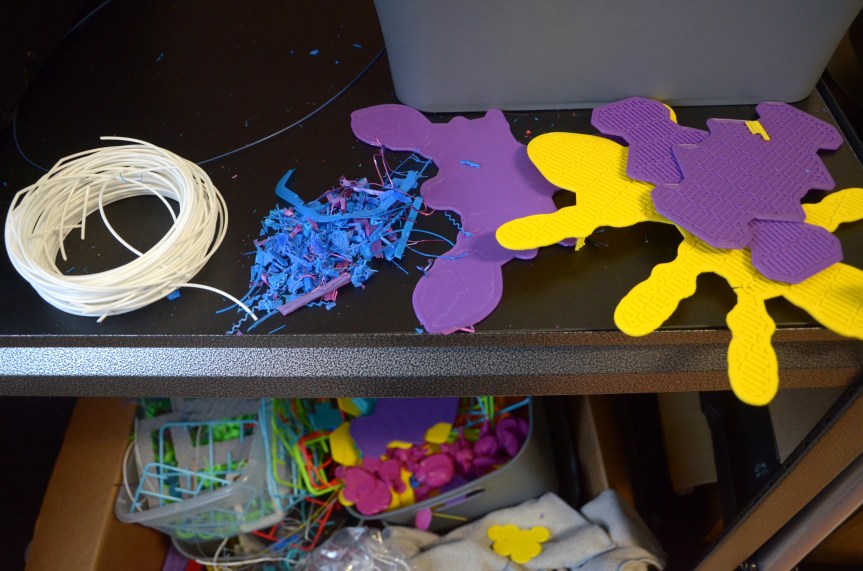
Projects like these can be exciting and interesting for teachers and students alike, but they also can be costly and wasteful. According to 3D4Create, a spool of filament will print 20-30 five- to six-inch tall models with 15-20% infill (“infill” refers to the internal structure of a printed item that gives it weight and strength). Each one kg spool can cost between $19-$32, which makes errors, a natural part of learning, and the inevitable production of waste byproducts costly. Jones-Rodriguez’s grant-funded project will allow the school district to make filament from discarded 3D printed projects otherwise destined for landfill, printing waste, and recyclable plastics that can be used in every school. The Teach with Tech grant has enabled Jones-Rodriguez to purchase the equipment needed to establish a complete recycling system that, besides producing savings in the schools’ budgets, will “also allow the kids to make mistakes” without having to worry about the cost of those errors and promote sustainable practices island-wide. The new equipment can produce recycled filament in any color and in 1.75mm and 2.85mm thicknesses.
A 3D printed vase made from recycled plastics turned into filament.
Recycled plastics must be ground twice before they can be turned into filament.
From material to finished product: plastic products are cleaned, ground twice, baked, and fed into an extruder to create filament for 3D printers.
Luis Jones-Rodriguez, the MDIRSS/AOS #91 IT Lead, inserts discarded 3D printed items into the grinder to prepare to convert it into printer filament.
A 3D-printed tumbler made with filament created from recycled plastics. The filament can be made in any color.
The goal, said Jones-Rodriguez, “is that no school will buy filament whatsoever and to have a place where plastics can be recycled instead of put into a landfill.” The recycling and production process will serve all of the MDIRSS/AOS #91. Schools have recycling containers to collect commercial food-grade plastics like soda bottles and milk jugs, and Jones-Rodriguez aspires to collect materials community-wide one day. Once it is fully operational, he estimates that the district could save an estimated $1,250 a month or $15,000 a year on filament costs.
Sustainability concerns and frustration with limiting resources also were driving factors behind this project. There had been pushback and 3D printing had started to fall out of favor because “anything that is printed was not recyclable,” said Jones-Rodriguez. In 2015, there was at least one 3D printer in one of the ten schools in MDIRSS/AOS #91. By 2022-2023, the eight schools on Mount Desert Island had “maybe two each,” according to Jones-Rodriguez. Not only were four schools left out of luck, but the ones in place were old and took a long time to print. Their use had fallen because “the old ones would take a week or more” to print items for just one class because they “were prone to failure and very slow.” In the pre-COVID era, some of the district’s schools were using some printers, including MDI High School, whose Maker Space students produced “ear savers” for face masks during the COVID period. Today the district’s schools have been outfitted with new printers that can print up to a “full class’s worth” of projects in one day, he said.
While the complete recycling process is time-consuming, it will be worthwhile. The home-grown filament project opens the door to a greater variety of items the students can create through the types of recycled plastics that are collected. “Different plastics have different uses,” he said. While filament made from food-safe plastics can be more durable, for instance, they have a low heat resistance, which can make them unsuitable for outdoor use. “Nylon from fishermen is what I’m really excited about because that’s the most durable.” The plastic nylon used in nets and lines has higher heat resistance and is UV-resistant, making it ideal for filament that can be used for products like lampshades and outdoor furniture. “Everyone is excited that it’s making 3D printing eco-friendly,” Jones-Rodriguez said.
Ultimately the goal is to incorporate 3D printing projects across the curriculum and in different subject areas, Jones-Rodriguez said. At Pemetic Elementary School, that has already started under Brzezowski’s guidance. While the Pemetic science class is working with rockets, one of the school’s French classes is printing chocolate molds that will be used to create chocolate bars with custom wrappers. The wrappers will “have reference to French culture, history, and symbology” and once the students make and wrap the bars using the molds, they will hold a “French Chocolate Market” at Birch Bay Retirement Village, where students will be able to talk to the residents about their chocolates and French culture, and residents will be able to “purchase” the chocolates with tokens they have been given, said Brzezowski. From a French classroom to a Maker Space and then into the community, all wrapped up in a chocolate bar, what student could argue with that?
The Maine Department of Education’s TeachWithTech grant is part of the Maine Learning Technology Initiative (MLTI). The grant is awarded to MLTI schools through a formal grant process and provides supplemental technology and related professional learning to support innovative teaching and learning with technology. Learn more about the TeachWithTech Grant here.
This story was submitted by Mount Desert Island Regional School System (MDIRSS/AOS #91). To submit good news about your school to the Maine Department of Education, complete our Good News Submission form.
Deb Backman’s German 3 class at Cony High School in Augusta is leading the way in educational technology by integrating virtual reality (VR) into their curriculum, thanks to the Maine Department of Education’s (DOE) TeachWithTech grant.
To immerse students in German culture and language, Mrs. Backman conducted a virtual field trip using VR headsets to explore the columns of STOA 169 in Polling, Germany. This innovative approach exposed students to Germany’s rich artistic scene and provided a unique opportunity for linguistic practice and cultural exploration.
The student response to the VR experience was overwhelmingly positive. They observed the intricate designs of the columns and engaged in thoughtful discussions about their significance while honing their German language skills.
Following the virtual excursion, students participated in a hands-on activity during which they created their own interpretations of columns using paper towel rolls. This practical exercise reinforced their understanding of the architectural elements discussed during the VR journey and encouraged creative expression.
Mrs. Backman observed a notable increase in student engagement and comprehension following the VR field trip and subsequent activity. Students demonstrated a deeper appreciation for art and culture and an enhanced ability to articulate their observations and interpretations in German.
Integrating VR technology into the classroom exemplifies Cony High School’s commitment to providing innovative and immersive learning experiences that empower students to broaden their horizons, develop cultural competency, and strengthen their language proficiency in an engaging and impactful manner.
The Maine Department of Education’s TeachWithTech grant is part of the Maine Learning Technology Initiative (MLTI). The grant is awarded to MLTI schools through a formal grant process and provides supplemental technology and related professional learning to support innovative teaching and learning with technology. Learn more about the TeachWithTech Grant here.
This story was submitted by Cony High School, Augusta School Department. To submit good news about your school to the Maine Department of Education, complete our Good News Submission form.
(Pictured: Kittery School Department Superintendent Eric Waddell with ninth-grade students Mary Auman and Aubrey Jackson)
Since 1999, May has been recognized as Military Appreciation Month after former Senator John McCain proposed this during the legislative session. Former U.S. Secretary of Defense Caspar Weinberger first designated April as the “Month of the Military Child,” acknowledging the significant role military-connected students play in our communities. In 2011, the University of New Hampshire Cooperative Extension Military Youth and Family Program started the “Purple Up! for Military Kids” to encourage communities to support military children for their strength and sacrifice.
Purple references the joint environment of the military, encompassing all service branches, Active Duty, Reserve, National Guard, and Veterans. Purple combines each branch’s colors into one: the Air Force, Navy, and Coast Guard all use shades of blue, the Army uses green, and the Marines use red.
The Portsmouth Naval Shipyard is located less than a mile from Traip Academy, which is part of the Kittery School Department. Kittery’s school communities are made up of about one-third of military families. To honor these families during this time of year, Shipyard School Liaison Officer Kirsten Ferullo and staff planted purple tulip bulbs last fall that will bloom soon.
“Being a military child is not always easy, but when you get a nice community you can thrive in, it lightens the load a bit,” said Mary Auman, a first-year student at Kittery School Department’s Traip Academy.
Another Traip Academy student, Aubrey Jackson, added, “It’s so important to get to know your new community before you move.”
Kittery School Department supports and empowers military-connected students and families. This spring, we celebrate their resilience, strength, and unique contributions to Maine’s education system.
“We have created a district video for those families who are moving into the area,” said Kittery Superintendent Eric Waddell. “Our goal is to ensure that every military family feels supported and welcomed as they become part of our Kittery family.”
What do you get when you combine adult education students, a tour of Kennebec Valley Community College (KVCC), and a variety of delicious pies? The answer is Brighter Futures!
A successful, immersive event occurred earlier this spring when 18 students from four local adult education programs spent two hours on the KVCC campus. In addition to touring the campus, students met the dean of students, key student success support staff, and a Maine Educational Opportunity Center advisor. After the tour, they enjoyed pie and ended the day with a fun activity led by a faculty member. The event was so successful that there are plans to offer it at least once a year.
Carolyn Haskell, the College and Career Success Coordinator (CCSC) at KVCC, a position funded through the Maine Jobs and Recovery Plan, played an integral part in planning the event and worked closely with Teresa Smith, KVCC Director of Enrollment, to make it a success. Area adult education directors and staff marketed the event and accompanied students to the campus.
Part of Haskell’s role is to be the on campus contact for adult education students interested in attending KVCC. Haskell is a resource for students navigating the college process and adult education. Being on campus gives her a unique perspective and informs how she advises students. She helps ease the transition from adult education to college and supports students along their college journey to help them succeed. She also connects current KVCC students to adult education for services to help them while they are in college.
Haskell has seen the power of getting adult learners to college campuses and believes that allowing them to see themselves as college students is monumental. She said, “Once they tour the campus, it is much easier for them to think of college as a goal to be accomplished rather than a dream.”
This story was submitted by Kennebec Valley Community College (KVCC). To submit good news about your school to the Maine Department of Education, complete our Good News Submission form.
Keith Morin loves watching students grow academically and socially; it’s one of the perks of his very busy job as RSU 18 Assistant Superintendent and Chief Academic Officer. He also loves watching the impact that RSU 18 staff make on students beyond academics, serving as mentors, role models, and sources of guidance and support.
That is why many people find the field of education as fulfilling as they do. And to nurture academic aspirations and cultivate a positive school community, everyone needs to feel safe.
As a school administrator serving the communities of Belgrade, China, Oakland, Rome, and Sidney, Morin knows how incredibly important it is to be knowledgeable and experienced in all aspects of education, especially in today’s fast-paced and ever-changing society. That includes school safety.
“My goals in participating in the school safety specialist program are simple; to enhance my skill set in providing guidance to a platform and culture where students and staff feel safe to attend school,” explains Morin.
Morin finished the Maine Department of Education (DOE) School Safety Specialist course in February of 2023 to help him better understand school safety and its complexities. Maine DOE’s Maine School Safety Center offers the 8-week course every month. It is provided asynchronously through Eastern Maine Community College (EMCC) and the Federal Emergency Management Agency (FEMA).
Since taking the course, RSU 18 has been hosting annual tabletop exercises for its staff, which include scenarios of real events, where they discuss their emergency plans and responses. They are also implementing student support resources such as the Second Step Program, a social emotional learning program, and Netsmartz, an online safety education program, delivered by RSU 18 district social workers and school resource officers.
RSU 18 is also implementing quarterly school safety committee meetings that include staff members from all departments and stakeholder groups, and they are hosting after-action meetings where RSU 18 staff can refine its safety practices.
Morin has also led RSU 18 efforts to expand partnerships with local law enforcement by hiring a third resource officer to build relationships with students and families. He also states that his district has hired a district safety officer to align safety practices before, during, and after school.
“In addition to making safety improvements identified throughout our consistent school safety review, we are now working on enhancing our already strengthened cybersecurity system,” added Morin. “We continue looking to build on our successes and improve areas to provide an academic environment that is safe and enjoyable.”
The School Safety Specialist course is a program of the Maine DOE’s Maine School Safety Center and is available at no cost to Maine schools. Cohorts start at the beginning of every month and complete in 8 weeks. All work is done asynchronously through Eastern Maine Community College (EMCC) and the Federal Emergency Management Agency (FEMA) and takes approximately 20-25 hours to complete.
For more information, visit theMaine DOE website, fill out aninterest form, or reach out to Maine DOE School Safety Training Coordinator Wendy Robichaud at Wendy.Robichaud@maine.gov.
As the state of emergency brought on by the COVID-19 pandemic gradually quelled, the Mt Blue Regional School District nurse team could finally catch their breath and refocus on the projects they had put on hold amidst the crisis.
“As COVID was winding down and we were getting back into our normal routines, it was hard to believe it was really over. We had been living with these high-stress levels for so long that it took a while to adjust mentally to our pre-COVID routines.” Janneke Strickland, BSN, RN, NCSN, RSU 9 Lead Nurse and Cascade Brook School nurse in Farmington, remembers, “But once things settled, it felt good to have time to devote energy to newer projects.”
One of those projects was a concerted effort to increase the number of district staff members certified in cardiopulmonary resuscitation/automated external defibrillator (CPR/AED). This endeavor, conceived as a group initiative for the 21/22 school year, resonated deeply with the nurses, who were driven by a shared commitment to enhancing the safety and well-being of their school community.
The team started by conducting polls in each Mt. Blue school building. The results painted a stark picture: a mere four to five percent of staff were certified in CPR/AED in each location. Undeterred by the challenge, the Mt. Blue Nurse team set their sights on an ambitious target – to ensure that at least 10% of staff were CPR/AED trained by the end of 2023.
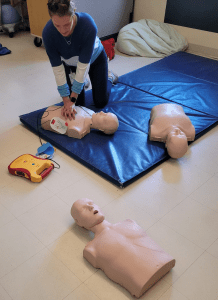
A Mt. Blue school nurse works on one of the CPR manikins purchased through Newhouse.
With their objectives clear, the nurse team strategically formulated a budget request for the 22/23 school year. This proposal encompassed provisions for CPR training kits and an AED trainer, essential tools needed to equip staff with life-saving skills.
Taking charge of the initiative, Kathryn Clement, a dedicated member of the nurse team and a Nationally Certified School Nurse, spearheaded efforts to explore avenues for Mt. Blue nurses to become certified as Basic life-saving instructors. “Over the summer, the majority of Mt. Blue nurses and some other Maine School nurses trained with Angie Newhouse of Newhouse Training,” explained Clement. “There were lots of moving pieces and a collaborative effort to provide training to our staff.” Through Newhouse, they also found and purchased the feedback CPR manikins they need to train educators.
Next, leveraging the support of the Mt. Blue administration, the nurse team forged a partnership with Franklin County Adult and Community Education. Through the Harold Alfond grant funding coordinated by their Adult Ed partner, the nurses were able to extend CPR/AED classes to staff members at no cost, eliminating barriers to participation.
As the prospect of teaching classes loomed, a few nurses grappled with apprehension. “The apprehension came from being new to teaching BLS and working with larger groups,” explained Strickland, “Usually, nurses teach one-on-one with students or families, so we aren’t used to teaching large groups.”
However, the Mt. Blue Nurse team rallied together, opting to co-teach sessions, honing their skills and fostering confidence. Gradually, their trepidation gave way to assurance, buoyed by the team’s collective expertise. By the end of the school year, Mt. Blue’s nurses not only met their target of 10% CPR/AED certification among staff but surpassed it, with 15% of staff becoming CPR/AED certified. Thanks to this team of dedicated educators, Mt. Blue was safer than ever.
“We have so many tools at our disposal, like defibrillators, out in the public, and it is nice to know our staff now know how to use them,” says Clement. “Now, more people in the public are comfortable administering
From the National Association of School Nurses
emergency response care.”
However, the Mt. Blue nurse team knew their mission for safer schools was far from over. Buoyed by the success of their endeavors, the nurses continue to offer classes to staff members, spurred by an overwhelming interest from the community. Their commitment to the well-being of the Mt. Blue community remains unwavering, underscoring the pivotal role nurses have in nurturing a culture of safety and preparedness within schools.
“School nurses occupy a unique space where education and healthcare converge. There are myriad aspects to this special type of nursing!” says Strickland. “Under guidance from the School Nursing Practice Framework (NASN, 2024) and the Maine
DOE, we strive to collaborate with families, school staff, administration, and the wider community to support the health and safety of our students. This approach, as research demonstrates, leads to improved academic achievement.”
School nurses are the backbone of our schools, keeping students healthy and safe. They deserve to be celebrated every day, but especially today on National School Nurse Day. Celebrate National School Nurse Day today by taking time to thank the school nurses in your community.














 Maine DOE Newsroom