Monmouth Memorial’s Makerspace Reaching Even More Students

A finished student independent project from wood and stain

Monmouth Memorial School has some innovative ideas on how to involve more of its students with their makerspace. Not only is this makerspace available to whole classes and individuals throughout the day, but students in grades 6-8 also take a unified arts class where they are exposed to many different components of the makerspace, including 3D printing, motors and electronics, woodworking, sewing, all the way to virtual and augmented reality. By the time the students finish middle school, they will have developed makerspace skills, learned about the design process, and completed an independent project. These projects can be hands-on, virtual, or anything in between with some projects including a YouTube instructional video on quilt sewing, marble runs, an American Flag made out of wood and stain, safety guides on tools in the makerspace, and a three-foot-tall basketball hoop.

Monmouth Memorial's studio space
Monmouth Memorial’s studio space

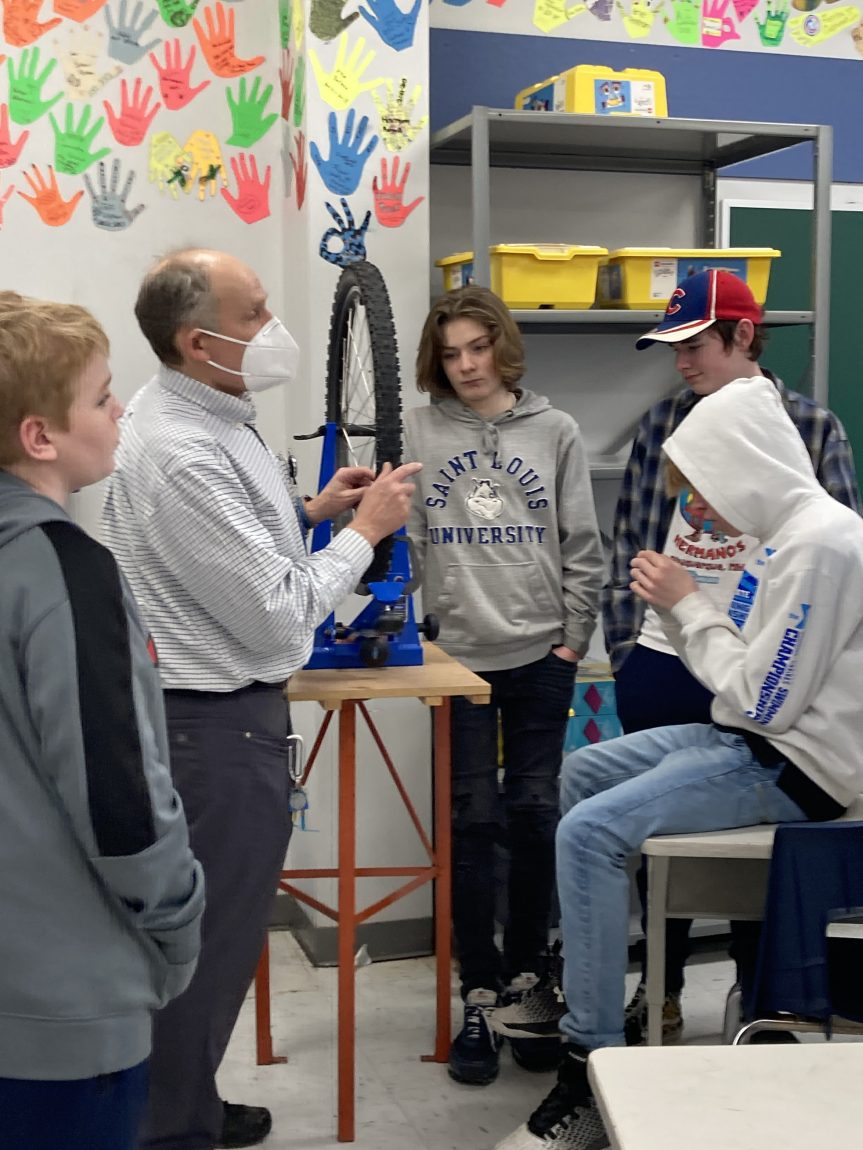
The makerspace projects are spearheaded by Elizabeth Bellegarde, the district librarian, and Seth Mitchell, who is the school’s technology integrator and the 2022 Kennebec County Teacher of the Tear. Bellegarde feels the system is a great fit for their school, saying “I feel as though the set-up we have is ideal for our school’s structure, allowing the maximum amount of student access.” That structure allows for many different projects happening all at once, with one space designed as a work area that involves everything from power tools and snap circuits as well as materials for the Lego Robotics and VEX Robotics teams, which competed in the 2022 Vex Robotics World Championship.

In the makerspace unified arts class, 6th-8th grade students will be working on a wide array of projects simultaneously, with Bellegarde moving between groups to provide support when needed. Students enthusiastically switch between low-tech and high-tech skills to complete their projects, but the energy and excitement from the students is constantly pulpable.

“It takes time to build that culture,” Mitchell says, “having administration who see the value in this program makes it even more successful.”

A student’s marble run project

Attached to the main makerspace area is Monmouth’s studio space. This area contains a wide array of materials including a sound board, iPad teleprompter, green screen walls, and resources for video editing. “Students and teachers have this wonderful resource available [that can] extend learning in a way that wasn’t previously possible,” Bellegarde says. “By using the makerspace this way, classes become more fun with memorable experiences that will increase retention.” For many students in the makerspace unified arts class, having flexibility between both learning spaces gives them even more options to create unique projects.

Bellegarde wants to continue making these learning resources available for as many students as possible. “We are still working on making more students aware of this opportunity, the makerspace unified arts class is a huge part of that,” she says, “but the students who do take advantage of the makerspace find it to be a rewarding experience.” Not only can students participate in the unified arts class, classroom teachers can use the space for whole-class learning experiences as well as individual students working independently during study halls and available times throughout the day. Bellegarde sees these learning experiences leading to the development of lifelong design, critical thinking, decision-making, and independent skills. “For me, this is the best part of the makerspace.”

This story was written and coordinated by MLTI Ambassador Joshua Schmidt as part of the Maine Schools Sharing the Success Campaign. To learn more, or to submit a story or an idea for a story, email rachel.paling@maine.gov.

Yarmouth Students Find Their Courage with SpiritCorps

Eighth graders at Frank H. Harrison Middle School in Yarmouth faced their fears this fall as they wrote, recorded, and shared short video stories of Courage from their own lives for SpiritCorps.

Barbara’s Story of Courage (3 mins)

In 3 weeks of project-based learning, students engaged in self-reflection and a rigorous 5-step narrative writing process, culminating in their Courage videos. Along the way, students were supported by their teachers, peer Story Partners, program videos, as well as adult volunteer Story Coaches–a distinguishing feature of SpiritCorps–providing approximately one hour of individualized feedback per student. Teachers and students were thrilled with the positive impact on both academic and social-emotional skills:

The support for students’ revision and encouragement they received from their Story Coaches was highly effective and helped to keep students motivated.” – Mike Rice, Yarmouth Partner Teacher

I learned that I’m braver than I think I am and that I show courage in many different ways throughout my life.” – 8th Grade student, Yarmouth

In partnership with the Maine DOE, we hope to bring the benefits of SpiritCorps to students throughout the state over the next two years. All participating schools receive a 100% scholarship in their first year, thanks to a federally funded DOE grant. We still have some openings in our spring schedule and would love the opportunity to work with you and your students! Keep your eye out for more wonderful SpiritCorps stories coming your way in the weeks ahead.

To find out more or schedule an information session, please email Dr. Christina O’Neal, our Director of Program Partnerships, at coneal@spiritseries.org.

Three School Projects Honored with ‘Spirit of America Foundation’ Award

Spirit of America Foundation, has selected three school programs with their ‘Spirit of America Foundation Award.

Nominated by local school leaders, the Award is presented to local individuals, organizations, and projects for commendable community service within the school community. The three awardees this year are:

  • Perry Elementary Parent-Teacher Committee (PTC) – The Perry Elementary PTC worked diligently to create a Haunted Trail at the school.  Many parents, teachers, students, community members, and alumni came together to design a haunted trail that has become an annual event.  This community project provided an evening for our families and area families to come together and “Get Spooked.” There were also indoor activities and concessions provided by the 8th-grade students. It was an amazing fundraiser for our PTC.
  • Kingfield Elementary School Growing Gardeners & Outdoor Learning Program – The Growing Gardeners Program teaches students about wellness: planting and growing healthy foods and herbs, as well as how to prepare healthy foods. The Outdoor Learning Program focuses on “Place” and teaches students about their environment and the world around them.
  • Stratton School Garden Team Harvest Fest – The Harvest fest is a collaborative event that takes place with the collaboration of the entire staff, including the students and community members.  It’s a good event in this crazy world. This year we had over 150 people in attendance and raised about $600 to support the growth of the garden program. This event brings the community together to break bread, chat and genuinely build community and good feelings.

Spirit of America Foundation is an Augusta based public charity established to honor volunteerism. To see past awardees or learn more about the Spirit of America Foundation, visit spiritofamerica.website.

RSU 13 Extended Learning Coordinator Creates Student-centered and Enriching Experiences for Oceanside High School Students

“Students are at the core of every move I make, and we create these internship experiences together,” said Molly Staples, Oceanside High School ELO Coordinator. “We treat every challenge as a learning experience and the students are able to dabble in real-world challenges.”

The best part of Molly’s day is hearing about students’ experiences at their internships. “I’m always wanting to unpack their time and hear how it made them feel,” she said. “I also love working through challenges.”

Realizing that oftentimes students don’t really want to make mistakes, Molly works hard to break down that fear of doing things wrong. She does this by encouraging students to test things out and experiment with how to work out a situation and to not be afraid of trying something and if that didn’t work out, then try something else.

“I’m most proud of the diversity in our program,” said Molly. She and others at RSU 13 have created a range of different opportunities for students which all may look a bit different depending on what the student’s needs are.  Where some ELOs may be a chance to connect with someone via email, on a video call, or attend a community meeting, other opportunities are more traditional experiences like job shadowing and full internships. It all depends on what the students’ goals dictate. “This allows for lots of wiggle room and time to segue to new experiences,” explains Molly. “It allows students the opportunity to say, ’that isn’t what I want to do,’ and pivot to a new avenue without consequence.”

Here are what a few students from the program had to say about their ELO experiences:

“It definitely impacted me. The stuff I’m working with really gives me a lot to think about.”

“I am really overall enjoying the internship and the work I do.”

“Being at the shelter working with animals takes my mind off of everything else letting me fully focus.”

“I absolutely loved it. I learned so much and I really enjoyed it.”

Here are a couple of parent comments:

“I am so proud of her and excited that she has this opportunity!”

“This program is so neat!” 

Looking ahead, Molly is working on expanding the program to allow students to be able to stay on for a second semester to elevate their work in career exploration.

In celebrating the success of the Oceanside High School ELO program, Molly and the RSU 13 school community would like to extend a heartfelt thank you to the following community partners who have helped make this all possible: Schooner Bay Taxi, Penobscot Island Air, Somebody Loves Me Bridal, Habitat for Humanity, City of Rockland, Dream Local, Hybrid Fitness, Adventure Advertising, Carleton Investment Properties, Center for Furniture Craftsmanship, Miller Turnery Co, Pitch, Flanagan Rec Center, Pope Memorial Humane Society, Officer Bagley and Rockland PD, Gerald Weinand, Architect, Penobscot Bay YMCA, Kim Young, Thomaston Grammar School, New Hope Midcoast, Jesse Rutter, Emily Philbrook, and SO many more!

“I am incredibly excited to see how receptive our local businesses and organizations have been to work with our students,” said Steffany Tribou, RSU 13 Assistant Superintendent. “We are merely building the foundation of this project, and in this work, we are seeing the great potential that it has for our students. There are great possibilities on the horizon for students in the Midcoast.”

To learn more about the RSU 13 ELO program visit their Facebook page.

Windham/Raymond ELO Coordinator Uses ‘Outside the Box’ Thinking to Connect Students to Opportunities in the Community

For RSU 14 Director of Community Connections & Windham High School (WHS) ELO Coordinator Lorraine Glowczak, the best part of her job is working with students. “A very close ‘second’ best part of my day is all the new people I get to meet throughout the state through my community outreach,” she added.

Although extended learning opportunities (a.k.a. ELOs) were officially implemented at WHS during this school year, Glowczak has been working with the Windham/Raymond community for quite some time as the school administrative unit’s (SAU) Community Connections Director engaging with community members and businesses to increase student educational opportunities and support school-related needs. As part of this work, she also carefully collaborates with multiple stakeholders within the SAU and school community, including administration, teachers, counselors, and parents.

“Although available for the whole district, my office is located at Windham High School, where I meet with high school students, assisting them in completing capstone project requirements,” said Glowczak. “I also act as an Extended Learning Opportunity (ELO) Coordinator for the high school, coordinating credit-based educational opportunities outside the traditional classroom for students through various methods, including internships, job shadows, and mentorships.”

Glowczak enjoys collaborating with educators and business leaders in both her roles.

“Just as importantly, and what I believe emerges as a benefit, is the ‘thinking outside the box’ creative innovation that is required to make it all happen,” she said. “This, I believe, is a win-win for all and a must for the best education possible.”

This year alone, she has helped coordinate opportunities for students to work in the yacht, filmmaking, civil engineering, architectural engineering, and publishing industries since taking on the ELO coordinator role.

One of those success stories was RSU 14 student, Greta Paulding who took an internship in Civil Engineering with the Town of Windham’s Economic Development Corporation (WEDC). “When I started this job, I wanted to be a civil engineer,” said Paulding Glowczak. “That career path still interests me, but I realized that the in-depth engineering side of things, the math, and physics of a project, is less interesting to me than the big picture.”  Pauling has since shifted her career focus to civil architecture, which focuses on building design. “The knowledge I gained helped me to sharpen my view of my future and set my sights on a career I can use to make a difference in my town and beyond,” Paulding added. WEDC Executive Director Tom Bartell was exceptionally pleased with Paulding’s work and offered her a part-time job that continues today.

Another online ELO success story at WHS, is a student who has some training and interest as an electrician and was recently accepted as a paid intern for Sabre Yachts in Raymond. “The student and the business are working together to see if this internship can turn into a full-time job as an electrician upon graduation from high school. So far, it looks very promising,” said Glowczak.

Looking to the future, Glowczak says their ELO program hopes to be able to expand the number of industry options for students to broaden their experiences and career horizons. One strong possibility is paid internships as a lifeguard with the Bureau of Parks and Recreation with the potential to offer students credit. Being able to offer credit-bearing paid internships would be an exciting expansion to RSU 16’s ELO Program.

Glowczak extends a special thanks to the following community partners who have helped with the success of their ELO program thus far:  Sabre Yachts of Raymond, Delano Architecture of Saco, The Windham Eagle Newspaper of Windham, Voices of Hope and Dave Packem of Scarborough, Fluky Fiction, a publishing company based out of Rockland, and Windham Economic Development Corporation of the Town of Windham.

Extended Learning Opportunities (ELOs) are hands-on, credit-bearing courses outside of the traditional classroom with an emphasis on community-based career exploration. These opportunities are personalized for students and help them explore options for their professional lives. They help students engage in learning through instruction, assignments, and experiential learning. The Maine Department of Education (DOE), along with state-wide partner Jobs for Maine Graduates (JMG), have made a concerted effort to provide working models, support, and funding opportunities for Maine schools to set up ELO programs within their school communities. To learn more about Maine’s initiatives with extended learning opportunities, visit: https://www.maine.gov/doe/index.php/learning/elo or reach out to Maine DOE ELO Coordinator Rick Wilson at rick.wilson@maine.gov.

Deer Isle Stonington High School Students Pitch in to Improve Elementary Outdoor Classroom

School Union 76 was awarded funding for a Rethinking Responsive Education Ventures (RREV) pilot project last year to create outdoor learning spaces for students across the district. With those funds, the district has created an ADA-accessible boardwalk with an adjacent ADA Outdoor Classroom that is part of a nature trail, both are designed to be inclusive for all students to be able to engage, connect, and explore and significantly boost their student learning proficiencies across all subjects – and even the students are pitching in to make improvements to the new spaces.

As part of regular maintenance to the district grounds, many saplings were taken down this past summer in the process of maintaining the campus driveway and the well. One of the teachers wisely set them aside, rather than sending them to the local dump. After agreeing to build the railing, Deer Isle Stonington High School students taking a course named Construction I class measured and planned their project. Then, they stripped the bark from the aspen, maple, and beech trees and cut the pieces to the correct length to assemble a beautiful railing for the new Outdoor Classroom. Visitors can see by their handiwork that they considered spacing and the shape of the branches as they installed the branches.

In addition to this upgrade, 7th graders have also stepped in to help. After hearing of the desire from the kindergarten classes for immediate seating, they rolled stumps leftover from prom into the space.

“The end result is stunning!” Remarked Science Teacher Mickie Flores. “Students and staff at both the elementary and high school are enjoying the space as a place to be outdoors and a place to learn,” she added.

RREV is an initiative of the Maine Department of Education, funded by the Education Stabilization Funds through the US Department of Education’s Rethink K-12 Education Models, that bolsters Maine educators’ innovative efforts to support their students with agile, effective, and resilient learning experiences that improve learning outcomes for all students.  

Martin Mackey, the former RREV Project Director who tragically passed away in April of 2022, embodied the RREV spirit: to think and act boldly to meet the needs of students. His passion was to “change lives.” As such, he challenged each and every RREV participant to do just that as they designed pilot ideas that would ultimately have a lasting systemic impact on students.  After 18 months of leading RREV, Martin’s passion had been passed on to over 200 educators who had participated in innovation professional development. From those educators, over 40 Pilot ideas were brought to fruition and have received over $8 million in RREV awards. Through their pilot ideas, these educators have pledged to commit themselves to innovation. 

The Maine DOE encourages all schools and districts across the State of Maine to learn more about these innovative educators and their RREV pilots through the RREV website and the online RREV collaborative platform known as EnGiNE. It is through EnGiNE that we all hope to continue the Martin Momentum to change students’ lives through innovative and responsive educational programs. 

Windham High School Students Practice Skills in Civic Engagement and Dialogue with Elected Officials

Approximately 20 Windham High School (WHS) students participated in three separate day-long retreats entitled the “Can We? Project”. Building up to the third retreat, students learned the skills of ‘listening to understand’ through a series of story exchanges. Then, using what they learned in the first retreat, students practiced their listening skills by discussing divisive topics at the second retreat where students chose political and social issues they deemed essential.

On the last day of the Can We? Project retreat, Wednesday, Dec. 7th, students practiced civic engagement skills by presenting their perspectives on their areas of concern to elected officials from the Windham Town Council and the RSU 14 School Board.

Students shared concerns from a global and local perspective ranging from various social, political, and environmental topics.

The students only had 1 ½ hours to choose from one of the issues established by the group to develop an argument. After their presentations, the elected officials were offered an opportunity to ask questions or give an opposing viewpoint to consider.

WHS English teacher, and Can We? Project liaison Chelsea Scott said four student groups and one teacher group presented to the officials in about an hour.

“The student’s level of courage was admirable,” Scott said. “They transformed feelings of anxiety into action and used the little time they had to prepare to create insightful presentations.”

School board member and chair, Kate Brix, was impressed with the students and the Can We? Project process, stating that it was a powerful example of the importance of student voice.

“Student engagement is a core belief of RSU 14’s strategic plan, and the students of this project were extremely articulate and respectful as they presented their viewpoint on a topic important to them,” she said. “The students I met clearly illustrated that they care and think deeply about issues that impact all our lives. I can’t say enough about how impressed I was with them and know that the skills they learned will be put to good use beyond their high school years.”

Town Council member and chair Mark Morrison said the project was timely and a valuable lesson in learning respectful dialogue between people with differing viewpoints.

“We saw the students apply and follow the program process with their presentations which stressed presenting respectfully, listening, and asking questions in a way that did not make the dialogue personal,” Morrison said. “I hope this program continues so the students learn the skills needed to effectively communicate so the focus is on the ideas where the pros and cons can be discussed and measured, not on the person. I hope I’m invited back to participate in another discussion.”

After the presentations, the students had an opportunity to reflect upon what they learned most.

“I realized I need to do more research about my subject,” stated senior Teddy Becker.

Junior Mareena Batsungnern said participating in the Can We? Project helped develop her skills in leadership. “It has also given me the courage and motivation to voice my beliefs to others.”

Junior Griffin Moreau said the Can We? Project taught him something that many of us try to learn in an attempt at deep listening. “The thing I think that I learned the most is, ‘be comfortable with silence’. It is something that I have struggled with all my life and have only started to realize the answer to and the Can We? project has helped with that.”

Scott stated that the Can We? Project was instrumental in empowering the students to truly listen to each other and discuss divisive topics with empathy and a desire to understand rather than to react.

“Participants have expressed that they feel supported, surprised, and inspired by this program and that they now have the tools and knowledge to participate in their own democracy,” she said.

Briefly, the Can We? Project was developed collaboratively between the Third Thought Initiatives for Civic Engagement from Waynflete School and the Maine Policy Institute. The mission is to allow high school students the opportunity to engage in thoughtful dialogue across different perspectives.

All three retreats were held at WHS and guided by John Holdridge, the Director of the Third Thought Initiatives for Civic Engagement, and Jacob Posik, the Director of Communications from the Maine Policy Institute. The twenty students were self-selected to participate and represented a true cross-section of ages, academic foci, family experiences and interests.

Students will have the opportunity to expand their experiences with other high school students across the state who also participated in the project, taking their experiences and practice of civil conversation and dialogue to the next level. In addition, WHS teachers who participated in the retreats plan to incorporate the project as an initiative for the whole school.

A thank you goes to the following elected officials who gave the gift of listening and allowing students to practice skills of civic engagement and dialogue respectfully. Thank you to Windham Town Council members Mark Morrison, Dave Nadeau, and Nick Kalogerakis. RSU 14 school board members (Kate Brix, Kate Leveille, Char Jewell, and Jessica Bridges) and former State Representative Patrick Corey.

Hartford/Sumner 6th Graders Star in Second Debut of MLTI 2.0 SLAM Showcase 

The Maine Department of Education’s MLTI Team, including MLTI Ambassadors, Nokomis SLAM students, and MLTI SLAM Coordinator, Kern Kelley spent the day presenting at the SLAM Showcase for sixth grade students and teachers from Hartford/Sumner Elementary School on November 22nd. This was the second of six SLAM (Student Leadership Ambassadors of Maine) Showcases happening at schools across Maine this year. (Read about the first SLAM Showcase here) 

The SLAM show empowers MLTI students to use their devices and technology tools by providing a platform where students can give back and share their innovative work in their schools. The live SLAM in-person showcases have been designed to directly align with MLTI’s vision that all Maine students engage in authentic, relevant, technology-rich, learning experiences that prepare them for a fulfilling future. 

Hartford/Sumner 2nd grade teacher Kelley Houghton attended a SLAM summer professional learning and applied to host a SLAM Showcase. As the selected candidate, Houghton invited MLTI to bring the SLAM Showcase to 6th grade students and teachers at her school. 

The students spent the day learning about robotic coding with MLTI Ambassador, Martha Thibodeau, learning about Canva, free design software, with Nokomis High School SLAM student, Mia Coots, learning how to use TinkerCAD, a free web app for 3D modeling, electronics, and coding, with Nokomis High School SLAM student John Davis, and learning about how to create Virtual Reality with MLTI Ambassador, Tracy Williams. 

The SLAM showcase provides the opportunity for students and teachers to learn new techniques and programs. Fifth grade teacher, Kate McCarthy, excitedly sat alongside students learning about Canva during one of the sessions. “I am very excited to use this in my classroom,” McCarthy later told SLAM student, Abby Caron, during a follow-up interview. 

Hartford-Sumner SLAM Showcase
Fifth grade teacher, Kate McCarthy being interviewed by SLAM student, Abby Caron

Following each session, students were invited to participate in the SLAM Exam where they are asked to answer a related question and invited to upload the work they created in the session. At the end of the SLAM Showcase, examples of student work are highlighted as part of the SLAM Show for all participants to view. Prizes were randomly selected from correctly answered SLAM Exams. 

Kelley tells us that the SLAM Exam is a low barrier way for the SLAM program to collect and showcase student work, promote student participation, and entice students to participate in future events. “Even if they don’t get a prize during this show, there is always the opportunity to share work during any of our SLAM shows, so we always hope they will share again and possibly win a prize during a future event.” In addition to the Live SLAM Showcases happening monthly this school year, SLAM also hosts weekly virtual SLAM shows where students across the state can participate. 

The day ended with a group activity that allowed students to, not only share their work, but also share what they learned and highlight their take-aways from a day of hands-on learning. Students also got the opportunity to take a group picture with a drone that was provided to the school, in addition to virtual reality (VR) headsets for each student that can be paired with any mobile device to show their parents and guardians the work they created that day in the Showcase.  

Check out a video of the SLAM Showcase here

To learn more about the MLTI 2.0 SLAM program visit: http://MLTI.me. View the latest SLAM episode on the MLTI 2.0 Youtube Channel. To sign your school or classroom up to take part in SLAM, fill out this form. 

Follow the Maine Department of Education on Facebook and Twitter to see a posting of the latest virtual SLAM show each week. Subscribe to the Maine DOE Newsroom to see a recap of the in-person SLAM shows each month. 

Student State Board Member Ryan Hafener Presents on the Importance of Involving Youth in Policy Making

(Pictured: Maine State Board of Education Student Member Ryan Hafener with fellow students at the National Association of State Boards of Education Conference)

At the November State Board of Education Workshop, Student Member Ryan Hafener presented on the importance of youth engagement and provided recommendations to the Maine State Board of Education on how to increase engagement. In October, Hafener was featured on a webinar by the National Association of State Boards of Education (NASBE) that focused on how state officials can develop youth-adult partnerships. In the webinar, available on the NASBE website, Hafener fielded questions on what successful youth-adult partnerships look like, what barriers can get in the way of student engagement, and what can make partnerships successful.

In addition to providing an overview of his experiences on the panel, Hafener also discussed his takeaways from his attendance at the NASBE Annual Conference in Phoenix, Arizona. Hafener presented on everything from understanding and addressing chronic absenteeism to understanding school climate and creating educational pathways that are relevant to all students. However, Hafener spent most of the presentation focusing on student engagement, an issue he is passionate about.

Hafener says that when engaging students, it is crucial to recognize the expertise that students bring to the table and to help mentor and foster the growth of students. He emphasized the importance of putting aside traditional youth-adult power dynamics, which he says is vital to ensuring partnerships are effective.

In his webinar, Hafener also highlighted the barriers to student engagement, which he separated into two categories: systemic and perceptual. Systemic barriers include the need to legislate student engagement and lack of access to information around opportunities, while perceptual barriers include ego and the perception that leaders’ work engaging students is finished once students are put into positions of leadership.

Hafener wrapped up his presentation with policy suggestions on how to further student engagement in education policymaking in Maine. He proposed an increase in the number of student members, which he said will bring along a myriad of benefits including increased equity and representation. Hafener also advocated for students to play a larger role on the board, as well as for the creation of more student-led spaces for discussion.

Figures compiled by the National Association of State Boards of Education show that 33 states now engage more than 400 students in education decision-making. Hafener reported that Maine is one of the leaders across the nation in student engagement, but he also reiterated the importance of continually investing in and adding pathways to amplify the student voice.

This article was written by Maine State Board of Education in collaboration with student member, Ryan Hafener as part of the Maine Schools Sharing Success Campaign. To submit a story or an idea, email Rachel Paling at rachel.paling@maine.gov.