Oxbow Outdoor RREV Pilot Creates New Spaces and Opportunities for RSU 9 Students 

Mount Blue Campus Instructors Jake Bogar and Travis Tierney were awarded funding for a RREV Pilot in August 2021 for an outdoor education project that aims to get students off screens and outside of traditional school building walls for a revolutionary new way of learning.

RREV stands for Rethinking Responsive Education Ventures and is an ongoing initiative of the Maine Department of Education (DOE) to fund innovative and responsive education pilots that allow educators to think outside the box, and outside Maine’s traditional education systems to respond to the unique needs of their students.

It was through this partnership with RREV, that the Oxbow Outdoor Pilot was born. It came about as a pushback toward the abundance and reliance on digital screens. “Research and other nationwide studies showed a need for outdoor and experiential learning to promote social and emotional wellbeing. This need, coupled with our uniquely situated geography/landscape of woods, waters, and mountains will seek to positively influence student and community outcomes,” as explained in the pilot’s description.

Serving students in grades 9-12 on the Mount Blue Campus, which houses Mount Blue High School and Foster Career and Technical Education Center, part of Regional School Unit (RSU) 9, the pilot will provide an interdisciplinary outdoor education program that supports student wellness and achievement. The goals of the program are to expand student-centered learning opportunities in a variety of outdoor settings; increase student engagement, motivation, and voice; provide flexible time frames based on students’ needs; collaborate with students to develop and monitor learning plans; and implement a challenging, meaningful, proficiency-based education system that transcends from the classroom into the community and the world.

“There are so many socio-economic barriers for students when it comes to participating in and accessing outdoor learning, leadership, and experiences. Our current system of traditional learning, traditional assessment, reliance on digital technology, has left many students wanting outdoor and experiential learning,” the pilot description explains.

Although the project aims to mainly serve students on the Mount Blue Campus, Bogar and Tierney expect it will reach further across their district by creating mentoring, educational, and outdoor learning experiences for younger students in the 6 other schools that RSU 9 serves.

One year into their project the team is well out of the planning stages and are beginning implementation with the help of their students. Seen in these pictures, Pre-Engineering students and Outdoor Leadership students collaborate on building and setting beams for the new yurt on the campus.

“New skills and ownership in the project have been a joy to watch,” said Tierney.


Like with any plan that bucks the traditional system and sets a new course (especially for a future generation of leaders), it’s not all smooth and seamless success for the Oxbow Outdoor Pilot team. Bogar and Tierney have jumped their fair share of hurdles and taken on a lot of extra work to see this project through. They report, however, that in the end it will all be worth it when they’ve set up a sustainable program that gets students learning outside and experiencing the dimensional and rich outdoor landscape of their region.

Once they are fully operational, the program will allow for two cohorts to move through the program each school year with the opportunity to earn certification in Industry Safety, Wilderness First Aid, Canoeing, and working toward their Maine Guide certification.

Bogar and Tierney tell us that there will be more to come and that things are moving fast, so stay tuned!

RREV is an initiative of the Maine Department of Education, funded by the Education Stabilization Funds through the US Department of Education’s Rethink K-12 Education Models, that bolsters Maine educators’ innovative efforts to support their students with agile, effective, and resilient learning experiences that improve learning outcomes for all students.  

Martin Mackey, the former RREV Project Director who tragically passed away in April of 2022, embodied the RREV spirit: to think and act boldly to meet the needs of students. His passion was to “change lives.” As such, he challenged each and every RREV participant to do just that as they designed pilot ideas that would ultimately have a lasting systemic impact on students.  After 18 months of leading RREV, Martin’s passion had been passed on to over 200 educators who had participated in innovation professional development. From those educators, over 40 Pilot ideas were brought to fruition and have received over $8 million in RREV awards. Through their pilot ideas, these educators have pledged to commit themselves to innovation. 

The Maine DOE encourages all schools and districts across the State of Maine to learn more about these innovative educators and their RREV pilots through the RREV website and the online RREV collaborative platform known as EnGiNE. It is through EnGiNE that we all hope to continue the Martin Momentum to change students’ lives through innovative and responsive educational programs. 

Innovation and Interdisciplinary Learning Has Students Doing Math in Orono’s Webster Park

Would you go to the park to do a little innovative learning connecting math, science, and art using the sun? Students from nearby schools did just that on October 21, 2022!

A unique partnership between the University of Maine and the Town of Orono made it possible for students, and members of the public, to go to the park and explore multiplication and division using the sun. The interactive sculpture, the SunRule, was unveiled in a public ceremony in October.

The project was a part of UMaine’s MIRTA accelerator program that is designed to advance research to commercialization with a focus on innovation and real-world connections. This type of work brings to light the connections within and across the content areas (math, science, and art) and community partnerships that opens doors to student curiosity, engagement, wonder and joy for learning.

The concept for the sculpture began as an email between UMaine Associate Professor of Mathematics Education and Instructional Technology, Justin Dimmel, and Associate Professor of Mathematics Education, Eric Pandiscio, in 2019 just before the pandemic started! The concept went from SunRule 1.0 (a sawhorse with dowels) to cardboard boxes and then was shared with UMaine Associate Professor of Art, Greg Ondo, and Sculpture Studio Technician, Sam Hoey. With the artistic influence of artwork using sunlight and further planning, a prototype sculpture was created and then a final sculpture of granite and bronze was produced and installed in Webster Park on North Main Avenue in Orono.
Using the sunlight to measure the shadow of an object is something that has been done in math classes for a very long time. The SunRule concept uses the sunlight, not the shadow, to show the continuous nature of multiplication by using a scaling model, showing that for every discrete number (1, 2, 3, etc.) and all those in between, there is a product.

You can read more about the SunRule at UMaine News.

Using Book Creator & Educational Technology Tools to Engage Students in Reading

The Gorham Middle School (GMS) library website is a rich resource for students to discover and access reading materials from their home or classroom using their MLTI iPads. Librarian Suzanne Liacos-Dix has created an extensive collection of Book Talk videos, a Google Classroom stream, and a selection of Google Forms to engage students in sharing their literary passions with others. This year, in collaboration with 7th grade teacher, Sherry Coyne and the GMS technology integrator, Terri Dawson, the library website has a new feature to help engage students in Silent Sustained Reading (SSR).

The GMS library website features a link to join a Google Classroom where Mrs. Dix streams library announcements like new book arrivals, book fair information, and author visit events. She has also created a Google Form where students can request a featured “Favorites Shelf” to display their top picks as well as a form to request new books to be added to the library. The forms are student-friendly and provide students an opportunity to have a voice in the library collection. The Google Classroom stream allows students across grade levels to have conversations that they might not otherwise from expressing excitement about a new book release or sharing thoughts on upcoming events with others. The stream is also an opportunity for Mrs. Dix to help students learn how to communicate effectively with others and become good digital citizens. Mrs. Dix says there is a long waiting list for the Favorites Shelf that just started this September. It has been extraordinarily popular with the students!

Like many middle schools, Gorham Middle School has a Silent Sustained Reading period during the day to allow students to dive into a book of their choice for a set amount of time. Sometimes getting students to actively engage in SSR can be a challenge. Sherry Coyne, a 7th grade teacher on the Little River team reached out to Mrs. Dix about an idea she had heard about that might help support students who have a difficult time with the SSR period. Mrs. Dix talked to the technology integrator and a new, creative solution was born: Meet a Book Mondays. Using Book Creator, an app for web browsers and tablets that “enables students to create and read multimodal digital books,” ¹ along with audio recording and image editing tools on the MLTI teacher MacBooks, Mrs. Dix and Mrs. Dawson created a comic book style book that is full of book previews, character descriptions, book release announcements, audio recordings of chapters and more. The book has a vibrant and fun design to grab student interest.  The Meet a Book Mondays book is projected for the class all together during SSR. Students fill out a feedback form on their iPads and draw whatever comes to mind as they listen. The following day, students have the option to read the books that they learned about. Students can come back to Meet a Book Mondays any time as it is readily accessible via their iPads. Mrs. Coyne has seen a positive result since introducing the project to her students, they are more engaged and she feels like the SSR time is becoming more valuable to students. They are already exploring a new Google Maps project based on the response from students on a particular book that they learned about through Meet a Book Mondays. They plan to virtually follow and map out a character’s journey around the world. After hearing about the success on the Little River team, other teachers are beginning to use the Meet a Book Mondays book with their classes for SSR as well!

Mrs. Dix’s library website and the Meet a Book Mondays Book Creator Project are great examples of blending educational technology tools into every day learning to provide accessibility and actively engage students in a creative way. Using their MLTI devices to create and access content, both teachers and students are connecting and discovering new resources to support reading. You can see the Gorham Middle School Library website and the ongoing Meet a Book Mondays project here: https://sites.google.com/view/gorhammiddle/home

¹University of Massachusetts Amherst. (n.d.). Learner-Centered Tools, Book Creator. Online Tools for Teaching and Learning. Retrieved October 18, 2022 from https://blogs.umass.edu/onlinetools/learner-centered-tools/book-creator/.

Augusta Adult and Community Education Offers Free Childcare for Students

Augusta Adult and Community Education is pleased to announce their partnership with the City of Augusta Parks & Recreation to offer free child watch services for adult education students. This is a momentous moment for adult education programming as childcare is the leading barrier for many adult education students.

“All students should be able to access their education. Adult education students often face many barriers when returning to school. As the director of this program, it is my goal to eliminate barriers whenever possible. I am excited for this opportunity to partner with our neighbors at Buker Community building and offer free child watch for our adult education students,” said Kayla Sikora, Director of Augusta Adult and Community.

“This partnership with Augusta Adult Education is extremely exciting for our community and the students that August Adult Education serves. We are so fortunate to have the Augusta Adult Education Program  in the Buker Community Center and I believe that our  partnership is going to continue to grow beyond the child watch program,” said Bruce Chase, Director of Parks & Recreation

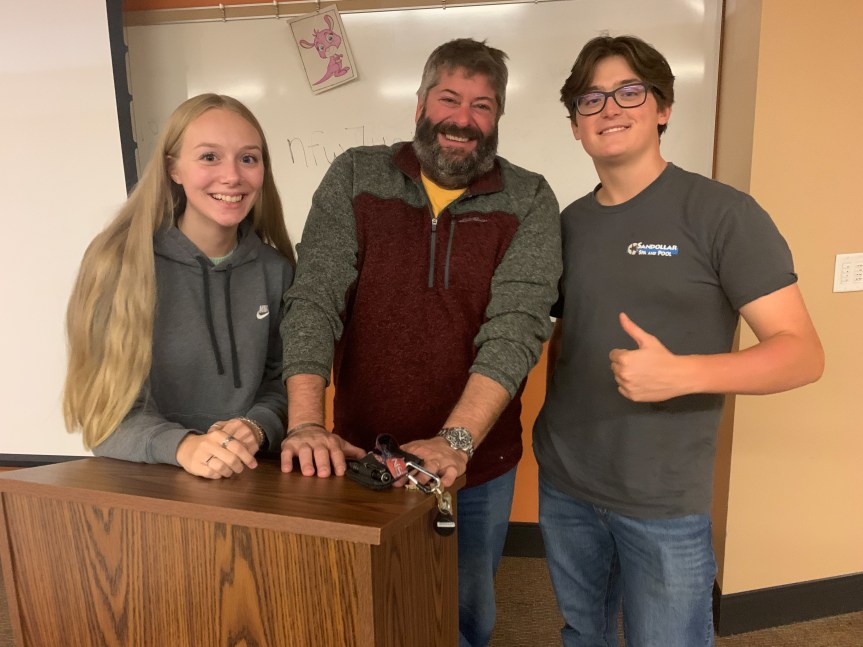
A Memorandum of Understanding was signed into effect on October 25, 2022 between Augusta Adult and Community Education and the City of Augusta Parks & Recreation to offer free child watch for adult education students. Pictured- Kayla Sikora, Director of Augusta Adult Education and Bruce Chase, Director of Parks & Recreation.

Old Town Elementary Hallway of Flags Celebrates Diverse School Community

A few years ago Old Town Elementary School (OTES) reflected on their school’s role in expanding the experiences and perspectives of the students and staff in the school. They realized they had an obligation to make the community aware of the diverse cultures and countries entering through their doors each day and to create a welcoming environment for all people at OTES. With the University of Maine as the school’s neighbor, they often receive students from the University because parents are finishing their degrees or are professors.

OTES decided to put a flag up for every country represented at the school to welcome families and teach their students about the various cultures represented at the school with each of these new community members. As a result, OTES families coming to the school building feel immediately welcomed by the gesture of seeing their native country flying in the hallways of the school.

“Students and staff are so excited about another country joining this hall of flags and getting to know about the country,” said OTES Principal Jeanna Tuell. “We have found more opportunities to make connections with other countries and to celebrate our diversity.”

Sparking Creativity: International Dot Day and Augmented Reality

When Terri Dawson, Technology Integrator at Gorham Middle School, heard Peter H. Reynolds read from his children’s book, The Dot, at an International Society for Technology in Education conference, she knew she had to bring the book back to her school. Reynolds’ book tells the story of a young student, Vashti, who feels like she can’t draw. Her teacher encourages her to simply “make a mark and see where it goes,” and by doing so, sparks Vashti’s creativity, inspiring the little girl and her classmates to have creative confidence.

So, when Dawson discovered a collaboration between QuiverVision, an augmented reality (AR) coloring app for iPads, and International Dot Day, she knew she had found an innovative way to connect sixth, seventh, and eighth-grade students to this beloved children’s book via technology. The students began by listening to Peter H. Reynolds read from his book on YouTube. That’s when they began their own creative process.

Dawson provided students with a paper template from QuiverVision that included space for the students to design their own dots and a QR code, that, when scanned by their iPads, displayed their dots in augmented reality. This allowed them to experience their drawings in a totally different way. Dawson noted that “when the students saw their dots come to life, their engagement and motivation to do another dot was amazing…it gave them another level of learning. They started to think about what else they could create.”

Dawson’s students were so engaged and inspired, they asked for the opportunity to take their iPads home and continue with their own designs using AR.

“Augmented reality and virtual reality seem to be a natural progression in education,” said Dawson, “there are so many different things that allow students to view their world differently. That’s what I want to expose them to. I want them to have these skills so that when they go out into the workforce they say, ‘I remember using AR! Did you know you could do this with a QR code?’”

600+ Devices Deployed to Mt. Ararat Middle School Students: a look at how one school implements the 1:1 device portion of MLTI 2.0

Thanks to the Maine Learning Technology Initiative (MLTI), every September, with the excitement of a new school year just beginning, the Learning Commons Team at Mt. Ararat Middle School (MAMS) prepares, organizes, and deploy 600+ laptops for student to use as critical tools for their learning throughout the school year. It is a group effort by Karen Silverman, Candy Wright, and Kat Campbell to get every kid their laptop. MAMS asks for all hands on deck, so they also are lucky to have the help of the IT team, Ryan Palmer, Corrie Calderwood, and Kate Greely.

The groundwork for laptop deployment starts in the summer. Each machine is cleaned, charged, and fitted with a student name sticker. These stickers are placed not only on the machine but also on the charger and case so that if anything is lost throughout the school year it can be returned.

There were many brand-new devices this year and Karen shared student reactions.

“Students were excited when I…showed them that all our laptops flip into tablet mode. They loved that! And then I would do my best Vanna White and tell them ‘but wait there’s more!’  MAMS students all have touchscreen laptops this year.”

MAMS was able to choose a Chromebook model from CTL for their students, one of the six choices available through the new and reimagined MLTI 2.0. Karen, who served on the 2020 MLTI Advisory Board, is now able to work with a program that is not just devices, but also offers the opportunity for teachers to develop their craft around technology. The program’s long-term goal is to provide the equitable integration of technology for engaging and effective educational experiences.

Students at MAMS are excited for the opportunities and most students have begun using their devices, and many students will be taking them home this week if their parents opted them in. Throughout the year, the Learning Commons Team will support students in troubleshooting problems, or if a student has lost their laptop, they will help locate it. This will keep the team busy until June when the same type of organization goes into collecting the devices and preparing them for the following year, until then the devices will help students at Mt. Ararat Middle School be engaged in learning.

Portland Public Schools Unveils New Mobile Makerspace to Provide All Elementary Students with STEM and Technology Learning Experiences

Joined by students, educators, and community members, Portland Public Schools held a ribbon cutting last week at Rowe Elementary School for their new Mobile Makerspace which will bring immersive, project-based STEM and technology learning experiences to all Portland elementary students.

The Mobile Makerspace will travel to elementary schools for two-week visits this fall and spring. Once at the schools, students along with their classroom teachers will visit the Mobile Makerspace for mini or immersive experiences depending on their grade level. It will provide every PreK-5 student in Portland Public Schools with at least one design/innovation/engineering experience each year. One project example involves sail cars. Based on grade-level standards, students will be exploring properties of materials as they try to determine the best material, the best size, and the best shape for their sail. During their experience, students will employ the Engineering Design Process to guide their work – Asking – Imagining – Planning – Creating – Experimenting – Improving.

“We want our students to be scientifically and ecologically literate as well as technologically capable problem solvers. We want our Portland Public Schools students to not just be consumers of technology but creators. Through rigorous and engaging science education, our students will learn to be caring, active participants in the world and become equipped to comprehend, analyze, and create solutions to global issues. The Mobile Makerspace is one way that we are addressing this vision,” said Portland Public Schools STEM Director Brooke Teller.

At the ribbon cutting, a group of 5th grade students got to explore some of the high- and low-tech gear and opportunities contained in the Mobile Makerspace, including the 3-d printer, technology projects, books on STEM-related topics, and creative building opportunities.

“I am so excited and honored to be the mobile makerspace coordinator for Portland Public Schools. I get to bring STEM opportunities and engineering design challenges to Portland’s elementary students. And I get to do this at a time when research is telling us that our young learners should be engaged with science and engineering practices,” said Mobile Makerspace Coordinator Karen Shibles. “In addition to a focus on NEXT GEN science and engineering standards & practices, there will be an emphasis on those key 21st Century skills, also known as the 4Cs: critical thinking, collaboration, communication, and creativity.”

Portland Public Schools, in partnership with the Foundation for Portland Public Schools, worked with the community to design, build, and outfit this mobile lab. The trailer was secured from On the Road trailers, Blue Planet Graphics installed the artwork, and Casco Bay High School alum Charlie Hindall made the artwork.

“We believe that these mobile makerspace experiences will be a spark that ignites a student’s further curiosity and engagement with all that science, technology, engineering, and math have to unlock for them. We believe that these experiences will be brought back into the school buildings, and in conjunction with a district wide science curriculum, students will receive the joyful and just science education they deserve,” said Teller.

2022 Maine Teacher of the Year Kelsey Stoyanova Attends NASA Space Camp with Teachers Across the Nation

Each year teachers from across the nation are invited to participate in an opportunity of a lifetime through the National Teacher of the Year (NTOY) program. NASA’s Space Academy for Educators is a place for all of the National Teachers of the Year to come together for a professional learning experience in space exploration.

“Before going to camp, as an English teacher, I felt some apprehension that I wouldn’t excel in the same ways that my NTOY colleagues in STEM [science, technology, engineering, and math] fields might,” said 2022 Maine Teacher of the Year Kelsey Stoyanova. “I quickly came to realize that there are so many career paths that exist within the realm of space and space exploration that I never expected.”

Held at NASA’s Space Camp Headquarters in Huntsville, Alabama, the Space Academy for Educators program includes authentic astronaut training simulators and activities developed to promote learning in a classroom setting. Curriculum includes NASA-inspired lesson plans and is correlated to the National Science Education Standards.

Upon understanding more about what the experience was all about, Stoyanova explained that, “many people look at anything NASA and space related and think SCIENCE, but the truth is, space exploration programs employ technical writers, PR specialists, photographers, architects, and more.”

Some of Stoyanova’s favorite experiences include travelling to the ISS via spacecraft and having to solve anomalies with friends and fellow mission specialists from New York and Michigan, getting “dropped” from a helicopter into the water and having to swim to a rescue rendezvous point (and ultimately having to get rescued), and launching rockets from the rocket launch pad where her team sported their Live and Work in Maine t-shirts which she had brought with her give to fellow educators.

She also got to experience the simulation of the space craft tumble in the multi-axis trainer. “[It] flipped me every which way and we all couldn’t stop laughing,” as well as the simulation of the moon walk.  “I’ve never felt so weightless — and I perfected the moon RUN,” said Stoyanova.

What topped all the once in a lifetime opportunities and experiences, Stoyanova says, was the unequivocal appreciation that exuded from everyone hosting educators at Space Camp that week. “The whole week was filled with gratitude at what educators do to help grow the next generation of thinkers, creators, speakers, innovators, and explorers.”

In fact, one thing that stood out to our Maine representative was the many counselors there who are now adults but were once campers. “My team leader, Sydney, is now a middle school science teacher while another is in school to be an aeronautical engineer. As space camp alum they continue to go back year after year to inspire the future generation to be innovators of space exploration in some way,” said Stoyanova. “Every kid should have the opportunity to go to space camp,” she added.

Stoyanova also found inspiration in learning that as part of the Artemis I mission which is set to try launching again in late September, the Space Launch System (SLS) and the Orion will have Maine made pieces that will aid in going to the moon. Two companies in Maine, both in Biddeford contributed to the building of the spacecraft being launched in the Artemis I mission (learn more here). “It takes so much more than just what you see on launch day for a successful mission.” For Stoyanova this is a wonderful example of the idea that in education, every lesson matters and students find success when they are able to connect and apply their learning to the world around them.

“My experiences at space camp, as a scientist, a builder, an inventor, a mission specialist, an astronaut, a critical thinker, and team member truly demonstrated my belief that authentic learning happens through experiences where students can see themselves in roles or actually be part of the outcome,” said Stoyanova. “As a lifelong learner, Space Camp holds lessons I’ll cherish forever.”


Another Successful Year of Maine’s Agriculture in the Classroom Summer Institute

There may only be one place where a teacher can make mozzarella cheese, tend to beehives, and take a virtual farm tour on the same day, the Maine Agriculture in the Classroom Summer Institute. In August, more than 25 educators came together for a 3-day institute at the University of Maine to engage in workshops that focused on including aquaculture facilities, school gardens, the research farm, and more. Educators developed new partnerships and formed ideas for integrating agriculture into their classrooms.

Maine DOE’s MLTI Ambassador, Erik Wade, shared resources on creating virtual tours, demonstrated the usefulness of virtual tours in bringing agriculture into the classroom, and shared resources for educators and students to develop their own tours and engage students in the creation process. Wade’s session also shared resources in agriculture game-based resources that educators can use with students to “gamify” their classrooms and engage students in agricultural simulations.

If you are interested in learning more about virtual tours, game-based agricultural simulations, or integrating technology into your garden or outdoor space, contact MLTI Ambassador, Erik Wade, at erik.wade@maine.gov.