New Maine Initiative to Build Ag Literacy Through Immersive CTE Culinary Arts Programs

A new University of Maine initiative to build agricultural literacy through an immersive culinary experience for career and technical education (CTE) culinary arts instructors is one of 21 projects funded nationwide by the U.S. Department of Agriculture’s National Institute of Food and Agriculture (NIFA).

NIFA has invested $6.2 million in the Professional Development and Secondary School Teacher grants to increase the number of K–14 teachers and educational professionals trained in the food and agricultural sciences. The grants to prepare more educators in food and ag science, and support best teaching practices that enhance student learning outcomes, are part of NIFA’s Agriculture and Food Research Initiative.

UMaine’s Building Agriculture Literacy Through an Immersive Culinary Experience project, which received a $300,000, four-year grant, is led by Kathy Savoie, University of Maine Cooperative Extension educator and professor; Willie Grenier, executive director of Maine Agriculture in the Classroom; and Rob Dumas, UMaine food science pilot plant manager. CTE culinary arts instructors will receive professional development experiences to increase their agricultural literacy, and enhance the connectedness between agriculture and food service in their culinary arts curricula.

A goal of the project is to help create a skilled, educated workforce that will increase the use of Maine grown, processed and produced foods in their programs and careers by changing the way students — tomorrow’s food professionals — think about the importance and value of local food, according to the researchers.

“Providing professional development experiences for CTE instructors will help to shift culinary arts programs toward local food system education with the end goal to create a workforce that is proficient in Maine agriculture, and that will be poised to meet today’s consumer needs and ultimately boost our state agriculture” says Savoie, the principal investigator on the initiative.

The project provides a holistic approach to uniting community partners to identify the best practices for agriculture literacy education at CTE culinary arts programs in Maine. UMaine Cooperative Extension and Maine Agriculture in the Classroom will collaborate to provide experiential learning opportunities for CTE culinary arts instructors through a week-long Immersive Culinary Arts Summer Institute. Project activities will include hands-on experience in local food procurement practices, demonstrations of food system lessons, educational field trips, financial support for experiential activities through their existing school restaurants, participation in a UMaine Local Foods Competition and coaching during the school year.

The CTE instructors also will experience the educational power of job shadowing, flipped classrooms and working relationships with employers that could help students make career connections. Participating instructors will be eligible to receive mini-grants to support nontraditional learning experiences — on-site learning opportunities with farmers, food processors and butchers, for example, and at food hubs, food incubator labs, aquaculture facilities, food pantries and restaurants — to increase students’ understanding of local food systems. In addition, the UMaine Food Pilot Plant will host local food competitions for CTE culinary arts students, challenging them to use Maine foods in creative and innovative ways to meet the demands of today’s consumers.

Maine DOE Director of Special Education Honored by MADSEC

The Maine Administrators of Services for Children with Disabilities (MADSEC) awarded Erin Frazier, Maine Department of Education (DOE) Director of Special Education from birth to 22, with the MADSEC President’s Award this year.

Frazier was selected to receive the award by the past MADSEC president Cheryl Mercier and current MADSEC president Deb Murphy.

Through weekly informational meetings with MADSEC and state special education leaders that she has led since March 2020, her ongoing coordination of the necessary changes to special education throughout the pandemic, and her continuous words of encouragement, Frazier was more than a worthy recipient of this prestigious award.

“Erin’s leadership has truly served as our beacon of light during this time of great uncertainty,” Mercier and Murphy stated at the recent award ceremony.

The Maine DOE is proud of this recognition of Erin’s leadership efforts and her ongoing accomplishments as a education leader in Maine.

This article was written by Maine DOE Intern Clio Bersani in collaboration with Maine Administrators of Service for Children with Disabilities as part of the Maine Schools Sharing Success Campaign. To submit a story or an idea email it to Rachel at rachel.paling@maine.gov.

Maine Students Earn Honors at the National History Day

Students from across Maine impressed judges from across the globe in the National History Day (NHD) competition. NHD is an international program focusing on studying and learning history in middle and high schools. Students choose a specific topic that fits in with the year’s theme and lead an extensive research project. NHD culminates in the presenting of the students’ projects to experts from across the field of history. The theme of the 2021 NHD contest was “Communication in History: the Key to Understanding.”

Several Maine students were given the Outstanding Affiliate Award. Jillian Muller, Charlotte McGreevy, and Brittany Carrier from Buckfield Jr./Sr. High school received this award for the documentary they created titled “Communicating with Children: How Fred Rogers Approached Tough Topics with Kids.” Uyen Nguyễn from John Bapst Memorial High school was also awarded for her website “United States Involvement in the Vietnam War: The Impacts of Multimedia ON Mainstream Opinion and U.S. Foreign Policy.”

The highlight of the tournament for the state of Maine was Maya Faulstich, who took second place overall in the Individual Performance category. Maya, an eighth-grader from Frank H. Harrison Middle School in Yarmouth, drew on Charles Dickens’ A Christmas Carol to create her project “A Climate Carol.”

Maya’s project illustrates how the Keep America Beautiful campaign in the 1950s-1970s had a lasting negative influence on how the public thinks about trash and litter and highlights how the campaign continues to influence public opinion today. Maya’s second-place finish is the highest place a Maine student has taken in the category of Individual Performance on NHD. Maya’s performance can be watched below. In addition, her research and process can be read here.

The Maine DOE congratulates all students and teachers involved in the competition on such an impressive showing.

More details on the NHD completion can be found on the official press release. Extensive information on Maya’s project can be found in her recent interview.

This article was written by Maine DOE Intern Clio Bersani in collaboration with National History Day in Maine and Yarmouth School Department as part of the Maine Schools Sharing Success Campaign. To submit a story or an idea email it to Rachel at rachel.paling@maine.gov.

EMCC, MCCS, and Maine DOE Celebrate 88 “Badguates” in Inaugural Cohort of Learning Facilitator Program

Eastern Maine Community College (EMCC), in partnership with the Maine Community College System (MCCS) and the Maine Department of Education (DOE), held a “Badguation” ceremony on June 23rd for the first class of Learning Facilitator Program completers, or “Badguates.”

In a response to critical staff shortages in Maine schools as a result of the pandemic, Governor Mills created additional flexibilities and opportunities for educators in Executive Order #7, which enabled the Maine DOE, MCCS, and EMCC to collaborate on a high quality, fast-track training program for paraprofessional level educators to expand, strengthen, and support our excellent educator workforce.

“This is emergency response at its finest, but this is also innovation at its finest where a real problem, a critical issue was presented, and everybody came to the fore to make it happen,” said Commissioner Makin during her remarks at the ceremony.

The Badguation ceremony honored the Learning Facilitators, many of whom were present during the virtual event, and featured a video message from Governor Janet Mills and remarks from EMCC faculty, EMCC President Dr. Lisa Larson, MCCS President David Daigler, Maine Education Commissioner Pender Makin, and DOE Representatives.

“You participated in a new model, a new way of thinking, and learning, and leading together,” said EMCC President Lisa Larson during her opening remarks. “You’ve earned credits and credentials, and along the way you also gained some new friends and colleagues.”

“You’re not only the first, you’re also a part of building the future of our economy and you’re core to families being able to find new successes as opportunities unveil themselves through this new, ever-changing economy,” MCCS President David Daigler said to the graduates in his remarks.

“While many people were reeling and pulling inward and saying, ‘I’m just going to try to stay safe and ride this out,’ you ran into the fire like first responders. You said, ‘yep, sign me up! I’m going to go take those courses, I am going to get into this credentialing program, and I’m going to help our schools,’” added Commissioner Makin in her remarks.
The event also featured a short video showcasing written messages from program participants who shared sentiments on how they changed in positive ways throughout the program. Here are a few:

“I am happy to say I learned that if I put my mind to it then I will do it. I really wanted to learn how to write a lesson plan for my students and I did. It took a few tries before I got there, but I did.”

“I am excited to take what I have learned and apply it to the areas of my teaching. I can observe a student and know what I am looking for, I can be a better co-teacher.”

“I don’t think you will ever be able to measure the success of this program as it will continue to have a positive impact for many, many years to come.”

Offered at no cost to the participants, the Learning Facilitator Program is completed in two phases in one academic year with the ongoing support of Eastern Maine Community College faculty. Upon completion of a 3-credit “boot camp” course in phase one of the program, participants have the foundational skills necessary to fill short-and long-term substitute educator roles, as well as all paraprofessional positions. In phase two, participants engage in a combination of online work and professional learning community meetings, as well as a 315-hour structured teaching apprenticeship. When they complete the program, participants are eligible for an emergency Education Technician authorization which allows them to be employed as an Education Technician III.

For more information related to the program, please visit the EMCC website, here.

Watch the 34 minute virtual ceremony on EMCC’s YouTube Channel:

Adult Education Determination Leads to a Diploma

Struggling in high school because she was a teen mom with no childcare, Michelle B. dropped out her junior year.  She first came to RSU #54 Adult Education in 2005. Initially, Michelle pursued her GED.  Because she is not a strong test taker, however, she found the high-stakes high school equivalency exams an insurmountable obstacle.

In 2010, Michelle followed the advice of the Adult Ed director and opted to pursue an SAHS diploma.  Despite her struggles in high school, Michelle had made good progress and was only a few classes shy of graduating, so she began the long process of earning her missing credits.

An English and history class were first in 2010. The pressures of marriage and raising children forced her to put academics on hold for a long while, but Michelle eventually returned to class in 2018, earning another English credit in 2019, American Government in 2020, and, lastly, science in 2021.

Despite working full time, raising two daughters as a single mom, grappling with the unexpected death of her own mother, and dealing with the disruption of a global pandemic, Michelle found time for her education.  She proudly joined many other Adult Education graduates for our June 9 ceremony.

Michelle did it for herself, but—even more importantly—she did it for her daughters.  In an essay written for her most recent English class, she explained that she wanted to show her children that if they are willing to work hard, anything is possible.  She wrote:

“Even if their dreams change ten times, as their mother I’ll always tell them they can be anything they want. Always, forever, I believe in my kids.”

Congratulations, Michelle!  Your experience testifies to the importance of diligence and determination as we pursue our goals.

This article was provided by RSU 54 as part of the Maine Schools Sharing Success Campaign. To submit a story or an idea email it to Rachel at rachel.paling@maine.gov

Down Syndrome Does Not Hold Back Portland Photographer Caleb Dunlap

Caleb Dunlap was born with down syndrome, but he did not let it get in the way of pursuing his passion for photography. Caleb was enrolled in the Maine Department of Education (DOE) led Child Development Services (CDS) when he was six days old. CDS along with the support of his family and friends enabled Caleb to follow his dreams. Caleb was gifted a camera after his high school graduation which began his passion for taking photos.

One day, a professional photographer looked at Caleb’s photos and remarked that he had a good eye- he could see things other people could not and turn it into a beautiful picture from then on, what began as a hobby turned into a business for Caleb.

Caleb now runs “Good Eye Photography” out of Portland where he hopes to inspire people with his photos. “When I take pictures of a cloud, I feel like a cloud,” Caleb stated in a presentation. He hopes other people can feel the transformative properties of art through his work. Caleb is inspired by the city of Portland and the nature surrounding the city. He aspires to have his work displayed in magazines and museums in the future.

Watch Caleb’s presentation below and view his photography on his website.

This article was written by Maine DOE Intern Clio Bersani as part of the Maine Schools Sharing Success Campaign. To submit a story or an idea email it to Rachel at rachel.paling@maine.gov

St. George School Second Grade Students Create Poster Campaign for Local Community

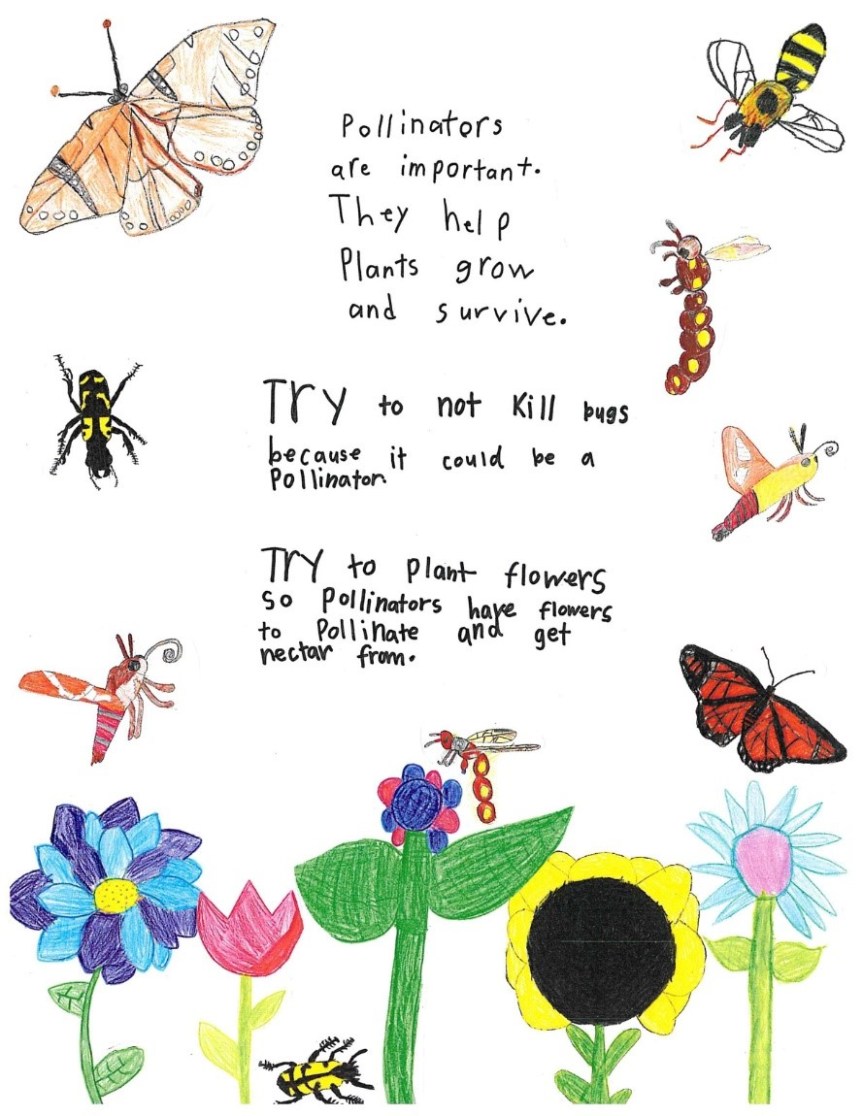
Second-grade students at St. George School in Tenants Harbor spent the spring working on a collaborative research project examining the process of pollination and the need for pollinators to create a healthy environment. The six-week-long project, led by their teacher Alison Babb, 2020 Knox County Teacher of the Year and 2021 Teacher of the Year Finalist, culminated in scientific drawings about various pollinators they had spent time learning about.

Before starting on the drawings, the students practiced their research, reading, and writing skills to create the strongest final product. The students collaborated on reading intricate scientific texts and gathered information on the various plants they were studying. After conducting thorough research on pollinators, the students began creating scientific drawings of the plants. Throughout the drawing process, the students were consistently giving and receiving feedback, enabling them to create the strongest final project possible.

Once completed, the students were not yet satisfied- they wanted to create a poster that would go beyond their classroom for their local communities to both showcase their pollinator drawings and to display some public service messaging regarding pollinators. The second-grade students demonstrated strong collaboration skills and thorough knowledge, and passion for their environments throughout this project.

Readers are encouraged to go to the Jackson Memorial Library in Tenants Harbor and the Camden Public Library to view the posters in person. Knox Village Soup will also be featuring the poster in their late June to early July edition.

Information for this article was provided by St. George School. The article was written by Maine Department of Education Intern Clio Bersani as part of the Maine Schools Sharing Success Campaign. To submit a story or an idea, email it to Rachel at rachel.paling@maine.gov.

UMaine-led Grant Helps Maine Schools Implement Behavioral Support Framework

More than 4,000 students across Maine are now receiving Positive Behavioral Interventions and Supports (PBIS) thanks to intensive professional development provided by University of Maine College of Education and Human Development experts supported by a grant from the Maine Department of Education.

PBIS is a nationally recognized, multi-tiered framework providing a continuum of supports to all students, promoting positive academic and socio-behavioral outcomes. In 2018, educators from 15 Maine schools formed the PBIS Regional Professional Development Cohort, receiving instruction on how to implement the framework, and meeting regularly with UMaine experts to share their experiences and address ongoing challenges during the three-year grant period.

“When we first started this project, nobody knew we’d have to complete it during a global pandemic,” says Courtney Angelosante, UMaine lecturer in special education and one of the experts who provided professional development to teachers and school leaders.

“It really has been a wonderful experience that will have enduring benefits for years to come,” she says.

The grant included schools from several parts of Maine, including RSU 3/MSAD 3 (Brooks, Freedom, Jackson, Knox, Liberty, Monroe, Montville, Thorndike, Troy, Unity and Waldo); Brewer Community School; Indian Island School; Dr. Lewis S. Libby School (Milford); Appleton Village School; Vassalboro Community School; East End Community School (Portland); RSU 20 (Searsport and Stockton Springs); and Wiscasset Elementary School.

“We’re really proud of the work these schools have done,” says Karen Robbie, PBIS trainer and doctoral candidate in the College of Education and Human Development. “Thanks to their efforts, more children in Maine are now experiencing positive, predictable, effective and equitable school environments.”

Other members of the UMaine team included Jim Artesani, associate dean for graduate education, research and outreach, and Kristin Grant, a retired principal from RSU 14.

“It has impacted me tremendously and made me become a better and more effective teacher and person,” says Vincent Vannah, a teacher at Morse Elementary School.

He adds that the PBIS framework made school staff rethink their mindset around teaching about behavior, creating a more positive atmosphere.

“I am able to lead and support fellow teachers in my school with implementation and support of strategies to best help teachers that are experiencing difficult and hard behavior,” says Vannah, who served as a PBIS coach for Morse Elementary throughout the project.

Members of the PBIS Regional Professional Development Cohort will gather on Monday, June 21 at the Hutchinson Center in Belfast to celebrate their accomplishments. Maine Department of Education Commissioner Pender Makin and other MDOE officials will deliver remarks at the event. Jen Freeman of the National Center on PBIS is also scheduled to share a message with the cohort.


Saco Sixth Graders Re-Design School Entrance Through Art, Science, and Self Reflection

Saco Middle School art teacher Alison Crofton-Macdonald wanted to do something completely different with her students this year. After the pandemic completely changed the way she was able to engage students with art, she was looking for something beyond getting creative with digital art, or other simple materials like paper and pencil that can be found in most homes and are commonly used during remote learning.

Once students were back to school for the year in a hybrid situation, Mrs. Crofton-Macdonald also wanted to get them up, out of their chairs, and outside for her art classes.

“We are all sick of being inside,” said Crofton-Macdonald. “If I’m sick of being inside, then they are really sick of being inside.”

This year with a rearrangement for hybrid scheduling, Unified Arts teachers were linked with teams to prevent cohorts of students mixing. This made it so that Crofton-Macdonald and her colleague, Lindsay Wirsing were on the same team teaching the same students, which allowed them to collaborate on a project.

Crofton-Macdonald and Wirsing decided to create a project that brought together art, science, and social emotional learning for their 6th grade students by redesigning the entrance to the school with a mosaic garden.

Seeing that there was no evidence of students when visitors first enter the building at Saco Middle School, they decided that giving the students an opportunity to change that would be a win all around for the school, the students, and the goals of the educators.

Tying in her own knowledge of the mosaic process, Crofton-Macdonald had each student make a mosaic stepping stone for the entry way. They were all challenged to create an “I am statement” having to do with something they learned about themselves this past year. They each then turned that statement into a design for a mosaic tile that would eventually be placed with the other mosaic tiles of the other students to make a walkway.

The project also had an accompanying science unit, taught by Ms. Wirsing, that aimed to reconstruct the entrance to have a better impact on the environment.

“Students examined the increases in human population per-capita, consumption of natural resources and the impact on Earth’s systems,” said Wirsing. “They study how their usage of water and land impacts the earth. Typically, as human populations and consumption of natural resources increase, so do the negative impacts on the earth unless the activities and technologies are engineered otherwise.”

“So, our project’s goal was to use the land in front of our school to have a better human impact than grass by planting more diverse flowering perennial plants.”

Each project challenged the students (and educators) to work together, and to be constantly thinking about how each of them can have a positive impact on the world around them.

To embark on the project the teachers were able to obtain some grant funding from SACO Steam, in addition to getting plants donated by the PTO, and borrowing tools from Saco school staff. They also had to find a piece of land at the school that needed a re-design. After pitching their idea to local school leaders, they received full support of the plan that would both provide valuable intradisciplinary learning for the students and improved school property for the community.

In addition to the Mosaic Garden designed by the Saco Middle School 6th graders, Mrs. Crofton-Macdonald also worked with her Gifted and Talented students on an additional section of the entry way that features a pebble mosaic of the Saco Middle School paw prints, to compliment the school mascot.

The project proved to be hard work, but well worth it with many weeks of planning, digging, planting, placing and a whole lot of teamwork. Saco Middle School STEM teacher Sam Blunda even stepped in in the final stages of the project to help cut all the curved stone pieces, finishing the edges to perfection.

In the final stretch of the last days of school, the project was finally finished, providing the building with a beautifully sustainable school entrance that has the most wonderful evidence of students who have and will have a lasting positive human impact on the land and school for many years to come.

Information for this article was provided by Saco Middle School as part of the Maine Schools Sharing Success Campaign. To submit a story or an idea, email it to Rachel at rachel.paling@maine.gov.

Maine FFA Association Completes Project on Homelessness and Food Insecurity

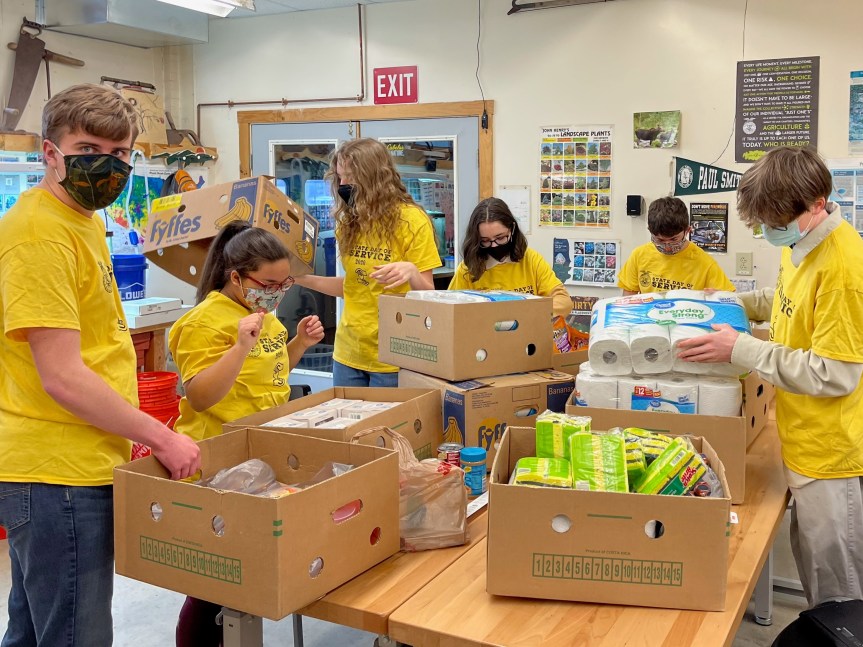
Maine FFA Association, representing nearly 400 students grades 7-12 enrolled in courses related to agriculture and natural resources, recently completed a valuable statewide community project addressing issues of homelessness and food insecurity in Maine. Four target areas, associated with nearby FFA chapters, were identified: Bangor (partnering with the Bangor Area Homeless Shelter), Waterville (partnering with the Mid-Maine Homeless Shelter), Cherryfield (partnering with Maine Seacoast Mission Food Pantry), and Presque Isle (partnering with the Aroostook County Action Program, the Sister Mary O’Donnell Homeless Shelter, Dahlgren Skidgel Farm of Hope in Caribou, Perham Food Cupboard and Washburn Food Pantry).

The goals of the project included purchasing materials to support the shelters and food pantry, sorting, packaging and distributing materials as well as learning more about the challenges and resources available to address homelessness and food insecurity. Highlights of the educational component of the project included FFA members at Narraguagus High School learning more about the services and volunteer needs of the food pantry in Cherryfield, the Aroostoock County Action Program (ACAP) preparing a YouTube video on homelessness and hosting a live Zoom panel on homelessness that included a question and answer session with FFA students.

The project was originally planned and funded in 2020, slated for implementation in March, which coincided with the onset of the coronavirus pandemic. As a result, many priority items, including some food staples and cleaning products were no longer available. Once items returned to store shelves, completion of the project became possible this spring, with items purchased, donated, sorted, packed and delivered to appreciative recipients. Project work was overseen by local FFA chapter advisors and students. As a result of the project, FFA student members came to a better understanding of social issues in their communities and outreach organizations gained many much-needed food, paper products, cleaning supplies and other staples for their facilities as well as clothing, toiletries, linens and other essentials to distribute directly to their clients.

We would like to thank the primary sponsor of this project, the National FFA Organization’s “State Day of Service” with their $8,000 contribution. We would also like to thank Wal-Mart Community Grants for their $3,000 in support with $2,000 coming from Wal-Mart Supercenter in Presque Isle and $1,000 coming from Wal-Mart Supercenter in Waterville. We would like to thank Willie Sawyer Grenier of Maine Agriculture in the Classroom for handling all shelter purchases in the Waterville area and for delivering items with her son, Jared.  Maine FFA Chapters of Ashland, Bangor, Caribou, Harrington, Mars Hill, Presque Isle and Washburn were particularly involved in the project and are all to be commended. There were also several additional local businesses and individuals in each community that contributed to this very rewarding project: thank you to all of them as well!

For more information on starting an FFA chapter in your community, please contact: Doug Robertson, State FFA Advisor, Maine Department of Education, doug.robertson@maine.gov, 207-62406744.