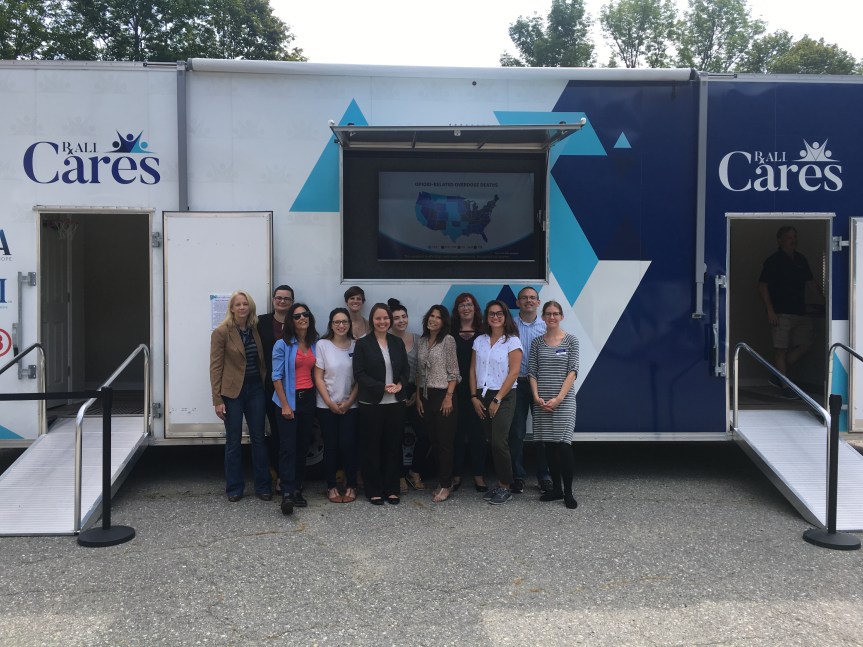
The Rx Abuse Leadership Initiative (RALI) of Maine hosted tours of a youth bedroom trailer in the parking lot at NAMI Maine (National Alliance on Metal Illness) today in Hallowell in an effort to raise awareness about the warning signs of opioid misuse in youths.
The youth bedroom trailer, created by Code 3 as a mobile awareness campaign, is staged as a typical teenager’s bedroom with tell-tale warning signs of opioid use arranged throughout the room. Tours of the trailer take participants through the bedroom pointing out a number of signs that the youth is misusing substances. The warning signs are often identifiable to veteran law enforcement but may not be as obvious to parents, guardians, or other adults.
The inside of the Trailer
Two bags that look like typical usable amounts of heroin.
Someone using substances may use a case such as a glasses case to hold drug paraphernalia.
Today’s tours hosted local law enforcement officers in addition to state government officials, members of the legislature, and local community members. The Trailer is scheduled to make another appearance today, details below, and plans for an appearance in Bangor are in the works:
Monday, September 9
3:00 pm-6:30 pm
Kennebunk Elementary School
177 Alewive Road
Kennebunk
RALI Maine is an alliance of organizations elevating programs that have a real impact on our state’s opioid crisis. They support a broad range of programs, including prevention, treatment and recovery services, facilitating the safe disposal of unused prescription medicines, and raising awareness of the warning signs of opioid misuse. For more information, including a list of local partners visit: https://www.rali-me.org/
The Maine Department of Education (DOE) recently launched a new leadership program called Maine’s Leadership Development Program (Maine LDP). The initiative aims to build and strengthen instructional leadership skills among Maine’s educational leaders at schools, districts, and across the state.
A group of 18 education leaders in Maine, including superintendents, assistant superintendents, curriculum and instructional leaders, regional education leaders, Maine DOE staff, and other school and district level staff are among the first cohort of candidates on track to become certified trainers and facilitators of future cohorts. The names, pictures, and biographies of the group of Fellows in the 1st cohort of the Maine LPD can be found here.
The Maine LDP is a partnership among the Maine DOE and its successful Transformation Leaders’ Network, along with the National Institute for School Leaders (NISL) and their nationally recognized Executive Development Program (EDP). NISL experts are delivering the Maine LDP curriculum and will provide additional training for Maine LDP facilitators. The cohort has already begun its trainings with a session about strategic thinking within systems, and high quality aligned instructional systems in classrooms, schools, and at the state level. The program is a full year commitment.
LDP Fellow Al Pfeiffer, Superintendent of Vassalboro School Department, had this to say about the training so far, “ Some of the richest, most robust and rewarding professional learning that I have experienced in recent memory. Powerful readings, case studies reinforced with video snapshots, and engaging conversations have left me eager for the next session and future sessions over the coming year.”
Paul Knowles,an educational leadership lecturer at the University of Maine and the UMaine Liaison to the Maine DOE for this initiative added that, “The University of Maine and the Educational Leadership Department are pleased to partner with the Department of Education for this important work. Personally, I am impressed with the caliber, diversity, passion, and commitment of the leaders participating in Maine’s Leadership Development Program.”
Maine’s LDP is delivered through a blended learning model and includes study, inquiry, and hands-on activities with practical applications that meet the rigorous expectations for today’s educational leaders. Some graduates from this cohort will deliver the Maine LDP curriculum to future cohorts regionally. The Department will be releasing an application for those interested in applying to be in the 2nd cohort of the LDP in March of 2020.
In her opening remarks to the York and Downeast convenings of Elevating and Celebrating Effective Teachers and Teaching (ECET2), Maine Education Association (MEA) president Grace Leavitt told those assembled, “teaching is not a profession you leave at the door when the bell rings, it is always on your mind.” For the teachers packed into the Pratt & Whitney Building at York County Community College on August 7, and the Science Building at the University of Maine at Machias on August 15, summertime professional learning was certainly alive and well!
This summer marked the fifth anniversary of ECET2 in Maine and the first summer of regional MaineECET2 convenings. Karen MacDonald and Jennifer Dorman (2014 & 2015 Maine Teachers of the Year) hosted the first ECET2 for 150 teachers at Colby College in August of 2015.
Karen MacDonald and Jennifer Dorman
MacDonald and Dorman wrote grants, sought sponsors, and spent countless hours (!!) handling the numerous logistics involved in planning and hosting a free, overnight conference for 150 Maine teachers. Why? They wanted to share the professional learning, leadership, and respect they experienced during their national Teacher of the Year travels with teachers here in Maine. They also wanted to highlight the role teacher leaders can play in our state. Dorman and MacDonald’s efforts were enthusiastically embraced by Maine teachers not only during that first summer, but in each subsequent year. As rave reviews of ECET2 spread, more teachers joined the planning process, including Diana Allen (Sanford Schools) as another co-chair, and the conference became so popular there was not only a waitlist for attendees, but the number of presentation proposals exceeded the available session slots! These factors led to ECET2 branching out to the regional convenings that took place this summer.
Why is ECET2 so popular? Let’s start with the title—this conference is all about celebrating effective teaching and teachers—and it is, from start to finish, put on by teachers for teachers. It was born out of a desire to provide a forum for exceptional teachers to learn from one another and to celebrate the teaching profession, and seeks to realize a teacher’s potential by ensuring each convening includes these six elements:
Nurtures trust among teachers
Focuses on each teacher’s potential for growth
Inspires both the intellect and the passion that drives teachers in their work
Provides time for collaboration and learning
Puts teachers in the lead
Recognizes teachers as talented professionals
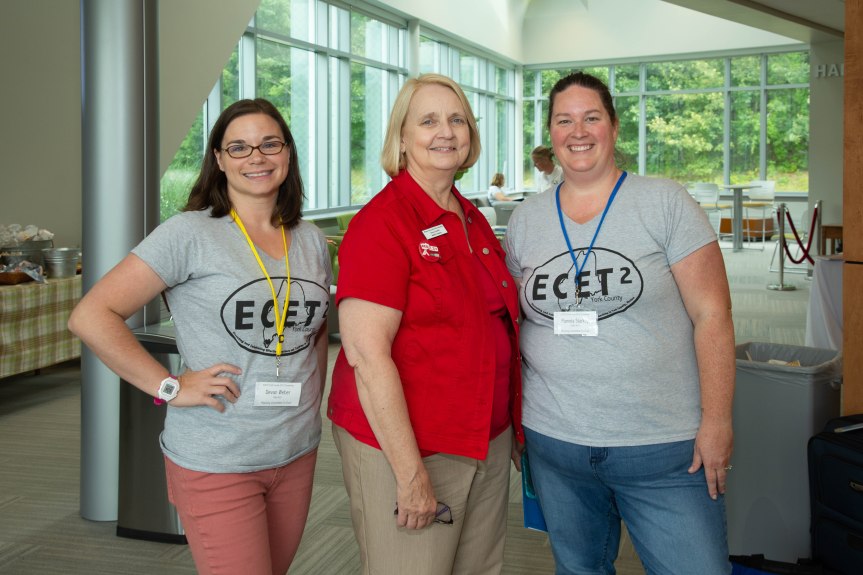
Inspired from their own experiences at ECET2, Pamela Starkey (Marshwood Great Works School, 2016 Oxford County Teacher of the Year), and Devan Weber (Eliot Elementary School) co-chaired ECET2 York, and Marielle Edgecomb (Peninsula School, 2017 Hancock County Teacher of the Year) chaired ECET2 Downeast. Both convenings featured breakout sessions on best teaching practices in content areas, as well as sessions on social-emotional learning and mindfulness in the classroom. Teacher leadership and innovation were embedded throughout the gatherings. Keeping in mind the importance of collaboration, inspiration, and celebration, the convenings also included these components:
Cultivating the Calling:
These inspirational talks are given by teachers on why they chose to teach, or what inspires them to continue teaching. In York, Katie Toothaker, 2018 Androscoggin Teacher of the Year, told the audience, “each school year is a new beginning for you and your students.” Toothaker shared how her teachers demonstrated the ability of public educators to nurture self-worth in their students and the difference that made for her and how she pays that forward with her own students. Teresa Gaetjens, National Board Certified Teacher, shared the importance of growth mindset, contextualizing her topic around the passing of her young daughter. This heart-wrenching story underscored the importance of perseverance both in and out of the classroom. At ECET2 Downeast, Marielle Edgecomb shared the importance of professional learning –teacher to teacher—being brave enough to open our classroom doors and teaching practices for others to see, learn from, and celebrate. Marielle challenged educators to see their students and colleagues through “eyes of appreciation.”
Colleague Circles:
This is a dedicated time for teachers to collaborate on “problems of practice” and generate possible solutions. Topics this year included: teacher shortages, school improvement, mental and physical wellness, school safety, diversity, and culturally responsive teaching. In York, teachers recorded goals or action steps on a post card and gave them to the ECET2 organizers, with the understanding that they will receive them in the mail sometime this fall as a reminder/check-in on their summer work and goals.
Educator Shark Tank—a fabulous idea that was shared from another state’s ECET2!
Just like on TV—except the prize money, $1000 generously donated by the Maine Education Association, was awarded to two innovative education projects that will positively impact student learning. Educators at ECET2 Downeast submitted many compelling proposals to the Sharks, four of which made the final round. The four finalists had three minutes each to present their best “pitch” to the Sharks. After a lively round of presentations and lots of laugher, followed by clarifying questions from the Sharks, the two $500 cash awards went to the Rose Gaffney School for their proposal to use technology to increase community and collaboration, and the Brooklin School for their work on diversity and literacy. Congratulations to all who submitted proposals—the Sharks had a tough task choosing just two!
The verdict is in on the first summer of regional ECET2 convenings: resounding success! As with their central Maine ECET2 predecessors, the regional convenings provided a platform for optimistic and personal professional learning—and a true celebration of teachers and the teaching profession! As teachers were preparing to leave, many of their comments echoed Paula Bourque’s (Instructional Coach, NBCT, Augusta Schools) reflection of her ECET2 experience:
“Each of us left the conference feeling inspired, empowered, and connected. We are charged with going out and sharing what we experienced and learned with our colleagues and cultivating the calling of teacher leadership. We left with a stronger network to lean on and collaborate with as we navigate the challenges of teaching. We are dedicated to promoting teacher leadership, positive school culture, and the advocacy for what is best for our students.”
ECET2: A perfect way for educators to recharge in preparation for a new school year!
The Washington County Educator Profile is submitted by Sarah Woog, Executive Director of the Washington County Consortium.
I have known Mitch Look for some years now. He’s been a member of the Washington County Leadership Team (WCLT) since before I began working with the team four years ago. I have always been struck by Mitch’s passion for education in Washington County, and by his skills as a leader. I appreciate his ability to act as a kind and supportive team member but also advocate and dissent when he is called to do so. Honestly, I admire Mitch and wanted to learn about what makes him tick. I also thought his story could provide some lessons for all of us. I met Mitch in his office last week, in the midst of back-to-school prep and PD that’s a familiar ritual to us all.
Mitch has been teaching “ever since I could.” He studied education at the University of Maine at Machias and coached basketball at Machias Memorial High School while still an undergraduate student. After working in the classroom for some years, as a middle school teacher and coach, he “wanted to have a bigger voice in decision-making” and went back to school to get his Master’s Degree and become a certified administrator. He engaged in the years long trek familiar to many of us, teaching full time while traveling back and forth in the evening for his studies in Orono. He earned his credentials, and was first a teaching principal at Fort O’brien Elementary, then principal at D.W. Merritt School, after which he served as principal at Rose M. Gaffney School for seventeen years. In 2009 he added a Certificate in Advanced Studies (CAS) to his resume.
Mitch became the ESEA/Curriculum Coordinator for AOS 96 five years ago. He is happy in his position, happy to “make it my own.” He had been apprehensive about assuming leadership positions outside of schools because he cannot stand the idea of his work getting further from the educators and students, which creates a tension with his desire to increase his impact. He told me he takes every opportunity to get into the schools of AOS 96, to feel the pulse of the school and learn from those he serves. His idea of staying current, in addition to being informed by current research and best practices, is also keeping an ear to the ground and finding innovative ways to problem-solve based on what’s working and what’s not working in schools. Mitch’s perspective expresses the duality we all experience in our work- the eternal quest for improvement fed by learning, not only from the “experts” but also, and especially, from the folks right in our schools and communities.
And Mitch loves those schools and communities. He has a keen eye for equity. When I asked what he hoped for education in Washington County, he said “the same opportunities and resources for our kids and educators that others get. Always been a dream of mine to see our kids and teachers have the resources that others have. With the talent we have down here, can you imagine what could be.” I hear you, Mitch. And I agree with your not-so-veiled critique of the inequities we all experience. However, I’d argue we can do what Mitch does in the meantime, and harness our greatest resource- our people- to realize the visions of our collective imagination.
Information submitted by Michael Burd, Franklin County Adult Education Technology Instructor/Integrator.
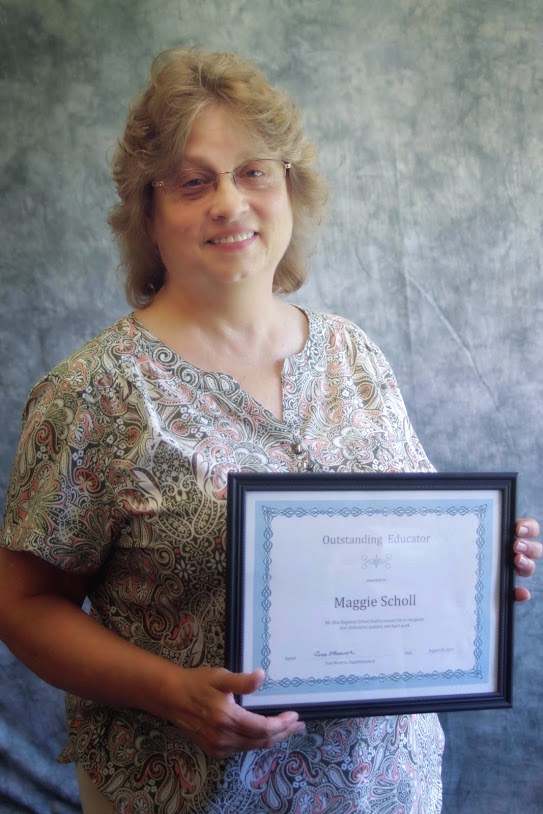
Long-time Adult Education Educator Maggie Scholl was recognized recently at an event that took place within her district.
Maggie is described as patient with a calm demeanor and the tenacity to make sure that each and every one of her students learns. She is known for maintaining positive communication with students, has a caring approach to education and a genuine interest in students.
Pleasant and collaborative with her colleagues, she contributes to the team both professionally and personally. One of her former students and a current colleague had this to say about Maggie, “I am the teacher that I am today because of great role models and this educator is definitely one of the larger role models of education for me.”
Maggie is a graduate of the University of Maine at Farmington where she later worked as a tutor in a program that helped veterans obtain a G.E.D. and improve their skills to go on to college. After a short stint working locally as a teacher, she left teaching to raise her children. Years later, she returned to the classroom when she accepted a position working for the Franklin County Adult Education Program in RSU 9 doing the same work she had enjoyed so much in the past. She has been teaching adult education there for more than 20 years.
Submitted by Ryan McDonald, Summer Programs Director and Public Relations Coordinator at Maine School of Science and Mathematics.
The STEM Summer Camp at Maine School of Science & Mathematics ended the 2019 season on August 3rd. Over 550 middle school campers came to the small town of Limestone in beautiful Aroostook County to learn about science, technology, engineering, and math. The campers had three hands-on classes daily and then a non-STEM class called “Instructor’s Passion”. After that, they participated in traditional summer camp activities such as rock climbing, creating tie dye shirts, baking, capture the flag, swimming, and of course our special 100-foot mega slip-n-slide.
The camp started in 1997 as a camp for girls to get them interested in the STEM fields, but expanded to six weeks total with three for boys and three for girls. In 2018, the camp changed to five weeks with a co-ed week in the middle. We have found the new model to be very effective and plan to continue.
The classes are designed to keep kids academically stimulated through the summer and have no homework nor prerequisites. The only requirement is curiosity for how things work. Some of the classes this year and past years have included Real Life CSI, Model Rocketry, 3D Printing, You Can Do the Cube (Rubik’s Cube), The Science of Clay, Intro to Programming, LEGO Robotics, Catapults and Trebuchets, and many more. This year brought a new idea, Instructor’s Passion for the 4th class. It was a shorter class where each instructor taught a hobby or interest such as origami, Japanese language, drawing, creating your own game, appreciating Beethoven’s music, team building, etc.
The MSSM STEM Summer Camp brings educators, staff, and campers from all 16 counties, a few other states, and even a few foreign countries. Each year we strive to improve the camp based on feedback from the campers. We don’t make anyone an expert in each week of camp, but we do love when campers learn something and say, “Wow! This exists.”
For more information about the MSSM STEM Summer Camp and Maine School of Science and Mathematics, go to: www.mssm.org.
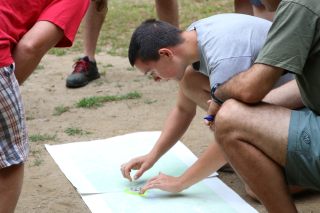
A student shows the class how to locate their position on the map
This article was written by Maine DOE Intern Emmeline Willey in collaboration with instructors from the 4H program at Bryant Pond and the UMaine Early College program.
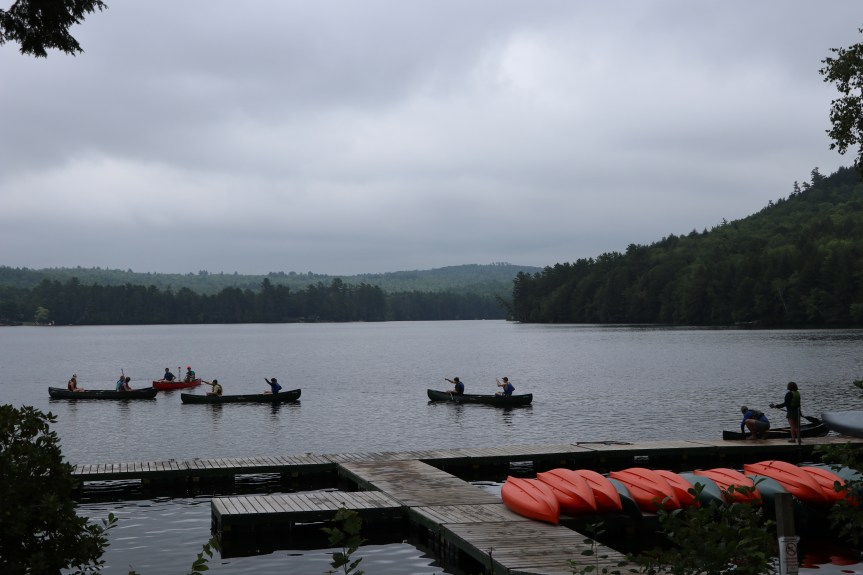
It’s the type of overcast morning that settles in a dewy film over lakeside Maine, where the air hangs thick and heavy and silent canoes prickle with fishing rods. At the end of a dirt road sprawls the University of Maine 4-HCenter at Bryant Pond. The rustic campus was built in 1956 and became part of UMaine Cooperative Extension in 2008. Today, it is home to the Outdoor Leadership Early College Program and the students who are pioneering it.
Students retrieve compasses to be used in orienteering.
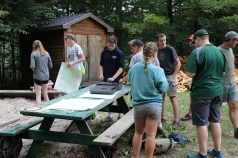
Upon my arrival, I catch a man as he’s sprinting out of the woods. He invites me to follow him back to the rest of the group after he retrieves a black case from a barn. I’m led up a steep hill on a rough draft of a path that opens on a dozen teenagers crouching over contour maps. Statewide Director Ryder Scott greets me in this clearing and explains that the students are finding their exact location using points of reference and geographic landmarks. Their knees are rooted in the ground and their sneakers are dirty; they tolerate the bugs with the nonchalance of camp kids on their second week of wilderness.
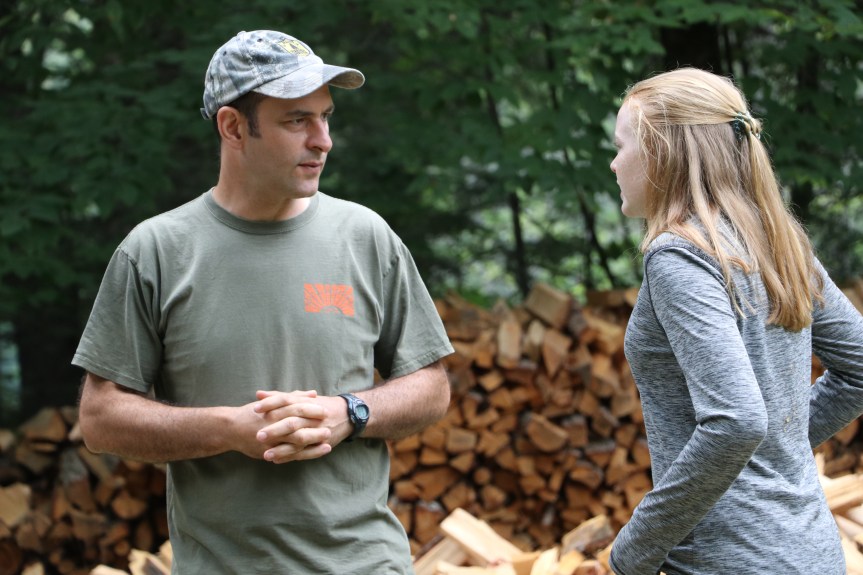
Scott in discussion with a student.
Minutes later, the group breaks, and the contents of the mysterious black case are revealed: compasses. The students retrieve them in pairs and trail off into the woods.
This is the sport of orienteering, one of many activities offered through the Outdoor Leadership Early College Program. In this competitive game, players are armed with a map and compass and sent into the wilderness to navigate their ways to checkpoints. Like many races, the goal is to finish in the shortest amount of time.
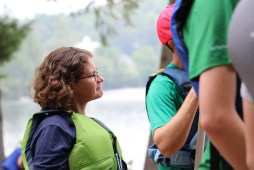
Tara Pocock, UMaine staff member with a background in outdoor education.
“Ryder! I have a question about trees!” yells a student, sprinting back out of the woods with a leaf in hand. They circle around the Ash leaf to take photos like scientists in an outdoor, worldwide laboratory. Shortly after, the rest of the class comes bounding out to regroup before they head to the lake.
“They’re learning to appreciate the natural world, to be a part of nature and recognize their impact on the environment,” says Tara Pocock, a UMaine staff member and instructor at the 4-H Center, explaining that this understanding of the outdoors is important to help teenagers grow into responsible world citizens.
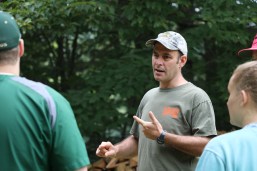
Ryder Scott, UMaine staff member with backgrounds in outdoor education.
The three-week college course is offered to Maine high school students through the UMaine Early College Program. By the end of the course, students will earn three credits in Outdoor and Adventure Activities (KPE 265). Scott expressed UMaine’s goal to grow this program into a 12 credit outdoor leadership pathway that could lead to a four-year degree from the University of Maine, and support workforce development throughout the state of Maine.
“It’s experience with real-world consequences,” Ryder Scott tells me, describing the three-day canoe trip the students will be taking next week. “If they misread the compass, if they burn the oatmeal, it’s going to be a bad time.”
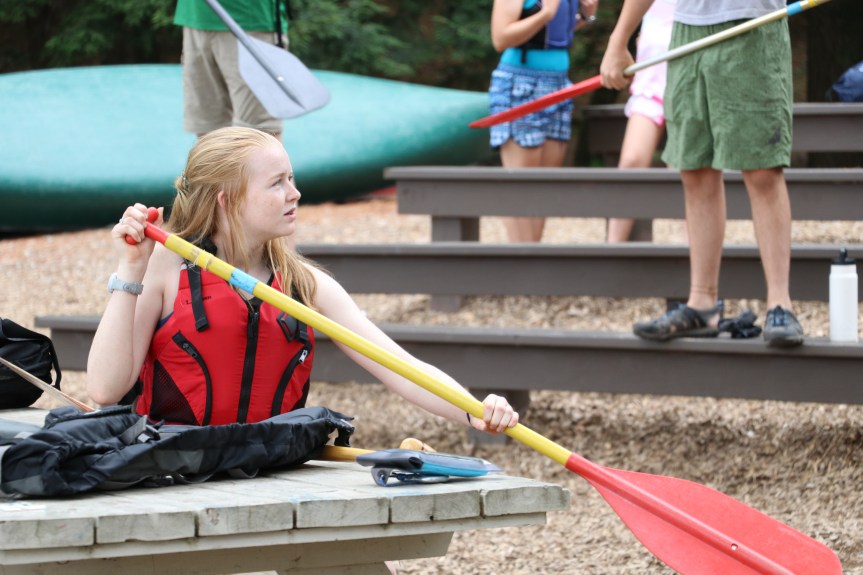
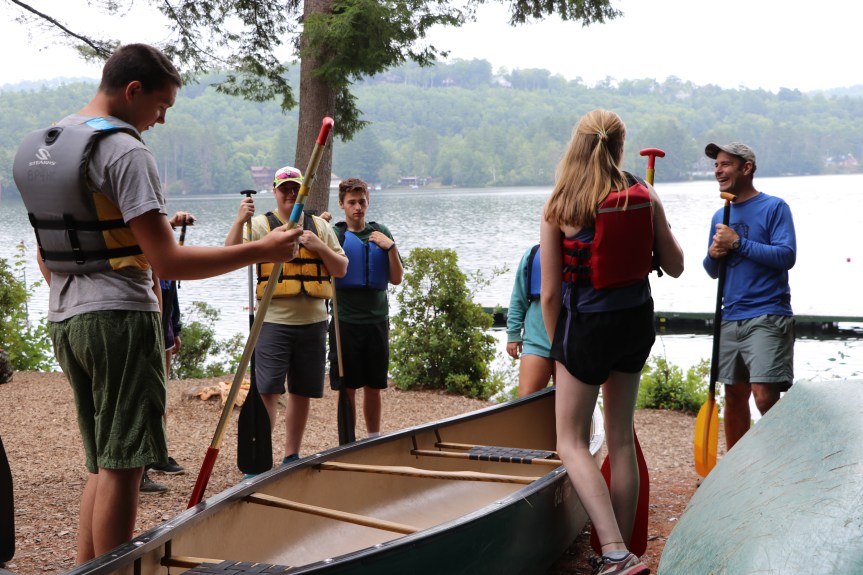
As the students make their way down to the water, discussion can be heard over the importance of wearing synthetic materials during aquatic activities. At the lakeside, the class gathers and student Laura Howe volunteers to give a lesson on proper paddling technique.
Laura Howe demonstrates proper paddle technique to the classThe class reviews the three points of contact necessary to canoe.
Halfway through the lesson, Scott interrupts to point out that the students are all holding their paddles correctly by balancing them on the tops of their shoes. Outdoor environments are conducive to this kind of rapid habit-building and learning via osmosis, as failure to remember instructions will have direct consequences on either expeditions or, in this case, expensive equipment.
Liz Dunn (right) says she met Ryder Scott through Oxford Hills’ science program, and became interested in outdoor career paths after participating in a Junior Maine Guide program. She hopes that Bryant Pond and similar programs will help her narrow down her career choices in the future.
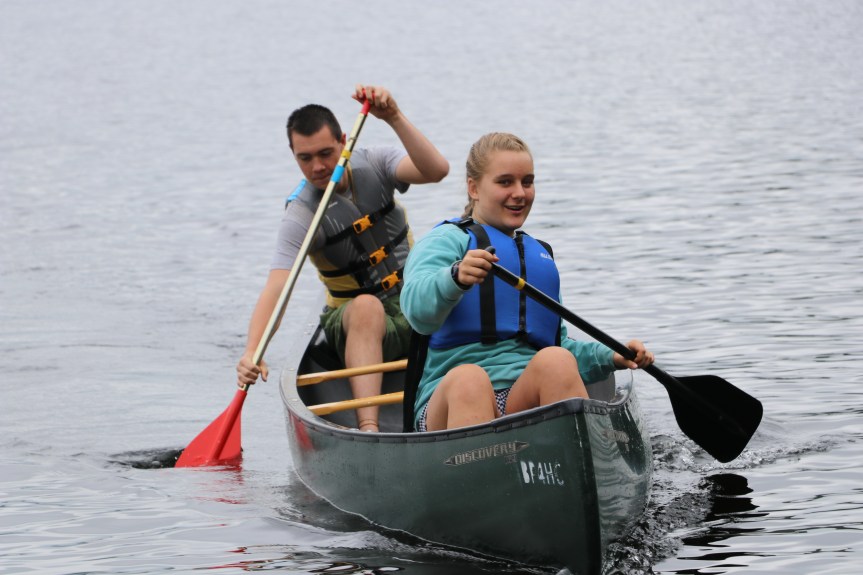
The class piles into canoes two at a time. They joke around with one another and hover nearby, waiting for their classmates. Students at experiential outdoors learning centers like this benefit from being a part of Maine and immersed in its enchanting wilderness. High school students can learn and adapt to the environment of the natural world, without missing out on the curriculum of the classroom. The UMaine Early College Program allows students to enjoy an outdoor summer, while still making critical progress toward their future careers and education.
This fall, UMaine Bryant Pond will be offering another course (KPE 209-Wilderness First Responder) as part of the Early College Outdoor Leadership program. For more information, contact Ryder Scott, Statewide Director of UMaine 4-H Centers at ryder.scott@maine.edu or 207-665-2935.
The University of Maine will be offering over 40 online courses in a wide range of academic disciplines to high school students this fall. Students across the state will benefit from the flexibility and variety of Academ–e online college courses. Through a partnership between the Maine Department of Education and the University of Maine, tuition is waived for students of Maine public and home schools for up to six college credits per semester and 12 college credits per year. Fall classes start Sept. 3. Registration is open at umaine.edu/earlycollege.
Interested students and parents are encouraged to contact Allison Small, Early College Programs Coordinator, 581.8004; um.earlycollege@maine.edu.
This article was written by Simon Handelman, a Maine DOE Intern from the Margaret Chase Smith Policy Institute.
Imagine how surprising it was seeing my own mother sitting in a classroomat Casco Bay High School, on a Friday morning in August. Allow me to clarify, I was not surprised to see her attending the professional learning class there; she is an extremely dedicated teacher. All I mean is it was serendipitous to see her on a day I might have otherwise stayed in Augusta at the Department of Education. My mother, Ellen Handelman, is the art teacher at Harrison Lyseth Elementary School in Portland. She, like so many other enthusiastic Maine teachers, is spending her last weeks of summer vacation attending professional learning classes, one after another. I do not believe she has had so much homework since college.
We were at Casco Bay High School that day for the same reasons. A session was being taught by former Cushing Community School teacher Beth Heidemann, and philanthropist David Perloff. They were underscoring the benefits of technology in elementary school classrooms. For my mother, the highlight of that day was a winning a 3D printer for her very own classroom. When I asked her to express her excitement about the printer, she said “my students can witness (in real time) how science, technology, engineering, and math combine with art to create usable objects which pair form and function.”
Teachers at Casco Bay PL Session use downtime to network and catch up with friends.
My mother is constantly developing methods to display for her students the foundational importance of art education. She firmly believes “everyone is an artist,” and I agree. In fact, that same mantra of was repeated again and again at Casco Bay that day. Heidemann’s company Go2Science, which she founded with scientist Curtis Bentley, allows kindergarten through second grade students to travel virtually around the world, investigating hypotheses for a representative group of scientists. Heidemann’s message: “everyone is a scientist.”
Teachers at Casco Bay PL Session Listening to a Presenter
Perloff’s Perloff Family Foundation, which donated the printer my mother won, believes all young students are equipped to learn about complicated technology, if given the chance. His foundation provided three hundred fifty 3D printers to Maine public schools, and the Maine Medical Center Children’s Hospital. Perloff believes “everyone is an engineer.”
Other elementary school teachers in attendance raved about occasions in their own classrooms when young students expressed high levelcritical thinking. In one case a teacher told the group that her kindergarten class was able to fix the internet for a substitute teacher, using only verbal directions (for safety reasons).
As the summer months come to a close, teachers across the state are eager to return to their students. There are many fantastic professional learning opportunities available in Maine, and many more dedicated teachers prepared to become the best they can possibly be.
This article was written by Maine DOE Intern Simon Handelman in collaboration with community members from the Emergency Action Network (TEAN) in Brunswick.
When Sarah Singer, Teresa Gillis, and other community leaders founded The Emergency Action Network (TEAN), they were responding to the rising poverty and homelessness afflicting students at Brunswick Schools. TEAN worked with teachers and administrators in Brunswick schools to identify the needs of struggling students and families. Once a specific need was clear to TEAN, they utilized the Yard Sale feature on Facebook to collect donations or, members of TEAN purchased the necessary item outright and delivered it to the Superintendent’s office.
Each fall TEAN members visit faculty in all four Brunswick schools. They connect with educators and identify needs the taskforce is equipped to address. When a child needed running shoes to participate in gym class, TEAN got those shoes to the student. Singer expressed how happy the recipient was once he was able to participate in activities with the rest of his class. When mobile home park Bay Bridge Estates experienced well failures, TEAN delivered a U-Hall filled with Poland Springs bottled water to the residents. These examples of TEAN’s excellent work explain Singer’s classification of the organization as a “catch-all safety net” and a “crisis response group.”
In recent weeks, the organization has committed itself to assisting families of asylum seekers in Brunswick. Erin Mangalam and Singer, both on the board of directors for TEAN, use their own multi-lingual skills to connect families to the resources they need. Maggy Jansson, another director, is using her background as a home visiting pediatric nurse to help families access healthcare services. However, TEAN understands they do not have the necessary background to provide optimal assistance, for this reason the taskforce pushed the town of Brunswick to hire a Cultural Broker. Nsiona Nguizani has been working in the Maine immigrant community for several years. His job is to break down linguistic and cultural barriers so support groups like TEAN or Mid Coast Hunger Prevention Program (MCHPP) can more efficiently meet the needs of these new Brunswick community members.
Support groups in Brunswick learned from Musalo Chitam at the Maine Immigrant Rights Coalition that newcomer families often travel thousands of miles over the course of several months. These families know how to be independent–they just need to become oriented in their new home. In response to this message, Mangalam and Dana Bateman (another TEAN volunteer) collected bikes for the families. TEAN does not have the resources to buy every family a car, but they can mobilize the community to get a significant number of bikes for families. Once the bikes were collected, Bruno Inacio translated Kris Haralson’s bike safety training from English to Portuguese so as many people as possible could understand the information.
TEAN is working on many projects, and more information can be found on their website and Facebook page. Moreover, TEAN is just one of many support groups working hard to help their neighbors, new and old. Similar efforts are being undertaken in Topsham by Mt. Ararat TEAN, and in Freeport by Freeport Friends. Singer says the goal was to build a “totally replicable model.” She says that it is necessary to understand that needs are different in each community. In some towns like Brunswick, the role of support groups is changing rapidly. However, dedicated people with open minds can alleviate some of the burdens for families, students, and teachers by building networks like TEAN in their own communities.
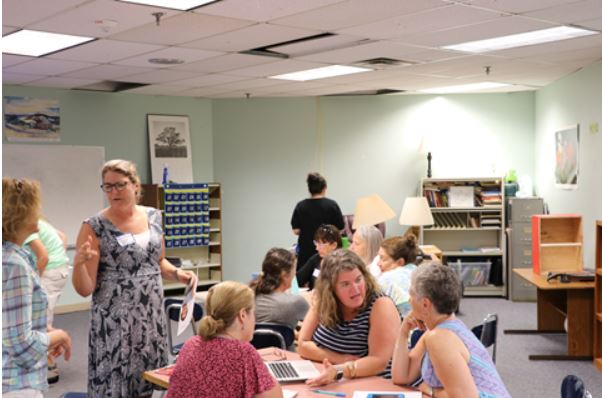
Prek teachers Melissa Brown, Jessie Carlson, Morgan Gallagher and Sarah Smith from RSU 57 provided training recently for new teachers ready to implement the PreK for ME program in the coming school year.
Prek for ME is a curriculum program based on the Boston Public School’s open source curriculum. Last year, 14 prek classroom teachers, including the 4 from RSU 57, were part of the pilot program that was successfully conducted last year assisting participants in improving their prek classroom instruction. RSU 57 saw great results in this research-based, whole child/multi-domain program.
Excited and eager to help bring their experience and expertise to others, the four RSU 57 teachers co-trained with some assistance from Sue Reed, Early Childhood Specialist from Maine DOE who is leading the efforts to adapt the Prek for ME curriculum for Maine.
The evaluations from the program help to illustrate its success:
“This was a super training! I appreciated the balance between presentation and hands on with the teachers.”
“Teachers who have used the program are very helpful!”
The prek teachers from RSU 57 invited participants to visit their classrooms and to contact them with any questions. The Prek for ME program will be available on the Maine DOE website by the end of August.









 Maine DOE Newsroom